REVIEW 3 major objections 4 minor 38 references
Higher homotopy wild sets
T0 review · 3 major / 4 minor · reviewed 2026-08-07 · deepseek-v4-flash
Pith's one-line read The π_n-wild set, the set of points admitting shrinking essential n-spheres, is a homotopy invariant that ranges over all compact metric spaces and becomes a homeomorphism invariant under rigidity hypotheses.
desk verdict Good ideas, one false lemma: Theorem 4.6 is clean, but Theorem 1.2 runs through Lemma 5.13, which is false as stated and needs repair before the realization claim holds. read the letter →
The pith
A machine-rendered reading of the paper's core claim, the machinery that carries it, and where it could break.
The reading
What carries the argument
The central objects are the n-dimensional infinite earring E^n, the shrinking wedge of countably many n-spheres, and the π_n-wild set w_n(X) of points admitting a fully essential map f: E^n → X, i.e. a map whose restriction to every sphere factor is non-null-homotopic; such maps encode shrinking sequences of essential S^n maps. The proof machinery includes shrinking point-attachment spaces S(X,A,B), obtained by attaching based spaces B_j to a compact space X at points a_j with a topology that makes the attachments shrink toward limit points of A; these are used to build Peano continua with prescribed wild sets. The rigidity argument runs through the set rg_n(X) of π_n-rigid points, points where some fully essential map f: E^n → X cannot be freely homotoped so that its basepoint moves. The key geometric input is Lemma 6.9: in an n-dimensional polyhedron with (n−1)-connected universal cover, two essential maps S^n → P with disjoint images cannot be freely homotopic.
What would settle it
For n = 2, compute w_2(S(Y,A,$E^{2}$)) for a Peano continuum Y with a dense attachment sequence A. If a point of A' is not π_2-wild, or if the equality w_2(S(Y,A,$E^{2}$)) = Y ∪ w_2(Y) fails, then Theorem 1.2's construction collapses; this same computation tests whether Lemma 5.13's missing hypothesis can be repaired.
Extended reading notes
Core claim
On its own terms, the paper's central claim is that algebraic wildness in higher homotopy groups is organized into a well-behaved subspace. A point x is π_n-wild exactly when there exists a fully essential map f: E^n → X based at x, where E^n is the infinite earring, the shrinking wedge of n-spheres; equivalently, there are essential based maps S^n → X converging to x. The paper proves that homotopy equivalences restrict to homotopy equivalences on these wild subspaces, so w_n(X) can be computed or compared without fixing a particular geometric model. The realization theorem then shows that w_n(X) ranges over all compact metric spaces inside n-dimensional Peano continua, and the rigidity theorems show that for n-dimensional π_n-shape-injective Peano continua built from polyhedra with (n−1)-connected universal covers, homotopy inverses restrict to inverse homeomorphisms on the wild set, upgrading homotopy invariance to homeomorphism invariance of w_n(X).
Load-bearing premise
The realization theorem depends on Lemma 5.13's formula for the wild set of a shrinking point-attachment space S(X,A,B); the lemma is stated for non-simply connected attachments B_j, while the theorem applies it with B_j = E^n, which is simply connected for n ≥ 2, so the written proof does not cover the n ≥ 2 case without an additional argument.
Editorial extensions
If this is right
- If X and Y are homotopy equivalent, then w_n(X) and w_n(Y) have the same homotopy type for every n ≥ 0, so the wild set is a legitimate homotopy invariant.
- Every compact metric space C is the π_n-wild set of some Peano continuum X with X \ C a countable union of open 1-cells and open n-cells and dim X = max(dim C, n); consequently, a compact metric space is exactly the π_n-wild set of some n-dimensional Peano continuum (Corollary 5.17).
- Whenever the rigidity hypotheses of Theorem 1.3 hold, homotopy equivalent spaces have homeomorphic π_n-wild sets; in particular, 2-dimensional π_2-shape-injective Peano continua are completely π_2-rigid (Corollary 1.4).
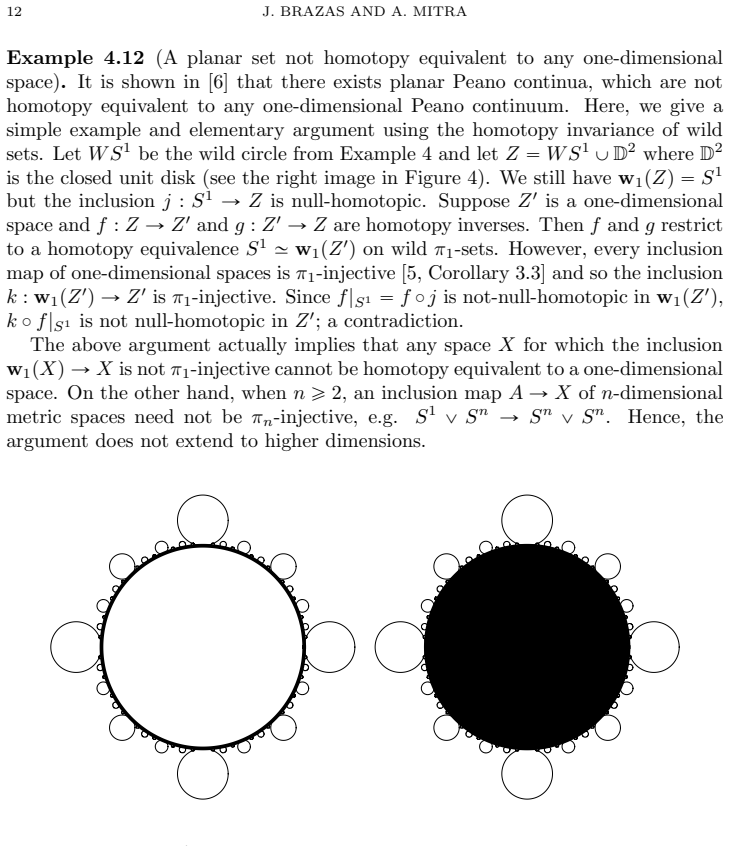
- A space with a nonempty π_n-wild set cannot be homotopy equivalent to a CW-complex or a manifold (Corollary 4.7), and spaces such as the wild n-sphere with w_n(W S^n) = S^n are distinguished for different n (Example 4.11).
- The π_n-wild set can differentiate homotopy types that have the same homotopy groups, e.g. trees with different numbers of attached shrinking earrings (Example 4.9).
Reading between the lines
- As an editorial check, the printed proof of the realization theorem appears to require a version of Lemma 5.13 for B_j = E^n, which is simply connected when n ≥ 2; the proof's loop-based argument does not apply as written, so the evident repair using essential maps S^n → B_j would need to be verified for Theorem 1.2 to hold for all n.
- If the rigidity theorem's hypotheses can be weakened beyond π_n-shape injectivity, Example 6.11 suggests the obstruction is controlled by the Hopf map and Whitehead products; a natural next question is whether complete π_n-rigidity holds for n-dimensional Peano continua whose approximating polyhedra have (n−1)-connected but not universal covers.
- The paper notes that Example 4.12's argument against homotopy equivalence with one-dimensional spaces relies on inclusion maps of one-dimensional spaces being π_1-injective, and that the same argument fails for n ≥ 2; finding the correct higher-dimensional replacement would extend that non-representability result to higher dimensions.
Editorial analysis
A structured set of objections, weighed in public.
Referee Report
Summary. The paper introduces the π_n-wild set w_n(X), the subspace of points at which there is a shrinking sequence of essential based maps S^n→X, equivalently a fully essential map from the n-dimensional infinite earring E^n. The main results are: Theorem 4.6, that the homotopy type of w_n(X) is a homotopy invariant of X; Theorem 1.2, that every compact metric space occurs as w_n(X) for a Peano continuum X; and Theorem 1.3, a complete π_n-rigidity theorem for n-dimensional π_n-shape injective Peano continua expressible as inverse limits of compact n-dimensional polyhedra with (n−1)-connected universal covers, which upgrades homotopy invariance of w_n to homeomorphism invariance in those cases. The paper also develops basic permanence properties, product formulas, dimension bounds, and several examples distinguishing homotopy types.
Significance. If the main theorems are correct, w_n is a genuinely new homotopy invariant with maximal range on Peano continua, and Theorem 1.3 is a substantial higher-dimensional analogue of the known one-dimensional rigidity results. The foundational part of the paper is strong: Theorem 4.6 is clean and self-contained, the examples are informative, and the use of shrinking point-attachment spaces is a natural and promising construction. The paper would be a useful contribution to the homotopy theory of locally complicated spaces. However, Lemma 5.13, which is load-bearing for Theorem 1.2, is false as stated, and its proof does not cover n≥2 under the stated hypotheses. The central claims appear repairable, but the manuscript cannot be accepted in its present form.
major comments (3)
- [Section 5, Lemma 5.13(2)] The second inclusion is false as stated. Take n=1, X=[0,1], A={1/k:k≥1}, and B_j=S^1 for all j. Let α_k be the path in X from 0 to 1/k and β_k a generator of π_1(S^1). The loop μ_k=α_k·β_k·α_k^{-1} is essential in S(X,A,B), because B_k is a retract of S(X,A,B) and conjugation by α_k is an isomorphism; the sequence (μ_k) converges to the constant map at 0 in the compact-open topology. Thus 0∈w_1(S), while w_1(X)=∅, A contains no point 0, and w_1(S^1)=∅. This contradicts w_1(S)⊆w_1(X)∪A∪∪_j w_1(B_j). The missing term is the set A' of limit points of A; the proof's assertion that w_n(X)∪A is closed in X is false in this example. The error is load-bearing for Lemma 5.16 and Theorem 1.2, but the theorem is likely repairable because in the application A is dense and hence A'=X.
- [Section 5, Lemma 5.13(1)] The proof constructs a fully essential map f:E^n→S by path-conjugating essential loops β_i:[0,1]→B_{j_i}. For n≥2 this argument produces maps from E^1, not from E^n, and the stated hypothesis that each B_j is non-simply connected does not supply essential maps S^n→B_{j_i}. In the application to Theorem 1.2 one has B_j=E^n with π_n(E^n)≠0, so a repair is available by assuming π_n(B_j)≠0 and using essential n-sphere maps. As written, however, the first inclusion of Lemma 5.13 is not established for n≥2.
- [Section 6, Lemma 6.9 and Theorem 1.3] Lemma 6.9 is the sole nontrivial geometric input in the rigidity theorem, but it is only sketched. The sketch appears to use standard Mayer-Vietoris and Hurewicz arguments, yet the paper should give a complete proof or a precise reference. In particular, the proof should justify that one can choose U and V so that U∩V has dimension at most n−1, that H_n(U∩V)=0, and that lifts of f and g to the universal cover remain disjoint and freely homotopic. Asking the reader to fill in these details at a load-bearing point is not satisfactory for a journal publication.
minor comments (4)
- [Section 5, Lemma 5.13 proof] The first line contains a typo: 'shirking wedges' should be 'shrinking wedges'.
- [Section 5, Lemma 5.13 proof] The sentence 'Since B_{j_i} is a retract of X' should read 'a retract of S(X,A,B)'.
- [Example 4.12] The reference 'Example 4' should be 'Example 4.11'.
- [Section 5, Lemma 5.13 proof] The reduction to injective A is unclear: please explain why repeated attachment points can be eliminated rather than merely citing the behavior of finite and shrinking wedges.
Circularity Check
Main derivation chain is self-contained: homotopy invariance, realization, and rigidity are proved by direct arguments, not by fitting or by definitional identification. Only a non-central self-citation to the first author's forthcoming work appears in Example 6.10.
-
self citation load bearing
[Example 6.10]
"In forthcoming work, the first author has used generalized covering space theory to show that spaces of the form Y_i are π_n-shape injective. Moreover, since X_i is an inverse limit of finite graphs, the space Y_i is an inverse limit of finite graphs with finitely many n-spheres attached. Such approximating spaces satisfy the hypotheses of Theorem 1.3. Thus Y_1, Y_2 are completely π_n-rigid."
This application of Theorem 1.3 to the wildification spaces Y_i depends on the π_n-shape-injectivity hypothesis, which is not proved in the paper but is asserted to follow from the first author's forthcoming work. The example's conclusion is therefore supported by a self-citation rather than by a proof contained in the paper. It is an illustrative application rather than one of the paper's central theorems; Theorem 1.3 itself is proved from shape injectivity, and Theorem 1.2 is built from the shrinking point-attachment construction, so removing this self-citation would not collapse the main derivation chain.
full rationale
The central claims are not circular. Definition 2.4 fixes the meaning of w_n(X), and Theorem 4.6 is proved by pushing fully essential maps through π_n-injective maps in Lemma 4.2; no fitted quantity or prior claim is renamed as a prediction. Theorem 1.2 is a constructive existence result: it builds a Peano continuum Z by attaching shrinking n-dimensional earrings to a dense subset of a target compactum and proves w_n(Z)=C using the shrinking point-attachment computation, not by declaring the equality. Theorem 1.3 uses shape injectivity and Lemma 6.9 to force rigidity; it does not assume its own conclusion. The only circularity-relevant passages are forward self-references to the first author's forthcoming work. Remark 5.2 attributes the full π_m-injectivity of Lemma 5.1's inclusion to such work, but Theorem 1.2 only needs the inclusion w_n(Y)⊆X, which is justified by local contractibility of the attached arcs; so Remark 5.2 is not load-bearing for the main realization result. Example 6.10 does use the first author's forthcoming work to supply the shape-injectivity hypothesis, so that illustrative application rests on a self-citation rather than an independent proof. The paper also appears to contain correctness gaps, for instance Lemma 5.13 is stated for non-simply connected B_j but is applied with B_j=E^n for n≥2, and its second inclusion is asserted using a closedness argument that likely needs A′ included; these are mathematical correctness risks, not circularity, because the lemma attempts a proof rather than defining its conclusion into its inputs.
Assumptions & free parameters
assumptions (10)
- standard math Hausdorff-Alexandroff theorem: every compact metric space is a continuous image of the Cantor set
- standard math Hahn-Mazurkiewicz theorem: a Hausdorff continuous image of [0,1] is a Peano continuum
- domain assumption [10, Lemma 4.3]: the inclusion X → Y is π_1-injective when Y\X is a countable disjoint union of open 1-cells
- domain assumption Eda-Kawamura [20]: for n ≥ 2, E^n is (n-1)-connected, locally (n-1)-connected, and Ψ_n: π_n(E^n) → ∏_N Z is an isomorphism
- standard math Hurewicz theorem and Mayer-Vietoris exact sequences for (n-1)-connected n-dimensional complexes
- standard math Free-product conjugacy fact: in G_1 * G_2, an element of G_1 conjugate to an element of G_2 is trivial
- standard math Countable sum theorem for covering dimension (Engelking [22])
- domain assumption Inverse limits of compact polyhedra form HPolf*-expansions; Ψ_n: π_n(X) → lim π_n(K_i) is the shape homomorphism
- ad hoc to paper The inclusion i: X → Y of Lemma 5.1 is π_m-injective for all m ≥ 1
- ad hoc to paper Wildification spaces S(X_i, A_i, E^n) built in Example 6.10 are π_n-shape injective
invented entities (3)
-
π_n-wild point and the π_n-wild set w_n(X)
independent evidence
-
Shrinking point-attachment space S(X,A,B) and π_n-wildification S(X,A,E^n)
independent evidence
-
π_n-rigid point set rg_n(X) and complete π_n-rigidity
independent evidence
Cite this review
Pith. "Pith review of Higher homotopy wild sets." pith.science (2026). https://pith.science/paper/J6POT5FY
@misc{pith2026250523665,
  author       = {Pith},
  title        = {Pith review of: Higher homotopy wild sets},
  year         = {2026},
  howpublished = {\url{https://pith.science/paper/J6POT5FY}},
  note         = {Machine review of arXiv:2505.23665}
}
abstract
The $\pi_n$-wild set $\mathbf{w}_{n}(X)$ of a topological space $X$ is the subspace of $X$ consisting of the points at which there exists a shrinking sequence of essential based maps $S^n\to X$. In this paper, we show that the homotopy type of $\mathbf{w}_{n}(X)$ is a homotopy invariant of $X$ and, in analogy to the known one-dimensional case, we show that for certain $n$-dimensional $\pi_n$-shape injective metric spaces, the homeomorphism type of $\mathbf{w}_{n}(X)$ is a homotopy invariant of $X$. We also prove that the $\pi_n$-wild set of a Peano continuum can be homeomorphic to any compact metric space.
Figures


Figures from the paper (2 more)

Reference graph
Works this paper leans on
- [1]
-
[2]
Brazas,Transfinite product reduction in fundamental groupoids, European J
J. Brazas,Transfinite product reduction in fundamental groupoids, European J. Math. 7 (2020) 28-47
work page 2020
- [3]
-
[4]
N. Brodskiy, J. Dydak, B. Labuz, A. Mitra,Covering maps for locally path-connected spaces, Fund. Math. 218 (2012) 13-46
work page 2012
-
[5]
J.W. Cannon, G.R. Conner,On the fundamental groups of one-dimensional spaces, Topology Appl. 153 (2006) 2648–2672
work page 2006
-
[6]
J.W. Cannon, G.R. Conner, A. Zastrow,One-dimensional sets and planar sets are aspherical, Topology Appl. 120 (2002) 23-45
work page 2002
- [7]
-
[8]
Algebraic topology of Peano continua
G.R. Conner, K. Eda,Correction to: “Algebraic topology of Peano continua” [Topology Appl. 153 (2-3) (2005) 213-226] and “Fundamental groups having the whole information of spaces” [Topology Appl. 146-147 (2005) 317-328], Topology Appl. 154 (2005), no. 3, 771-773
work page 2005
Show all 38 references
-
[9]
G. R. Conner, C. Kent,Fundamental groups of locally connected subsets of the plane, Adv. Math. 347 (2019) 384-407
2019
-
[10]
Conner, M
G.R. Conner, M. Meilstrup, D. Repov˘ s, A. Zastrow, M.˘Zeljko,On small homotopies of loops, Topology Appl. 155 (2008) 1089-1097
2008
-
[11]
Corson,Applications of Descriptive Set Theory in Homotopy Theory
S. Corson,Applications of Descriptive Set Theory in Homotopy Theory. (2010). Brigham Young University Masters Thesis. https://scholarsarchive.byu.edu/etd/2401
2010
-
[12]
Corson,The Griffiths double cone group is isomorphic to the triple
S. Corson,The Griffiths double cone group is isomorphic to the triple. Pacific J. Math. 327 (2023) 297-336
2023
-
[13]
Curtis,Some nonzero homotopy groups of spheres, Bull
E. Curtis,Some nonzero homotopy groups of spheres, Bull. Amer. Math. Soc. (N.S.) 75 (1969), 541-544
1969
-
[14]
Curtis, M.K
M.L. Curtis, M.K. Fort, Jr.,Homotopy groups of one-dimensional spaces, Proc. Amer. Math. Soc. 8 (1957), no. 3, 577-579
1957
-
[15]
Eda,The fundamental groups of one-dimensional spaces and spatial homomorphisms, Topology Appl
K. Eda,The fundamental groups of one-dimensional spaces and spatial homomorphisms, Topology Appl. 123 (2002) 479–505
2002
-
[16]
Eda,Homotopy types of one-dimensional Peano continua, Fund
K. Eda,Homotopy types of one-dimensional Peano continua, Fund. Math. 209 (2010) 27–42
2010
-
[17]
Eda,Making spaces wild (simply-connected case)Topology Appl
K. Eda,Making spaces wild (simply-connected case)Topology Appl. 288 (2021) 107483
2021
-
[18]
K. Eda, M. Higasikawa,Trees and fundamental groups, Ann. Pure Appl. Log., 111 (2001), 185-201
2001
-
[19]
Eda, U.H
K. Eda, U.H. Karimov, D. Repovˇ s,A nonaspherical cell-like 2-dimensional simply connected continuum and related constructions, Topol. Appl. 156 (2009), no. 3, 515-521
2009
-
[20]
K. Eda, K. Kawamura,Homotopy and homology groups of then-dimensional Hawaiian ear- ring, Fundamenta Mathematicae 165 (2000) 17-28
2000
-
[21]
K. Eda, H. FischerCotorsion-free groups from a topological viewpoint, Topology Appl. 214 (2016) 21–34
2016
-
[22]
Engelking.Dimension Theory
R. Engelking.Dimension Theory. North-Holland, Amsterdam, 1978
1978
-
[23]
Felt,Homotopy groups of compact Hausdorff spaces with trivial shape, Proc
J.E. Felt,Homotopy groups of compact Hausdorff spaces with trivial shape, Proc. Amer. Math. Soc. 44 (1974), 500-504
1974
-
[24]
Fischer, A
H. Fischer, A. Zastrow,The fundamental groups of subsets of closed surfaces inject into their first shape groups, Algebraic and Geometric Topology 5 (2005) 1655-1676
2005
-
[25]
Fischer, A
H. Fischer, A. Zastrow,Generalized universal covering spaces and the shape group, Fund. Math. 197 (2007) 167–196
2007
-
[26]
Griffiths,The fundamental group of two spaces with a point in common, Quart
H.B. Griffiths,The fundamental group of two spaces with a point in common, Quart. J. Math. Oxford, 5 (1954). 175-190
1954
-
[27]
Ivanov, R
S.O. Ivanov, R. Mikhailov, J. Wu,On Nontriviality of certain homotopy groups of spheres, Homotopy Homology Appl. 18 (2016), no. 2, 337-344
2016
-
[28]
Karimov and D
U.H. Karimov and D. Repovˇ s,A noncontractible cell-like compactum whose suspension is contractible, Indagationes Math. 10 (1999) 513-517. HIGHER-HOMOTOPY WILD SETS 23
1999
-
[29]
Karimov, D
U.H. Karimov, D. Repovˇ s,Hawaiian groups of topological spaces, Uspehi. Math. Nauk. 61 (2007), no. 5, 185-186. (in Russian); English transl. in Russian Math. Surv. 61 (2006), no. 5, 987-989
2007
-
[30]
Karimov, D
U.H. Karimov, D. Repovˇ s,On noncontractible compacta with trivial homology and homotopy groups, Proc. Amer. Math. Soc. 138 (2010) 1525-1531
2010
-
[31]
Kent,Homotopy type of planar Peano continua, Advances Math
C. Kent,Homotopy type of planar Peano continua, Advances Math. 391 (2021) 107971
2021
-
[32]
Mahowald,The image of J in the EHP sequence
M. Mahowald,The image of J in the EHP sequence. Ann. of Math. (2) 116 (1982), no. 1, 65-112
1982
-
[33]
Mori,Applications of secondary e-invariants to unstable homotopy theory groups of spheres, Mem
M. Mori,Applications of secondary e-invariants to unstable homotopy theory groups of spheres, Mem. Fac. Sci., Kyushu Univ. Ser. A 29 (1975), 59-87
1975
-
[34]
Mardeˇ si´ c, J
S. Mardeˇ si´ c, J. Segal,Shape theory, North-Holland Publishing Company, 1982
1982
-
[35]
Nadler Jr.,Continuum theory, M
S.B. Nadler Jr.,Continuum theory, M. Dekker, New York, Basel and Hong Kong, 1992
1992
-
[36]
Pawlikowski.The fundamental group of a compact metric space
J. Pawlikowski.The fundamental group of a compact metric space. Proc. of the Amer. Math. Soc. 126 (1998) 3083-3087
1998
-
[37]
Shelah.Can the fundamental (homotopy) group of a space be the rationals?Proc
S. Shelah.Can the fundamental (homotopy) group of a space be the rationals?Proc. of the Amer. Math. Soc., 103 (1988) 627-632
1988
-
[38]
J. H. C. Whitehead,Combinatorial homotopy. II., Bull. Amer. Math. Soc., 55 (1949), 453- 496. West Chester University, Department of Mathematics, West Chester, PA 19383, USA Email address:jbrazas@wcupa.edu Montana Technical University, Department of Mathematical Sciences, 1300 ...
1949
Reviewed August 7, 2026 · model on record in the stance chip above.
Discussion (0). Continue with ORCID to comment.