REVIEW 3 major objections 5 minor 40 references
Observations of a Footpoint Drift of an Erupting Flux Rope
T0 review · 3 major / 5 minor · reviewed 2026-08-14 · deepseek-v4-flash
Pith's one-line read Flux rope footpoint drifts tens of arcseconds during an M-class flare.
desk verdict Careful single-event observation that makes a plausible but unproven case for a drifting flux-rope footpoint; the novel hook re-formation deserves peer review, but the central identity needs quantitative support. read the letter →
The pith
A machine-rendered reading of the paper's core claim, the machinery that carries it, and where it could break.
The reading
What carries the argument
Two concepts carry the argument. The J-shaped ribbon hook is the surface footprint of a quasi-separatrix layer—a thin volume where the magnetic connectivity changes sharply—wrapped around a leg of the flux rope, so the hook's location marks where the rope is anchored. The process that moves it is ar–rf reconnection: an inclined arcade field line 'a' reconnects with a flux-rope field line 'r' to produce a new flux-rope field line and a flare loop 'f', transferring the rope's footpoint to a new location. Slipping reconnection, the apparent sideways motion of coronal loops as field lines exchange partners, is the observed signature of this process.
What would settle it
Map the magnetic connectivity of the region before, during, and after the flare (for example with time-dependent nonlinear force-free field extrapolations anchored to observed magnetograms) and ask whether the field lines rooted in the new hook trace back through the reconnection history to the filament and the sigmoid. If they belong to a different magnetic flux system, or if the negative-polarity footpoint shows no matching conjugate drift, the footpoint-drift claim collapses.
Extended reading notes
Core claim
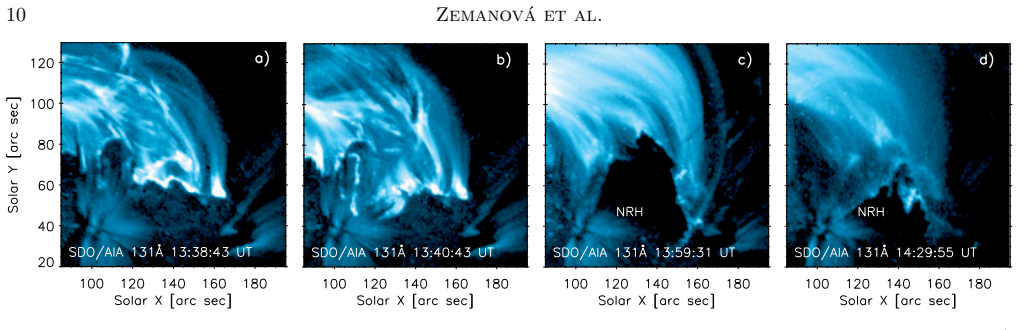
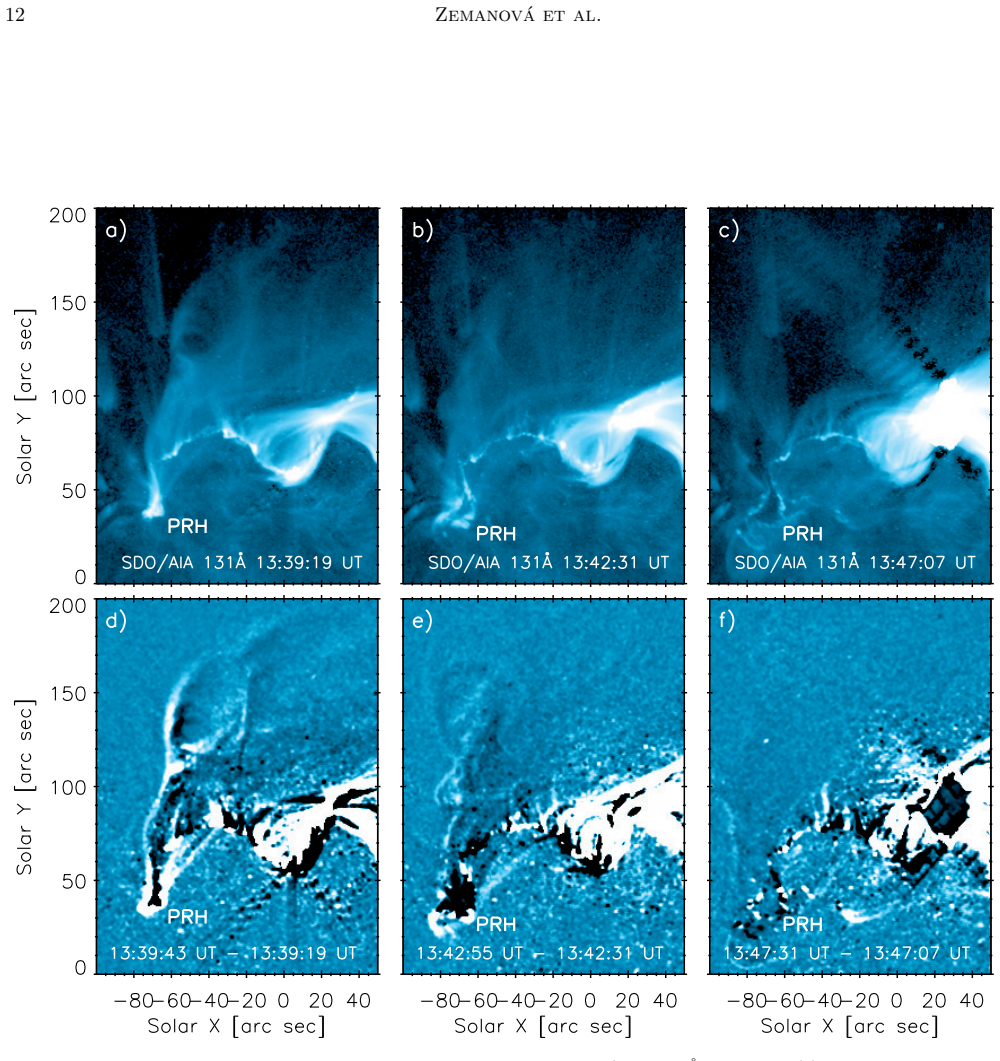
Using extreme-ultraviolet and X-ray imaging of the 2015 November 4 M3.7 flare, the paper documents a chain of events. The pre-eruption Hα filament, reproduced by a nonlinear force-free field extrapolation, consists of two neighbouring helical systems whose tether-cutting reconnection forms a hot sigmoidal loop S; S is rooted in a small positive ribbon hook SPRH. The hook's loops then slip-reconnect eastward, SPRH disappears while the positive ribbon elongates, and a new, larger hook PRH appears at the end of the elongated ribbon, about 40 arcseconds in solar Y (approximately 80 arcseconds along the ribbon), with hot twisted loops that erupt. The central claim is that these structures are one and the same flux rope, so the sequence is the drift of its footpoint: from the filament to the sigmoid S, then to the erupting rope anchored in PRH. The paper further reports that PRH expanded after the eruption and later contracted, and that one photospheric location was swept by the hook twice, which it interprets as evidence for a series of two ar–rf reconnections, in which an inclined arcade field line reconnects with a flux-rope field line and becomes part of the rope.
Load-bearing premise
The load-bearing premise is that the small hook, the sigmoid, and the later large hook are all anchors of one and the same flux rope whose footpoint travels; this identity is inferred from images, a pre-flare magnetic field model, and assumed reconnection, not from directly measured magnetic connectivity.
Editorial extensions
If this is right
- Footpoint drift means that the surface location anchoring an erupting flux rope can change by tens of arcseconds, so identifying a coronal mass ejection's source region from the pre-eruptive filament alone can be off by that distance.
- Ribbon hooks can disappear and re-form elsewhere rather than only expanding, and a single photospheric location can be engulfed by the hook, left behind, and engulfed again.
- Reconnection can continue into the gradual phase of a flare, producing the observed late expansion and then contraction of the hook, which can shrink coronal dimmings rather than letting them grow monotonically.
- The observed drift of about 80 arcseconds along the ribbon is larger than the drift produced by the 3D model this interpretation is compared with, indicating real hook evolution can be more complex than current models capture.
- The erupting flux rope is longer than the pre-eruptive filament or its modelled field, so estimates of the mass lifted during an eruption that use the pre-eruptive structure may be underestimates.
Reading between the lines
- If footpoint drift is a general feature of eruptive flares, the centroids of the two coronal dimming regions should drift in step with the ribbon hook motion; measuring that drift in a larger sample would test the interpretation without relying on loop morphology.
- The weakest link is the assumed identity of the pre-drift and post-drift flux systems. A time series of nonlinear force-free field extrapolations, or a direct calculation of field-line connectivity at several instants, could check whether the field lines rooted in the new hook are reconnection descendants of those rooted in the old hook.
- The model implies a conjugate test: the negative-polarity footpoint of the rope should show a matching drift. The paper notes that the negative hook formed later and was difficult to track, so a delayed matching displacement on the negative side would confirm the claim.
- The proposed double ar–rf reconnection at one surface location predicts that the field line there ends as a flare loop after the second sweep; spectroscopic observations of that loop's temperature or line-of-sight flow during the late phase could test this specific sequence.
Signed reviews
Editorial analysis
A structured set of objections, weighed in public.
Referee Report
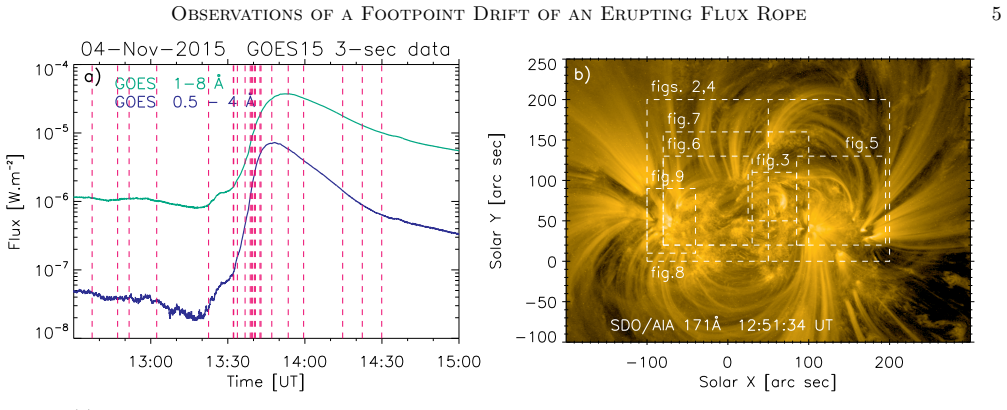
Summary. The paper presents SDO/AIA, Hinode/XRT, HMI, and H-alpha observations of the M3.7 flare of 2015 November 4 in NOAA AR 12443. The pre-flare H-alpha filament is modeled with NLFFF, revealing two helical systems threaded by a single field line. During the flare, tether-cutting of two J-shaped loops J1 and J2 forms a hot sigmoidal structure S rooted in a small positive ribbon hook SPRH. The loops then slip, SPRH disappears, the positive ribbon PR elongates, and a new, larger hook PRH forms at the end of the elongated ribbon; hot loops rooted in PRH erupt. After the eruption, PRH expands and then contracts. The authors interpret these sequences as a drift of the flux rope footpoint by about 40 arcseconds in solar Y (about 80 arcseconds along the ribbon), first from the filament F to S/SPRH and then to the erupting rope rooted in PRH, and they attribute the drift to ar-rf reconnection in the 3D flare model of Aulanier and Dudik (2019). They further interpret the expansion/contraction of PRH as evidence for repeated a-r-f reconnection series. The paper concludes that the observed footpoint drift is the first observational evidence of this process over tens of arcseconds, while noting that the displacement is larger than the model predicts.
Significance. If the identification of SPRH, S, and PRH as successive footpoints of a single flux rope is correct, this paper provides a valuable observational test of the 3D extension of the standard flare model and, in particular, of the ar-rf reconnection geometry predicted by Aulanier and Dudik (2019). The multi-instrument dataset (SDO/AIA, HMI, Hinode/XRT, H-alpha) is well suited to the study, and the NLFFF model quality metrics (CWsin = 0.1, <|fi|> ~ 3e-4, |Ediv|/E ~ 0.01) are reasonable. The paper honestly acknowledges that the observed drift is larger than the model prediction, and it reports measured slipping velocities (30-120 km/s) consistent with earlier work. These are strengths. However, the central claim relies on an identity assumption that is not directly tested, and the quantitative displacement lacks uncertainty estimates; these issues limit the strength of the conclusion.
major comments (3)
- [Section 3.1, Figure 12a] The central claim that SPRH, S, and PRH are successive footpoints of one drifting flux rope is not established by direct magnetic connectivity measurements. The evidence is morphological (Figures 6, 8, 9) and relies on a pre-flare NLFFF model (Figure 4f) that is not extended to the flare times. Because slipping reconnection changes which field lines are part of the rope, an apparent footpoint displacement along the ribbon could be produced by a sequence of distinct flux systems rather than a single rope. The manuscript should either provide quantitative connectivity tracking (e.g., time-dependent NLFFF or field-line mapping) or explicitly test the single-rope hypothesis against the alternative, and should state the uncertainty in the identification.
- [Section 2.3 and Section 3.1] The 40 arcsecond and 80 arcsecond displacements are reported without uncertainties. They are obtained by manual tracing in 304 Å (Figure 12a), and it is not shown that the separation between SPRH and PRH exceeds the combined tracing, alignment, and projection errors. The authors should estimate the tracing uncertainty (e.g., repeated measurements by independent analyzers, comparison with other filters, or conservative error bars based on pixel scale and co-alignment) and clarify the geometric relation between the 40 arcsecond shift in solar Y and the 80 arcsecond along the ribbon.
- [Section 1 and Abstract] The Introduction states that Aulanier and Dudik (2019) already presented two flares with observed hook drift and deformation, yet the Abstract and Section 1 claim 'for the first time' observational evidence of footpoint drift over tens of arcseconds. The authors should explicitly compare the present event with the two Aulanier and Dudik examples and state what is actually new (e.g., magnitude of the drift, the direct slipping-loop connection, or the specific reconnection series). Without this, the novelty statement is ambiguous and could be read as overclaiming.
minor comments (5)
- [Abstract] The phrase 'slipping away form the small hook' should read 'from the small hook'; this is a typographical error.
- [Section 2.1 and Section 3.2] There are typographical errors: 'foopoints' should be 'footpoints' in Section 2.1, and 'reonnection' should be 'reconnection' in Section 3.2.
- [Figure 4] The panel labels are duplicated: the left column has (d) for the 304 Å image and the right column also has (d) for the H-alpha image. Relabel the H-alpha panel (e) or use a different letter to avoid confusion.
- [Section 3.2] The claim that the x-position provides the 'first observational candidate for series of two ar-rf reconnections' is based on an inferred sequence without direct observation of the reconnecting field lines; it should be explicitly marked as speculative.
- [Section 1] The sentence 'For the first time, provide an observational evidence of a drift of the flux rope footpoint over distances of several tens of arc seconds' is grammatically incomplete; 'we provide' or 'we present' would be clearer.
Circularity Check
No significant circularity: the observed hook drift is an independent measurement, and the same-author MHD model is used as an interpretive framework rather than a fitted input.
full rationale
The derivation chain is observational rather than parametric: the paper measures the apparent displacement of ribbon hooks and slipping loops in AIA, XRT, and H-alpha data, and then interprets it with the 3D flare model. No model parameter is fitted to the displacement, and the claimed 40-arcsecond (about 80 arcseconds along the ribbon) shift is read off manually traced 304-Angstrom images, not produced by the model. The cited prediction of footpoint drift (Aulanier & Dudik 2019) is an independent MHD simulation with stated assumptions; it is not calibrated on this flare, and the authors explicitly note that the observed drift is larger than in the model, so the observation is not forced by the model. The load-bearing interpretive assumption that SPRH, S, and PRH are successive anchors of one drifting flux rope is a physical inference from morphology and loop slippage, not a tautology defined by the model; it could be wrong, but that is a correctness/validity risk rather than circular reasoning. Self-citation is present but not load-bearing in a circular sense, and no equation or fitted parameter is renamed as a prediction. Therefore the paper receives a circularity score of 0.
Assumptions & free parameters
free parameters (1)
- NLFFF reconstruction free parameters (preprocessing weights and smoothing) =
not reported; quality metrics CWsin=0.1, |Ediv|/E=0.01
assumptions (4)
- domain assumption The nonlinear force-free field extrapolation from the 12:59 UT HMI vector magnetogram approximates the preflare coronal field well enough to identify the filament's magnetic systems.
- domain assumption Apparent slippage of EUV loops corresponds to genuine magnetic reconnection-driven changes of field line connectivity, not to plasma bulk motion.
- domain assumption The 3D MHD model of Aulanier and Dudik (2019) correctly identifies which reconnection geometries operate in the real corona.
- domain assumption The ribbon hooks are the line-tied footpoints of the flux rope, not unrelated chromospheric brightenings.
Cite this review
Pith. "Pith review of Observations of a Footpoint Drift of an Erupting Flux Rope." pith.science (2026). https://pith.science/paper/J7BHAWYU
@misc{pith2026190802082,
  author       = {Pith},
  title        = {Pith review of: Observations of a Footpoint Drift of an Erupting Flux Rope},
  year         = {2026},
  howpublished = {\url{https://pith.science/paper/J7BHAWYU}},
  note         = {Machine review of arXiv:1908.02082}
}
read the original abstract
We analyze the imaging observations of an M-class eruptive flare of 2015 November, 4. The pre-eruptive H alpha filament was modelled by the non-linear force free field model, which showed that it consisted of two helical systems. Tether-cutting reconnection involving these two systems led to the formation of a hot sigmoidal loop structure rooted in a small hook that formed at the end of the flare ribbon. Subsequently, the hot loops started to slip away form the small hook until it disappeared. The loops continued slipping and the ribbon elongated itself by several tens of arc seconds. A new and larger hook then appeared at the end of elongated ribbon with hot and twisted loops rooted there. After the eruption of these hot loops, the ribbon hook expanded and later contracted. We interpret these observations in the framework of the recent three dimensional (3D) extensions to the standard solar flare model, which predict the drift of the flux rope footpoints. The hot sigmoidal loop is interpreted as the flux rope, whose footpoints drift during the eruption. While the deformation and drift of the new hook can be described by the model, the displacement of the flux rope footpoint from the filament to that of the erupting flux rope indicate that the hook evolution can be more complex than those captured by the model.
Figures


Figures from the paper (9 more)






Reference graph
Works this paper leans on
- [1]
- [2]
-
[3]
2012, A&A, 543, A110
Aulanier, G., Janvier, M., & Schmieder, B. 2012, A&A, 543, A110
2012
-
[4]
Aulanier, G., Pariat, E., D´ emoulin, P., & DeVore, C. R. 2006, SoPh, 238, 347
work page 2006
-
[5]
Aulanier, G., T¨ or¨ ok, T., D´ emoulin, P., & DeLuca, E. E. 2010, ApJ, 708, 314
work page 2010
- [6]
-
[7]
1964, NASA Special Publication, 50, 451 D´ emoulin, P., Priest, E
Carmichael, H. 1964, NASA Special Publication, 50, 451 D´ emoulin, P., Priest, E. R., & Lonie, D. P. 1996, J. Geophys. Res., 101, 7631
work page 1964
-
[8]
M., Temmer, M., Podladchikova, T., & Vanninathan, K
Dissauer, K., Veronig, A. M., Temmer, M., Podladchikova, T., & Vanninathan, K. 2018a, ApJ, 855, 137 —. 2018b, ApJ, 863, 169 Dud´ ık, J., Janvier, M., Aulanier, G., et al. 2014, ApJ, 784, 144 Dud´ ık, J., Polito, V., Janvier, M., et al. 2016, ApJ, 823, 41
work page 2014
Show all 40 references
-
[9]
A., & Hagyard, M
Gary, G. A., & Hagyard, M. J. 1990, SoPh, 126, 21
1990
-
[10]
2007, SoPh, 243, 63
Golub, L., Deluca, E., Austin, G., et al. 2007, SoPh, 243, 63
2007
-
[11]
1974, SoPh, 34, 323
Hirayama, T. 1974, SoPh, 34, 323
1974
-
[12]
T., Liu, Y., Hayashi, K., et al
Hoeksema, J. T., Liu, Y., Hayashi, K., et al. 2014, SoPh, 289, 3483
2014
-
[13]
2014, ApJ, 788, 60
Janvier, M., Aulanier, G., Bommier, V., et al. 2014, ApJ, 788, 60
2014
-
[14]
2015, SoPh, 290, 3425
Janvier, M., Aulanier, G., & D´ emoulin, P. 2015, SoPh, 290, 3425
2015
-
[15]
2013, A&A, 555, A77 Karlick´ y, M., Zemanov´ a, A., Dud´ ık, J., & Radziszewski, K
Janvier, M., Aulanier, G., Pariat, E., & D´ emoulin, P. 2013, A&A, 555, A77 Karlick´ y, M., Zemanov´ a, A., Dud´ ık, J., & Radziszewski, K. 2018, ApJL, 854, L29
2013
-
[16]
A., & Pneuman, G
Kopp, R. A., & Pneuman, G. W. 1976, SoPh, 50, 85
1976
-
[17]
2007, SoPh, 243, 3
Kosugi, T., Matsuzaki, K., Sakao, T., et al. 2007, SoPh, 243, 3
2007
-
[18]
R., Title, A
Lemen, J. R., Title, A. M., Akin, D. J., et al. 2012, SoPh, 275, 17
2012
-
[19]
2015, ApJL, 804, L8
Li, T., & Zhang, J. 2015, ApJL, 804, L8
2015
-
[20]
2017, ApJ, 848, 32 Observations of a Footpoint Drift of an Erupting Flux Rope 17
Li, T., Zhang, J., & Hou, Y. 2017, ApJ, 848, 32 Observations of a Footpoint Drift of an Erupting Flux Rope 17
2017
-
[21]
H., Nakwacki, M
Mandrini, C. H., Nakwacki, M. S., Attrill, G., et al. 2007, SoPh, 244, 25
2007
-
[22]
L., Sterling, A
Moore, R. L., Sterling, A. C., Hudson, H. S., & Lemen, J. R. 2001, ApJ, 552, 833
2001
-
[23]
D., Thompson, B
Pesnell, W. D., Thompson, B. J., & Chamberlin, P. C. 2012, SoPh, 275, 3
2012
-
[24]
Petschek, H. E. 1964, NASA Special Publication, 50, 425
1964
-
[25]
2016, in Astrophysics and Space Science Library, Vol
Priest, E. 2016, in Astrophysics and Space Science Library, Vol. 427, Magnetic Reconnection: Concepts and Applications, ed. W. Gonzalez & E. Parker, 101
2016
-
[26]
R., & D´ emoulin, P
Priest, E. R., & D´ emoulin, P. 1995, J. Geophys. Res., 100, 23443
1995
-
[27]
R., Hornig, G., & Pontin, D
Priest, E. R., Hornig, G., & Pontin, D. I. 2003, Journal of Geophysical Research (Space Physics), 108, 1285
2003
-
[28]
2016, ApJ, 817, 43 —
Savcheva, A., Pariat, E., McKillop, S., et al. 2016, ApJ, 817, 43 —. 2015, ApJ, 810, 96
2016
-
[29]
J., De Rosa, M
Schrijver, C. J., De Rosa, M. L., Metcalf, T. R., et al. 2006, SoPh, 235, 161
2006
-
[30]
1995, ApJL, 451, L83
Shibata, K., Masuda, S., Shimojo, M., et al. 1995, ApJL, 451, L83
1995
-
[31]
Sturrock, P. A. 1966, Nature, 211, 695
1966
-
[32]
2013, ApJL, 770, L1
Testa, P., De Pontieu, B., Mart´ ınez-Sykora, J., et al. 2013, ApJL, 770, L1
2013
-
[33]
2013, A&A, 553, A38
Valori, G., D´ emoulin, P., Pariat, E., & Masson, S. 2013, A&A, 553, A38
2013
-
[34]
M., Dissauer, K., & Temmer, M
Vanninathan, K., Veronig, A. M., Dissauer, K., & Temmer, M. 2018, ApJ, 857, 62
2018
-
[35]
2019, ApJ, 879, 85
Vanninathan, K. 2019, ApJ, 879, 85
2019
-
[36]
Webb, D. F. 2000, Journal of Atmospheric and Solar-Terrestrial Physics, 62, 1415
2000
-
[37]
S., Sturrock, P
Wheatland, M. S., Sturrock, P. A., & Roumeliotis, G. 2000, ApJ, 540, 1150
2000
-
[38]
2010, A&A, 516, A107
Wiegelmann, T., & Inhester, B. 2010, A&A, 516, A107
2010
-
[39]
A., Aulanier, G., et al
Zhao, J., Gilchrist, S. A., Aulanier, G., et al. 2016, ApJ, 823, 62
2016
-
[40]
P., Aulanier, G., & Gilchrist, S
Zuccarello, F. P., Aulanier, G., & Gilchrist, S. A. 2015, ApJ, 814, 126
2015
Reviewed August 14, 2026 · model on record in the stance chip above.
Discussion (0). Continue with ORCID to comment.