REVIEW 4 major objections 6 minor 36 references
Physics-informed neural network enhanced multispectral single-pixel imaging with a chip spectral sensor
T0 review · 4 major / 6 minor · reviewed 2026-08-15 · deepseek-v4-flash
Pith's one-line read A portable single-pixel multispectral imager recovers 12-channel spectral images at a 10% sampling rate using an untrained physics-informed U-Net, with no labeled training data.
desk verdict A plausible hardware-plus-pipeline contribution for compact multispectral single-pixel imaging, but the 'high-quality' and 'outperforms TVAL3' claims rest on a training curve and a no-reference metric, not on measured accuracy. read the letter →
The pith
A machine-rendered reading of the paper's core claim, the machinery that carries it, and where it could break.
The reading
What carries the argument
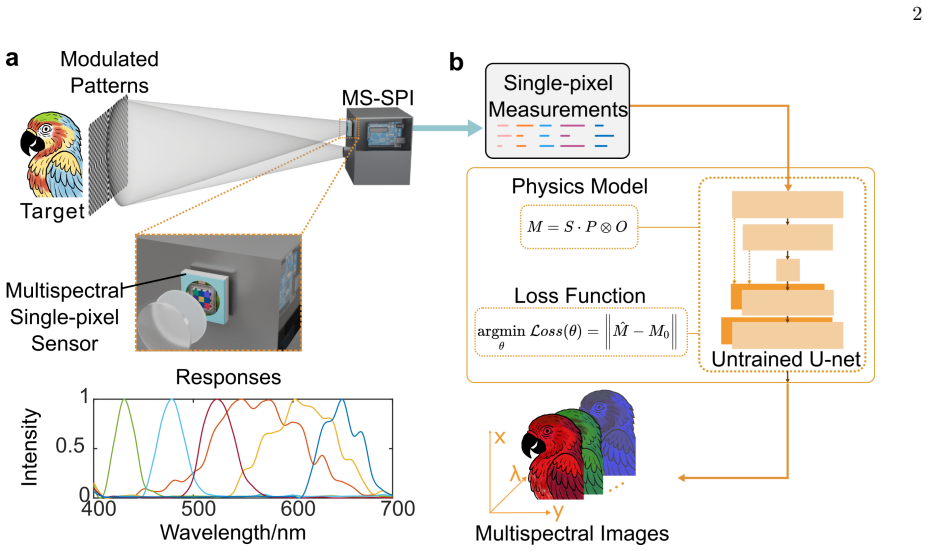
The load-bearing element is a differentiable forward model of the multispectral single-pixel measurement process, combined with an untrained U-Net. The U-Net takes a coarse cube produced by TVAL3 and outputs a refined cube; the forward model maps that cube to predicted single-pixel measurements, and Adam minimizes the discrepancy $\|\hat{M}-M\|$ between predicted and raw measurements. Because the sensor's per-channel spectral responses $S_n(\lambda_k)$ and the projected binary patterns $P_m(x_i,y_j)$ are inserted as fixed operators, every gradient step presses the reconstruction toward one that explains the actual detector readings, which is what allows self-corrected recovery without labeled data.
What would settle it
Compare the reconstructed 12-channel cube to a reference measurement of a calibrated reflectance chart under the same illumination; if channel crosstalk or pattern miscalibration makes the forward model wrong, the reconstruction will show a systematic spectral bias that no amount of U-Net iteration removes. A simpler check: illuminate the sensor with a monochromatic source at one channel's center wavelength and confirm that adjacent channels read only the calibrated leakage level.
Extended reading notes
Core claim
The central discovery is that an untrained U-Net, initialized with a rough TVAL3 reconstruction and then optimized against the raw sensor measurements through the physical forward model, can recover high-fidelity multispectral images from heavily undersampled single-pixel data. The authors formalize the forward model as $M_{m,n}=\sum_{x_i,y_j,\lambda_k} S_n(\lambda_k) P_m(x_i,y_j) O(x_i,y_j,\lambda_k)$ and the training loss as $\|\hat{M}-M\|$, so the network never sees ground-truth images. In experiments with a 12-channel chip sensor and a compact projector, the method reconstructs clear spatial details at sampling rates of 10% and 20% across wavelengths from 450 nm to 855 nm, with PIQUE scores favoring PINN over TVAL3 in all examined channels at 20% sampling. The authors further show that the measurement MSE drops rapidly within about 25 iterations, indicating that the physics loss, not the initial estimate, drives reconstruction quality.
Load-bearing premise
The whole reconstruction is only as good as the forward model's assumption that the chip's measured intensity is exactly the sum of known pattern weights times known per-channel spectral responses, with no crosstalk, nonlinearity, or drift during capture.
Editorial extensions
If this is right
- At 10% sampling, the method reconstructs 12-channel spectral cubes with fine spatial detail, so portable devices can acquire multispectral data with a fraction of the measurements a full raster scan would need.
- Because the network needs no training set, a new scene or a different sensor chip only requires updating the forward model and re-optimizing the untrained weights, not collecting labeled images.
- The measurement-fidelity loss converges within roughly 25 iterations across sampling rates, meaning the per-scene optimization is fast enough to run on a laptop.
- The reconstructed cubes carry enough spectral contrast for unsupervised segmentation, so downstream analysis such as sorting regions by material or state works directly on the recovered data.
Reading between the lines
- Beyond the paper's experiments, the same differentiable forward model should transfer to any sensor with a known spectral response, including RGB or hyperspectral chips, by swapping $S_n(\lambda_k)$.
- A testable extension is to co-optimize the illumination patterns inside the loop, which could recover some of the high-frequency spatial information the authors note is lost at low Hadamard sampling rates.
- One could also make calibration parameters such as per-channel gains and pattern transmittance learnable variables in the loss, letting the network absorb slow sensor drift without changing the architecture.
Signed reviews
Editorial analysis
A structured set of objections, weighed in public.
Referee Report
Summary. The manuscript reports a portable multispectral single-pixel imaging prototype that combines a chip-scale 12-channel spectral sensor with an untrained physics-informed U-Net. Raw measurements are first inverted coarsely with TVAL3; the U-Net is then optimized with a measurement-fidelity loss under a forward model that uses known binary patterns and calibrated spectral responses. The authors claim 10% sampling-rate reconstruction of high-quality 12-channel spectral cubes, report qualitative and PIQUE-based comparisons with TVAL3, and demonstrate a K-means segmentation application on the reconstructed multispectral images.
Significance. If the quality claim were quantitatively established, the contribution would be useful: it offers a compact, calibration-aware, label-free reconstruction pipeline for multispectral single-pixel imaging and a concrete proof-of-concept hardware demonstration. Strengths include the physical forward model with independently characterized spectral responses, the use of an untrained network that avoids labeled datasets, an actual working prototype, and a downstream segmentation demonstration. The main reservation is that the evidence for 'high-quality' and 'superiority over TVAL3' is currently qualitative and no-reference, so the significance is conditional on additional validation rather than fully demonstrated in the present form.
major comments (4)
- [§II, Fig. 4 and Fig. 5(b)] The central claim of high-quality 12-channel reconstruction at 10% sampling is not quantitatively established: the paper states that ground-truth reference images under identical conditions were unavailable, and the only quantitative support is the PIQUE no-reference comparison at 20% sampling plus the training MSE curve. Because PIQUE measures natural-image statistics rather than spectral or spatial fidelity, and because the MSE in Fig. 5(b) is exactly the loss minimized in Eq. (1), neither metric distinguishes a physically accurate cube from a smooth artifact-free cube that fits the measurements. Please add ground-truth validation (for example, a 100%-sampling scan or a reference camera image) with PSNR/SSIM/spectral-angle metrics, or revise the claims to be explicitly about perceptual quality.
- [§II, Eq. (1) and Eq. (2)] The measurement-fidelity loss is circular evidence for reconstruction accuracy. At 10% sampling the linear system Eq. (2) has I×J×K unknowns but only M×N measurements, so its nullspace is large; driving the residual in Eq. (1) to zero can be achieved by many different spectral cubes, including ones that fit noise or sensor artifacts. The near-zero MSE in Fig. 5(b) therefore shows only that the network has learned to reproduce the raw measurements, not that the reconstructed cube is correct. This point should be acknowledged and addressed with a metric that does not use the same objective as the optimizer.
- [§II, Eq. (2) forward model] The claim that the loss is 'physics-corrected' depends on Eq. (2) being an exact description of the chip sensor. The manuscript characterizes the spectral responses but does not report validation of the assumed linear, crosstalk-free, drift-free model. If the real sensor has spectral leakage, angle-dependent response, or nonlinearity, the PINN will faithfully fit measurements to an incorrect model and the reconstructed cube will inherit systematic error regardless of iteration count. Please provide a calibration-validation experiment (e.g., forward-model prediction error on a known target, or a residual analysis across channels) or state the model mismatch as a limitation.
- [§II, Fig. 5 and initialization] The claim in the text that 'PINN does not rely on the initial input, but continuously iterates to approach the physically correct result' is not supported by the reported experiments: the U-Net is always initialized from the TVAL3 coarse reconstruction, and no comparison with a different initialization (e.g., zero, random, or direct measurement backprojection) is shown. Since TVAL3 already imposes sparse regularization, the final result may inherit its biases. Please test the dependence of the reconstruction on the initialization, or soften the claim.
minor comments (6)
- [Eq. (1)] The norm is written without a subscript; please specify the L2 norm and define \hat{M} before the equation.
- [Fig. 5(b)] The text calls the plotted quantity 'MSE values between predicted measurements and raw signals'; this is a training loss, and calling it 'ground truth measurements' in the caption is confusing. Please relabel it as a measurement-fidelity loss.
- [§II, Fig. 3] No architecture details for the U-Net (depth, channel width, skip connections, number of parameters) or optimizer settings (learning rate, iterations, batch size) are given, which prevents reproduction. Please add a method subsection or table.
- [Title page] 'Augest' is a typo for 'August'.
- [References] Reference [8] is formatted as 'Nature Communications 1, 59 (2010)'; please check the volume and article number.
- [Fig. 4(c)] The PIQUE panel is reported only for a 20% sampling rate; the caption should state this explicitly to avoid implying that 10% quality was quantified.
Circularity Check
Partial circularity: the Fig. 5(b) 'MSE' validation is exactly the Eq. (1) loss minimized by Adam, so the reported improvement reduces to the training objective.
-
fitted input called prediction
[Section II, Eq. (1) and Fig. 5(b)]
"argmin θ Loss (θ) = ‖cM−M‖. (1) ... Figure 5(b) illustrates the mean square error (MSE) curve between the physical model’s predicted single-pixel measurements and the ground truth measurements. The mentioned above together reflect the performance of the neural network."
Eq. (1) defines the loss as the residual between predicted and raw measurements, and the Adam optimizer updates the network parameters to minimize exactly this quantity. Fig. 5(b) plots the same residual and presents it as evidence that the network 'continuously iterates to approach the physically correct result.' Because the plotted MSE is the training objective itself, its decline is forced by construction and cannot demonstrate reconstruction fidelity, spectral accuracy, or superiority over TVAL3. The paper even states that ground-truth reference images under identical conditions were unavailable, so this self-referential training curve is used as physical validation, which is the fitted quantity renamed as a prediction.
full rationale
The core reconstruction pipeline is not circular: Eq. (2) is a forward model using externally characterized spectral responses and binary patterns, and the U-Net output is optimized against raw single-pixel measurements rather than against a target image. No uniqueness theorem or load-bearing self-citation is used; the untrained U-Net is adopted as a standard architecture via [29], and the cited prior works are not used to forbid alternatives or define the result. However, one validation step is self-referential. Fig. 5(b) plots the MSE between predicted and measured single-pixel signals, which is precisely the loss in Eq. (1) minimized by Adam; a decreasing curve is therefore forced by construction and cannot demonstrate that the reconstruction is 'physically correct' or that PINN outperforms TVAL3 in fidelity. The paper explicitly notes ground-truth references were unavailable and relies on the no-reference PIQUE metric, which does not measure spectral or spatial accuracy. Thus the central 'high-quality at 10%' claim is partially supported by a training curve, i.e., a fitted quantity renamed as physical validation, giving partial circularity. No other steps reduce to their inputs.
Assumptions & free parameters
free parameters (2)
- TVAL3 regularization parameter =
not reported
- U-Net and Adam hyperparameters =
not reported
assumptions (4)
- domain assumption The forward model Eq. (2) exactly represents the acquisition: known binary patterns Pm, known spectral response functions Sn, no crosstalk or nonlinearity.
- domain assumption An untrained U-Net with random initialization and measurement-fidelity loss can represent the target multispectral cube.
- domain assumption The scene is static and its reflectance does not change during the full sequence of M patterns and N spectral channels.
- ad hoc to paper The TVAL3 coarse reconstruction is a sufficient initialization and does not bias the final solution.
Cite this review
Pith. "Pith review of Physics-informed neural network enhanced multispectral single-pixel imaging with a chip spectral sensor." pith.science (2026). https://pith.science/paper/J7IRYYG3
@misc{pith2026250820566,
  author       = {Pith},
  title        = {Pith review of: Physics-informed neural network enhanced multispectral single-pixel imaging with a chip spectral sensor},
  year         = {2026},
  howpublished = {\url{https://pith.science/paper/J7IRYYG3}},
  note         = {Machine review of arXiv:2508.20566}
}
read the original abstract
Multispectral imaging (MSI) captures data across multiple spectral bands, offering enhanced informational depth compared to standard RGB imaging and benefiting diverse fields such as agriculture, medical diagnostics, and industrial inspection. Conventional MSI systems, however, suffer from high cost, complexity, and limited performance in low-light conditions. Moreover, data-driven MSI methods depend heavily on large, labeled training datasets and struggle with generalization. In this work, we present a portable multispectral single-pixel imaging (MS-SPI) method that integrates a chip-sized multispectral sensor for system miniaturization and leverages an untrained physics-informed neural network (PINN) to reconstruct high-quality spectral images without the need for labeled training data. The physics-informed structure of the network enables the self-corrected reconstruction of multispectral images directly with the input of raw measurements from the multispectral sensor. Our proof-of-concept prototype achieves the reconstruction of 12-channel high-quality spectral images at the sampling rate of 10%. We also experimentally validate its performance under varying sampling rate conditions, by comparing it with conventional compressive sensing algorithms. Furthermore, we demonstrate the application of this technique to an MSI-based image segmentation task, in which spatial regions are discriminated according to their characteristic spectral signatures. This compact, high-fidelity, and portable approach offers promising pathways to lightweight and cost-effective spectral imaging on mobile platforms.
Figures


Figures from the paper (3 more)


Reference graph
Works this paper leans on
- [1]
-
[2]
A. Spreinat, G. Selvaggio, L. Erpenbeck, and S. Kruss, Journal of Biophotonics 13, e201960080 (2020)
work page 2020
-
[3]
Qin, J., Chao, K., Kim, M.S., Lu, R., and Burks, T.F., Journal of Food Engineering118, 157 (2013)
work page 2013
- [4]
-
[5]
J. F. Bell, M. A. Ravine, M. A. Caplinger, and e. a. Schaffner, Space Science Reviews221, 47 (2025)
work page 2025
-
[6]
M. W. Kudenov and E. L. Dereniak, Optics Express 20, 17973 (2012)
work page 2012
-
[7]
Arbabi, Science Advances6, eabc7646 (2020)
A.McClung, S.Samudrala, M.Torfeh, M.Mansouree, and A. Arbabi, Science Advances6, eabc7646 (2020)
work page 2020
- [8]
Show all 36 references
-
[9]
M. Yako, Y. Yamaoka, T. Kiyohara, C. Hosokawa, A. Noda, K. Tack, N. Spooren, T. Hirasawa, and A. Ishikawa, Nature Photonics17, 218 (2023)
2023
-
[10]
G. M. Gibson, S. D. Johnson, and M. J. Padgett, Optics Express 28, 28190 (2020)
2020
-
[11]
B. Liu, F. Wang, C. Chen, F. Dong, and D. McGloin, Optica 8, 1340 (2021)
2021
-
[12]
D. Wang, B. Liu, J. Song, Y. Wang, X. Shan, X. Zhong, and F. Wang, Optics Express 31, 14225 (2023)
2023
-
[13]
J. Song, B. Liu, Y. Wang, C. Chen, X. Shan, X. Zhong, L.-A. Wu, and F. Wang, Photonics Re- search 12, 226 (2024)
2024
-
[14]
H. Wu, B. Hu, L. Chen, F. Peng, Z. Wang, G. Genty, and H. Liang, Light: Science & Applications13, 124 (2024)
2024
-
[15]
SPI based spectral imaging can also be achieved with simplified hard- ware implementations, compared with conventional MSI systems [17]
or terahertz wavelengths [16]. SPI based spectral imaging can also be achieved with simplified hard- ware implementations, compared with conventional MSI systems [17]. Recent advances in multispectral single-pixel imaging (MS-SPI) include the use of mul- tiple single-pixel det...
2025 arXiv
-
[16]
Zhang, Y.-H
A.-X. Zhang, Y.-H. He, L.-A. Wu, L.-M. Chen, and B.-B. Wang, Optica5, 374 (2018)
2018
-
[17]
T. Mohr, A. Herdt, and W. Elsässer, Optics Express 26, 3353 (2018)
2018
-
[18]
B. Liu, F. Wang, C. Chen, and D. McGloin, IEEE Photonics Journal 13, 7800205 (2021)
2021
-
[19]
S. S. Welsh, M. P. Edgar, R. Bowman, P. Jonathan, B. Sun, and M. J. Padgett, Optics Express21, 23068 (2013)
2013
-
[20]
Zhang, S
Z. Zhang, S. Liu, J. Peng, M. Yao, G. Zheng, and J. Zhong, Optica5, 315 (2018)
2018
-
[21]
Jiang, Z
X. Jiang, Z. Li, G. Du, J. Jia, Q. Wang, N. Chi, and Q. Dai, Optics Express30, 25995 (2022)
2022
-
[22]
L. Bian, J. Suo, G. Situ, Z. Li, J. Fan, F. Chen, and Q. Dai, Scientific Reports6, 24752 (2016)
2016
-
[23]
Y. Xu, L. Lu, V. Saragadam, and K. F. Kelly, Nature Communications 15, 1456 (2024)
2024
-
[24]
Park and L
J. Park and L. Gao, PhotoniX5, 37 (2024)
2024
-
[25]
Y. Ni, D. Zhou, S. Yuan, X. Bai, Z. Xu, J. Chen, C. Li, and X. Zhou, Optics Letters46, 1840 (2021)
2021
-
[26]
Y. Chen, Y. Wang, and H. Zhang, IEEE Transactions on Circuits and Systems for Video Technology 34, 8629 (2024)
2024
-
[27]
Zhang, X
H. Zhang, X. Zhao, Y. Liu, X. Shi, S. Zhou, and Y. Chen, Optics & Laser Technology 184, 112446 (2025)
2025
-
[28]
T. Hu, J. Chen, S. Wang, J. Wu, Z. Chen, Z. Tian, R. Ma, and D. Wu, IEEE Photonics Journal 15, 7800910 (2023)
2023
-
[29]
K. Song, Y. Bian, D. Wang, R. Li, K. Wu, H. Liu, C. Qin, J. Hu, and L. Xiao, Laser & Photonics Re- views 19, 2401397 (2025)
2025
-
[30]
F. Wang, C. Wang, M. Chen, W. Gong, Y. Zhang, S. Han, and G. Situ, Light: Science & Applications 11, 1 (2022)
2022
-
[31]
C. Li, W. Yin, H. Jiang, and Y. Zhang, Computa- tional Optimization and Applications56, 507 (2013)
2013
-
[32]
V. N, P. D, M. C. Bh, S. S. Channappayya, and S. S. Medasani, in 2015 Twenty First National Conference on Communications (NCC) (2015) pp. 1–6
2015
-
[33]
Lloyd, IEEE Transactions on Information Theory 28, 129 (1982)
S. Lloyd, IEEE Transactions on Information Theory 28, 129 (1982)
1982
-
[34]
M. Tian, B. Liu, Z. Lu, Y. Wang, Z. Zheng, J. Song, X. Zhong, and F. Wang, Light: Science & Applica- tions 13, 278 (2024)
2024
-
[35]
Zhang, Z
Q. Zhang, Z. Yu, X. Liu, C. Wang, and Z. Zheng, Optics Communications 530, 129154 (2023). 8
2023
-
[36]
Jiang, J
W. Jiang, J. Song, Z. Chen, and S. Qu, Optics Ex- press 32, 48672 (2024)
2024
Reviewed August 15, 2026 · model on record in the stance chip above.
Discussion (0). Continue with ORCID to comment.