REVIEW 3 major objections 5 minor 22 references
Two-step laser resonant ionization spectroscopy of chromium
T0 review · 3 major / 5 minor · reviewed 2026-08-16 · deepseek-v4-flash
Pith's one-line read Two-step laser spectroscopy fixes chromium's ionization potential at 54575.49(2)(2) cm⁻¹, ten times more precise than the accepted value.
desk verdict Cr IP improved by 10x with a clean Rydberg fit; main fix is a fit-range typo. read the letter →
The pith
A machine-rendered reading of the paper's core claim, the machinery that carries it, and where it could break.
The reading
What carries the argument
The load-bearing machinery is the Rydberg series $3d^5(^6S)ns\,^7S_3$ combined with the Rydberg-Ritz formula: each level satisfies $E_n = \mathrm{IP} - R_M/(n-\delta(n))^2$, with mass-corrected $R_M = 109736.157$ cm$^{-1}$ for $^{52}$Cr and $\delta(n)=\delta_0 + a/(n-\delta_0)^2$. The Lu-Fano plot identifies the series by comparing the observed quantum defect modulo 1 against known $ns$ and $nd$ series values; the adjacent broad autoionizing state perturbs high-$n$ members, so the fit is restricted to $n=20$–50. The 600 MHz wavelength-meter accuracy determines the 0.02 cm$^{-1}$ systematic uncertainty.
What would settle it
Record the same Rydberg region with a narrow-band laser that resolves fine structure, or independently excite the $nd$ series; if the series limit from those data differs from 54575.49 cm$^{-1}$ by more than roughly 0.1 cm$^{-1}$, the $ns$ assignment or the Ritz extrapolation is biased.
Extended reading notes
Core claim
The paper's central result is a new ionization potential for chromium, $54575.49(2)_\mathrm{stat}(2)_\mathrm{sys}$ cm$^{-1}$, obtained from the even-parity Rydberg series $3d^5(^6S)ns\,^7S_3$ observed by two-step laser ionization from the three $J$ levels of the intermediate state $3d^4(^5D)4s4p(^3P^\circ)\,^7P^\circ_{2,3,4}$. A Lu-Fano plot identifies the series: the observed quantum defect, $\delta \approx 2.55$, matches the known $ns$ series rather than the $nd$ series, and the same series appears for all three intermediate states. Fitting $n=20$–50 with the Rydberg-Ritz formula, and excluding the higher members perturbed by a broad autoionizing resonance at 54695 cm$^{-1}$, gives the ionization potential with 0.02 cm$^{-1}$ statistical and 0.02 cm$^{-1}$ systematic uncertainty. The paper further shows that the scheme using 357.971 nm then 373.935 nm is the most efficient of the three tested and was deployed for on-line radioactive chromium beam delivery.
Load-bearing premise
The load-bearing premise is that the observed series really is the $ns$ Rydberg series with a slowly varying quantum defect, so that the two-term Rydberg formula fitted over $n=20$–50 extrapolates to the correct series limit even though an autoionizing resonance sits just above it.
Editorial extensions
If this is right
- The improved ionization potential should replace the accepted database value and should be used to recalculate term energies and series limits for chromium.
- The measured even-parity Rydberg levels fill a gap in chromium atomic data, giving anchor points for future analyses of channel interactions near the ionization threshold.
- The 357.971 nm plus 373.935 nm scheme excites a broad, strong autoionizing resonance, making it a frequency-drift-tolerant and efficient ionization path for Ti:Sa-based resonance ionization sources.
- Because the second-step excitation remains linear up to 340 mW, increasing the second-step laser power should raise the chromium ion yield still further.
- The yield pattern, with stable isotopes far exceeding radioactive ones, indicates stable chromium contamination in the target and ion-source materials that future beam developments will need to control.
Reading between the lines
- A natural next test would combine the new $ns$ series limit with the older odd-parity $np$ series in a joint Rydberg-Ritz or multichannel fit; consistency would strengthen the assignment and could push the uncertainty below 0.02 cm$^{-1}$.
- The broad autoionizing feature at 54695 cm$^{-1}$ may be a cluster of unresolved states; spectroscopy with a narrower-band laser could resolve its substructure and test whether its wing explains the quantum-defect drift seen for $n > 50$.
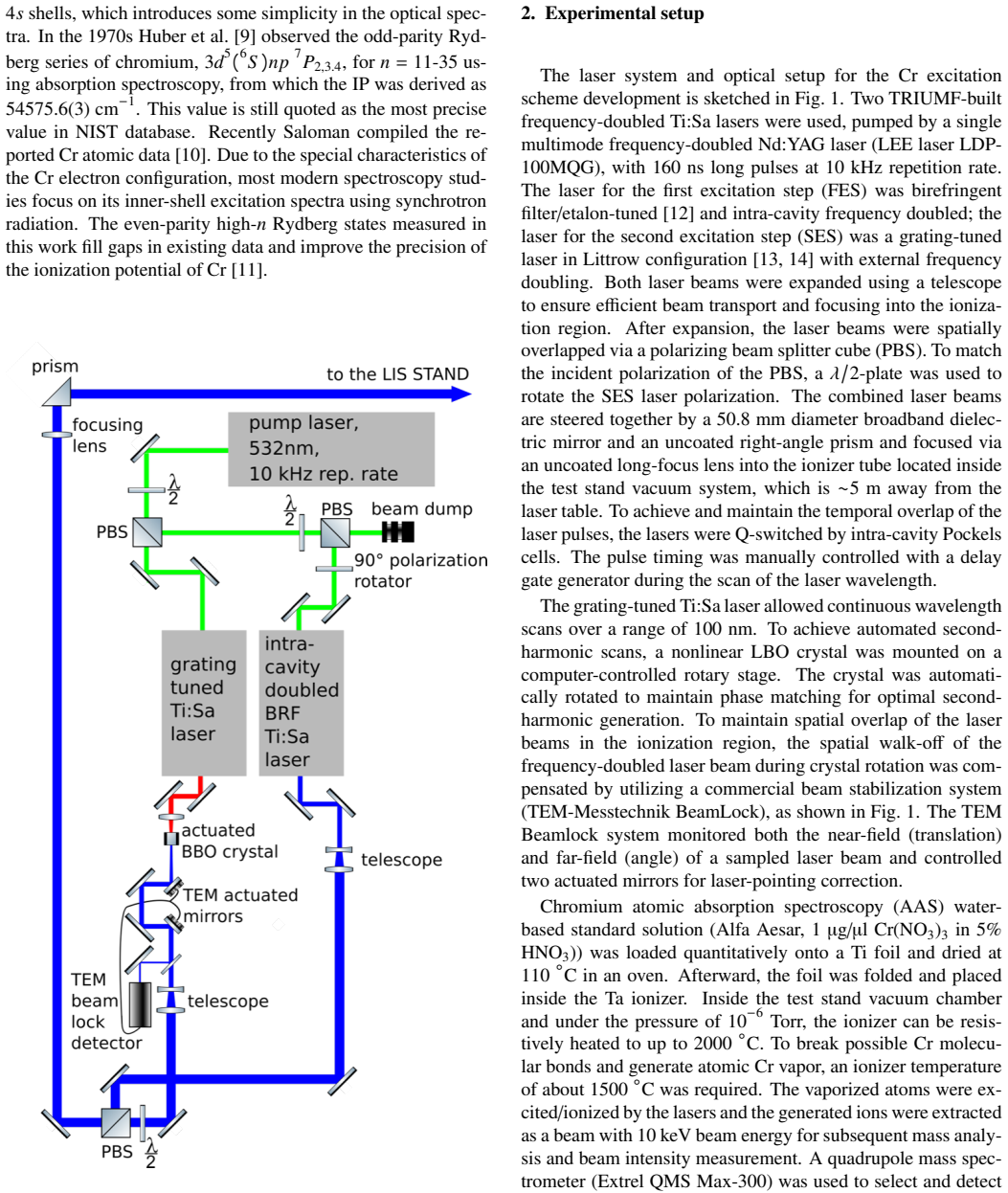
- The same automated scanning recipe, a frequency-doubled grating-tuned Ti:Sa laser with active beam stabilization, should transfer directly to other transition metals whose ionization potentials are still database-limited, provided a suitable intermediate state lies within the laser range.
Signed reviews
Editorial analysis
A structured set of objections, weighed in public.
Referee Report
Summary. The authors report two-step resonant laser ionization spectroscopy of chromium performed at TRIUMF's offline laser ion source test stand. Three first-step excitations to 3d4(5D)4s4p(3P°) 7P°2,3,4 are used, and the frequency-doubled grating-tuned Ti:Sa laser is scanned across high-n Rydberg states and autoionizing resonances. The observed even-parity series is assigned to 3d5(6S)ns 7S3, and a Rydberg-Ritz fit to Eqs. (1)-(2) over the range n = 20-50 (Fig. 5 caption says n = 20-45) yields IP = 54575.49(2)stat(2)sys cm^-1, an order of magnitude more precise than the NIST value of 54575.6(3) cm^-1. The most efficient ionization scheme (357.971 nm + 373.935 nm via an AI state at 54695 cm^-1) was deployed online at ISAC, and yields for 50-59Cr as well as saturation curves are presented. Table 1 lists the measured Rydberg-state energies and quantum defects, which supports independent re-analysis.
Significance. If the extracted IP is robust, the result is a meaningful improvement in the known ionization potential of chromium and fills a gap for the even-parity Rydberg series. The paper is also of practical value to RILIS operations, providing a two-step scheme with a saturated first step and an AI-state second step that was used for radioactive beam delivery. The Rydberg-state energies are made available in Table 1, and the fitting procedure is standard. The main caveat is that the fit range is described inconsistently and no sensitivity test is shown for the boundary near the AI-state perturbation; because the headline claim is an order-of-magnitude precision gain, this needs to be addressed before the result can be fully accepted.
major comments (3)
- [Section 4 and Figure 5] The text in Section 4 says 'only the states of n = 20-50 were used in the data analysis', while the Fig. 5 caption says 'fit ... for n = 20-45'. This discrepancy matters because the text places the wing onset of the AI state 'around n = 50 beneath the IP'. If n = 46-50 were included, they are close to or at the perturbation onset; if not, the analysis does not match the description. Please report the exact range used, and show the fitted IP and its uncertainty for both n = 20-45 and n = 20-50, including a residual plot for the larger range. If the IP is insensitive to this choice, state that explicitly with numbers; otherwise revise the quoted precision accordingly.
- [Section 4, Eqs. (1)-(2)] The two-term Ritz expansion is validated only by the statement that 'no obvious further improvement was found by including higher orders'. Since the series terminates near an autoionizing state, model error from the truncation and from residual perturbations could bias the extrapolated IP by more than the 0.02 cm^-1 fitting error. The reduced chi-square of 0.63 is consistent with overestimated point uncertainties but does not exclude a correlated perturbation at the upper end. Please perform a sensitivity analysis: fit with and without n = 50, with and without n = 46-50, and with a third-order Ritz term; report the resulting IP and fitting errors and add a fit-model systematic uncertainty to the final value.
- [Section 4, systematic uncertainty] The systematic uncertainty is set equal to the wavelength-meter accuracy of 0.02 cm^-1, but no account is taken of possible line-profile asymmetries or scan nonlinearities in the centroid determination. Given that the laser linewidth is 4-10 GHz (0.13-0.33 cm^-1), the authors should justify that the centroid systematic is fully captured by the wavelength-meter accuracy and the standard error across the three spectra.
minor comments (5)
- [Figure 6 caption] The scheme is given as '357.973 nm + 373.935 nm', while Table 2 and the text use 357.971 nm; please make the wavelengths consistent.
- [Section 4] The sentence 'The resulting χ2r, which is smaller than 1, indicates the statistical uncertainty σ of En (listed in Tab. 1) are slightly overestimated' has a subject-verb disagreement; also specify whether the fitting error was scaled by χ2r or by sqrt(χ2r).
- [Introduction] There is a typo in 'V ancouver' in the author affiliation; it should be 'Vancouver'.
- [Section 4] The statement that the wavelength-meter accuracy is '600 MHz, i.e. 0.02 cm−1, according to a 3-σ criterion' should clarify whether 600 MHz is the 3σ value or the 1σ value, and how the quoted systematic uncertainty is derived from it.
- [Table 1] The δ values for n = 56-62 show a clear downward trend, consistent with the onset of AI perturbation, but the text says the deviation 'begins to deviate' around n = 50; the table suggests significant deviations appear only for n ≥ 53. Please reconcile the verbal description with the tabulated values.
Circularity Check
No circularity: the Cr ionization potential is extracted from measured Rydberg energies via an independent Rydberg-Ritz fit, not from any fitted parameter or self-citation chain.
full rationale
The central derivation is self-contained. The ionization potential is obtained by fitting the measured Rydberg-series energies E_n to Eq. (1), E_n = IP - R_M/(n-δ(n))^2, with independent inputs: intermediate-state energies from NIST and laser wavelengths from a calibrated wavelength meter. The fitted parameters δ0 and a describe the quantum-defect variation and are not used to define the target IP; the IP itself is the fit output. The series assignment to 3d5(6S)ns is justified by comparison with NIST quantum-defect data (δmod1 ≈ 0.5 versus ≈ 0.0 for nd), not by the newly determined IP. The quantum defects listed in Table 1 and plotted in Fig. 4 do use the new IP, but only for presentation after the fit; the fit itself does not depend on them. The 0.15 cm^-1 uncertainty benchmark for Rydberg-state energies was estimated by comparing earlier measurement of Sb, Lu, and Te with NIST data, which is a calibration check rather than a circular load-bearing assumption. No self-citation is invoked to force the result, and no fitted parameter is renamed as a prediction. The only notable issue is a textual inconsistency between the stated fit range n = 20-50 in Section 4 and the n = 20-45 range in the Fig. 5 caption; that is a reproducibility or correctness concern near the known AI-state perturbation, not a circularity, because either way the IP is still derived from independently measured Rydberg energies rather than from the claim being proved.
Assumptions & free parameters
free parameters (2)
- Quantum defect δ0 =
2.552(4)
- Ritz coefficient a =
not given numerically
assumptions (4)
- standard math Rydberg-Ritz formula (Eq. 1) and Ritz expansion (Eq. 2) describe the series energies.
- domain assumption The observed series is 3d5(6S)ns 7S3 with L = 0 and no resolved fine structure.
- domain assumption The intermediate state energies adopted from NIST are accurate to about 0.002 cm^-1.
- domain assumption Perturbation from the autoionizing state is negligible for n = 20-50.
Cite this review
Pith. "Pith review of Two-step laser resonant ionization spectroscopy of chromium." pith.science (2026). https://pith.science/paper/JBCUTBBQ
@misc{pith2026250416067,
  author       = {Pith},
  title        = {Pith review of: Two-step laser resonant ionization spectroscopy of chromium},
  year         = {2026},
  howpublished = {\url{https://pith.science/paper/JBCUTBBQ}},
  note         = {Machine review of arXiv:2504.16067}
}
abstract
At TRIUMF's off-line laser ion source test stand, stepwise resonant laser ionization spectroscopy of chromium (Cr) was carried out, to find an efficient ionization scheme suitable for titanium sapphire (Ti:Sa) laser systems. With three different first-excitation transitions, 357.971 nm, 359.451 nm, and 360.636 nm, automated continuous laser-frequency scans using a frequency-doubled, grating-tuned Ti:Sa laser were performed. Rydberg series as well as autoionizing(AI) states were observed. From these results, the ionization potential (IP) of Cr was determined as 54575.49(2)$_\text{stat}$(2)$_\text{sys}$ cm$^{-1}$, which is one order of magnitude more precise than the previously reported 54575.6(3) cm$^{-1}$ in NIST database. The ionization scheme using the observed AI resonance, with 357.971 nm as the first step and 373.935 nm as the second step was subsequently deployed to the online delivery of radioactive Cr isotope beams for precision mass measurements. The online yields of $^{50-59}$Cr have been measured at TRIUMF-ISAC.
Figures


Figures from the paper (4 more)


Reference graph
Works this paper leans on
- [1]
-
[2]
J. Lassen, R. Li, S. Raeder, X. Zhao, T. Dekker, H. Heggen, P. Kunz, C. D. P. Levy, M. Mostanmand, A. Teigelh¨ofer and F. Ames, Hyperfine Interact. 238 (2017) 33 https://doi.org/10.1007/s10751-017-1407-9
-
[3]
U K ¨oster, V . N. Fedoseyev and V . I. Mishin, Spectrochim. Acta Part B., 58 (2003) 1047–1068 https://doi.org/10.1016/S0584-8547(03) 00075-2
-
[4]
E. B. Saloman, Spectrochim. Acta Part B., 46B (1991) 319-378 https: //doi.org/10.1016/0584-8547(91)80035-2
-
[5]
P. M. Paquet, J.-F. Gravel, P. Nobert, D. Boudreau, Spectrochim. Acta Part B., 53 (1998) 1907–1917 https://doi.org/10.1016/S0584- 8547(98)00237-7
-
[6]
J. Levinea, M. R. Savina, T. Stephan, N. Dauphas, A. M. Davis, K. B. Knight and M. J. Pellin, International Journal of Mass Spectrometry 288 (2009) 36–43 https://doi.org/10.1016/j.ijms.2009.07.013
-
[7]
Y . Kudryavtsev, R. Ferrer, M. Huyse, P. Van den Bergh, P. Van Duppen and L. Vermeeren, Rev. Sci. Instrum. 85 (2014) 02B915.https://doi. org/10.1063/1.4850695
-
[8]
T. D. Goodacre, K. Chrysalidis, D. Fedorov, V . Fedosseev, B. Marsh, P. Molkanov, R. Rossel, S. Rothe, C. Sei ffert, Spectrochim. Acta Part B., 129 (2017) 58–63. https://doi.org/10.1016/j.sab.2017.01. 001
Show all 22 references
-
[9]
M. C. E. Huber, R. J. Sandeman, and E. F. Tubbs, Proc. R. Soc. London, Ser. A 342, 431–438 (1975)https://doi.org/10.1098/rspa.1975. 0033
1975 doi
-
[10]
E. B. Saloman, Journal of Physical and Chemical Reference Data, 41 (4) (2012) 043103. https://doi.org/10.1063/1.4754694
2012 doi
-
[11]
Kramida, Yu
A. Kramida, Yu. Ralchenko, J. Reader, and NIST ASD Team (2024). NIST Atomic Spectra Database (ver. 5.12), [Online]. Avail- able: https://physics.nist.gov/asd [2025, March 10]. National Institute of Standards and Technology, Gaithersburg, MD. https://doi.org/10. 18434/T4W30F
2024
-
[12]
J. Yi, C. Geppert, R. Horn and K. Wendt, Jpn. J. Appl. Phys. 42 (2003) 5066–5070 https://doi.org/10.1143/JJAP.42.5066
2003 doi
-
[13]
Teigelh ¨ofer, P
A. Teigelh ¨ofer, P. Bricault, O. Chachkova, M. Gillner, J. Lassen, J. P. Lavoie, R. Li, J. Meissner, W. Neu and K. Wendt, Hyperfine Interact. 196 (2010) 161 https://doi.org/10.1007/s10751-010-0171-x
2010 doi
-
[14]
R. Li, J. Lassen, S. Rothe, A. Teigelh ¨ofer, and M. Mostamand, Opt. Ex- press, 25 (2017) 1123 https://doi.org/10.1364/OE.25.001123
2017 doi
-
[15]
J. P. Lavoie, R. Li, P. Bricault, J. Lassen, O. Chachkova, and A. Teigelh¨ofer, Rev. Sci. Instrum. 84, 013306 (2013) https://doi.org/ 10.1063/1.4788938
2013 doi
-
[16]
R. Li, J. Lassen, J. Ruczkowski, A. Teigelh ¨ofer and P. Bricault, Spec- trochim. Acta Part B. 128 (2017) 36 https://doi.org/10.1016/j. sab.2016.12.001
2017 doi
-
[17]
R. Li, J. Lassen, Z. P. Zhong, F. D. Jia, M. Mostamand, X. K. Li, B. B. Reich, A. Teigelh ¨ofer and H. Yan, Phys. Rev. A, 95 (2017) 052501 https://doi.org/10.1103/PhysRevA.95.052501
2017 doi
-
[18]
R. Li, Y . Liu, M. Mostamand, T. Kieck, K. D. A. Wendt and J. Lassen, Phys. Rev. A 100 (2019) 052510. https://doi.org/10. 1103/PhysRevA.100.052510
2019
-
[19]
highfinesse.com/en/wavelengthmeter/wavelengthmeter- ws-6-600.html
HighFinesse WS6-600 Wavelength meter https://www. highfinesse.com/en/wavelengthmeter/wavelengthmeter- ws-6-600.html
-
[20]
TRIUMF EEC letter of intent-S1917LOI, Neutron-rich chromium iso- topes for n = 40 nuclear, (2019) https://mis.triumf.ca/science/ experiment/view/S1917LOI
2019
-
[21]
Kunz, TRIUMF Isotope Database https://yield.targets
P. Kunz, TRIUMF Isotope Database https://yield.targets. triumf.ca/search/yield/data
-
[22]
P. Kunz, C. Andreoiu, P. Bricault, M. Dombsky, J. Lassen, A. Teigelh¨ofer, H. Heggen and F. Wong, Rev. Sci. Instrum. 85 (2014) 53305 https: //doi.org/10.1063/1.4878718. 8
2014 doi
Reviewed August 16, 2026 · model on record in the stance chip above.
Discussion (0). Continue with ORCID to comment.