REVIEW 3 major objections 6 minor 12 references
AI-assisted PHY technologies for 6G and beyond wireless networks
T0 review · 3 major / 6 minor · reviewed 2026-08-14 · deepseek-v4-flash
Pith's one-line read The paper claims that machine-learning implementations of channel decoding, obstacle detection, and transmitter authentication belong in the 6G physical layer, backed by simulations in which a recurrent neural network decoder outperforms…
desk verdict A clearly written position piece that repackages the authors' own prior ML-PHY results; its central RNN-vs-turbo claim is under-specified and not independently verifiable here. read the letter →
The pith
A machine-rendered reading of the paper's core claim, the machinery that carries it, and where it could break.
The reading
What carries the argument
The machinery is the learned input-output mapping that stands in for a model-based physical-layer block. For channel coding, a recurrent neural network learns the mapping from received noisy symbols to decoded bits for turbo codes. For ranging and obstacle detection, supervised multiclass hypothesis learning runs on raw time-domain UWB waveforms to output the likelihood of obstacle collision. For security, unsupervised Gaussian mixture model clustering builds a statistical description of channel estimates, and the number of OFDM pilot tones $M$ used for channel estimation is the tunable feature dimension that shifts the detection-rate-versus-false-alarm-rate curve.
What would settle it
Run the RNN decoder and a conventional turbo decoder under identical code rate, block length, modulation, and channel model over the full SNR range shown in Fig. 1, with enough random trials to draw tight confidence intervals; if the RNN's bit-error rate is not lower than the turbo decoder's at low SNR, the paper's most concrete performance claim is wrong.
Extended reading notes
Core claim
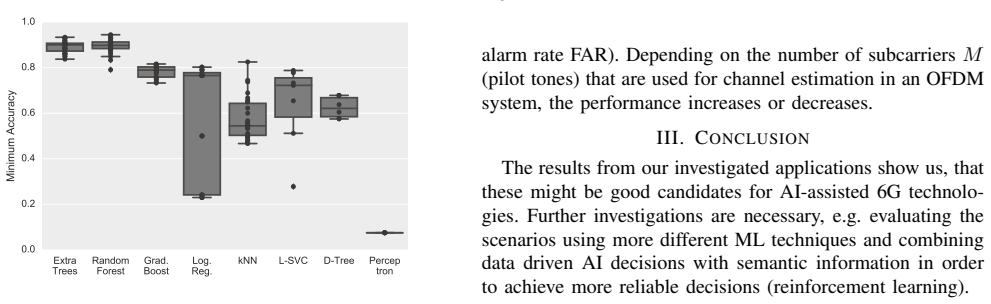
The paper's central claim is that ML-based physical-layer functions are candidate technologies for 6G and merit consideration alongside conventional model-based designs. Its concrete evidence is three simulation results: an RNN-based decoder that outperforms a conventional turbo decoder at low SNR (Fig. 1), supervised learning on raw UWB waveforms that predicts obstacle collisions with accuracy close to 95% (Fig. 2), and GMM clustering on OFDM channel estimates that authenticates packets with detection rates that rise as the number of pilot tones $M$ increases (Fig. 3). The paper argues that these examples show learned input-output mappings can match or exceed the performance of model-based physical-layer blocks.
Load-bearing premise
The central claim collapses if the three simulations compare unlike with unlike — for instance, if the RNN decoder faces a turbo decoder of different rate, block length, or iteration count, or if the reported accuracy is an artifact of the specific channel model, since the paper gives no code, parameters, or error bars to check.
Editorial extensions
If this is right
- If the RNN decoder's low-SNR advantage holds, channel decoding for latency-constrained devices could become less computationally intensive and more parallelizable.
- Obstacle detection near 95% accuracy from raw UWB waveforms would enable mission-critical industrial use cases such as automatic guided vehicles and automatic train pairing without explicit channel modeling.
- GMM-based channel authentication would let receivers verify packet origin using physical-layer metadata, with the number of pilot tones $M$ as a tunable tradeoff between detection rate and false-alarm rate.
- These three examples together indicate that future 6G physical layers could be built as trainable functions rather than as a chain of separately optimized signal-processing blocks.
- Because learned functions can be retrained during deployment, physical-layer behavior could adapt to new channel conditions without a full redesign.
Reading between the lines
- All three examples share a single pattern: replace a hand-derived statistical model of the channel with a function fit to observed waveforms. If that pattern generalizes, the 6G physical layer may come to be specified by training data and loss functions rather than by block diagrams.
- A natural testable extension is to apply the same RNN-decoding idea to LDPC or polar codes at short block lengths, where learned decoders are most likely to beat traditional iterative decoding.
- The GMM authentication result implies an adjustable security-performance tradeoff: the number of pilot tones $M$ acts as a security knob, and the same channel estimates used for equalization could serve authentication with no extra radio overhead.
- The paper's online-learning argument suggests a robustness question the paper does not answer: how much do these learned blocks degrade when deployment channel statistics differ from the training channel statistics?
Signed reviews
Editorial analysis
A structured set of objections, weighed in public.
Referee Report
Summary. The paper argues that machine learning and artificial intelligence techniques applied at the physical layer (PHY) are candidate technologies for future 6G wireless networks. It illustrates this through three application examples: (i) channel decoding with recurrent neural networks (RNNs), reporting in Section II-A that the proposed RNN decoder outperforms a conventional turbo decoder at low SNR; (ii) ranging and obstacle detection using supervised learning on UWB waveforms, reporting obstacle-collision likelihood accuracies close to 95% in Section II-B; and (iii) physical layer authentication using Gaussian mixture model (GMM) clustering, showing detection-rate versus false-alarm-rate curves in Section II-C. The paper concludes that these applications are promising candidates for AI-assisted 6G technologies.
Significance. If the reported performance claims are correct, the paper provides support for a meaningful design direction: replacing or augmenting model-based PHY blocks with learned functions, which is a relevant topic for 6G research. The paper's breadth, covering decoding, sensing, and security, is a strength and gives a useful overview of where ML can enter the PHY stack. However, the significance is substantially conditional: the three quantitative results are inherited from the authors' earlier papers [2], [5], [12], are described without adequate experimental detail, and are not independently reproduced here or compared with external baselines. The strongest and most falsifiable claim, the RNN-versus-turbo decoder comparison, is the least specified. As a result, the paper currently functions more as a position statement than as a self-contained evidence-bearing study.
major comments (3)
- [Section II-A, Fig. 1] The central quantitative claim, that the proposed RNN model outperforms a conventional turbo decoder at low SNR, cannot be assessed from the information provided. The manuscript does not specify the code rate, block length, generator polynomials, interleaver design, turbo decoding stopping criterion, or the number of RNN layers/units and training hyperparameters. It also does not state whether the RNN and the turbo decoder decode the same code ensemble. Figure 1 plots two RNN input variants ('DemodData' and 'NoiseData') against turbo decoders with 1-5 iterations, but there is no statement that the turbo decoder is converged or that the comparison is apples-to-apples. If the baseline turbo decoder is under-converged or uses a different effective rate, the reported low-SNR advantage could be an artifact of an unfair baseline rather than evidence of superior learned decoding. Please provide the complete simulation setup or explicitly reference [5] with the relevant parameters reproduced in the manuscript.
- [Section II (all)] The three application results are presented as if they are new evaluations, but they are re-presentations of results from the authors' earlier papers [2], [5], and [12]. The manuscript does not clearly distinguish new work from prior work, and it provides no error bars, complexity comparisons, or external baselines for any of the three figures. Since the paper's central message depends on these quantitative examples, the lack of independent grounding is a load-bearing weakness. Please clarify for each subsection which results are new and which are reproduced, and include sufficient experimental detail (channel models, dataset sizes, training/test splits, hyperparameters) or explicitly reframe the paper as a survey/position paper that does not rest on specific performance claims.
- [Sections II-B and II-C, Figs. 2 and 3] The obstacle detection and GMM authentication results are under-specified to the point where they cannot be interpreted or reproduced. For Fig. 2, the text does not define the classification problem (e.g., number of obstacle classes, the UWB waveform parameters, the training and test sets), and it does not explain what 'accuracy close to 95%' measures. For Fig. 3, the OFDM system parameters, pilot pattern, channel model, and GMM training details are omitted; only the feature dimension M is varied. As a result, the reader cannot judge whether these results are representative or how they would scale to a 6G scenario. Please add the missing setup details or point explicitly to the original publications with the full configuration.
minor comments (6)
- [Abstract and Section I] There are numerous typographical and grammatical errors, including 'examplary', 'choosen', 'therfore', 'deployement', 'apriori', and 'ca n be'. A thorough language edit is needed.
- [Figure 2] The axis labels in Figure 2 contain corrupted text beginning with '/uni00000028/uni0000005b/...'; this must be fixed before publication.
- [Section I] The statement that neural networks 'can be executed faster and at lower energy cost' because they can be parallelized is not supported by any citation or quantitative analysis, and it is not obviously true for hardware-constrained mobile devices; please qualify or remove this claim.
- [Section I] The reference to universal approximation [9] and Turing completeness is used loosely; these results do not by themselves imply that PHY-layer ML solutions are computationally advantageous, so the argument should be rephrased.
- [Figure 1 caption] The caption does not explain what 'DemodData' and 'NoiseData' refer to; please add a short definition.
- [Section III] The conclusion is very brief and does not summarize the conditions under which the reported gains hold, nor does it acknowledge the limitations of the three examples (e.g., short block lengths, specific channel models). A short limitations paragraph would strengthen the paper.
Circularity Check
The paper's concrete PHY performance claims are imported from the authors' own prior papers [2], [5], [12] rather than independently derived or verified; the central thesis remains an independent position.
-
self citation load bearing
[Section II-A, 'Channel Coding using RNNs', first paragraph]
"In [5], we study the feasibility of using Deep Learning (DL) architectures based on RNNs for encoding and decoding of turbo codes. Simulation results (Fig. 1) show, that the proposed RNN model outperforms the decoding performance of a conventional turbo decoder at low Signal to Noise Ratio (SNR) regions."
The paper's central quantitative claim is not derived in this manuscript; it is imported from [5], a prior paper by the same authors. The only evidence offered is Fig. 1, with no code rate, block length, generator polynomials, RNN topology, training SNR, or channel model stated, so the reader cannot verify that the RNN and turbo decoder are compared on the same code or against a converged baseline. Accepting the claim therefore requires accepting the unshown validity of the authors' own earlier simulation, making the citation load-bearing rather than independent evidence.
-
self citation load bearing
[Section II-B, 'Ranging & Obstacle Detection using Supervised Learning', first paragraph]
"In [2], the raw time domain UWB waveforms is used in order to detect obstacles by constructing a multiclass hypothesis and using supervised learning for predictions. Simulation results show (Fig. 2) that the Ensemble tree based methods are able to calculate the likelihood of obstacle collision with accuracies close to 95%."
The 95% obstacle-detection accuracy is taken directly from [2], a prior paper by two of the present authors. The manuscript provides no dataset description, waveform parameters, train/test split, or error bars, and re-presents the earlier accuracy as current support for the 6G candidate claim. The claim's evidentiary weight reduces to the self-citation, since the current paper contributes no independent reproduction or external baseline.
1 more flagged steps
-
self citation load bearing
[Section II-C, 'PHY Layer Security using Unsupervised Learning', first paragraph]
"This can be achieved by different methods, either by conventional statistics such as generalized likelihood ratio testing [10] or ML based approaches such as SVMs [11] or GMM [12]. Fig. 3 shows the performance of the GMM based approach in [12] (detection rate DR vs. false alarm rate FAR)."
The GMM authentication performance curve is attributed to [12], another prior paper by the present authors. The manuscript states that Fig. 3 shows the performance of the GMM based approach in [12] without re-deriving the clustering, stating the OFDM system parameters, or supplying a baseline comparison to conventional authentication. The reported DR/FAR trade-off is therefore only as trustworthy as the self-cited prior work, and the current paper adds no independent verification.
full rationale
This is a short position paper with no equations, no fits, and no derivations; it argues broadly that ML-based PHY functions are candidate 6G technologies. That central thesis has independent content and does not reduce to any fitted parameter. However, every concrete quantitative result presented as evidence—the RNN decoder outperforming turbo decoding at low SNR, the close-to-95% obstacle-detection accuracy, and the GMM authentication detection-rate curve—is explicitly inherited from the authors' own earlier papers [2], [5], and [12]. None of these citations is machine-checked, code-reproduced, or provided with enough parameters and baseline detail in this manuscript to constitute independent support. The self-citations are load-bearing because the strongest falsifiable claims stand or fall on the unshown validity of those prior simulations. This is not full constructional circularity, since the general 6G-candidate claim is not equivalent to any of the cited results, so a moderate score of 4 is appropriate.
Assumptions & free parameters
free parameters (4)
- Turbo decoder iteration count =
1, 2, 3, 4, 5 iterations
- Feature dimension M (pilot subcarriers) =
3, 6, 12, 24, 48
- RNN architecture and training hyperparameters =
not specified
- Ensemble tree hyperparameters =
not specified
assumptions (4)
- standard math Multilayer feedforward networks are universal function approximators (Hornik et al. [9]).
- domain assumption Machine learning can achieve optimal end-to-end performance by learning direct input-output mappings.
- domain assumption Physical-layer metadata such as channel impulse response are not spoofable and thus carry authentication information.
- domain assumption Ultra-wideband raw waveforms contain enough information to detect obstacles and ranging with supervised learning.
Cite this review
Pith. "Pith review of AI-assisted PHY technologies for 6G and beyond wireless networks." pith.science (2026). https://pith.science/paper/JBRYG5RF
@misc{pith2026190809523,
  author       = {Pith},
  title        = {Pith review of: AI-assisted PHY technologies for 6G and beyond wireless networks},
  year         = {2026},
  howpublished = {\url{https://pith.science/paper/JBRYG5RF}},
  note         = {Machine review of arXiv:1908.09523}
}
read the original abstract
Machine Learning (ML) and Artificial Intelligence(AI) have become alternative approaches in wireless networksbeside conventional approaches such as model based solutionconcepts. Whereas traditional design concepts include the mod-elling of the behaviour of the underlying processes, AI basedapproaches allow to design network functions by learning frominput data which is supposed to get mapped to specific outputs(training). Additionally, new input/output relations can be learntduring the deployement phase of the function (online learning)and make AI based solutions flexible, in order to react to newsituations. Especially, new introduced use cases such as UltraReliable Low Latency Communication (URLLC) and MassiveMachine Type Communications (MMTC) in 5G make this ap-proach necessary, as the network complexity is further enhancedcompared to networks mainly designed for human driven traffic(4G, 5G xMBB). The focus of this paper is to illustrate exemplaryapplications of AI techniques at the Physical Layer (PHY) offuture wireless systems and therfore they can be seen as candidatetechnologies for e.g. 6G systems.
Figures

Reference graph
Works this paper leans on
-
[2]
Machine learning based obstacle detection for Automatic Train Pairing,
R. Sattiraju, J. Kochems, and H. D. Schotten, “Machine learning based obstacle detection for Automatic Train Pairing,” in 2017 IEEE 13th International Workshop on Factory Communication Systems (WFCS) . IEEE, may 2017, pp. 1–4
work page 2017
-
[5]
Performance analysis of deep learning based on recurrent neural networks for channel cod- ing,
R. Sattiraju, A. Weinand, and H. D. Schotten, “Performance analysis of deep learning based on recurrent neural networks for channel cod- ing,” Proceedings of 2018 IEEE International Conference on Advanced Networks and Telecommunications Systems (ANTS) , 2018
work page 2018
-
[12]
A. Weinand, M. Karrenbauer, J. Lianghai, and H. D. Schotten, “Physical layer authentication for mission critical machine type communication using gaussian mixture model based clustering,” in 2017 IEEE 85th V ehicular Technology Conference (VTC Spring) , June 2017, pp. 1–5
work page 2017
-
[1]
Proactive Resource Management in LTE-U Systems: A Deep Learning Perspective,
U. Challita, L. Dong, and W. Saad, “Proactive Resource Management in LTE-U Systems: A Deep Learning Perspective,” feb 2017
work page 2017
-
[3]
Deep Convolutional Neural Networks for Massive MIMO Fingerprint-Based Positioning,
J. Vieira, E. Leitinger, M. Sarajlic, X. Li, and F. Tufvesson, “Deep Convolutional Neural Networks for Massive MIMO Fingerprint-Based Positioning,” aug 2017
work page 2017
-
[4]
Error correcting neural networks for channels with Gaussian noise,
I. Ortuno, M. Ortuno, and J. Delgado, “Error correcting neural networks for channels with Gaussian noise,” in [Proceedings 1992] IJCNN International Joint Conference on Neural Networks , vol. 4. IEEE, 1992, pp. 295–300
work page 1992
-
[6]
An Introduction to Deep Learning for the Physical Layer,
T. O’Shea and J. Hoydis, “An Introduction to Deep Learning for the Physical Layer,” IEEE Transactions on Cognitive Communications and Networking, vol. 3, no. 4, pp. 563–575, dec 2017
work page 2017
-
[7]
A. Weinand, M. Karrenbauer, R. Sattiraju, and H. Schotten, “Application of machine learning for channel based message authentication in mission critical machine type communication,” in European Wireless 2017; 23th European Wireless Conference , May 2017, pp. 1–5
work page 2017
Show all 12 references
-
[8]
Channel Esti- mation for Massive MIMO Using Gaussian-Mixture Bayesian Learning,
C.-K. Wen, S. Jin, K.-K. Wong, J.-C. Chen, and P. Ting, “Channel Esti- mation for Massive MIMO Using Gaussian-Mixture Bayesian Learning,” IEEE Transactions on Wireless Communications , vol. 14, no. 3, pp. 1356–1368, mar 2015
2015
-
[9]
Multilayer feedforward networks are universal approximators,
K. Hornik, M. Stinchcombe, and H. White, “Multilayer feedforward networks are universal approximators,” Neural Networks , vol. 2, no. 5, pp. 359–366, jan 1989
1989
-
[10]
Physical layer authentication over mimo fading wiretap channels,
P. Baracca, N. Laurenti, and S. Tomasin, “Physical layer authentication over mimo fading wiretap channels,” IEEE Transactions on Wireless Communications, vol. 11, no. 7, pp. 2564–2573, July 2012
2012
-
[11]
Channel-based physi- cal layer authentication,
C. Pei, N. Zhang, X. S. Shen, and J. W. Mark, “Channel-based physi- cal layer authentication,” in IEEE Global Communications Conference (GLOBECOM), 2014
2014
Reviewed August 14, 2026 · model on record in the stance chip above.
Discussion (0). Continue with ORCID to comment.