False Positives, False Negatives, and the Detection-Only Problem: A Hierarchical Model for Species Occurrence with Observation Error
Pith reviewed 2026-06-26 00:48 UTC · model grok-4.3
The pith
A hierarchical model for detection-only species data accounts for both false positives and false negatives via targeted priors.
A machine-rendered reading of the paper's core claim, the machinery that carries it, and where it could break.
Core claim
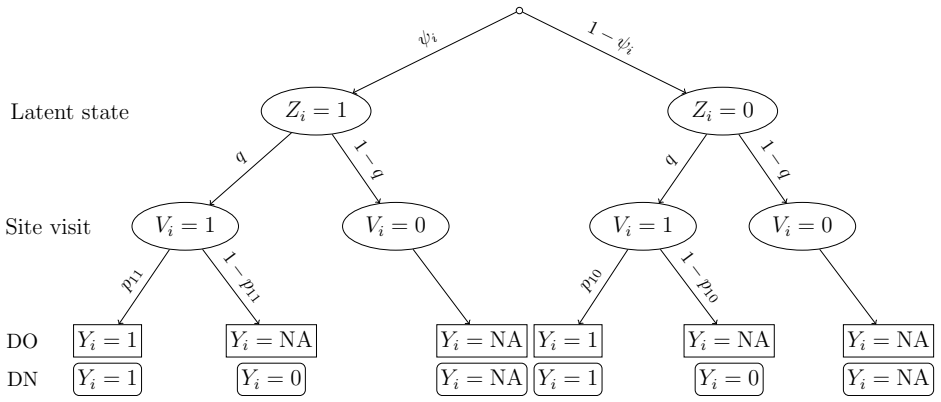
We argue that these are all special cases of a single hierarchical observation process. To make these connections explicit, we introduce a unified terminology centred on two data types: detection/non-detection data with T visits (DN-T) and detection-only data (DO), where DN-T with T>1 corresponds to traditional occupancy modelling, DN-1 to species distribution modelling, and DO to what the literature commonly, but we argue inaccurately, calls presence-only data. Within this framework, we study the identifiability of DO models and propose a novel hierarchical model for DO data that, for the first time, explicitly accounts for both false positive and false negative detection errors. Identifiab
What carries the argument
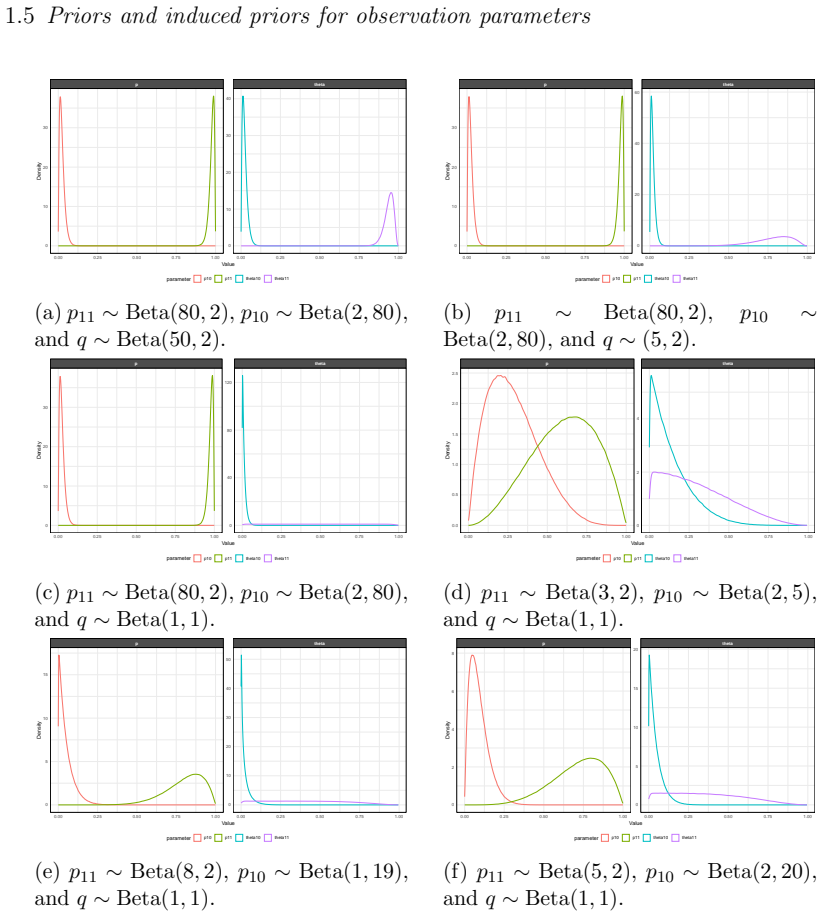
Hierarchical model for DO data with priors on recording probabilities that are higher conditional on true presence than on absence.
If this is right
- Occupancy, species distribution, and presence-only approaches become interchangeable under one observation process.
- Detection-only records can be analyzed while separating false positives from false negatives.
- Species occurrence estimates from imperfect data become usable for conservation without requiring repeated visits.
- The unified terminology allows direct comparison of results across different survey designs.
Where Pith is reading between the lines
- Data sets collected under different protocols could be pooled or compared more directly.
- The strength of the identifying priors may need calibration against known cases to avoid over- or under-correction.
- The same prior structure might extend to multi-species or spatially explicit versions of the model.
Load-bearing premise
The priors that encode higher recording probability where a species is present than absent are sufficient to achieve identifiability.
What would settle it
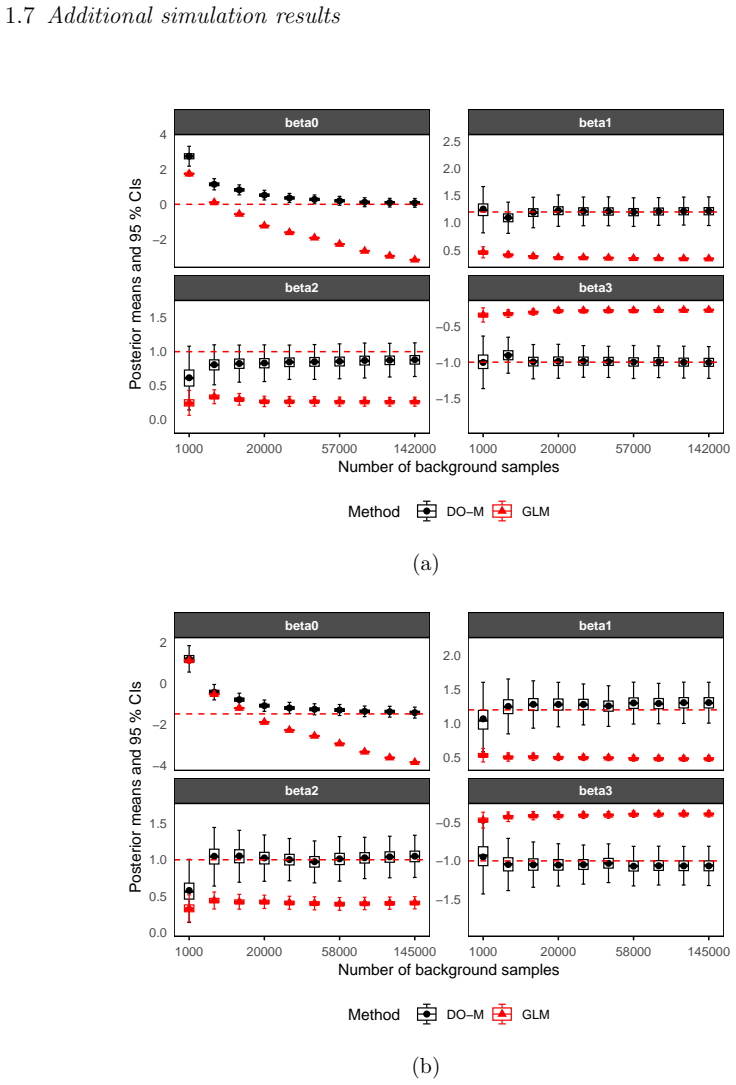
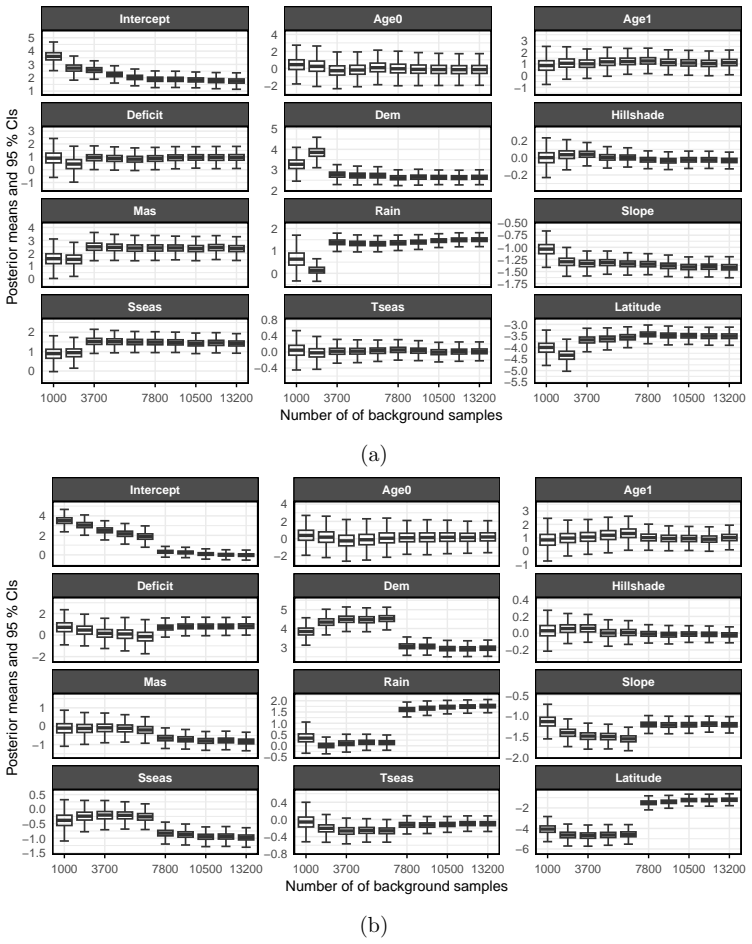
A simulation or field study with known true presence/absence locations where the posterior distributions for occupancy and detection parameters remain non-identifiable or produce biased estimates despite the specified priors.
Figures
read the original abstract
Monitoring species occurrence is essential for understanding biodiversity change, informing conservation decisions, and assessing the impact of environmental pressures on ecosystems. Species occurrence data arise from different survey designs, and the statistical literature has developed distinct corresponding modelling approaches, namely occupancy models, species distribution models, and presence-only methods, whose fundamental connections have remained largely unrecognised. We argue that these are all special cases of a single hierarchical observation process. To make these connections explicit, we introduce a unified terminology centred on two data types: detection/non-detection data with T visits (DN-T) and detection-only data (DO), where DN-T with T>1 corresponds to traditional occupancy modelling, DN-1 to species distribution modelling, and DO to what the literature commonly, but we argue inaccurately, calls presence-only data. Within this framework, we study the identifiability of DO models and propose a novel hierarchical model for DO data that, for the first time, explicitly accounts for both false positive and false negative detection errors. Identifiability is achieved through prior distributions that express the natural belief that a species is more likely to be recorded where it is present than where it is absent. ...
Editorial analysis
A structured set of objections, weighed in public.
Referee Report
Summary. The manuscript unifies occupancy models, species distribution models, and presence-only methods as special cases of a single hierarchical observation process with two data types: detection/non-detection with T visits (DN-T) and detection-only (DO). It proposes a novel hierarchical model for DO data that explicitly accounts for both false-positive and false-negative errors and claims that identifiability is achieved for the first time by placing priors that encode the belief P(record|present) > P(record|absent).
Significance. If the identifiability claim holds with data-driven recovery rather than prior domination, the unification would connect previously separate literatures and enable more reliable use of common DO data for biodiversity monitoring and conservation. The framework itself is a useful conceptual contribution even if the DO model requires further validation.
major comments (2)
- [Abstract] Abstract (and the central claim): the statement that the chosen priors achieve identifiability 'for the first time' is not supported by either an analytic proof that the posterior separates the occurrence probability, true-positive rate, and false-positive rate globally, or by simulation results demonstrating parameter recovery at realistic sample sizes. The DO likelihood depends only on the product of occurrence and detection probabilities minus false-positive contributions, leaving the surface flat along the relevant manifold; priors can regularize but do not automatically supply the missing information.
- [Model description / Results] The manuscript does not appear to contain simulation experiments or analytic derivations that test whether posterior means and credible intervals recover known true values when data are generated from the model; without such evidence the practical utility of the DO model remains unestablished.
minor comments (2)
- [Model] Clarify the exact functional form of the hierarchical likelihood for DO data (including how false positives enter) and state whether any auxiliary assumptions beyond the priors are required.
- [Introduction] The unified terminology (DN-T, DN-1, DO) is helpful but should be accompanied by an explicit mapping table showing how each literature's standard model emerges as a special case.
Simulated Author's Rebuttal
We thank the referee for their constructive and detailed comments, which highlight important aspects of our work on the unified hierarchical framework for species occurrence data. We address each major comment below.
read point-by-point responses
-
Referee: [Abstract] Abstract (and the central claim): the statement that the chosen priors achieve identifiability 'for the first time' is not supported by either an analytic proof that the posterior separates the occurrence probability, true-positive rate, and false-positive rate globally, or by simulation results demonstrating parameter recovery at realistic sample sizes. The DO likelihood depends only on the product of occurrence and detection probabilities minus false-positive contributions, leaving the surface flat along the relevant manifold; priors can regularize but do not automatically supply the missing information.
Authors: We agree that the manuscript does not contain an analytic proof of global identifiability or simulation results demonstrating parameter recovery. The proposed identifiability relies on the informative priors that encode the belief P(record|present) > P(record|absent), which we argue separates the parameters in the posterior by breaking the flat manifold in the likelihood. However, we acknowledge that this requires empirical support to confirm data-driven recovery rather than prior domination. We will revise the abstract to remove or qualify the 'for the first time' phrasing and add simulation studies in the revised manuscript to demonstrate parameter recovery at realistic sample sizes. revision: yes
-
Referee: [Model description / Results] The manuscript does not appear to contain simulation experiments or analytic derivations that test whether posterior means and credible intervals recover known true values when data are generated from the model; without such evidence the practical utility of the DO model remains unestablished.
Authors: We acknowledge the absence of simulation experiments or analytic derivations testing parameter recovery in the current manuscript. To establish the practical utility of the DO model, we will conduct and include simulation studies that generate data from the model and evaluate whether posterior means and credible intervals recover the known true values under various scenarios. These results will be added to the revised version. revision: yes
Circularity Check
No circularity: identifiability claim rests on explicit prior construction rather than reduction to inputs
full rationale
The paper's central step is the introduction of a hierarchical model for DO data whose identifiability is asserted to follow from the choice of priors that encode P(record|present) > P(record|absent). This is a modeling assumption, not a derivation that reduces by construction to fitted parameters or prior self-citations. No equations are shown that equate a 'prediction' to a fitted quantity, and the abstract supplies no self-citation chain that bears the load of the uniqueness claim. The derivation chain therefore remains self-contained against external benchmarks; the Bayesian identifiability statement is a direct consequence of the stated prior family rather than a renaming or smuggling of an earlier result.
Axiom & Free-Parameter Ledger
axioms (2)
- domain assumption Occupancy models, species distribution models, and presence-only methods are all special cases of a single hierarchical observation process.
- ad hoc to paper Prior distributions expressing that a species is more likely recorded where present than absent achieve identifiability for DO models.
Reference graph
Works this paper leans on
-
[1]
2006 , publisher=
Uncertain judgements: eliciting experts' probabilities , author=. 2006 , publisher=
2006
-
[2]
Journal of Computational and Graphical Statistics , year =
Programming with models: writing statistical algorithms for general model structures with. Journal of Computational and Graphical Statistics , year =
-
[3]
Isaac, N. J. B. and van Strien, A. J. and August, T. A. and de Zeeuw, M. P. and Roy, D. B. , title =. Methods in Ecology and Evolution , year =
-
[4]
and Nichols, J
Altwegg, R. and Nichols, J. D. , title =. Methods in Ecology and Evolution , year =
-
[5]
Doser, J. W. and Finley, A. O. and Banerjee, S. , title =. Global Ecology and Biogeography , year =
-
[6]
Ecological Modelling , volume=
Incorporation of latitude-adjusted bioclimatic variables increases accuracy in species distribution models , author=. Ecological Modelling , volume=. 2022 , publisher=
2022
-
[7]
Annals of Botany , volume=
Evolution of genome size in Carex (Cyperaceae) in relation to chromosome number and genomic base composition , author=. Annals of Botany , volume=. 2013 , publisher=
2013
-
[8]
2023 , school =
Changes in the British and Irish flora: the role of genome size , author =. 2023 , school =
2023
-
[9]
and Dirzo, Rodolfo , title =
Ceballos, Gerardo and Ehrlich, Paul R. and Dirzo, Rodolfo , title =. Proceedings of the National Academy of Sciences , year =
-
[10]
IPBES secretariat , volume=
Global assessment report on biodiversity and ecosystem services of the Intergovernmental Science-Policy Platform on Biodiversity and Ecosystem Services , author=. IPBES secretariat , volume=. 2019 , publisher=
2019
-
[11]
, title =
Urban, Mark C. , title =. Science , year =
-
[12]
Miller, David A. W. and Pacifici, Krishna and Sanderlin, Jamie S. and Reich, Brian J. , title =. Methods in Ecology and Evolution , year =
-
[13]
, title =
Neal, Radford M. , title =. Handbook of. 2011 , pages =
2011
-
[14]
, title =
Gelman, Andrew and Rubin, Donald B. , title =. Statistical Science , year =
-
[15]
Trends in ecology & evolution , volume=
Data integration for large-scale models of species distributions , author=. Trends in ecology & evolution , volume=. 2020 , publisher=
2020
-
[16]
Scientific Data , volume=
A taxonomic, genetic and ecological data resource for the vascular plants of Britain and Ireland , author=. Scientific Data , volume=. 2022 , publisher=
2022
-
[17]
Biometrical Journal , volume=
Binary regression with misclassified response and covariate subject to measurement error: a Bayesian approach , author=. Biometrical Journal , volume=. 2008 , publisher=
2008
-
[18]
Biodiversity informatics , volume=
Presence-only and presence-absence data for comparing species distribution modeling methods , author=. Biodiversity informatics , volume=
-
[19]
arXiv preprint arXiv:1912.10981 , year=
Missing data analysis and imputation via latent Gaussian Markov random fields , author=. arXiv preprint arXiv:1912.10981 , year=
arXiv 1912
-
[20]
Ecography , volume=
Novel methods improve prediction of species’ distributions from occurrence data , author=. Ecography , volume=. 2006 , publisher=
2006
-
[21]
Ecological monographs , volume=
Predictive performance of presence-only species distribution models: a benchmark study with reproducible code , author=. Ecological monographs , volume=. 2022 , publisher=
2022
-
[22]
Methods in Ecology and Evolution , volume=
Point process models for presence-only analysis , author=. Methods in Ecology and Evolution , volume=. 2015 , publisher=
2015
-
[23]
Ecological applications , volume=
Sample selection bias and presence-only distribution models: implications for background and pseudo-absence data , author=. Ecological applications , volume=. 2009 , publisher=
2009
-
[24]
Journal of the Royal Statistical Society Series C: Applied Statistics , volume=
Bayesian analysis of measurement error models using integrated nested Laplace approximations , author=. Journal of the Royal Statistical Society Series C: Applied Statistics , volume=. 2015 , publisher=
2015
-
[25]
Biometrics , volume=
Presence-only data and the EM algorithm , author=. Biometrics , volume=. 2009 , publisher=
2009
-
[26]
Methods in Ecology and Evolution , volume=
Local frequency as a key to interpreting species occurrence data when recording effort is not known , author=. Methods in Ecology and Evolution , volume=. 2012 , publisher=
2012
-
[27]
Biodiversity Informatics , year =
Presence-only and presence-absence data for comparing species distribution modeling methods , author =. Biodiversity Informatics , year =
-
[28]
Journal of applied ecology , volume=
Modelling distribution and abundance with presence-only data , author=. Journal of applied ecology , volume=. 2006 , publisher=
2006
-
[29]
Communications in Statistics-Theory and Methods , volume=
Estimating logistic regression models when the dependent variable has no variance , author=. Communications in Statistics-Theory and Methods , volume=. 1992 , publisher=
1992
-
[30]
Ecology , volume=
Weighted distributions and estimation of resource selection probability functions , author=. Ecology , volume=. 2006 , publisher=
2006
-
[31]
Journal of Econometrics , volume=
Case-control studies with contaminated controls , author=. Journal of Econometrics , volume=. 1996 , publisher=
1996
-
[32]
Proceedings of the AAAI Conference on Artificial Intelligence , volume=
Logistic methods for resource selection functions and presence-only species distribution models , author=. Proceedings of the AAAI Conference on Artificial Intelligence , volume=
-
[33]
The annals of applied statistics , volume=
Finite-sample equivalence in statistical models for presence-only data , author=. The annals of applied statistics , volume=
-
[34]
The Annals of Applied Statistics , volume=
Analysis of presence-only data via exact Bayes, with model and effects identification , author=. The Annals of Applied Statistics , volume=. 2022 , publisher=
2022
-
[35]
Proceedings of the twenty-first international conference on Machine learning , pages=
A maximum entropy approach to species distribution modeling , author=. Proceedings of the twenty-first international conference on Machine learning , pages=
-
[36]
Ecography , volume=
Modeling of species distributions with Maxent: new extensions and a comprehensive evaluation , author=. Ecography , volume=. 2008 , publisher=
2008
-
[37]
Methods in ecology and evolution , volume=
Selecting pseudo-absences for species distribution models: How, where and how many? , author=. Methods in ecology and evolution , volume=. 2012 , publisher=
2012
-
[38]
Journal of the Royal Statistical Society Series C: Applied Statistics , volume=
Point pattern modelling for degraded presence-only data over large regions , author=. Journal of the Royal Statistical Society Series C: Applied Statistics , volume=. 2011 , publisher=
2011
-
[39]
Biometrics , volume=
Predicting the geographic distribution of a species from presence-only data subject to detection errors , author=. Biometrics , volume=. 2012 , publisher=
2012
-
[40]
Ecography , volume=
BIOMOD--a platform for ensemble forecasting of species distributions , author=. Ecography , volume=. 2009 , publisher=
2009
-
[41]
Journal of biogeography , volume=
Making better Maxent models of species distributions: complexity, overfitting and evaluation , author=. Journal of biogeography , volume=. 2014 , publisher=
2014
-
[42]
Ecological Modelling , volume=
The influence of the number and distribution of background points in presence-background species distribution models , author=. Ecological Modelling , volume=. 2024 , publisher=
2024
-
[43]
Diversity and Distributions , volume=
A review of evidence about use and performance of species distribution modelling ensembles like BIOMOD , author=. Diversity and Distributions , volume=. 2019 , publisher=
2019
-
[44]
Ecography , volume=
Opening the black box: An open-source release of Maxent , author=. Ecography , volume=. 2017 , publisher=
2017
-
[45]
Global Ecology and Biogeography , volume=
Accounting for imperfect detection and survey bias in statistical analysis of presence-only data , author=. Global Ecology and Biogeography , volume=. 2014 , publisher=
2014
-
[46]
Journal of Agricultural, Biological and Environmental Statistics , volume=
Presence-only for marked point process under preferential sampling , author=. Journal of Agricultural, Biological and Environmental Statistics , volume=. 2024 , publisher=
2024
-
[47]
Ecology , volume=
On estimating probability of presence from use--availability or presence--background data , author=. Ecology , volume=. 2013 , publisher=
2013
-
[48]
2002 , publisher=
Resource selection by animals: statistical design and analysis for field studies , author=. 2002 , publisher=
2002
-
[49]
Ecological modelling , volume=
Maximum entropy modeling of species geographic distributions , author=. Ecological modelling , volume=. 2006 , publisher=
2006
-
[50]
Methods in Ecology and Evolution , volume=
Likelihood analysis of species occurrence probability from presence-only data for modelling species distributions , author=. Methods in Ecology and Evolution , volume=. 2012 , publisher=
2012
-
[51]
Ecography , volume=
Inference from presence-only data; the ongoing controversy , author=. Ecography , volume=. 2013 , publisher=
2013
-
[52]
Journal of econometrics , volume=
Misclassification of the dependent variable in a discrete-response setting , author=. Journal of econometrics , volume=. 1998 , publisher=
1998
-
[53]
Journal of Econometrics , volume=
Misclassification in binary choice models , author=. Journal of Econometrics , volume=. 2017 , publisher=
2017
-
[54]
Ecology , volume=
Generalized site occupancy models allowing for false positive and false negative errors , author=. Ecology , volume=. 2006 , publisher=
2006
-
[55]
Journal of Applied Statistics , volume=
Bayesian estimation of logistic regression with misclassified covariates and response , author=. Journal of Applied Statistics , volume=. 2018 , publisher=
2018
-
[56]
Journal of the Royal Statistical Society Series C: Applied Statistics , volume=
Modelling environmental DNA data; Bayesian variable selection accounting for false positive and false negative errors , author=. Journal of the Royal Statistical Society Series C: Applied Statistics , volume=. 2020 , publisher=
2020
-
[57]
Ecography , volume=
Climate-related range shifts--a global multidimensional synthesis and new research directions , author=. Ecography , volume=. 2015 , publisher=
2015
-
[58]
Environmental Evidence , volume=
Climate change and the global redistribution of biodiversity: substantial variation in empirical support for expected range shifts , author=. Environmental Evidence , volume=. 2023 , publisher=
2023
-
[59]
Global Change Biology , volume=
Species’ traits as predictors of range shifts under contemporary climate change: A review and meta-analysis , author=. Global Change Biology , volume=. 2017 , publisher=
2017
-
[60]
science , volume=
The biodiversity of species and their rates of extinction, distribution, and protection , author=. science , volume=. 2014 , publisher=
2014
-
[61]
Conservation Biology , volume=
A framework for evaluating the impact of the IUCN Red List of threatened species , author=. Conservation Biology , volume=. 2020 , publisher=
2020
-
[62]
PloS one , volume=
The effects of sampling bias and model complexity on the predictive performance of MaxEnt species distribution models , author=. PloS one , volume=. 2013 , publisher=
2013
-
[63]
Methods Ecol Evol 6 (4): 424--438 , author=
Bias correction in species distribution models: pooling survey and collection data for multiple species. Methods Ecol Evol 6 (4): 424--438 , author=
-
[64]
Methods in Ecology and Evolution , volume=
Understanding co-occurrence by modelling species simultaneously with a Joint Species Distribution Model (JSDM) , author=. Methods in Ecology and Evolution , volume=. 2014 , publisher=
2014
-
[65]
2020 , publisher=
Joint species distribution modelling: With applications in R , author=. 2020 , publisher=
2020
-
[66]
Ecology , volume=
Estimating site occupancy rates when detection probabilities are less than one , author=. Ecology , volume=. 2002 , publisher=
2002
-
[67]
2017 , publisher=
Occupancy estimation and modeling: inferring patterns and dynamics of species occurrence , author=. 2017 , publisher=
2017
-
[68]
arXiv preprint arXiv:2501.18106 , year=
Logistic regression models: practical induced prior specification , author=. arXiv preprint arXiv:2501.18106 , year=
-
[69]
2024 , url =
Siegrist, Kyle , title =. 2024 , url =
2024
-
[70]
Communications in Statistics-Simulation and Computation , volume=
The need to conduct repeated classifications in a logistic regression model with misclassification in the dependent variable , author=. Communications in Statistics-Simulation and Computation , volume=. 2021 , publisher=
2021
-
[71]
PeerJ , volume=
Characterisation of false-positive observations in botanical surveys , author=. PeerJ , volume=. 2017 , publisher=
2017
-
[72]
2025 , note =
cmdstanr: R Interface to 'CmdStan' , author =. 2025 , note =
2025
-
[73]
The Annals of Applied Statistics , volume=
Models with observation error and temporary emigration for count data , author=. The Annals of Applied Statistics , volume=. 2024 , publisher=
2024
-
[74]
Ecological Solutions and Evidence , volume=
Predicting detection probabilities to estimate species' population sizes , author=. Ecological Solutions and Evidence , volume=. 2026 , publisher=
2026
-
[75]
Ecological modelling , volume=
Predicting species spatial distributions using presence-only data: a case study of native New Zealand ferns , author=. Ecological modelling , volume=. 2002 , publisher=
2002
-
[76]
Journal of applied ecology , volume=
An improved approach for predicting the distribution of rare and endangered species from occurrence and pseudo-absence data , author=. Journal of applied ecology , volume=. 2004 , publisher=
2004
-
[77]
Ecography , volume=
Effects of restricting environmental range of data to project current and future species distributions , author=. Ecography , volume=. 2004 , publisher=
2004
-
[78]
pseudo-absence problem
Poisson point process models solve the" pseudo-absence problem" for presence-only data in ecology , author=. The Annals of Applied Statistics , pages=. 2010 , publisher=
2010
-
[79]
Biometrics , volume=
Equivalence of MAXENT and Poisson point process models for species distribution modeling in ecology , author=. Biometrics , volume=. 2013 , publisher=
2013
-
[80]
Diversity and distributions , volume=
Predicting species distributions from museum and herbarium records using multiresponse models fitted with multivariate adaptive regression splines , author=. Diversity and distributions , volume=. 2007 , publisher=
2007
discussion (0)
Sign in with ORCID, Apple, or X to comment. Anyone can read and Pith papers without signing in.