Overview of ESDD2: Environment-Aware Speech and Sound Deepfake Detection Challenge
Pith reviewed 2026-06-29 05:17 UTC · model grok-4.3
The pith
Best ESDD2 system reaches Macro-F1 of 0.8775 by decomposing detection into modules and using cross-domain self-supervised encoders.
A machine-rendered reading of the paper's core claim, the machinery that carries it, and where it could break.
Core claim
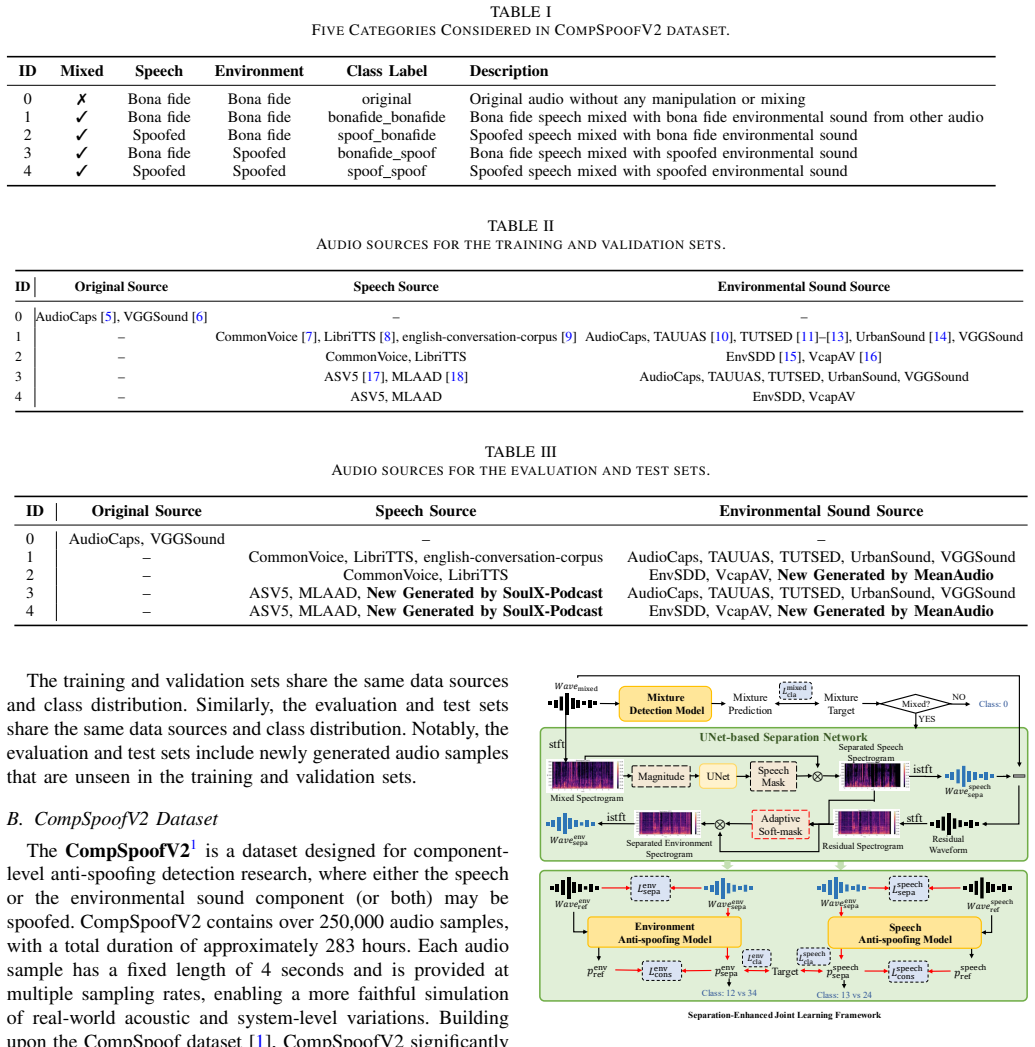
The ESDD2 challenge evaluated systems for five component-level audio spoofing detection tasks in which speech and environmental sounds may be manipulated independently or jointly. On the test set the best system achieved a Macro-F1 score of 0.8775, substantially outperforming the separation-enhanced joint learning baseline of 0.6327. Top submissions consistently benefited from modular task decomposition, cross-domain self-supervised encoders, targeted data augmentation, and selective ensembling rather than simple model scaling. Auxiliary EER analyses reveal persistent difficulty in detecting the spoofed environmental component and in generalizing to unseen generators in the test set.
What carries the argument
The ESDD2 leaderboard together with post-challenge analysis of the thirteen retained submissions, which isolates modular task decomposition and cross-domain self-supervised encoders as the practices that drove the largest gains over the joint-learning baseline.
If this is right
- Modular task decomposition yields larger gains than simply scaling model capacity.
- Cross-domain self-supervised encoders improve robustness when speech and environmental sounds are altered separately.
- Targeted data augmentation and selective ensembling help maintain performance under independent component manipulations.
- Detection of spoofed environmental sounds remains harder than speech detection even for the best systems.
- Generalization to generators never seen during training continues to limit absolute performance.
Where Pith is reading between the lines
- The public CompSpoofV2 dataset now supplies a standardized benchmark against which new modular detectors can be compared directly.
- Deployed systems could adopt the same decomposition strategy to handle mixed speech-plus-environment recordings without retraining the entire pipeline.
- Future challenges might add an explicit track that forces independent manipulation of only the environmental track to isolate remaining weaknesses.
Load-bearing premise
The challenge evaluation assumes that the fixed test set and submitted systems provide a representative measure of real-world generalization, including to unseen generators and the independent manipulation of environmental sound components.
What would settle it
Release of a new test partition containing generators and environmental manipulations absent from the original training and test data on which the top ESDD2 systems drop below 0.7 Macro-F1 would falsify the reported generalization benefit of the modular approaches.
Figures

read the original abstract
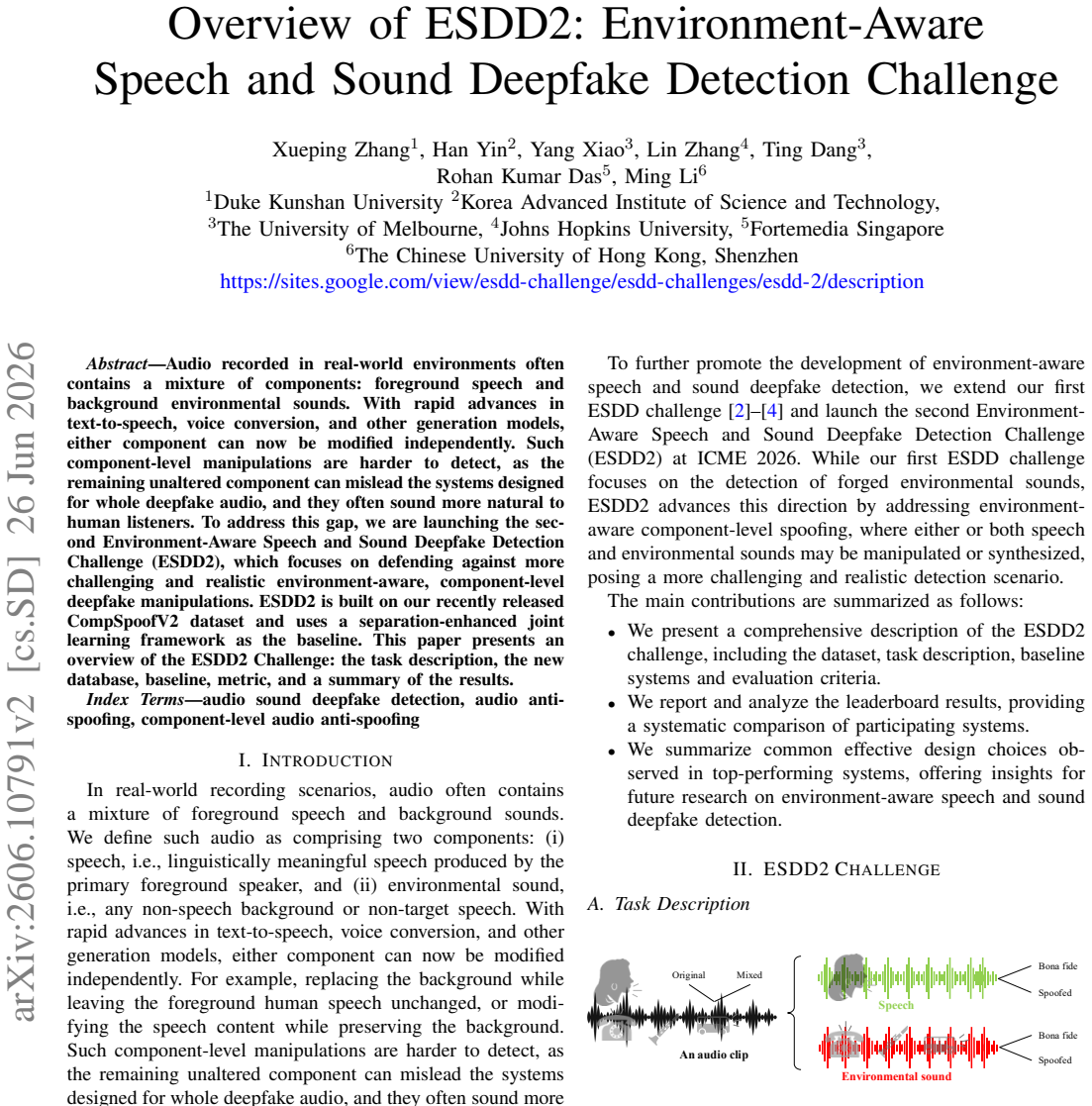
The Environment-Aware Speech and Sound Deepfake Detection Challenge (ESDD2), held in conjunction with ICME 2026, evaluated systems for five component-level audio spoofing detection, where speech and environmental sounds may be manipulated independently or jointly. After the challenge concludes, we analyze the final leaderboard and summarize effective design choices from the top-performing submissions. The challenge attracted 94 registrations from 16 countries; after verification of submission requirements and metadata, 13 teams were retained for the final analysis. On the test set, the best system achieved a Macro-F1 score of 0.8775, substantially outperforming the separation-enhanced joint learning baseline (0.6327). Top systems consistently benefited from modular task decomposition, cross-domain self-supervised encoders, targeted data augmentation, and selective ensembling rather than simple model scaling. At the same time, auxiliary EER analyses reveal persistent difficulty in detecting the spoofed environmental component and in generalizing to unseen generators in the test set. This paper reports challenge results and provides insights for future environment-aware deepfake detection research. The CompSpoofV2 dataset and baseline code remain publicly available for reproducibility.
Editorial analysis
A structured set of objections, weighed in public.
Referee Report
Summary. The manuscript is an overview of the ESDD2 challenge on environment-aware deepfake detection for speech and environmental sounds that may be manipulated independently or jointly. It reports participation (94 registrations, 13 verified teams), leaderboard results on a fixed test set (top Macro-F1 of 0.8775 vs. baseline 0.6327), common design patterns among top submissions (modular decomposition, self-supervised encoders, targeted augmentation, selective ensembling), and persistent weaknesses in detecting spoofed environmental components and generalizing to unseen generators. The CompSpoofV2 dataset and baseline code are released publicly.
Significance. If the reported patterns hold, the work supplies a public benchmark, dataset, and empirical summary of approaches that outperformed a joint-learning baseline in this specific challenge setting, offering concrete starting points for environment-aware audio deepfake research.
major comments (1)
- [Abstract] Abstract: the claim that top systems 'consistently benefited from modular task decomposition, cross-domain self-supervised encoders, targeted data augmentation, and selective ensembling rather than simple model scaling' is presented as an insight for future research, yet rests entirely on performance rankings within one fixed test partition. The manuscript itself notes persistent failure on spoofed environmental components and unseen generators, but provides no cross-generator ablation, held-out generator evaluation, or statistical test demonstrating that the listed strategies produce gains that survive distribution shift. This makes the design-choice summary load-bearing for the paper's utility claim but insufficiently supported.
minor comments (2)
- [Abstract] Abstract: the phrase 'five component-level audio spoofing detection' is used without enumerating or briefly defining the five components, which reduces immediate clarity for readers unfamiliar with the task formulation.
- The manuscript states that the dataset and baseline code 'remain publicly available,' but does not include explicit links, DOIs, or access instructions in the provided text; adding these would improve reproducibility.
Simulated Author's Rebuttal
Thank you for the review. We address the concern about evidentiary support for the design-pattern claims below and will revise the manuscript accordingly.
read point-by-point responses
-
Referee: [Abstract] Abstract: the claim that top systems 'consistently benefited from modular task decomposition, cross-domain self-supervised encoders, targeted data augmentation, and selective ensembling rather than simple model scaling' is presented as an insight for future research, yet rests entirely on performance rankings within one fixed test partition. The manuscript itself notes persistent failure on spoofed environmental components and unseen generators, but provides no cross-generator ablation, held-out generator evaluation, or statistical test demonstrating that the listed strategies produce gains that survive distribution shift. This makes the design-choice summary load-bearing for the paper's utility claim but insufficiently supported.
Authors: We agree that the observed patterns are correlational, based on post-challenge analysis of the 13 verified submissions and their scores on the single fixed test partition; no per-team ablations, cross-generator experiments, or statistical significance tests were conducted. The manuscript already flags the persistent weaknesses on environmental spoofing and unseen generators. We will revise the abstract and discussion to describe the strategies as 'patterns associated with the highest scores in this challenge' rather than claiming they 'consistently benefited,' and will add an explicit limitations paragraph noting the absence of controlled ablation evidence. This change will be incorporated in the revised version. revision: yes
Circularity Check
No circularity: empirical challenge overview with no derivations or self-referential reductions
full rationale
This paper is an overview of a detection challenge that reports leaderboard Macro-F1 scores (0.8775 vs. 0.6327), observed patterns from 13 external submissions, and auxiliary EER analyses on a fixed test set. No mathematical derivations, parameter fittings presented as predictions, uniqueness theorems, or ansatzes appear. Central claims rest on external team submissions and public dataset release rather than any reduction to the authors' prior fitted values or self-citations. The analysis is self-contained against the challenge data; concerns about generalization to unseen generators belong to validity, not circularity.
Axiom & Free-Parameter Ledger
Reference graph
Works this paper leans on
-
[1]
Compspoof: A dataset and joint learning framework for component- level audio anti-spoofing countermeasures,
Xueping Zhang, Yechen Wang, Linxi Li, Liwei Jin, and Ming Li, “Compspoof: A dataset and joint learning framework for component- level audio anti-spoofing countermeasures,” inIEEE International Conference on Acoustics, Speech and Signal Processing (ICASSP), 2026, pp. 18067–18071
2026
-
[2]
Environmental sound deepfake detection challenge: An overview,
Han Yin, Yang Xiao, Rohan Kumar Das, Jisheng Bai, and Ting Dang, “Environmental sound deepfake detection challenge: An overview,” inIEEE International Conference on Acoustics, Speech and Signal Processing (ICASSP), 2026, pp. 21772–21774
2026
-
[3]
Esdd 2026: Environmental sound deepfake detection challenge evalu- ation plan,
Han Yin, Yang Xiao, Rohan Kumar Das, Jisheng Bai, and Ting Dang, “Esdd 2026: Environmental sound deepfake detection challenge evalu- ation plan,”arXiv preprint arXiv:2508.04529, 2025
-
[4]
Han Yin, Yang Xiao, Rohan Kumar Das, Jisheng Bai, and Ting Dang, “The first environmental sound deepfake detection challenge: Benchmarking robustness, evaluation, and insights,”arXiv preprint arXiv:2603.04865, 2026
work page internal anchor Pith review Pith/arXiv arXiv 2026
-
[5]
Audiocaps: Generating captions for audios in the wild,
Chris Dongjoo Kim, Byeongchang Kim, Hyunmin Lee, and Gunhee Kim, “Audiocaps: Generating captions for audios in the wild,” in The North American Chapter of the Association for Computational Linguistics: Human Language Technologies, Volume 1 (Long and Short Papers), 2019, pp. 119–132
2019
-
[6]
Vggsound: A large-scale audio-visual dataset,
Honglie Chen, Weidi Xie, Andrea Vedaldi, and Andrew Zisserman, “Vggsound: A large-scale audio-visual dataset,” inIEEE International Conference on Acoustics, Speech and Signal Processing (ICASSP), 2020, pp. 721–725
2020
-
[7]
Common voice: A massively-multilingual speech corpus,
Rosana Ardila, Megan Branson, Kelly Davis, Michael Kohler, Josh Meyer, Michael Henretty, Reuben Morais, Lindsay Saunders, Francis Tyers, and Gregor Weber, “Common voice: A massively-multilingual speech corpus,” inLanguage Resources and Evaluation Conference, 2020, pp. 4218–4222
2020
-
[8]
Libritts: A corpus derived from librispeech for text-to-speech,
Heiga Zen, Viet Dang, Rob Clark, Yu Zhang, Ron J Weiss, Ye Jia, Zhifeng Chen, and Yonghui Wu, “Libritts: A corpus derived from librispeech for text-to-speech,” inInterspeech, 2019, pp. 1526–1530
2019
-
[9]
Enhancing Speaking Styles in Conversational Text-to- Speech Synthesis with Graph-Based Multi-Modal Context Modeling,
Jingbei Li, Yi Meng, Chenyi Li, Zhiyong Wu, Helen Meng, Chao Weng, and Dan Su, “Enhancing Speaking Styles in Conversational Text-to- Speech Synthesis with Graph-Based Multi-Modal Context Modeling,” inIEEE International Conference on Acoustics, Speech and Signal Processing (ICASSP), 2022, pp. 7917–7921
2022
-
[10]
TAU urban acoustic scenes 2019 open set, development dataset,
Toni Heittola, Annamaria Mesaros, and Tuomas Virtanen, “TAU urban acoustic scenes 2019 open set, development dataset,” 2019. 2https://ofspectrum.com/
2019
-
[11]
Tut database for acoustic scene classification and sound event detection,
Annamaria Mesaros, Toni Heittola, and Tuomas Virtanen, “Tut database for acoustic scene classification and sound event detection,” inEuropean Signal Processing Conference (EUSIPCO), 2016, pp. 1128–1132
2016
-
[12]
Tut sound events 2017, development dataset,
Annamaria Mesaros, Toni Heittola, and Tuomas Virtanen, “Tut sound events 2017, development dataset,” 2017
2017
-
[13]
Tut sound events 2017, evaluation dataset,
Annamaria Mesaros, Toni Heittola, and Tuomas Virtanen, “Tut sound events 2017, evaluation dataset,” 2017
2017
-
[14]
A dataset and taxonomy for urban sound research,
Justin Salamon, Christopher Jacoby, and Juan Pablo Bello, “A dataset and taxonomy for urban sound research,” inACM International Conference on Multimedia (ACM MM), 2014, pp. 1041–1044
2014
-
[15]
Envsdd: Benchmarking environ- mental sound deepfake detection,
Han Yin, Yang Xiao, Rohan Kumar Das, Jisheng Bai, Haohe Liu, Wenwu Wang, and Mark D Plumbley, “Envsdd: Benchmarking environ- mental sound deepfake detection,” inInterspeech, 2025, pp. 201–205
2025
-
[16]
VCapA V: A Video-Caption Based Audio-Visual Deepfake Detection Dataset,
Yuxi Wang, Yikang Wang, Qishan Zhang, Hiromitsu Nishizaki, and Ming Li, “VCapA V: A Video-Caption Based Audio-Visual Deepfake Detection Dataset,” inInterspeech, 2025, pp. 3908–3912
2025
-
[17]
Asvspoof 5: crowdsourced speech data, deepfakes, and adversarial attacks at scale,
Xin Wang, H ´ector Delgado, Hemlata Tak, Jee-weon Jung, Hye-jin Shim, Massimiliano Todisco, Ivan Kukanov, Xuechen Liu, Md Sahidullah, Tomi H Kinnunen, et al., “Asvspoof 5: crowdsourced speech data, deepfakes, and adversarial attacks at scale,” inASVspoof, 2024, pp. 1–8
2024
-
[18]
Mlaad: The multi-language audio anti-spoofing dataset,
Nicolas M M ¨uller, Piotr Kawa, Wei Herng Choong, Edresson Casanova, Eren G ¨olge, Thorsten M ¨uller, Piotr Syga, Philip Sperl, and Konstantin B¨ottinger, “Mlaad: The multi-language audio anti-spoofing dataset,” in The International Joint Conference on Neural Networks (IJCNN), 2024, pp. 1–7
2024
-
[19]
Deepfake Audio Detection Using Self-supervised Fusion Representations
Khalid Zaman, Qixuan Huang, Muhammad Uzair, and Masashi Unoki, “Deepfake audio detection using self-supervised fusion representations,” arXiv preprint arXiv:2605.03420, 2026
work page internal anchor Pith review Pith/arXiv arXiv 2026
-
[20]
Xls-r: Self-supervised cross-lingual speech representation learning at scale,
Arun Babu, Changhan Wang, Andros Tjandra, Kushal Lakhotia, Qiantong Xu, Naman Goyal, Kritika Singh, Patrick von Platen, Yatharth Saraf, Juan Pino, et al., “Xls-r: Self-supervised cross-lingual speech representation learning at scale,” inInterspeech, 2022, pp. 2278–2282
2022
-
[21]
Eat: self-supervised pre-training with efficient audio transformer,
Wenxi Chen, Yuzhe Liang, Ziyang Ma, Zhisheng Zheng, and Xie Chen, “Eat: self-supervised pre-training with efficient audio transformer,” in The International Joint Conference on Artificial Intelligence (IJCAI), 2024, pp. 3807–3815
2024
-
[22]
Sslam: Enhancing self-supervised models with audio mixtures for polyphonic soundscapes,
Tony Alex, Sara Atito Ali Ahmed, Armin Mustafa, Muhammad Awais, and Philip JB Jackson, “Sslam: Enhancing self-supervised models with audio mixtures for polyphonic soundscapes,” inThe International Conference on Learning Representations-Proceedings (ICLR), 2025, vol. 2025, pp. 22608–22626
2025
-
[23]
Scaling up masked audio encoder learning for general audio classification,
Heinrich Dinkel, Zhiyong Yan, Yongqing Wang, Junbo Zhang, Yujun Wang, and Bin Wang, “Scaling up masked audio encoder learning for general audio classification,” inInterspeech, 2024, pp. 547–551
2024
-
[24]
Do compact ssl backbones matter for audio deepfake detection? a controlled study with raptor,
Ajinkya Kulkarni, Sandipana Dowerah, Atharva Kulkarni, Tanel Alum¨ae, and Mathew Magimai Doss, “Do compact ssl backbones matter for audio deepfake detection? a controlled study with raptor,”arXiv preprint arXiv:2603.06164, 2026
-
[25]
Xlsr-mamba: A dual-column bidirectional state space model for spoofing attack detection,
Yang Xiao and Rohan Kumar Das, “Xlsr-mamba: A dual-column bidirectional state space model for spoofing attack detection,” inIEEE Signal Processing Letters, 2025, vol. 32, pp. 1276–1280
2025
-
[26]
Audio deepfake detection with self-supervised xls-r and sls classifier,
Qishan Zhang, Shuangbing Wen, and Tao Hu, “Audio deepfake detection with self-supervised xls-r and sls classifier,” inACM International Conference on Multimedia (ACM MM), 2024, pp. 6765–6773
2024
-
[27]
Temporal-channel modeling in multi-head self-attention for synthetic speech detection,
Duc-Tuan Truong, Ruijie Tao, Tuan Nguyen, Hieu-Thi Luong, Kong Aik Lee, and Eng Siong Chng, “Temporal-channel modeling in multi-head self-attention for synthetic speech detection,” inInterspeech, 2024, pp. 537–541
2024
-
[28]
Rawboost: A raw data boosting and augmentation method applied to automatic speaker verification anti-spoofing,
Hemlata Tak, Madhu Kamble, Jose Patino, Massimiliano Todisco, and Nicholas Evans, “Rawboost: A raw data boosting and augmentation method applied to automatic speaker verification anti-spoofing,” inIEEE International Conference on Acoustics, Speech and Signal Processing (ICASSP), 2022, pp. 6382–6386
2022
discussion (0)
Sign in with ORCID, Apple, or X to comment. Anyone can read and Pith papers without signing in.