REVIEW 2 major objections 4 minor 17 references
Heegaard Floer theory and pseudo-Anosov flows II: Differential and Fried pants
T0 review · 2 major / 4 minor · reviewed 2026-08-07 · deepseek-v4-flash
Pith's one-line read Every sleek multi-orbit of a pseudo-Anosov flow contributes exactly one dimension to sutured Floer homology, and for suspension flows the next-to-top grading counts least-period periodic points.
desk verdict Solid sequel: new rs-grading and dimension count for sleek summands, but hinges on imported Proposition 3.3 from the companion paper. read the letter →
The pith
A machine-rendered reading of the paper's core claim, the machinery that carries it, and where it could break.
The reading
What carries the argument
The central object is the rs-grading, defined from a multi-valued lift $\mathrm{r}\varepsilon$ of the $\varepsilon$-map: a generator $x$ maps to the homology classes of all possible strums of its multi-loop $\mu_x$ in the augmented dual graph, and two generators are rs-equivalent when these sets overlap, with the relation transitively closed. This grading works because, in the canonical veering Heegaard diagram, every effective domain is embedded with alternating $\alpha/\beta$ boundary, so the $\beta$-boundary decomposes into paths whose homology classes force a common strum. The second carrying device is the dynamic annulus or Möbius band $D(\gamma)$ associated to a sleek orbit $\gamma$, together with its maximal core $C$; on $C$ one defines the combinatorial complex $CC(C)$ generated by loops representing the orbit and equipped with a differential counting single strums across red sectors forward and blue sectors backward. The proof of Theorem 1.7 identifies the Floer subcomplex with $CC(C)$, then runs an induction over cores, reducing to a single loop with trivial homology.
What would settle it
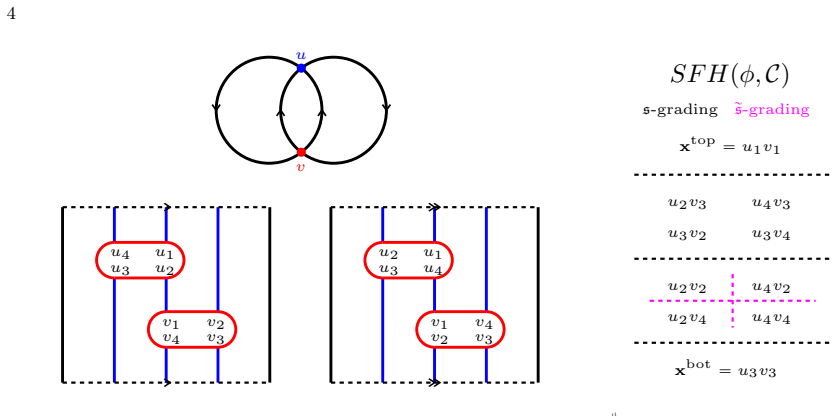
Compute, for a small canonical diagram such as the figure-eight knot complement whose 10 Heegaard states are explicitly listed, all effective domains between generators: a single effective domain connecting two generators whose sets of strum homology classes are disjoint would refute Lemma 1.3, and a sleek summand whose homology has dimension different from 1 would refute Theorem 1.7.
Extended reading notes
Core claim
On the paper's own terms, the central claim is Theorem 1.7: for any sleek multi-orbit $\gamma$ of the blown-up flow $\phi^\#$, the corresponding summand $\mathrm{SF}\,C(\phi,\mathcal{C},\gamma)$ has homology $H_*(\mathrm{SF}\,C(\phi,\mathcal{C},\gamma)) \cong \mathbb{F}$. The rs-grading is a genuine refinement of the $\mathrm{spin}^c$-grading, and each rs-class for a sleek orbit is generated exactly by the Heegaard states whose multi-loop represents that orbit. The proof identifies this summand with a combinatorial chain complex $CC(C)$ on a maximal core of the dynamic annulus or Möbius band of $\gamma$, whose differential counts single strums across red and blue sectors; an induction on cores shows every such complex has one-dimensional homology. Theorem 1.8 transfers this to suspension flows: for the blown-up monodromy $f^\#$ with least period $P$, one has $\dim \mathrm{SF}\,H(Y^\#, n) = \frac{1}{n} \cdot \#\{\text{period-}n\text{ periodic points of } f^\#\}$ whenever $n$ lies between $P$ and $2P-1$, and symmetrically near the top grading, which makes the next-to-top grading count periodic points of least period.
Load-bearing premise
The argument rests on Proposition 3.3 imported from the companion paper: in this specially constructed Heegaard diagram every effective domain has all multiplicities 0 or 1, its boundary alternates between $\alpha$- and $\beta$-arcs, and no $\alpha$- or $\beta$-arc contains a point of the top generator; if a domain with higher multiplicity or non-alternating boundary existed, the common-strum obstruction and the description of the differential would both need to be modified.
Editorial extensions
If this is right
- The sutured Heegaard Floer chain complex decomposes into rs-graded summands, and no differential term can join generators with different rs-gradings, so the $\mathrm{spin}^c$-graded blocks split further in a way read off from the veering branched surface.
- Every pants-irreducible multi-orbit is sleek, so each such orbit contributes at least one dimension to $\mathrm{SF}\,H(Y^\#)$; in particular, $\dim \mathrm{SF}\,H(Y^\#) \geq \#\{\text{pants-irreducible multi-orbits of } \phi^\#\}$.
- For a suspension pseudo-Anosov flow, $\dim \mathrm{SF}\,H(Y^\#, n) = \frac{1}{n}\cdot\#\{\text{period-}n\text{ periodic points of } f^\#\}$ for $n = P, \ldots, 2P-1$ and for the symmetric top interval $n = \frac{3e}{2}-(2P-1), \ldots, \frac{3e}{2}-P$; the next-to-top nonzero grading counts least-period periodic points, and the second-to-top grading counts fixed points.
- For fibered hyperbolic knots satisfying the stated monodromy and degeneracy-slope hypotheses, the knot Floer homology dimension in grading $g-1$ equals the number of interior fixed points of the monodromy plus $4g-1$, recovering known knot Floer counts.
Reading between the lines
- If the common-strum obstruction behind Lemma 1.3 is as strong as claimed, then the same criterion should govern effective domains in any Heegaard diagram arising from a veering branched surface; testing it on veering triangulations beyond the examples treated here would be a cheap, direct check of the method.
- The one-dimensional sleek summands suggest a direct categorification of the zeta function: 'long' or tangled multi-orbits would cancel in pairs under strumming, so the homology keeps one generator per sleek orbit; a formal spectral-sequence proof of that cancellation would connect the present complex to a Novikov-ring complex counting all multi-orbits.
- For Anosov flows that are not suspensions, the same sleek-summand counting should give lower bounds on sutured Floer homology in terms of pants-irreducible orbits, potentially certifying nonzero Floer classes from flow data alone.
Editorial analysis
A structured set of objections, weighed in public.
Referee Report
Summary. The paper studies the differential of the sutured Heegaard Floer chain complex associated to a veering branched surface of a pseudo-Anosov flow. It introduces a multi-valued lift rε of the Ozsváth-Szabó ε-map, defines a refined rs-grading, and proves that an effective domain connecting two states forces their rε-sets to intersect (Lemma 3.4). It then associates to each sleek multi-orbit a combinatorial chain complex CC(C) whose differential is given by strumming, proves that H(CC(C)) ≅ F, and identifies the sleek summand SF C(φ,C,rs) with CC(C) (Proposition 6.5), yielding Theorem 1.7. Applications to suspension flows and fibered knots are then derived, including counting statements in the spirit of Ni and Ghiggini-Spano.
Significance. The main theorems, if correct, would be a substantial bridge between sutured Floer homology and the periodic orbit structure of pseudo-Anosov flows, giving an explicit combinatorial model for certain summands of the Floer chain complex. The inductive proof that H(CC(C)) ≅ F is explicit and largely checkable from the text, and the identification of the differential with strumming in Proposition 6.5 is a valuable structural statement. However, the advertised counting applications currently contain a mismatch between the stated formula and its use, and the main results depend heavily on a structural proposition imported from the companion paper [AT25].
major comments (2)
- [Section 1.4, Theorem 1.8; Section 7.2, proof of Corollary 1.9] The statement of Theorem 1.8 is internally inconsistent. The displayed formula asserts that for n in the top range, dim SF H(Y#, n) = (1/n)·(# periodic points of f# of period n). In the setting of Corollary 1.9, f# is obtained by blowing up a pseudo-Anosov map at a fixed singular point, so the least period is P = 1, e = 4g−2, and the top range reduces to the single value n = 3e/2 − 1 = 6g−4. The formula therefore says that dim SF H(Y7, 6g−4) equals (1/(6g−4)) times the number of period-(6g−4) points, not the number of fixed points. Nevertheless, the proof of Corollary 1.9 invokes Theorem 1.8 to conclude dim SF H(Y7, 6g−4) = # fixed points of f#. These two statements cannot both be correct. The final sentence of Theorem 1.8, saying that the next-to-top nonzero grading counts periodic points of the least period, appears to conflate the grading n with the period P, and the same conflation is carried into the proof of Corollary 1.9. The theorem and corollary need to be corrected so that the counting claim follows from the stated formula.
- [Sections 3.4 and 6.2 (Lemma 3.4 and Proposition 6.5)] Lemma 3.4 and Proposition 6.5 are load-bearing for Theorems 1.7 and 1.8, and both rely on Proposition 3.3, which is imported from [AT25, Propositions 5.9, 5.13, 5.15] and not proved here. Clause (1) of Proposition 3.3 is used in Lemma 3.4 to decompose ∂βD into simple arcs; clause (3) is used to write each such arc as a difference of directed paths from xbot; and clause (2) controls the boundary pattern in the proof of Proposition 6.5. If any effective domain with multiplicities, non-alternating boundary, or an α/β-arc through x_top existed, the rs-grading would not be a genuine obstruction and the strumming differential could miss terms. Because the companion proof is not included, the central results are conditional on an external structural input. I recommend stating this dependence explicitly in the statements of Theorems 1.7 and 1.8 and, if [AT25] is not yet available in published form, providing a proof or a detailed sketch of the three clauses of Proposition 3.3.
minor comments (4)
- [Section 7.2, proof of Corollary 1.9] The phrase '4 longitudinal sutures' appears to be a typo for '2 longitudinal sutures'; with four sutures per solid torus the suture counts in the decomposition do not add up to 8g−4, while with two sutures they do, matching the two generators z_top and z_bot used later.
- [Section 6.2, proof of Proposition 6.5] The proof cites 'Theorem 2.15' for the Lipshitz index computation; the correct references are Definition 2.15 and Theorem 2.16.
- [Section 7.1, Corollary 7.2] The statement 'dim SF H(Q) ≥ 2N+1' should presumably be 'dim SF H(Q) ≥ 2^{N+1}', since 2^N multi-loops are formed from the N eastward branch loops.
- [Section 4.2, Definition 4.9] There is a typo in the resolution relation: 'γ˝∪{G}' should be 'γ˝∪{γ+}' (or the analogous object).
Circularity Check
No circularity: the refined grading and chain-complex identification are proved from structural lemmas rather than assumed.
full rationale
The paper's central claim (Theorem 1.7) is not equivalent to any input by construction. The rs-grading is defined through a multi-valued homology lift of the Ozsváth–Szabó ε-map, independently of the differential, and Lemma 3.4 proves that any effective domain forces a common strum. The combinatorial complex CC(C) has its own differential given by strumming across red/blue sectors, and Proposition 6.5 identifies it with the Floer differential by a direct computation of effective domains and their Lipshitz indices, not by declaring the two complexes equal. The induction over cores, reducing to the trivial one-orbit base case, is substantive. The suspension-flow application counts rs-gradings against periodic orbits using the established bijection F, rather than renaming a known count. The only external dependence is on Proposition 3.3, imported from the authors' companion paper [AT25]; this is a normal sequel dependency on a stated structural lemma about effective domains, and it does not smuggle in the theorem being proved. No fitted parameters or tautological redefinitions appear.
Assumptions & free parameters
assumptions (5)
- domain assumption Theorem 2.7: for a pseudo-Anosov flow with no perfect fits relative to C (containing singular orbits), there is a veering branched surface B and a bijection F from sweep-equivalence classes of loops in G+ to closed orbits of φ#.
- domain assumption Proposition 3.3: every effective domain in the canonical veering Heegaard diagram is embedded, has alternating α/β boundary, and has boundary arcs avoiding x_top.
- domain assumption Theorem 2.18: an empty 2n-gon has exactly one holomorphic representative, so its contribution to the differential coefficient is 1.
- standard math Standard sutured Heegaard Floer theory: the chain complex is well-defined, invariant, and splits along spinc-structures after admissible diagrams.
- domain assumption The no-perfect-fits hypothesis and nonempty C containing singular orbits are satisfied whenever the framework is applied, including suspension flows with C containing singular orbits.
Cite this review
Pith. "Pith review of Heegaard Floer theory and pseudo-Anosov flows II: Differential and Fried pants." pith.science (2026). https://pith.science/paper/JDRV72T2
@misc{pith2026250607163,
  author       = {Pith},
  title        = {Pith review of: Heegaard Floer theory and pseudo-Anosov flows II: Differential and Fried pants},
  year         = {2026},
  howpublished = {\url{https://pith.science/paper/JDRV72T2}},
  note         = {Machine review of arXiv:2506.07163}
}
abstract
In earlier work, relying on work of Agol-Gu\'eritaud and Landry-Minsky-Taylor, we showed that given a pseudo-Anosov flow $(Y,\phi)$ and a collection of closed orbits $\mathcal{C}$ satisfying the `no perfect fit' condition, one can construct a special Heegaard diagram for the link complement $Y^\sharp= Y \setminus \nu (\mathcal{C})$ framed by the degeneracy curves. In this paper, we demonstrate how the special combinatorics of this diagram can be used to understand the differential of the associated Heegaard Floer chain complex. More specifically, we introduce a refinement of the $\text{spin}^\text{c}$-grading obstructing two Heegaard states from being connected by an effective domain. We describe explicitly the subcomplexes in the refined gradings that represent irreducible multi-orbits, in the sense that they contain states corresponding to multi-orbits which cannot be resolved along Fried pants. In particular we show that the homology of these subcomplexes are 1-dimensional. When specialized to the case of suspension flows our arguments prove some results in the spirit of Ni, Ghiggini, and Spano: the next-to-top non-zero sutured Floer group counts the number of periodic points of least period.
Figures


Figures from the paper (19 more)




Reference graph
Works this paper leans on
-
[1]
Antonio Alfieri and Chi Cheuk Tsang. Heegaard F loer theory and pseudo- A nosov flows I : Generators and categorification of the zeta function, 2025
work page 2025
-
[2]
Quasigeodesic flows in hyperbolic 3-manifolds
S\' e rgio Fenley and Lee Mosher. Quasigeodesic flows in hyperbolic 3-manifolds. Topology , 40(3):503--537, 2001
work page 2001
-
[3]
Transitive A nosov flows and pseudo- A nosov maps
David Fried. Transitive A nosov flows and pseudo- A nosov maps. Topology , 22(3):299--303, 1983
1983
-
[4]
Knot F loer homology of fibred knots and F loer homology of surface diffeomorphisms, 2022
Paolo Ghiggini and Gilberto Spano. Knot F loer homology of fibred knots and F loer homology of surface diffeomorphisms, 2022
work page 2022
-
[5]
Holomorphic discs and sutured manifolds
Andr\' a s Juh\' a sz. Holomorphic discs and sutured manifolds. Algebr. Geom. Topol. , 6:1429--1457, 2006
2006
-
[6]
Floer homology and surface decompositions
Andr\' a s Juh\' a sz. Floer homology and surface decompositions. Geom. Topol. , 12(1):299--350, 2008
work page 2008
-
[7]
The sutured F loer homology polytope
Andr\' a s Juh\' a sz. The sutured F loer homology polytope. Geom. Topol. , 14(3):1303--1354, 2010
2010
-
[8]
A cylindrical reformulation of H eegaard F loer homology
Robert Lipshitz. A cylindrical reformulation of H eegaard F loer homology. Geom. Topol. , 10:955--1096, 2006. [Paging previously given as 955--1097]
2006
Show all 17 references
-
[9]
Landry, Yair N
Michael P. Landry, Yair N. Minsky, and Samuel J. Taylor. Flows, growth rates, and the veering polynomial. Ergodic Theory Dynam. Systems , 43(9):3026--3107, 2023
2023
-
[10]
Knot F loer homology and fixed points, 2022
Yi Ni. Knot F loer homology and fixed points, 2022
2022
-
[11]
Holomorphic disks and topological invariants for closed three-manifolds
Peter Ozsv\' a th and Zolt\' a n Szab\' o . Holomorphic disks and topological invariants for closed three-manifolds. Ann. of Math. (2) , 159(3):1027--1158, 2004
2004
-
[12]
Ozsváth, András I
Peter S. Ozsváth, András I. Stipsicz, and Zoltán Szabó. Heegaard F loer homology. In preparation
-
[13]
Stipsicz, and Zolt\' a n Szab\' o
Peter Ozsv\' a th, Andr\' a s I. Stipsicz, and Zolt\' a n Szab\' o . Combinatorial H eegaard F loer homology and nice H eegaard diagrams. Adv. Math. , 231(1):102--171, 2012
2012
-
[14]
From veering triangulations to link spaces and back again, 2019
Saul Schleimer and Henry Segerman. From veering triangulations to link spaces and back again, 2019
2019
-
[15]
An algorithm for computing some H eegaard F loer homologies
Sucharit Sarkar and Jiajun Wang. An algorithm for computing some H eegaard F loer homologies. Ann. of Math. (2) , 171(2):1213--1236, 2010
2010
-
[16]
Veering Triangulations and Pseudo- A nosov Flows
Chi Cheuk Tsang. Veering Triangulations and Pseudo- A nosov Flows . PhD thesis, 2023
2023
-
[17]
Anosov flows and the pair of pants differential
Jonathan Zung. Anosov flows and the pair of pants differential. In preparation
Reviewed August 7, 2026 · model on record in the stance chip above.
Discussion (0). Continue with ORCID to comment.