REVIEW 3 major objections 5 minor 135 references
Where is AIED Headed? Key Topics and Emerging Frontiers (2020-2024)
T0 review · 3 major / 5 minor · reviewed 2026-08-06 · deepseek-v4-flash
Pith's one-line read Tracking four years of keyword networks maps where AI in education is heading, naming four emerging frontiers: large language models, generative AI, multimodal learning analytics, and human-AI collaboration.
desk verdict Solid descriptive mapping of AIED 2020-2024 whose four frontiers are plausible but whose top-20 cutoff needs a sensitivity check before the headline list is taken as robust. read the letter →
The pith
A machine-rendered reading of the paper's core claim, the machinery that carries it, and where it could break.
The reading
What carries the argument
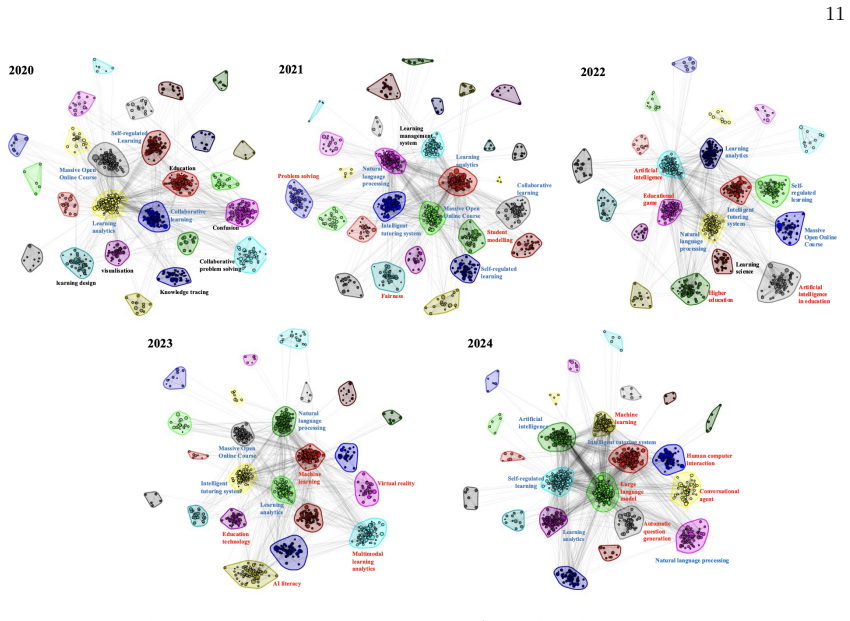
The central object is the keyword co-occurrence network (KCN): a weighted graph whose nodes are author-keywords and whose edges count how often two keywords appear in the same article. The argument is carried by two network measures: modularity-based clustering, which groups keywords into knowledge clusters at the meso level, and weighted betweenness centrality, which identifies bridging keywords at the micro level. Keywords that newly enter the top-20 betweenness list in a given year are treated as emerging frontiers.
What would settle it
Re-run the same analysis with a different defensible venue set (for example, adding journals such as Computers & Education or British Journal of Educational Technology, or removing one of the eight) or with a different cutoff (top-10, top-30) and check whether the same four frontiers appear; if the frontier list changes materially, the identification of emergent topics is not robust to corpus or threshold choice.
Extended reading notes
Core claim
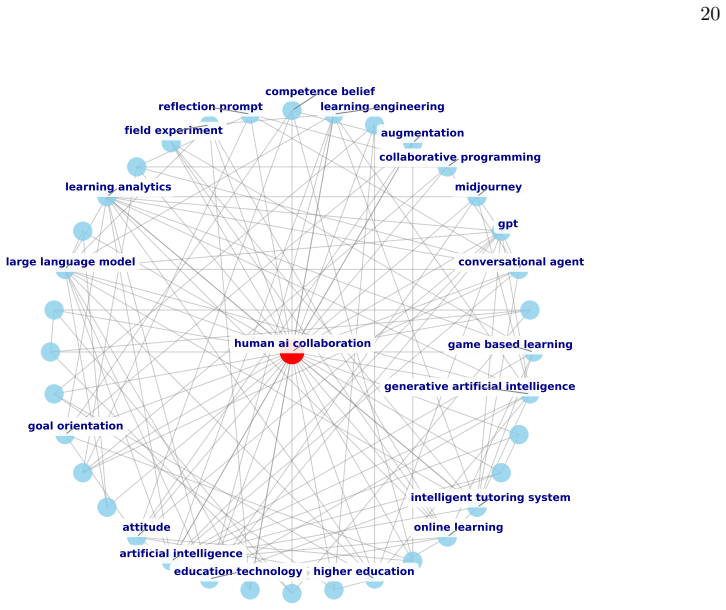
The central claim is that, between 2020 and 2024, the AIED field's most dynamically growing and structurally central topics are large language models (LLMs), generative artificial intelligence (GenAI), multimodal learning analytics (MMLA), and human-AI collaboration. This is established by tracking keywords that first appear in the top-20 weighted betweenness centrality list of each year's keyword co-occurrence network: high betweenness means a keyword acts as a bridge between otherwise separate research clusters. The paper also finds that the field's sustained core topics remain intelligent tutoring systems, learning analytics, natural language processing, and MOOCs, and that current GenAI interest clusters around personalization, self-regulated learning, feedback, assessment, motivation, and ethics.
Load-bearing premise
The study assumes that the eight expert-selected venues stand in for the entire AIED field and that a keyword's first appearance in the top-20 betweenness list is a reliable marker of an emerging frontier.
Editorial extensions
If this is right
- If this map is right, research funding and curriculum planning in AIED should expect LLMs and GenAI to keep absorbing an increasing share of the field's attention for the near future.
- Since the four frontiers all emphasize co-adaptive, human-centered AI, the field is likely to see more work on AI systems that collaborate with learners and teachers rather than simply automate instruction.
- MMLA's emergence as a cluster independent from learning analytics suggests that data collection from multiple modalities, not just clicks and logs, will be a growing methodological focus.
- The persistence of ITS, learning analytics, NLP, and MOOCs as core clusters means new AI tools will increasingly be integrated into these existing applications rather than replacing them.
- If the identified GenAI interest areas are representative, expect research on GenAI ethics, motivation, and self-regulated learning to expand to match the volume of technical development work.
Reading between the lines
- A testable extension would be to compare the 2025-2029 keyword networks against these 2020-2024 frontiers: the four frontiers should either grow into sustained core clusters or be displaced by new bridging keywords.
- The method likely undercounts the importance of GenAI relative to LLMs because 'generative artificial intelligence' and 'large language model' are overlapping sibling keywords; splitting or merging them at a different level would redistribute their centrality.
- The human-AI collaboration frontier may be more of a framing theme than a separate technical cluster, since many of its top neighboring keywords (ITS, learning analytics, conversational agents) belong to established clusters; this wording shift could still be meaningful as a signal of how researchers are reframing existing work.
- Connecting these four frontiers to a citation network could show whether they are growing within the same communities or recruiting new researchers into AIED, which the keyword-only method cannot detect.
Editorial analysis
A structured set of objections, weighed in public.
Referee Report
Summary. The manuscript presents a bibliometric analysis of 2,398 articles from eight English-language AIED venues (2020-2024). The authors construct yearly and overall keyword co-occurrence networks, report macro-level structural metrics (density, clustering, degree correlation, a fitted power-law exponent), identify ten knowledge clusters at the meso level via modularity-based clustering, and at the micro level track the top-20 weighted betweenness centrality keywords in each yearly network. The central claim, stated in the Abstract and Section IV.D, is that four emerging frontiers—large language models, generative artificial intelligence, multimodal learning analytics, and human-AI collaboration—are identified by keywords that first appear in these top-20 lists. The discussion interprets these frontiers as reflecting a broader turn toward co-adaptive, human-centered AI in education.
Significance. If the finding is robust, this is a useful large-scale field mapping that extends the prior work of Feng and Law (2021) and provides one of the first data-grounded accounts of AIED's transition into the GenAI era. The paper's strengths are the relatively large corpus, the transparent description of keyword preprocessing (lemmatization, abbreviation expansion, synonym merging with manual validation), and the consistent application of an established network-analysis workflow. The four identified frontiers are plausible and broadly consistent with the surrounding literature. However, the headline result depends on a specific and unvalidated operationalization of 'emerging frontier,' and the manuscript does not demonstrate that the list survives reasonable changes in that operationalization or in the venue selection. The paper is descriptive rather than causal, and it does not overclaim beyond its network evidence, but the central list needs robustness testing before it can be taken as established.
major comments (3)
- [Section IV.D, Figure 7] The central claim rests on an under-specified and untested rule. Section III.B states that 'nodes showing sudden increases in betweenness centrality' are treated as new trending topics, but Section IV.D instead uses 'keywords that first appeared in the top 20 list'; these are not the same criterion, and no quantitative definition of 'sudden increase' is provided. The paper also reports no numerical betweenness values or the margins separating rank 20 from ranks 21-30, so the reader cannot assess stability in yearly networks of 1,222-1,560 nodes. Keywords such as conversational agent, AI literacy, and virtual reality are described in Section IV.C as growing clusters, yet they are absent from the four frontiers; the paper does not explain whether this is due to the cutoff or to the clustering versus betweenness distinction. Please report the full ranked lists with numerical scores and rank margins, and provide sensitivity analyses using alternative cutoffs (e.g., top 10, top 50) and minimum frequency or degree filters, showing whether the four frontiers survive.
- [Section III.A] The selection of the eight venues is justified only through expert consultation, and it includes Computers and Education: Artificial Intelligence, a journal launched in 2020. Because this venue is likely to contain a concentrated set of LLM and GenAI papers, the identified frontier list may partly reflect the venue set rather than the field as a whole. Please test robustness of the frontier list to venue selection—for example, by re-running the betweenness analysis without C&EAI, or by applying a systematic venue-selection criterion such as venue-level AIED focus, publication volume, or citation impact. Without such a test, the boundary between field-level trends and venue-specific sampling effects remains unclear.
- [Section IV.B, Figure 2] The reported power-law exponent of 2.28 is presented without uncertainty, goodness-of-fit testing, or comparison with alternative distributions such as log-normal. This is a secondary claim relative to the frontier identification, but it is presented as evidence of a scale-free or hierarchical structure, so it should be supported with standard power-law diagnostics (e.g., the Clauset-Shalizi-Newman procedure) or hedged accordingly.
minor comments (5)
- [Abstract] The abstract introduces the term 'GAI-driven personalization' without defining GAI; the term GAI appears in the full text as well, and the authors should either define it on first use or use 'GenAI' consistently throughout.
- [Section IV.B, Table I] The table note says 'degree person correlation coefficient' and should say 'degree correlation coefficient'; the surrounding text also contains several typographical errors ('showedn', 'wais', 'ariseds', 'weare') that should be corrected.
- [Section II] The phrase 'Additionally, Additionally,' is duplicated and should be reduced to a single occurrence.
- [References] The reference numbering jumps from [160] to [162], and the two entries both labeled [162] correspond to Yim (2024a) and Yim (2024b); the numbering should be re-sequenced and deduplicated.
- [Data availability] The paper does not state whether the processed keyword dataset, yearly betweenness rankings, or analysis scripts will be made available; given that the main claims depend on threshold and merging choices, sharing these artifacts would materially improve reproducibility.
Circularity Check
No significant circularity: the frontier list is a data-derived summary, not a fitted prediction.
full rationale
The central claim—that LLMs, GenAI, multimodal learning analytics, and human-AI collaboration are emerging frontiers—is computed from weighted betweenness centrality rankings of keyword co-occurrence networks. No parameter is fitted to reproduce the target list, and the top-20 cutoff is a measurement choice rather than a circular reduction: the betweenness values are calculated, not adjusted to force the four frontiers. The method is drawn from Feng and Law (2021), whose first author is also on this paper, but that citation provides an externally published analytical procedure that is applied here; the results are not asserted by the citation, and no uniqueness theorem is invoked to forbid alternative operationalizations. The identification of an 'emerging frontier' as a keyword that first appears in the top-20 betweenness list is a definitional operationalization, and the resulting list is a descriptive summary of the same data—this is inherent to bibliometric mapping and does not make the claim equivalent to its input by construction. Robustness concerns about the top-20 threshold, the expert-selected venue set, and the inconsistency between the methods text ('sudden increases') and the results text ('first appeared in the top 20 list') are validity issues, not circularity. The paper also acknowledges its own limitation of relying on keyword metadata without citation or author information, which further indicates that the analysis is presented as a descriptive map rather than a self-justifying derivation.
Assumptions & free parameters
free parameters (2)
- Similarity threshold for synonym merging =
90 (rapidfuzz score)
- Top-20 betweenness cutoff =
20
assumptions (3)
- domain assumption Keyword co-occurrence reflects the knowledge structure of a research field.
- domain assumption The eight selected venues comprehensively represent AIED research.
- domain assumption A sudden increase in betweenness centrality indicates an emerging topic.
Cite this review
Pith. "Pith review of Where is AIED Headed? Key Topics and Emerging Frontiers (2020-2024)." pith.science (2026). https://pith.science/paper/JEWJS6LA
@misc{pith2026250620971,
  author       = {Pith},
  title        = {Pith review of: Where is AIED Headed? Key Topics and Emerging Frontiers (2020-2024)},
  year         = {2026},
  howpublished = {\url{https://pith.science/paper/JEWJS6LA}},
  note         = {Machine review of arXiv:2506.20971}
}
read the original abstract
In this study, we analyze 2,398 research articles published between 2020 and 2024 across eight core venues related to the field of Artificial Intelligence in Education (AIED). Using a three-step knowledge co-occurrence network analysis, we analyze the knowledge structure of the field, the evolving knowledge clusters, and the emerging frontiers. Our findings reveal that AIED research remains strongly technically focused, with sustained themes such as intelligent tutoring systems, learning analytics, and natural language processing, alongside rising interest in large language models (LLMs) and generative artificial intelligence (GenAI). By tracking the bridging keywords over the past five years, we identify four emerging frontiers in AIED--LLMs, GenAI, multimodal learning analytics, and human-AI collaboration. The current research interests in GenAI are centered around GAI-driven personalization, self-regulated learning, feedback, assessment, motivation, and ethics.The key research interests and emerging frontiers in AIED reflect a growing emphasis on co-adaptive, human-centered AI for education. This study provides the first large-scale field-level mapping of AIED's transformation in the GenAI era and sheds light on the future research development and educational practices.
Figures


Figures from the paper (9 more)




Reference graph
Works this paper leans on
-
[1]
Acosta, H., Lee, S., Mott, B., Bae, H., Glazewski, K., Hmelo-Silver, C., & Lester, J. (2024). Mul- timodal learning analytics for predicting student collaboration satisfaction in collaborative game- based learning. In B. Paas & C. Demmans Epp (Eds.), Proceedings of the 17th International Con- ference on Educational Data Mining (pp. 224–235). International...
-
[2]
Ahmed, N., Saha, A. K., Noman, M. a. A., Jim, J. R., Mridha, M., & Kabir, M. M. (2024a). Deep learning-based natural language processing in human–agent interaction: Ap- plications, advancements and challenges. Natural Language Processing Journal , 9, 100112. https://doi.org/10.1016/j.nlp.2024.100112
arXiv 2024
-
[4]
Alfredo, R., Echeverria, V., Jin, Y., Yan, L., Swiecki, Z., Gaˇ sevi´ c, D., & Martinez-Maldonado, R. (2024). Human-centred learning analytics and AI in education: A systematic literature review. Com- puters and Education Artificial Intelligence , 6, 100215. https://doi.org/10.1016/j.caeai.2024.100215
arXiv 2024
-
[5]
Alaqlobi, O., Alduais, A., Qasem, F., & Alasmari, M. (2024). Artificial intelligence in ap- plied (linguistics): a content analysis and future prospects. Cogent Arts and Humanities , 11(1). https://doi.org/10.1080/23311983.2024.2382422
arXiv 2024
-
[6]
Albano, V., Firmani, D., Laura, L., Mathew, J. G., Paoletti, A. L., & Torrente, I. (2023). NLP-Based Management of Large Multiple-Choice Test item repositories. Journal of Learning Analytics , 10(3), 28–44. https://doi.org/10.18608/jla.2023.7897
arXiv 2023
-
[7]
Alemdag, E. (2023). The effect of chatbots on learning: a meta-analysis of empirical research. Journal of Research on Technology in Education , 1–23. https://doi.org/10.1080/15391523.2023.2255698
arXiv 2023
-
[9]
Aryadoust, V., Zakaria, A., & Jia, Y. (2024). Investigating the affordances of OpenAI’s large language model in developing listening assessments. Computers and Education Artificial Intelligence, 6, 100204. https://doi.org/10.1016/j.caeai.2024.100204
arXiv 2024
-
[10]
M., Alyuz, N., Okur, E., Sharma, S., Savur, C., & Nachman, L
Aslan, S., Durham, L. M., Alyuz, N., Okur, E., Sharma, S., Savur, C., & Nachman, L. (2024). Immersive multi-modal pedagogical conversational artificial intelligence for early childhood education: An exploratory case study in the wild. Computers and Education Artificial Intelligence , 6, 100220. https://doi.org/10.1016/j.caeai.2024.100220
arXiv 2024
Show all 135 references
-
[12]
Ayemowa, M., Ibrahim, R., & Khan, M. M. (2024). Analysis of Recommender System Us- ing Generative Artificial Intelligence: A Systematic Literature Review. SSRN Electronic Journal . https://doi.org/10.2139/ssrn.4922584
2024 doi
-
[13]
Barger, R. P. (2020). Democratization of Education through Massive Open Online Courses in Asia. IAFOR Journal of Education , 8(2), 29–46. https://doi.org/10.22492/ije.8.2.02
2020 doi
-
[15]
Blikstein, P., & Worsley, M. (2016). Multimodal Learning Analytics and Education Data Mining: using computational technologies to measure complex learning tasks. Journal of Learning Analytics , 3(2), 220–238. https://doi.org/10.18608/jla.2016.32.11
2016 doi
-
[17]
Boulahmel, A., Djelil, F., Gilliot, JM., Leray, P., Smits, G. (2024). Mining Discriminative Sequential Patterns of Self-regulated Learners. In: Sifaleras, A., Lin, F. (eds) Generative Intelligence and Intel- ligent Tutoring Systems . ITS 2024. Lecture Notes in Computer Science...
2024 doi
-
[18]
E., & Rodr ´ ıguez, M
Bozkurt, A., Karadeniz, A., Baneres, D., Guerrero-Rold´ an, A. E., & Rodr ´ ıguez, M. E. (2021). Artificial Intelligence and Reflections from Educational Landscape: A Review of AI Studies in Half a Century. Sustainability, 13(2), 800. https://doi.org/10.3390/su13020800
2021 doi
-
[25]
Chen, X., Tian, W., & Fang, H. (2024). Bibliometric analysis of natural language processing using CiteSpace and VOSviewer. Natural Language Processing Journal , 100123. https://doi.org/10.1016/j.nlp.2024.100123
2024
-
[26]
Chiu, T. K. (2023). Future research recommendations for transforming higher educa- tion with generative AI. Computers and Education Artificial Intelligence , 6, 100197. https://doi.org/10.1016/j.caeai.2023.100197 25
2023
-
[27]
Clauset, A., Newman, M. E. J., & Moore, C. (2004). Finding community structure in very large networks. Physical Review E , 70(6). https://doi.org/10.1103/physreve.70.066111
2004 doi
-
[28]
Clow, D. (2012). The learning analytics cycle: Closing the loop effectively. In Proceedings of the 2nd International Conference on Learning Analytics and Knowledge (LAK ’12) (pp. 134–138). Association for Computing Machinery. https://doi.org/10.1145/2330601.2330636
2012
-
[29]
Cochran, K., Cohn, C., Hutchins, N., Biswas, G., Hastings, P. (2022). Improving Automated Eval- uation of Formative Assessments with Text Data Augmentation. In: Rodrigo, M.M., Matsuda, N., Cristea, A.I., Dimitrova, V. (eds) Artificial Intelligence in Education . AIED 2022. Lec...
2022 doi
-
[31]
H., & Marrone, R
Cropley, D. H., & Marrone, R. L. (2022). Automated scoring of figural creativity using a convolutional neural network. Psychology of Aesthetics Creativity and the Arts. https://doi.org/10.1037/aca0000510
2022 doi
-
[32]
Dai, W., Tsai, Y., Lin, J., Aldino, A., Jin, H., Li, T., Gaˇ sevi´ c, D., & Chen, G. (2024). Assessing the proficiency of large language models in automatic feedback generation: An evaluation study. Com- puters and Education Artificial Intelligence , 7, 100299. https://doi.org...
2024
-
[33]
Delen, I., Sen, N., Ozudogru, F., & Biasutti, M. (2024). Understanding the Growth of Artificial Intelligence in Educational Research through Bibliometric Analysis. Sustainability, 16(16), 6724. https://doi.org/10.3390/su16166724
2024 doi
-
[34]
I., Kursad, M
Dibek, M. I., Kursad, M. S., & Erdogan, T. (2024). Influence of artificial intelligence tools on higher order thinking skills: a meta-analysis. Interactive Learning Environments , 1–23. https://doi.org/10.1080/10494820.2024.2402028
2024
-
[35]
Diwan, C., Srinivasa, S., Suri, G., Agarwal, S., & Ram, P. (2023). AI-based learning content genera- tion and learning pathway augmentation to increase learner engagement. Computers and Education Artificial Intelligence, 4, 100110. https://doi.org/10.1016/j.caeai.2022.100110
2023
-
[36]
Du, J., & Daniel, B. K. (2024). Transforming language education: A systematic review of AI-powered chatbots for English as a foreign language speaking practice. Computers and Education Artificial Intelligence, 6, 100230. https://doi.org/10.1016/j.caeai.2024.100230
2024
-
[37]
Edwards, J., Nguyen, A., L¨ ams¨ a, J., Sobocinski, M., Whitehead, R., Dang, B., Roberts, A., & J¨ arvel¨ a, S. (2024). Human-AI collaboration: Designing artificial agents to facilitate socially shared regulation among learners. British Journal of Educational Technology . http...
2024 doi
-
[38]
Eisbach, S., Langer, M., & Hertel, G. (2023). Optimizing human-AI collaboration: Effects of moti- vation and accuracy information in AI-supported decision-making. Computers in Human Behavior Artificial Humans, 1(2), 100015. https://doi.org/10.1016/j.chbah.2023.100015
2023
-
[39]
Emerson, A., Min, W., Rowe, J., Azevedo, R., & Lester, J. (2023). Multimodal predictive student modeling with multi-task transfer learning. In LAK23: 13th International Learning Analytics and Knowledge Conference (LAK2023) (pp. 333–344). Association for Computing Machinery
2023
-
[41]
Fan, Y., Lim, L., Van Der Graaf, J., Kilgour, J., Rakovi´ c, M., Moore, J., Molenaar, I., Bannert, M., & Gaˇ sevi´ c, D. (2022). Improving the measurement of self-regulated learning using multi-channel data. Metacognition and Learning, 17(3), 1025–1055. https://doi.org/10.1007...
2022 doi
-
[42]
Feitosa, R. G. F., De Campos, G. a. L., De Sousa Santos, I., Gon¸ calves, C. H. R., De Barros Serra, A., De Oliveira, A. R., Feitosa, P. L. P., Santos, Y. D., Bispo, E. L., & Esmeraldo, G. ´A. R. M. (2024). Competency and Skill-Based Educational Recommendation System. Internat...
2024 doi
-
[43]
Feng, S., & Law, N. (2021). Mapping Artificial Intelligence in Education Research: a Network- 26 based Keyword Analysis. International Journal of Artificial Intelligence in Education , 31(2), 277–303. https://doi.org/10.1007/s40593-021-00244-4
2021 doi
-
[45]
S., Zhang, Y., Zhou, M., Ayalon, E., Lane, A., Steinberg, S., Anton, G., Danish, J., Enyedy, N., & Biswas, G
Fonteles, J., Davalos, E., Ashwin, T. S., Zhang, Y., Zhou, M., Ayalon, E., Lane, A., Steinberg, S., Anton, G., Danish, J., Enyedy, N., & Biswas, G. (2024). A First Step in Using Machine Learning Methods to Enhance Interaction Analysis for Embodied Learning Environments. In: Ol...
2024
-
[46]
Fortunato, S. (2010). Community detection in graphs. Physics Reports , 486(3–5), 75–174. https://doi.org/10.1016/j.physrep.2009.11.002
2010 doi
-
[50]
Gal-Or, S. (2025). Human-AI Collaboration: Synergies and Challenges. In: Garden of Wis- dom. International Series on Computer, Entertainment and Media Technology. Springer, Cham. https://doi.org/10.1007/978-3-031-83085-3 114
2025 doi
-
[52]
Giannakos, M., Azevedo, R., Brusilovsky, P., Cukurova, M., Dimitriadis, Y., Hernandez-Leo, D., J¨ arvel¨ a, S., Mavrikis, M., & Rienties, B. (2024). The promise and challenges of generative AI in edu- cation. Behaviour and Information Technology, 1–27. https://doi.org/10.1080/...
2024
-
[53]
Giannakos, M., Spikol, D., Di Mitri, D., Sharma, K., Ochoa, X., Hammad, R. (2022). Introduc- tion to Multimodal Learning Analytics. In: Giannakos, M., Spikol, D., Di Mitri, D., Sharma, K., Ochoa, X., Hammad, R. (eds) The Multimodal Learning Analytics Handbook . Springer, Cham....
2022 doi
-
[54]
J., Rowe, J., & Lester, J
Goslen, A., Kim, Y. J., Rowe, J., & Lester, J. (2024). LLM-Based Student Plan Generation for Adap- tive Scaffolding in Game-Based Learning Environments.International Journal of Artificial Intelligence in Education. https://doi.org/10.1007/s40593-024-00421-1
2024 doi
-
[55]
Y., & Gu, M
Guan, L., Zhang, E. Y., & Gu, M. M. (2024). Examining generative AI–mediated informal digital learning of English practices with social cognitive theory: a mixed-methods study. ReCALL, 1–17. https://doi.org/10.1017/s0958344024000259
2024 doi
-
[56]
Guggemos, J. (2024). To fear or not to fear – Human resource development professionals’ position- ing towards artificial intelligence with a focus on augmentation. Computers and Education Artificial Intelligence, 7, 100260. https://doi.org/10.1016/j.caeai.2024.100260
2024
-
[57]
Gupta, P., Ding, B., Guan, C., & Ding, D. (2024). Generative AI: A systematic re- view using topic modelling techniques. Data and Information Management , 8(2), 100066. https://doi.org/10.1016/j.dim.2024.100066
2024
-
[58]
Hayashi, Y., Shimojo, S. (2022). Modeling Perspective Taking and Knowledge Use in Collaborative Ex- planation: Investigation by Laboratory Experiment and Computer Simulation Using ACT-R. In: Ro- drigo, M.M., Matsuda, N., Cristea, A.I., Dimitrova, V. (eds)Artificial Intelligenc...
2022
-
[62]
Huawei, S., & Aryadoust, V. (2023). A systematic review of automated writing evaluation systems. Education and Information Technologies, 28(1), 771–795. https://doi.org/10.1007/s10639-022-11200-7
2023 doi
-
[63]
J., & Tu, Y
Hwang, G. J., & Tu, Y. F. (2021). Roles and research trends of artificial intelligence in mathematics education: A bibliometric mapping analysis and systematic review. Mathematics, 9 (6), 584
2021
-
[64]
W., & Gaˇ sevi´ c, D
Hwang, G., Xie, H., Wah, B. W., & Gaˇ sevi´ c, D. (2020). Vision, challenges, roles and research issues of Artificial Intelligence in Education. Computers and Education Artificial Intelligence , 1, 100001. https://doi.org/10.1016/j.caeai.2020.100001
2020
-
[65]
J¨ arvel¨ a, S., Malmberg, J., Haataja, E., Sobocinski, M., & Kirschner, P. A. (2019). What multimodal data can tell us about the students’ regulation of their learning process? Learning and Instruction , 72, 101203. https://doi.org/10.1016/j.learninstruc.2019.04.004
2019 doi
-
[66]
J¨ arvel¨ a, S., Nguyen, A., & Hadwin, A. (2023a). Human and artificial intelligence collaboration for socially shared regulation in learning. British Journal of Educational Technology , 54(5), 1057–1076. https://doi.org/10.1111/bjet.13325
2023 doi
-
[67]
J¨ arvel¨ a, S., Zhao, G., Heikkil¨ a, J., J¨ arvenoja, H., Mikkonen, K., & Kaleva, S. (2023b). Hybrid intel- ligence—human–AI co-evolution and learning in multirealities (HI). In Proceedings of the 2nd Inter- national Conference on Hybrid Human–Artificial Intelligence (pp. 39...
2023
-
[68]
Jiang, T., Sun, Z., Fu, S., & Lv, Y. (2024). Human-AI interaction research agenda: A user-centered perspective. Data and Information Management , 100078. https://doi.org/10.1016/j.dim.2024.100078
2024
-
[69]
Jin, F., Maheshi, B., Martinez-Maldonado, R., Gaˇ sevi´ c, D., & Tsai, Y. S. (2024a). Scaffolding feedback literacy: Designing a feedback analytics tool with students. Journal of Learning Analytics, 11(2), 123– 137
2024
-
[70]
Jin, Y., Yan, L., Echeverria, V., Gaˇ sevi´ c, D., & Martinez-Maldonado, R. (2024b). Generative AI in Higher Education: A Global Perspective of Institutional adoption Policies and Guidelines. Computers and Education Artificial Intelligence , 100348. https://doi.org/10.1016/j.c...
2024
-
[71]
Johnson, W. L. (2024). How to harness Generative AI to accelerate Human Learning. International Journal of Artificial Intelligence in Education , 34(3), 1287–1291. https://doi.org/10.1007/s40593-023- 00367-w
2024 doi
-
[72]
G., Van Campenhout, R., Jerome, B., Castro, M
Johnson, B. G., Van Campenhout, R., Jerome, B., Castro, M. F., Bistolfi, R., & Dittel, J. S. (2024a). Automatic Grading System Using Sentence-BERT Network. International Journal of Artificial Intel- ligence in Education . https://doi.org/10.1007/s40593-024-00394-1
2024 doi
-
[73]
Johnson, B., Dittel, J., & Van Campenhout, R. (2024b). Investigating student ratings with features of automatically generated questions: A large-scale analysis using data from natural learning con- texts. In Proceedings of the 17th International Conference on Educational Data ...
2024 doi
-
[75]
Kaya, F., Aydin, F., Schepman, A., Rodway, P., Yeti¸ sensoy, O., & Demir Kaya, M. (2024). The roles of personality traits, AI anxiety, and demographic factors in attitudes toward artificial intelligence. 28 International Journal of Human–Computer Interaction , 40(2), 497–514
2024
-
[77]
Y., Cheung, K
Lai, C. Y., Cheung, K. Y., & Chan, C. S. (2023). Exploring the role of intrinsic motivation in ChatGPT adoption to support active learning: An extension of the technology acceptance model. Computers and Education Artificial Intelligence , 5, 100178. https://doi.org/10.1016/j.c...
2023
-
[79]
L¨ ams¨ a, J., Edwards, J., Haataja, E., Sobocinski, M., Pe˜ na, P., Nguyen, A., & J¨ arvel¨ a, S. (2024). Learners’ Linguistic Alignment and Physiological Synchrony. Journal of Learning Analytics , 1–18. https://doi.org/10.18608/jla.2024.8287
2024
-
[80]
Lee, J., Hicke, Y., Yu, R., Brooks, C., & Kizilcec, R. F. (2024). The life cycle of large language models in education: A framework for understanding sources of bias. British Journal of Educational Technology, 55(5), 1982–2002. https://doi.org/10.1111/bjet.13505
2024 doi
-
[82]
Li, H., Guo, R., Li, C., & Xing, W. (2024b). Automated quality assessment of multimodal math- ematical stories generated by generative artificial intelligence. In Proceedings of the Eleventh ACM Conference on Learning @ Scale (L@S ’24) (pp. 110–121). Association for Computing ...
2024
-
[83]
Li, H., Lee, S., & Botelho, A. F. (2024c). This paper was written with the help of ChatGPT: Exploring the consequences of AI-driven academic writing on scholarly practices. In B. Paassen & C. Demmans Epp (Eds.), Proceedings of the 17th International Conference on Educational D...
2024 doi
-
[84]
Li, Y. (2021). The impact of massive open online courses globalization on educational equity. In 2021 2nd International Conference on Education, Knowledge and Information Management (ICEKIM) (pp. 248–251). Xiamen, China. https://doi.org/10.1109/ICEKIM52309.2021.00061
2021
-
[85]
Li Y., Rakovi´ c, M., Dai, W., Lin, J., Khosravi, H., Galbraith, K., Lyons, K., Gaˇ sevi´ c, D., & Chen, G. (2023). Are deeper reflectors better goal-setters? AI-empowered analytics of reflective writing in pharmaceutical education. Computers and Education Artificial Intellige...
2023
-
[87]
Lin, C., Huang, A. Y. Q., & Lu, O. H. T. (2023a). Artificial intelligence in intelligent tutoring systems toward sustainable education: a systematic review. Smart Learning Environments , 10(1). https://doi.org/10.1186/s40561-023-00260-y
2023 doi
-
[88]
P., & Chang, D
Lin, M. P., & Chang, D. (2023). CHAT-ACTS: A pedagogical framework for personalized chatbot to enhance active learning and self-regulated learning. Computers and Education Artificial Intelligence , 5, 100167. https://doi.org/10.1016/j.caeai.2023.100167
2023
-
[89]
Lin, J., Chen, E., Gurung, A., & Koedinger, K. R. (2024). MuFIN: A framework for automating multimodal feedback generation using generative artificial intelligence. In Proceedings of the Eleventh ACM Conference on Learning @ Scale(L@S ’24) (pp. 550–552). Association for Comput...
2024
-
[90]
Litovkin, D., Anikin, A., Kulyukin, K., Sychev, O. (2022). Intelligent Tutor for Designing Func- tion Interface in a Programming Language. In: Crossley, S., Popescu, E. (eds) Intelligent Tu- 29 toring Systems . ITS 2022. Lecture Notes in Computer Science, vol 13284. Springer, ...
2022 doi
-
[91]
Liu, V., Latif, E., & Zhai, X. (2025). Advancing education through tutoring systems: A systematic literature review. arXiv. https://arxiv.org/abs/2503.09748
2025 arXiv
-
[93]
Mangaroska, K., Sharma, K., Gaˇ sevi´ c, D., & Giannakos, M. (2020). Multimodal Learning Analytics to Inform Learning Design: Lessons Learned from Computing Education. Journal of Learning Analytics, 7(3), 79–97. https://doi.org/10.18608/jla.2020.73.7
2020 doi
-
[94]
Meaney, M., & Fikes, T. (2022). Adding a demographic lens to cluster analysis of par- ticipants in entry-level massive open online courses (MOOCs). In Proceedings of the Ninth ACM Conference on Learning @ Scale (pp. 355–359). Association for Computing Machinery. https://doi.or...
2022
-
[95]
Meta. (2024). Advancing embodied AI through progress in touch perception, dexterity, and human- robot interaction. Meta. Retrieved May 23, 2025, from https://ai.meta.com/blog/fair-robotics-open- source/
2024
-
[96]
Mousavinasab, E., Zarifsanaiey, N., Kalhori, S. R. N., Rakhshan, M., Keikha, L., & Saeedi, M. G. (2018). Intelligent tutoring systems: a systematic review of characteris- tics, applications, and evaluation methods. Interactive Learning Environments , 29(1), 142–163. https://do...
2018
-
[97]
Mosqueira-Rey, E., Hern´ andez-Pereira, E., Alonso-R ´ ıos, D., Bobes-Bascar´ an, J., & Fern´ andez-Leal, ´A. (2023). Human-in-the-loop machine learning: a state of the art. Artificial Intelligence Review , 56(4), 3005–3054
2023
-
[98]
Y., Tlili, A., Lampropoulos, G., Huang, R., Jandri´ c, P., Zhao, J., Salha, S., Xu, L., Panda, S., Kinshuk, N., L´ opez-Pernas, S., & Saqr, M
Mustafa, M. Y., Tlili, A., Lampropoulos, G., Huang, R., Jandri´ c, P., Zhao, J., Salha, S., Xu, L., Panda, S., Kinshuk, N., L´ opez-Pernas, S., & Saqr, M. (2024). A systematic review of literature reviews on artificial intelligence in education (AIED): a roadmap to a future re...
2024 doi
-
[99]
Myint, P. Y. W., Lo, S. L., & Zhang, Y. (2024). Harnessing the power of AI-Instructor Collabo- rative Grading Approach: Topic-Based effective grading for Semi Open-Ended Multipart questions. Computers and Education Artificial Intelligence , 100339. https://doi.org/10.1016/j.ca...
2024
-
[100]
R., Kamath, A., Ma, Q., Wu, S
Naik, A., Yin, J. R., Kamath, A., Ma, Q., Wu, S. T., Murray, C., Bogart, C., Sakr, M., & Rose, C. P. (2024). Generating Situated Reflection Triggers About Alternative Solution Paths: A Case Study of Generative AI for Computer-Supported Collaborative Learning. In: Olney, A.M., ...
2024 doi
-
[101]
Newman, M. E. (2003). The structure and function of complex networks. SIAM Review, 45(2), 167–
2003
-
[102]
Newman, M. E. (2006). Modularity and community structure in networks. Proceedings of the national academy of sciences , 103(23), 8577–8582
2006
-
[103]
Ndukwe, I.G., Amadi, C.E., Nkomo, L.M., Daniel, B.K. (2020). Automatic Grading System Using Sentence-BERT Network. In: Bittencourt, I., Cukurova, M., Muldner, K., Luckin, R., Mill´ an, E. (eds) Artificial Intelligence in Education . AIED 2020. Lecture Notes in Computer Science...
2020 doi
-
[104]
T.-D., Hu, X., & Que, Y
Ng, J. T.-D., Hu, X., & Que, Y. (2022). Towards multi-modal evaluation of eye-tracked virtual heritage environment. In LAK22: 12th International Learning Analytics and Knowledge Conference (pp. 451–457). Association for Computing Machinery. https://doi.org/10.1145/3506860.3506881
2022
-
[105]
Ng, J. T. D., Liu, Y., Chui, D. S. Y., Man, J. C. H., & Hu, X. (2023). Leveraging LMS logs to analyze self-regulated learning behaviors in a maker-based course. In LAK23: 13th International Learning Analytics and Knowledge Conference (LAK2023) (pp. 670–676). Association for Co...
2023
-
[106]
Nguyen, A., Gul, F., Dang, B., Huynh, L., & Tuunanen, T. (2025). Designing embodied generative artificial intelligence in mixed reality for active learning in higher education. Innovations in Education and Teaching International, 1–16. https://doi.org/10.1080/14703297.2025.2499177
2025
-
[107]
H., Tschiatschek, S., & Singla, A
Nguyen, M. H., Tschiatschek, S., & Singla, A. (2024). Large language models for in- context student modeling: Synthesizing student’s behavior in visual programming. In Pro- ceedings of the 17th International Conference on Educational Data Mining (pp. 341–348). https://doi.org/...
2024 doi
-
[109]
Nishida, N., Nozaki, H., & Shizuki, B. (2022). Laugh at your own pace: Basic performance evaluation of language learning assistance by adjustment of video playback speeds based on laughter detection. In Proceedings of the Ninth ACM Conference on Learning @ Scale (L@S ’22) (pp....
2022
-
[110]
Ouhaichi, H., Spikol, D., & Vogel, B. (2023). Research trends in multimodal learning analyt- ics: A systematic mapping study. Computers and Education Artificial Intelligence , 4, 100136. https://doi.org/10.1016/j.caeai.2023.100136
2023
-
[111]
Paaß, G., & Giesselbach, S. (2023). Foundation Models for Speech, Images, Videos, and Control. In Artificial intelligence: foundations, theory, and algorithms/Artificial intelligence: Foundations, theory, and algorithms (pp. 313–382). https://doi.org/10.1007/978-3-031-23190-2 7
2023 doi
-
[112]
Pinkwart, N. (2016). Another 25 Years of AIED? Challenges and Opportunities for Intelligent Educa- tional Technologies of the Future. International Journal of Artificial Intelligence in Education , 26(2), 771–783. https://doi.org/10.1007/s40593-016-0099-7
2016 doi
-
[113]
C., Yıldız, M., Ta¸ slıbeyaz, E., & Kur¸ sun, E
Polat, H., Topuz, A. C., Yıldız, M., Ta¸ slıbeyaz, E., & Kur¸ sun, E. (2024). A Bibliometric Analysis of Research on ChatGPT in Education. International Journal of Technology in Education , 7(1), 59–85. https://doi.org/10.46328/ijte.606
2024 doi
-
[114]
Preiksaitis, C., & Rose, C. (2023). Opportunities, Challenges, and Future Directions of Generative Artificial Intelligence in Medical Education: Scoping review. JMIR Medical Education , 9, e48785. https://doi.org/10.2196/48785
2023 doi
-
[115]
Puranam, P. (2021). Human–AI collaborative decision-making as an organization design problem. Journal of Organization Design , 10(2), 75–80. https://doi.org/10.1007/s41469-021-00095-2
2021 doi
-
[116]
D., Motz, B., & Morrone, A
Quick, J. D., Motz, B., & Morrone, A. (2023). Lost in translation: Determining the generaliz- ability of temporal models across course contexts. In LAK23: 13th International Learning Analyt- ics and Knowledge Conference (LAK2023) (pp. 273–283). Association for Computing Machin...
2023
-
[117]
A., & Kamarthi, S
Radhakrishnan, S., Erbis, S., Isaacs, J. A., & Kamarthi, S. (2017). Novel keyword co-occurrence network-based methods to foster systematic reviews of scientific literature. PLoS ONE , 12(3), e0172778. https://doi.org/10.1371/journal.pone.0172778
2017 doi
-
[118]
J., Palaguachi, C., & Kang, J
Rajarathinam, R. J., Palaguachi, C., & Kang, J. (2024). Enhancing multimodal learning analytics: A comparative study of facial features captured using traditional vs 360-degree cameras in collab- orative learning. In B. Paas & C. D. Epp (Eds.), Proceedings of the 17th Internat...
2024 doi
-
[119]
Ravasz, E., & Barab´ asi, A. (2003). Hierarchical organization in complex networks. Physical Review. E, Statistical Physics, Plasmas, Fluids, and Related Interdisciplinary Topics , 67(2). https://doi.org/10.1103/physreve.67.026112
2003 doi
-
[120]
D., Cabral, L., Gaˇ sevi´ c, D., Ramalho, G., & Mello, R
Rodrigues, L., Pereira, F. D., Cabral, L., Gaˇ sevi´ c, D., Ramalho, G., & Mello, R. F. (2024). Assessing the quality of automatic-generated short answers using GPT-4. Computers and Education Artificial Intelligence, 7, 100248. https://doi.org/10.1016/j.caeai.2024.100248
2024
-
[121]
Salih, S., Husain, O., Hamdan, M., Abdelsalam, S., Elshafie, H., & Motwakel, A. (2024). Transforming Education with AI: A Systematic Review of ChatGPT’s Role in Learning, Academic Practices, and Institutional Adoption. Results in Engineering, 103837. https://doi.org/10.1016/j....
2024
-
[123]
R., Bogart, C., Murray, R
Sankaranarayanan, S., Kandimalla, S. R., Bogart, C., Murray, R. C., Hilton, M., Sakr, M., & Ros´ e, C. (2021). Combining collaborative reflection based on worked-out examples with problem-solving practice: Designing collaborative programming projects for learning at scale. In ...
2021
-
[124]
Schneider, B., & Sung, G. (2024). Is seeing the instructor’s face or gaze in online videos helpful for learning? Journal of Learning Analytics , 11(3), 210–223. https://doi.org/10.18608/jla.2024.8235
2024
-
[125]
H., Chaudhury, R., Oh, J., Kicklighter, C., Arguello, T., Wells-Beede, E., & Weston, C
Seo, J. H., Chaudhury, R., Oh, J., Kicklighter, C., Arguello, T., Wells-Beede, E., & Weston, C. (2023). Development of Virtual Reality SBIRT Skill Training with Conversational AI in Nursing Education. In: Wang, N., Rebolledo-Mendez, G., Matsuda, N., Santos, O.C., Dimitrova, V....
2023 doi
-
[126]
Sheel, S., Anastasopoulos, I., & Pardos, Z. A. (2024). Comparing authoring experiences with spread- sheet interfaces vs GUIs. In Proceedings of the 14th Learning Analytics and Knowledge Conference (LAK ’24) (pp. 598–607). Association for Computing Machinery
2024
-
[127]
B., Ferguson, R., & Martinez-Maldonado, R
Shum, S. B., Ferguson, R., & Martinez-Maldonado, R. (2019). Human-Centred Learning Analytics. Journal of Learning Analytics , 6(2). https://doi.org/10.18608/jla.2019.62.1
2019 doi
-
[128]
Smerdon, D. (2024). AI in essay-based assessment: Student adoption, usage, and performance. Com- puters and Education Artificial Intelligence , 7, 100288. https://doi.org/10.1016/j.caeai.2024.100288
2024
-
[131]
Su, H., & Lee, P. (2010). Mapping knowledge structure by keyword co-occurrence: a first look at journal papers in Technology Foresight.Scientometrics, 85(1), 65–79. https://doi.org/10.1007/s11192- 010-0259-8
2010 doi
-
[132]
Su, J., Ng, D. T. K., & Chu, S. K. W. (2023). Artificial intelligence (AI) literacy in Early Child- hood education: the challenges and opportunities. Computers and Education Artificial Intelligence , 4, 100124. https://doi.org/10.1016/j.caeai.2023.100124
2023
-
[134]
Tchio, G.C.T., Nkambou, R., Tato, A.A.N., Psych´ e, V. (2024). Towards Cognitive Coaching in Air- craft Piloting Tasks: Building an ACT-R Synthetic Pilot Integrating an Ontological Reference Model to Assist the Pilot and Manage Deviations. In: Sifaleras, A., Lin, F. (eds) Gene...
2024 doi
-
[135]
P., Gajula, S
Thomas, C., Sarma, K. P., Gajula, S. S., & Jayagopi, D. B. (2022). Automatic prediction of presen- tation style and student engagement from videos. Computers and Education Artificial Intelligence , 3, 100079. https://doi.org/10.1016/j.caeai.2022.100079
2022
-
[136]
Vaccaro, M., Almaatouq, A., & Malone, T. (2024). When combinations of humans and AI are useful: A systematic review and meta-analysis. Nature Human Behaviour , 8, 2293–2303. https://doi.org/10.1038/s41562-024-02024-1
2024 doi
-
[137]
Valle Torre, M., Tan, E., & Hauff, C. (2020). EdX log data analysis made easy: Introducing ELAT: An open-source, privacy-aware and browser-based edX log data analysis tool. In Proceedings of the Tenth 32 International Conference on Learning Analytics & Knowledge (LAK ’20) (pp....
2020
-
[138]
S., & Johnson, B
Van Campenhout R., Clark, M., Jerome, B., Dittel, J. S., & Johnson, B. G. (2023). Advancing Intel- ligent Textbooks with Automatically Generated Practice: A Large-Scale Analysis of Student Data. 5th Workshop on Intelligent Textbooks. The 24th International Conference on Artifi...
2023
-
[141]
Wambsganss, T., Benke, I., Maedche, A., Koedinger, K., & K¨ aser, T. (2024). Evaluating the impact of learner control and interactivity in conversational tutoring systems for persuasive writing. Interna- tional Journal of Artificial Intelligence in Education . https://doi.org/...
2024 doi
-
[142]
Wang, H., Dang, A., Wu, Z., & Mac, S. (2024a). Generative AI in Higher Education: Seeing CHAT- GPT through universities’ policies, resources, and guidelines. Computers and Education Artificial Intelligence, 100326. https://doi.org/10.1016/j.caeai.2024.100326
2024
-
[144]
Wang, Y., Guo, S., Ling, L., & Tan, C. W. (2024b). Nemobot: Crafting strategic gaming LLM agents for K-12 AI education. In Proceedings of the Eleventh ACM Conference on Learning @ Scale (L@S ’24) (pp. 393–397). Association for Computing Machinery. https://doi.org/10.1145/36576...
2024
-
[145]
Wang, Y., Zhang, T., Yao, L., & Seedhouse, P. (2025). A scoping review of empirical studies on generative artificial intelligence in language education.Innovation in Language Learning and Teaching, 1–28. https://doi.org/10.1080/17501229.2025.2509759
2025
-
[146]
Wang, Z., Ng, J. T. D., Que, Y., & Hu, X. (2024c). Unveiling synchrony of learners’ mul- timodal data in collaborative maker activities. In Proceedings of the 14th Learning Analytics and Knowledge Conference (LAK ’24) (pp. 922–928). Association for Computing Machinery. https:/...
2024
-
[147]
Watson, S., Shi, S. (2024). Generative AI Integration in Education: Challenges and Approaches. In: Ilic, P., Casebourne, I., Wegerif, R. (eds) Artificial Intelligence in Education: The Intersec- tion of Technology and Pedagogy . Intelligent Systems Reference Library, vol 261. ...
2024 doi
-
[149]
Wu, S., Liu, Y., Ruan, M., Chen, S., & Xie, X. (2025). Human-generative AI collaboration en- hances task performance but undermines human’s intrinsic motivation. Scientific Reports , 15(1). https://doi.org/10.1038/s41598-025-98385-2
2025 doi
-
[150]
Xing, W., Nixon, N., Crossley, S., Denny, P., Lan, A., Stamper, J., & Yu, Z. (2025). The Use of Large Language Models in Education. International Journal of Artificial Intelligence in Education . https://doi.org/10.1007/s40593-025-00457-x
2025 doi
-
[151]
Xu, W., & Ouyang, F. (2022). The application of AI technologies in STEM education: a systematic review from 2011 to 2021. International Journal of STEM Education , 9(1). https://doi.org/10.1186/s40594-022-00377-5
2022 doi
-
[152]
A., & Pai, A
Xu, L., Pardos, Z. A., & Pai, A. (2023). Convincing the expert: Reducing algorithm aver- sion in administrative higher education decision-making. In Proceedings of the Tenth ACM Con- ference on Learning @ Scale (L@S ’23) (pp. 215-225). Association for Computing Machinery. http...
2023
-
[153]
An AI-Learner Shared Control Model Design for Adaptive Prac- ticing
Yan, H., Lin, F., Kinshuk (2024a). An AI-Learner Shared Control Model Design for Adaptive Prac- ticing. In: Sifaleras, A., Lin, F. (eds) Generative Intelligence and Intelligent Tutoring Systems . ITS
2024
-
[154]
Yan, L., Echeverria, V., Jin, Y., Fern´ andez-Nieto, G., Zhao, L., Li, X., Alfredo, R., Swiecki, Z., Gaˇ sevi´ c, D., & Martinez-Maldonado, R. (2024b). Evidence-based multimodal learning analytics for feedback and reflection in collaborative learning. British Journal of Educat...
2024 doi
-
[155]
Yan, L., Greiff, S., Teuber, Z., & Gaˇ sevi´ c, D. (2024c). Promises and challenges of gen- erative artificial intelligence for human learning. Nature Human Behaviour , 8(10), 1839-1850. https://doi.org/10.1038/s41562-024-02004-5
2024 doi
-
[156]
Yan, L., Martinez-Maldonado, R., & Gaˇ sevi´ c, D. (2024d). Generative artificial intelligence in learn- ing analytics: Contextualising opportunities and challenges through the learning analytics cycle. In Proceedings of the 14th Learning Analytics and Knowledge Conference (LA...
2024
-
[157]
Springer, Cham
Lecture Notes in Computer Science, vol 14798. Springer, Cham. https://doi.org/10.1007/978- 3-031-63028-6 21
-
[158]
C., Lin, J., Lin, C., & Ogata, H
Yang, A. C., Lin, J., Lin, C., & Ogata, H. (2024). Enhancing Python Learning with PyTutor: Effi- cacy of a ChatGPT-Based Intelligent Tutoring System in Programming Education. Computers and Education Artificial Intelligence , 100309. https://doi.org/10.1016/j.caeai.2024.100309
2024
-
[159]
J., Ogata, H., Matsui, T., & Chen, N
Yang, S. J., Ogata, H., Matsui, T., & Chen, N. (2021). Human-centered artificial intelligence in education: Seeing the invisible through the visible. Computers and Education Artificial Intelligence , 2, 100008. https://doi.org/10.1016/j.caeai.2021.100008
2021
-
[160]
Yang, Y., Dong, Y., & Chawla, N. V. (2014). Predicting Node Degree Centrality with the Node Prominence Profile. Scientific Reports, 4(1). https://doi.org/10.1038/srep07236
2014 doi
-
[161]
Zhao, L., Echeverria, V., Jin, Y., Alfredo, R., Li, X., Gaˇ sevi’c, D., & Martinez-Maldonado, R
Yan, L. Zhao, L., Echeverria, V., Jin, Y., Alfredo, R., Li, X., Gaˇ sevi’c, D., & Martinez-Maldonado, R. (2024e). VizChat: Enhancing Learning Analytics Dashboards with Contextualised Explanations Using Multimodal Generative AI Chatbots. In: Olney, A.M., Chounta, IA., Liu, Z., ...
2024 doi
-
[163]
and Choi, S
Zafari, M., Bazargani, J.S., Sadeghi-Niaraki, A. and Choi, S. (2022) Artificial Intelligence Ap- plications in K-12 Education: A Systematic Literature Review. IEEE Access , 10, 61905-61921. https://doi.org/10.1109/access.2022.3179356
2022
-
[164]
Zarour, M., Ben Abdessalem, H., Frasson, C. (2023). Distraction Detection and Monitoring Using Eye Tracking in Virtual Reality. In: Frasson, C., Mylonas, P., Troussas, C. (eds) Augmented Intelligence and Intelligent Tutoring Systems . ITS 2023. Lecture Notes in Computer Scienc...
2023 doi
-
[165]
S., Jong, M
Zhai, X., Chu, X., Chai, C. S., Jong, M. S. Y., Istenic, A., Spector, M., Liu, J., Yuan, J., & Li, Y. (2021). A Review of Artificial Intelligence (AI) in Education from 2010 to 2020. Complexity, 2021(1). https://doi.org/10.1155/2021/8812542
2021 doi
-
[166]
Yim, I. H. Y. (2024b). A Critical Review of Teaching and Learning Artificial intelligence (AI) Literacy: Developing an intelligence-based AI literacy Framework for Primary school education.Computers and Education Artificial Intelligence , 100319. https://doi.org/10.1016/j.caea...
2024
-
[167]
Zhang, J., Borchers, C., Aleven, V., & Baker, R. S. (2024b). Using large language models to detect self- regulated learning in think-aloud protocols. In B. Paas & C. Demmans Epp (Eds.), Proceedings of the 17th International Conference on Educational Data Mining (pp. 157-168). ...
2024 doi
-
[168]
Zhang, Z., Zhang, J., Zhang, X., & Mai, W. (2025). A comprehensive overview of 34 Generative AI (GAI): Technologies, applications, and challenges. Neurocomputing, 129645. https://doi.org/10.1016/j.neucom.2025.129645
2025
-
[169]
intelligent tutor- ing system
Zheng, L., Niu, J., Zhong, L., & Gyasi, J. F. (2021). The effectiveness of artificial intelligence on learning achievement and learning perception: A meta-analysis. Interactive Learning Environments, 31(9), 5650-5664. https://doi.org/10.1080/10494820.2021.2015693 Appendix A: A...
2021
-
[170]
Zhang, H., Perry, A., & Lee, I. (2024a). Developing and Validating the Artificial Intelligence Lit- eracy Concept Inventory: an Instrument to Assess Artificial Intelligence Literacy among Mid- dle School Students. International Journal of Artificial Intelligence in Education ,...
2024 doi
-
[174]
artificial intelligence
’causal inference’ ’programming’, ’user experience’, ’hint’, ’self explanation’, ’schedul- ing’, ’python’, ’productive ’per- sistence’, ’tutoring system’, ’data driven method’, ’worked example’ 3.’massive open on- line course’ ’online learning’, ’higher educa- tion’, ’ai liter...
-
[256]
https://doi.org/10.1137/s003614450342480
Reviewed August 6, 2026 · model on record in the stance chip above.
Discussion (0). Sign in to comment.