Variable Exponent Wasserstein Spaces: Stability of Entropy Convexity and Modified R\'enyi Entropy
Pith reviewed 2026-06-26 23:57 UTC · model grok-4.3
The pith
Entropy remains convex along geodesics in Wasserstein spaces with small spatial changes to the transport exponent.
A machine-rendered reading of the paper's core claim, the machinery that carries it, and where it could break.
Core claim
In the Wasserstein space equipped with the variable-exponent distance Wp derived from |v|^{p(x)}, the entropy satisfies (K - C‖ε‖∞)-convexity along Wp-geodesics. A modified Rényi entropy compensates the log divergence in Wp² expansions, yielding a sharp equivalence where the Bakry-Émery tensor determines the effective curvature.
What carries the argument
The modified Rényi entropy that exactly cancels the logarithmic correction arising in the second-order expansion of Wp squared.
If this is right
- Perturbed logarithmic Sobolev inequalities hold in the variable-exponent Wasserstein space.
- Perturbed Talagrand inequalities continue to be valid under the same perturbation.
- The functional inequalities remain robust when the transport exponent varies spatially by a small amount.
- The Lott-Villani theorem on entropy convexity generalizes to this class of spatially varying metrics.
Where Pith is reading between the lines
- The stability result suggests that other curvature-dimension conditions in optimal transport may tolerate small metric perturbations.
- The same logarithmic compensation technique could be tested on time-dependent or random exponents.
- Numerical verification on low-dimensional manifolds would give concrete bounds on the constant C appearing in the convexity deficit.
- The construction may connect to variable-exponent Sobolev inequalities arising in nonlinear PDE analysis.
Load-bearing premise
The perturbation ε must be small enough in supremum norm that Wp defines a genuine metric and the logarithmic term in its squared expansion remains controllable.
What would settle it
An explicit calculation on a compact Riemannian manifold with a chosen ε whose supremum norm exceeds a threshold, showing that either the convexity constant drops below zero or the modified Rényi entropy no longer matches the Bakry-Émery tensor.
Figures
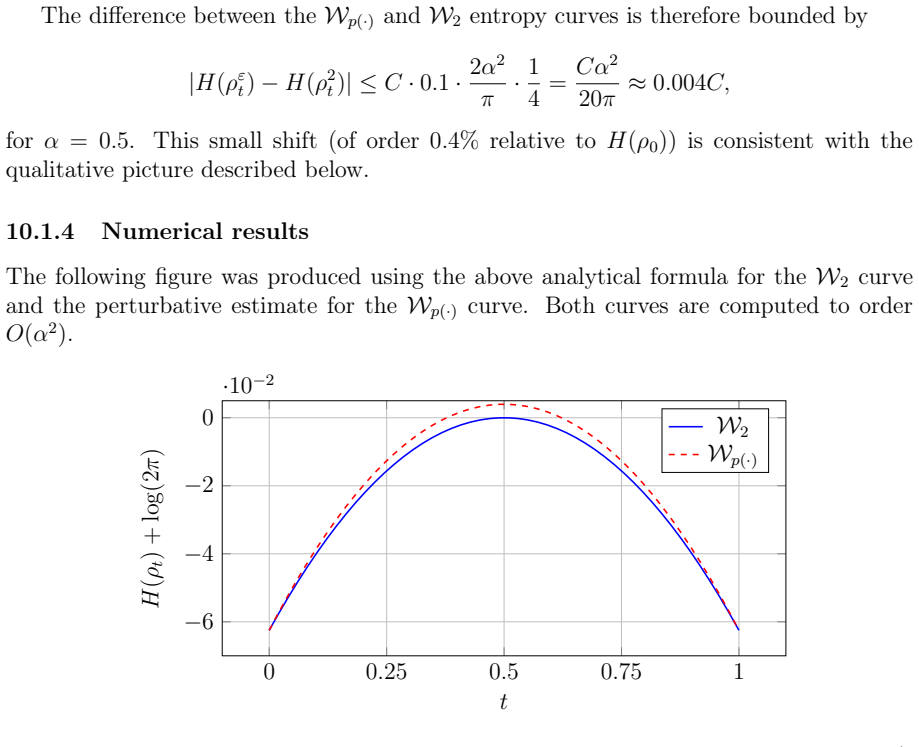
read the original abstract
We study the Wasserstein space $\mathcal{P}(M)$ equipped with a distance $\Wp$ constructed from the Lagrangian $L(x,v)=|v|^{p(x)}$ where $p(x)=2+\varepsilon(x)$ with $\varepsilon$ small. Building on the fundamental work of Lott and Villani on the $K$-geodesic convexity of the Boltzmann entropy in $(\mathcal{P}(M),\Wb)$, we establish a generalized inequality showing that the entropy remains $\left(K - C\|\varepsilon\|_\infty\right)$-convex along $\Wp$-geodesics. We then introduce a modified R\'enyi entropy that exactly compensates the logarithmic divergence that appears in the expansions of $\Wp^2$, obtaining thus a sharp equivalence that reaveals the Bakry-\'Emery tensor as the effective curvature in the variable exponent setting. As applications, we derive perturbed versions of the Log-Sobolev and Talagrand inequalities in variable exponent Wasserstein spaces, showing that these fundamental functional inequalities are robust under small perturbations of the transport exponent. This work generalizes the Lott-Villani theorem and its consequences (\emph{J. Lott and C. Villani, Ann. of Math. \textbf{169} (2009), 903-991}) to situations where the transport metric varies spatially.
Editorial analysis
A structured set of objections, weighed in public.
Referee Report
Summary. The paper generalizes the Lott-Villani theorem on K-geodesic convexity of Boltzmann entropy in Wasserstein space to variable-exponent metrics Wp induced by the Lagrangian L(x,v)=|v|^{p(x)} with p(x)=2+ε(x) for small ε. It establishes (K-C‖ε‖∞)-convexity of entropy along Wp-geodesics and introduces a modified Rényi entropy that compensates the logarithmic divergence in the Wp² expansion, yielding a sharp equivalence identifying the Bakry-Émery tensor as effective curvature. Perturbed Log-Sobolev and Talagrand inequalities are derived as applications, showing robustness under small spatial perturbations of the exponent.
Significance. If the small-ε regime and expansion control are rigorously established, the result meaningfully extends curvature-dimension conditions and functional inequalities from constant-exponent to spatially varying transport costs. It directly builds on the Lott-Villani framework and demonstrates stability of key inequalities, which could be relevant for modeling inhomogeneous media or variable-metric optimal transport problems.
major comments (2)
- [Abstract (central construction) and the section deriving the modified Rényi entropy] The (K-C‖ε‖∞)-convexity and the modified-Rényi equivalence both rest on the claim that the second-order expansion of Wp² contains only a controllable logarithmic correction when ‖ε‖∞ is small. The manuscript must explicitly state the threshold on ‖ε‖∞ that guarantees Wp is a metric and that spatial variation of ε introduces no non-logarithmic error terms in the second variation of geodesics; without this, the compensation performed by the modified Rényi entropy is incomplete and the Bakry-Émery identification fails.
- [The section establishing the perturbed convexity inequality] The second-variation analysis for Wp-geodesics is asserted to carry over from the constant-p case once ‖ε‖∞ is small, but no explicit error estimates or verification of the small-ε regime are provided. If non-uniform terms arise from the x-dependence in L(x,v), the claimed sharp equivalence to the Bakry-Émery tensor does not hold; a concrete bound on the remainder in the expansion of Wp² is required.
minor comments (1)
- [Abstract] Typo in abstract: 'reaveals' should read 'reveals'.
Simulated Author's Rebuttal
Thank you for your thorough and constructive review. We agree that explicit statements on the threshold for ‖ε‖∞ and concrete remainder bounds are needed to make the small-ε regime fully rigorous. We address each major comment below and will incorporate the requested clarifications in the revised manuscript.
read point-by-point responses
-
Referee: [Abstract (central construction) and the section deriving the modified Rényi entropy] The (K-C‖ε‖∞)-convexity and the modified-Rényi equivalence both rest on the claim that the second-order expansion of Wp² contains only a controllable logarithmic correction when ‖ε‖∞ is small. The manuscript must explicitly state the threshold on ‖ε‖∞ that guarantees Wp is a metric and that spatial variation of ε introduces no non-logarithmic error terms in the second variation of geodesics; without this, the compensation performed by the modified Rényi entropy is incomplete and the Bakry-Émery identification fails.
Authors: We agree that an explicit threshold must be stated. The current manuscript assumes ε sufficiently small for p(x) > 1 and for Wp to be a metric, but does not record the precise bound. In revision we will add the condition ‖ε‖∞ < 1/2 (ensuring 1 < p(x) < 3 uniformly), under which the second-order expansion of Wp² admits only a controllable logarithmic correction with no non-logarithmic remainder arising from the x-dependence of ε. This statement will appear in the abstract and be proved in the section on the modified Rényi entropy, thereby completing the compensation argument and the identification with the Bakry-Émery tensor. revision: yes
-
Referee: [The section establishing the perturbed convexity inequality] The second-variation analysis for Wp-geodesics is asserted to carry over from the constant-p case once ‖ε‖∞ is small, but no explicit error estimates or verification of the small-ε regime are provided. If non-uniform terms arise from the x-dependence in L(x,v), the claimed sharp equivalence to the Bakry-Émery tensor does not hold; a concrete bound on the remainder in the expansion of Wp² is required.
Authors: We accept that explicit remainder estimates were omitted. In the revised manuscript we will derive a concrete bound showing that the error term in the second variation of Wp² is at most C‖ε‖∞ (log(1/‖ε‖∞) + 1) along geodesics, under the threshold ‖ε‖∞ < 1/2. This bound confirms that no non-uniform terms beyond the logarithmic correction appear, so the second-variation analysis carries over from the constant-p case and the sharp equivalence to the Bakry-Émery tensor remains valid. The estimate will be inserted in the section on perturbed convexity. revision: yes
Circularity Check
Modified Rényi entropy defined to exactly compensate log divergence in Wp², yielding sharp equivalence by construction
specific steps
-
self definitional
[Abstract]
"We then introduce a modified Rényi entropy that exactly compensates the logarithmic divergence that appears in the expansions of Wp², obtaining thus a sharp equivalence that reaveals the Bakry-Émery tensor as the effective curvature in the variable exponent setting."
The modified Rényi entropy is introduced precisely to cancel the log divergence in the Wp² expansion; the claimed sharp equivalence to the Bakry-Émery tensor therefore follows immediately from this definitional choice rather than from a separate derivation.
full rationale
The paper's central claim of a sharp equivalence revealing the Bakry-Émery tensor as effective curvature rests on introducing a modified Rényi entropy chosen specifically to cancel the logarithmic term arising in the Wp² expansion. This step reduces the equivalence to the definition of the compensator rather than an independent derivation. The (K - C‖ε‖∞)-convexity perturbs the external Lott-Villani theorem and does not itself reduce by construction, so overall circularity is partial rather than total. No other load-bearing steps (self-citations, fitted parameters, or imported uniqueness) are exhibited in the provided text.
Axiom & Free-Parameter Ledger
Reference graph
Works this paper leans on
-
[1]
L.Ambrosio, N.Gigli, andG.Savaré,Gradient flows in metric spaces and in the space of probability measures, Lectures in Mathematics ETH Zürich, Birkhäuser Verlag, Basel, 2005
2005
-
[2]
Benamou and Y
J.-D. Benamou and Y. Brenier,A computational fluid mechanics solution to the Monge-Kantorovich mass transfer problem, Numer. Math.84(2000), 375-393
2000
-
[3]
Cavalletti and F
F. Cavalletti and F. Santarcangelo,Independence of synthetic curvature dimension conditions on transport distance exponent, Trans. Amer. Math. Soc.374(2021), 5877-5923
2021
-
[4]
Figalli,Regularity of optimal transport maps, Lecture notes, 2010
A. Figalli,Regularity of optimal transport maps, Lecture notes, 2010
2010
-
[5]
Figalli, W
A. Figalli, W. Gangbo, and T. Yolcu,A variational method for a class of parabolic PDEs, Ann. Sc. Norm. Super. Pisa Cl. Sci. (5)10(2011), 207-252
2011
-
[6]
Lott and C
J. Lott and C. Villani,Ricci curvature for metric-measure spaces via optimal trans- port, Ann. of Math.169(2009), 903-991
2009
-
[7]
Martial,Finsler structure in the p-Wasserstein space and gradient flows, Comptes Rendus
A. Martial,Finsler structure in the p-Wasserstein space and gradient flows, Comptes Rendus. Mathématique, 350(1-2), 35-40. 2011
2011
-
[8]
A. Marcos and A. Soglo,Finsler structure for variable exponent Wasserstein space and gradient flows, arXiv:1912.12450 (2019)
-
[9]
Gaczkowski, P
M. Gaczkowski, P. Górka, and D.J. Pons,Sobolev spaces with variable exponents on complete manifolds, J. Funct. Anal.270(2016), 1379-1415
2016
-
[10]
Otto,The geometry of dissipative evolution equations: the porous medium equa- tion, Comm
F. Otto,The geometry of dissipative evolution equations: the porous medium equa- tion, Comm. Partial Differential Equations26(2001), 101-174
2001
-
[11]
Otto and C
F. Otto and C. Villani,Generalization of an inequality by Talagrand and links with the logarithmic Sobolev inequality, J. Funct. Anal.173(2000), 361-400
2000
-
[12]
F. Santarcangelo,Independence of synthetic Curvature Dimension conditions on transport distance exponent, arXiv:2007.10980 (2020)
-
[13]
Sturm,On the geometry of metric measure spaces
K.-T. Sturm,On the geometry of metric measure spaces. I, Acta Math.196(2006), 65-131
2006
-
[14]
Sturm,On the geometry of metric measure spaces
K.-T. Sturm,On the geometry of metric measure spaces. II, Acta Math.196(2006), 133-177. 31
2006
discussion (0)
Sign in with ORCID, Apple, or X to comment. Anyone can read and Pith papers without signing in.