REVIEW 2 major objections 16 references
Small-noise limit of the quasi-Gaussian log-normal HJM model
T0 review · 2 major / 0 minor · reviewed 2026-08-14 · deepseek-v4-flash
Pith's one-line read In the small-noise deterministic limit, the short rate in a one-factor log-normal quasi-Gaussian HJM model explodes in finite time whenever mean reversion falls below the critical value $\beta_C=\sigma\sqrt{2\lambda_0}$, with an explicit…
desk verdict The constant-λ deterministic analysis is worth attention, but a load-bearing initial-condition error (r'(0) is set to 0 when it should be λ'(0)) makes Proposition 4 false as stated. read the letter →
The pith
A machine-rendered reading of the paper's core claim, the machinery that carries it, and where it could break.
The reading
What carries the argument
The load-bearing object is the differential inequality $r''(t)+3\beta r'(t)+2\beta^2 r(t)\ge \sigma^2 r^2(t)+2\beta^2\lambda_0$, obtained from the exact second-order ODE for $r(t)$ once Assumption 1 forces $\Lambda(t)=2\beta^2(\lambda(t)-\lambda(0))+3\beta\lambda'(t)+\lambda''(t)\ge0$. A comparison lemma, proved by a generalized Gronwall inequality, shows that any solution of this inequality stays above the solution of the corresponding equality with the same initial conditions. That equality case is analytically tractable: for $\beta=0$ it is solved by the Weierstrass elliptic function, and for positive $\beta$ the change of variables $y(x)=(r'(r^{-1}(x)))^2$ reduces it to a first-order ODE whose zero develops exactly at $\beta_C$. This mechanism turns a question about a two-dimensional ODE system into a one-dimensional comparison problem and yields the explicit explosion-time bound.
What would settle it
For a flat forward curve $\lambda(t)\equiv\lambda_0$, fix any $\beta<\beta_C=\sigma\sqrt{2\lambda_0}$ and numerically integrate the deterministic system (6) until $r(t)$ exceeds a large threshold. If the first such time is greater than $\bar\tau_\infty$ from (34), or if $r(t)$ stays finite as $\beta$ approaches $\beta_C$ from below for any initial curve satisfying Assumption 1, the claimed explosion bound is false. A simpler spot check: for $\lambda_0=5\%$ and $\sigma=20\%$ the paper predicts the zero-mean-reversion explosion time $66.5$ years; a numerical solution that does not blow up near that time would contradict the central claim.
Extended reading notes
Core claim
The central claim is that the deterministic approximation of the short rate, obtained by sending the Brownian noise in the quasi-Gaussian log-normal HJM model to zero, can reach infinity in finite time, and the boundary between explosion and non-explosion is set by the simple parameter $\beta_C=\sigma\sqrt{2\lambda_0}$. Under Assumption 1, $r(t)$ satisfies $r''(t)+3\beta r'(t)+2\beta^2 r(t)\ge \sigma^2 r^2(t)+2\beta^2\lambda_0$, and a comparison lemma shows that every such solution dominates the solution of the corresponding equality. For $\beta<\beta_C$ the equality-case solution explodes, giving the upper bound $\bar\tau_\infty=\int_{\lambda_0}^\infty dx/\sqrt{y(x)}$, where $y(x)$ solves a first-order nonlinear ODE; for a flat forward curve this bound is attained. In the zero-mean-reversion case the bound becomes $\tau_\infty\le 2.97448/(\sigma\sqrt{\lambda_0})$, computed from the Weierstrass elliptic function. The paper then uses Jensen's inequality to infer that Eurodollar futures prices explode before $\tau_\infty$, because the futures payoff is bounded below by an exploding exponential of the expected short rate.
Load-bearing premise
The load-bearing premise is Assumption 1: the initial forward curve must be flat or upward-sloping and not too concave, so that $\Lambda(t)=2\beta^2(\lambda(t)-\lambda(0))+3\beta\lambda'(t)+\lambda''(t)\ge0$ for all $t\ge0$; if this sign condition fails, no explosion bound follows, and the proof for general $\lambda(t)$ also assumes without proof that $r(t)$ is strictly increasing and invertible for small $\beta$.
Editorial extensions
If this is right
- For flat initial forward curves and $\beta<\beta_C$, the deterministic short rate explodes exactly at $\bar\tau_\infty$, and the same value is an upper bound for every initial curve satisfying Assumption 1.
- Eurodollar futures prices in this model explode in finite time when the contract maturity approaches the short-rate explosion time, because the futures price is bounded below by an exploding exponential of the expected short rate.
- For $\beta\ge\beta_C$ and constant $\lambda_0$, the deterministic short rate does not explode and instead converges to the stable fixed point $x_1$ of the system.
- As $\beta\to\infty$ or $\sigma\to0$, the deterministic short rate converges uniformly to the initial forward curve $\lambda(t)$, so explosion cannot occur in those limits.
- Numerical implementations of the model should expect a finite-time singularity in simulated short-rate paths for small mean reversion and typical market parameters, which limits the maturity range over which the model can be trusted.
Reading between the lines
- The same comparison mechanism should apply to other interest-rate derivatives whose payoffs are convex and increasing in the short rate; swap-rate and caplet prices may inherit a finite-time singularity even when futures contracts are not being priced.
- The paper does not quantify how the shape of the initial curve changes the explosion time beyond the bound $\bar\tau_\infty$; computing $\bar\tau_\infty$ for steep upward-sloping versus concave curves would separate the effect of Assumption 1's slack from the sharp flat-curve case.
- Since the paper mentions that Brownian noise gives the explosion time a distribution around the deterministic limit, a small-noise expansion of that distribution is a natural next step and would give a practical estimate of explosion probabilities for finite maturities.
- The criterion $\beta<\sigma\sqrt{2\lambda_0}$ offers a simple calibration diagnostic: a calibrated model with $\beta\le0.1$ and $\sigma\sqrt{\lambda_0}>0.07$ lies in the explosive regime, so an explosion-time check should accompany any reported simulation results.
Signed reviews
Editorial analysis
A structured set of objections, weighed in public.
Referee Report
Summary. The paper studies the one-factor log-normal quasi-Gaussian HJM model and its deterministic small-noise limit. For the resulting two-dimensional ODE, the authors derive an integral equation for the short rate, prove non-explosion for sufficiently large mean reversion or small volatility, analyze the fixed points, and then, under Assumption 1, derive differential inequalities that are claimed to give explicit finite-time explosion bounds for small mean reversion. They also define a critical mean reversion beta_C and argue that Eurodollar futures prices explode as a consequence. The paper is clearly written and contains several sound elements, but the central quantitative claims in Section 4 are not supported by the stated assumptions.
Significance. If the explosion criteria were proved under the stated assumptions, this would be a valuable cautionary result for practitioners using log-normal Cheyette-type models: it would show that futures prices can become infinite within the model's deterministic approximation. The paper's reduction of the SDE to a two-dimensional ODE, the integral equation, and the large-beta boundedness result are sound and elegant. However, the main theorems in Section 4 rely on assumptions that are too weak: the initial condition used in the comparison lemma is inconsistent with the ODE unless lambda'(0)=0, and Assumption 1 does not guarantee this. A concrete counterexample satisfies Assumption 1 but violates the claimed explosion-time bound. The qualitative phenomenon (explosion for small beta) appears to survive, but the paper's stated quantitative results and the claimed extension to general lambda(t) are not correct as written.
major comments (2)
- [Section 4.2, proof of Proposition 5] The initial condition r'(0)=0 used in the differential inequality (27)-(28) and in Proposition 4 is inconsistent with the original ODE (6). From (6) and y(0)=0 one obtains r'(0)=lambda'(0). Assumption 1 does not require lambda'(0)=0 and in fact permits negative values. The comparison Lemma 1 and the proofs of Propositions 4 and 5 therefore apply only to the special case lambda'(0)=0. This is not just a technical gap: for beta=0, sigma=1, lambda0=1, and lambda(t)=1-0.1t, Assumption 1 holds (Lambda(t)=lambda''(t)=0), but the true solution r(t) of (6) satisfies r''(t)=r(t)^2 with r(0)=1, r'(0)=-0.1. Its blow-up time is approximately 3.07, which is larger than the claimed upper bound 2.97448 in Eq. (29). Thus Proposition 4 is false as stated for curves admitted by Assumption 1. The assumption must be strengthened (e.g., add lambda'(0)>=0 or lambda'(t)>=0) and the comparison lemma must be reproved with a nonzero initial slope.
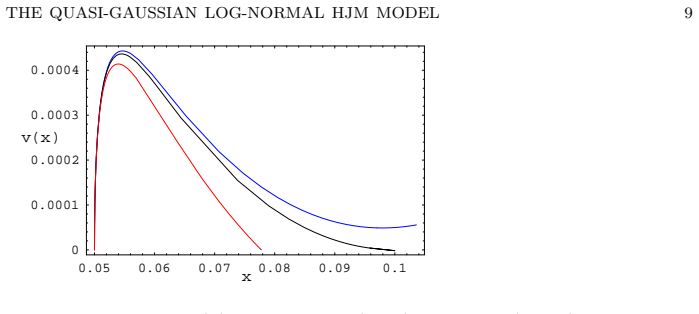
- [Section 4.2, proof of Proposition 5] The assertion 'For suIn this plot, the solution of the equation of state is not a monotone function of the initial slope. The text states 'For suIn this plot, the solution of the equation of state is not a monotone function of the initial slope.'
Circularity Check
No circularity: the small-noise explosion result is derived from the stated ODE with external comparison arguments; the sole self-citation is contextual.
full rationale
The paper's main derivation is self-contained. Equation (6) is the deterministic limit of the SDE (5); Proposition 1 derives the integral equation (7) by direct integration; Propositions 2, 4, and 5 compare this ODE to solvable special cases using external comparison arguments, the generalized Gronwall inequality, and Weierstrass elliptic functions. Assumption 1 (Lambda(t) >= 0) is an explicit, honest hypothesis on the initial forward curve, not a parameter fitted to the target explosion; the upper bound on tau_infty is obtained by comparison to the flat-forward equality case rather than being imposed by definition. The only self-citation is [14], which is used only to note that the stochastic process may explode with non-zero probability ('This will be discussed in [14]'), and no equation or result from [14] is used in the deterministic derivation or in the Eurodollar futures section. No fitted input is renamed as a prediction, and no external uniqueness theorem is imported. The reader-facing weakness about the comparison initial condition r'(0)=0 in (28), when Eq. (6) gives r'(0)=lambda'(0), and the unproved monotonicity of r(t) in Proposition 5 are mathematical correctness or assumption gaps, not circularity: they do not make the output equivalent to the input by construction.
Assumptions & free parameters
assumptions (5)
- domain assumption The HJM no-arbitrage drift condition and the quasi-Gaussian Markov representation (3)-(4).
- ad hoc to paper Assumption 1: Lambda(t) = 2*beta^2*(lambda(t) - lambda(0)) + 3*beta*lambda'(t) + lambda''(t) >= 0 for all t >= 0.
- domain assumption The deterministic ODE (6) is the small-noise limit of the SDE (5), and EQ[rt] is approximately r(t).
- ad hoc to paper For sufficiently small beta, r(t) is strictly increasing in t and hence invertible.
- standard math Generalized Gronwall inequality from [9] and standard properties of the Weierstrass elliptic function from [16].
Cite this review
Pith. "Pith review of Small-noise limit of the quasi-Gaussian log-normal HJM model." pith.science (2026). https://pith.science/paper/JFHQC7GK
@misc{pith2026190807098,
  author       = {Pith},
  title        = {Pith review of: Small-noise limit of the quasi-Gaussian log-normal HJM model},
  year         = {2026},
  howpublished = {\url{https://pith.science/paper/JFHQC7GK}},
  note         = {Machine review of arXiv:1908.07098}
}
read the original abstract
Quasi-Gaussian HJM models are a popular approach for modeling the dynamics of the yield curve. This is due to their low dimensional Markovian representation, which greatly simplifies their numerical implementation. We present a qualitative study of the solutions of the quasi-Gaussian log-normal HJM model. Using a small-noise deterministic limit we show that the short rate may explode to infinity in finite time. This implies the explosion of the Eurodollar futures prices in this model. We derive explicit explosion criteria under mild assumptions on the shape of the yield curve.
Figures

Reference graph
Works this paper leans on
-
[1]
Andersen, L. and V. Piterbarg. Interest Rate Modeling . Atlantic Press, London, 2010
work page 2010
-
[2]
Markovian term structure models, in Encyclopedia of Quantitative Finance , Ed
Andreasen, J. Markovian term structure models, in Encyclopedia of Quantitative Finance , Ed. R. Cont, Wiley, New York, 2010
work page 2010
-
[3]
Babbs, S. (1993). Generalized Vasicek models of the term structure, Applied Stochastic Models and Data Analysis . 1, 49-62
work page 1993
-
[4]
Cakici, N. and J. Zhu. (2001). Pricing Eurodollar futures options with the Heath-Jarrow-Morton model. Journal of Futures Markets . 21, 655-680
work page 2001
-
[5]
Cheyette, O. (1992). Markov representation of the Heath-Jarrow-Morton model. Working paper, Barra
work page 1992
-
[6]
(2012) Explicit volatility specification for the linear Cheyette model
Chibane, M. (2012) Explicit volatility specification for the linear Cheyette model. Working paper, Shinsei Bank Ltd
work page 2012
-
[7]
Chibane, M. and D. Law (2013). A quadratic volatility Cheyette model. Risk, 60-63 (July)
work page 2013
- [8]
Show all 16 references
-
[9]
Chu, S. and F. Metcalf. (1967). On Gronwall’s Inequality. Proc. Amer. Math. Soc. 18, 439-440
1967
-
[10]
Jarrow and A
Heath, D., R. Jarrow and A. Morton. (1992). Bond pricing and the term structure of interest rates: A new methodology for contingent claim valuation. Econometrica. 60, 77-105
1992
-
[11]
Hunt, P. J. and J. E. Kennedy. Financial Derivatives in Theory and Practice . Wiley Series in Probability and Statistics, 2004
2004
-
[12]
Jamshidian, F. (1991). Bond and option evaluation in the Gaussian interest rate model. Research in Finance. 8, 131-170
1991
-
[13]
Morton, A. J. (1989). Arbitrage and martingales. Doctoral dissertation, Cornell University
1989
-
[14]
Pirjol, D. and L. Zhu. (2018). Explosion of the quasi-Gaussian log-normal HJM model. Finance and Stochastics . 22, 643-666. 12 DAN PIRJOL AND LINGJIONG ZHU
2018
-
[15]
Ritchken, P. and L. Sankarasubramanian. (1995). Volatility structures of forward rates and the dynamics of the term structure. Math. Finance. 5, 55-72
1995
-
[16]
Whittaker, E. T. and G. N. Watson (1927). A Course of Modern Analysis . Cambridge University Press. E-mail address : dpirjol@gmail.com E-mail address : ling@cims.nyu.edu
1927
Reviewed August 14, 2026 · model on record in the stance chip above.
Discussion (0). Continue with ORCID to comment.