A second-order diffusive-interface immersed boundary method for incompressible flow with phase change and moving interfaces
Pith reviewed 2026-07-03 05:32 UTC · model grok-4.3
The pith
Extrapolating the scalar field across the interface restores second-order spatial accuracy in diffuse-interface immersed boundary methods for flows with phase change.
A machine-rendered reading of the paper's core claim, the machinery that carries it, and where it could break.
Core claim
By extrapolating the scalar field across the interface, the method structurally ensures derivative continuity and thereby restores formal second-order spatial accuracy in diffuse-interface IBMs for phase-changing boundaries, while the velocity field retains the standard diffuse-interface treatment to preserve the divergence-free condition of the incompressible solver.
What carries the argument
The smooth extension strategy, which extrapolates the scalar field across the interface to enforce derivative continuity while leaving the velocity treatment unchanged.
If this is right
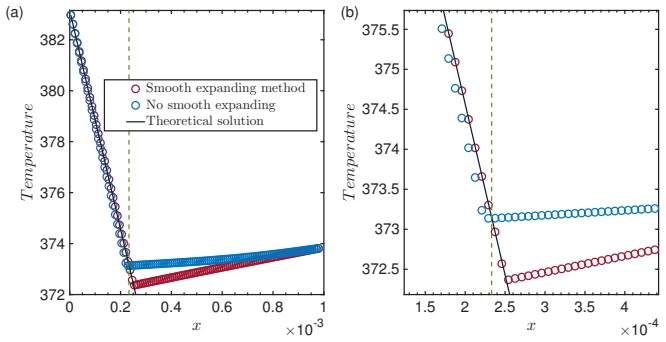
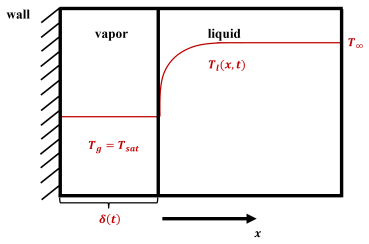
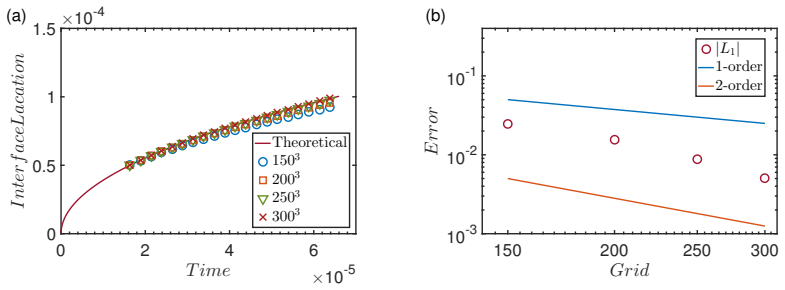
- The method produces second-order spatial accuracy on one-dimensional evaporation and boiling problems.
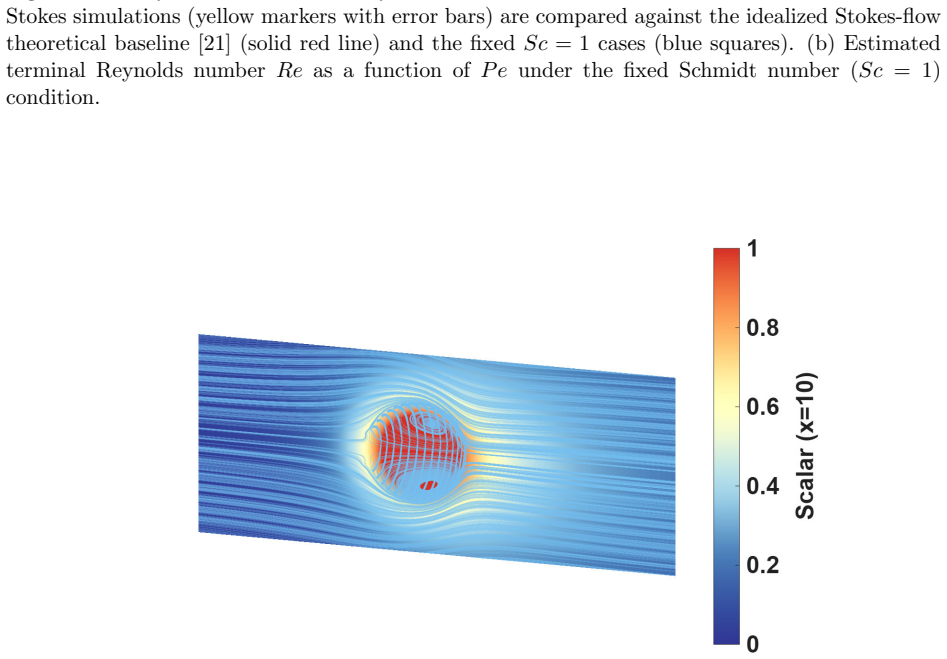
- It resolves the spontaneous autophoretic motion of isotropic particles while maintaining incompressibility.
- Complex multi-physics boundary couplings at moving phase-change interfaces can be captured without order reduction.
- Derivative continuity is achieved without modifying the velocity solver or its divergence-free enforcement.
Where Pith is reading between the lines
- The scalar-only extension principle may apply to other transport equations in active-matter or reaction-diffusion systems.
- Implementation in three-dimensional codes could reveal whether the same accuracy gain holds for curved or topologically changing interfaces.
- The separation of scalar and velocity treatments suggests a modular way to add high-order corrections to existing immersed-boundary codes without re-deriving the projection step.
Load-bearing premise
Local derivative discontinuities are the main source of accuracy loss, and applying the smooth extension only to scalars will not break the divergence-free constraint enforced by the incompressible solver.
What would settle it
A grid-refinement study on the one-dimensional evaporation benchmark that yields only first-order error reduction with the proposed method would falsify the claim of restored second-order accuracy.
Figures





read the original abstract
Accurately resolving interfacial gradients is critical for simulating two-phase flows, particularly those involving phase transitions or active matter. The traditional diffuse-interface immersed boundary methods (IBMs) are highly efficient for such problems, but they typically suffer from a reduction to first-order accuracy near the phase-changing boundaries. We clarify that the main reason is the local derivative discontinuities. Here, we propose a smooth extension strategy to restore formal second-order spatial accuracy. By extrapolating the scalar field across the interface, the method structurally ensures derivative continuity. To preserve the divergence-free condition in incompressible fluid solvers, this smooth extension is applied exclusively to the scalar transport equations. The velocity field retains the standard diffuse-interface treatment. The proposed framework is systematically validated against classical phase-change benchmarks, specifically one-dimensional evaporation and boiling problems. Additionally, the method is applied to the spontaneous autophoretic motion of isotropic particles. The numerical results confirm the capability of our method in resolving the complex multi-physics boundary couplings.
Editorial analysis
A structured set of objections, weighed in public.
Referee Report
Summary. The manuscript proposes a second-order diffusive-interface immersed boundary method for incompressible flows with phase change and moving interfaces. It identifies local derivative discontinuities as the source of first-order accuracy degradation in standard diffuse-interface IBMs and introduces a smooth extension by extrapolating the scalar field across the interface to enforce derivative continuity. The extension is restricted to scalar transport equations to preserve the divergence-free condition, while the velocity field retains standard diffuse-interface treatment. Validation is reported on one-dimensional evaporation and boiling benchmarks, with an additional application to spontaneous autophoretic motion of isotropic particles.
Significance. If the central accuracy claim holds under the reported coupling, the approach would provide a practical route to second-order spatial accuracy in phase-change IBM simulations without altering the incompressible solver or introducing free parameters, addressing a recurring limitation in diffuse-interface methods for multi-physics interfacial problems.
major comments (1)
- [Method and validation sections (Stefan condition implementation)] The core claim that scalar-only extrapolation restores formal second-order accuracy rests on the assumption that derivative discontinuities are the dominant error source and that the Stefan-condition coupling to the (non-extrapolated) velocity field does not degrade the global order. The abstract states that interface velocity is set by the Stefan condition while velocity retains standard treatment; a load-bearing demonstration is therefore required that the computed normal interface speed and subsequent advection remain second-order accurate. A concrete test would be to report observed convergence rates for the interface position and temperature field in the 1D Stefan problems both with and without the scalar extrapolation, including the measured order for the velocity field near the interface.
minor comments (1)
- [Abstract and results] The abstract mentions systematic validation on classical benchmarks but does not include quantitative error tables, observed convergence rates, or grid sizes; these should be added to the main text or a dedicated results table for reproducibility.
Simulated Author's Rebuttal
We thank the referee for the detailed review and constructive feedback on our manuscript. The major comment raises a valid point about explicitly verifying that the Stefan-condition coupling preserves second-order accuracy for the interface motion and velocity field. We address this directly below and will incorporate the requested additional convergence data in the revised version.
read point-by-point responses
-
Referee: [Method and validation sections (Stefan condition implementation)] The core claim that scalar-only extrapolation restores formal second-order accuracy rests on the assumption that derivative discontinuities are the dominant error source and that the Stefan-condition coupling to the (non-extrapolated) velocity field does not degrade the global order. The abstract states that interface velocity is set by the Stefan condition while velocity retains standard treatment; a load-bearing demonstration is therefore required that the computed normal interface speed and subsequent advection remain second-order accurate. A concrete test would be to report observed convergence rates for the interface position and temperature field in the 1D Stefan problems both with and without the scalar extrapolation, including the measured order for the velocity field near the interface.
Authors: We agree that a direct comparison of convergence rates with and without the scalar extrapolation, including the velocity field, would strengthen the validation. Our analysis in the manuscript identifies derivative discontinuities as the primary source of order reduction in standard diffuse-interface IBMs, and the 1D evaporation/boiling benchmarks already show second-order behavior for temperature and interface position under the new method. However, the referee is correct that the manuscript does not explicitly tabulate orders for the non-extrapolated velocity field or provide the with/without comparison. In the revised manuscript we will add these convergence studies for the 1D Stefan problems, reporting observed orders for temperature, interface position, and velocity near the interface in both configurations. This will confirm that the Stefan coupling does not degrade the global order. revision: yes
Circularity Check
No circularity: accuracy restoration follows from explicit construction, validated externally
full rationale
The paper states that local derivative discontinuities cause first-order loss and proposes extrapolation on scalars to ensure continuity by construction, applied only to transport equations while velocity retains standard treatment. This is an independent algorithmic modification whose claimed effect on order is asserted from the structural property of the extension, not from any fitted parameter, self-referential definition, or load-bearing self-citation. Validation is performed against external classical benchmarks (1D evaporation/boiling, autophoretic motion), with no equations or results shown to reduce the second-order claim to an input by tautology. The derivation chain therefore remains self-contained against external checks.
Axiom & Free-Parameter Ledger
axioms (1)
- domain assumption The velocity field must remain divergence-free to enforce incompressibility.
Reference graph
Works this paper leans on
-
[1]
C. S. Peskin, Flow patterns around heart valves: a numerical method, Journal of Computa- tional Physics 10 (1972) 252–271
work page 1972
- [2]
-
[3]
L. Wang, G. M. Currao, F. Han, A. J. Neely, J. Young, F.-B. Tian, An immersed bound- ary method for fluid–structure interaction with compressible multiphase flows, Journal of Computational Physics 346 (2017) 131–151
work page 2017
-
[4]
W. Xiao, H. Zhang, K. Luo, C. Mao, J. Fan, Immersed boundary method for multiphase transport phenomena, Reviews in Chemical Engineering 38 (2022) 363–405
work page 2022
-
[5]
P. R. C. Souza, H. R. Neto, M. M. Villar, J. M. Vedovotto, A. A. Cavalini Jr, A. S. Neto, Multi-phase fluid–structure interaction using adaptive mesh refinement and immersed bound- ary method, Journal of the Brazilian Society of Mechanical Sciences and Engineering 44 (2022) 152
work page 2022
-
[6]
H. Yan, G. Zhang, D. Wang, Y. Lu, S. Wang, Improved diffuse interface-immersed bound- ary method for three-dimensional multiphase fluids–structure interaction with moving contact lines, Applied Ocean Research 151 (2024) 104181
work page 2024
-
[7]
Q. Jin, D. Hudson, W. G. Price, A combined volume of fluid and immersed boundary method for modeling of two-phase flows with high density ratio, Journal of Fluids Engineering 144 (2022) 031402
work page 2022
- [8]
-
[9]
V. E. Badalassi, H. D. Ceniceros, S. Banerjee, Computation of multiphase systems with phase field models, Journal of computational physics 190 (2003) 371–397
work page 2003
- [10]
-
[11]
J. H. Seo, R. Mittal, A sharp-interface immersed boundary method with improved mass conservation and reduced spurious pressure oscillations, Journal of computational physics 230 (2011) 7347–7363
work page 2011
-
[12]
M. Uhlmann, An immersed boundary method with direct forcing for the simulation of partic- ulate flows, Journal of Computational Physics 209 (2005) 448–476
work page 2005
- [13]
-
[14]
A. M. D. Jost, S. Glockner, Direct forcing immersed boundary methods: Improvements to the ghost-cell method, Journal of Computational Physics 438 (2021) 110371. 21
work page 2021
- [15]
-
[16]
Z. Li, The immersed interface method using a finite element formulation, Applied Numerical Mathematics 27 (1998) 253–267
work page 1998
-
[17]
M. C. Lai, C. S. Peskin, An immersed boundary method with formal second-order accuracy and reduced numerical viscosity, Journal of Computational Physics 160 (2000) 705–719
work page 2000
-
[18]
B. E. Griffith, C. S. Peskin, On the order of accuracy of the immersed boundary method: Higher order convergence rates for sufficiently smooth problems, Journal of Computational Physics 208 (2005) 75–105
work page 2005
-
[19]
T. Treeratanaphitak, N. M. Abukhdeir, Diffuse-interface blended method for imposing physical boundaries in two-fluid flows, ACS omega 8 (2023) 15518–15534
work page 2023
-
[20]
C. Shao, K. Luo, M. Chai, H. Wang, J. Fan, A computational framework for interface-resolved dns of simultaneous atomization, evaporation and combustion, Journal of Computational Physics 371 (2018) 751–778
work page 2018
-
[21]
S. Michelin, E. Lauga, D. Bartolo, Spontaneous autophoretic motion of isotropic particles, Physics of Fluids 25 (2013) 061701
work page 2013
-
[22]
Q. Mao, J. E. C. Cabezas, S. Zhao, P. Boivin, J. Favier, An explicit fully one-sided diffuse- interface immersed boundary method for compressible flows, Journal of Computational Physics (2026) 114721
work page 2026
-
[23]
X. Zhu, Y. Chen, K. L. Chong, D. Lohse, R. Verzicco, A boundary condition-enhanced direct- forcing immersed boundary method for simulations of three-dimensional phoretic particles in incompressible flows, Journal of Computational Physics 509 (2024) 113028
work page 2024
-
[24]
R. P. Beyer, R. J. LeVeque, Analysis of a one-dimensional model for the immersed boundary method, SIAM Journal on Numerical Analysis 29 (1992) 332–364
work page 1992
-
[25]
D. B. Stein, R. D. Guy, B. Thomases, Immersed boundary smooth extension: a high-order method for solving pde on arbitrary smooth domains using fourier spectral methods, Journal of Computational Physics 304 (2016) 252–274
work page 2016
-
[26]
W. Chen, S. Zou, Q. Cai, Y. Yang, An explicit and non-iterative moving-least-squares immersed-boundary method with low boundary velocity error, J. Comp. Phys. 474 (2023) 111803
work page 2023
-
[27]
R. Verzicco, P. Orlandi, A finite-difference scheme for three-dimensional incompressible flows in cylindrical coordinates, Journal of Computational Physics 123 (1996) 402–414
work page 1996
-
[28]
R. Ostilla-M´ onico, Y. Yang, E. P. Van Der Poel, D. Lohse, R. Verzicco, A multiple-resolution strategy for direct numerical simulation of scalar turbulence, Journal of Computational Physics 301 (2015) 308–321
work page 2015
-
[29]
M. Vanella, E. Balaras, A moving-least-squares reconstruction for embedded-boundary formu- lations, Journal of Computational Physics 228 (2009) 6617–6628. 22
work page 2009
-
[30]
M. Vanella, E. Balaras, Direct Lagrangian Forcing Methods Based on Moving Least Squares, Springer Singapore, Singapore, 2020, pp. 45–79
work page 2020
-
[31]
S. Wang, X. Zhang, An immersed boundary method based on discrete stream function formu- lation for two- and three-dimensional incompressible flows, Journal of Computational Physics 230 (2011) 3479–3499
work page 2011
- [32]
-
[33]
H. Udaykumar, R. Mittal, P. Rampunggoon, A. Khanna, A sharp interface cartesian grid method for simulating flows with complex moving boundaries, Journal of computational physics 174 (2001) 345–380
work page 2001
-
[34]
J. Kim, D. Kim, H. Choi, An immersed-boundary finite-volume method for simulations of flow in complex geometries, Journal of Computational Physics 171 (2001) 132–150
work page 2001
-
[35]
S. W. Welch, J. Wilson, A volume of fluid based method for fluid flows with phase change, Journal of computational physics 160 (2000) 662–682
work page 2000
- [36]
-
[37]
Y. Sato, B. Niˇ ceno, A sharp-interface phase change model for a mass-conservative interface tracking method, Journal of Computational Physics 249 (2013) 127–161
work page 2013
- [38]
-
[39]
Scriven, On the dynamics of phase growth, Chemical Engineering Science 10 (1959) 1–18
L. Scriven, On the dynamics of phase growth, Chemical Engineering Science 10 (1959) 1–18
work page 1959
-
[40]
C. Kunkelmann, P. Stephan, CFD simulation of boiling flows using the volume-of-fluid method within openfoam, Numerical Heat Transfer, Part A 56 (2009) 631–646
work page 2009
-
[41]
S. Michelin, E. Lauga, Phoretic self-propulsion at finite p´ eclet numbers, Journal of fluid mechanics 747 (2014) 572–604
work page 2014
-
[42]
A. S. Khair, N. G. Chisholm, Expansions at small reynolds numbers for the locomotion of a spherical squirmer, Physics of Fluids 26 (2014)
work page 2014
-
[43]
N. G. Chisholm, D. Legendre, E. Lauga, A. S. Khair, A squirmer across reynolds numbers, Journal of Fluid Mechanics 796 (2016) 233–256
work page 2016
-
[44]
Y. Chen, K. L. Chong, L. Liu, R. Verzicco, D. Lohse, Instabilities driven by diffusiophoretic flow on catalytic surfaces, Journal of Fluid Mechanics 919 (2021) A10
work page 2021
-
[45]
R. Verzicco, M. D. de Tullio, F. Viola, An Introduction to Immersed Boundary Methods, Cambridge Monographs on Applied and Computational Mathematics, Cambridge University Press, Cambridge, 2025. 23
work page 2025
discussion (0)
Sign in with ORCID, Apple, or X to comment. Anyone can read and Pith papers without signing in.