Functional Interface Blocks for Neuromorphic Hardware: A Junction-Centered Framework
Pith reviewed 2026-06-28 07:02 UTC · model grok-4.3
The pith
Assigning drive and sense roles at junctions and grouping them into functional blocks solves compatibility issues in heterogeneous neuromorphic hardware.
A machine-rendered reading of the paper's core claim, the machinery that carries it, and where it could break.
Core claim
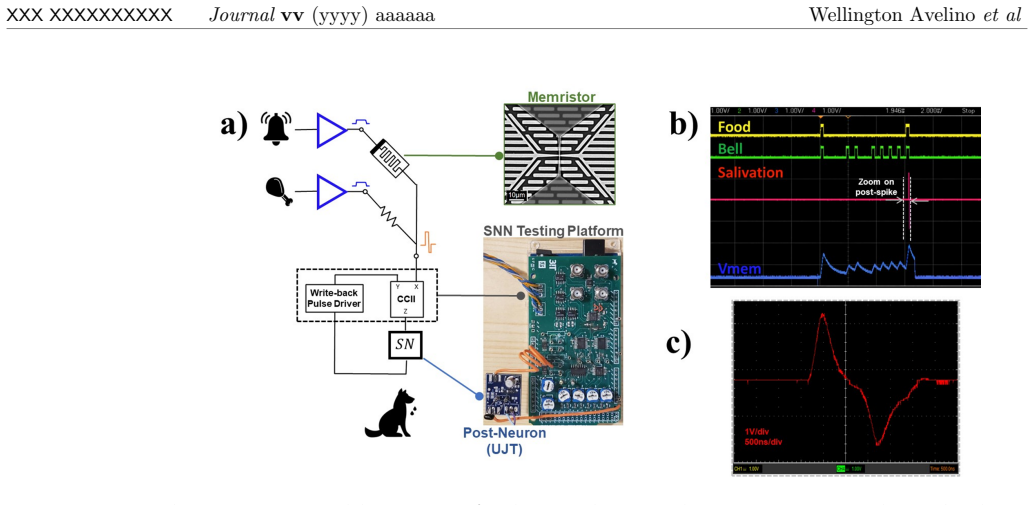
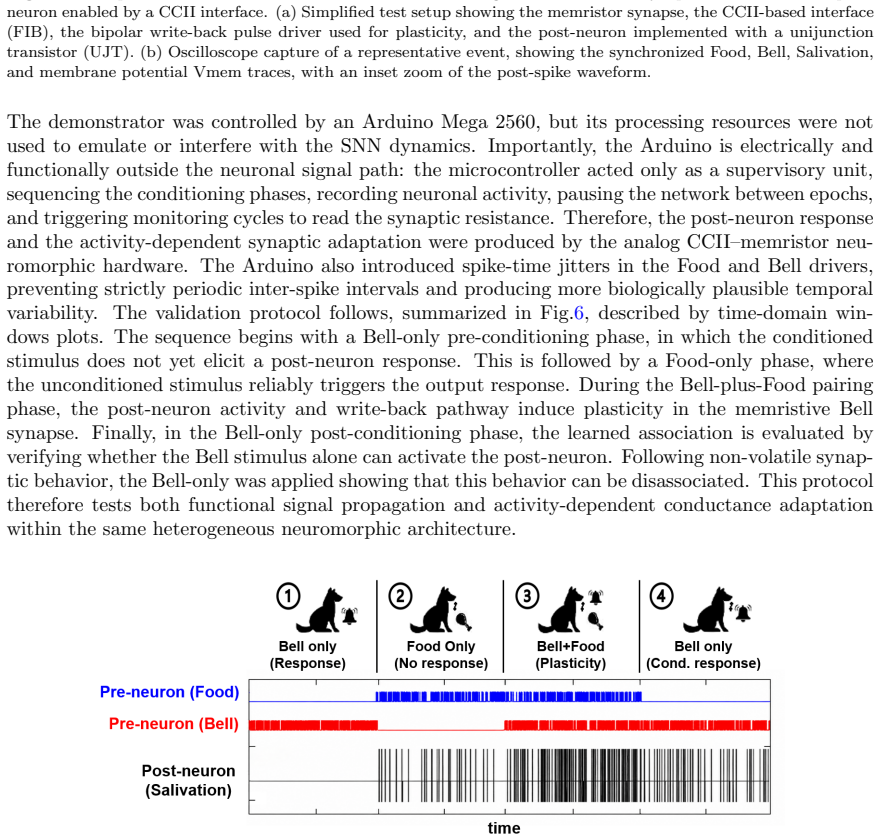
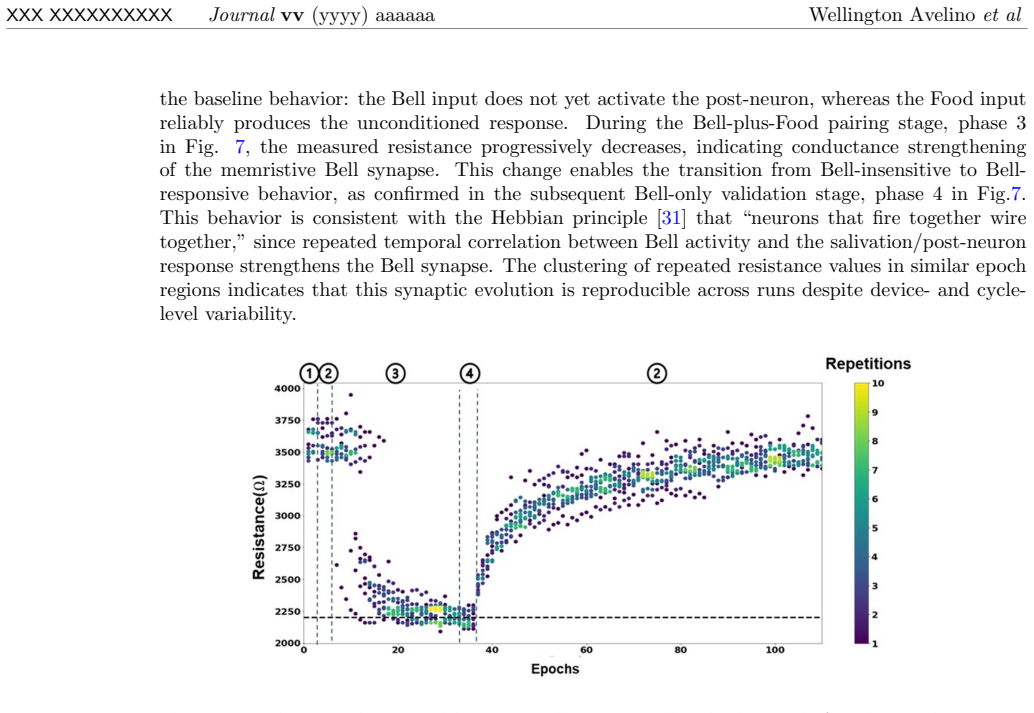
Inter-device connections are described through assigned drive/sense roles and organized into canonical functional interface blocks; a CCII-based composite circuit realizes these primitives, and the resulting framework is validated by correct operation of a Pavlovian-conditioning demonstrator that combines a memristive synapse with a UJT post-neuron.
What carries the argument
The junction-centered interface framework that assigns drive/sense roles at each connection point and assembles them into reusable functional interface blocks.
If this is right
- Designers can compose systems from different device technologies without custom interface circuitry for every pair.
- System behavior can be analyzed from the local role assignments rather than from exhaustive simulation of every device characteristic.
- A small library of blocks realized with current conveyors supplies a practical hardware layer for many device combinations.
- The same role-assignment method can be applied to larger networks once the primitive blocks are verified.
Where Pith is reading between the lines
- The same junction-role method could be used to match devices whose dynamics differ in time scale rather than in steady-state characteristics.
- Software that automatically selects and wires the blocks could turn the framework into a design tool for mixed neuromorphic circuits.
- Adding blocks that enforce timing constraints would extend the approach to systems where phase or frequency mismatch is the dominant problem.
Load-bearing premise
Defining drive and sense roles at junctions and collecting those roles into standard blocks will overcome the operating-regime mismatches that arise when devices with dissimilar dynamics are connected directly.
What would settle it
A test circuit built with the proposed blocks in which the devices still fail to reach the intended operating points because of unaccounted load-line effects.
Figures
read the original abstract
Heterogeneous neuromorphic hardware integrates devices with dissimilar electrical characteristics and dynamics, making functional compatibility at their interconnections a primary design challenge. Direct coupling alone is insufficient to ensure correct operation, because the load-line conditions established at each junction determine the effective operating regime. Here, we propose a junction-centered interface framework in which inter-device connections are described through assigned drive/sense roles and organized into canonical functional interface blocks. As a concrete hardware realization, a second-generation current conveyor (CCII)-based implementation is then adopted as a composite realization of these interface primitives. The framework is validated experimentally in a Pavlovian-conditioning demonstrator combining a memristive synapse with a unijunction-transistor (UJT) post-neuron. By linking local junction conditions to reusable interface functions, the proposed methodology provides a systematic basis for the design and analysis of heterogeneous neuromorphic systems.
Editorial analysis
A structured set of objections, weighed in public.
Referee Report
Summary. The paper proposes a junction-centered interface framework for heterogeneous neuromorphic hardware. Inter-device connections are described by assigning drive/sense roles at junctions and organizing them into canonical functional interface blocks; these are realized in hardware via second-generation current conveyors (CCII) and validated experimentally in a single Pavlovian-conditioning demonstrator that combines a memristive synapse with a unijunction-transistor (UJT) post-neuron.
Significance. If the framework can be shown to generalize, it would supply a reusable, junction-level methodology for ensuring functional compatibility between devices whose I-V characteristics and dynamics differ, addressing a recognized obstacle that direct coupling cannot reliably solve.
major comments (1)
- [Abstract and experimental validation] Abstract and experimental validation section: the central claim that the methodology 'provides a systematic basis for the design and analysis of heterogeneous neuromorphic systems' rests on the assertion that drive/sense assignment plus canonical blocks resolve compatibility for arbitrary dissimilar device dynamics. Only a single Pavlovian demonstrator (memristive synapse + UJT post-neuron realized with CCII primitives) is supplied; no second device pair, no enumeration of failure modes outside the example, and no general derivation mapping blocks to arbitrary I-V curves are given, leaving the scope of the claim untested.
Simulated Author's Rebuttal
We thank the referee for the detailed assessment and for identifying the need to clarify the intended scope of the framework's generality. We respond to the major comment below.
read point-by-point responses
-
Referee: [Abstract and experimental validation] Abstract and experimental validation section: the central claim that the methodology 'provides a systematic basis for the design and analysis of heterogeneous neuromorphic systems' rests on the assertion that drive/sense assignment plus canonical blocks resolve compatibility for arbitrary dissimilar device dynamics. Only a single Pavlovian demonstrator (memristive synapse + UJT post-neuron realized with CCII primitives) is supplied; no second device pair, no enumeration of failure modes outside the example, and no general derivation mapping blocks to arbitrary I-V curves are given, leaving the scope of the claim untested.
Authors: The framework begins from the observation that compatibility at each junction is governed by the drive/sense roles that set the local load-line conditions. These roles are abstracted into a fixed set of canonical functional interface blocks whose definitions are independent of any particular device's I-V curve or dynamics. The CCII implementation then supplies a concrete circuit-level realization of those blocks. The Pavlovian demonstrator confirms that the blocks operate correctly when applied to one heterogeneous pair. We agree that the experimental section contains only a single device pair and does not enumerate failure modes or supply an exhaustive I-V mapping; such additions would require further experimental work beyond the present scope. The claim in the abstract is therefore that the role-based construction itself constitutes a systematic methodology, not that every possible device pair has been exhaustively validated. We are willing to revise the abstract wording to make this distinction explicit. revision: partial
Circularity Check
No circularity: framework is an independent organizing proposal
full rationale
The paper introduces a junction-centered interface framework that assigns drive/sense roles and organizes connections into canonical functional interface blocks, then realizes them via CCII primitives and validates the approach with one Pavlovian-conditioning circuit. No equations, fitted parameters, or self-referential definitions appear in the provided text that would make any claimed result equivalent to its inputs by construction. The central claim is presented as a conceptual methodology rather than a derivation that loops back on itself, and no load-bearing self-citations or uniqueness theorems from the authors are invoked. The derivation chain is therefore self-contained.
Axiom & Free-Parameter Ledger
Reference graph
Works this paper leans on
-
[1]
Mead C 2002Proceedings of the IEEE781629–1636
-
[2]
Indiveri Get al.2011Frontiers in Neuroscience573
-
[3]
Adhikari S Pet al.2012IEEE Transactions on Neural Networks and Learning Systems23 1426–1435
-
[4]
Rozenberg M J, Schneegans O and Stoliar P 2019Scientific Reports911123
-
[5]
Pickett M D, Medeiros-Ribeiro G and Williams R S 2013Nature Materials12114–117
-
[6]
Grollier Jet al.2020Nature Electronics3360–370
-
[7]
Sowmya Net al.2023International Journal of Computing and Digital Systems141–1
-
[8]
Brown T Det al.2024Nature633804–810
-
[9]
Markovi´ c D, Mizrahi A, Querlioz D and Grollier J 2020Nature Reviews Physics2499–510
-
[10]
Series B- Biological Sciences140177–183
Hodgkin A L and Huxley A F 1952Proceedings of the Royal Society of London. Series B- Biological Sciences140177–183
-
[11]
Mahowald M and Douglas R 1991Nature354515–518
-
[12]
Del Valle J, Salev P, Tesler F, Vargas N M, Kalcheim Y, Wang P, Trastoy J, Lee M H, Kassabian G, Ram´ ırez J Get al.2019Nature569388–392
-
[13]
Chicca E, Stefanini F, Bartolozzi C and Indiveri G 2014Proceedings of the IEEE1021367–1388
-
[14]
Yang J J, Pickett M D, Li X, Ohlberg D A, Stewart D R and Williams R S 2008Nature nanotechnology3429–433
-
[15]
Wang Y Fet al.2015Scientific Reports510150
-
[16]
Garg Net al.2024 Versatile cmos analog lif neuron for memristor-integrated neuromorphic circuits2024 International Conference on Neuromorphic Systems (ICONS)(IEEE)
2024
-
[17]
Huang Yet al.2024Nature Reviews Electrical Engineering1286–299
-
[18]
Koo R Het al.2025Device
-
[19]
Li Jet al.2023Nanoscale Horizons81456–1484
-
[20]
Sedra A and Smith K 1970IEEE Transactions on Circuit Theory17132–134
-
[21]
Lecerf G, Tomas J, Boyn S, Girod S, Mangalore A, Grollier J and Sa¨ ıghi S 2014 Silicon neuron dedicated to memristive spiking neural networks2014 IEEE International Symposium on Cir- cuits and Systems (ISCAS)(Melbourne, VIC, Australia: IEEE) pp 1568–1571
2014
-
[22]
Sedra A Set al.2011Microelectronic Circuitsvol 4 (Oxford: Oxford University Press)
-
[23]
Wang Zet al.2020Nature Reviews Materials5173–195
-
[24]
Sarkar Tet al.2022Nature Electronics5774–783
-
[25]
Kim Yet al.2024Scientific Reports148356
-
[26]
Zamarre˜ no-Ramos Cet al.2011Frontiers in Neuroscience526 10 XXX XXXXXXXXXXJournalvv(yyyy) aaaaaa Wellington Avelinoet al
-
[27]
Alexander C K and Sadiku M N O 2021Fundamentals of Electric Circuits7th ed (McGraw-Hill)
-
[28]
Musil R, Prokop V and Prokop R 2009Annual Journal of Electronics73–76
-
[29]
Querlioz Det al.2013IEEE Transactions on Nanotechnology12288–295
-
[30]
El Mesoudy Aet al.2022Microelectronic Engineering255111706
-
[31]
Hebb D O 1949The Organization of Behavior: A Neuropsychological Theory(Wiley) Acknowledgments The authors acknowledge the support of 3iT (Interdisciplinary Institute for Technological Innova- tion) and the Department of Physics of the Universidade Federal de Minas Gerais (UFMG). The authors also thank the colleagues and collaborators who contributed throu...
discussion (0)
Sign in with ORCID, Apple, or X to comment. Anyone can read and Pith papers without signing in.