REVIEW 4 major objections 4 minor 18 references
Parameter Modeling for Small-Scale Mobility in Indoor THz Communication
T0 review · 4 major / 4 minor · reviewed 2026-08-14 · deepseek-v4-flash
Pith's one-line read For moving THz users, beamwidth has a sweet spot
desk verdict Useful engineering intuition about THz beamwidth and mobility, but the headline optimal-beamwidth numbers rest on an unstated rotation-combination rule and are not reproducible as written. read the letter →
The pith
A machine-rendered reading of the paper's core claim, the machinery that carries it, and where it could break.
The reading
What carries the argument
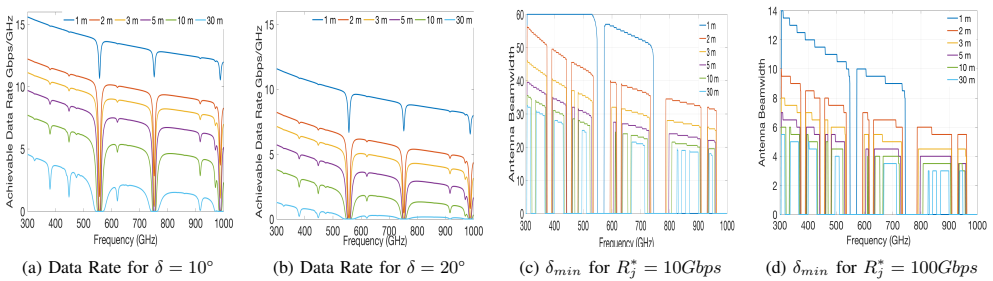
The central mechanism is the 'beamwidth dilemma' expressed through a quantitative trade-off. Antenna gain for a conical main lobe is $G = X/\delta^2$, with $X$ an aperture-dependent constant, so narrower beams give higher gain; but a link is assumed to go into outage when the user's body rotation angle (yaw, pitch, or roll) exceeds the beamwidth $\delta$. The mobility model condenses human motion into the system instability parameter $\Theta$, a six-dimensional vector of position and rotation changes, with per-service-type amplitudes (e.g., S1 uses a $15.5^\circ$ yaw amplitude, S3 only $5^\circ$). The simulation also uses a frequency-window lookup table and a minimum-beamwidth bound $\delta_{\min}$ derived from the Shannon capacity formula, so each scenario has an outage-limited coverage curve with a clear maximum. That maximum is the paper's optimal beamwidth $\delta_{\mathrm{opt}}$, and its location shifts with both the $\Theta$ statistics of the service type and the access-point geometry.
What would settle it
Take the three service classes (VR gaming, walking, sitting), measure real head and torso rotation amplitudes with a motion-capture device across a population, and run the same coverage simulation with those measured amplitudes; if the resulting beamwidth at peak coverage differs by more than a few degrees from the paper's 23 and 25 degree values, or if the outage curve loses its interior maximum, the model's rotation assumptions are unrepresentative. A direct wireless test—sweeping beamwidth on an indoor THz link while a person plays a VR game—would settle the same question empirically.
Extended reading notes
Core claim
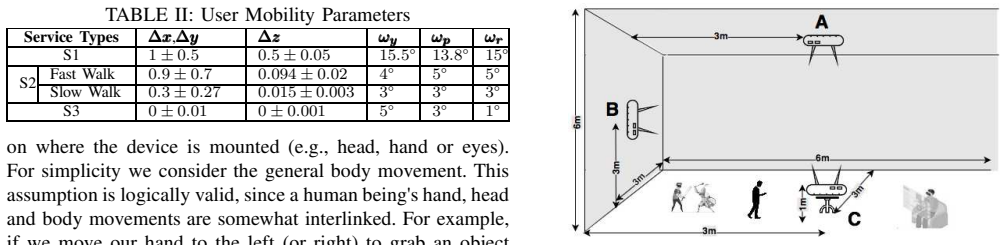
The central claim is that for mobile users there exist optimal beamwidths that are affected by the mobility type (high, constrained, low) and access-point placement, and that these optima are computable from a small set of mobility parameters. For a static user, the paper derives a theoretical lower bound on beamwidth from the requested data rate, frequency window, distance, and antenna aperture. For mobile users, it introduces the system instability parameter $\Theta = [\Delta x, \Delta y, \Delta z, \Delta \omega_{\mathrm{yaw}}, \Delta \omega_{\mathrm{pitch}}, \Delta \omega_{\mathrm{roll}}]$, which captures both translation and rotation of the device, and assigns typical values to three service types: S1 (high mobility, e.g., intense VR gaming), S2 (constrained mobility, fast and slow walking), and S3 (low mobility, sitting/standing). Using a random-waypoint simulation with these $\Theta$ patterns and three access-point placements (ceiling, wall, and table), the paper finds that while throughput generally rises as the access point moves closer to users, user coverage is maximized at an intermediate beamwidth: for S1 users the optimum is $\delta_{\mathrm{opt}} = 23^\circ$ for wall placement and $\delta_{\mathrm{opt}} = 25^\circ$ for table placement, while S2 and S3 reach their coverage optima at lower beamwidths. This directly addresses the beamwidth dilemma: narrower beams give higher gain but suffer outages when body rotation exceeds the beamwidth, so the best beamwidth balances gain against rotation-induced misalignment.
Load-bearing premise
The load-bearing premise is that a link outage occurs whenever a user's body rotation (yaw, pitch, or roll) exceeds the antenna beamwidth, and that the rotation amplitudes assigned to each service type—borrowed from separate motion studies of running, walking, and VR tracking—accurately represent indoor user behavior.
Editorial extensions
If this is right
- An indoor THz access point can improve the number of satisfied users by dynamically steering beamwidth to the $\delta_{\mathrm{opt}}$ of its dominant mobility class instead of always using the narrowest beam.
- Wall and table placements are better than ceiling placement for capturing yaw and pitch movements, so single-AP deployments for walking or sedentary users should favor lower, closer antenna positions.
- For high-mobility services like VR gaming, coverage is maximized at beamwidths around 23 to 25 degrees, not at single-digit beamwidths which would suffer frequent rotation outages.
- Frequency-window selection and beamwidth tuning are interdependent: the static minimum beamwidth bound from target data rate and distance sets a floor, and mobility pushes the operating point above that floor.
- The service-type classification (S1/S2/S3) with its $\Theta$ parameter set can serve as a control input for adaptive beamforming in future THz systems.
Reading between the lines
- If the mobility amplitudes were measured directly from real users in each service class, the $\delta_{\mathrm{opt}}$ values would likely shift, but the qualitative structure—an interior optimum set by the balance of gain and rotation-induced outage—should persist for any unimodal rotation distribution.
- The same $\Theta$-based outage model could be applied to reconfigurable intelligent surfaces or multi-AP cooperative systems, where the optimal beam pattern might be a function of the dominant instability direction rather than a single scalar $\delta$.
- A natural field test would be to run a VR session with an indoor THz link and sweep beamwidth while logging packet errors; the resulting coverage curve should peak near the predicted $\delta_{\mathrm{opt}}$ if the model's rotation amplitudes are representative.
- The paper's static minimum-beamwidth bound suggests a quick heuristic: choose the smallest beamwidth that satisfies the rate requirement at the maximum expected user distance, then broaden it just enough to cover the largest expected rotation amplitude.
Signed reviews
Editorial analysis
A structured set of objections, weighed in public.
Referee Report
Summary. The paper considers indoor THz communication with a single access point (AP) and studies how system parameters—humidity, distance, frequency windows, antenna beamwidth, AP placement, and user mobility type—affect throughput and user coverage. It first develops a static model that selects frequency windows based on distance and water-vapor concentration, and derives a closed-form minimum beamwidth for a target data rate (Eq. 2). It then introduces a mobility model characterized by a six-dimensional instability parameter Θ = [Δx, Δy, Δz, Δω_y, Δω_p, Δω_r], classifies users into three service types (S1 high mobility, S2 constrained mobility with fast/slow walking, S3 low mobility), and simulates a random-waypoint indoor scenario with three AP placements to evaluate peak throughput and average user coverage as a function of beamwidth. The central claim is that for mobile users there exist mobility- and placement-dependent optimal beamwidths—for example, δopt = 23° for S1 in Scenario B and δopt = 25° in Scenario C—which resolve the 'beamwidth dilemma' between antenna gain and rotation-induced outage.
Significance. If the quantitative results are reliable, the paper provides a useful parameter-based approach for adaptive beamwidth selection in indoor THz networks, addressing a real deployment concern: narrow beams increase gain but are sensitive to small-scale body/device motion. The static model with Eq. (2) gives a simple closed-form bound, and the instability-parameter framework is a reasonable way to organize mobility scenarios. The qualitative finding that the optimal beamwidth depends on mobility class and AP placement is plausible and consistent with prior work on small-scale mobility in THz/mmWave bands. However, the paper's main quantitative contribution rests on a simulator whose outage model and instance parameters are not fully specified, and the reported optima appear to imply an unstated combination rule for the rotation components; this limits the reproducibility and transferability of the specific δopt values until the missing details are supplied.
major comments (4)
- [Section IV, Fig. 6 and Table II] The outage model that maps the six-dimensional instability parameter Θ to a beamwidth-dependent outage is never written down. The text in Section IV states that outages occur when 'the rotation angle of the body (yaw, pitch, and roll) is higher than the beamwidth', but it does not specify how the three rotation components are combined into a single angle. This is load-bearing because Table II lists S1 peak rotations of ω_y = 15.5°, ω_p = 13.8°, and ω_r = 15°; under a max-component rule the coverage-optimal beamwidth for S1 would be just above 15.5°, yet the paper reports δopt = 23° (Scenario B) and 25° (Scenario C), values close to the Euclidean norm of the three rotations (≈25.6°). The apparent use of an unstated norm-like combination rule makes the headline numerical results non-reproducible from the text alone.
- [Section IV, Figs. 5 and 6] The simulation instance is underspecified. The number of active users M, room dimensions, simulation duration, random-waypoint parameters, the noise applied to the rotational movements, and the threshold used for 'clipping off the data rate dips' in the frequency-window selection are not reported. Without these values, the coverage curves in Fig. 6 and the quantitative ranking of Scenarios A, B, and C cannot be audited, reproduced, or transferred to a different room geometry.
- [Table II and Sections III–IV] The mobility amplitudes assigned to the three service types are taken from unrelated motion-capture studies (walking [15,16], running [17], VR tracking [18]) and mapped to S1/S2/S3 by hand, and the sinusoidal rotation pattern is described only verbally. Because the optimal beamwidth is largely dictated by these amplitude choices, the paper should either justify their representativeness for the target THz device placements (head, hand, body) or provide a sensitivity analysis showing how δopt changes with the amplitude assumptions; otherwise the specific optimal values are an artifact of the chosen table.
- [Section IV, Fig. 6] The paper should explicitly acknowledge that the existence of an optimal beamwidth is a direct consequence of the assumed outage model: if outages occur whenever the rotation angle exceeds the beamwidth, then any δ below the characteristic rotation amplitude yields high outage probability and any δ above it eliminates rotation-induced outage, so the existence of a peak is built into the simulation. The contribution is therefore the parameterization and the specific tradeoff curves, not the qualitative existence of an optimum; this distinction should be stated clearly to avoid overclaiming.
minor comments (4)
- [Section II, Equations] The equation numbering is inconsistent: the capacity expression is labelled 'Equation 2' in the text but is actually the first numbered equation, and subsequent references to 'Equation 2' point to the δmin formula; please renumber the equations.
- [Section IV and Conclusion] There are several typos: 'standard division' should be 'standard deviation', 'Eucladian' should be 'Euclidean' in Section II, and 'econonomically' in the Conclusion should be 'economically'.
- [Table I] The column headings 'Average Center Frequencies' and 'Average Bandwidths' are misleading because each cell lists several distinct window values rather than an average; the count column format '4 (≥ 50Ghz), 0( < 50Ghz)' should be explained in the caption.
- [Fig. 1 and Fig. 3] Figure 1 captions should define LA and LT (absorption loss and total path loss) at first use, and the small fonts in the figures reduce readability; Fig. 3 would benefit from a reference to the Six-DoF axes being shown in the bottom-right panel.
Circularity Check
No significant circularity; the reported beamwidth optima are nontrivial simulation outputs, not restatements of the model inputs.
full rationale
The paper's central quantitative claims—δopt ≈ 23° for Scenario B and 25° for Scenario C for S1 users—are simulation outputs obtained from a stated tradeoff, not definitions. The outage premise ('If the rotation angle of the body (yaw, pitch, and roll) is higher than the beamwidth of the antenna, there are likely to be higher outages') makes beamwidth-versus-rotation the mechanism, but the numerical optima are not equal to any single input in Table II; they emerge from the interaction of the antenna gain model (G = X/δ²), the target data rate, AP placement, random waypoint positions, and rotation noise. The qualitative ordering (high-mobility users need wider beams) is an expected consequence of the explicit outage model, but an expected consequence of a stated assumption is not circularity: the paper does not fit or redefine the optimum as the input rotation amplitude, and the amplitude values are cited from external motion studies [15]–[18]. The only self-citation ([13]) supplies a standard capacity expression and is not load-bearing. The underspecification of how yaw, pitch, and roll combine into a single 'rotation angle' is a reproducibility and validity concern, not a circular reduction of the output to the input. No derivation step in the paper equates its conclusion to its premise by construction.
Assumptions & free parameters
free parameters (3)
- Frequency-window clipping threshold =
Unspecified
- Service-type mobility parameters (Table II) =
e.g., S1: Δx=1±0.5, yaw=15.5°, pitch=13.8°, roll=15°
- Simulation instance parameters (M, room dimensions, duration, rotation noise) =
Unspecified
assumptions (6)
- standard math Shannon capacity R = B log2(1 + SNR)
- domain assumption Perfect conical antenna main lobe with gain G = X/δ², equal horizontal and vertical beamwidths
- domain assumption ITU-R P.676 atmospheric attenuation model for total path loss
- domain assumption Random waypoint model for user positions
- domain assumption Body rotations are sinusoidal with amplitudes from Table II
- ad hoc to paper Outage occurs when body rotation angle exceeds beamwidth
invented entities (1)
-
System instability parameter Θ = [Δx, Δy, Δz, Δω_y, Δω_p, Δω_r]
Cite this review
Pith. "Pith review of Parameter Modeling for Small-Scale Mobility in Indoor THz Communication." pith.science (2026). https://pith.science/paper/JGD3ASY5
@misc{pith2026190809047,
  author       = {Pith},
  title        = {Pith review of: Parameter Modeling for Small-Scale Mobility in Indoor THz Communication},
  year         = {2026},
  howpublished = {\url{https://pith.science/paper/JGD3ASY5}},
  note         = {Machine review of arXiv:1908.09047}
}
read the original abstract
Despite such challenges as high path loss and equipment cost, THz communication is becoming one of the potentially viable means through which ultra-high data rate can be achieved. To compensate for the high path loss, we present parameter modeling for indoor THz communication. To maximize efficient and opportunistic use of resources, we analyze the potential workarounds for a single access point to satisfy most of the mobile terminals by varying such parameters as humidity, distance, frequency windows, beamwidths, antenna placement, and user mobility type. One promising parameter is antenna beamwidth, where narrower beams results in higher antenna gain. However, this can lead to "\textit{beamwidth dilemma}" scenario, where narrower beamwidth can result in significant outages due to device mobility and orientation. In this paper, we address this challenge by presenting a mobility model that performs an extensive analysis of different human mobility scenarios, where each scenario has different data rate demands and movement patterns. We observe that for mobile users, there are optimal beamwidths that are affected by the mobility type (high mobility, constrained mobility, and low mobility) and AP placement.
Figures


Figures from the paper (4 more)


Reference graph
Works this paper leans on
-
[17]
T. Otani, et.al, “Upper-Body Control and Mechanism of H umanoids to Compensate for Angular Momentum in the Y aw Direction Based o n Human Running,” in Proc. IEEE International Conference on Robotics and Automation (ICRA) , 2017
work page 2017
-
[18]
D.C. Niehorster, L. Li, M. Lappe, “The Accuracy and Prec ision of Position and Orientation Tracking in the HTC Vive Virtual Re ality System for Scientific Research,” Iperception, vol. 8, no. 3, 2017
work page 2017
-
[1]
E. C. Strinati, et.al., “6G: The Next Frontier,” Jan 2019 . Available: https://arxiv.org/abs/1901.03239
work page Pith review arXiv 2019
-
[2]
Millimeter-Wave Enhanced Local Area Systems: A High-Data-Rate Approach for Future Wireless Networks,
A. Ghosh, et.al., “Millimeter-Wave Enhanced Local Area Systems: A High-Data-Rate Approach for Future Wireless Networks,” IEEE Journal on Selected Areas in Communications , vol. 32, no. 6, pp. 1152-1163, June 2014
work page 2014
-
[3]
IEEE 802.11ay: Next-Generation 60 GHz Communication for 100 Gb/ s Wi- Fi,
Y . Ghasempour, C. R. C. M. da Silva, C.Cordeiro, E. W. Knig htly, “IEEE 802.11ay: Next-Generation 60 GHz Communication for 100 Gb/ s Wi- Fi,” IEEE Communications Magazine , vol. 55, no. 12, pp. 186-192, Dec 2017
work page 2017
-
[4]
Attenuation by atmospheric gases-P Series Radiowa ve propaga- tion,
Radiocommunication Sector of International Telecommu nication Union (ITU), “Attenuation by atmospheric gases-P Series Radiowa ve propaga- tion,” Tech.Rep. ITU-R P .676-10, 2013
work page 2013
-
[5]
TeraNets: ultra-br oadband com- munication networks in the terahertz band,
I. F. Akyildiz, J. M. Jornet, C. Han, “TeraNets: ultra-br oadband com- munication networks in the terahertz band,” IEEE Wireless Communi- cations, vol. 21, no. 4, pp. 130-135, Aug 2014
work page 2014
-
[6]
A Di stance and Bandwidth Dependent Adaptive Modulation Scheme for THz Com mu- nications,
A. A. Boulogeorgos ; E. N. Papasotiriou; A. Alexiou, “A Di stance and Bandwidth Dependent Adaptive Modulation Scheme for THz Com mu- nications,” in Proc. of IEEE 19th International W orkshop on Signal Processing Advances in Wireless Communications (SPAWC) , Jun. 2018
work page 2018
Show all 18 references
-
[7]
Multi-Ray Channel Mo deling and Wideband Characterization for Wireless Communication s in the Terahertz Band,
C. Han, A. O. Bicen, I. F. Akyildiz, “Multi-Ray Channel Mo deling and Wideband Characterization for Wireless Communication s in the Terahertz Band,” IEEE Transactions on Wireless Communications , vol. 14, no. 5, pp. 2402 - 2412, May 2015
2015
-
[8]
InferBeam: A Fast Beam Alig n- ment Protocol for Millimeter-wave Networking,
Q. Z. Sai, H.T. Kung, Y . Gwon, “InferBeam: A Fast Beam Alig n- ment Protocol for Millimeter-wave Networking,” [online] A vailable: https://arxiv.org/pdf/1802.03373.pdf
-
[9]
Indoor Terahertz Communications: How M any Antenna Arrays Are Needed?,
C. Lin, G. Y . Li, “Indoor Terahertz Communications: How M any Antenna Arrays Are Needed?,” IEEE Transactions on Wireless Com- munications, vol. 14, no. 6, pp. 3097-3107, Jun 2015
2015
-
[10]
Link Budget Analysis for Terahe rtz Fixed Wireless Links,
T. Schneider, et.al., “ Link Budget Analysis for Terahe rtz Fixed Wireless Links,” IEEE Transactions on Terahertz Science and Technology , vol. 2, no. 2, pp. 250-256, 2012
2012
-
[11]
The effect of small-scale mobility on terahertz band communications,
V . Petrov, D. Moltchanov, Y . Koucheryavy, J. M. Jornet, “The effect of small-scale mobility on terahertz band communications, ” in Proc. of the 5th ACM International Conference on Nanoscale Computin g and Communication (NANOCOM) , no. 40, Sept. 2018
2018
-
[12]
Recent advances in augmented realit y,
R. Azuma, et.al., “Recent advances in augmented realit y,” IEEE Com- puter Graphics and Applications , vol. 21, no. 6, pp. 34-47, 2001
2001
-
[13]
Improving User Cov erage Through Resource Aware Handoff Management in Heterogeneou s Net- works,
R. Singh, S. Mukherjee, S. C. Ghosh, “Improving User Cov erage Through Resource Aware Handoff Management in Heterogeneou s Net- works,” in Proc. 13th International Conference on Advances in Mobile Computing and Multimedia (MoMM) , Dec. 2015, pp. 179-188
2015
-
[14]
Gain of Directional Antennas,
J. E. Hill, “Gain of Directional Antennas,” Watkins-Jo hnson Company Tech-notes, 1976. Tech.Rep
1976
-
[15]
The up and do wn bobbing of human walking: a compromise between muscle work and effici ency
F. Massaad, T. M. Lejeune, C. Detrembleur, “The up and do wn bobbing of human walking: a compromise between muscle work and effici ency.” J. Physiol , vol. 582, no. 2, pp. 789-799, 2007
2007
-
[16]
Interaction o f the body, head, and eyes during walking and turning,
T. Imai, S. T. Moore, T. Raphan, B. Cohen, “Interaction o f the body, head, and eyes during walking and turning,” Exp Brain Res, Springer , vol. 136, no. 1, pp. 1-18, 2001
2001
Reviewed August 14, 2026 · model on record in the stance chip above.
Discussion (0). Continue with ORCID to comment.