pith. sign in

arxiv: 1907.01479 · v2 · pith:JHA3KEAHnew · submitted 2019-07-02 · 🧮 math.NA · cs.NA

Analytic and directional wavelet packets in the space of periodic signals

Pith reviewed 2026-05-25 10:39 UTC · model grok-4.3

classification 🧮 math.NA cs.NA
keywords wavelet packetsanalytic waveletsdirectional waveletsspline waveletsimage restorationsignal processingperiodic signalscomplex wavelets
0
0 comments X

The pith

Quasi-analytic wavelet packets from discrete splines add directional selectivity and antisymmetric components for signal and image restoration.

A machine-rendered reading of the paper's core claim, the machinery that carries it, and where it could break.

The paper builds a library of complex-valued wavelet packets whose real parts reuse existing real orthonormal spline packets while the imaginary parts supply antisymmetric complements. Tensor products of the one-dimensional versions produce two-dimensional packets pointing in many distinct directions, reaching 62 orientations at decomposition level four. The construction supports fast transforms and is shown to restore images corrupted by additive noise or by the absence of up to 90 percent of their pixels.

Core claim

Quasi-analytic complex wavelet packets are formed by pairing each regular spline-based orthonormal packet with a complementary antisymmetric packet; their tensor-product extensions supply oriented two-dimensional bases that enable efficient processing of periodic signals and images, including restoration from heavy noise or large missing-data fractions.

What carries the argument

Quasi-analytic wavelet packets obtained by adjoining regular orthonormal spline packets to their complementary antisymmetric counterparts, then taking tensor products to create multi-directional two-dimensional packets.

If this is right

  • Images missing up to 90 percent of their pixels can be restored by decomposition and coefficient selection in the directional packets.
  • The same packets support additive-noise removal while preserving directional features at multiple scales.
  • Arbitrary spline orders allow the user to tune the smoothness of the basis functions to the regularity of the target signal.
  • The fast transform algorithm makes the full library practical for repeated application on large data sets.

Where Pith is reading between the lines

These are editorial extensions of the paper, not claims the author makes directly.

  • The antisymmetric imaginary parts may capture phase or odd-symmetry features that improve reconstruction of edges or textures.
  • The explicit directional set could be used to design orientation-selective filters for tasks such as texture classification.
  • Because the packets are defined on periodic signals, direct extension to non-periodic domains would require additional boundary handling.

Load-bearing premise

The quasi-analytic pairing and its directional tensor-product versions deliver measurable gains in restoration tasks beyond those already obtained with the real-valued spline packets alone.

What would settle it

An experiment that applies both the new quasi-analytic packets and the earlier real spline packets to identical restoration tasks and finds no reduction in error for the complex versions would falsify the claim of practical advantage.

Figures
Figures reproduced from arXiv: 1907.01479 by Amir Averbuch, Pekka Neittaanmaki, Valery Zheludev.

Figure 2
Figure 2. Figure 2: displays the discrete-spline wavelet packets [PITH_FULL_IMAGE:figures/full_fig_p005_2.png] view at source ↗
Figure 2.1
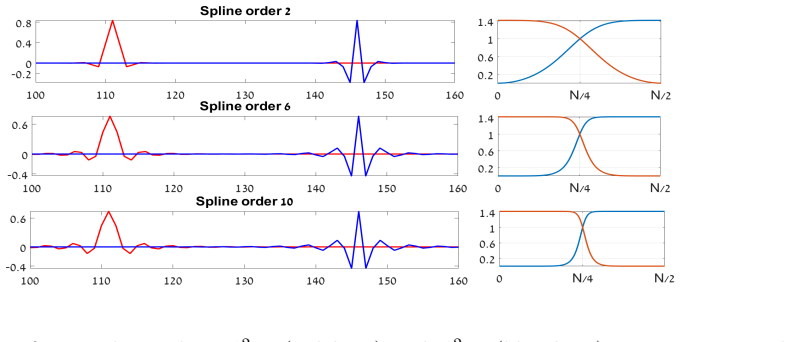
Figure 2.1. Figure 2.1: Left: wavelet packets ψ 2r [1],0 (red lines) and ψ 2r [1],1 (blue lines), r = 1, 3, 5. Right: magnitude spectra of ψ 2r [1],0 (red lines) and ψ 2r [1],1 (blue lines) 2.3 One-level wavelet packet transform of a signal The transform of a signal x ∈ Π[N] into the pair n y 0 [1], y 1 [1]o of signals from Π[N/2] is referred to as the one-level wavelet packet transform (WPT) of the signal x. According to Propo… view at source ↗
Figure 2
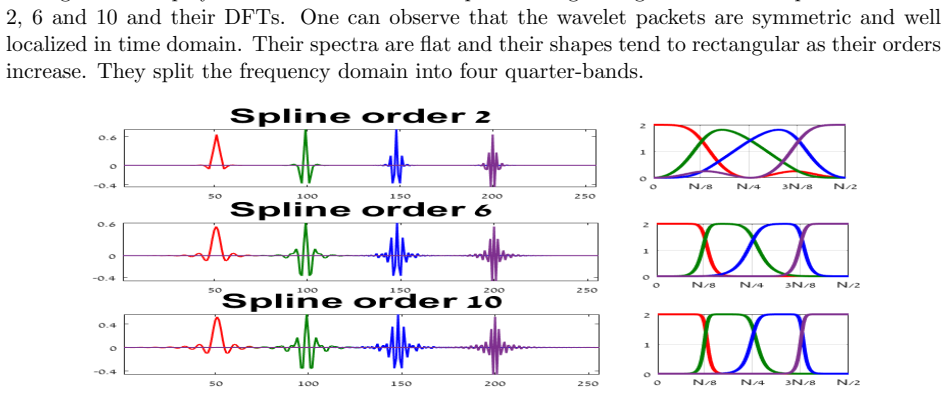
Figure 2. Figure 2: displays the second-level wavelet packets originating from discrete splines of orders [PITH_FULL_IMAGE:figures/full_fig_p008_2.png] view at source ↗
Figure 2.2
Figure 2.2. Figure 2.2: Left: second-level discrete-spline wavelet packets of different orders; left to right: [PITH_FULL_IMAGE:figures/full_fig_p008_2_2.png] view at source ↗
Figure 2
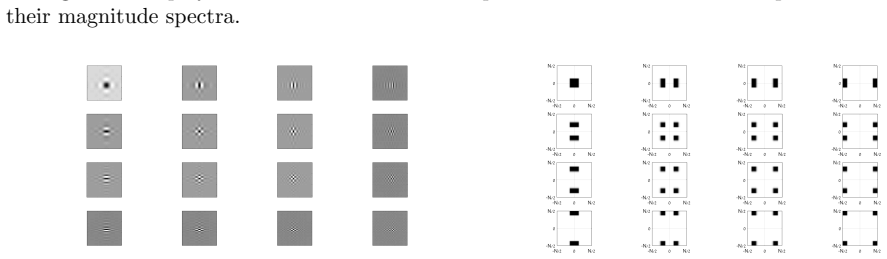
Figure 2. Figure 2: displays the tenth-order 2D wavelet packets from the second decomposition level and [PITH_FULL_IMAGE:figures/full_fig_p010_2.png] view at source ↗
Figure 2.3
Figure 2.3. Figure 2.3: WPs from the second decomposition level (left) and their magnitude spectra (right) [PITH_FULL_IMAGE:figures/full_fig_p010_2_3.png] view at source ↗
Figure 3
Figure 3. Figure 3: displays the wavelet packets [PITH_FULL_IMAGE:figures/full_fig_p013_3.png] view at source ↗
Figure 3.1
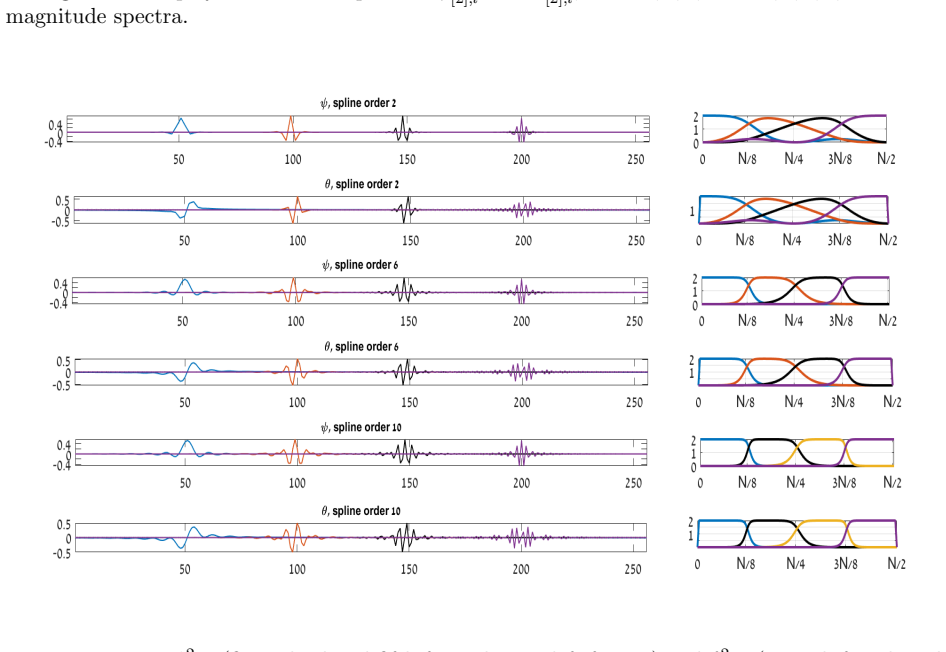
Figure 3.1. Figure 3.1: displays the wavelet packets ψ 2r [2],l and θ 2r [2],l, r = 1, 3, 5, l = 0, 1, 2, 3, and their magnitude spectra [PITH_FULL_IMAGE:figures/full_fig_p013_3_1.png] view at source ↗
Figure 3
Figure 3. Figure 3: displays the signals [PITH_FULL_IMAGE:figures/full_fig_p014_3.png] view at source ↗
Figure 3.2
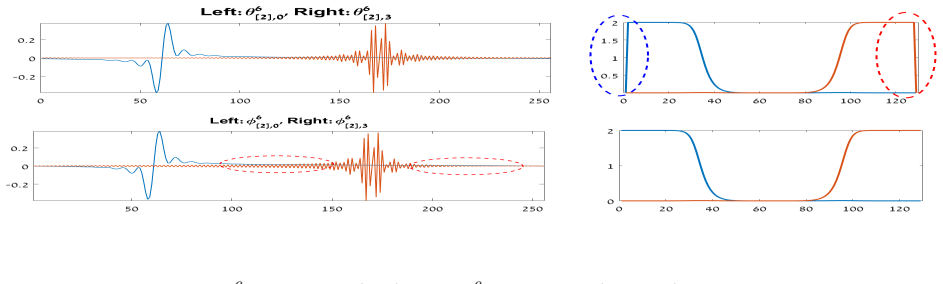
Figure 3.2. Figure 3.2: Left: signals θ 6 [2],l, l = 0, 3 (top), and ϕ 6 [2],l, l = 0, 3 (bottom). Right: their magnitude DFT spectra, respectively We call the signals n ϕ 2r [m],lo , m = 1, ..., M, l = 0, ..., 2 m − 1, the complementary wavelet packets (cWPs). Similarly to the WPs n ψ 2r [m],lo , differenent combinations of the cWPs can provide differenent orthonormal bases for the space Π[N]. These can be, for example, the wa… view at source ↗
Figure 4.1
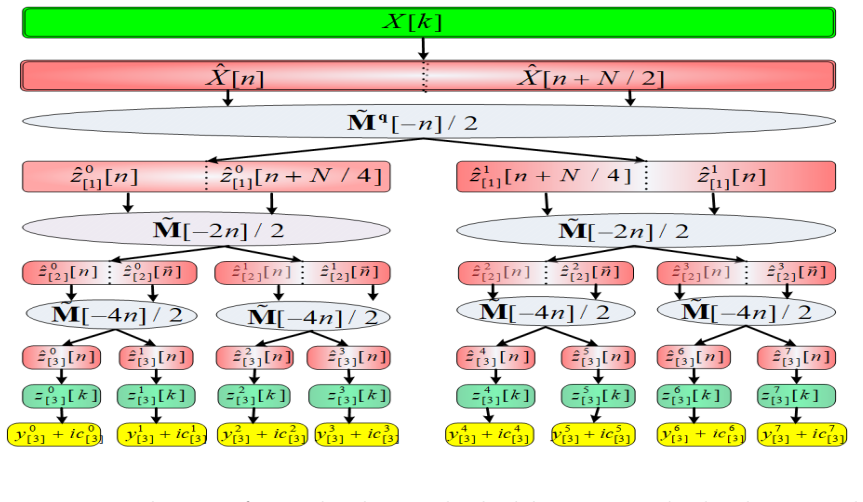
Figure 4.1. Figure 4.1: Forward qWTP of a signal X down to the third decomposition level with quasi-analytic wavelet packets. Here ~n means n + N/8 [PITH_FULL_IMAGE:figures/full_fig_p021_4_1.png] view at source ↗
Figure 4.2
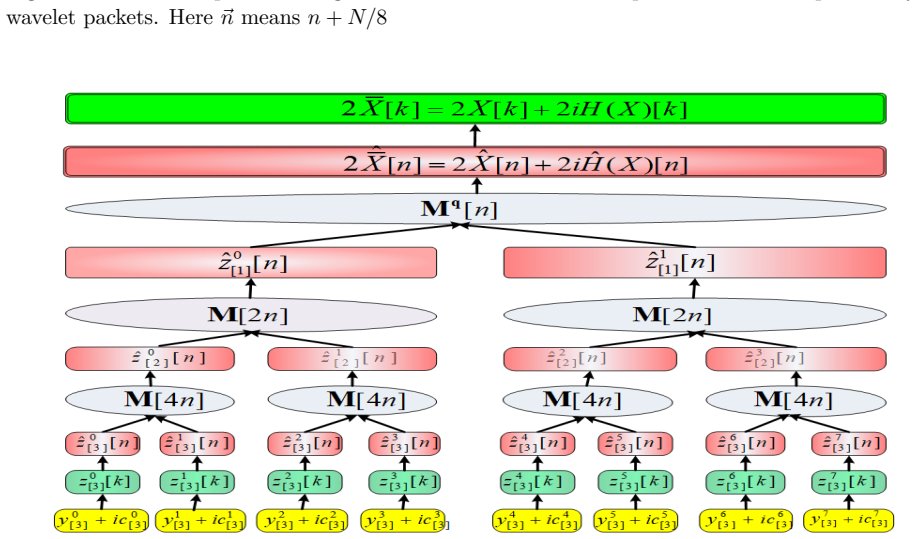
Figure 4.2. Figure 4.2: Inverse qWTP from the transform coefficients from the third decomposition level that [PITH_FULL_IMAGE:figures/full_fig_p021_4_2.png] view at source ↗
Figure 5.1
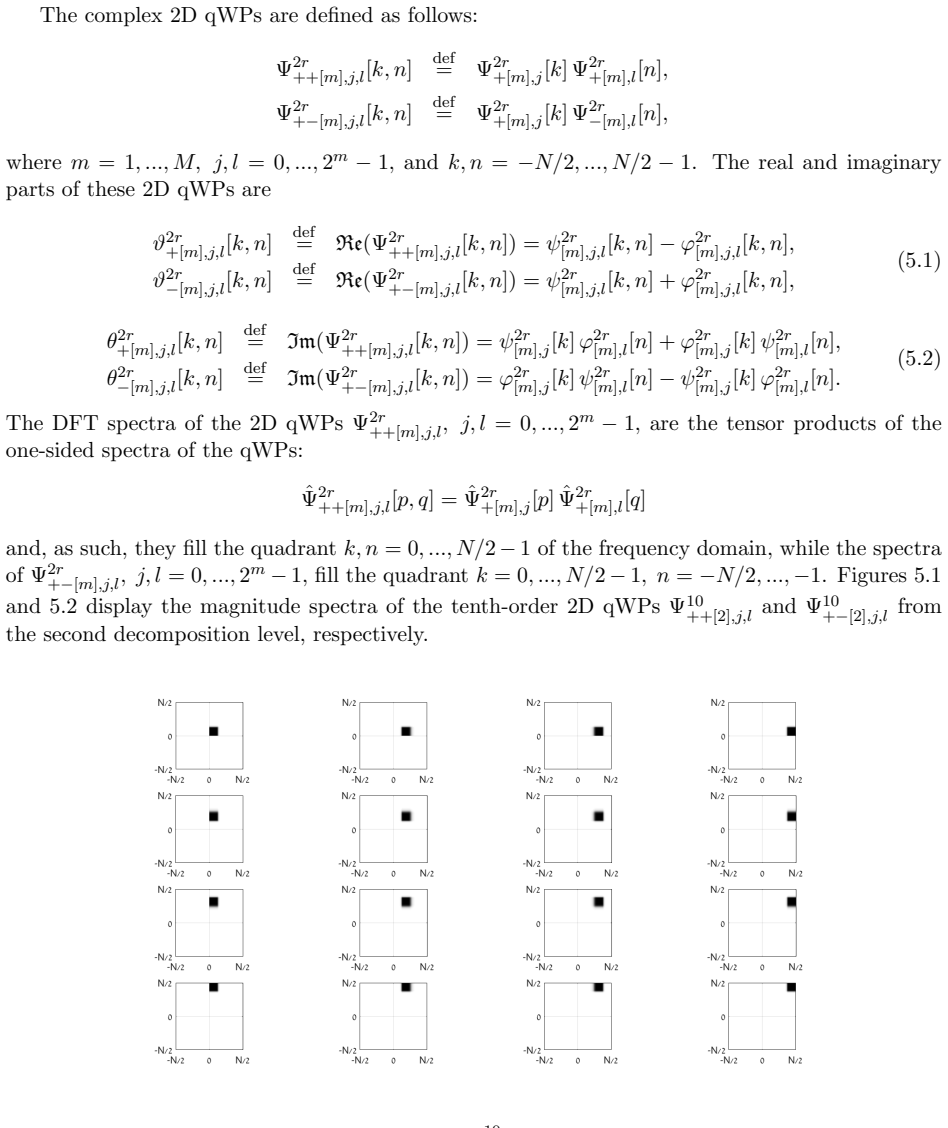
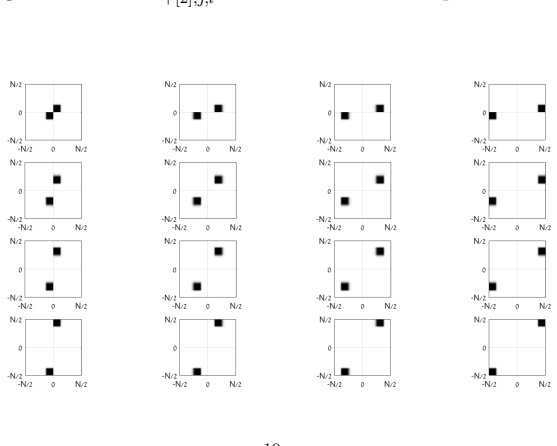
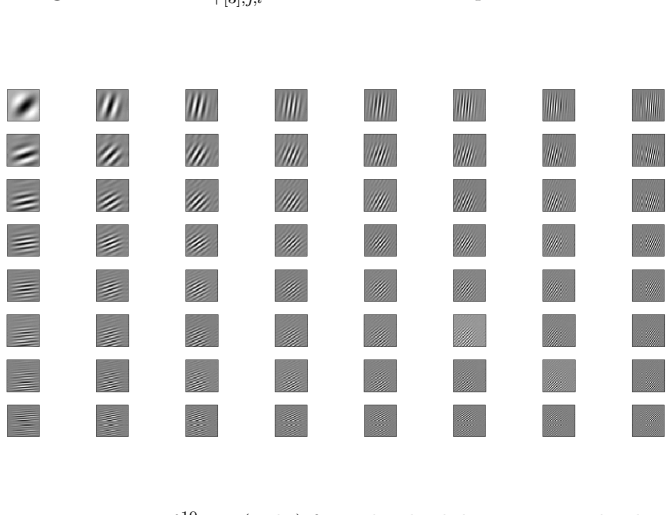
Figure 5.1. Figure 5.1: Magnitude spectra of 2D qWPs Ψ10 ++[2],j,l from the second decomposition level 23 [PITH_FULL_IMAGE:figures/full_fig_p023_5_1.png] view at source ↗
Figure 5.2
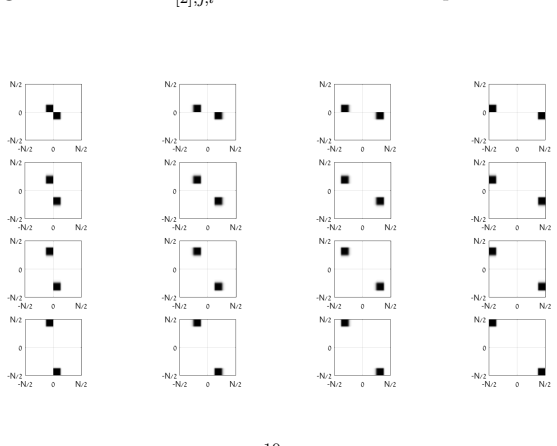
Figure 5.2. Figure 5.2: Magnitude spectra of 2D qWPs Ψ10 +−[2],j,l from the second decomposition level Remark 5.1 The 2D qWPs Ψ2r +±[m],j,l are the tensor products of 1D qWPs from the decomposition level m. However, there is no problems to design the 2D qWPs as a tensor products of 1D qWPs from different decomposition levels such as Ψ2r +±[m,s],j,l[k, n] def = Ψ2r +[m],j [k] Ψ2r ±[s],l[n]. 5.1.2 Directionality of real-valued 2D… view at source ↗
Figure 5.3
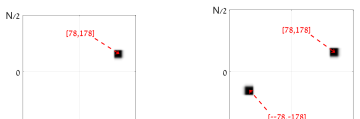
Figure 5.3. Figure 5.3: Magnitude spectra of 2D qWP Ψ (left) and Re(Ψ) = ϑ (right) the vector V~ ++[2],2,5 = 178~i + 78~j. The 2D WP ϑ[k, n] is well localized in the spatial domain as is seen from Eq. (5.1) and the same is true for the low-frequency signal ϑ. Therefore, WP ϑ[k, n] can be regarded as the directional cosine modulated by the localized low-frequency signal ϑ. The same arguments, which to some extent are similar to … view at source ↗
Figure 5.4
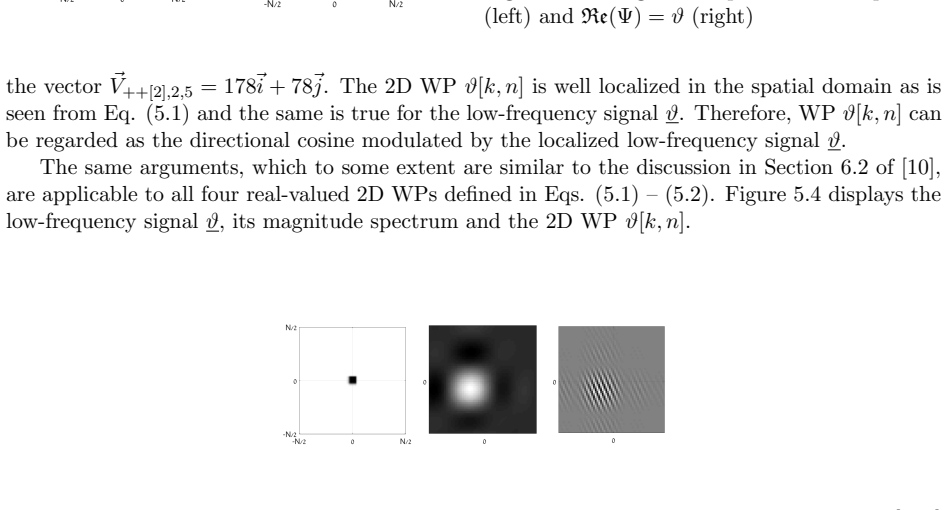
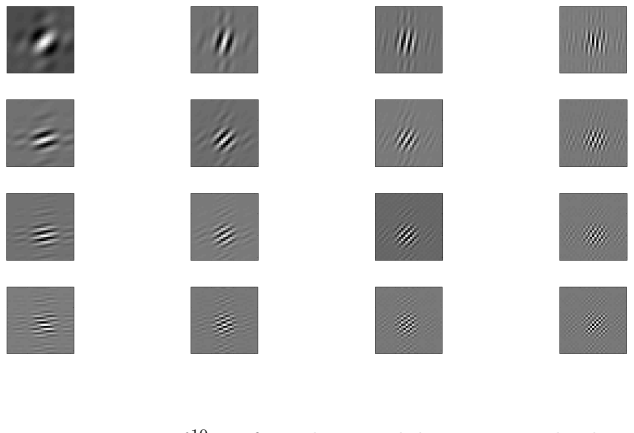
Figure 5.4. Figure 5.4: Center: Low-frequency signal ϑ. Left: Its magnitude spectrum. Right: 2D WP ϑ[k, n] Figures 5.5 and 5.6 display WPs ϑ 10 +[2],j,l, j, l = 0, 1, 2, 3, from the second decomposition level and their magnitude spectra, respectively. Figures 5.7 and 5.8 display WPs ϑ 10 −[2],j,l, j, l = 0, 1, 2, 3, from the second decomposition level and their magnitude spectra, respectively. 25 [PITH_FULL_IMAGE:figures/full_… view at source ↗
Figure 5.5
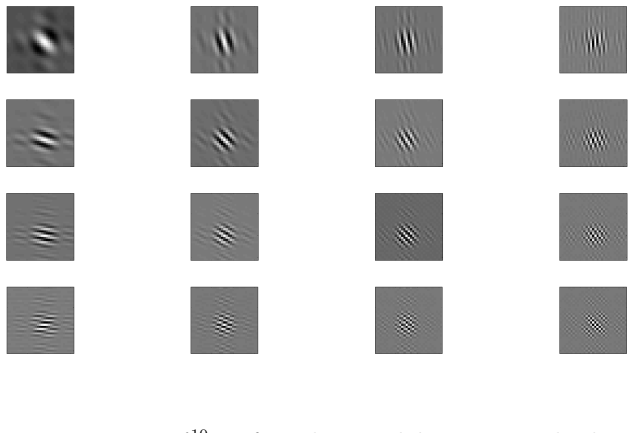
Figure 5.5. Figure 5.5: WPs ϑ 10 +[2],j,l from the second decomposition level [PITH_FULL_IMAGE:figures/full_fig_p026_5_5.png] view at source ↗
Figure 5.6
Figure 5.6. Figure 5.6: Magnitude spectra of WPs ϑ 10 +[2],j,l from the second decomposition level 26 [PITH_FULL_IMAGE:figures/full_fig_p026_5_6.png] view at source ↗
Figure 5.7
Figure 5.7. Figure 5.7: WPs ϑ 10 −[2],j,l from the second decomposition level [PITH_FULL_IMAGE:figures/full_fig_p027_5_7.png] view at source ↗
Figure 5.8
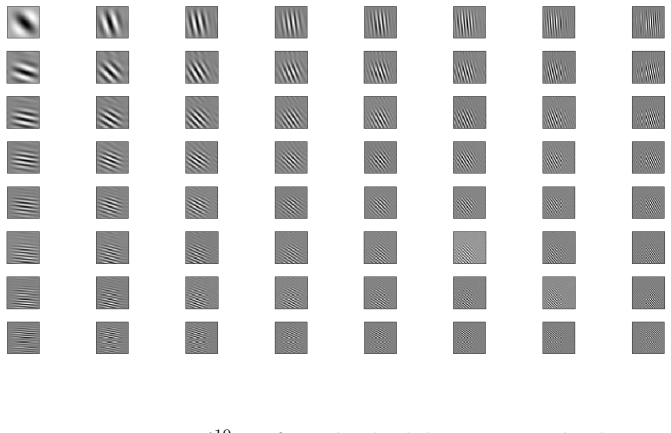
Figure 5.8. Figure 5.8: Magnitude spectra of WPs ϑ 10 −[2],j,l from the second decomposition level Remark 5.2 Note that orientations of the vectors V~ ++[m],j,l and V~ ++[m],j+1,l+1 are approximately the same. These vectors determine the orientations of the WPs ϑ 2r +[m],j,l and ϑ 2r +[m],j+1,l+1, respec￾tively. Thus, these WPs have approximately the same orientation. Consequently, the WPs from the m-th decomposition level are … view at source ↗
Figure 5.9
Figure 5.9. Figure 5.9: WPs ϑ 10 +[3],j,l from the third decomposition level [PITH_FULL_IMAGE:figures/full_fig_p028_5_9.png] view at source ↗
Figure 5.10
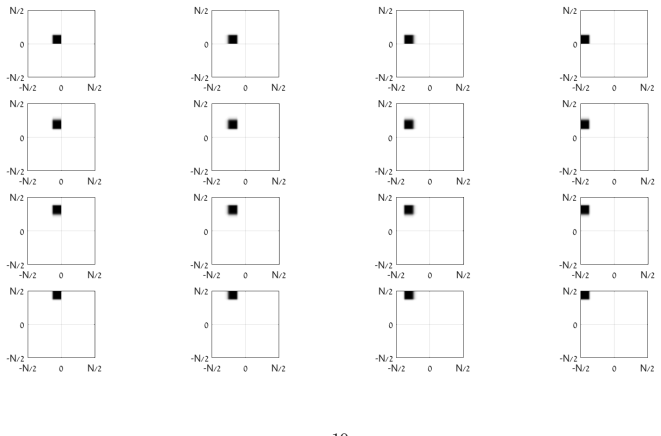
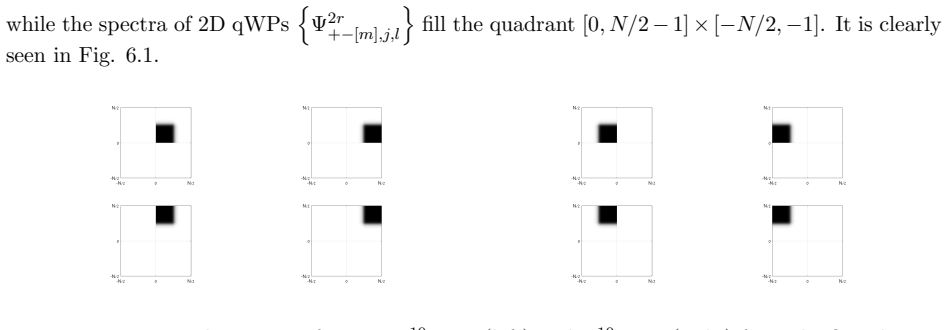
Figure 5.10. Figure 5.10: WPs ϑ 10 −[3],j,l (right) from the third decomposition level 6 Implementation of 2D qWP transforms The spectra of 1D qWPs n Ψ2r +[m],jo , j = 0, ..., 2 m − 1, fill the non-negative half-band [0, N/2], and vice versa for the qWPs n Ψ2r −[m],jo , j = 0, ..., 2 m − 1 . Therefore, the spectra of 2D qWPs n Ψ2r ++[m],j,lo , j, l = 0, ..., 2 m −1 fill the quadrant [0, N/2−1]×[0, N/2−1] of the frequency domain,… view at source ↗
Figure 6.1
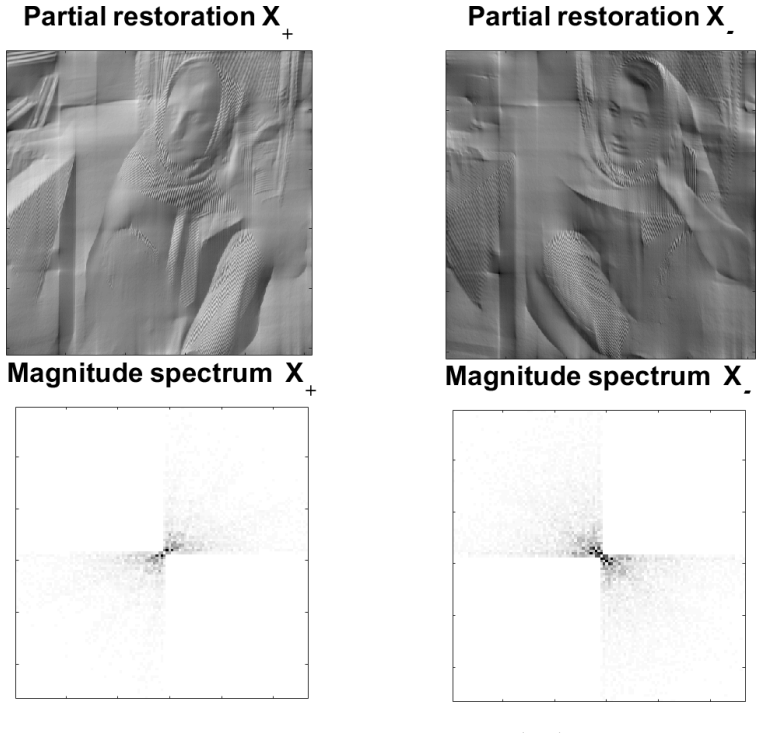
Figure 6.1. Figure 6.1: Magnitude spectra of qWPs Ψ10 ++[1],j,l (left) and Ψ10 +−[1],j,l (right) from the first decom￾position level Consequently, the spectra of the real-valued 2D WPs n ϑ 2r +[m],j,lo , j, l = 0, ..., 2 m − 1, and n ϑ 2r −[m],j,lo fill the pairs of quadrant Q+ def = [0, N/2 − 1] × [0, N/2 − 1] S [−N/2, −1] × [−N/2, −1] and Q− def = [0, N/2 − 1] × [−N/2, −1] S [−N/2, −1] × [0, N/2 − 1], respectively (Figs. 5.6 … view at source ↗
Figure 6.2
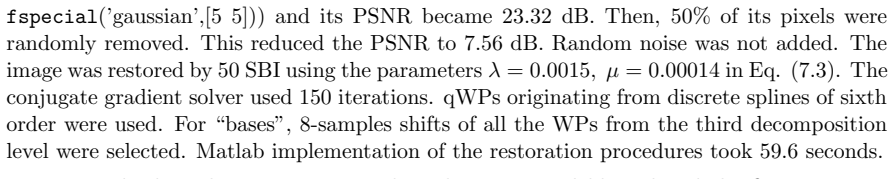
Figure 6.2. Figure 6.2: Top left: Partially restored “Barbara” image by [PITH_FULL_IMAGE:figures/full_fig_p032_6_2.png] view at source ↗
Figure 6.3
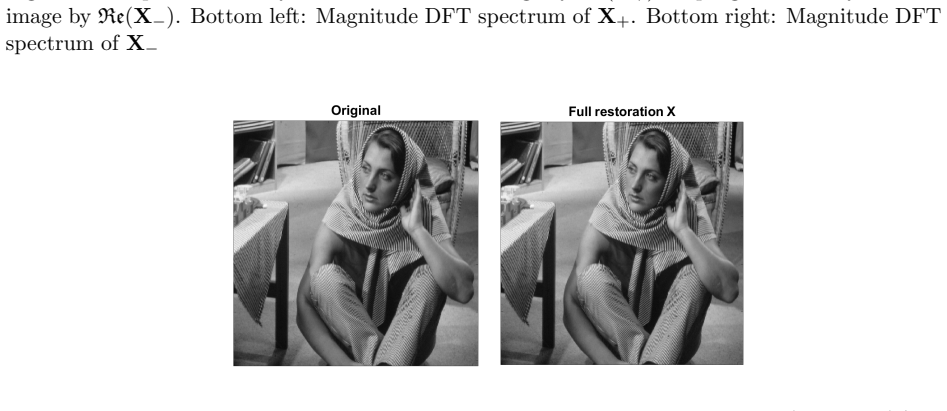
Figure 6.3. Figure 6.3: Left: Original “Barbara” image. Right: Fully restored image by [PITH_FULL_IMAGE:figures/full_fig_p032_6_3.png] view at source ↗
Figure 7
Figure 7. Figure 7: is the outputs of the image reconstruction by the directional qWPT and the non [PITH_FULL_IMAGE:figures/full_fig_p035_7.png] view at source ↗
Figure 7.1
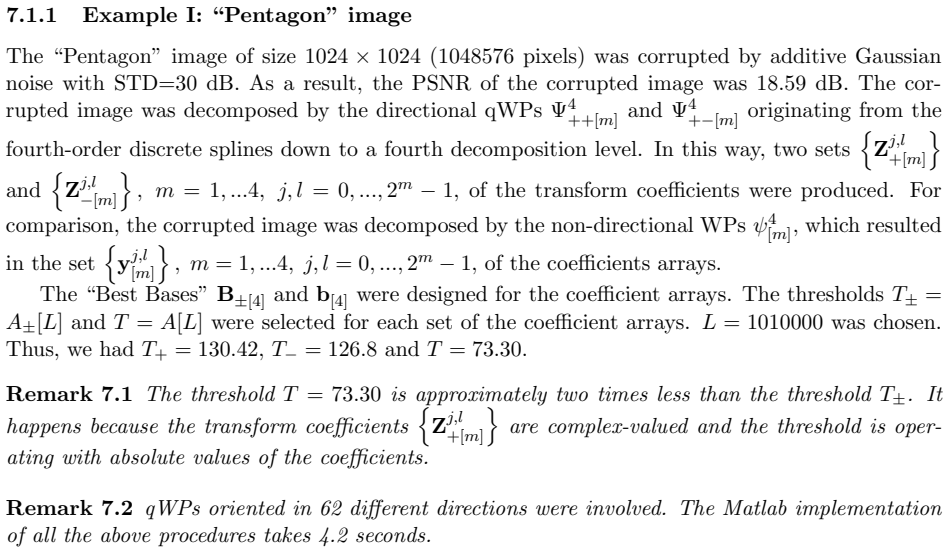
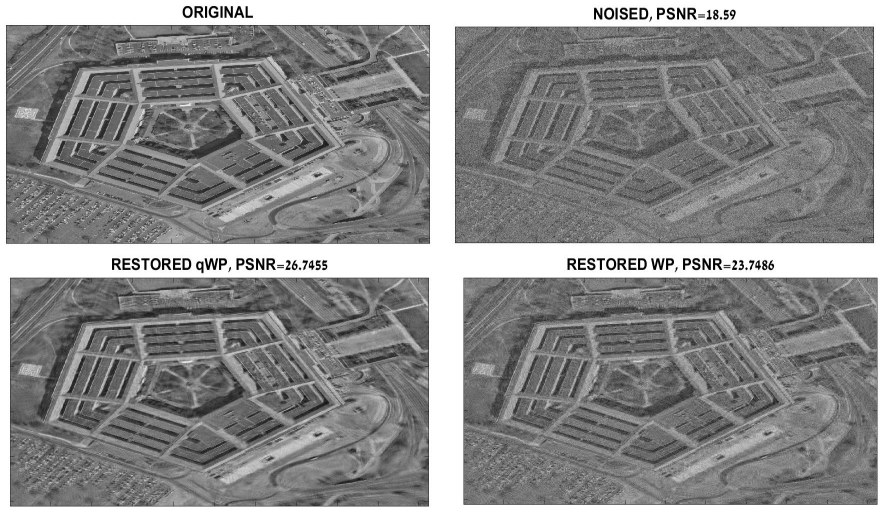
Figure 7.1. Figure 7.1: Top left: Original “Pentagon” image. Top right: Image corrupted by noise with [PITH_FULL_IMAGE:figures/full_fig_p036_7_1.png] view at source ↗
Figure 7.2
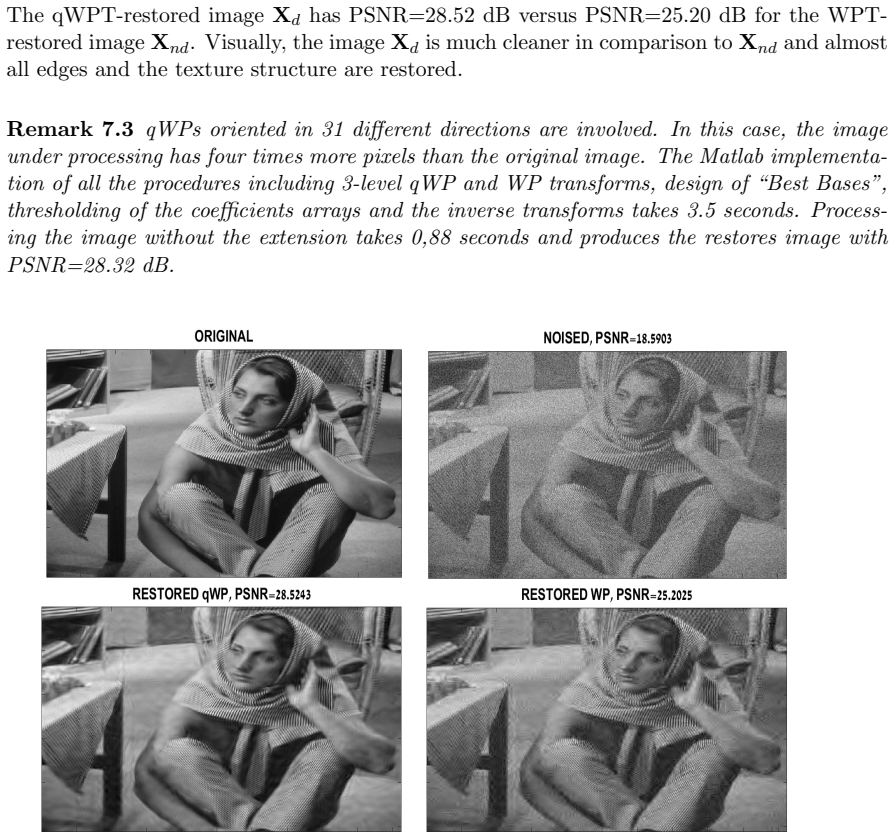
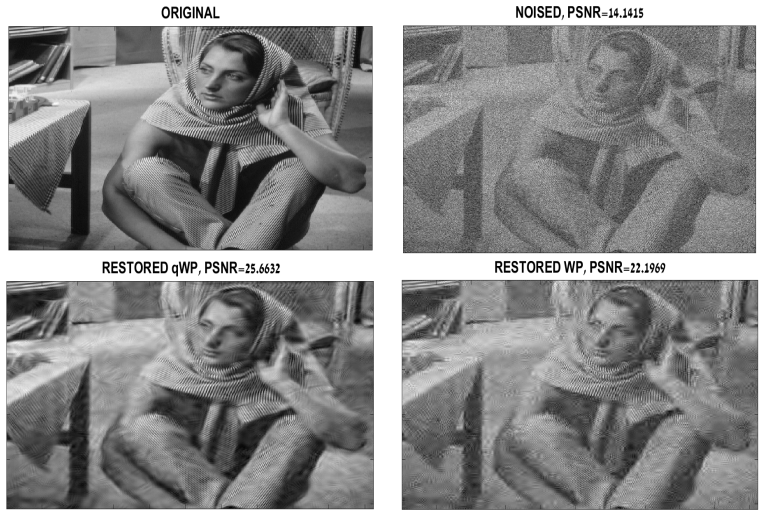
Figure 7.2. Figure 7.2: Top left: Original “Barbara” image. Top right: Image corrupted by noise with STD=30 [PITH_FULL_IMAGE:figures/full_fig_p037_7_2.png] view at source ↗
Figure 7.3
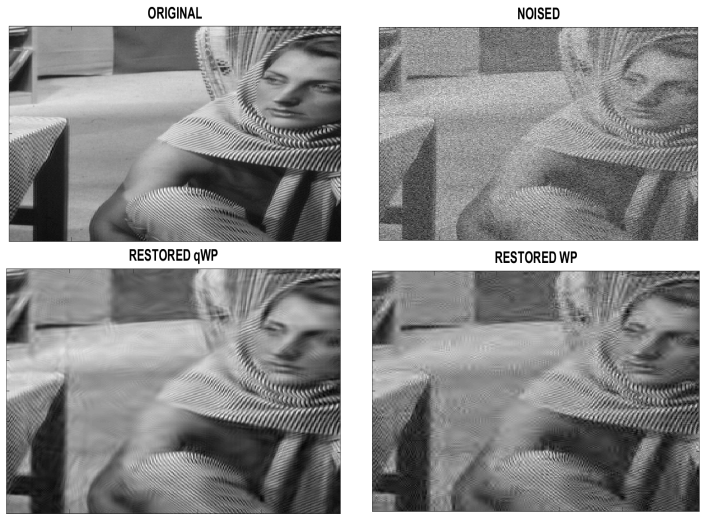
Figure 7.3. Figure 7.3: Fragments of the images shown in Fig. 7.2 [PITH_FULL_IMAGE:figures/full_fig_p038_7_3.png] view at source ↗
Figure 7.4
Figure 7.4. Figure 7.4: Top left: Original “Barbara” image. Top right: Image corrupted by noise with STD=50 [PITH_FULL_IMAGE:figures/full_fig_p039_7_4.png] view at source ↗
Figure 7.5
Figure 7.5. Figure 7.5: Fragments of the images shown in Fig. 7.4 [PITH_FULL_IMAGE:figures/full_fig_p040_7_5.png] view at source ↗
Figure 7
Figure 7. Figure 7: displays the restoration result. The image is deblurred, noise is removed and the [PITH_FULL_IMAGE:figures/full_fig_p042_7.png] view at source ↗
Figure 7.6
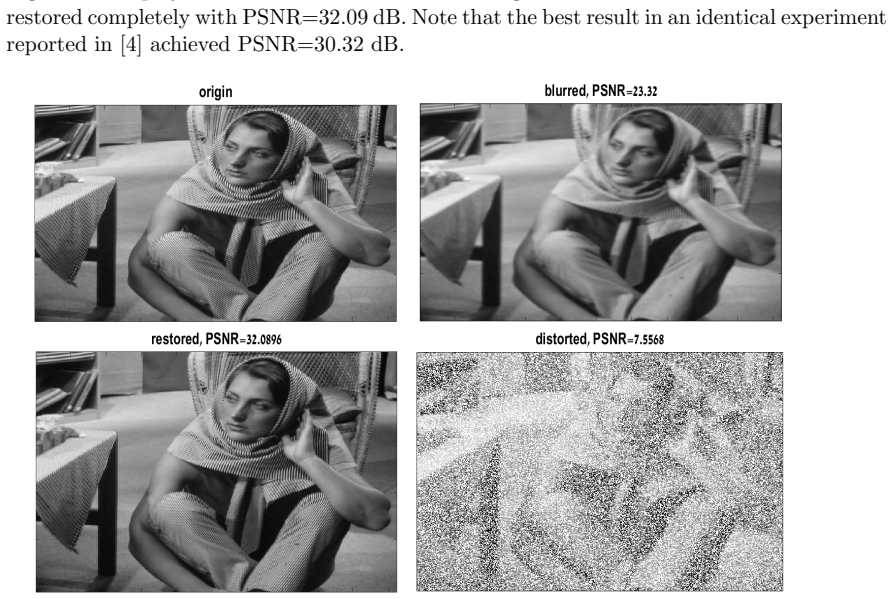
Figure 7.6. Figure 7.6: Top left: Source input - “Barbara” image. Top right: Blurred, PSNR=23.32 dB. [PITH_FULL_IMAGE:figures/full_fig_p042_7_6.png] view at source ↗
Figure 7.7
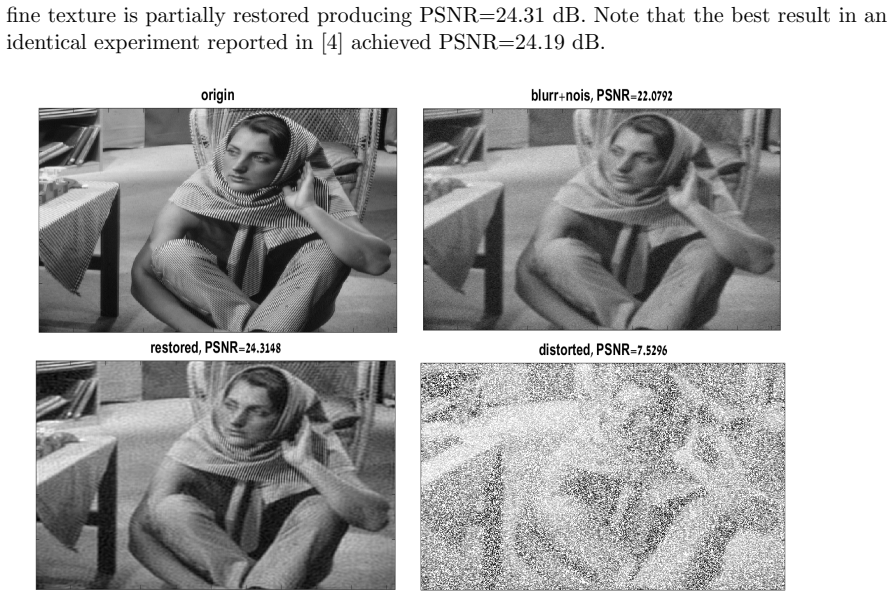
Figure 7.7. Figure 7.7: Top left: Source input - “Barbara” image. Top right: Blurred and noised, PSNR=22.08 [PITH_FULL_IMAGE:figures/full_fig_p043_7_7.png] view at source ↗
Figure 7
Figure 7. Figure 7: displays the restoration result. The image is deblurred and the fine texture is [PITH_FULL_IMAGE:figures/full_fig_p043_7.png] view at source ↗
Figure 7.8
Figure 7.8. Figure 7.8: Top left: Source input - “Barbara” image. Top right: Blurred, PSNR=23.32 dB. [PITH_FULL_IMAGE:figures/full_fig_p044_7_8.png] view at source ↗
read the original abstract

The paper presents a versatile library of analytic and quasi-analytic complex-valued wavelet packets (WPs) which originate from discrete splines of arbitrary orders. The real parts of the quasi-analytic WPs are the regular spline-based orthonormal WPs designed in [2]. The imaginary parts are the so-called complementary orthonormal WPs, which, unlike the symmetric regular WPs, they are antisymmetric. Tensor products of 1D quasi-analytic WPs provide a diversity of 2D WPs oriented in multiple directions. For example, a set of the fourth-level WPs comprises 62 different directions. The designed computational scheme in the paper enables us to get fast and easy implementation of the WP transforms. The presented WPs proved to be efficient in signal/image processing applications such as restoration of images degraded by either additive noise or missing of up to 90% of their pixels.

Editorial analysis

A structured set of objections, weighed in public.

Desk editor's note, referee report, simulated authors' rebuttal, and a circularity audit. Tearing a paper down is the easy half of reading it; the pith above is the substance, this is the friction.

Referee Report

1 major / 1 minor

Summary. The paper presents constructions of quasi-analytic and analytic complex-valued wavelet packets from discrete splines of arbitrary orders for periodic signals. The real parts are the orthonormal spline wavelet packets from [2], and the imaginary parts are complementary antisymmetric WPs. It provides tensor-product constructions for directional 2D WPs and a fast transform scheme. The WPs are claimed to be efficient for restoration tasks in signal and image processing, such as denoising and inpainting with high percentages of missing data.

Significance. If the results hold, the work offers a new family of directional analytic wavelet packets based on splines, extending previous real-valued designs with potential benefits for applications involving oriented features and phase information. The fast computational scheme is a strength. The significance is reduced by the absence of supporting experimental data for the efficiency claims.
major comments (1)
  1. [Abstract] Abstract: The statement that the presented WPs 'proved to be efficient' in restoration of images degraded by additive noise or missing up to 90% of pixels lacks any quantitative support, such as error metrics, comparison with baselines from [2], or experimental setup details. This issue is load-bearing for the central application claim.
minor comments (1)
  1. The abstract could be revised to separate the construction claims from the empirical assertions more clearly.

Simulated Author's Rebuttal

1 responses · 0 unresolved

We thank the referee for the careful review and constructive feedback. We address the single major comment below.

read point-by-point responses
  1. Referee: [Abstract] Abstract: The statement that the presented WPs 'proved to be efficient' in restoration of images degraded by additive noise or missing up to 90% of pixels lacks any quantitative support, such as error metrics, comparison with baselines from [2], or experimental setup details. This issue is load-bearing for the central application claim.

    Authors: We agree that the abstract overstates the application results. The manuscript's core contribution is the construction of the quasi-analytic and analytic complex wavelet packets from discrete splines, together with the tensor-product directional 2-D extensions and the fast transform algorithm. The restoration examples are presented only illustratively and do not contain the quantitative error metrics, baseline comparisons with the real-valued packets of [2], or experimental protocols that would be required to support the phrase 'proved to be efficient.' We will therefore revise the abstract by removing the sentence that begins 'The presented WPs proved to be efficient...' and replace it with a statement limited to the theoretical and algorithmic contributions. This change will be incorporated in the revised manuscript. revision: yes

Circularity Check

0 steps flagged

No significant circularity identified

full rationale

The paper constructs quasi-analytic and directional wavelet packets from discrete splines, with real parts explicitly referencing the orthonormal WPs from prior work [2]. The new analytic/complementary parts and tensor-product directional extensions are derived independently via explicit definitions and fast transform schemes in the present manuscript. No load-bearing step reduces a claimed result to a fitted parameter, self-citation chain, or ansatz imported from the same authors; the central construction and efficiency claims rest on the supplied derivations rather than circular reduction to inputs.

Axiom & Free-Parameter Ledger

0 free parameters · 1 axioms · 0 invented entities

Construction rests on standard properties of discrete splines and orthonormal wavelet packet theory; no free parameters, ad-hoc axioms, or invented entities are introduced in the abstract.

axioms (1)
  • domain assumption Discrete splines of arbitrary orders admit orthonormal wavelet packet bases whose real parts match the construction in the referenced prior work.
    Invoked to define the real part of the quasi-analytic packets.

pith-pipeline@v0.9.0 · 5683 in / 1147 out tokens · 50320 ms · 2026-05-25T10:39:34.639410+00:00 · methodology

discussion (0)

Sign in with ORCID, Apple, or X to comment. Anyone can read and Pith papers without signing in.

Reference graph

Works this paper leans on

27 extracted references · 27 canonical work pages

  1. [1]

    Averbuch, P

    A. Averbuch, P. Neittaanm¨ aki, and V. Zheludev. Periodic spline-based frames: Design and applications for image restoration. Inverse Problems and Imaging , 9(3):661–707, 2015

  2. [2]

    Averbuch, P

    A. Averbuch, P. Neittaanm¨ aki, and V. Zheludev. Splines and spline wavelet methods with application to signal and image processing, Volume III: Selected topics . Springer, 2019

  3. [3]

    Averbuch, V

    A. Averbuch, V. Zheludev, and M. Khazanovsky. Deconvolution by matching pursuit using spline wavelet packets dictionaries. Appl. Comput. Harmon. Anal. , 31(1):98–124, 2011

  4. [4]

    A. Z. Averbuch, P. Neittaanm¨ aki, and V. A. Zheludev.Spline and spline wavelet methods with applications to signal and image processing, Volume I: Periodic splines . Springer, 2014

  5. [5]

    Bayram and I

    I. Bayram and I. W. Selesnick. On the dual-tree complex wavelet packet and m-band trans- forms. IEEE Trans. Signal Process., 56, 2008

  6. [6]

    Che and X

    Z. Che and X. Zhuang. Digital affine shear filter banks with 2-layer structure and their applications in image processing. IEEE Transactions on Image Processing , 27(8):3931–3941, 2016

  7. [7]

    R. R. Coifman and V. M. Wickerhauser. Entropy-based algorithms for best basis selection. IEEE Trans. Inform. Theory , 38(2):713–718, 1992

  8. [8]

    Goldstein and S

    T. Goldstein and S. Osher. The split Bregman method for L1-regularized problems. SIAM J. Imaging Sci., 2(2):323–343, 2009

  9. [9]

    Golub, A

    M. Golub, A. Averbuch, M. Nathan, V. Zheludev, J. Hauser, S. Gurevitch, R. Malinsky, and A. Kagan. Compressed sensing snapshot spectral imaging by a regular digital camera with an added optical diffuser. Applied Optics, 55:432–443, March 2016

  10. [10]

    Han and Z

    B. Han and Z. Zhao. Tensor product complex tight framelets with increasing directionality. SIAM J. Imaging Sci. , 7, 2014

  11. [11]

    B. Han, Z. Zhao, and X. Zhuang. Directional tensor product complex tight framelets with low redundancy. Appl. Comput. Harmon. Anal. , 41(2):603–637, 2016

  12. [12]

    Han and X

    B. Han and X. Zhuang. Smooth affine shear tight frames with mra structures. Appl. Comput. Harmon. Anal., 39(2):300–338, 2015

  13. [13]

    Jalobeanu, L

    A. Jalobeanu, L. Blanc-F´ eraud, and J. Zerubia. Satellite image deconvolution using complex wavelet packets. In Proc. IEEE Int. Conf. Image Process. (ICIP) , pages 809–812, 2000

  14. [14]

    Jalobeanu, L

    A. Jalobeanu, L. Blanc-F´ eraud, and J. Zerubia. Satellite image deblurring using complex wavelet packets. Int. J. Comput. Vision , 51(3):205–217, 2003

  15. [15]

    Jalobeanu, N

    A. Jalobeanu, N. Kingsbury, and J. Zerubia. Image deconvolution using hidden markov tree modeling of complex wavelet packets. In Proc. IEEE Int. Conf. Image Process. (ICIP) , pages 201–204, 2001

  16. [16]

    H. Ji, Z. Shen, and Y. Xu. Wavelet based restoration of images with missing or damaged pixels. East Asian J. Appl. Math. , 1(2):108–131, 2011. 47

  17. [17]

    Kingsbury

    N.G. Kingsbury. Image processing with complex wavelets. philos. Trans. R. Soc. London A, Math. Phys. Sci. , 357(1760):2543–2560, 1999

  18. [18]

    Kingsbury

    N.G. Kingsbury. Complex wavelets for shift invariant analysis and filtering of signals. J. Appl. Comput. Harm. Anal. , 10(3):234–253, 2001

  19. [19]

    Mallat and Z

    S. Mallat and Z. Zhang. Matching pursuits with time-frequency dictionaries. IEEE Trans. Signal Process., 41(12):3397–3415, 1993

  20. [20]

    A. V. Oppenheim and R. W. Schafer. Discrete-time signal processing . Prentice Hall, New York, 3rd edition, 2010

  21. [21]

    Portilla, V

    J. Portilla, V. Strela, M. J. Wainwright, and E. P. Simoncelli. Image denoising using scale mixtures of gaussians in the wavelet domain. IEEE Trans. Image Process., 12, 2003

  22. [22]

    Saito and R

    N. Saito and R. R. Coifman. Local discriminant bases and their applications. J. Math. Imaging Vision, 5(4):337–358, 1995

  23. [23]

    Saito and R

    N. Saito and R. R. Coifman. Improved discriminant bases using empirical probability density estimation. In Proceedings of the Statistical Computing Section , pages 312–321, Washington, DC, 1997. Amer. Statist. Assoc

  24. [24]

    Selesnick, R.G

    I.W. Selesnick, R.G. Baraniuk, and N.G. Kingsbury. The dual-tree complex wavelet transform. IEEE Signal Process. Mag. , 22(6):123–151, 2005

  25. [25]

    Sendur and I

    L. Sendur and I. W. Selesnick. Bivariate shrinkage functions for wavelet-based denoising exploiting interscale dependency. IEEE Trans. Signal Process., 50, 2002

  26. [26]

    Xie, E.Wang, G

    Z. Xie, E.Wang, G. Zhang, G. Zhao, and X. Chen. Seismic signal analysis based on the dual-tree complex wavelet packet transform. Acta Seismologica Sinica, 17(1):117–122, 2004

  27. [27]

    X. Zhuang. Digital affine shear transforms: fast realization and applications in image/video processing. SIAM J. Imag. Sci. , 9(3):1437–1466, 2016. 48