Pairwise Reflection Symmetry in Generalized Latin Rectangles
Pith reviewed 2026-06-29 01:21 UTC · model grok-4.3
The pith
Pairwise reflection symmetry holds in generalized Latin rectangles with column multiplicity λ=1 exactly when n is a power of two.
A machine-rendered reading of the paper's core claim, the machinery that carries it, and where it could break.
Core claim
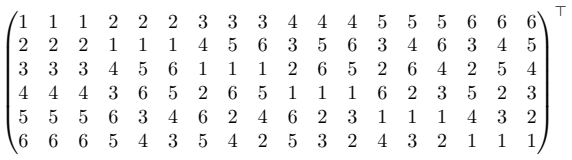
Generalized Latin rectangles admit pairwise reflection symmetry with column multiplicity λ=1 if and only if n is a power of two. For even λ the condition is easier to satisfy, while for odd λ existence requires sufficiently large values; the paper supplies a direct product construction and observes that many examples possess an underlying group-theoretic structure, conjecturing this structure may be unavoidable in some cases. Computational searches via a quadratically constrained integer program confirm the pattern for small instances.
What carries the argument
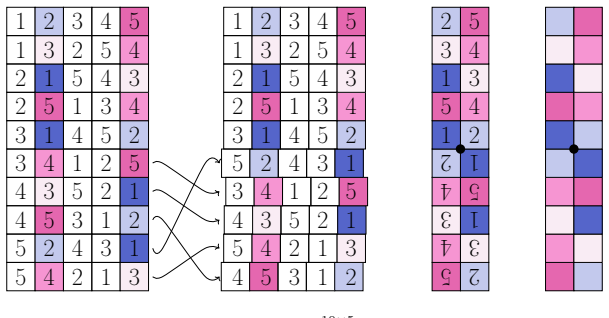
The pairwise reflection symmetry condition, requiring that every ordered symbol pair (p,q) appears across any two columns exactly as often as its reversal (q,p).
If this is right
- Existence for λ=1 is settled completely by the power-of-two characterization.
- For odd λ greater than 1, existence holds once λ is large enough.
- A direct product construction produces new symmetric rectangles from existing ones.
- Many constructed examples display an underlying group structure.
Where Pith is reading between the lines
- The same symmetry condition could be imposed on other row-column designs such as Latin cubes or orthogonal arrays.
- When n is a power of two the minimal λ=1 case may allow the smallest possible fair comparison matrices for applications.
- If the group-theoretic structure is unavoidable, algebraic constructions over finite fields of characteristic 2 could generate all solutions.
Load-bearing premise
The pairwise reflection symmetry condition can be satisfied simultaneously with the column frequency rules of generalized Latin rectangles for every power of two without extra obstructions from the symbol alphabet or matrix size.
What would settle it
Exhibit either a power-of-two n for which no λ=1 matrix with the symmetry exists, or a non-power-of-two n for which such a matrix does exist.
Figures
read the original abstract
Many combinatorial designs ask for equal distribution of given symbols across the entries of a matrix. The paramount examples are Latin squares, where each symbol from $\{1,\dots,n\}$ appears once per row and column of an $n\times n$ matrix. Generalized Latin rectangles extend this to $\lambda n \times n$ matrices with repeated symbols under controlled column frequencies. In this more general setting, we examine structural properties of pairwise reflection-symmetry, which requires that, on every pair of columns, each ordered symbol pair $(p,q)$ occurs as often as its reversal $(q,p)$. This order-balance is precisely what makes head-to-head comparisons unbiased, i.e., no symbol gains a systematic advantage from the position it occupies relative to another, a fairness demand arising for instance when scheduling tournaments or laying out comparative trials. Existence of such objects for odd $\lambda$ turns out to be remarkably more subtle than for even $\lambda$. After showing that existence holds also for sufficiently large odd $\lambda$, we initiate the search for the smallest possible value of $\lambda$ in this setting. We obtain the insight that a column multiplicity of $\lambda=1$ can be achieved if and only if $n$ is a power of two. We complement the existence results with a direct product construction and add several further observations on the property. Finally, we propose and evaluate a quadratically constrained integer program to computationally search for these objects. The resulting experiments reveal that many of them possess an underlying group-theoretic structure which, as we conjecture, may even be unavoidable in certain settings.
Editorial analysis
A structured set of objections, weighed in public.
Referee Report
Summary. The manuscript examines pairwise reflection symmetry in generalized Latin rectangles (λn × n matrices with controlled column frequencies). It establishes existence for all sufficiently large odd λ, provides an if-and-only-if characterization that λ = 1 is achievable precisely when n is a power of two (supported by a direct-product construction in the positive direction), introduces a quadratically constrained integer program for computational search, and reports experiments indicating that many solutions possess an underlying group-theoretic structure.
Significance. If the central characterization holds, the result supplies a sharp existence threshold for the minimal column multiplicity under the reflection-symmetry constraint, with direct implications for unbiased head-to-head comparisons in scheduling and experimental design. The explicit direct-product construction and the QCIP formulation constitute constructive and algorithmic contributions, while the experimental group-theoretic observations, if pursued, could link the objects to algebraic structures such as elementary abelian 2-groups.
minor comments (2)
- [Abstract] The abstract refers to 'several further observations on the property' and a conjecture on group structure without naming them; a one-sentence enumeration of the main additional results would improve readability.
- The description of the quadratically constrained integer program in the abstract omits the decision variables and the quadratic constraints; a brief high-level formulation (e.g., in the introduction or a dedicated section) would make the computational contribution more self-contained.
Simulated Author's Rebuttal
We thank the referee for the positive summary, significance assessment, and recommendation of minor revision. No specific major comments were raised in the report, so we have no individual points requiring rebuttal or clarification at this stage. We will incorporate any editorial suggestions for minor changes in the revised version.
Circularity Check
No significant circularity identified
full rationale
The paper establishes an if-and-only-if characterization for existence of pairwise reflection-symmetric generalized Latin rectangles with λ=1 precisely when n is a power of two. The positive direction is supported by an explicit direct-product construction, while the negative direction uses an invariant argument; neither reduces to a self-definition, a fitted parameter renamed as prediction, or a load-bearing self-citation. The integer-programming search and group-theoretic observations function as complementary verification and conjecture rather than core derivation steps. The overall chain is self-contained and independent of the target claim.
Axiom & Free-Parameter Ledger
axioms (1)
- standard math Standard definition of generalized Latin rectangles with controlled column frequencies
Reference graph
Works this paper leans on
-
[1]
L. D. Andersen, A. J. W. Hilton, Generalized Latin rectangles I: Construction and decomposition, Discrete Mathematics 31 (2) (1980) 125–152.doi:10.1016/0012-365x(80)90030-8
-
[2]
V. Bargachev, On some properties of min-wise independent families and groups of permutations, Journal of Mathematical Sciences 134 (5) (2006) 2340–2345.doi:10.1007/s10958-006-0110-1
-
[3]
A. Z. Broder, M. Charikar, A. M. Frieze, M. Mitzenmacher, Min-wise independent permutations, Journal of Computer and System Sciences 60 (3) (2000) 630–659.doi:10.1006/jcss.1999.1690
-
[4]
W. Bruine de Bruin, Save the last dance for me: unwanted serial position effects in jury evaluations, Acta Psychologica 118 (3) (2005) 245–260.doi:10.1016/j.actpsy.2004.08.005
-
[5]
D. S. Dummit, R. M. Foote, Abstract Algebra, 3rd Edition, John Wiley & Sons, Hoboken, NJ, 2004
2004
-
[6]
A. R. Gentle, I. M. Wanless, On perfect sequence covering arrays, Annals of Combinatorics 27 (3) (2023) 539–563.doi:10.1007/s00026-022-00610-6
-
[7]
C. Godsil, G. Royle, Algebraic Graph Theory, Vol. 207 of Graduate Texts in Mathematics, Springer, New York, 2001.doi:10.1007/978-1-4613-0163-9. 13
-
[8]
K. Heinrich, W. D. Wallis, The maximum number of intercalates in a Latin square, in: K. L. McAvaney (Ed.), Combinatorial Mathematics VIII (Geelong, 1980), Vol. 884 of Lecture Notes in Mathematics, Springer, Berlin, Heidelberg, 1981, pp. 221–233.doi:10.1007/bfb0091822
-
[9]
F. C. Hiner, R. B. Killgrove, Subsquare complete Latin squares, manuscript mentioned in [14, Sec. 1.6] (year unknown, likely 1970–1980)
1970
-
[10]
T. Itoh, Y. Takei, J. Tarui, On permutations with limited independence, in: D. B. Shmoys (Ed.), Proceedings of the Eleventh Annual ACM-SIAM Symposium on Discrete Algorithms, ACM/SIAM, 2000, pp. 137–146. URLhttps://dl.acm.org/doi/10.5555/338219.338245
-
[11]
T. Itoh, Y.Takei, J. Tarui, Onthe sample size ofk-restricted min-wise independent permutations and otherk-wise distributions, in: L. L. Larmore, M. X. Goemans (Eds.), Proceedings of the 35th Annual ACMSymposiumonTheoryofComputing, ACM,2003, pp.710–719.doi:10.1145/780542.780645
-
[12]
E. Iurlano, Scrambling permutations and related structures: Asymptotics and constructions, Mas- ter’s thesis, TU Wien, Austria (2022).doi:10.34726/hss.2022.102263
-
[13]
E. Iurlano, Growth of the perfect sequence covering array number, Designs, Codes and Cryptography 91 (4) (2023) 1487–1494.doi:10.1007/s10623-022-01168-3
-
[14]
A. D. Keedwell, J. Dénes, Latin Squares and Their Applications, 2nd Edition, North-Holland, 2015
2015
-
[15]
S. Markovski, D. Gligoroski, L. Kocarev, Unbiased random sequences from quasigroup string trans- formations, in: H. Gilbert, H. Handschuh (Eds.), Fast Software Encryption: 12th International Workshop—FSE 2005, Vol. 3557 of LNCS, Springer, 2005, pp. 163–180.doi:10.1007/11502760\ _11
-
[16]
R. Mathon, T. van Trung, Directedt-packings and directedt-Steiner systems, Designs, Codes and Cryptography 18 (1) (1999) 187–198.doi:10.1023/a:1008353723204
-
[17]
J. Na, J. Jedwab, S. Li, A group-based structure for perfect sequence covering arrays, Designs, Codes and Cryptography 91 (3) (2023) 951–970.doi:10.1007/s10623-022-01132-1
-
[18]
OEIS Foundation Inc., The On-Line Encyclopedia of Integer Sequences, published electronically at https://oeis.org(2026)
2026
-
[19]
I. G. Rosenberg, The number of maximal closed classes in the set of functions over a finite domain, Journal of Combinatorial Theory, Series A 14 (1) (1973) 1–7.doi:10.1016/0097-3165(73)90058-7
-
[20]
J. Tarui, T. Itoh, Y. Takei, A nearly linear size 4-min-wise independent permutation family by finite geometries, in: S. Arora, K. Jansen, J. D. P. Rolim, A. Sahai (Eds.), Approximation, Randomization, and Combinatorial Optimization. Algorithms and Techniques, Vol. 2764 of LNCS, Springer, 2003, pp. 396–408.doi:10.1007/978-3-540-45198-3_33
-
[21]
E. J. Williams, Experimental designs balanced for the estimation of residual effects of treatments, Australian Journal of Scientific Research, Series A: Physical Sciences 2 (1949) 149–168.doi:10. 1071/ch9490149
1949
-
[22]
doi:10.1007/s10623-019-00698-7
R.Yuster, Perfectsequencecoveringarrays, Designs, CodesandCryptography88(3)(2020)585–593. doi:10.1007/s10623-019-00698-7. 14 A. Appendix A.1. The utilized QCP In what follows, we briefly explain how one cancomputationally enumerateallURS(n, λ)which are reduced(Definition 2) as the feasible region of a binary QCP. For every triple(i, j, s)∈[λn]×[n]×[n] we ...
discussion (0)
Sign in with ORCID, Apple, or X to comment. Anyone can read and Pith papers without signing in.