REVIEW 4 major objections 9 minor 1 cited by
Methods for pitch analysis in contemporary popular music: multiple pitches from harmonic tones in Vitalic's music
T0 review · 4 major / 9 minor · reviewed 2026-08-07 · deepseek-v4-flash
Pith's one-line read The paper claims that producing several simultaneous pitches from one harmonic tone is an intentional, active feature of contemporary popular music, demonstrated through listening tests on Vitalic's music.
desk verdict The listening tests are a genuinely useful demonstration that synthetic harmonic tones can carry multiple perceived pitches, but the paper's intentionality claim outruns its evidence and the acoustic controls are confounded. read the letter →
The pith
A machine-rendered reading of the paper's core claim, the machinery that carries it, and where it could break.
The reading
What carries the argument
The central object is tonal fission, the perception of multiple distinct pitches from a single quasi-harmonic complex tone, measured through listening tests and linked to signal properties. The explanatory machinery is the pairing of two standard pitch-perception models: spectral modeling, which derives perceived pitches from prominent resolved partials, and temporal modeling, which derives pitch from autocorrelation peaks, analyzed here through short-term autocorrelation (STAC). The paper argues that when the two models point to different pitches, or when upper partials are loud enough to be individually audible, the tone becomes ambiguous and can convey several pitches at once. Short-term Fourier transforms, STAC, and ISO 226 equal-loudness weighting are used to connect each listener's transcribed pitches to partials and autocorrelation features, and a certainty-weighted Jaccard similarity quantifies how much listeners' pitch sets agree.
What would settle it
A controlled experiment presenting the same synthetic harmonic tones under a neutral instruction that never mentions counting or multiple pitches, such as asking listeners to play back only the main melody, would weaken the strong claim if single-pitch responses dominate; additionally, matching synthetic and acoustic tones for overall spectrum, loudness, and duration should make the reported multiplicity gap disappear if it is an artifact of attention rather than of tone design.
Extended reading notes
Core claim
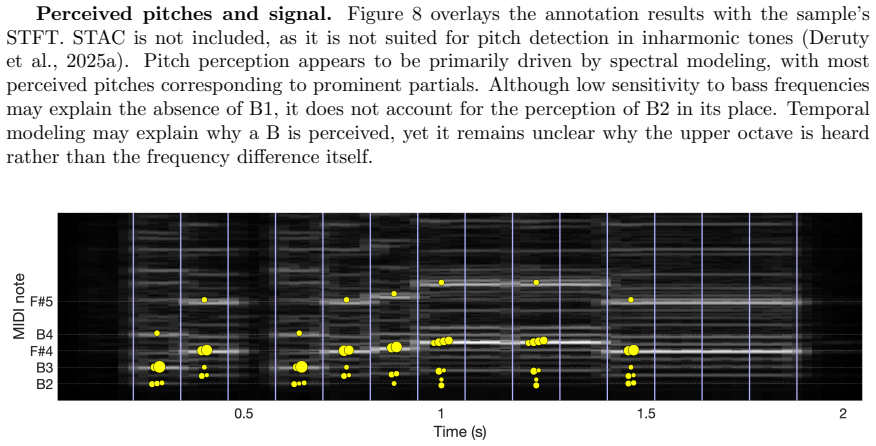
The central discovery is that contemporary popular music, especially electronic music, uses tonal fission as a deliberate compositional resource: a single quasi-harmonic tone can be designed to project several ambiguous pitches simultaneously. In Listening Test 1, no sample, acoustic or electronic, produced unanimous single-pitch perception, and the electronic excerpts, particularly inharmonic ones, were associated with significantly more perceived pitches. In Listening Test 2, trained listeners transcribed multiple pitches from the synthetic and distorted tones, with pitch sets varying by listener and often concentrated on octaves or harmonics of the fundamental; only the acoustic cello produced unanimous, stable single-pitch transcriptions. Signal analysis links the extra pitches to loud upper partials, which support spectral pitch models, and to autocorrelation structure that supports a different pitch than the fundamental, consistent with temporal pitch models. The paper concludes that pitch should be understood as a listener-dependent, context-dependent set of possible pitches rather than an intrinsic property of the tone.
Load-bearing premise
The load-bearing premise is that a listener's count of how many simultaneous pitches are heard is a stable, valid measurement of what the tone conveys, even though the paper itself reports that more attention to counting increased the number reported and that all expert listeners had difficulty separating pitch from timbre.
Editorial extensions
If this is right
- Pitch-tracking and audio-to-MIDI systems that assume one fundamental per tone will systematically misrepresent much contemporary popular music, including over half of Vitalic's discography by the paper's count.
- The perceived pitch set of a tone is not fixed by the signal alone; it shifts with listening conditions, playback system, and listener expertise, so pitch analysis in this repertoire should report a distribution rather than a point estimate.
- Producers can treat the number of pitches per tone as a controllable musical parameter, shaped by choosing partial loudness and autocorrelation structure, which the paper reports Vitalic does intentionally.
- The phenomenon extends beyond electronic music: a distorted guitar power chord becomes a single quasi-harmonic tone conveying several pitches, suggesting that score-based analysis of rock and metal also needs revision.
- If pitch is a set of possible percepts rather than a single value, then conventional definitions of a musical note, and the reification of the score, apply poorly to this body of music.
Reading between the lines
- Unstated in the paper: the counting task in Listening Test 1 may itself inflate the reported multiplicity, since the authors note that more focused attention on counting led to more perceived pitches; a neutral task that never mentions the number of pitches could produce lower, more stable counts.
- The multistability language suggests a testable extension: presenting the same tone with different verbal or visual primes, such as 'listen for the bass line' versus 'listen for the upper line,' should shift which pitch set is heard, much as Necker cube orientation can be primed.
- If pitch is a probability distribution over a set of possible pitches, then a practical production metric is the effective number of pitches or the pitch ambiguity of a tone, which could be predicted from spectral and autocorrelation features and used to control ambiguity in music generation.
- The paper does not directly measure whether tonal fission contributes to listener engagement or repeated listening; a controlled experiment varying pitch ambiguity while holding other musical factors constant could test the proposed satiation-delay hypothesis.
Editorial analysis
A structured set of objections, weighed in public.
Referee Report
Summary. This paper argues that a single harmonic complex tone in contemporary popular music can convey multiple simultaneous pitches (which the authors call 'tonal fission') and claims that this is an active and intentional feature in the work of electronic producer Vitalic. The authors present two listening tests: (1) 59 participants reported the number of simultaneous pitches perceived in twelve short extracts (nine electronic Vitalic excerpts, one piano transcription, and two classical solo-string controls); and (2) seven expert listeners transcribed the pitches they perceived in six samples (cello, two Vitalic synthesizer tones, a 'No Fun' inharmonic tone, a distorted guitar power chord, and an 808-style bass patch) using piano matching. Signal analyses with STFT and short-term autocorrelation were used to relate perceived pitches to spectral partials and temporal peaks. The results show that the synthetic harmonic tones were perceived as carrying more simultaneous pitches than the acoustic controls, with large inter-listener variation, while the cello transcription was unanimous single-pitch. The paper concludes that pitch is not an intrinsic property of a tone but a listener-constructed, context-dependent percept, and that harmonic tones in contemporary popular music can deliberately project multiple ambiguous pitches.
Significance. The paper's new listening-test data are a genuine contribution: they are independent of the authors' prior signal analyses, the procedure is reported in reasonable detail, and the limitations (uncontrolled listening conditions, habituation, piano-matching precision) are acknowledged rather than hidden. If the perceptual result holds, it strengthens the case that single-f0 pitch trackers and score-based transcription are inadequate for a nontrivial share of contemporary popular music, and it provides an empirical bridge between psychoacoustic demonstrations of pitch ambiguity and real studio-produced records. The supplementary audio examples are also a useful resource for replication. The main weakness is that the strongest framing—that tonal fission is 'active and intentional'—is not established by the tests; it rests on private interviews and under-review preprints. The study is therefore better described as demonstrating that such tones can be perceived as multi-pitch, not that producers intentionally design them to be. The paper also over-generalizes from classical-string controls and a small Vitalic sample to 'contemporary popular music' at large.
major comments (4)
- [§4.1, §7.1, Figures 1–2] The response variable in Listening Test 1 (number of perceived simultaneous pitches) may be partly constructed by the task. Section 4.1 concedes that 'the more listeners focused on the number of pitches, the more they perceived,' and Section 7.1 reports that all expert listeners found it difficult to disentangle pitch from timbre, with one listener choosing to hear the extra pitches as timbre. The transcription test provides convergent evidence, but it likewise instructs listeners to report multiple pitches. The paper should quantify test–retest reliability beyond a single anecdotal retest, add a free-description control condition, or explicitly model attention/focus; otherwise the synthetic-versus-acoustic gap in Figures 1 and 2 may reflect task framing rather than a stable property of the tones.
- [§4.2] The logistic regression analysis is under-specified. The text states only that 'the number of perceived pitches' was treated as an ordinal variable with controls for age, listening device, and environment. Because each participant rated all extracts, the observations are not independent; a mixed-effects model with random intercepts for participant and sample (or cluster-robust standard errors) is needed. Without this, the reported p-values for musical expertise (p<0.001) and audio expertise (p=0.209) are not trustworthy, and no effect size or confidence interval is provided. Please report the full model specification or re-analyze with appropriate random effects and provide effect sizes.
- [§3.3, Table 1, Figure 1] The acoustic control samples are classical solo strings (cello, violin) plus a piano transcription, not acoustic instruments typical of contemporary popular music. The abstract's comparison to 'acoustic counterparts' is therefore confounded with genre and cultural familiarity. Either add acoustic CPM controls (e.g., clean electric bass, acoustic guitar, vocals) or explicitly restrict the claim to 'compared with classical acoustic solo instruments.' This also bears on the generalization from a mostly Vitalic sample to 'contemporary popular music' at large, which the current data do not support.
- [§5.3, §6.4, Table 2] The treatment of 'No Fun' (sample 1) as a special case defines 'f0' as the frequency spacing between adjacent partials. For an inharmonic tone whose partials are shifted rather than exact multiples of that spacing, this pseudo-f0 is not a fundamental frequency, and classifying perceived pitches as 'harmonics' of this spacing is arbitrary. This affects the 'Fundamental' and 'Harmonics' columns for sample 1 in Table 2 and Figure 4. Please report the raw partial frequencies and perceived pitches for this sample separately, or remove it from the harmonic-category framework.
minor comments (9)
- [§5.3] The text says "'No Fun' (sample 7)" but should be "sample 1."
- [§5.2] In the 808 paragraph, "The results resemble those of samples 2, 7, and 14" should presumably read "2, 7, and 13," since sample 14 is the 808 itself.
- [§6.7] The phrase "non-acoustic quasi-harmonic tones (samples 3, 7, 13, and 14)" should be "2, 7, 13, and 14," because sample 3 was not included in Listening Test 2.
- [Table 2] The abbreviation "sple." should be "sample."
- [§8.1] The sentence "This definition is adopted in Section 2.3" refers to the common-fate definition of a tone, but Section 2.3 defines partials and harmonics, not the common-fate concept; the cross-reference should be corrected.
- [§2.2] The claim that Vitalic "confirmed in private interviews" should be documented with dates, recordings, or a transcript; otherwise it is an unverifiable personal communication.
- [§4.1] The single participant who took the test twice and reported 2.4 then 3 pitches is anecdotal; report formal test–retest statistics or remove this datum.
- [§3.3] The statement that 38 of 72 songs "feature instrumental tracks based on tones that evoke more than one pitch" is based on the authors' own critical listening; label this as an informal survey rather than a measured result.
- [§4] The participant demographics (age, musical expertise, listening environment, monitoring system) are summarized only in percentages in the text; a table with full distributions would aid reproducibility.
Circularity Check
Perceptual core is independently tested, but the 'active and intentional' headline is carried by the authors' own prior work and private interviews rather than by this study's data.
-
self citation load bearing
[Abstract; Section 1; Section 2.2; Section 8.1; Section 9]
"Deruty et al. (2025c,a) find that the artists they studied use tonal fission and pitch ambiguity deliberately as compositional tools. ... Prior research (Deruty et al., 2025a,c), this study, and the producer's deliberate use of pitch uncertainty suggest that these views may be inadequate for musical contexts beyond Western classical music."
The paper's own experiments measure how many pitches listeners perceive and which pitches they transcribe; they include no measure of production intent. The 'intentional' part of the central claim is imported from self-citations to under-review papers by the same authors and from private interviews with Vitalic reported in Section 2.2. Section 8.1 then treats 'the producer's deliberate use' as an established premise, and the conclusion asserts that Vitalic 'deliberately designs' such tones. The public MusicRadar citation ('a melody inside the bass') documents a secondary melodic line, not control over the number of perceived pitches per tone.
full rationale
The listening-test core is not circular: the number-of-pitches judgments and the pitch transcriptions are new, externally reported data; the WJS in Eq. 1 is a descriptive agreement measure; and the signal analyses are post-hoc interpretations rather than quantities fitted to predict the test outcomes. The conclusion that single harmonic tones in this repertoire can convey several perceived pitches is therefore independently supported. However, the abstract's stronger claim that this multiplicity is 'an active and intentional feature' is not derivable from the tests. It is supported by self-citations to the authors' own under-review preprints and by private interviews, and Section 8.1 reuses it as a premise. This makes the intentionality component load-bearing self-citation rather than an independent result. The acknowledged habituation effect ('the more listeners focused on the number of pitches, the more they perceived') and the pitch-timbre confusions reported in Section 7.1 are validity concerns for the counts, but they are disclosed by the authors and do not make the derivation circular. Overall score 4: the perceptual claim has independent content, but the headline intentionality claim leans on the authors' own prior work.
Assumptions & free parameters
assumptions (5)
- domain assumption X-UMX source separation reproduces the original signal faithfully enough that pitch-relevant content is not altered.
- domain assumption ISO226:2023 50-phon equal-loudness weighting approximates what listeners actually hear.
- domain assumption The number of perceived pitches is a valid, countable response variable.
- ad hoc to paper For 'No Fun' (sample 1), f0 is defined as the frequency spacing between adjacent partials.
- domain assumption Vitalic's private statements establish deliberate use of pitch multiplicity.
invented entities (1)
-
'Tonal fission' as a label for single-tone pitch fission
independent evidence
Cite this review
Pith. "Pith review of Methods for pitch analysis in contemporary popular music: multiple pitches from harmonic tones in Vitalic's music." pith.science (2026). https://pith.science/paper/JHYHQM2S
@misc{pith2026250612405,
  author       = {Pith},
  title        = {Pith review of: Methods for pitch analysis in contemporary popular music: multiple pitches from harmonic tones in Vitalic's music},
  year         = {2026},
  howpublished = {\url{https://pith.science/paper/JHYHQM2S}},
  note         = {Machine review of arXiv:2506.12405}
}
read the original abstract
Aims. This study suggests that the use of multiple perceived pitches arising from a single harmonic complex tone is an active and intentional feature of contemporary popular music. The phenomenon is illustrated through examples drawn from the work of electronic artist Vitalic and others. Methods. Two listening tests were conducted: (1) evaluation of the number of simultaneous pitches perceived from single harmonic tones, and (2) manual pitch transcription of sequences of harmonic tones. Relationships between signal characteristics and pitch perception were then analyzed. Results. The synthetic harmonic tones found in the musical sequences under study were observed to transmit more perceived pitches than their acoustic counterparts, with significant variation across listeners. Multiple ambiguous pitches were associated with tone properties such as prominent upper partials and particular autocorrelation profiles. Conclusions. Harmonic tones in a context of contemporary popular music can, in general, convey several ambiguous pitches. The set of perceived pitches depends on both the listener and the listening conditions.
Figures


Figures from the paper (8 more)




Forward citations
Cited by 1 Pith paper
-
Evolving music theory for emerging musical languages
Pitch in electronic music is better understood as a listener-dependent perceptual construct than an objective property of the sound.
Reference graph
Works this paper leans on
-
[1]
Bach, J. S. (2010). Partita II BWV 1004 in D minor: V. Ciaccona. [music recording]. Isabelle Faust, violin. Harmonia Mundi. https://youtu.be/r67BASAgP5Q
work page 2010
- [2]
-
[3]
Bloothooft, G., Bringmann, E., Van Cappellen, M., Van Luipen, J. B., and Thomassen, K. P. (1992). Acoustics and perception of overtone singing. The Journal of the Acoustical Society of America , 92(4):1827--1836. https://doi.org/10.1121/1.403839
-
[4]
Bregman, A. S. (1994). Auditory scene analysis: The perceptual organization of sound . MIT press. https://mitpress.mit.edu/9780262521956/
arXiv 1994
-
[5]
De Cheveign \'e , A. and Kawahara, H. (2002). Yin, a fundamental frequency estimator for speech and music. The Journal of the Acoustical Society of America , 111(4):1917--1930. \ ://audition.ens.fr/adc/pdf/2002_JASA_YIN.pdf
work page 2002
-
[6]
Deruty, E. (2024a). An introduction to pitch strength in contemporary popular music analysis and production . In In Music 2024, Innovation in Music Conference . \ ://arxiv.org/abs/2506.07473
arXiv 2024
- [7]
-
[8]
Deruty, E., Arbez-Nicolas, P., and Meredith, D. (2025a). Methods for pitch analysis in contemporary popular music: deviations from twelve-tone equal temperament in V italic's work. Journal of the Audio Engineering Society , (5):256--281. https://doi.org/10.17743/jaes.2022.0203
arXiv 2025
Show all 72 references
-
[9]
Deruty, E., Arbez-Nicolas, P., and Meredith, D. (2025b). Methods for pitch analysis in contemporary popular music: Vitalic's use of tones that do not operate on the principle of acoustic resonance. Under review, https://arxiv.org/abs/2506.07207
2025 arXiv
-
[10]
and Grachten, M
Deruty, E. and Grachten, M. (2022). `` M elatonin'': A case study on AI -induced musical style. In Proceedings of the 3rd Conference on AI Music Creativity . AIMC. https://doi.org/10.5281/zenodo.7088302
2022 doi
-
[11]
and Grachten, M
Deruty, E. and Grachten, M. (2024). Insights on harmonic tones from a generative music experiment. In Proceedings of the 15th International Workshop on Machine Learning and Music . Springer. https://arxiv.org/abs/2506.07073
2024 arXiv
-
[12]
Deruty, E., Grachten, M., Lattner, S., Nistal, J., and Aouameur, C. (2022). On the development and practice of AI technology for contemporary popular music production. Transactions of the International Society for Music Information Retrieval , 5(1). \ ://transactions.ismir.net...
2022 doi
-
[13]
Deruty, E., Leroy, L., Mac \'e , Y., and Meredith, D. (2025c). Methods for pitch analysis in contemporary popular music: highlighting pitch uncertainty in primaal's commercial works. Under review, https://arxiv.org/abs/2502.08131
2025 arXiv
-
[14]
Deutsch, D. (1991). The tritone paradox: An influence of language on music perception. Music perception , 8(4):335--347. https://doi.org/10.2307/40285517
1991 doi
-
[15]
DeWitt, L. A. and Crowder, R. G. (1987). Tonal fusion of consonant musical intervals: The oomph in stumpf. Perception & Psychophysics , 41(1):84. https://doi.org/10.3758/BF03208216
1987 doi
-
[16]
Dixon Ward, W. (1970). Musical perception. In Tobias, J., editor, Foundations of Modern Auditory Theory , volume 1, page 438. Academic Press. \ ://doi.org/10.1016/B978-0-12-691901-1.X5001-3
1970 doi
-
[17]
Drugman, T., Huybrechts, G., Klimkov, V., and Moinet, A. (2018). Traditional machine learning for pitch detection. IEEE Signal Processing Letters , 25(11):1745--1749. \ ://doi.org/10.1109/LSP.2018.2874155
2018
-
[18]
Evans, W., Dyreby, J., Bech, S., Zielinski, S., and Rumsey, F. (2009). Effects of loudspeaker directivity on perceived sound quality-a review of existing studies. In Audio Engineering Society Convention 126 . Audio Engineering Society. \ ://aes2.org/publications/elibrary-page/...
2009
-
[19]
Ewert, S., Muller, M., Konz, V., Mullensiefen, D., and Wiggins, G. A. (2012). Towards cross-version harmonic analysis of music. IEEE Transactions on Multimedia , 14(3):770--782. \ ://doi.org/10.1109/TMM.2012.2190047
2012
-
[20]
Fallowfield, E. (2020). Cello multiphonics: Technical and musical parameters. Tempo , 74(291):51--69. https://doi.org/10.1017/S0040298219000974
2020 doi
-
[21]
and Munson, W
Fletcher, H. and Munson, W. A. (1933). Loudness, its definition, measurement and calculation. Bell System Technical Journal , 12(4):377--430. \ ://doi.org/10.1002/j.1538-7305.1933.tb00403.x
1933
-
[22]
and Fallowfield, E
Fox, C. and Fallowfield, E. (2020). The art of the string multiphonic. Tempo , 74(291):3--5. \ ://doi.org/10.1017/S0040298219000949
2020 doi
-
[23]
Goldstein, J. L. (1973). An optimum processor theory for the central formation of the pitch of complex tones. The Journal of the Acoustical Society of America , 54(6):1496--1516. \ ://doi.org/10.1121/1.1914448
1973 doi
-
[24]
Helmholtz, H. L. F. v. (1885). On the sensations of tone as a physiological basis for the theory of music . Longmans, Green, and Co. Translated by Alexander John Ellis. \ ://archive.org/details/onsensationsofto00helmrich
-
[25]
J., Vuust, P., and Stupacher, J
Hove, M. J., Vuust, P., and Stupacher, J. (2019). Increased levels of bass in popular music recordings 1955--2016 and their relation to loudness. The Journal of the Acoustical Society of America , 145(4):2247--2253. https://psyarxiv.com/r2kgn/download?format=pdf
2019
-
[26]
Huron, D. (2001). Tone and voice: A derivation of the rules of voice-leading from perceptual principles. Music Perception , 19(1):1--64. \ ://www.jstor.org/stable/pdf/10.1525/mp.2001.19.1.1.pdf
2001 doi
-
[27]
and Berec, J
Huron, D. and Berec, J. (2009). Characterizing idiomatic organization in music: A theory and case study of musical affordances. Empirical Musicology Review , 4(1):103--122. \ ://oa.mg/work/10.18061/1811/44531
2009 doi
-
[28]
Normal equal-loudness level contours-ISO 226: 2023
ISO (2023). Normal equal-loudness level contours-ISO 226: 2023 . Standard, International Organization for Standardization, Geneva, Switzerland. https://www.iso.org/standard/83117.html
2023
-
[29]
W., Salamon, J., Li, P., and Bello, J
Kim, J. W., Salamon, J., Li, P., and Bello, J. P. (2018). Crepe: A convolutional representation for pitch estimation. In 2018 IEEE International Conference on Acoustics, Speech and Signal Processing (ICASSP) , pages 161--165. IEEE, IEEE. \ ://doi.org/10.1109/ICASSP.2018.8461329
2018
-
[30]
Licklider, J. C. R. (1951). A duplex theory of pitch perception. The Journal of the Acoustical Society of America , 23(1, Supplement):147--147. https://doi.org/10.1121/1.1917296
1951 doi
-
[31]
and Schi \"o lde, G
Madison, G. and Schi \"o lde, G. (2017). Repeated listening increases the liking for music regardless of its complexity: Implications for the appreciation and aesthetics of music. Frontiers in neuroscience , 11:147. https://doi.org/10.3389/fnins.2017.00147
2017
-
[32]
Mersenne, M. (1636). Harmonie Universelle . Paris: chez S\'ebastien Cramoisy. \ ://imslp.org/wiki/Harmonie_universelle_(Mersenne,_Marin)
-
[33]
Middleton, R. (1990). Studying popular music . McGraw-Hill Education (UK). I SBN 9780335152766
1990
-
[34]
C., Glasberg, B
Moore, B. C., Glasberg, B. R., Flanagan, H. J., and Adams, J. (2006). Frequency discrimination of complex tones; assessing the role of component resolvability and temporal fine structure. The Journal of the Acoustical Society of America , 119(1):480--490. \ ://doi.org/10.1121/...
2006 doi
-
[35]
C., Glasberg, B
Moore, B. C., Glasberg, B. R., and Peters, R. W. (1985). Relative dominance of individual partials in determining the pitch of complex tones. The Journal of the Acoustical Society of America , 77(5):1853--1860. https://doi.org/10.1121/1.391936
1985 doi
-
[36]
C., Glasberg, B
Moore, B. C., Glasberg, B. R., and Peters, R. W. (1986). Thresholds for hearing mistuned partials as separate tones in harmonic complexes. The Journal of the Acoustical Society of America , 80(2):479--483. https://doi.org/10.1121/1.394043
1986 doi
-
[37]
Moore, B. C. and Gockel, H. E. (2012). Properties of auditory stream formation. Philosophical Transactions of the Royal Society B: Biological Sciences , 367(1591):919--931. \ ://doi.org/10.1098/rstb.2011.0355
2012
-
[38]
Vitalic in the studio with Future Music
MusicRadar Tech (2014). Vitalic in the studio with Future Music . https://youtu.be/-G76oQ3uL90&t=364. \ ://youtu.be/ogjeXBY-iEI?t=180
2014
-
[39]
Necker, L. A. (1832). LXI . O bservations on some remarkable optical ph nomena seen in S witzerland; and on an optical ph nomenon which occurs on viewing a figure of a crystal or geometrical solid. The London, Edinburgh, and Dublin Philosophical Magazine and Journal of Science...
-
[40]
Newell, P. (2017). Recording studio design . Taylor & Francis. \ ://doi.org/10.4324/9781315675367
2017 doi
-
[41]
R., Holland, K
Newell, P. R., Holland, K. R., and Newell, J. P. (2001). The Y amaha NS10M : twenty years a reference monitor. W hy? Proceedings of the Institute of Acoustics , 23(8):29--40. \ ://doi.org/10.25144/18531
2001 doi
-
[42]
C., Ordanini, A., and Valsesia, F
Nunes, J. C., Ordanini, A., and Valsesia, F. (2015). The power of repetition: Repetitive lyrics in a song increase processing fluency and drive market success. Journal of Consumer Psychology , 25(2):187--199. https://doi.org/10.1016/j.jcps.2014.12.004
2015 doi
-
[43]
Orbach, J., Ehrlich, D., and Heath, H. A. (1963). Reversibility of the N ecker cube: I . an examination of the concept of ``satiation of orientation'''. Perceptual and motor skills , 17(2):439--458. \ ://doi.org/10.2466/pms.1963.17.2.439
1963 doi
-
[44]
Plomp, R. (1964). The ear as a frequency analyzer. The Journal of the Acoustical Society of America , 36(9):1628--1636. https://doi.org/10.1121/1.1919256
1964 doi
-
[45]
Plomp, R. (1967). Pitch of complex tones. The Journal of the Acoustical Society of America , 41(6):1526--1533. https://doi.org/10.1121/1.1910515
1967 doi
-
[46]
Plomp, R. (1976). Aspects of tone sensation: A psychophysical study . Academic Press. I SBN 9780125583503
1976
-
[47]
Plomp, R. (2001). The intelligent ear: On the nature of sound perception . Psychology Press. https://doi.org/10.4324/9781410604255
2001 doi
-
[48]
and Hup \'e , J.-M
Pressnitzer, D. and Hup \'e , J.-M. (2006). Temporal dynamics of auditory and visual bistability reveal common principles of perceptual organization. Current biology , 16(13):1351--1357. \ ://doi.org/10.1016/j.cub.2006.05.054
2006 doi
-
[49]
Rabiner, L., Cheng, M., Rosenberg, A., and McGonegal, C. (1976). A comparative performance study of several pitch detection algorithms. IEEE Transactions on Acoustics, Speech, and Signal Processing , 24(5):401. https://doi.org/10.1109/TASSP.1976.1162846
1976
-
[50]
Rameau, J. P. (1750). D\'emonstration du Principe de L'Harmonie, Servant de base \`a tout l'Art Musical th\'eorique et pratique . Paris: Durand et Pissot. \ ://gallica.bnf.fr/ark:/12148/bpt6k1082246/
-
[51]
and Plomp, R
Rasch, R. and Plomp, R. (1982). The perception of musical tones. In Deutsch, D., editor, The Psychology of Music , pages 89--112. Academic Press. \ ://doi.org/10.1016/B978-012213564-4/50005-6
1982 doi
-
[52]
Richter, L. (2001). Ptolemy [Klaudios Ptolemaios; Claudius Ptolemaeus] . In Grove Music Online . Oxford Music Online. https://doi.org/10.1093/gmo/9781561592630.article.22510
2001
-
[53]
Robinson, D. W. and Dadson, R. S. (1956). A re-determination of the equal-loudness relations for pure tones. British Journal of Applied Physics , 7(5):166. \ ://doi.org/10.1088/0508-3443/7/5/302
1956 doi
-
[54]
C., and Pressnitzer, D
Schwartz, J.-L., Grimault, N., Hup \'e , J.-M., Moore, B. C., and Pressnitzer, D. (2012). Multistability in perception: binding sensory modalities, an overview. Philosophical Transactions of the Royal Society B: Biological Sciences , 367(1591):896--905. https://doi.org/10.1098...
2012
-
[55]
Shackleton, T. M. and Carlyon, R. P. (1994). The role of resolved and unresolved harmonics in pitch perception and frequency modulation discrimination. The Journal of the Acoustical Society of America , 95(6):3529--3540. https://doi.org/10.1121/1.409970
1994 doi
-
[56]
Shepard, R. N. (1964). Circularity in judgments of relative pitch. The Journal of the Acoustical Society of America , 36(12):2346--2353. https://doi.org/10.1121/1.1919362
1964 doi
-
[57]
and Nielsen, S
Skovenborg, E. and Nielsen, S. H. (2004). Evaluation of different loudness models with music and speech material. In Audio Engineering Society Convention 117 . Audio Engineering Society. https://aes2.org/publications/elibrary-page/?id=12891
2004
-
[58]
St \"o ter, F.-R., Uhlich, S., Liutkus, A., and Mitsufuji, Y. (2019). Open-unmix-a reference implementation for music source separation. Journal of Open Source Software , 4(41):1667. \ ://doi.org/10.21105/joss.01667
2019 doi
-
[59]
Stumpf, C. (1890). Tonpsychologie , volume 2. Leipzig: S. Hirzel. \ ://archive.org/details/b21983161_0001
-
[60]
Tchaikovsky, B. (2018). Solo cello suite in d minor: Iii. aria. adagio. [music recording]. Christopher Marwood, cello. Naxos. https://youtu.be/KEBcrzhxjTQ
2018
-
[61]
Turner, R. S. (1977). The Ohm-Seebeck dispute , Hermann von Helmholtz , and the origins of physiological acoustics. The British Journal for the History of Science , 10(1):1--24. \ ://www.jstor.org/stable/pdf/4025578.pdf
1977
-
[62]
Van Noorden, L. P. A. S. (1975). Temporal coherence in the perception of tone sequences . PhD thesis, Technische Hogeschool Eindhoven. \ ://pure.tue.nl/ws/portalfiles/portal 3389175/152538.pdf
1975
-
[63]
No fun [song]
Vitalic (2005). No fun [song]. Album: OK Cowboy. Record label: Different Records / PIAS. https://youtu.be/f8K7Pbxhgps
2005
-
[64]
See the sea (blue) [song]
Vitalic (2009). See the sea (blue) [song]. Album: Flashmob. Record label: Different Records / PIAS. https://youtu.be/Q7KpYxb4Xhg
2009
-
[65]
La mort sur le dance floor [song]
Vitalic (2012a). La mort sur le dance floor [song]. Album: Rave Age. Record label: Different Records / PIAS. https://youtu.be/jhsIyAVz1eI
2012
-
[66]
Next I 'm ready [song]
Vitalic (2012b). Next I 'm ready [song]. Album: Rave Age. Record label: Different Records / PIAS. https://youtu.be/FhOfNgDNia8
2012
-
[67]
Stamina [song]
Vitalic (2012c). Stamina [song]. Album: Rave Age. Record label: Different Records / PIAS. https://youtu.be/OebhxAJnF-E
2012
-
[68]
Sweet cigarette [song]
Vitalic (2017). Sweet cigarette [song]. Album: Voyager. Record label: Clivage Music / Universal. https://youtu.be/mFxpPNLS0W8
2017
-
[69]
Forgiven [song]
Vitalic (2023). Forgiven [song]. Album: Confess EP. Record label: Citizen Records / Virgin Music France. https://youtu.be/j5Z-YCwcMts
2023
-
[70]
Wertheimer, M. (1938). Laws of organization in perceptual forms. In Ellis, W. D., editor, A Source Book of Gestalt Psychology , pages 71--88. Kegan Paul, Trench, Trubner & Company. \ ://doi.org/10.1037/11496-005
1938 doi
-
[71]
Winter, M., Wannamaker, R., Pratt, L., Polansky, L., and Tenney, J. (2014). From Scratch: Writings in Music Theory . University of Illinois Press. \ ://muse.jhu.edu/pub/34/monograph/book/42398
2014
-
[72]
Yost, W. A. (2009). Pitch perception. Attention, Perception, & Psychophysics , 71(8):1701--1715. https://doi.org/10.3758/APP.71.8.1701
2009 doi
Reviewed August 7, 2026 · model on record in the stance chip above.
Discussion (0). Sign in to comment.