REVIEW 4 major objections 4 minor 94 references
Recycled Gas Dominates the Metal-rich Fuel of Supermassive Black Holes
T0 review · 4 major / 4 minor · reviewed 2026-08-16 · deepseek-v4-flash
Pith's one-line read Across 30 simulated massive galaxies, gas recycled within the host galaxy supplies roughly 59% of the mass accreted by supermassive black holes, and this gas is metal-rich from early cosmic times.
desk verdict The chemistry is new and the census is clean, but the 58.7% recycled-gas fraction is a subgrid-Bondi-selected number, so the title should not outrun the model. read the letter →
The pith
A machine-rendered reading of the paper's core claim, the machinery that carries it, and where it could break.
The reading
What carries the argument
The central object is the traced gas particle: each gas element that ever joins the black hole is followed from the moment of black-hole seeding to accretion, with its formation site, trajectory, and chemical history recorded at every simulation snapshot. The argument's load-bearing device is the four-way origin census these trajectories make possible — Recycled, Early, External, and Smooth — combined with the mass-weighted abundance histories that assign each class its characteristic $[{\rm Fe/H}]$ and $[{\rm Mg/Fe}]$. This particle-level classification is what converts the raw simulation into the claim that recycled stellar ejecta dominate the fuel budget.
What would settle it
A zoom-in simulation of the same halo sample that resolves the accretion flow down to sub-parsec scales, rather than using the soft-Bondi subgrid recipe, would settle the claim: if the gas reaching the black hole in such runs is dominated by cold, metal-poor material from the cosmic web or from mergers instead of by recycled stellar ejecta, the 58.7% recycled census would be overturned.
Extended reading notes
Core claim
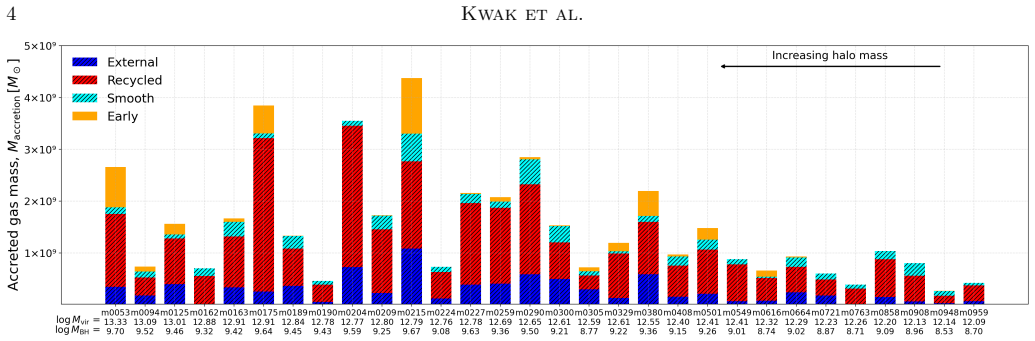
The paper's central discovery is that the cosmological gas supply to supermassive black holes in massive galaxies is dominated by material recycled through stellar evolution within the main galaxy. By classifying the accreted gas into four origin categories — Early (first entering the main halo at $z\ge 3$), External (from other halos or subhalos), Recycled (from asymptotic giant branch winds and supernova ejecta inside the main galaxy), and Smooth (from the intergalactic medium) — the authors find sample-averaged accreted-mass fractions of 58.7% Recycled, 19.8% External, 11.8% Smooth, and 9.8% Early. Recycled gas is intrinsically metal-rich already at early epochs, while the other components become enriched gradually while residing in the galactic environment before accretion. The resulting $[{\rm Fe/H}]$ of the accreted population shows only weak redshift evolution and $[{\rm Mg/Fe}]$ declines mildly, both broadly consistent with observed quasar broad-line region abundances. The authors conclude that the metal-rich nature of supermassive black hole fuel arises naturally from cosmological galaxy evolution and stellar recycling, and need not invoke sub-parsec enrichment processes.
Load-bearing premise
The paper assumes that unresolved small-scale physics near the black hole does not change which large-scale gas reservoirs actually feed it, so the simulation's simplified subgrid accretion recipe reliably selects the gas that a real black hole would consume.
Editorial extensions
If this is right
- Mergers are not the dominant long-term fuel source for supermassive black hole growth in massive group-scale galaxies; recycled stellar ejecta sustain the accretion budget instead.
- The high, nearly redshift-independent metallicities inferred for quasar broad-line regions need not be produced by sub-parsec enrichment; they follow naturally from galaxy-scale stellar recycling.
- Because recycled gas is preferentially metal-rich, gas accreted by the black hole is systematically more enriched than the average interstellar gas of the host galaxy, especially at z ~ 1-3.
- The mild [Mg/Fe] decline of accreted gas toward low redshift is a direct prediction of delayed Type Ia supernova iron enrichment that could be checked against quasar abundance-ratio evolution.
- In quenched massive galaxies at low redshift, stellar mass loss alone can continue to feed the black hole, providing a physical basis for observed AGN activity in quiescent galaxies.
Reading between the lines
- If recycled gas dominates the fuel supply, quasar metallicity should correlate more strongly with a host galaxy's old stellar mass and age than with recent merger activity or gas-richness, a distinction testable with resolved stellar-population observations of quasar hosts.
- The sample is restricted to massive, group-scale, largely quenched galaxies at z = 0; in lower-mass, star-forming, or gas-rich systems the recycled fraction is likely smaller, and smooth or external gas may dominate at high redshift.
- The weak redshift evolution of the accreted gas iron abundance implies that, at a fixed epoch, the gas reaching a black hole should be as metal-rich as the most enriched gas in the inner circumgalactic medium, which could be tested by comparing quasar broad-line metallicities with host stellar metallicities at matched stellar mass.
Signed reviews
Editorial analysis
A structured set of objections, weighed in public.
Referee Report
Summary. The paper analyzes 30 high-resolution cosmological zoom-in simulations of massive galaxies from the Choi et al. (2017) suite, tracing individual gas particles that are accreted by the central supermassive black hole (SMBH) under a soft-Bondi prescription. The accreted gas is classified into four origin categories: Recycled, Early, External, and Smooth. The authors report that, on average, 58.70% of the accreted gas mass is Recycled (originating from stellar mass loss within the main galaxy), that this component is already metal-rich at early epochs, and that the gas reaching the SMBH is more metal-rich than the average central galaxy gas. They further examine the redshift evolution of [Fe/H] and [Mg/Fe], find weak trends, and argue that the simulated abundance ratios are broadly compatible with observed quasar broad-line-region metallicities. The paper concludes that metal-rich SMBH fuel is a natural consequence of cosmological galaxy evolution and stellar recycling, and it explicitly frames the results as providing cosmological boundary conditions rather than a direct model of the sub-parsec accretion flow.
Significance. If the reported census is robust, the paper makes a valuable contribution by linking SMBH fueling to internal stellar recycling and by providing a physically grounded explanation for the high, weakly evolving metallicities inferred in quasar environments. The strengths include the large 30-galaxy zoom-in sample, the explicit particle tracing with an 11-element chemical network, the systematic treatment of four origin channels, and the candid enumeration of limitations in Section 4.4. The paper also shows appropriate restraint in treating [Mg/Fe] as a secondary diagnostic and in labeling the observational comparison as qualitative. The central concern is that the headline quantitative result, the 58.70% recycled fraction, is not yet shown to be robust to numerical resolution or to the choice of subgrid accretion model, which is load-bearing for the paper's main claim.
major comments (4)
- [§2.1, Figure 1] The central quantitative claim that Recycled gas constitutes 58.70% of the accreted mass rests on a single simulation resolution and a single subgrid accretion prescription; no resolution-convergence test is reported, even though the gas distribution and feedback behavior in such simulations can change with resolution. Please add a convergence test on a subset of runs at higher resolution, or explicitly reframe the headline result as conditional on the adopted numerical setup.
- [§2.2, item 2] The Early category is defined by first accretion onto the main halo at z≥3, and the text states that recycled gas produced at z>3 is deliberately assigned to Early rather than Recycled. This makes the origin categories non-exclusive and could bias the chemical comparison between Early and Recycled gas reported in Section 3. Please quantify how many z>3 recycled particles are placed in Early and demonstrate that the main conclusions are unchanged if they are reclassified.
- [§4.4] The paper concedes that small-scale physics can modify the accretion budget, yet the title and summary assert that Recycled gas dominates the metal-rich fuel of SMBHs. Because the traced sample is selected by the stochastic soft-Bondi criterion, which preferentially chooses dense, low-sound-speed gas, the census may overrepresent centrally enriched recycled ejecta relative to an inflow-based accounting. A minimal remedy is to report the origin distribution of gas within r10 as an accretion-independent reference, and to adjust the conclusions to the demonstrated 'gas reservoir delivered to the smallest resolved scales' rather than to the final accretion flow.
- [§4.2, footnote 7] The paper states that the comparison with quasar BLR abundances should be interpreted qualitatively, and the footnote notes that the observational values are not direct intrinsic abundances. This is a reasonable caution, but the abstract's phrase 'broadly compatible' is stronger than the analysis supports; please make the abstract and the conclusions reflect the qualitative nature of this comparison more explicitly.
minor comments (4)
- [Figure 1] The sample-averaged recycled fraction is quoted as 58.70% without a scatter or range; given the visible system-to-system variation, please quote the standard deviation or interquartile range as well.
- [§2.2] The definition of r10 as 0.1×r_vir is used to define the central galaxy, but the text does not state whether the same r10 criterion is applied consistently at all redshifts for the classification; please clarify.
- [Abstract] The abstract says the abundance ratios 'are broadly compatible with the high metallicities inferred for quasar broad-line regions,' but the body's limitation statement is stronger; aligning the abstract with the body would improve precision.
- [General] The draft header includes the string 'LATEXtwocolumnstyle', which appears to be a formatting artifact; this should be cleaned up before final submission.
Circularity Check
No significant circularity; only the metal-richness of the 'Recycled' category is definitional, while the 58.70% dominance is a genuine simulation output.
-
self definitional
[Section 2.2 category definition and Section 3 (Figure 2 caption text)]
"Recycled gas originates from stellar mass loss within the central region of the main galaxy and is therefore already chemically enriched when it is released into the interstellar medium."
In Section 2.2, 'Recycled gas' is defined as 'gas originating from stellar evolution within the main galaxy, including AGB winds and SN explosions,' and the simulation's enrichment model deposits metals from SN/AGB yield tables onto gas. Stellar ejecta are therefore metal-enriched by construction, so the statement that recycled gas is 'already chemically enriched' and 'intrinsically metal rich' is an immediate consequence of the category definition and the input yields, not an independent numerical prediction. This does not compromise the main census result: the 58.70% recycled fraction and the chemical state of the total accreted population are outputs of the simulation, so the circularity is limited to the characterization of the recycled component itself.
full rationale
The paper's central quantitative claim, that recycled gas constitutes 58.70% of the accreted gas mass in the sample, is a simulation output obtained by tracing individual gas particles; it is not fitted to quasar metallicity observations and is not forced by any normalization or scoring step. The particle-tracing methodology is inherited from Paper I (Choi et al. 2024), but the present analysis re-derives the census on a larger, independent sample of 30 galaxies, so the self-citation is methodological rather than load-bearing. The comparison with BLR abundances from Yoshii et al. (2022) is an external benchmark and is explicitly described as qualitative, with no parameter adjustment to match it. No fitted input is renamed as a prediction, no uniqueness theorem is imported from the authors' prior work, and no ansatz is smuggled in via citation. The only by-construction element is that the 'Recycled' category is defined as gas originating from stellar evolution, which in the adopted enrichment model is metal-enriched stellar ejecta; therefore the finding that recycled gas is already metal-rich is largely definitional. That minor self-definitional step does not propagate to the dominance fraction, which is independently determined, so the overall circularity is low.
Assumptions & free parameters
free parameters (3)
- AGN mechanical and radiative feedback efficiency parameters =
Not specified in paper (calibrated in Choi et al. 2015, 2017)
- Soft-Bondi accretion probability parameters =
Not specified in paper
- Stellar yield normalization parameters for SNIa, SNII, and AGB enrichment =
Not specified in paper (adopted from Iwamoto 1999, Woosley and Weaver 1995, Karakas 2010)
assumptions (4)
- domain assumption The adopted subgrid models for star formation, stellar feedback, and chemical enrichment (Aumer et al. 2013; Nunez et al. 2017) are accurate enough to reproduce the metal enrichment of real galaxies.
- domain assumption The Bondi-Hoyle-Lyttleton soft accretion prescription selects the same gas population that real SMBHs accrete on unresolved scales.
- domain assumption Gas particles retain their identity through mass deposition, metal mixing, and particle splitting, allowing reliable tracing.
- standard math WMAP3 cosmological parameters (h=0.72, Omega_b=0.044, Omega_dm=0.26, Omega_Lambda=0.74, sigma8=0.77, ns=0.95) describe the universe.
Cite this review
Pith. "Pith review of Recycled Gas Dominates the Metal-rich Fuel of Supermassive Black Holes." pith.science (2026). https://pith.science/paper/JI6VX5XO
@misc{pith2026260812462,
  author       = {Pith},
  title        = {Pith review of: Recycled Gas Dominates the Metal-rich Fuel of Supermassive Black Holes},
  year         = {2026},
  howpublished = {\url{https://pith.science/paper/JI6VX5XO}},
  note         = {Machine review of arXiv:2608.12462}
}
abstract
Understanding the origin and chemical properties of gas accreted by supermassive black holes (SMBHs) is essential for linking black hole growth to galaxy evolution. Using a suite of 30 high-resolution cosmological zoom-in simulations, we investigate the chemical properties of gas accreted onto SMBHs in massive galaxies with stellar masses of $10^{10.9-11.9}\,\rm M_\odot$ and black hole masses of $10^{8.5-9.7}\,\rm M_\odot$ at $z=0$. By tracing the full cosmological histories of individual gas particles, we identify their origins and enrichment pathways. The accreted gas is classified into four categories: ``early'' gas accreted during the early assembly phase of the main halo, ``external'' gas originating from other galaxies or subhalos, ``recycled'' gas enriched through stellar evolution processes within the primary galaxy, including asymptotic giant branch (AGB) winds and supernova ejecta, and ``smooth'' gas accreted from the intergalactic medium. We find that recycled gas dominates the accretion budget and is already metal rich at early epochs. Gas from other origins typically undergoes gradual chemical enrichment within the galactic environment prior to black hole accretion. The mean abundance ratios show only weak redshift evolution and are broadly compatible with the high metallicities inferred for quasar broad-line regions. Our results suggest that metal-rich gas supply to SMBHs arises naturally from cosmological galaxy evolution and stellar recycling.
Figures


Figures from the paper (1 more)

Reference graph
Works this paper leans on
-
[1]
Aird, J., Coil, A. L., & Georgakakis, A. 2018, Monthly Notices of the Royal Astronomical Society, 474, 1225, doi: 10.1093/MNRAS/STX2700
-
[2]
Aird, J., Coil, A. L., & Georgakakis, A. 2019, Monthly Notices of the Royal Astronomical Society, 484, 4360, doi: 10.1093/mnras/stz125
-
[3]
Aird, J., Coil, A. L., & Kocevski, D. D. 2022, Monthly Notices of the Royal Astronomical Society, 515, 4860, doi: 10.1093/mnras/stac2103 Angl´ es-Alc´ azar, D., Faucher-Gigu` ere, C.-A., Quataert, E., et al. 2017, MNRAS, 472, L109, doi: 10.1093/mnrasl/slx161 12Kwak et al. Angl´ es-Alc´ azar, D., Dav´ e, R., Faucher-Gigu` ere, C.-A.,¨Ozel, F., & Hopkins, P...
-
[4]
Arav, N., Xu, X., Miller, T., Kriss, G. A., & Plesha, R. 2020, The Astrophysical Journal Supplement Series, 247, 37, doi: 10.3847/1538-4365/ab66af
-
[5]
Asplund, M., Grevesse, N., Sauval, A. J., & Scott, P. 2009, Annual Review of Astronomy and Astrophysics, 47, 481, doi: 10.1146/annurev.astro.46.060407.145222
arXiv 2009
-
[6]
D., Naab, T., & Scannapieco, C
Aumer, M., White, S. D., Naab, T., & Scannapieco, C. 2013, Monthly Notices of the Royal Astronomical Society, 434, 3142, doi: 10.1093/mnras/stt1230
-
[7]
Barth, A. J., Martini, P., Nelson, C. H., & Ho, L. C. 2003, ApJL, 594, L95, doi: 10.1086/378735
doi:10.1086/378735 2003
-
[8]
Behroozi, P. S., Wechsler, R. H., & Wu, H.-Y. 2013, The Astrophysical Journal, 762, 109, doi: 10.1088/0004-637X/762/2/109
Show all 94 references
-
[9]
2013, The Astrophysical Journal, 779, 136, doi: 10.1088/0004-637X/779/2/136
Bellovary, J., Brooks, A., Volonteri, M., et al. 2013, The Astrophysical Journal, 779, 136, doi: 10.1088/0004-637X/779/2/136
2013 doi
-
[10]
L., Watson, M
Birchall, K. L., Watson, M. G., Aird, J., & Starling, R. L. 2023, Monthly Notices of the Royal Astronomical Society, 523, 4756, doi: 10.1093/mnras/stad1723
2023 doi
-
[11]
1952, Monthly Notices of the Royal Astronomical Society, 112, 195, doi: 10.1093/mnras/112.2.195
Bondi, H. 1952, Monthly Notices of the Royal Astronomical Society, 112, 195, doi: 10.1093/mnras/112.2.195
1952 doi
-
[12]
1944, Monthly Notices of the Royal Astronomical Society, 104, 273, doi: 10.1093/mnras/104.5.273
Bondi, H., & Hoyle, F. 1944, Monthly Notices of the Royal Astronomical Society, 104, 273, doi: 10.1093/mnras/104.5.273
1944 doi
-
[13]
S., et al
Brennan, R., Choi, E., Somerville, R. S., et al. 2018, The Astrophysical Journal, 860, 14, doi: 10.3847/1538-4357/aac2c4
2018 doi
-
[14]
S., et al
Choi, E., Brennan, R., Somerville, R. S., et al. 2020, ApJ, 904, 8, doi: 10.3847/1538-4357/abba7d
2020 doi
-
[15]
Moster, B. P. 2014, Monthly Notices of the Royal Astronomical Society, 442, 440, doi: 10.1093/mnras/stu874
2014 doi
-
[16]
P., Naab, T., & Johansson, P
Choi, E., Ostriker, J. P., Naab, T., & Johansson, P. H. 2012, Astrophysical Journal, 754, 125, doi: 10.1088/0004-637X/754/2/125
2012 doi
-
[17]
P., Naab, T., Oser, L., & Moster, B
Choi, E., Ostriker, J. P., Naab, T., Oser, L., & Moster, B. P. 2015, Monthly Notices of the Royal Astronomical Society, 449, 4105, doi: 10.1093/mnras/stv575
2015 doi
-
[18]
P., Naab, T., et al
Choi, E., Ostriker, J. P., Naab, T., et al. 2017, ApJ, 844, 31, doi: 10.3847/1538-4357/aa7849
2017 doi
-
[19]
S., Ostriker, J
Choi, E., Somerville, R. S., Ostriker, J. P., Hirschmann, M., & Naab, T. 2024, ApJ, 964, 54, doi: 10.3847/1538-4357/ad245a
2024 doi
-
[20]
R., Dav´ e, R., Governato, F., et al
Christensen, C. R., Dav´ e, R., Governato, F., et al. 2016, ApJ, 824, 57, doi: 10.3847/0004-637X/824/1/57
2016 doi
-
[21]
Ciotti, L., & Ostriker, J. P. 2007, The Astrophysical Journal, 665, 1038, doi: 10.1086/519833
2007 doi
-
[22]
2010, Monthly Notices of the Royal Astronomical Society, 408, 669, doi: 10.1111/j.1365-2966.2010.17158.x De Rosa, G., Decarli, R., Walter, F., et al
Cullen, L., & Dehnen, W. 2010, Monthly Notices of the Royal Astronomical Society, 408, 669, doi: 10.1111/j.1365-2966.2010.17158.x De Rosa, G., Decarli, R., Walter, F., et al. 2011, ApJ, 739, 56, doi: 10.1088/0004-637X/739/2/56
2010
-
[23]
C., et al
Dietrich, M., Hamann, F., Shields, J. C., et al. 2003, ApJ, 589, 722, doi: 10.1086/374662
2003 doi
-
[24]
C., et al
Dong, X.-B., Wang, J.-G., Ho, L. C., et al. 2011, ApJ, 736, 86, doi: 10.1088/0004-637X/736/2/86
2011 doi
-
[25]
2012, Monthly Notices of the Royal Astronomical Society, 420, 2662, doi: 10.1111/j.1365-2966.2011.20236.x
Dubois, Y., Devriendt, J., Slyz, A., & Teyssier, R. 2012, Monthly Notices of the Royal Astronomical Society, 420, 2662, doi: 10.1111/j.1365-2966.2011.20236.x
2012
-
[26]
2017, Monthly Notices of the Royal Astronomical Society, 468, 751, doi: 10.1093/mnras/stx473
Emsellem, E. 2017, Monthly Notices of the Royal Astronomical Society, 468, 751, doi: 10.1093/mnras/stx473
2017 doi
-
[27]
J., Wetzel, A., Boylan-Kolchin, M., et al
Gandhi, P. J., Wetzel, A., Boylan-Kolchin, M., et al. 2024, MNRAS, 533, 1059, doi: 10.1093/mnras/stae1584
2024 doi
-
[28]
S., et al
Habouzit, M., Li, Y., Somerville, R. S., et al. 2021, MNRAS, 503, 1940, doi: 10.1093/mnras/stab496
2021 doi
-
[29]
A., Angl´ es-Alc´ azar, D., et al
Hafen, Z., Faucher-Gigu` ere, C. A., Angl´ es-Alc´ azar, D., et al. 2019, Monthly Notices of the Royal Astronomical Society, 1248, doi: 10.1093/mnras/stz1773
2019 doi
-
[30]
2020, Monthly Notices of the Royal Astronomical Society, doi: 10.1093/mnras/staa902
Hafen, Z., Faucher-Gigu` ere, C.-A., Angl´ es-Alc´ azar=, D., et al. 2020, Monthly Notices of the Royal Astronomical Society, doi: 10.1093/mnras/staa902
2020 doi
-
[31]
1992, ApJL, 391, L53, doi: 10.1086/186397
Hamann, F., & Ferland, G. 1992, ApJL, 391, L53, doi: 10.1086/186397
1992 doi
-
[32]
M., & Best, P
Heckman, T. M., & Best, P. N. 2014, ARA&A, 52, 589, doi: 10.1146/annurev-astro-081913-035722
2014 doi
-
[33]
H., Martin, C
Ho, S. H., Martin, C. L., & Turner, M. L. 2019, ApJ, 875, 54, doi: 10.3847/1538-4357/ab0ec2
2019 doi
-
[34]
Hoyle, F., & Lyttleton, R. A. 1939, Proceedings of the Cambridge Philosophical Society, 34, 405
1939
-
[35]
Y., Naab, T., Walch, S., Moster, B
Hu, C. Y., Naab, T., Walch, S., Moster, B. P., & Oser, L. 2014, Monthly Notices of the Royal Astronomical Society, 443, 1173, doi: 10.1093/mnras/stu1187
2014 doi
-
[36]
1999, The Astrophysical Journal Supplement Series, 125, 439, doi: 10.1086/313278
Iwamoto, K., Brachwitz, F., Nomoto, K., et al. 1999, The Astrophysical Journal Supplement Series, 125, 439, doi: 10.1086/313278
1999 doi
-
[37]
G., Starkenburg, T
Iyer, K. G., Starkenburg, T. K., Bryan, G. L., et al. 2025, ApJ, 994, 174, doi: 10.3847/1538-4357/ae0334 Metal-rich Fuel for SMBHs13
2025 doi
-
[38]
S., et al
Jhee, H., Choi, E., Somerville, R. S., et al. 2026, MNRAS, 548, stag435, doi: 10.1093/mnras/stag435
2026 doi
-
[39]
2024, ApJ, 975, 214, doi: 10.3847/1538-4357/ad7d09
Jiang, D., Onoue, M., Jiang, L., et al. 2024, ApJ, 975, 214, doi: 10.3847/1538-4357/ad7d09
2024 doi
-
[40]
2007, AJ, 134, 1150, doi: 10.1086/520811
Jiang, L., Fan, X., Vestergaard, M., et al. 2007, AJ, 134, 1150, doi: 10.1086/520811
2007 doi
-
[41]
2009, A&A, 494, L25, doi: 10.1051/0004-6361:200811415
Juarez, Y., Maiolino, R., Mujica, R., et al. 2009, A&A, 494, L25, doi: 10.1051/0004-6361:200811415
2009 doi
-
[42]
Karakas, A. I. 2010, Monthly Notices of the Royal Astronomical Society, 403, 1413, doi: 10.1111/j.1365-2966.2009.16198.x
2010
-
[43]
Kormendy, J., & Ho, L. C. 2013, ARA&A, 51, 511, doi: 10.1146/annurev-astro-082708-101811
2013 doi
-
[45]
D., Walter, F., Fan, X., et al
Kurk, J. D., Walter, F., Fan, X., et al. 2007, ApJ, 669, 32, doi: 10.1086/521596
2007 doi
-
[46]
N., & Kravtsov, A
Leitner, S. N., & Kravtsov, A. V. 2011, Astrophysical Journal, 734, 48, doi: 10.1088/0004-637X/734/1/48
2011 doi
-
[47]
1998, AJ, 115, 2285, doi: 10.1086/300353
Magorrian, J., Tremaine, S., Richstone, D., et al. 1998, AJ, 115, 2285, doi: 10.1086/300353
1998 doi
-
[48]
2003, ApJL, 596, L155, doi: 10.1086/379600
Oliva, E. 2003, ApJL, 596, L155, doi: 10.1086/379600
2003 doi
-
[49]
2015, ApJ, 810, 51, doi: 10.1088/0004-637X/810/1/51
Mayer, L., Fiacconi, D., Bonoli, S., et al. 2015, ApJ, 810, 51, doi: 10.1088/0004-637X/810/1/51
2015 doi
-
[50]
P., et al
Mazzucchelli, C., Ba˜ nados, E., Venemans, B. P., et al. 2017, ApJ, 849, 91, doi: 10.3847/1538-4357/aa9185
2017 doi
-
[51]
J., & Ma, C.-P
McConnell, N. J., & Ma, C.-P. 2013, ApJ, 764, 184, doi: 10.1088/0004-637X/764/2/184
2013 doi
-
[52]
C., et al
Mercedes-Feliz, J., Angl´ es-Alc´ azar, D., Hayward, C. C., et al. 2023, MNRAS, 524, 3446, doi: 10.1093/mnras/stad2079
2023 doi
-
[53]
K., et al
Mercedes-Feliz, J., Angl´ es-Alc´ azar, D., Oh, B. K., et al. 2025, arXiv e-prints, arXiv:2510.19905, doi: 10.48550/arXiv.2510.19905
2025 doi
-
[54]
D., Schaye, J., Bower, R
Mitchell, P. D., Schaye, J., Bower, R. G., & Crain, R. A. 2020, MNRAS, 494, 3971, doi: 10.1093/mnras/staa938
2020 doi
-
[55]
J., Warren, S
Mortlock, D. J., Warren, S. J., Venemans, B. P., et al. 2011, Nature, 474, 616, doi: 10.1038/nature10159
2011 doi
-
[56]
Naab, T., & Ostriker, J. P. 2017, Annual Review of Astronomy and Astrophysics, 55, 59, doi: 10.1146/annurev-astro-081913-040019
2017 doi
-
[57]
2006, A&A, 447, 157, doi: 10.1051/0004-6361:20054024
Nagao, T., Marconi, A., & Maiolino, R. 2006, A&A, 447, 157, doi: 10.1051/0004-6361:20054024
2006 doi
-
[58]
2023, Monthly Notices of the Royal Astronomical Society, 524, 4778, doi: 10.1093/mnras/stad2070 N´ u˜ nez, A., Ostriker, J
Ni, Q., Aird, J., Merloni, A., et al. 2023, Monthly Notices of the Royal Astronomical Society, 524, 4778, doi: 10.1093/mnras/stad2070 N´ u˜ nez, A., Ostriker, J. P., Naab, T., et al. 2017, The Astrophysical Journal, 836, 204, doi: 10.3847/1538-4357/836/2/204
2023 doi
-
[59]
2020, ApJ, 898, 105, doi: 10.3847/1538-4357/aba193
Onoue, M., Ba˜ nados, E., Mazzucchelli, C., et al. 2020, ApJ, 898, 105, doi: 10.3847/1538-4357/aba193
2020 doi
-
[60]
2010, Astrophysical Journal, 725, 2312, doi: 10.1088/0004-637X/725/2/2312
Burkert, A. 2010, Astrophysical Journal, 725, 2312, doi: 10.1088/0004-637X/725/2/2312
2010 doi
-
[61]
P., Choi, E., Ciotti, L., et al
Ostriker, J. P., Choi, E., Ciotti, L., et al. 2010, ApJ, 722, 642, doi: 10.1088/0004-637X/722/1/642
2010 doi
-
[62]
Pellegrini, S., Ciotti, L., Negri, A., & Ostriker, J. P. 2018, ApJ, 856, 115, doi: 10.3847/1538-4357/aaae07
2018 doi
-
[63]
Proga, D., & Kallman, T. R. 2004, The Astrophysical Journal, 616, 688, doi: 10.1086/425117
2004 doi
-
[64]
M., & Kallman, T
Proga, D., Stone, J. M., & Kallman, T. R. 2000, The Astrophysical Journal, 543, 686, doi: 10.1086/317154
2000 doi
-
[65]
I., & Hayfield, T
Read, J. I., & Hayfield, T. 2012, Monthly Notices of the Royal Astronomical Society, 422, 3037, doi: 10.1111/j.1365-2966.2012.20819.x
2012
- [66]
-
[67]
G., Riffel, R
Riffel, R., Dahmer-Hahn, L. G., Riffel, R. A., et al. 2022, Monthly Notices of the Royal Astronomical Society, 512, 3906, doi: 10.1093/mnras/stac740
2022 doi
-
[68]
D., Rembold, S
Riffel, R., Mallmann, N. D., Rembold, S. B., et al. 2023, Monthly Notices of the Royal Astronomical Society, 524, 5640, doi: 10.1093/mnras/stad2234
2023 doi
-
[69]
W., & Thomas, P
Ritchie, B. W., & Thomas, P. A. 2001, Monthly Notices of the Royal Astronomical Society, 323, 743, doi: 10.1046/j.1365-8711.2001.04268.x R¨ ottgers, B., Naab, T., Cernetic, M., et al. 2020, MNRAS, 496, 152, doi: 10.1093/mnras/staa1490
2001
-
[70]
2017, ApJ, 834, 203, doi: 10.3847/1538-4357/834/2/203
Sameshima, H., Yoshii, Y., & Kawara, K. 2017, ApJ, 834, 203, doi: 10.3847/1538-4357/834/2/203
2017 doi
-
[71]
2020, ApJ, 904, 162, doi: 10.3847/1538-4357/abc33b
Sameshima, H., Yoshii, Y., Matsunaga, N., et al. 2020, ApJ, 904, 162, doi: 10.3847/1538-4357/abc33b
2020 doi
-
[72]
N., Bellovary, J
Sanchez, N. N., Bellovary, J. M., Holley-Bockelmann, K., et al. 2018, The Astrophysical Journal, 860, 20, doi: 10.3847/1538-4357/AAC015
2018 doi
-
[74]
Y., Ostriker, J
Sazonov, S. Y., Ostriker, J. P., & Sunyaev, R. A. 2004, Monthly Notices of the Royal Astronomical Society, 347, 144, doi: 10.1111/j.1365-2966.2004.07184.x
2004
-
[75]
C., Crain, R
Segers, M. C., Crain, R. A., Schaye, J., et al. 2016, Monthly Notices of the Royal Astronomical Society, 456, 1235, doi: 10.1093/mnras/stv2562
2016 doi
-
[76]
S., Choi, E., Somerville, R
Sharma, R. S., Choi, E., Somerville, R. S., et al. 2024, MNRAS, 527, 9461, doi: 10.1093/mnras/stad3836 14Kwak et al
2024 doi
-
[77]
2004, ApJ, 614, 547, doi: 10.1086/423607
Shemmer, O., Netzer, H., Maiolino, R., et al. 2004, ApJ, 614, 547, doi: 10.1086/423607
2004 doi
-
[78]
Shin, J., Nagao, T., Woo, J.-H., & Le, H. A. N. 2019, ApJ, 874, 22, doi: 10.3847/1538-4357/ab05da
2019 doi
-
[79]
2021, ApJ, 917, 107, doi: 10.3847/1538-4357/ac0adf
Shin, J., Woo, J.-H., Nagao, T., Kim, M., & Bahk, H. 2021, ApJ, 917, 107, doi: 10.3847/1538-4357/ac0adf
2021 doi
-
[80]
Shin, J., Woo, J.-H., Nagao, T., & Kim, S. C. 2013, ApJ, 763, 58, doi: 10.1088/0004-637X/763/1/58
2013 doi
-
[81]
2023, ApJ, 949, 44, doi: 10.3847/1538-4357/acc582
Shipp, N., Panithanpaisal, N., Necib, L., et al. 2023, ApJ, 949, 44, doi: 10.3847/1538-4357/acc582
2023 doi
-
[82]
D., & Hernquist, L
Sijacki, D., Springel, V., Matteo, T. D., & Hernquist, L. 2007, Monthly Notices of the Royal Astronomical Society, 380, 877, doi: 10.1111/j.1365-2966.2007.12153.x
2007
-
[83]
2015, MNRAS, 452, 575, doi: 10.1093/mnras/stv1340
Sijacki, D., Vogelsberger, M., Genel, S., et al. 2015, MNRAS, 452, 575, doi: 10.1093/mnras/stv1340
2015 doi
- [84]
-
[85]
S., & Dav´ e, R
Somerville, R. S., & Dav´ e, R. 2015, Annual Review of Astronomy and Astrophysics, 53, 51, doi: 10.1146/annurev-astro-082812-140951
2015 doi
-
[86]
S., Hopkins, P
Somerville, R. S., Hopkins, P. F., Cox, T. J., Robertson, B. E., & Hernquist, L. 2008, Monthly Notices of the Royal Astronomical Society, 391, 481, doi: 10.1111/j.1365-2966.2008.13805.x
2008
-
[87]
N., Bean, R., Dore, O., et al
Spergel, D. N., Bean, R., Dore, O., et al. 2007, The Astrophysical Journal Supplement Series, 170, 377, doi: 10.1086/513700
2007 doi
-
[88]
2005, Monthly Notices of the Royal Astronomical Society, 364, 1105, doi: 10.1111/j.1365-2966.2005.09655.x
Springel, V. 2005, Monthly Notices of the Royal Astronomical Society, 364, 1105, doi: 10.1111/j.1365-2966.2005.09655.x
2005
-
[89]
2005, ApJL, 620, L79, doi: 10.1086/428772
Springel, V., Di Matteo, T., & Hernquist, L. 2005, ApJL, 620, L79, doi: 10.1086/428772
2005 doi
-
[90]
A., Bell, E
Terrazas, B. A., Bell, E. F., Pillepich, A., et al. 2020, Monthly Notices of the Royal Astronomical Society, 493, 1888, doi: 10.1093/mnras/staa374 Tollet, ´E., Cattaneo, A., Macci` o, A. V., Dutton, A. A., &
2020 doi
-
[91]
2019, MNRAS, 485, 2511, doi: 10.1093/mnras/stz545
Kang, X. 2019, MNRAS, 485, 2511, doi: 10.1093/mnras/stz545
2019 doi
-
[92]
2022, ApJ, 925, 121, doi: 10.3847/1538-4357/ac3a69
Wang, S., Jiang, L., Shen, Y., et al. 2022, ApJ, 925, 121, doi: 10.3847/1538-4357/ac3a69
2022 doi
-
[93]
2013, ApJ, 772, 49, doi: 10.1088/0004-637X/772/1/49
Woo, J.-H., Schulze, A., Park, D., et al. 2013, ApJ, 772, 49, doi: 10.1088/0004-637X/772/1/49
2013 doi
-
[94]
Woo, J.-H., Yoon, Y., Park, S., Park, D., & Kim, S. C. 2015, ApJ, 801, 38, doi: 10.1088/0004-637X/801/1/38
2015 doi
-
[95]
E., & Weaver, T
Woosley, S. E., & Weaver, T. A. 1995, The Astrophysical Journal Supplement Series, 101, 181, doi: 10.1086/192237
1995 doi
-
[96]
2022, ApJ, 937, 61, doi: 10.3847/1538-4357/ac8163
Yoshii, Y., Sameshima, H., Tsujimoto, T., et al. 2022, ApJ, 937, 61, doi: 10.3847/1538-4357/ac8163
2022 doi
Reviewed August 16, 2026 · model on record in the stance chip above.
Discussion (0). Continue with ORCID to comment.