Spherical Geometrical Bases of Spherical Origami
Pith reviewed 2026-05-21 01:01 UTC · model grok-4.3
The pith
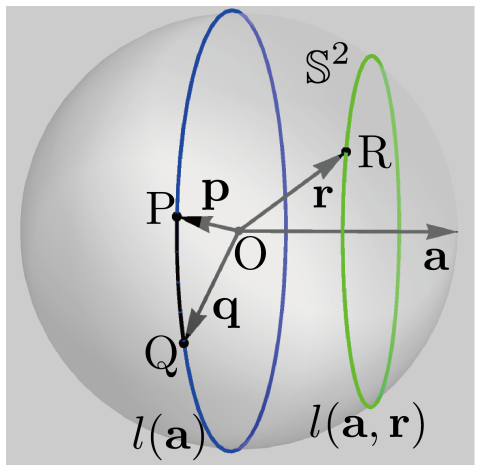
A rigorous geometrical framework extends the seven Huzita-Justin axioms to spherical origami on the unit sphere with explicit equations.
A machine-rendered reading of the paper's core claim, the machinery that carries it, and where it could break.
Core claim
The central claim is that origami on the unit sphere admits explicit equations for all seven Huzita-Justin axioms through systematic extension of Euclidean definitions, while three-dimensional folding of spherical sheets is enabled by introducing equidistant curves as fold curves instead of geodesics, with validation via computer-generated spherical origami birds.
What carries the argument
Systematic extension of Euclidean origami definitions to the spherical setting on the unit sphere, together with equidistant curves replacing geodesics for three-dimensional folds.
Load-bearing premise
The definitions and operations of Euclidean origami can be systematically extended to the spherical setting while preserving essential properties and allowing explicit equation representations without inconsistencies.
What would settle it
An inability to derive an explicit equation for any one of the seven Huzita-Justin axioms on the unit sphere, or a failure to construct a valid computer graphics model of a spherical origami bird using the proposed fold curves.
Figures




read the original abstract
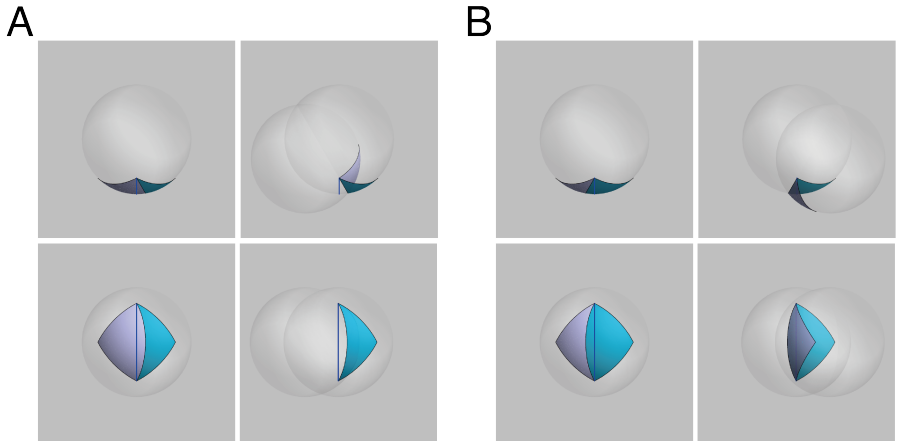
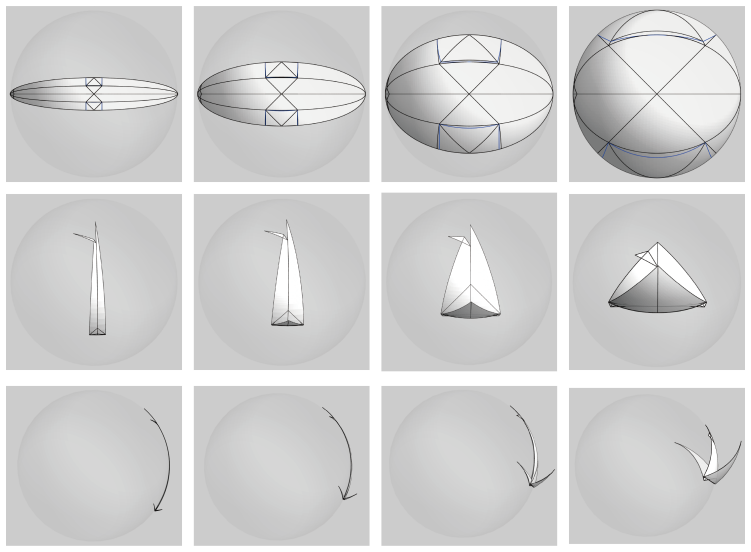
This paper establishes a rigorous geometrical framework for spherical origami, origami using spherical sheets based on spherical geometry. Two settings are treated: origami restricted to the unit sphere ($\mathbb{S}^2$), and three-dimensional folding of spherical sheets in space. For origami on $\mathbb{S}^2$, the definitions of Euclidean origami are systematically extended to the spherical setting, and all seven Huzita--Justin axioms are shown to admit explicit equations in spherical geometry. For three-dimensional folding, equidistant curves are introduced as fold curves, replacing geodesics and enabling a richer family of folds. The framework is validated by successfully constructing computer graphics of spherical origami birds, demonstrating both the theoretical completeness and practical utility of the proposed approach.
Editorial analysis
A structured set of objections, weighed in public.
Referee Report
Summary. The paper claims to establish a rigorous geometrical framework for spherical origami on the unit sphere S^2 by systematically extending Euclidean origami definitions, showing that all seven Huzita-Justin axioms admit explicit equations in spherical geometry, and for three-dimensional folding of spherical sheets introducing equidistant curves as fold curves in place of geodesics. The framework is validated by computer graphics constructions of spherical origami birds.
Significance. If the extensions are shown to be free of inconsistencies arising from positive curvature and compactness, this would supply a foundational theory bridging classical origami axioms with spherical geometry, enabling new constructions in computational geometry and curved-surface design. The emphasis on explicit equations and practical CG validation would be strengths if the derivations are complete.
major comments (3)
- [§3 (Spherical Axiom Extensions)] The central extension of Euclidean definitions to S^2 (described in the sections treating origami restricted to the unit sphere) must address existence and uniqueness for all point configurations. On the sphere, perpendicular bisectors and angle bisectors central to axioms 2–7 can fail to exist or become non-unique when angular distances approach π, unlike the Euclidean case; the manuscript should either restrict the domain or supply global checks that the local trigonometric equations remain well-defined.
- [§5 (Three-Dimensional Folding)] The introduction of equidistant curves as fold curves for three-dimensional folding (in the section on 3D spherical sheets) replaces geodesics to enable richer folds, but it is unclear whether these curves preserve the reflection or isometry properties required for valid origami folds; without explicit verification that they avoid self-intersections on the compact topology, the claim of a richer yet consistent family is not yet load-bearing.
- [§6 (Validation and CG Constructions)] The computer-graphics constructions of spherical origami birds are presented as validation of theoretical completeness, yet no details are supplied on which specific axioms were implemented, the numerical solution of the spherical equations, or any error metrics; this leaves the practical-utility claim unsupported by reproducible evidence.
minor comments (2)
- [Abstract] The abstract asserts that axioms 'admit explicit equations' but supplies no example form (e.g., spherical law of cosines for intersection points); a single illustrative equation would clarify the approach without lengthening the summary.
- [§2 (Definitions)] Notation for spherical distances and angles should be introduced early and used consistently to distinguish great-circle quantities from their Euclidean counterparts.
Simulated Author's Rebuttal
We thank the referee for their thorough review and valuable suggestions. We address each of the major comments point by point, indicating where revisions will be made to strengthen the manuscript.
read point-by-point responses
-
Referee: [§3 (Spherical Axiom Extensions)] The central extension of Euclidean definitions to S^2 (described in the sections treating origami restricted to the unit sphere) must address existence and uniqueness for all point configurations. On the sphere, perpendicular bisectors and angle bisectors central to axioms 2–7 can fail to exist or become non-unique when angular distances approach π, unlike the Euclidean case; the manuscript should either restrict the domain or supply global checks that the local trigonometric equations remain well-defined.
Authors: We agree with the referee that the spherical setting introduces potential issues with existence and uniqueness of bisectors when angular distances approach π. The current manuscript focuses on local configurations typical for origami folds, where distances are sufficiently small to ensure uniqueness via the spherical law of cosines. To make this rigorous, we will revise §3 to explicitly state the domain restrictions (e.g., all points within a hemisphere) and add algorithmic checks that verify the discriminant of the quadratic equations derived from the axioms is positive before proceeding with solutions. This will prevent invalid configurations. revision: yes
-
Referee: [§5 (Three-Dimensional Folding)] The introduction of equidistant curves as fold curves for three-dimensional folding (in the section on 3D spherical sheets) replaces geodesics to enable richer folds, but it is unclear whether these curves preserve the reflection or isometry properties required for valid origami folds; without explicit verification that they avoid self-intersections on the compact topology, the claim of a richer yet consistent family is not yet load-bearing.
Authors: Regarding the use of equidistant curves for 3D folding, these curves are the spherical analogs of lines parallel to a given geodesic at a fixed distance, and reflection over them can be defined using the spherical exponential map. We will add in §5 a proof sketch showing that such reflections are local isometries and discuss the avoidance of self-intersections by limiting the folding angle and curve length to less than π, leveraging the compactness of S^2. This addresses the consistency concern. revision: yes
-
Referee: [§6 (Validation and CG Constructions)] The computer-graphics constructions of spherical origami birds are presented as validation of theoretical completeness, yet no details are supplied on which specific axioms were implemented, the numerical solution of the spherical equations, or any error metrics; this leaves the practical-utility claim unsupported by reproducible evidence.
Authors: We acknowledge the lack of implementation details in §6. In the revision, we will expand the validation section to include: (1) a list of the specific Huzita-Justin axioms employed in constructing the spherical origami birds, (2) the numerical approach used to solve the spherical trigonometric equations (e.g., iterative methods with initial guesses from Euclidean approximations), and (3) quantitative error metrics, such as the maximum residual in fold condition satisfaction and visual inspection of intersections. This will provide reproducible evidence for the practical utility. revision: yes
Circularity Check
No significant circularity; derivation is a direct definitional extension
full rationale
The paper's central chain consists of extending Euclidean origami definitions to the spherical setting on S^2 and deriving explicit trigonometric equations for each of the seven Huzita-Justin axioms, followed by introducing equidistant curves for 3D folding. These steps are presented as systematic mathematical constructions rather than reductions to fitted parameters, self-referential definitions, or load-bearing self-citations. No equations or claims in the provided abstract and context reduce a result to its own inputs by construction; the validation via computer graphics of origami models provides an independent check. The framework therefore remains self-contained against external benchmarks without circular steps.
Axiom & Free-Parameter Ledger
axioms (1)
- domain assumption Definitions of Euclidean origami can be systematically extended to the spherical setting on S^2.
invented entities (1)
-
Equidistant curves as fold curves
no independent evidence
Lean theorems connected to this paper
-
IndisputableMonolith/Foundation/AlexanderDuality.leanalexander_duality_circle_linking unclear?
unclearRelation between the paper passage and the cited Recognition theorem.
Theorem 1 (Spherical Huzita–Justin Axioms). Under the spherical definitions 1–8 above, every Huzita–Justin axiom admits an explicit construction on S² … solution counts mirror the Euclidean case.
What do these tags mean?
- matches
- The paper's claim is directly supported by a theorem in the formal canon.
- supports
- The theorem supports part of the paper's argument, but the paper may add assumptions or extra steps.
- extends
- The paper goes beyond the formal theorem; the theorem is a base layer rather than the whole result.
- uses
- The paper appears to rely on the theorem as machinery.
- contradicts
- The paper's claim conflicts with a theorem or certificate in the canon.
- unclear
- Pith found a possible connection, but the passage is too broad, indirect, or ambiguous to say the theorem truly supports the claim.
Reference graph
Works this paper leans on
-
[1]
Hull, Project origami: activities for exploring mathematics, CRC Press, Boca Raton, USA, 2012
T. Hull, Project origami: activities for exploring mathematics, CRC Press, Boca Raton, USA, 2012. 24
work page 2012
-
[2]
Geretschläger, Geometric Origami, Arbelos, Shipley, UK, 2008
R. Geretschläger, Geometric Origami, Arbelos, Shipley, UK, 2008
work page 2008
-
[3]
D. Misseroni, P. P. Pratapa, K. Liu, B. Kresling, Y. Chen, C. Daraio, G. H. Paulino, Origami engineering, Nature Reviews Methods Primers 4 (1) (2024) 40
work page 2024
-
[4]
H. Liu, P. Plucinsky, F. Feng, R. D. James, Origami and materials science, Philosophical Transactions of the Royal Society A 379 (2201) (2021) 20200113
work page 2021
-
[5]
Miura, The science of miura-ori: A review, in: R
K. Miura, The science of miura-ori: A review, in: R. J. Lang (Ed.), Origami 4, Fourth International Meeting of Origami Science, Mathe- matics, and Education, A K Peters, Ltd., Natick, USA, 2009, pp. 87–99
work page 2009
-
[6]
J.Mitani, Curved-foldingorigamidesign, CRCPress, BocaRaton, USA, 2019
work page 2019
-
[7]
Lukasheva, Curved Origami, New Origami Publishing, Columbia, USA, 2021
E. Lukasheva, Curved Origami, New Origami Publishing, Columbia, USA, 2021
work page 2021
-
[8]
Kawasaki, A note on operations of spherical origami constructions, in: P
T. Kawasaki, A note on operations of spherical origami constructions, in: P. Wang-Iverson, R. Lang, M. Yim (Eds.), Origami 5, CRC Press, Boca Raton, USA, 2011, pp. 543–551
work page 2011
-
[9]
R. C. Alperin, B. Hayes, R. J. Lang, Folding the hyperbolic crane., Mathematical Intelligencer 34 (2) (2012) ???–???
work page 2012
-
[10]
R. C. Alperin, R. J. Lang, One-, two-, and multi-fold origami axioms, in: Origami 4, 2006, pp. 371–393
work page 2006
-
[11]
J. Justin, Résolution par le pliage de l’équation du troisième degré et applications géométriques, L’Ouvert - Journal de l’APMEP d’Alsace et de l’IREM de Strasbourg 42 (1986) 9–19
work page 1986
-
[12]
H. Huzita, Axiomatic development of origami geometry, in: Proceedings of the First International Meeting of Origami Science and Technology, 1989, 1989, pp. 143–158
work page 1989
-
[13]
K. Hatori, Origami versus straight-edge-and-compass, https://origami.ousaan.com/library/conste.html, (Retrieved on 12/29/2024). 25
work page 2024
-
[14]
R.J.Lang, Huzita-justinaxioms,https://langorigami.com/article/huzita-justin-axioms/, (Retrieved on 12/29/2024)
work page 2024
-
[15]
Kawasaki, Roses, origami & math, Japan Publications Trading, Tokyo, JPN, 2005
T. Kawasaki, Roses, origami & math, Japan Publications Trading, Tokyo, JPN, 2005
work page 2005
-
[16]
S. A. Robertson, Isometric folding of riemannian manifolds, Proceedings of the Royal Society of Edinburgh: Section A Mathematics 79 (1977) 275–284. doi:10.1017/S0308210500019788
-
[17]
A. M. Breda, A. F. Santos, On deformations of spherical isometric fold- ings, Czechoslovak Mathematical Journal 60 (1) (2010) 149–159
work page 2010
-
[18]
Fejes Tóth, Lagerungen in der Ebene, auf der Kugel und im Raum, Springer, Berlin, DE, 1953
L. Fejes Tóth, Lagerungen in der Ebene, auf der Kugel und im Raum, Springer, Berlin, DE, 1953
work page 1953
-
[19]
Ogawa, A new aspect of spherical harmonics, Forma 13 (2) (1998) 51–62
T. Ogawa, A new aspect of spherical harmonics, Forma 13 (2) (1998) 51–62. 26
work page 1998
discussion (0)
Sign in with ORCID, Apple, or X to comment. Anyone can read and Pith papers without signing in.