REVIEW 4 major objections 6 minor 45 references
Received Signal Strength Based Wireless Source Localization with Inaccurate Anchor Position
T0 review · 4 major / 6 minor · reviewed 2026-08-14 · deepseek-v4-flash
Pith's one-line read The paper proposes an RSS-based source localization method that stays accurate when anchor positions are only known within a bound, using a worst-case semidefinite relaxation and joint source-and-anchor rounding.
desk verdict The paper's core rounding idea is worth attention, but the derivation changes the estimator mid-stream and the main SDP has a sign error, so the reported simulation results cannot be tied to the stated method without code or a corrected formulation. read the letter →
The pith
A machine-rendered reading of the paper's core claim, the machinery that carries it, and where it could break.
The reading
What carries the argument
The load-bearing object is the min-max reformulation of the RSS objective: replace the original sum of squared log-ratio terms by $\max_i \left|\log_{10}\left((\|x-\hat z_i\|-\delta_i)^2/\beta_i^2\right)\right|$ after a first-order Taylor expansion of the anchor error. This makes the worst case over anchor perturbations reduce to a known bound $\zeta$ on $\delta_i$, so the nonconvex problem becomes a semidefinite program with variables $x$, scalar $k$, distance vector $l$, and matrices $X=xx^T$, $L=ll^T$ relaxed to convex matrix constraints. The second mechanism is the joint rounding algorithm: it uses $X^* - x^* x^{*T}$ as a covariance to sample source candidates and uniformly samples anchor candidates inside each $\zeta$-ball, selecting the pair with the lowest RSS residual. The combination is what converts a loose convex relaxation into a usable point estimate.
What would settle it
Run a dense grid search over a small two-dimensional configuration with noiseless RSS, known anchor error bound $\zeta$, and anchor positions that satisfy $\|x-\hat z_i\|>\zeta$; compare the global minimum of the original sum-of-squared log-ratio objective (Eq. (8)) with the output of the SDP plus rounding. If for some geometry the rounded SDP solution lies farther from the true source than the grid's best point by more than the grid resolution, the relaxation demonstrably solves a different problem than the announced robust estimator.
Extended reading notes
Core claim
The central claim is that inaccurate anchor positions need not be modeled statistically for robust RSS source localization: a bounded worst-case model suffices. The paper starts from the log-normal shadowing model, writes the maximum-likelihood estimate as minimizing the sum of squared log-ratio terms, then Taylor-expands the anchor perturbation (Eq. (9)) and converts the sum into a max over anchors of absolute log-ratios (Eq. (13)). This converts the uncertainty set into an additive bound $\pm\zeta$ on each distance ratio, allowing a semidefinite relaxation (Eq. (25)) with linear matrix inequality constraints. The final step is a rounding algorithm that samples candidate source positions from the relaxed covariance and candidate anchors uniformly inside each error ball, then picks the combination whose simulated RSS residuals are smallest. The paper's simulations report this 'r-r' pipeline as the best performer in root-mean-square error among all compared methods.
Load-bearing premise
The method stands on the assumption that the first-order Taylor expansion of anchor error plus the switch to a max-over-anchors absolute log-ratio objective leaves the optimum close enough to the original robust maximum-likelihood estimate that the relaxed problem still solves the localization task.
Editorial extensions
If this is right
- Field deployments can relax the requirement of precisely surveyed anchors: a conservative bound $\zeta$ on anchor error is enough to run the estimator.
- Since the SDP relaxation is convex, the method needs no initialization, removing the local-minimum dependence that makes the ML baseline impractical.
- The relaxation also yields a covariance-type uncertainty measure $X^* - x^* x^{*T}$, so the estimator can report a rough confidence region along with the point estimate.
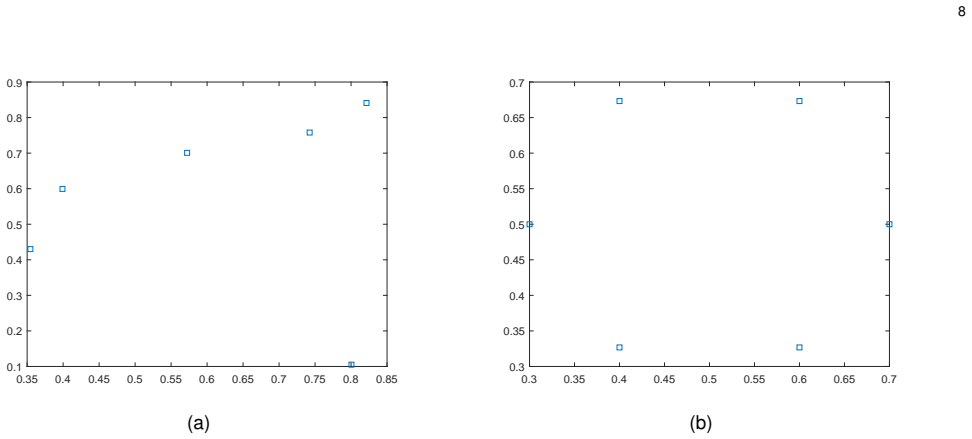
- The joint rounding over source and anchor candidates is what recovers accuracy under random anchor layouts; planned layouts already give a low error before rounding because the source tends to lie inside the region enclosed by the anchors (the convex hull).
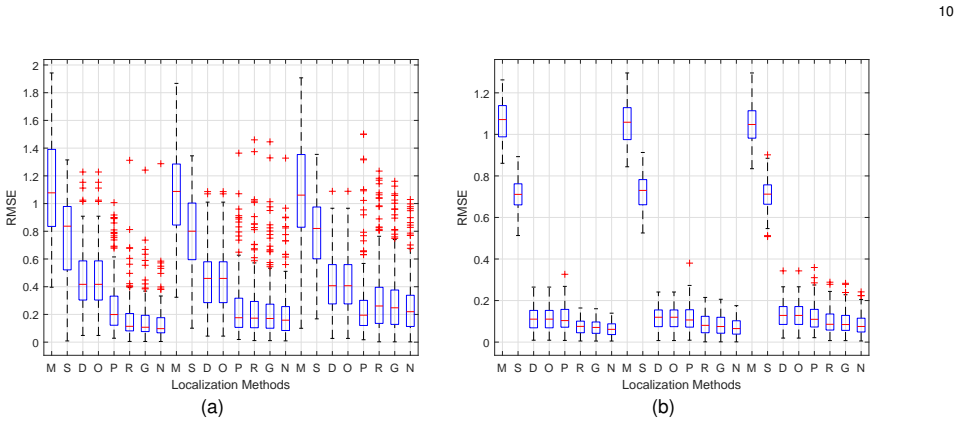
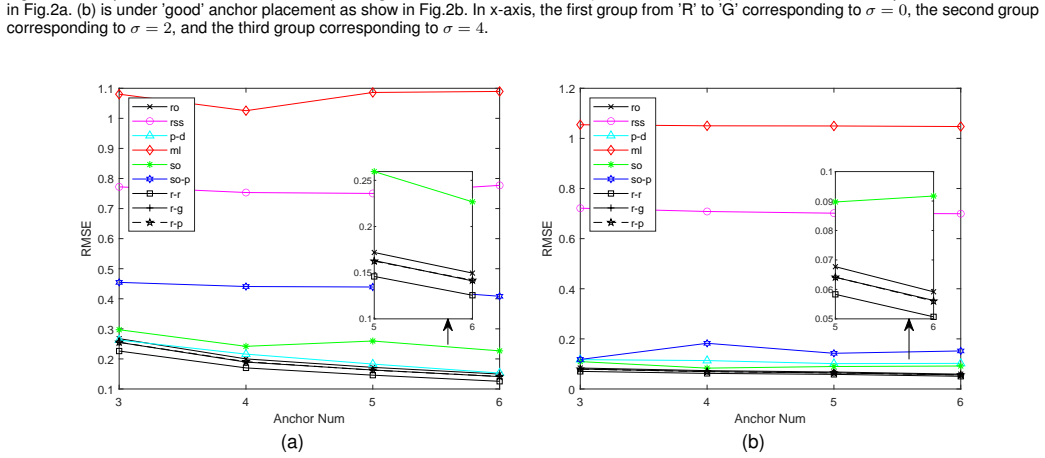
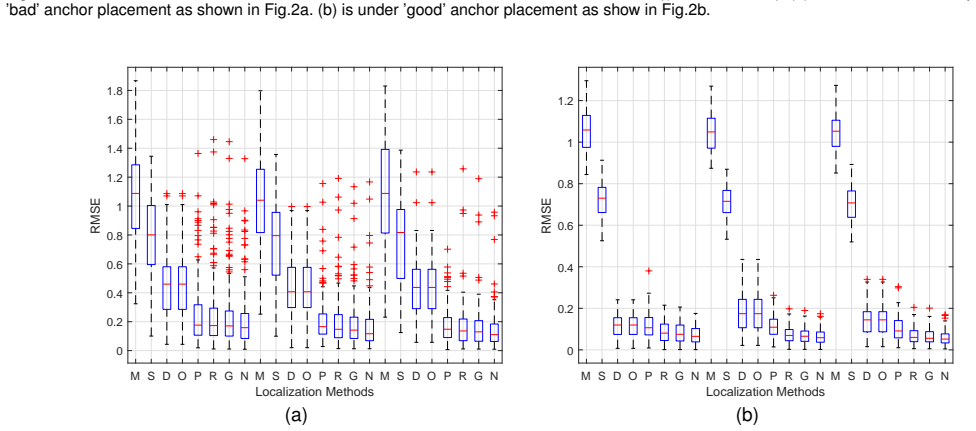
- Across the simulated range of anchor error, measurement noise, and anchor count, the combined pipeline is reported to have the smallest RMSE and the narrowest error distribution among the compared methods.
Reading between the lines
- The same worst-case relaxation could be extended to unknown path-loss parameters or transmit power, since the paper notes propagation-parameter self-estimation as future work; the $\zeta$-ball treatment of anchor error is a template for other bounded model errors.
- The joint rounding algorithm could be repurposed as an anchor-calibration tool: when the source position is known, the selected candidate anchors form a corrected anchor map, a use the paper does not explore.
- Because the method replaces the sum-of-squares ML objective with an $\ell^\infty$ (max) objective, it likely trades statistical efficiency for robustness; comparing full minimax SDP estimates against the $\ell^\infty$ version on the same data would quantify that trade.
- The uniform sampling of anchor candidates inside the $\zeta$-ball means accuracy should improve as more candidate anchors per anchor are drawn; a testable extension is to measure RMSE as a function of the sample count $N$ to find the point of diminishing returns.
Signed reviews
Editorial analysis
A structured set of objections, weighed in public.
Referee Report
Summary. The manuscript studies RSS-based source localization when anchor positions are known only up to a bounded error norm ζ. Starting from a log-normal path-loss model, the authors propose a min-max ('robust ML') estimator, transform it by Taylor expansion into a scalar radial uncertainty model, relax the resulting nonconvex problem to an SDP by dropping rank-one constraints, and develop three rounding schemes, including one that also refines anchor candidate positions. Simulations under random and planned anchor deployments compare the proposed Robust-RSS estimators with existing SDP, SOCP, distance-based, and ML methods. The paper claims that the proposed estimator with anchor-aware rounding (r-r) achieves the lowest RMSE under anchor position uncertainty and RSS measurement noise.
Significance. If correct, the paper would provide a practical contribution: an SDP-based RSS localization method that requires no distributional assumption on anchor errors and that can be solved efficiently with standard SDP solvers. The paper also contains useful practical discussion of numerical scaling and of why RSS-based methods degrade under anchor error. The strongest asset is the explicit worst-case formulation and the attempt to use RSS consistency in rounding. However, the derivation contains objective substitutions and sign/dimension inconsistencies that make the solved problem not exactly the announced estimator, and no code or data is provided. The significance is therefore conditional on correcting these technical issues.
major comments (4)
- [3.2, Eqs. (11)-(13)] Eq. (11) defines the robust estimator as min_x max_{|δ_i|≤ζ} ∑_{i=1}^M ( log10( (||x−ẑ_i||−δ_i)^2 / β_i^2 ) )^2. Eq. (13) is min_x max_i | log10( (||x−ẑ_i||−δ_i)^2 / β_i^2 ) |, which replaces the sum over anchors with a maximum over anchors and drops the square; this is a Chebyshev (l∞) fit, not the ML estimator announced in Eq. (8). The text says only that the l∞-norm is used 'to facilitate the design of a convex estimator,' but no argument is given that the two objectives share a minimizer or have comparable risk. Since every subsequent constraint and all simulation results inherit Eq. (13), the abstract's 'maximum likelihood estimator' claim is not supported. Either supply a proof or justification, or re-label the estimator as a robust Chebyshev/minimax estimator throughout.
- [3.2, Eqs. (22) and (25)] There is a sign error relative to Eq. (18). Eq. (18) gives ||x−ẑ_i||^2 = tr(X) − 2x^T ẑ_i + ẑ_i^T ẑ_i. The constraints in Eqs. (22) and (25) use tr(X) + 2x^T ẑ_i + ẑ_i^T ẑ_i ± 2ζ l_i + ζ^2. As printed, these constraints bound quantities involving ||x + ẑ_i||^2, not the intended squared distance to the inaccurate anchor. If the simulations used the printed signs, the reported RMSE is for a different SDP. In addition, Eq. (25) states X∈R^{M×M} while Eqs. (19) and (23) require X = xx^T ∈ S^2; the Schur complement (X x; x^T 1) is only well-formed for X∈S^2. These corrections are essential before the numerical results can be interpreted.
- [3.2, rank-one relaxation] The paper drops X = xx^T and L = ll^T with no analysis of the relaxation gap. The rounding algorithms depend on X* − x*x*^T being a meaningful covariance/error ellipsoid, and the 'ro' baseline is claimed to be the relaxed solution of Eq. (16); neither is justified without evidence on tightness. Please report the ranks of X* and L* and the objective gap, or provide a theoretical tightness argument. If the relaxation is loose, explain how the rounding algorithms compensate, since otherwise the reported gains from rounding are not explained.
- [4, validation] All numerical results are generated from the same log-normal model (Eq. (1)) used in the derivation, so the experiments test self-consistency but not robustness to model mismatch. The Introduction announces real experiment results in 'Section V,' but the manuscript contains no real experiment. Either include real measurements or delete that claim and temper statements about practical deployment. This matters because the paper's title and conclusions emphasize robustness under anchor uncertainty.
minor comments (6)
- [3.3, Alg. 3] The while condition 'whileds =||xo− x∗||)≤ 3σd do' is malformed; it should state a proper loop condition involving ds and the distance to x*.
- [Notation throughout] The symbol L is overloaded: Eq. (20) uses L = ll^T, while Alg. 4 uses L for the RSS vector; β_i^2 and k also appear with inconsistent subscripts in Eqs. (28)-(30).
- [Figs. 4 and 6] The captions' abbreviated label mapping is inconsistent (e.g., 'M,S,D,O,P,R,G,N' includes 'ml' twice and does not match the legend order).
- [3.3, Alg. 4] The notation p←(M N) for M-permutations of N and the complexity of enumerating all combinations is not discussed; the choice of N and tt is left unspecified.
- [1, organization] The Introduction states that Section V will present numerical and real experiment results, but the experiments are in Section IV and no real results are reported; renumber and correct.
- [4, Eq. (28)] Equation (28) contains stray text ('...,M' and missing parentheses) that makes the SOCP-RSS constraints ambiguous.
Circularity Check
No circularity found: the derivation is a sequence of explicit relaxations and approximations, and the in-sample simulations plus measurement-based rounding are standard estimation practice rather than fitted inputs renamed as predictions.
full rationale
The paper's central derivation chain is transparent: Eq. (8) poses a min-max robust ML problem, Eq. (9) uses a Taylor expansion, Eqs. (12)-(13) replace the sum-of-squared residual objective with a max-of-absolute-residual objective, and Eqs. (15)-(25) relax the nonconvex problem into an SDP. Each of these is an explicit modeling or relaxation step, not a definition of the output in terms of the output. Even where the algebra is questionable (e.g., the signs in Eq. (25) appear inconsistent with Eq. (18)), that is a correctness or verifiability concern, not circularity, because the SDP is not constructed from the quantity it is supposed to predict. The rounding algorithm Alg. 4 selects a candidate source-anchor combination by minimizing the squared RSS residual against the measured RSS vector L; this is the standard role of measurements in estimation, not a hidden parameter fit. The simulations are generated from the same log-normal shadowing model used in the derivation, which limits external validation, but it does not make the RMSE comparison circular: the compared methods are also model-based, and the proposed estimator could in principle perform poorly under the stated model. The author self-citations ([18], [19], [42], [43]) appear only as related-work pointers on distance-matrix localization and sensor deployment, and they are not load-bearing premises in the derivation. No unique-theorem or ansatz-by-citation pattern is present. Overall, no step in the paper reduces by construction to its own inputs, so the circularity score is 0.
Assumptions & free parameters
free parameters (3)
- Number of randomization trials tt
- Number of anchor candidates N
- Grid search step sizes ds and Delta-ds
assumptions (6)
- domain assumption Log-normal shadowing path loss model in Eq (1), with known transmit power, reference path loss, and path loss exponent gamma.
- domain assumption Anchor position errors are bounded as ||Delta_i|| <= zeta, with no specified distribution, in Eq (3).
- domain assumption First-order Taylor expansion of ||x - z_i|| in Eq (9), neglecting o(||Delta_i||).
- domain assumption The assumption ||x - hat-z_i|| - zeta > 0 for all i, stated in Section 3.2.
- ad hoc to paper The rank-one constraints X = xx^T and L = ll^T in Eq (22) can be dropped without destroying solution quality.
- ad hoc to paper The covariance matrix X* - x*x*^T used in randomization approximates the error distribution of the source estimate.
Cite this review
Pith. "Pith review of Received Signal Strength Based Wireless Source Localization with Inaccurate Anchor Position." pith.science (2026). https://pith.science/paper/JKX55R44
@misc{pith2026190803202,
  author       = {Pith},
  title        = {Pith review of: Received Signal Strength Based Wireless Source Localization with Inaccurate Anchor Position},
  year         = {2026},
  howpublished = {\url{https://pith.science/paper/JKX55R44}},
  note         = {Machine review of arXiv:1908.03202}
}
read the original abstract
Received signal strength (RSS)-based wireless localization is easy to implement at low cost. In practice,exact positions of anchors may not be available. This paper focuses on determining the location of a source in the presence of inaccurate positions of anchors based on RSS directly. We first use Taylor expansion and a min-max approach to get a maximum likelihood estimator of the coordinates of the source. Then we propose a relaxed semi-definite programming model to circumvent the non-convexity. We also propose a rounding algorithm considering both inaccurate source location and inaccurate anchor locations.Simulation results together with analysis are presented to validate the proposed method.
Figures


Figures from the paper (5 more)


Reference graph
Works this paper leans on
-
[22]
Robust differential received signal strength- based localization,
Y. Hu and G. Leus, “Robust differential received signal strength- based localization,” IEEE T ransactions on Signal Processing, vol. 65, no. 12, pp. 3261–3276, 2017
work page 2017
-
[29]
S. Tomic, M. Beko, and R. Dinis, “Rss-based localization in wireless sensor networks using convex relaxation: Noncooperative and cooperative schemes,” IEEE T ransactions on Vehicular T echnology , vol. 64, no. 5, pp. 2037–2050, May 2015
work page 2015
-
[1]
Smartphone- based indoor positioning using ble ibeacon and reliable lightweight fingerprint map,
T.-M. T. Dinh, N.-S. Duong, and K. Sandrasegaran, “Smartphone- based indoor positioning using ble ibeacon and reliable lightweight fingerprint map,” IEEE Sensors Journal , vol. 20, no. 17, pp. 10 283–10 294, 2020
work page 2020
-
[2]
Cedar: A cost-effective crowdsensing system for detecting and localizing drones,
G. Yang, X. Shi, L. Feng, S. He, Z. Shi, and J. Chen, “Cedar: A cost-effective crowdsensing system for detecting and localizing drones,” IEEE T ransactions on Mobile Computing, vol. 19, no. 9, pp. 2028–2043, Jan. 2020
work page 2020
-
[3]
Target detection and localization meth- ods using compartmental model for internet of things,
S. Kumar and S. K. Das, “Target detection and localization meth- ods using compartmental model for internet of things,” IEEE T ransactions on Mobile Computing, vol. 19, no. 9, pp. 2234–2249, Jan. 2020
work page 2020
-
[4]
H. Zou, C.-L. Chen, M. Li, J. Yang, Y. Zhou, L. Xie, and C. J. Spanos, “Adversarial learning-enabled automatic wifi indoor radio map construction and adaptation with mobile robot,” IEEE Internet of Things Journal, vol. 7, no. 8, pp. 6946–6954, Aug. 2020
work page 2020
-
[5]
Smartloc: Smart wireless indoor localization empowered by machine learning,
L. Li, X. Guo, and N. Ansari, “Smartloc: Smart wireless indoor localization empowered by machine learning,” IEEE T ransactions on Industrial Electronics , vol. 67, no. 8, pp. 6883–6893, Aug. 2020
work page 2020
-
[6]
Spear: Source position estimation for anchor po- sition uncertainty reduction,
M. Angjelichinoski, D. Denkovski, V . Atanasovski, and L. Gavrilovska, “Spear: Source position estimation for anchor po- sition uncertainty reduction,” IEEE Communications Letters, vol. 18, no. 4, pp. 560–563, Apr. 2014
work page 2014
Show all 45 references
-
[7]
Cramer-rao lower bounds of rss-based localization with anchor position uncertainty,
M. Angjelichinoski and D. Denkovski, “Cramer-rao lower bounds of rss-based localization with anchor position uncertainty,” IEEE T ransactions on Information Theory , vol. 61, no. 5, pp. 2807–2834, May 2015
2015
-
[8]
Rss distribution-based passive localization and its application in sensor networks,
C. Liu, D. Fang, Z. Yang, H. Jiang, X. Chen, W. Wang, T. Xing, and L. Cai, “Rss distribution-based passive localization and its application in sensor networks,” IEEE T ransactions on Wireless Communications, vol. 15, no. 4, pp. 2883–2895, April 2016
2016
-
[9]
Distributed algorithm for target localiza- tion in wireless sensor networks using rss and aoa measurements,
S. Tomic and M. Beko, “Distributed algorithm for target localiza- tion in wireless sensor networks using rss and aoa measurements,” Pervasive and Mobile Computing , vol. 37, pp. 63–77, 2017
2017
-
[10]
Source localization in wireless sensor networks from signal time-of-arrival measurements,
E. Xu, Z. Ding, and S. Dasgupta, “Source localization in wireless sensor networks from signal time-of-arrival measurements,” IEEE T ransactions on Signal Processing, vol. 59, no. 6, pp. 2887–2897, 2011
2011
-
[11]
Localization via ultra-wideband radios,
S. Gezici, Z. Tian, G. B. Giannakis, H. Kobayashi, A. F. Molisch, H. V . Poor, and Z. Sahinoglu, “Localization via ultra-wideband radios,” IEEE Signal Processing Magazine , vol. 22, no. 4, pp. 70–84, 2005
2005
-
[12]
Uav-based passive geolocation based on channel estimation,
Q. Liang and S. W. Samn, “Uav-based passive geolocation based on channel estimation,” in 2010 IEEE Globecom Workshops , Dec 2010, pp. 1821–1825
2010
-
[13]
Tdoa approach for target localization based on improved genetic algorithm,
M. Rosi ´c, M. Simie, and P . Luki ´c, “Tdoa approach for target localization based on improved genetic algorithm,” in 2016 24th T elecommunications Forum (TELFOR), Nov 2016, pp. 1–4
2016
-
[14]
Source localization using tdoa and fdoa mea- surements based on modified cuckoo search algorithm,
M. Abd El Aziz, “Source localization using tdoa and fdoa mea- surements based on modified cuckoo search algorithm,” Wireless Networks, vol. 23, no. 2, pp. 487–495, 2017
2017
-
[15]
Second-order cone relaxation for tdoa-based localization under mixed los/nlos condi- tions,
W. Wang, G. Wang, F. Zhang, and Y. Li, “Second-order cone relaxation for tdoa-based localization under mixed los/nlos condi- tions,” IEEE Signal Processing Letters, vol. 23, no. 12, pp. 1872–1876, 2016
2016
-
[16]
Doa acoustic source localization in mobile robot sensor networks,
R. Levorato and E. Pagello, “Doa acoustic source localization in mobile robot sensor networks,” in 2015 IEEE International Confer- ence on Autonomous Robot Systems and Competitions , April 2015, pp. 71–76
2015
-
[17]
Sectorized antenna-based doa estimation and localization: Advanced algorithms and measurements,
J. Werner and J. Wang, “Sectorized antenna-based doa estimation and localization: Advanced algorithms and measurements,” IEEE Journal on Selected Areas in Communications , vol. 33, no. 11, pp. 2272–2286, 2015
2015
-
[18]
Local patches alignment embed- ding based localization for wireless sensor networks,
Y. Liu, J. Chen, and Y.-j. Zhan, “Local patches alignment embed- ding based localization for wireless sensor networks,” Wireless Personal Communications, vol. 70, no. 1, pp. 373–389, 2013
2013
-
[19]
Wireless sensor network localization based on semi-supervised local subspace alignment,
J. Chen and Y. Liu, “Wireless sensor network localization based on semi-supervised local subspace alignment,” in Applied Mechanics and Materials, vol. 385, 2013, pp. 1618–1621
2013
-
[20]
Second-order cone programming relaxation of sensor network localization,
P . Tseng, “Second-order cone programming relaxation of sensor network localization,” SIAM Journal On Optimization, vol. 18, no. 1, pp. 156–185, 2007
2007
-
[21]
Robust relative location estimation in wireless sensor networks with inexact position problems,
B.-S. C. Wei-Yu Chiu, “Robust relative location estimation in wireless sensor networks with inexact position problems,” IEEE T ransactions on Mobile Computing, vol. 11, no. 6, pp. 935–946, 2012
2012
-
[23]
Source localization using tdoa and fdoa measurements in the presence of receiver location errors: Analysis and solution,
K. C. Ho and X. N. Lu, “Source localization using tdoa and fdoa measurements in the presence of receiver location errors: Analysis and solution,” IEEE T ransactions on Signal Processing, vol. 55, no. 2, pp. 684–696, 2007
2007
-
[24]
Effect in range difference position estimation due to stations’ position errors,
D. E. Manolakis and M. E. Cox, “Effect in range difference position estimation due to stations’ position errors,” IEEE T ransactions on Aerospace and Electronic Systems , vol. 34, no. 1, pp. 329–334, 1998
1998
-
[25]
Second Order Cone Programming for Sensor Network Localization with Anchor Position Uncertainty,
G. Naddafzadeh-Shirazi, M. B. Shenouda, and L. Lampe, “Second Order Cone Programming for Sensor Network Localization with Anchor Position Uncertainty,” IEEE T ransactions On Wireless Com- munications, vol. 13, no. 2, pp. 749–763, FEB 2014
2014
-
[26]
Efficient convex relaxation methods for robust target localization by a sensor network using time differences of arrivals,
K. Yang, G. Wang, and Z.-Q. Luo, “Efficient convex relaxation methods for robust target localization by a sensor network using time differences of arrivals,” IEEE T ransactions on Signal Processing, vol. 57, no. 7, pp. 2775–2784, 2009
2009
-
[27]
Range-Based Rigid Body Localization With a Calibration Emitter for Mitigating Anchor Position Un- certainties,
B. Hao, K. C. Ho, and Z. Li, “Range-Based Rigid Body Localization With a Calibration Emitter for Mitigating Anchor Position Un- certainties,” IEEE T ransactions On Wireless Communication , vol. 18, no. 12, pp. 5734–5748, DEC 2019
2019
-
[28]
On the performance limits of cooperative localization in wireless sensor networks with strong sensor position uncertainty,
Y. Xiong, N. Wu, and H. Wang, “On the performance limits of cooperative localization in wireless sensor networks with strong sensor position uncertainty,” IEEE Communications Letters , vol. 21, no. 7, pp. 1613–1616, Jul. 2017
2017
-
[30]
Geometric interpretation of theoretical bounds for rss-based source localization with uncertain anchor positions,
D. Denkovski, M. Angjelichinoski, V . Atanasovski, and L. Gavrilovska, “Geometric interpretation of theoretical bounds for rss-based source localization with uncertain anchor positions,” Digital Signal Processing , vol. 68, pp. 167–181, Sep. 2017. 12
2017
-
[31]
Goldsmith, Wireless Communications
A. Goldsmith, Wireless Communications . Cambridge University Press, 2005
2005
-
[32]
Rank-one semidefinite programming solutions for mobile source localization in sensor networks,
X. Wu, H. Qi, and N. Xiong, “Rank-one semidefinite programming solutions for mobile source localization in sensor networks,” IEEE T ransactions on Network Science and Engineering , vol. 8, no. 1, pp. 638–650, Jan. 2021
2021
-
[33]
CVX: Matlab software for disciplined convex programming, version 2.1,
M. Grant and S. Boyd, “CVX: Matlab software for disciplined convex programming, version 2.1,” http://cvxr.com/cvx, Mar. 2014
2014
-
[34]
Solving semidefinite- quadratic-linear programs using sdpt3,
R. H. T ¨ut ¨unc ¨u, K. C. Toh, and M. J. Todd, “Solving semidefinite- quadratic-linear programs using sdpt3,” Mathematical Program- ming, vol. 95, no. 2, pp. 189–217, Feb 2003
2003
-
[35]
Relative location estimation in wireless sensor networks,
N. Patwari and A. Hero, “Relative location estimation in wireless sensor networks,” IEEE T ransactions On Signal Processing , vol. 51, no. 8, pp. 2137–2148, AUG 2003
2003
-
[36]
Received Signal Strength-Based Wireless Localization via Semidefinite Programming: Noncooper- ative and Cooperative Schemes,
R. W. Ouyang and A. K.-S. Wong, “Received Signal Strength-Based Wireless Localization via Semidefinite Programming: Noncooper- ative and Cooperative Schemes,” IEEE T ransactions On Vehicular T echnology, vol. 59, no. 3, pp. 1307–1318, MAR 2010
2010
-
[37]
The effect of multipath and nlos on toa ranging error and energy based on uwb,
X. Li and J. He, “The effect of multipath and nlos on toa ranging error and energy based on uwb,” in 2016 IEEE International Con- ference on Consumer Electronics-T aiwan (ICCE-TW) , May 2016, pp. 1–2
2016
-
[38]
https://www.ibm.com/analytics/cplex-optimizer
“https://www.ibm.com/analytics/cplex-optimizer.”
-
[39]
A novel algorithm for dis- tributed localization in wireless sensor networks,
M. Naraghi-Pour and G. C. Rojas, “A novel algorithm for dis- tributed localization in wireless sensor networks,” ACM T ransac- tion on Sensor Networks , vol. 11, no. 9, pp. 1–25, Sep. 2014
2014
-
[40]
A distributed support vector ma- chine learning over wireless sensor networks,
W. Kim and M. S. Stankovic, “A distributed support vector ma- chine learning over wireless sensor networks,” IEEE T ransactions on Cybernetics, vol. 45, no. 11, pp. 2599–2611, Nov. 2015
2015
-
[41]
Distributed event localization via alternat- ing direction method of multipliers,
C. Zhang and Y. Wang, “Distributed event localization via alternat- ing direction method of multipliers,” IEEE T ransactions on Mobile Computing, vol. 17, no. 2, pp. 348–361, Feb. 2018
2018
-
[42]
Optimization of sensor deployment for localization accuracy improvement,
R. Wang, B. Shen, and Y. Liu, “Optimization of sensor deployment for localization accuracy improvement,” in 2016 IEEE International Conference on Consumer Electronics-China (ICCE-China) , 2017
2016
-
[43]
To improve localization accuracy: A two-objective optimization method,
R. Wang, C. Ye, B. Shen, and Y. Liu, “To improve localization accuracy: A two-objective optimization method,” in 2018 13th IEEE Conference on Industrial Electronics and Applications (ICIEA) , 2018, pp. 2510–2513
2018
-
[44]
A general framework for sensor placement in source localization,
B. Spinelli, L. E. Celis, and P . Thiran, “A general framework for sensor placement in source localization,” IEEE T ransactions on Network Science and Engineering, vol. 6, no. 2, pp. 86–102, Apr. 2019
2019
-
[45]
Informative path planning for location fingerprint collection,
Y. Wei, C. Frincu, and R. Zheng, “Informative path planning for location fingerprint collection,” IEEE T ransactions on Network Science and Engineering , vol. 7, no. 3, pp. 1633–1644, Jul. 2020
2020
Reviewed August 14, 2026 · model on record in the stance chip above.
Discussion (0). Continue with ORCID to comment.