REVIEW 4 major objections 4 minor 42 references
Unusual Coulomb phase physics in the arctic square ice
T0 review · 4 major / 4 minor · reviewed 2026-08-12 · deepseek-v4-flash
Pith's one-line read Arctic square ice keeps algebraic spin correlations even as magnetic order sets in.
desk verdict A careful numerical study of the six-vertex model under DWBC, but the headline Coulomb-phase claim is not actually established by the data presented. read the letter →
The pith
A machine-rendered reading of the paper's core claim, the machinery that carries it, and where it could break.
The reading
What carries the argument
The central object is the arctic square ice, the spin-liquid state confined inside the arctic circle when the square ice model obeys domain wall boundary conditions. The key diagnostic is the magnetic structure factor computed in annular rings within the disk, whose pinch points are the reciprocal-space signature of algebraic spin correlations. A loop flip algorithm generates a statistical ensemble of $10^{3}$ ice-rule-obeying configurations, and radial profiles of vertex populations and average spin magnitude track how order sets in toward the perimeter.
What would settle it
Compute the radial correlation function $C(r) = \langle \mathbf{S}_i \cdot \mathbf{S}_j \rangle$ inside the arctic disk for a sequence of lattice sizes $N = 30, 60, 101, 200$: if, at fixed separation normalized by the disk radius, $C(r)$ decays exponentially rather than as a power law, the algebraic Coulomb-phase claim fails. Equivalently, measure the full width at half maximum of the diffuse intensity around $\mathbf{q} = (2,2)$ in the annular structure factor for increasing $N$; a width that grows as $1/N$ would show that the apparent pinch point is only a finite-size effect.
Extended reading notes
Core claim
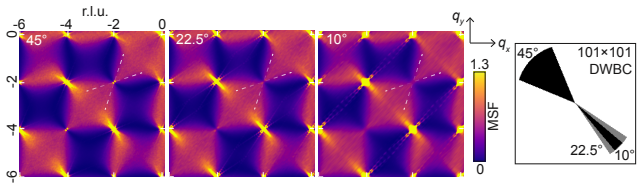
In the ground state of square ice with domain wall boundary conditions, the spin liquid occupying the arctic disk is not a homogeneous Coulomb phase. All local quantities—vertex populations, average spin texture, and pairwise correlations—depend on the distance r from the disk center: they match the conventional square ice for r/d < 1/5, change continuously in the intermediate regime, and saturate into ordered type-II tiling beyond the arctic curve. When the magnetic structure factor is computed in annular regions of fixed radius, the diffuse pinch point at reciprocal lattice vectors remains sharp and un-broadened relative to the open-boundary square ice, despite the growing Bragg intensity at the zone center. Since these ordered correlations cannot be separated from the fluctuating component by a Helmholtz decomposition, the authors argue the arctic square ice is a Coulomb phase of a new kind: ordered and disordered at once, within a charge-neutral vacuum.
Load-bearing premise
The claim that the arctic square ice is a Coulomb phase rests on the assumption that the sharp, un-broadened feature seen at the pinch-point location inside the annular structure factor is a genuine algebraic singularity and not a finite-size artifact or a leftover of the Bragg peak that sits at the same wavevector.
Editorial extensions
If this is right
- If correct, the arctic square ice provides a concrete spin model in which algebraic spin correlations coexist with magnetic Bragg peaks in the same ground state manifold.
- The radial dependence of vertex populations means experimental imaging of arctic square ice should expect local ice-rule statistics to drift from the 38/62 square-ice fractions near the center toward pure type-II tiling near the arctic curve.
- Because the ordered component cannot be extracted by Helmholtz decomposition, the result distinguishes boundary-driven order from the fragmentation of magnetic moments into charge-crystal and Coulomb channels.
- The un-broadened pinch point offers a testable reciprocal-space signature that could be searched for in scattering experiments on artificial square ice arrays with domain wall boundary conditions.
- The fine structure of the Bragg peaks, with sub-peaks at the zone center, encodes the quadrant-wise type-II tiling and may serve as a fingerprint for identifying the arctic phase in experiments.
Reading between the lines
- A natural extension is to check whether the same coexistence of sharp pinch points and boundary-induced Bragg peaks appears for other boundary conditions in the six-vertex model, which would make the radial order a generic feature of arctic-type phase separation rather than a square-ice accident.
- The result suggests a broader class of 'boundary Coulomb phases' in which long-range order is induced purely by constraints at the sample edge while the bulk retains algebraic correlations; testing this on kagome or other ice models would probe its generality.
- One could test the unconventional nature directly by measuring real-space spin correlations in the arctic disk as a function of system size: a correlation length that grows with N would support a true algebraic phase, whereas saturation would indicate only a dressed paramagnet dressed by the boundary texture.
Editorial analysis
A structured set of objections, weighed in public.
Referee Report
Summary. The manuscript studies the ground-state manifold of the square ice model under domain-wall boundary conditions (DWBC), which produces an arctic-circle phase separation into an interior disordered region and ordered corner regions. Using a loop-flip algorithm, the authors compute local magnetizations, vertex populations, and magnetic structure factors (MSFs) in annular regions inside the arctic circle. They report that all quantities vary radially, that the liquid resembles the conventional square ice near the center but orders near the perimeter, and that diffuse intensity coexists with Bragg peaks. The central claim, stated in the abstract and Sec. IV, is that this coexistence, together with the apparent absence of broadening of a pinch-point feature in the MSF, implies that the arctic square ice is an unconventional Coulomb phase with algebraic spin correlations coexisting with Bragg peaks. The paper explicitly notes that Henley's sufficient conditions for a Coulomb phase are not fulfilled.
Significance. If the central claim were established, the paper would document a distinctive boundary-condition-driven spin liquid in which algebraic fluctuations coexist with an inhomogeneous ordered texture on a charge-neutral vacuum, connecting arctic-circle phenomena to fragmented spin-liquid physics. The numerical protocol is straightforward and parameter-free: ground-state configurations are generated by loop flips with no fitted parameters, and the open-boundary square ice serves as an external benchmark. The qualitative observations of a radial vertex-population variation, a radial average magnetization profile, and the coexistence of Bragg peaks with diffuse intensity in annular MSFs are well supported by the presented maps and cuts. However, the paper's defining claim—that the fluctuating component is algebraic—is not established by the evidence shown; this is the load-bearing weakness that requires additional analysis.
major comments (4)
- [Section III.D, Fig. 5] The central claim that algebraic spin correlations coexist with Bragg peaks is supported only by the observation that the pinch-point feature in the annular MSF is "not broadened" relative to the square ice, even though the authors state that the pinch-point singularity cannot be resolved because a magnetic Bragg peak sits at the same wavevector. Since the white-contour width in Fig. 5 can be set by the Bragg peak line shape and by the form factor of the annular region (the surrounding ripples are attributed to the form factor in Sec. III.C), an absence of extra broadening is a null measurement and does not by itself establish an algebraic singularity. Please provide a direct real-space diagnostic, such as the connected spin-spin correlator within annular regions, with an explicit test for power-law decay and a quantitative comparison with the square ice.
- [Section III.C, Eq. (2)] The annular MSFs and intensity cuts are presented without statistical uncertainties or convergence diagnostics: no error bars are shown in Figs. 4(c,d) or Fig. 5, and there is no discussion of how many statistically independent configurations were used after the loop-flip updates, nor of how the results depend on the number of loop updates n and on lattice size N. Because the core pinch-point claim is an absence of broadening, it is essential to show that the measured width is stable under increased sampling and system size; otherwise finite-size or sampling artifacts cannot be excluded. Please report error bars and convergence tests for the quantities used to support the Coulomb-phase claim.
- [Section IV] The paper explicitly acknowledges that Henley's sufficient conditions for a Coulomb phase are not fulfilled: coarse-grained regions are strongly correlated, and the ordered component cannot be separated from the fluctuating component by a Helmholtz decomposition. This admission is appropriate, but it increases the burden on the direct evidence for algebraic correlations. As it stands, the MSF analysis does not separate the fluctuating contribution from the Bragg contribution, so the assertion in Sec. III.D and the abstract that the correlations are algebraic is underdetermined. Please either separate the fluctuating component (e.g., by subtracting a fitted Bragg/background model or by computing the connected correlator after removing the local average spin texture) or soften the claim to the coexistence of Bragg peaks with a diffuse, structured component whose algebraic nature remains an open question.
- [Section III.D, Fig. 6 caption] The main text states that "the pinch point singularity cannot be resolved," while the Fig. 6 caption states that pinch points are "unambiguously revealed." These statements need to be reconciled. Please specify quantitatively what feature in the sector MSFs is identified as a pinch point (for instance, the behavior of the intensity minimum at q=(2,2) along the two orthogonal axes) and how its width is extracted from the data.
minor comments (4)
- [Section II] In the second paragraph, "Typically,n = N^2 loops" is missing a space after the comma, and "constraint" is misspelled as "contraint"; these should be corrected.
- [Section III.C, Eq. (2)] Equation (2) uses N as the total number of spins, but when the MSF is computed in annular or sector regions the normalization becomes ambiguous; please specify how N is defined for each region and whether the normalization affects the relative intensities shown in Figs. 4 and 5.
- [Section IV] The text contains typos "corse-grained" for "coarse-grained" and "there is not reason a priori" for "there is no reason a priori"; please correct them.
- [Abstract and Fig. 3 caption] The abstract and main text call the features at the zone center "magnetic Bragg peaks," while the Fig. 3 caption uses "Bragg-like features"; please use consistent terminology throughout.
Circularity Check
No significant circularity: the arctic square ice study is a direct numerical characterization with no fitted parameters or self-referential derivation.
full rationale
The paper's central claim is that algebraic spin-spin correlations coexist with magnetic Bragg peaks in the arctic square ice, inferred from an unpinned, unbroadened pinch-point feature in the magnetic structure factor computed from explicitly generated ground-state configurations. There is no fitted parameter that is later renamed as a prediction, and no quantity is defined in terms of the result it is used to establish. The comparison to the open-boundary square ice is an external benchmark, not an input that forces the conclusion. The paper's own Sec. IV explicitly acknowledges that Henley's sufficient conditions for a Coulomb phase are not fulfilled because coarse-grained regions are strongly correlated, which is an honest limitation rather than a circular maneuver. The self-citations to prior work by the same authors, e.g., Ref. [18] for the arctic-circle phenomenology and Ref. [29] for loop-flip shuffling efficiency, are not load-bearing in the derivation of the new claim; they provide context and algorithmic precedent. The skeptical concern that the apparent pinch-point width may be contaminated by the Bragg peak or the annular form factor is a question of evidence strength and underdetermination, not circularity. Accordingly, the circularity score is low.
Assumptions & free parameters
free parameters (3)
- Loop updates per stored configuration (n) =
3 x 10^6
- Annular region boundaries (r1/R, r2/R) =
(1,0.8), (0.77,0.61), (0.56,0.40), (0.37,0.20), (0.20,0)
- Sector cone angles for MSF cuts =
45, 22.5, 10 degrees
assumptions (4)
- domain assumption The loop-flip algorithm samples the ground-state manifold of the six-vertex model with DWBC representatively (ergodic or at least unbiased).
- standard math Known square-ice Coulomb phase results (algebraic correlations, pinch points, vertex populations of 38% and 62% under OBC) from the cited literature are correct.
- domain assumption The arctic circle phenomenon and its thermodynamic-limit density profiles for the six-vertex model with DWBC are as described in Refs. 19-27.
- standard math The magnetic structure factor defined with the perpendicular spin component (Eq. 2) is the appropriate probe for the spin correlations in this model.
Cite this review
Pith. "Pith review of Unusual Coulomb phase physics in the arctic square ice." pith.science (2026). https://pith.science/paper/JLOJIBLN
@misc{pith2026241116526,
  author       = {Pith},
  title        = {Pith review of: Unusual Coulomb phase physics in the arctic square ice},
  year         = {2026},
  howpublished = {\url{https://pith.science/paper/JLOJIBLN}},
  note         = {Machine review of arXiv:2411.16526}
}
read the original abstract
The square ice is a two-dimensional spin liquid hosting a Coulomb phase physics. When constrained under specific boundary conditions, the so-called domain-wall boundary conditions, a phase separation occurs that leads to the formation of a spin liquid confined within a disk surrounded by magnetically ordered regions. Here, we numerically characterize the ground-state properties of this spin liquid, coined the arctic square ice in reference to a phenomenon known in statistical mechanics. Our results reveal that both the vertex distributions and the magnetic correlations are inhomogeneous within the liquid region, and they exhibit a radial dependence. If these properties resemble those of the conventional square ice close to the center of the disk, they evolve continuously as the disk perimeter is approached. There, the spin liquid orders. As a result, pinch points, signaling the presence of algebraic spin correlations, coexist with magnetic Bragg peaks in the magnetic structure factor computed within the disk. The arctic square ice thus appears as an unconventional Coulomb phase sharing common features with a fragmented spin liquid, albeit on a charge-neutral vacuum.
Figures


Figures from the paper (3 more)


Reference graph
Works this paper leans on
-
[1]
L. Pauling, The structure and entropy of ice and of other crystals with some randomness of atomic ar- rangement. J. Am. Chem. Soc. 57, 2680 (1935)
work page 1935
-
[2]
J. F. Nagle, Lattice statistics of hydrogen bonded crystals. I. The residual entropy of ice. J. Math. Phys. 7, 1484 (1966)
work page 1966
-
[3]
E. H. Lieb, Exact solution of the problem of the en- tropy of two-dimensional ice. Phys. Rev. Lett.18, 692 (1967)
work page 1967
-
[4]
E. H. Lieb, Residual entropy of square ice. Phys. Rev. 162, 162 (1967)
work page 1967
- [5]
-
[6]
E. ¨Ostman, H. Stopfel, I.-A. Chioar, U. B. Arnalds, A. Stein, V. Kapaklis, and B. Hj¨ orvarsson, Interac- tion modifiers in artificial spin ices Nat. Phys. 14, 375 (2018)
work page 2018
- [7]
-
[8]
N. Rougemaille and B. Canals, Cooperative mag- netic phenomena in articial spin systems: spin liquids, Coulomb phase and fragmentation of magnetism - a colloquium. Eur. Phys. J. B 92, 62 (2019)
work page 2019
Show all 42 references
-
[9]
Perrin, B
Y. Perrin, B. Canals, and N. Rougemaille Quasidegen- erate ice manifold in a purely two-dimensional square array of nanomagnets Phys. Rev. B 99, 224434 (2019)
2019
-
[10]
Rougemaille and B
N. Rougemaille and B. Canals, The magnetic struc- ture factor of the square ice: A phenomenological de- scription. Appl. Phys. Lett. 118, 112403 (2021)
2021
-
[11]
Brunn, Y
O. Brunn, Y. Perrin, B. Canals, and N. Rougemaille Signatures of farther neighbor couplings in artificial square ice Phys. Rev. B 103, 094405 (2021)
2021
-
[12]
Goryca, X
M. Goryca, X. Zhang, J. Li , A. L. Balk, J. D. Watts, C. Leighton, C. Nisoli, P. Schiffer, and S. A. Crooker Field-Induced Magnetic Monopole Plasma in Artifi- cial Spin Ice Phys. Rev. X 11, 011042 (2021)
2021
-
[13]
Sch´ anilec, O
V. Sch´ anilec, O. Brunn, M. Hor´ aˇ cek, S. Kr´ atk´ y, P. Meluz ´ ın, T.ˇSikola, B. Canals, and N. Rougemaille, Approaching the Topological Low-Energy Physics of the F Model in a Two-Dimensional Magnetic Lattice. Phys. Rev. Lett. 129, 027202 (2022). 6 -6 -4 -2 0 -6 -4 -2 0 r...
2022
-
[14]
I. A. Ryzhkin, J. Exp. Theor. Phys. 101, 481 (2005)
2005
-
[15]
Castelnovo, R
C. Castelnovo, R. Moessner, and S. L. Sondhi, Mag- netic monopoles in spin ice. Nature 451, 42-45 (2008)
2008
-
[16]
C. L. Henley, The ’Coulomb Phase’ in frustrated systems. Annu. Rev. Condens. Matter Phys. 1, 179 (2010)
2010
-
[17]
Rehn and R
J. Rehn and R. Moessner, Maxwell electromagnetism as an emergent phenomenon in condensed matter. Phil. Trans. R. Soc. A 374, 20160093 (2016)
2016
-
[18]
A. D. King, J. Coraux, B. Canals, and N. Rougemaille Magnetic Arctic Circle in a Square Ice Qubit Lattice. Phys. Rev. Lett. 131, 166701 (2023)
2023
-
[19]
T. S. Tavares, G. A. P. Ribeiro, and V E Korepin The entropy of the six-vertex model with a variety of different boundary conditions. J. Stat. Mech.: Th. Exp. P06016 (2015)
2015
-
[20]
I. N. Elkies, G. Kuperberg, M. Larsen, and J. Propp, Alternating-sign matrices and domino tilings. J. Al- gebraic Combin. 1, 111-132 (1992)
1992
-
[21]
Jockush, J
W. Jockush, J. Propp, and P. Shor, Random Domino Tilings and the Arctic Circle Theorem. arxiv.org/abs/math/9801068
-
[22]
Johansson, Non-intersecting paths, random tilings and random matrices
K. Johansson, Non-intersecting paths, random tilings and random matrices. Probab. Theory Relat. Fields 123, 225-280 (2002)
2002
-
[23]
Zinn-Justin, Six-vertex, Loop and Tiling Models: Integrability and Combinatorics
P. Zinn-Justin, Six-vertex, Loop and Tiling Models: Integrability and Combinatorics. arXiv:0901.0665
-
[24]
Korepin and P
V. Korepin and P. Zinn-Justin, Thermodynamic limit of the six-vertex model with domain wall boundary conditions. J. Phys. A 33, 7053-7066 (2000)
2000
-
[25]
Kenyon, A
R. Kenyon, A. Okounkov, and S. Sheffield, Dimers and amoebae Ann. Math. 163, 1019-1056 (2006)
2006
-
[26]
L. F. Cugliandolo, G. Gonnella, and A. Pelizzola, Six- vertex model with domain wall boundary conditions in the Bethe-Peierls approximation J. Stat. Mech.: Theo. and Exp. P06008 (2015)
2015
-
[27]
L. F. Cugliandolo, Artificial Spin-Ice and Vertex Mod- els. J. Stat. Phys. 167, 499-514 (2017)
2017
-
[28]
M. E. Brooks-Bartlett, S. T. Banks, L. D. C. Jaubert, A. Harman-Clarke, and P. C. W. Holdsworth, Magnetic-moment fragmentation and monopole crys- tallization. Phys. Rev. X 4, 011007 (2014)
2014
-
[29]
Coraux, N
J. Coraux, N. Rouger, B. Canals, and N. Rougemaille Square ice Coulomb phase as a percolated vertex lat- tice. Phys. Rev. B 109, 224422 (2024)
2024
-
[30]
Two neighboring spins from the same sub-lattice are separated by a distance a
The square lattice consists of two sub-lattices, one bonding the vertical spins, the other bonding the hor- izontal ones. Two neighboring spins from the same sub-lattice are separated by a distance a. The unit cell we consider has a2 area and comprises one verti- cal spin and ...
-
[31]
Sch´ anilec, B
V. Sch´ anilec, B. Canals, V. Uhl ´ ıˇ r, L. Flajˇ sman, J. Sad ´ ılek, T.ˇSikola, and N. Rougemaille, Bypassing dy- namical freezing in artificial kagome ice. Phys. Rev. Lett. 125, 057203 (2020)
2020
-
[32]
W.-C. Yue, Z. Yuan, Y.-Y. Lyu, S. Dong, J. Zhou, Z.-L. Xiao, L. He, X. Tu, Y. Dong, H. Wang, W. Xu, L. Kang, P. Wu, C. Nisoli, W.-K. Kwok, and Y.-L. Wang, Crystallizing Kagome artificial spin ice. Phys. Rev. Lett. 129, 057202 (2020)
2020
-
[33]
Hofhuis, S
K. Hofhuis, S. H. Skjærvø, S. Parchenko, H. Arava, Z. Luo, A. Kleibert, P. M. Derlet, and L. J. Heyderman, Real-space imaging of phase transitions in bridged ar- tificial kagome spin ice. Nat. Phys. 18, 699 (2022)
2022
-
[34]
Canals, I.-A
B. Canals, I.-A. Chioar, V.-D. Nguyen, M. Hehn, D. Lacour, F. Montaigne, A. Locatelli, T. O. Mente¸ s, B. Santos Burgos, and N. Rougemaille, Fragmentation of magnetism in artificial kagome dipolar spin ice. Nat. Commun. 7, 11446 (2016)
2016
-
[35]
Petit, E
S. Petit, E. Lhotel, B. Canals, M. C. Hatnean, J. Ol- livier, H. Mutka, E. Ressouche, A. R. Wildes, M. R. Lees, and G. Balakrishnan, Observation of magnetic fragmentation in spin ice. Nat. Phys. 12, 746 (2016)
2016
-
[36]
Lefran¸ cois, V
E. Lefran¸ cois, V. Cathelin, E. Lhotel, J. Robert, P. Lejay, C. V. Colin, B. Canals, F. Damay, J. Ollivier, B. F ˚ ak, L. C. Chapon, R. Ballou, and V. Simonet, Fragmentation in spin ice from magnetic charge in- jection. Nat. Commun. 8, 209 (2017)
2017
-
[37]
Lhotel, L
E. Lhotel, L. D. C. Jaubert, and P. C. W. Holdsworth, Fragmentation in Frustrated Magnets: A Review. J. Low Temp. Phys. 201, 710 (2020)
2020
-
[38]
Rougemaille, F
N. Rougemaille, F. Montaigne, B. Canals, A. Dulu- ard, D. Lacour, M. Hehn, R. Belkhou, O. Fruchart, S. El Moussaoui, A. Bendounan, and F. Maccherozzi, Artificial kagome arrays of nanomagnets: a frozen dipolar spin ice. Phys. Rev. Lett. 106, 057209 (2011)
2011
-
[39]
Zhang, I
S. Zhang, I. Gilbert, C. Nisoli, G.-W. Chern, M. J. Erickson, L. O’Brien, C. Leighton, P. E. Lammert, V. H. Crespi, and P. Schiffer, Crystallites of magnetic charges in artificial spin ice. Nature 500, 553 (2013). 7
2013
-
[40]
Chioar, B
I.-A. Chioar, B. Canals, D. Lacour, M. Hehn, B. Santos- Burgos, T. O. Mentes, A. Locatelli, F. Mon- taigne, and N. Rougemaille, Kinetic pathways to the magnetic charge crystal in artificial dipolar spin ice. Phys. Rev. B 90, 220407(R) (2014)
2014
-
[41]
Montaigne, D
F. Montaigne, D. Lacour, I.-A. Chioar, N. Rouge- maille, D. Louis, S. Mc Murtry, H. Riahi, B. Santos Burgos, T. O. Mente¸ s, A. Locatelli, B. Canals, and M. Hehn, Size distribution of magnetic charge do- mains in thermally activated but out-of-equilibrium artificial spin ice. ...
2015
-
[42]
Drisko, S
J. Drisko, S. Daunheimer, and J. Cumings, FePd 3 as a material for studying thermally active artificial spin ice systems. Phys. Rev. B 91, 224406 (2015). 8
2015
Reviewed August 12, 2026 · model on record in the stance chip above.
Discussion (0). Continue with ORCID to comment.