REVIEW 3 major objections 5 minor 30 references
A novel method for measuring the attenuation length and the group velocity of transparent liquids in a variable length cavity
T0 review · 3 major / 5 minor · reviewed 2026-08-16 · deepseek-v4-flash
Pith's one-line read Amplitude-modulated cavity measures liquid transparency to 2 percent
desk verdict CELLPALS is a genuinely new variable-length cavity instrument for simultaneous attenuation length and group velocity in liquids; the method looks sound but the paper needs a corrected Eq. 9, a quantitative loss budget, and a check of the EJ-309 group velocity. read the letter →
The pith
A machine-rendered reading of the paper's core claim, the machinery that carries it, and where it could break.
The reading
What carries the argument
The central object is a variable-length Fabry-Pérot cavity formed by two concave mirrors of reflectivity $R$ and radius of curvature $r$, filled with the liquid under test, illuminated by a sinusoidally modulated laser whose modulation frequency is swept up to about 350 MHz. Each ray that leaves the cavity has been reflected $n$ times and has traversed the liquid a distance $(2n+1)L$; summing the geometric series of these rays produces the measured amplitude ratio and phase shift. The two fit parameters are the free spectral range $\Delta\nu=v_g/(2L)$, which gives the group velocity, and the attenuation parameter $A_\mathrm{eff}=R^2\exp(-2L/L_\mathrm{att})$, which gives the attenuation length once $R$ has been removed by a multi-length fit. A stability criterion and a collimation-deviation check are used to identify data affected by incomplete detection of the outgoing beam.
What would settle it
Take a liquid whose attenuation length has been established with an independent long-path method and fit the CELLPALS data in two separate length ranges, say 30–60 cm and 60–90 cm; if the two fitted values of $L_\mathrm{att}$ differ by more than the quoted 2 percent, unmodeled length-dependent losses are biasing the result.
Extended reading notes
Core claim
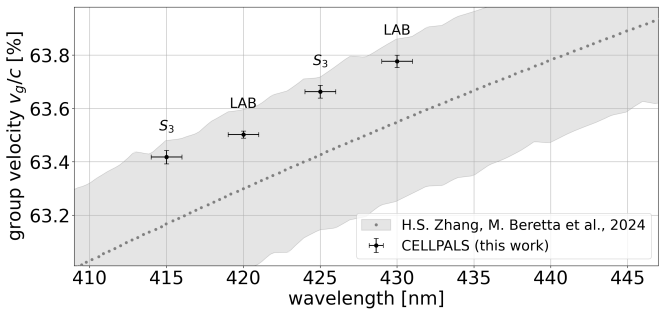
CELLPALS determines the attenuation length $L_\mathrm{att}$ and the group velocity $v_g$ of a transparent liquid inside an optical cavity by measuring, as a function of modulation frequency $\nu$, the amplitude ratio $A(\nu)$ and the phase shift $\Delta\phi(\nu)$ between a reference beam and light transmitted through the cavity. The measured curves follow closed-form expressions in which the free spectral range $\Delta\nu=v_g/(2L)$ fixes the resonance positions and the parameter $A_\mathrm{eff}=R^2\exp(-2L/L_\mathrm{att})$ sets the resonance contrast. Because $A_\mathrm{eff}$ is recorded at many cavity lengths $L$, the mirror reflectivity $R$ cancels when the exponential decay is fitted, removing the dominant systematic error of a single-cavity measurement. The reported uncertainties are about $0.03\%$ for $v_g$ and below $2\%$ for $L_\mathrm{att}$ when more than fifty cavity lengths are used, and the group-velocity results agree with literature values in air and with refractive-index-based values in a liquid scintillator.
Load-bearing premise
The inference from the measured $A_\mathrm{eff}(L)$ to $L_\mathrm{att}$ assumes that the only loss growing with cavity length is Beer's-law attenuation in the liquid, so $A_\mathrm{eff}=R^2\exp(-2L/L_\mathrm{att})$ with a constant mirror reflectivity; any other length-dependent loss, such as clipping, diffraction, or scattering at the liquid-mirror surfaces, would be misread as a shorter attenuation length.
Editorial extensions
If this is right
- A single compact cell holding roughly one litre can monitor attenuation length with about 2 percent uncertainty, making inline purification monitoring practical for large liquid-scintillator detectors.
- The same measurement returns the group velocity to about 0.03 percent, which improves timing and position reconstruction in large detectors and is not accessible with standard attenuation-length instruments.
- For liquids with attenuation lengths above about ten metres, CELLPALS has substantially smaller uncertainties than UV-Vis cuvette spectroscopy, where the sample attenuation is below half a percent and reflection corrections dominate.
- Measuring $A_\mathrm{eff}(L)$ at many lengths also extracts the mirror reflectivity $R$, potentially with better precision than the manufacturer's specification.
Reading between the lines
- A natural extension, not discussed in the paper, would be to sweep the laser wavelength as well as the modulation frequency, turning the same cavity into a dispersion-measuring instrument that maps both $L_\mathrm{att}(\lambda)$ and $v_g(\lambda)$.
- A testable implication is that selecting the detection geometry could separate absorption from scattering: rays that scatter out of the cavity mode contribute to the fitted loss, while small-angle scattered rays that remain in the cavity do not, so a variant with a movable iris might distinguish the two components.
- The frequency-domain readout is the Fourier analogue of time-domain cavity ring-down, so a direct comparison of the two on the same liquid should expose unmodeled mode-dependent or polarization-dependent losses if they exist.
Signed reviews
Editorial analysis
A structured set of objections, weighed in public.
Referee Report
Summary. The paper presents CELLPALS, a new method for measuring the attenuation length and group velocity of transparent liquids using a variable-length Fabry-Pérot cavity with an amplitude-modulated laser. The method fits the frequency-dependent amplitude ratio and phase shift of the cavity output to extract the free spectral range Δν and the attenuation parameter A_eff, from which the group velocity v_g = 2L Δν and the attenuation length L_att via A_eff = R^2 exp(-2L/L_att) are derived. The authors demonstrate the method on several liquids, report ~2% relative uncertainty for L_att and ~0.03% for v_g, validate v_g against the known group velocity of air, and compare L_att results with UV-Vis spectroscopy. The paper includes a derivation in Appendix A, an experimental setup description, and measurements of LAB at different purification stages.
Significance. If the accuracy claims hold, CELLPALS is a significant practical advance for characterizing liquid scintillators and water in neutrino detectors: it requires only about a liter of sample, measures both L_att and v_g simultaneously, and reaches uncertainties competitive with long-tube methods while being far more compact. The manuscript is thorough in its empirical characterization: 15,675 measurements at 51 cavity lengths, a dedicated test of the group-velocity determination against the literature value for air, and a comparison with UV-Vis spectroscopy. The derivation in Appendix A is standard and correctly gives the resonance structure. The main weakness is that the central ~2% accuracy claim for L_att rests on an implicit assumption that no length-dependent loss other than Beer's-law attenuation contributes to the fitted slope, and the manuscript does not provide a quantitative loss budget for this assumption. A clear typographical error in Eq. (9) also needs correction. Overall, the method is promising and the results are broadly supportive, but the accuracy claim requires additional systematic analysis.
major comments (3)
- [§2.2, Eq. (9)] Equation (9) is printed as A(ν) = b1 √(A_eff² − 2A_eff cos(2πν/Δν) + 1), i.e., the square root is multiplied by b1. The derivation in Appendix A.4, however, gives the amplitude as IT² exp(−L/L_att) divided by this same square-root factor, so the amplitude ratio should be b1 / √(A_eff² − 2A_eff cos(2πν/Δν) + 1). With the printed multiplicative form, A(ν) would be minimal at the resonance ν = Δν, inverting the peak structure shown in Fig. 3. Since the fits evidently use the denominator form (Fig. 3 shows resonance peaks), this is a severe typographical error in a central equation that must be corrected; the fitting code should also be cross-checked against the published formula.
- [§3.3, Eq. (12); §3.4; §7] The claim that L_att is determined with ~2% relative uncertainty rests on Eq. (12), which assumes that the only length-dependent loss is Beer's-law attenuation, so that ln A_eff(L) = ln R² − 2L/L_att is a straight line in L. The manuscript does not provide a quantitative budget for other losses that can scale with cavity length: changes in the Gaussian mode size on the 1-inch mirrors and clipping by the PTFE bore, diffraction at the edges of the stability range, scattering at the liquid–mirror interfaces, and alignment changes as the movable mirror is translated. The stability criterion (Eq. 16) and the qualitative 'characteristic deviations' collimation test of §3.4 do not bound these effects at the 0.2% level in A_eff over the 0.3–0.9 m scan. A length-dependent loss of ~0.2% over the scan would bias a 12 m attenuation length by ~2%, exactly the claimed precision. Please provide a quantitative estimate of each length-dependent loss, or an experimental test (e.g., measuring A_eff(L) with different mirror apertures or beam sizes, or measuring a sample with an independently known L_att), to support the accuracy rather than only the precision.
- [§7, Fig. 11] The conclusion states that 'the data for some resonator lengths show deviations that are larger than the corresponding fit errors' and attributes these to collimation effects, while §3.4 says that measurements showing 'characteristic deviations' are dismissed. This indicates that data points are excluded from the L_att fit after inspection. The manuscript does not state how many lengths were excluded, the exact selection criterion, or the resulting change in the fitted L_att. Without this information, the least-squares uncertainty does not include model-selection uncertainty, and the fitted slope could be biased by the post hoc removal of points. Please quantify the exclusions, report a fit that includes all measured lengths, and discuss whether L_att changes by more than the quoted 2%.
minor comments (5)
- [§3.3, Eq. (16)] The stability parameter is printed as g = 1 + L/r. For concave mirrors with the usual sign convention (r > 0 for the radius of curvature), the g-factor is g = 1 − L/r. The stated maximum length L_max = 2r corresponds to the minus sign, so Eq. (16) appears to have a sign error unless a nonstandard sign convention is being used; please clarify.
- [Throughout] Cross-references to sections appear as 'In 2', 'cf. 2.1', 'in 3', 'in 6', etc. Please replace these with 'Section 2', 'Section 2.1', 'Section 3', 'Section 6', and similar.
- [Abstract and §1] The phrase 'Beers’ law' is used consistently; the standard name is 'Beer’s law' (after August Beer). Please correct this throughout.
- [§2.1, Eq. (4)] The transmission coefficient is defined as T = 1 − R, which assumes lossless mirrors. Since the mirror reflectivity is specified as R = 0.95, a small absorption/scattering loss in the mirrors is possible. This does not affect the slope used for L_att, but a sentence stating this assumption would improve clarity.
- [§5, Eq. (20)] The text states that Asub = Afull − (1/2)Aempty is ≥ 0, but immediately afterward the plot shows Asub < 0 for some wavelengths. This is discussed as a puzzle, but the inequality in the text is incorrect as stated; it should say that the theoretical model predicts nonnegative values, while the data show negative values, which is the observed discrepancy.
Circularity Check
No circularity found: CELLPALS is a self-contained measurement inference, with fitted cavity parameters inverted through Eqs. 11-12 and cross-checked against independent air and UV-Vis benchmarks.
full rationale
The paper does not recycle a fitted quantity as an input to predict itself. The central derivation constructs the frequency-dependent amplitude ratio and phase shift (Eqs. 9 and 10) from a geometric-series model of cavity round trips, with model parameters A_eff = R^2 exp(-2L/L_att) and Delta-nu = v_g/(2L) defined in Eqs. 11 and 12. The measurements fit Delta-nu and A_eff from data and then algebraically invert these defining relations to obtain v_g and L_att. This is a standard measurement inversion, not a circular prediction: no target quantity is inserted into the fit to force the output. The group velocity determination is independently anchored to the literature value of the group velocity of air (Eq. 14), and the resulting air measurement (0.99986 +/- 0.00083)c is consistent with that external value, providing an independent validation of the Delta-nu-to-v_g conversion. Attenuation lengths are additionally compared with UV-Vis measurements across five samples and are consistent within uncertainties, providing external, non-fitted corroboration. The authors' own self-citations are absent, and the cited external works ([16], [17], [19], [30]) supply standard cavity optics, a similar mathematical treatment, and an independent refractive-index-based group velocity comparison rather than load-bearing uniqueness claims. The acknowledged limitation that Eq. 12 attributes all length-dependent loss to Beer's-law attenuation, and the conclusion's note that some resonator lengths show deviations larger than fit errors, are accuracy and systematic-error concerns about unmodeled losses such as clipping or incomplete collimation; they do not amount to definitional circularity, fitted-input recycling, or self-citation dependence. Under the stated rules, those concerns belong to correctness risk rather than to the circularity score, so the appropriate finding is no significant circularity.
Assumptions & free parameters
free parameters (2)
- Fit range for the free spectral range =
[0.9, 1.1] * Delta-nu
- Fit range for the attenuation parameter =
[0.0, 0.2] * Delta-nu
assumptions (5)
- domain assumption Beer's law with a single attenuation length L_att describes the light intensity loss in the liquid (Eq. 1).
- domain assumption The cavity round-trip loss is exactly R^2 exp(-2L/L_att), so mirror reflectivity and liquid attenuation are the only length-dependent losses (Eq. 12).
- standard math The geometric series sum in Appendix A converges because A_eff < 1.
- domain assumption The Gaussian beam remains within the cavity when the stability criterion 0 <= g^2 <= 1 with g = 1 + L/r holds (Eq. 16).
- domain assumption The literature value of the group velocity of air, v_g,air = (0.999700 +/- 0.000005)c, is correct (Eq. 14).
Cite this review
Pith. "Pith review of A novel method for measuring the attenuation length and the group velocity of transparent liquids in a variable length cavity." pith.science (2026). https://pith.science/paper/JM6AMG4G
@misc{pith2026250416811,
  author       = {Pith},
  title        = {Pith review of: A novel method for measuring the attenuation length and the group velocity of transparent liquids in a variable length cavity},
  year         = {2026},
  howpublished = {\url{https://pith.science/paper/JM6AMG4G}},
  note         = {Machine review of arXiv:2504.16811}
}
read the original abstract
The transparency of liquid scintillators or water is an important parameter for many detectors in particle and astroparticle physics. In this work, the Cavity Enhanced Long Light Path Attenuation Length Screening (CELLPALS) method for the determination of the attenuation length is presented for the first time. The method is based on an experimental setup similar to a Fabry-P\'erot interferometer but adding up multiple-reflected intensities of a modulated light source. CELLPALS was developed to measure the attenuation length of highly transparent liquids (> 10 m) with significantly lower uncertainties than with UV-Vis spectroscopy, which is a standard method for determining the attenuation length. In addition to the attenuation length, the group velocity of light in the sample can also be derived from the free spectral range of the cavity, which is not provided by any conventional method for determining the attenuation length. In this work, the CELLPALS method, its achievable precision and an experimental setup to demonstrate its feasibility are discussed. The attenuation lengths and group velocities of several transparent liquids were measured at wavelengths between 420 nm and 435 nm. In addition, the attenuation length and group velocity of linear alkylbenzene (LAB) samples after different purification stages and a purified LAB-based liquid scintillator were measured at a wavelength of 425 nm. The results confirmed the potential of CELLPALS to determine the attenuation length with an uncertainty of ~ 2 %. The group velocity of light in the sample can be determined with an uncertainty of ~ 0.03 %.
Figures


Figures from the paper (9 more)


Reference graph
Works this paper leans on
-
[1]
An Overview of the KamLAND 1-kiloton Liquid Scintillator
F. Suekane, T. Iwamoto, H. Ogawa, O. Tajima, H. Watanabe, An Overview of the KamLAND 1-kiloton Liquid Scintillator (2004).arXiv:physics/0404071
work page Pith review arXiv 2004
-
[2]
G. Bellini, Technological Novelties and Scientific Discoveries with the Borexino Experiment, Annual Review of Nuclear and Particle Science 74 (Volume 74, 2024) (2024) 369–388.doi: 10.1146/annurev-nucl-102622-021701
-
[3]
The SNO+ collaboration, Development, characterisation, and deployment of the SNO+ liquid scintillator, Journal of Instrumentation 16 (05) (2021) P05009.doi:10.1088/1748-0221/16/ 05/P05009
-
[4]
JUNO Collaboration, JUNO physics and detector, Progress in Particle and Nuclear Physics 123 (2022) 103927.doi:10.1016/j.ppnp.2021.103927
arXiv 2022
-
[5]
Suzuki, The Super-Kamiokande experiment, The European Physical Journal C 79 (2019)
Y. Suzuki, The Super-Kamiokande experiment, The European Physical Journal C 79 (2019). doi:10.1140/epjc/s10052-019-6796-2
-
[6]
Hyper-Kamiokande Proto-Collaboration, Hyper-Kamiokande Design Report (2018).arXiv: 1805.04163
arXiv 2018
-
[7]
Z. Zhu, L. Sun, T. Hu, J. Fang, J. Ye, L. Zhou, M. Liu, W. Liu, X. Cai, X. Sun, Y. Ding, Y. Xie, B. Yu, Optical purification pilot plant for JUNO liquid scintillator, Nuclear Instruments and Methods in Physics Research Section A: Accelerators, Spectrometers, Detectors and Associated Equipment 1048 (2023) 167890.doi:10.1016/j.nima.2022.167890
arXiv 2023
- [8]
Show all 30 references
-
[9]
Hesse, H
M. Hesse, H. Meier, B. Zeeh, Spektroskopische Methoden in der organischen Chemie, 7th Edition, Vol. 0-32, Georg Thieme Verlag, 2005
2005
-
[10]
Upstone, Validating UV/Visible Spectrophotometers, available:https://resources
S. Upstone, Validating UV/Visible Spectrophotometers, available:https://resources. perkinelmer.com/lab-solutions/resources/docs/tch_validating_uv_visible.pdf(Ac- cessed: 14-February-2025)
2025
-
[11]
Rompel, S
V. Rompel, S. Franke, F. Kübelbäck, L. Oberauer, L. Schweizer, K. Stangler, H. T. J. Steiger, M. R. Stock, A. Ulrich, PALM – Precision Attenuation Length Measurement in Liquid Scintil- lators (2024).arXiv:2412.15855. 19
2024 arXiv
-
[12]
Gao, B.-X
L. Gao, B.-X. Yu, Y.-Y. Ding, L. Zhou, L.-J. Wen, Y.-G. Xie, Z.-G. Wang, X. Cai, X.-L. Sun, J. Fang, Z. Xue, A.-W. Zhang, Q.-W. Lü, L.-J. Sun, Y.-S. Ge, Y.-B. Liu, S.-L. Niu, T. Hu, J. Cao, J.-G. Lü, Attenuation length measurements of a liquid scintillator with LabVIEW and rel...
2013
-
[13]
X.-W. Yin, T. Hu, B.-X. Yu, W. Hu, W.-Q. Yan, L. Jiang, Jie-Chen abd Zhou, X. Cai, L.-J. Sun, J. Fang, Y.-G. Xie, Precise measurement of attenuation length of the JUNO liquid scintillator, Radiation Detection Technology and Methods 4 (2020).doi:10.1007/s41605-020-00185-x
2020 doi
-
[14]
G. Yu, J. Zhang, S. Li, Z. Xu, L. Zhang, A. Huang, M. Qi, Improved measurement of the light attenuation length of a high-quality linear alkylbenzene for the JUNO experiment, Journal of Applied Physics 134 (24) (2023) 244502.doi:10.1063/5.0169963
2023 doi
-
[15]
Goett, J
J. Goett, J. Napolitano, M. Yeh, R. Hahn, J. Cumming, S. Hans, R. Rosero, M. Di- wan, K. Sexton, Optical attenuation measurements in metal-loaded liquid scintillators with a long-pathlength photometer, Nuclear Instruments and Methods in Physics Research Section A: Accelerators...
2011 doi
-
[16]
Gagliardi, H.-P
D.Romanini, I.Ventrillard, G.Méjean, J.Morville, E.Kerstel, IntroductiontoCavityEnhanced Absorption Spectroscopy, in: G. Gagliardi, H.-P. Loock (Eds.), Cavity-Enhanced Spectroscopy and Sensing, Springer Berlin Heidelberg, 2014, pp. 1–60.doi:10.1007/978-3-642-40003-2_1
2014 doi
-
[17]
G. D. Reid, M. D. Robertson, A. Z. Tong, Derivation of New Equations for Phase-Shift Cavity Ring-Down Spectroscopy, The Journal of Physical Chemistry A 115 (19) (2011) 4902–4908. doi:10.1021/jp200796m
2011 doi
-
[18]
P. E. Ciddor, R. J. Hill, Refractive index of air. 2. Group index, Appl. Opt. 38 (9) (1999) 1663–1667.doi:10.1364/AO.38.001663
1999 doi
-
[19]
Hecht, Optics, Vol
E. Hecht, Optics, Vol. 255-266, Pearson Education, Incorporated, 2017
2017
-
[20]
roithner-laser.com/datasheets/ld_div/rlt4xx-50cmg.pdf(Accessed: 14-February-2025)
RoithnerLasertechnik, Datasheet of RLT4xx-50CMG, available:http://www. roithner-laser.com/datasheets/ld_div/rlt4xx-50cmg.pdf(Accessed: 14-February-2025)
2025
-
[21]
Thorlabs, Data sheet of Temperature Controlled Mount for∅5.6 mm or∅9 mm Laser Diodes, available:https://www.thorlabs.com/catalogpages/obsolete/2017/TCLDM9.pdf (Accessed: 14-February-2025)
2017
-
[22]
Thorlabs, Operation Manual of Thermoelectric Temperature Controller TED200C, avail- able:https://www.thorlabs.com/thorproduct.cfm?partnumber=TED200C(Accessed: 14- February-2025)
2025
-
[23]
Thorlabs, Operation Manual of Laser Diode Controller LDC200C Series, available:https: //www.thorlabs.com/catalogPages/420.pdf(Accessed: 14-February-2025)
2025
-
[24]
com/products/rf-signal-generators/dsg800/(Accessed: 14-February-2025)
Rigol, Data Sheet of DSG800 Series | RF Signal Generators, available:https://www.rigolna. com/products/rf-signal-generators/dsg800/(Accessed: 14-February-2025). 20
2025
-
[25]
Thorlabs, Operation Manual of APD430x Avalanche Photodetectors Adjustable Gai, avail- able:https://www.thorlabs.com/thorproduct.cfm?partnumber=APD430A/M(Accessed: 14- February-2025)
2025
-
[26]
KeysightTechnologies, Datasheet of Agilent InfiniiVision 4000 X-Series Oscilloscopes, avail- able:https://www.keysight.com/de/de/assets/7018-03631/data-sheets/5991-1103.pdf (Accessed: 14-February-2025)
2025
-
[27]
F. S. Rocha, A. J. Gomes, C. N. Lunardi, S. Kaliaguine, G. S. Patience, Experimental methods in chemical engineering: Ultraviolet visible spectroscopy—UV-Vis, The Canadian Journal of Chemical Engineering 96 (12) (2018) 2512–2517.doi:10.1002/cjce.23344
2018 doi
-
[28]
P. E. Ciddor, Refractive index of air: new equations for the visible and near infrared, Appl. Opt. 35 (9) (1996) 1566–1573.doi:10.1364/AO.35.001566
1996 doi
-
[29]
I. H. Malitson, Interspecimen Comparison of the Refractive Index of Fused Silica, J. Opt. Soc. Am. 55 (10) (1965) 1205–1209.doi:10.1364/JOSA.55.001205
1965 doi
-
[30]
Zhang, M
H. Zhang, M. Beretta, S. Cialdi, C. Yang, J. Huang, F. Ferraro, G. Cao, G. Reina, Z. Deng, E. Suerra, S. Altilia, V. Antonelli, D. Basilico, A. Brigatti, B. Caccianiga, M. Giammarchi, C. Landini, P. Lombardi, L. Miramonti, E. Percalli, G. Ranucci, A. Re, P. Saggese, M. Torri, ...
2024
Reviewed August 16, 2026 · model on record in the stance chip above.
Discussion (0). Continue with ORCID to comment.