REVIEW 2 major objections 4 minor 192 references
Cosmic Velocity Flows: from Theory to Observations
T0 review · 2 major / 4 minor · reviewed 2026-08-05 · deepseek-v4-flash
Pith's one-line read The thesis claims that cosmic filaments are hierarchically nested structures whose phase space shows coherent infall, multistreaming, and caustic-like features, recoverable from discrete tracers by Skeletor, a Voronoi-based hierarchical fil
desk verdict Sahyadri and the mock-calibration framework are real contributions, but the phase-space 'discovery' rests on defining Rv as the infall minimum and then scaling by Rv, so the headline features are built in. read the letter →
The pith
A machine-rendered reading of the paper's core claim, the machinery that carries it, and where it could break.
The reading
What carries the argument
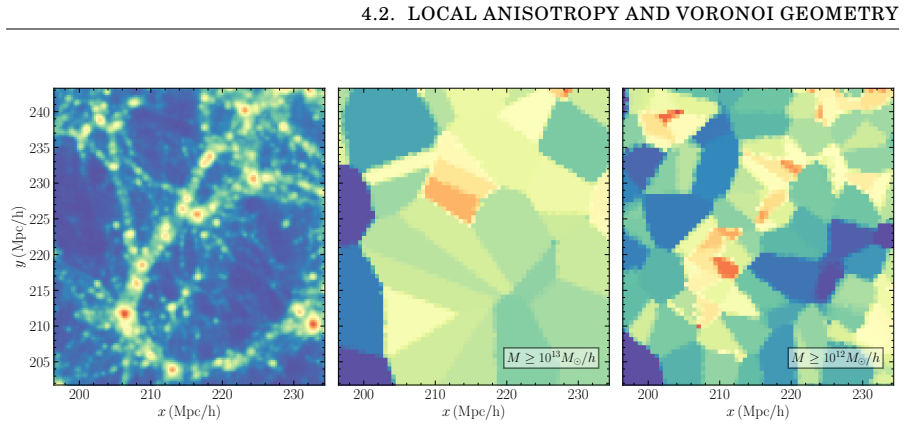
Skeletor is the central object: a Voronoi-based hierarchical filament finder. It quantifies local anisotropy from the Voronoi tessellation of tracer positions, selects filament-like cells, connects them into spines, orders the resulting network by a mass hierarchy, and optionally refines spines with dark-matter density while estimating filament radius Rv from the minimum of the radial infall velocity. Supporting it are the FilGen/FilAPT calibration tools, which create controlled mock filaments with known spines, and the Sahyadri N-body suite, whose seed-matched parameter variations and high mass resolution supply the tracer populations and the beyond-two-point statistics (VVF, kNN) that the
What would settle it
Recompute the stacked phase-space profiles using a filament radius defined independently of the velocity profile—say, from the density-gradient or tangential-velocity transition—and without the Rv>0.6 cut; if the coherent-infall and caustic features at r/Rv≈1 disperse, they were built in by the radius definition rather than discovered.
Extended reading notes
Core claim
The central discovery is that the phase space of cosmic filaments is organized and hierarchical. Using Skeletor, the thesis reconstructs filament spines directly from discrete tracers with a Voronoi tessellation, uses dark-matter information to refine the spine and to define each filament's radius Rv as the location of maximum radial infall, and classifies nested sub-filaments within parent filaments. Stacked profiles then show coherent anisotropic inflow toward the spine, a velocity transition at the inferred boundary, multistreaming inside, and localized caustic-like features—signatures expected from anisotropic gravitational collapse. The thesis also shows that sub-filaments are statistic
Load-bearing premise
The central premise is that every filament has a single coherent radial infall whose deepest point is its physical edge; filaments whose fitted infall profile shows a different inner minimum are cut out rather than analysed.
Editorial extensions
If this is right
- Filament boundaries can be defined dynamically by the radius of maximum coherent infall, tying geometry directly to ongoing gravitational collapse.
- Filament hierarchy matters: sub-filaments embedded in parent filaments have distinct density and velocity profiles, so stacked filament statistics should separate hierarchy levels.
- Phase-space diagnostics such as infall, multistreaming, and caustics provide observables beyond the power spectrum for the quasi-linear and nonlinear regimes.
- Optimized Fourier spine smoothing substantially improves the recovery of density and velocity profiles, reducing methodology-induced bias in filament studies.
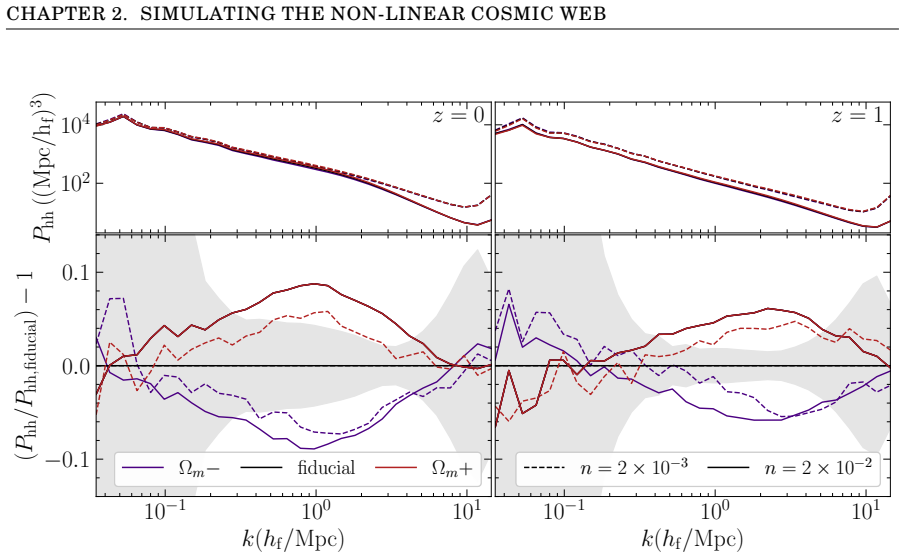
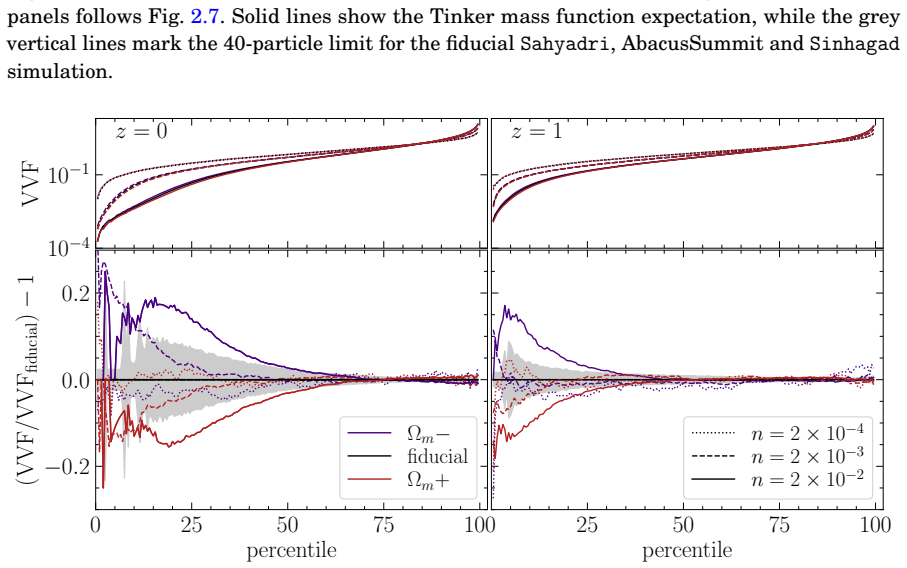
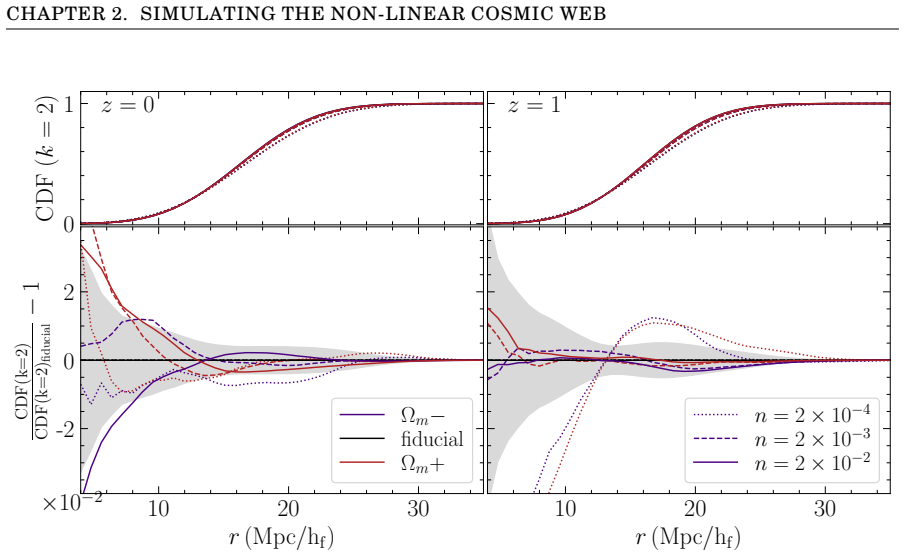
- Sahyadri's resolution enables VVF and kNN statistics at high tracer density with clear Omega_m sensitivity, supporting cosmological constraints from beyond-two-point statistics.
Reading between the lines
- A natural next step, not developed in the thesis, is to test whether the stacked phase-space profiles are universal across mass and redshift; the thesis frames universality as motivation, and the tools make it directly testable.
- Because the Rv-scaled profiles may be partly built into the radius definition, the claimed features near r/Rv=1 should be checked against a radius defined independently of the velocity profile, for example from the density gradient.
- The parent/sub-filament decomposition suggests that environment definitions for galaxy evolution studies may need to distinguish parent-filament from sub-filament membership, potentially affecting quenching and assembly-bias analyses.
- Skeletor's inputs are only tracer positions and masses, so the same phase-space reconstruction could be attempted with spectroscopic galaxy surveys; the thesis's calibration framework could quantify how redshift-space distortions bias the inferred velocities.
Editorial analysis
A structured set of objections, weighed in public.
Referee Report
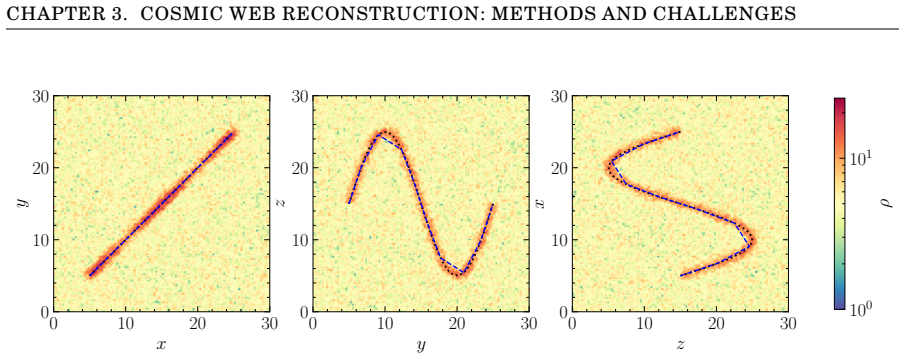
Summary. The thesis develops a set of numerical and methodological tools for studying the non-linear cosmic web, with emphasis on filamentary structure and velocity flows. It introduces the Sahyadri suite of high-resolution N-body simulations with systematic cosmological parameter variations; a calibration framework (FilGen/FilAPT) built on controlled filament realizations with known ground truth, including a Fourier-space smoothing technique; and Skeletor, a Voronoi-based hierarchical filament finder that reconstructs filament spines and sub-filaments from discrete tracers. These tools are then applied to study filament phase-space structure, reporting coherent radial infall, multistreaming, caustic-like features, and a hierarchy of sub-filaments. The central dynamical claims are that filaments have physically meaningful boundaries and that stacked phase-space profiles reveal a universal or quasi-universal structure.
Significance. The manuscript has several genuine strengths. The Sahyadri suite is carefully validated against Halofit and Tinker predictions (§2.4.2, Appendix A.3), and its improved mass resolution is quantified clearly. The FilGen/FilAPT calibration framework is a valuable contribution: it provides controlled realizations with known truth, and the optimized Fourier smoothing demonstrably reduces reconstruction biases (§3.3–3.4). Skeletor is a novel method that incorporates hierarchy in a principled way and does not require gridding of tracers. The public release of code and data products is also commendable. If the phase-space results were robust, the thesis would constitute a significant step toward a physical, dynamics-based description of filaments. However, as detailed below, the central phase-space claims currently rest on a radius definition that is partly circular, so the dynamical picture--coherent infall, filament boundaries, and the distinctiveness of sub-filaments--needs additional independent validation before those claims can be accepted.
major comments (2)
- [§4.3.6, Figs. 5.2, 6.6, 6.8] The comparison of alternative radius definitions in Fig. 6.8 is performed in bins of Rv after the sample has already been selected and scaled by Rv, so it does not break the circularity. An independent radius estimator (e.g., from density gradient or velocity dispersion) should be computed per filament, and the correlation between Rv and that estimator should be assessed without conditioning on Rv. Unless the phase-space features are shown to persist with an independently defined radius, the central claim of coherent infall and filament boundaries is not yet supported.
- [§6.3.4, Fig. 6.5] The same concern applies to the substructure analysis in Chapter 5, where parent and sub-filament profiles are compared using Rv-scaled radial distances (Fig. 5.2 and Fig. 4.10). The claim that sub-filaments are 'distinctly different' is based on the same velocity-defined radius and the same quality cuts. Please show whether the differences persist when profiles are compared in absolute radius or with a radius definition that does not rely on the infall minimum.
minor comments (4)
- [Appendix C.2] Typo in figure caption: 'panles' should be 'panels'. There are also several similar typographical and formatting issues throughout (e.g., 'wheras' in the Appendix C.4 caption, inconsistent spacing in 'er f'). A careful proofreading pass is needed.
- [§3.4.1] The description of the optimized Fourier smoothing is clear but the connection to the earlier FilAPT module could be made more explicit. In particular, the reader would benefit from a statement of how the optimization criterion behaves when the true profile is not known (as in real applications), and whether the method has been tested on mock filaments with a wide range of signal-to-noise.
- [Chapter 6] The phase-space plots (Fig. 6.10) and the interpretation in terms of multistreaming are interesting, but the figure labels are small and the text does not state the number of filaments used to produce the stacked distribution. Adding the sample size and the uncertainty on the median velocity would strengthen the presentation.
- [§2.4.1] The claim that 'Sahyadri resolves halos down to M_min = 3.2e9 h−1 M_sun' relies on a 40-particle threshold. The manuscript could state more explicitly how the results depend on this resolution threshold, particularly for the VVF and kNN statistics, since these are sensitive to the lowest-mass tracers.
Circularity Check
Phase-space 'boundary' and coherent-infall features are largely built into the Rv definition and the Rv cut; other results (multistreaming, density profiles) remain independent.
-
self definitional
[Ch. 4 §4.3.6 / Fig. 4.5 caption; Ch. 5 Fig. 5.2 caption]
"The red curve shows the quadratic fit used to locate the velocity dip. The solid vertical line indicates the final filament radius Rv, defined by the location of largest radial infall. ... The radial distance is scaled by the radius of the filament, Rv."
Because Rv is defined as the location of the vr dip, stacking profiles in units of r/Rv places the dip at r/Rv=1 by construction. The thesis then presents this dip as a discovered 'filament boundary' and 'coherent infall' feature. The existence of negative vr at small radii is an independent measurement, but the specific claim that the boundary/infall feature sits at r/Rv≈1 is a restatement of the definition, not an empirical discovery.
-
fitted input called prediction
[Ch. 6 Fig. 6.5 caption; Ch. 6 Figs. 6.6, 6.8]
"The main population shows the expected positive correlation between filament radius and node mass, while a secondary population at low Rv arises from systems where the fitting procedure identifies an unphysical inner minimum in the radial velocity profile. The vertical dashed line marks the cut at Rv = 0.6 h−1Mpc adopted for the remainder of the analysis."
The sample is cleaned by removing systems whose quadratic fit yields Rv < 0.6 h−1Mpc, described as an 'unphysical inner minimum'. These are precisely the objects that do not conform to the assumed single-infall profile used to define Rv. After this cut, the stacked profiles are presented as evidence of coherent infall and universal filament boundaries. The agreement with the assumed profile is therefore partly enforced by sample selection, so the 'prediction' of coherent infall is not independent of the fitted definition and cut.
full rationale
The central dynamical claim—that filament boundaries and coherent infall features appear at r/Rv≈1—is partially circular. Rv is defined as the location of maximum radial infall (the vr minimum) via a quadratic fit, and then all stacked phase-space profiles are scaled by Rv. This forces the infall dip to appear at r/Rv=1 by construction. The additional cut at Rv=0.6 h−1Mpc removes the secondary population whose fits show an 'unphysical inner minimum', i.e., the systems that most strongly violate the assumed single-infall profile; the cleaned sample is then used to report coherent inflow and boundary features, making the agreement with the assumed profile partly a selection effect. However, the thesis also contains genuinely independent content: the multistreaming and caustic-like phase-space features are not guaranteed by the radius definition, the density and dispersion profiles are measured without imposing the dip position, the substructure classification is geometric rather than velocity-based, and the Sahyadri suite is validated against external fitting functions (Halofit, Tinker). The optimized-smoothing claim is checked against known ground-truth profiles in the FilGen framework, so it is not circular despite its heuristic objective. No load-bearing self-citation chain or imported uniqueness theorem was found. Score 6 reflects partial circularity of the boundary/infall claim, not full circularity of the thesis.
Assumptions & free parameters
free parameters (6)
- FilGen velocity ansatz parameters (V0z, V0r, sigma0, a, b, c, u, g) =
V0z=V0r=250 km/s, sigma0=300 km/s, a=0.125, b=2.5, c=15, u=8, g=0.5
- Anisotropy threshold alpha_th =
95th percentile of random-catalogue alpha distribution (default)
- Connectivity parameter dcut =
l_mean (mean inter-tracer spacing)
- Hierarchy mass thresholds =
Mass bins used in the mass-thresholded hierarchy (Appendix C.2)
- Filament radius quality cut =
Rv > 0.6 h^-1 Mpc
- Smoothing parameters in optimized Fourier/neighbour smoothing =
Chosen per filament by minimizing the width of the inferred density profile
assumptions (6)
- standard math FLRW background and Newtonian N-body dynamics for sub-horizon structure formation
- domain assumption Cold dark matter with collisionless particles and no massive neutrinos
- ad hoc to paper The cosmic web has a hierarchical filament-in-filament structure that can be decomposed via mass thresholds
- ad hoc to paper The location of maximum radial infall defines the 'true' filament radius
- domain assumption The analytic velocity ansatz in Eqs. 3.1-3.3 represents realistic cosmic filament kinematics
- domain assumption Voronoi cell anisotropy is a faithful proxy for filamentary environment
invented entities (1)
-
Sub-filaments (filamentary substructures embedded within parent filaments)
Cite this review
Pith. "Pith review of Cosmic Velocity Flows: from Theory to Observations." pith.science (2026). https://pith.science/paper/JMBJJDVG
@misc{pith2026260803530,
  author       = {Pith},
  title        = {Pith review of: Cosmic Velocity Flows: from Theory to Observations},
  year         = {2026},
  howpublished = {\url{https://pith.science/paper/JMBJJDVG}},
  note         = {Machine review of arXiv:2608.03530}
}
abstract
The Large-Scale Structure (LSS) of the Universe forms a complex network of nodes, filaments, sheets, and voids known as the Cosmic Web. As current and upcoming galaxy surveys increasingly probe the quasi-linear and non-linear regimes of structure formation, understanding its geometry and dynamics is essential for precision cosmology. In particular, cosmic filaments, which channel matter across the web, are central to these dynamical processes. This thesis develops numerical tools to study the non-linear cosmic web. First, the Sahyadri suite of high-resolution cosmological $N$-body simulations is introduced, providing a framework for precision studies of LSS and its cosmological dependence. A calibration framework for filament reconstruction is then developed using controlled filament realizations, enabling systematic investigation of reconstruction biases. The effects of filament curvature and reconstruction noise on inferred filament properties are quantified, and a novel Fourier-space smoothing approach is introduced to improve profile recovery. The thesis further presents Skeletor, a Voronoi-based filament finder that identifies filamentary structures directly from discrete tracers while explicitly incorporating the hierarchical nature of the cosmic web. A novel framework for classifying sub-filamentary structure is developed. Applying these tools to cosmological simulations reveals distinct properties of filament substructure and provides a detailed view of filament phase space, including coherent inflows, multistreaming, and caustic-like features. Together, these developments provide a framework for studying the geometry, hierarchy, and dynamics of the non-linear cosmic web. More broadly, they contribute to the ongoing effort to build a physically motivated understanding of the non-linear cosmic web beyond traditional measures of clustering.
Figures


Figures from the paper (47 more)










Reference graph
Works this paper leans on
-
[1]
Springel, Volker and White, Simon D. M. and Jenkins, Adrian and others , journal =. Simulations of the formation, evolution and clustering of galaxies and quasars , volume =. 2005 , doi =
2005
-
[2]
2008 , doi =
, month = jan, number =. 2008 , doi =
2008
-
[3]
2014 , doi =
, month = jan, number =. 2014 , doi =
2014
-
[4]
2010 , doi =
, month =. 2010 , doi =
2010
-
[5]
2002 , doi =
, month = dec, number =. 2002 , doi =
2002
-
[6]
2005 , doi =
, month = nov, number =. 2005 , doi =
2005
-
[7]
arXiv e-prints , title =
-
[8]
LSST: From Science Drivers to Reference Design and Anticipated Data Products , volume =
Ivezi. LSST: From Science Drivers to Reference Design and Anticipated Data Products , volume =. The Astrophysical Journal , number =. 2019 , doi =
2019
Show all 192 references
-
[9]
2018 , doi =
, month = sep, pages =. 2018 , doi =
2018
-
[10]
2015 , doi =
, month = nov, number =. 2015 , doi =
2015
-
[11]
2011 , doi =
Philosophical Transactions of the Royal Society of London Series A , month = dec, number =. 2011 , doi =
2011
-
[12]
2011 , doi =
, month =. 2011 , doi =
2011
-
[13]
2011 , doi =
, month = nov, number =. 2011 , doi =
2011
-
[14]
2005 , doi =
, month =. 2005 , doi =
2005
-
[15]
2021 , doi =
, month =. 2021 , doi =
2021
-
[16]
2010 , doi =
, month = jan, number =. 2010 , doi =
2010
-
[17]
2002 , doi =
, month = apr, pages =. 2002 , doi =
2002
-
[18]
Computational Astrophysics and Cosmology , keywords =
PKDGRAV3: beyond trillion particle cosmological simulations for the next era of galaxy surveys. Computational Astrophysics and Cosmology , keywords =. doi:10.1186/s40668-017-0021-1 , archivePrefix =. 1609.08621 , primaryClass =
-
[19]
2021 , doi =
, month = nov, number =. 2021 , doi =
2021
-
[20]
2013 , doi =
, month = nov, number =. 2013 , doi =
2013
-
[21]
2016 , doi =
, month = jan, pages =. 2016 , doi =
2016
-
[22]
2024 , doi =
, month = may, number =. 2024 , doi =
2024
-
[23]
1985 , doi =
, month = may, pages =. 1985 , doi =
1985
-
[24]
2001 , doi =
, month = dec, number =. 2001 , doi =
2001
-
[25]
and Hearin, Andrew P
Behroozi, Peter and Wechsler, Risa H. and Hearin, Andrew P. and Conroy, Charlie , journal =. UniverseMachine: The correlation between galaxy growth and dark matter halo assembly from z = 0-10 , volume =. 2019 , doi =
2019
-
[26]
The IllustrisTNG simulations: public data release , volume =
Nelson, Dylan and Pillepich, Annalisa and Springel, Volker and others , journal =. The IllustrisTNG simulations: public data release , volume =. 2019 , doi =
2019
-
[27]
and Bower, Richard G
Schaye, Joop and Crain, Robert A. and Bower, Richard G. and others , journal =. The EAGLE project: simulating the evolution and assembly of galaxies and their environments , volume =. 2015 , doi =
2015
-
[28]
SIMBA: Cosmological simulations with black hole growth and feedback , volume =
Dav. SIMBA: Cosmological simulations with black hole growth and feedback , volume =. Monthly Notices of the Royal Astronomical Society , number =. 2019 , doi =
2019
-
[29]
2019 , doi =
The Open Journal of Astrophysics , month = jun, number =. 2019 , doi =
2019
-
[30]
de Jong, R. S. and Agertz, O. and Berbel, A. Agudo and others , journal =. 4MOST: Project overview and information for the First Call for Proposals , volume =. 2019 , doi =
2019
-
[31]
and Chiba, Masashi and others , journal =
Takada, Masahiro and Ellis, Richard S. and Chiba, Masashi and others , journal =. Extragalactic science, cosmology, and Galactic archaeology with the Subaru Prime Focus Spectrograph , volume =. 2014 , doi =
2014
-
[32]
and others , journal =
Ishiyama, Tomoaki and Prada, Francisco and Klypin, Anatoly A. and others , journal =. The Uchuu simulations: Data Release 1 and dark matter halo concentrations , volume =. 2021 , doi =
2021
-
[33]
Introducing the Illustris Project: simulating the coevolution of dark and visible matter in the Universe , volume =
Vogelsberger, Mark and Genel, Shy and Springel, Volker and others , journal =. Introducing the Illustris Project: simulating the coevolution of dark and visible matter in the Universe , volume =. 2014 , doi =
2014
-
[34]
First results from the IllustrisTNG simulations: the galaxy colour bimodality , volume =
Pillepich, Annalisa and Nelson, Dylan and Hernquist, Lars and others , journal =. First results from the IllustrisTNG simulations: the galaxy colour bimodality , volume =. 2018 , doi =
2018
-
[35]
Boylan-Kolchin, Michael and Springel, Volker and White, Simon D. M. and Jenkins, Adrian and Lemson, Gerard , journal =. Resolving cosmic structure formation with the Millennium-II Simulation , volume =. 2009 , doi =
2009
-
[36]
and Trujillo-Gomez, Sebastian and Primack, Joel , journal =
Klypin, Anatoly A. and Trujillo-Gomez, Sebastian and Primack, Joel , journal =. Dark Matter Halos in the Standard Cosmological Model: Results from the Bolshoi Simulation , volume =. 2011 , doi =
2011
-
[37]
MultiDark simulations: the story of dark matter halo concentrations and density profiles , volume =
Klypin, Anatoly and Yepes, Gustavo and Gottl. MultiDark simulations: the story of dark matter halo concentrations and density profiles , volume =. Monthly Notices of the Royal Astronomical Society , number =. 2016 , doi =
2016
-
[38]
The Quijote simulations , volume =
Villaescusa-Navarro, Francisco and Hahn, ChangHoon and Massara, Elena and others , journal =. The Quijote simulations , volume =. 2020 , doi =
2020
-
[39]
and Tinker, Jeremy L
DeRose, Joseph and Wechsler, Risa H. and Tinker, Jeremy L. and others , journal =. The Aemulus Project. II. Emulating the Halo Mass Function , volume =. 2019 , doi =
2019
-
[40]
McClintock, Thomas and Varga, T. N. and Gruen, D. and others , journal =. Dark Energy Survey Year 1 Results: Weak Lensing Mass Calibration of redMaPPer Galaxy Clusters , volume =. 2019 , doi =
2019
-
[41]
Dark Quest
Nishimichi, Takahiro and Shirata, Akihito and Taruya, Atsushi and others , journal =. Dark Quest. I. Fast and Accurate Emulation of Halo Clustering Statistics and Its Application to Galaxy Clustering , volume =. 2019 , doi =
2019
-
[42]
and Garrison, Lehman H
Maksimova, Nina A. and Garrison, Lehman H. and Hadzhiyska, Boryana and others , journal =. AbacusSummit: a massive set of high-accuracy, high-resolution N-body simulations , volume =. 2021 , doi =
2021
-
[43]
Using GAMA to probe the impact of small-scale galaxy physics on nonlinear redshift-space distortions , volume =
Alam, Shadab and Peacock, John A and Farrow, Daniel J and Loveday, J and Hopkins, A M , journal =. Using GAMA to probe the impact of small-scale galaxy physics on nonlinear redshift-space distortions , volume =. 2021 , doi =
2021
-
[44]
, keywords =
Towards unbiased recovery of cosmic filament properties: the role of spine curvature and optimized smoothing. , keywords =. doi:10.1088/1475-7516/2024/09/041 , archivePrefix =. 2402.18669 , primaryClass =
2024 arXiv
-
[45]
and Ruiz-Macias, Omar and others , journal =
Hahn, ChangHoon and Wilson, Michael J. and Ruiz-Macias, Omar and others , journal =. The DESI Bright Galaxy Survey: Final Target Selection, Design, and Validation , volume =. 2023 , doi =
2023
-
[46]
Towards testing the theory of gravity with DESI: summary statistics, model predictions and future simulation requirements , volume =
Yildiz, Eleonora and Biagetti, Matteo and Seljak, Uro. Towards testing the theory of gravity with DESI: summary statistics, model predictions and future simulation requirements , volume =. Monthly Notices of the Royal Astronomical Society , number =. 2020 , doi =
2020
-
[47]
and McIntosh, Daniel H
Bell, Eric F. and McIntosh, Daniel H. and Katz, Neal and Weinberg, Martin D. , journal =. The Optical and Near-Infrared Properties of Galaxies. I. Luminosity and Stellar Mass Functions , volume =. 2003 , doi =
2003
-
[48]
and Hill, David T
Driver, Simon P. and Hill, David T. and Kelvin, Lee S. and others , journal =. Galaxy and Mass Assembly (GAMA): survey diagnostics and core data release , volume =. 2011 , doi =
2011
-
[49]
Baldry, I. K. and Driver, S. P. and Loveday, J. and others , journal =. Galaxy And Mass Assembly (GAMA): the galaxy stellar mass function at z < 0.06 , volume =. 2012 , doi =
2012
-
[50]
and Tinker, Jeremy L
Wetzel, Andrew R. and Tinker, Jeremy L. and Conroy, Charlie and van den Bosch, Frank C. , journal =. Galaxy Evolution in Groups and Clusters: Satellite Star Formation Histories and Quenching Time-scales in a Hierarchical Universe , volume =. 2013 , doi =
2013
-
[51]
and Greene, Jenny E
Reines, Amy E. and Greene, Jenny E. and Geha, Marla , journal =. Dwarf Galaxies with Optical Signatures of Active Massive Black Holes , volume =. 2013 , doi =
2013
-
[52]
and Yuan, Wenlong and Macri, Lucas M
Riess, Adam G. and Yuan, Wenlong and Macri, Lucas M. and others , journal =. A Comprehensive Measurement of the Local Value of the Hubble Constant with 1 km s ^. 2022 , doi =
2022
-
[53]
Planck 2018 results. VI. Cosmological parameters , volume =. Astronomy & Astrophysics , pages =. 2020 , doi =
2018
-
[54]
2024 , doi =
arXiv e-prints , month =. 2024 , doi =
2024
-
[55]
and Aguilar, J
Abdul Karim, M. and Aguilar, J. and Ahlen, S. and Alam, S. and Allen, L. and Prieto, C. Allende and Alves, O. and Anand, A. and Andrade, U. and Armengaud, E. and Aviles, A. and Bailey, S. and Baltay, C. and Bansal, P. and Bault, A. and Behera, J. and BenZvi, S. and Bianchi, D....
2025
-
[56]
Galaxy power spectrum multipoles covariance in perturbation theory , volume =
Wadekar, Digvijay and Scoccimarro, Rom. Galaxy power spectrum multipoles covariance in perturbation theory , volume =. Physical Review D , number =. 2020 , doi =
2020
-
[57]
Galaxy clustering in the DESI Legacy Survey and its imprint on the CMB , volume =
Hang, Qianjun and Alam, Shadab and Peacock, John A and Cai, Yan-Chuan , journal =. Galaxy clustering in the DESI Legacy Survey and its imprint on the CMB , volume =. 2020 , doi =
2020
-
[58]
, journal =
Ishiyama, Tomoaki and Prada, Francisco and Klypin, Anatoly A. , journal =. Evolution of clustering in cosmological models with time-varying dark energy , volume =. 2025 , doi =
2025
-
[59]
2013 , doi =
, month =. 2013 , doi =
2013
-
[60]
2018 , doi =
, month =. 2018 , doi =
2018
-
[61]
2020 , doi =
, month =. 2020 , doi =
2020
-
[62]
2007 , doi =
, month =. 2007 , doi =
2007
-
[63]
2015 , doi =
, month =. 2015 , doi =
2015
-
[64]
2016 , doi =
, month =. 2016 , doi =
2016
-
[65]
2022 , doi =
, month =. 2022 , doi =
2022
-
[66]
2012 , doi =
, month =. 2012 , doi =
2012
-
[67]
2008 , doi =
, month =. 2008 , doi =
2008
-
[68]
Nouvelles applications des paramètres continus à la théorie des formes quadratiques
Voronoi, Georges , journal =. Nouvelles applications des paramètres continus à la théorie des formes quadratiques. Deuxième mémoire. Recherches sur les parallélloèdres primitifs. , volume =. 1908 , url =
1908
-
[69]
2020 , doi =
Banerjee, Arka and Abel, Tom , journal =. 2020 , doi =
2020
-
[70]
2021 , doi =
Banerjee, Arka and Abel, Tom , journal =. 2021 , doi =
2021
-
[71]
2023 , doi =
Banerjee, Arka and Abel, Tom , journal =. 2023 , doi =
2023
-
[72]
2025 , doi =
Gangopadhyay, Kwanit and Banerjee, Arka and Abel, Tom , journal =. 2025 , doi =
2025
-
[73]
2022 , doi =
Banerjee, Arka and Kokron, Nickolas and Abel, Tom , journal =. 2022 , doi =
2022
-
[74]
2019 , doi =
, month =. 2019 , doi =
2019
-
[75]
2025 , doi =
, month =. 2025 , doi =
2025
-
[76]
1998 , doi =
, month =. 1998 , doi =
1998
-
[77]
The Cosmic Linear Anisotropy Solving System (CLASS)
Blas, Diego and Lesgourgues, Julien and Tram, Thomas , journal =. The Cosmic Linear Anisotropy Solving System (CLASS). Part II: Approximation schemes , volume =. 2011 , doi =
2011
-
[78]
The Cosmic Linear Anisotropy Solving System (CLASS) I: Overview , year =
Lesgourgues, Julien , journal =. The Cosmic Linear Anisotropy Solving System (CLASS) I: Overview , year =
-
[79]
2023 , doi =
, month =. 2023 , doi =
2023
-
[80]
and Garrison, Lehman H
Maksimova, Nina A. and Garrison, Lehman H. and Hadzhiyska, Boryana and Bose, Sownak and Eisenstein, Daniel J. , journal =. AbacusSummit: a massive set of high-accuracy, high-resolution N-body simulations , volume =. 2021 , doi =
2021
-
[81]
arXiv , author =:1712.05768 , journal =
doi:10.3847/1538-4365/aabfd3 , eid =. arXiv , author =:1712.05768 , journal =
-
[82]
, keywords =
Hydrodynamical Simulations of the Galaxy Population: Enduring Successes and Outstanding Challenges. , keywords =. doi:10.1146/annurev-astro-041923-043618 , archivePrefix =. 2309.17075 , primaryClass =
-
[83]
Nature Reviews Physics , keywords =
Cosmological simulations of galaxy formation. Nature Reviews Physics , keywords =. doi:10.1038/s42254-019-0127-2 , archivePrefix =. 1909.07976 , primaryClass =
1909 arXiv
-
[84]
, keywords =
The clustering of galaxies in the completed SDSS-III Baryon Oscillation Spectroscopic Survey: cosmological analysis of the DR12 galaxy sample. , keywords =. doi:10.1093/mnras/stx721 , archivePrefix =. 1607.03155 , primaryClass =
-
[85]
, keywords =
Assembly bias in the clustering of dark matter haloes. , keywords =. doi:10.1111/j.1745-3933.2007.00292.x , archivePrefix =. astro-ph/0611921 , primaryClass =
2007
-
[86]
, keywords =
The Sloan Digital Sky Survey: Technical Summary. , keywords =. doi:10.1086/301513 , archivePrefix =. astro-ph/0006396 , primaryClass =
-
[87]
, keywords =
Detection of the Baryon Acoustic Peak in the Large-Scale Correlation Function of SDSS Luminous Red Galaxies. , keywords =. doi:10.1086/466512 , archivePrefix =. astro-ph/0501171 , primaryClass =
-
[88]
IEEE Proceedings , year = 2009, month = aug, volume =
The Square Kilometre Array. IEEE Proceedings , year = 2009, month = aug, volume =. doi:10.1109/JPROC.2009.2021005 , adsurl =
2009
-
[89]
, keywords =
Observational probes of cosmic acceleration. , keywords =. doi:10.1016/j.physrep.2013.05.001 , archivePrefix =. 1201.2434 , primaryClass =
2013 arXiv
- [90]
-
[92]
doi:10.1086/192267 , journal =
-
[93]
, keywords =
How filaments of galaxies are woven into the cosmic web. , keywords =. doi:10.1038/380603a0 , archivePrefix =. astro-ph/9512141 , primaryClass =
- [94]
- [95]
- [96]
-
[97]
arXiv , author =:2003.09697 , journal =
doi:10.1051/0004-6361/202037986 , eid =. arXiv , author =:2003.09697 , journal =
2003 arXiv
-
[98]
arXiv , author =:2002.01486 , journal =
doi:10.1051/0004-6361/202037647 , eid =. arXiv , author =:2002.01486 , journal =
2002 arXiv
- [99]
-
[100]
doi:10.1111/j.1365-2966.2010.17263.x , eprint =
, keywords =. doi:10.1111/j.1365-2966.2010.17263.x , eprint =
2010
-
[101]
, keywords =
Galaxy morphology in rich clusters: implications for the formation and evolution of galaxies. , keywords =. doi:10.1086/157753 , adsurl =
-
[102]
, keywords =
Physical Properties and Environments of Nearby Galaxies. , keywords =. doi:10.1146/annurev-astro-082708-101734 , archivePrefix =. 0908.3017 , primaryClass =
-
[104]
, keywords =
Swirling around filaments: are large-scale structure vortices spinning up dark haloes?. , keywords =. doi:10.1093/mnras/stu2289 , archivePrefix =. 1310.3801 , primaryClass =
-
[105]
doi:10.1093/mnras/227.1.1 , journal =
-
[106]
, keywords =
Redshift-space distortions, pairwise velocities, and nonlinearities. , keywords =. doi:10.1103/PhysRevD.70.083007 , archivePrefix =. astro-ph/0407214 , primaryClass =
-
[107]
The Evolving Universe , year = 1998, editor =
Linear Redshift Distortions: a Review. The Evolving Universe , year = 1998, editor =. doi:10.1007/978-94-011-4960-0_17 , archivePrefix =. astro-ph/9708102 , primaryClass =
1998 arXiv
-
[108]
, keywords =
A test of the nature of cosmic acceleration using galaxy redshift distortions. , keywords =. doi:10.1038/nature06555 , archivePrefix =. 0802.1944 , primaryClass =
1944 arXiv
-
[109]
doi:10.1016/S0370-1573(02)00135-7 , eprint =
, keywords =. doi:10.1016/S0370-1573(02)00135-7 , eprint =
-
[110]
, keywords =
Critical look at cosmological perturbation theory techniques. , keywords =. doi:10.1103/PhysRevD.80.043531 , archivePrefix =. 0905.0479 , primaryClass =
-
[111]
, keywords =
Cosmological non-linearities as an effective fluid. , keywords =. doi:10.1088/1475-7516/2012/07/051 , archivePrefix =. 1004.2488 , primaryClass =
2012 arXiv
-
[112]
Journal of High Energy Physics , keywords =
The effective field theory of cosmological large scale structures. Journal of High Energy Physics , keywords =. doi:10.1007/JHEP09(2012)082 , archivePrefix =. 1206.2926 , primaryClass =
2012 arXiv
-
[113]
doi:10.1086/184625 , journal =
- [115]
-
[117]
doi:10.1111/j.1365-2966.2006.11318.x , eprint =
, keywords =. doi:10.1111/j.1365-2966.2006.11318.x , eprint =
2006
- [118]
- [119]
-
[120]
doi:10.1111/j.1365-2966.2009.15271.x , eprint =
, keywords =. doi:10.1111/j.1365-2966.2009.15271.x , eprint =
2009
- [121]
- [122]
-
[123]
doi:10.1111/j.1365-2966.2005.09451.x , eprint =
, keywords =. doi:10.1111/j.1365-2966.2005.09451.x , eprint =
2005
-
[124]
American Astronomical Society Meeting Abstracts , eid =
-
[125]
arXiv , author =:1301.6792 , journal =
doi:10.1088/0004-637X/766/2/115 , eid =. arXiv , author =:1301.6792 , journal =
- [126]
-
[127]
arXiv , author =:1507.05926 , journal =
doi:10.1051/0004-6361/201525861 , eid =. arXiv , author =:1507.05926 , journal =
-
[128]
arXiv , author =:2107.08663 , journal =
doi:10.3847/1538-4357/ac15f1 , eid =. arXiv , author =:2107.08663 , journal =
-
[129]
arXiv , author =:2402.11678 , journal =
-
[130]
Trudy Astrofizicheskogo Instituta Alma-Ata , month =
- [131]
- [133]
-
[134]
arXiv , author =:1403.5499 , journal =
doi:10.1103/PhysRevLett.112.251302 , eid =. arXiv , author =:1403.5499 , journal =
- [135]
- [136]
-
[139]
doi:10.1111/j.1365-2966.2011.18394.x , eprint =
, keywords =. doi:10.1111/j.1365-2966.2011.18394.x , eprint =
2011
-
[140]
, keywords =
Minimal spanning trees, filaments and galaxy clustering. , keywords =. doi:10.1093/mnras/216.1.17 , adsurl =
-
[141]
, keywords =
Detection and analysis of cluster-cluster filaments. , keywords =. doi:10.1093/mnras/staa3112 , archivePrefix =. 1911.06768 , primaryClass =
1911 arXiv
-
[143]
, keywords =
Cosmic web, multistream flows, and tessellations. , keywords =. doi:10.1103/PhysRevD.85.083005 , archivePrefix =. 1111.2366 , primaryClass =
- [144]
- [145]
-
[146]
arXiv , author =:2209.05495 , journal =
doi:10.1051/0004-6361/202244935 , eid =. arXiv , author =:2209.05495 , journal =
- [147]
-
[148]
arXiv , author =:2103.06619 , journal =
doi:10.1051/0004-6361/202039169 , eid =. arXiv , author =:2103.06619 , journal =
- [149]
-
[150]
Resumming cosmological perturbations via the Lagrangian picture: One-loop results in real space and in redshift space , author =. Phys. Rev. D , volume =. 2008 , month =. doi:10.1103/PhysRevD.77.063530 , url =
2008 doi
-
[151]
, keywords =
Stabilizing simulation-based cosmological Fisher forecasts: a case study using the Voronoi volume function. , keywords =. doi:10.1088/1475-7516/2026/03/040 , archivePrefix =. 2506.16408 , primaryClass =
2026
- [152]
-
[153]
doi:10.1111/j.1365-2966.2012.21911.x , eprint =
, keywords =. doi:10.1111/j.1365-2966.2012.21911.x , eprint =
2012
-
[154]
doi:10.1046/j.1365-8711.2001.04222.x , eprint =
, keywords =. doi:10.1046/j.1365-8711.2001.04222.x , eprint =
2001
- [155]
-
[156]
doi:10.1111/j.1745-3933.2011.01081.x , eprint =
, keywords =. doi:10.1111/j.1745-3933.2011.01081.x , eprint =
2011
-
[157]
arXiv , author =:1101.4017 , journal =
doi:10.1088/1475-7516/2011/05/010 , eid =. arXiv , author =:1101.4017 , journal =
2011 arXiv
- [158]
- [159]
- [160]
-
[161]
, isbn =
Apostol, T.M. , isbn =. Calculus, Volume I, 2nd Ed One-variable Calculus, with an Introduction to Linear Algebra , url =
-
[162]
doi:10.1086/170520 , journal =
- [163]
-
[165]
, keywords =
ZOBOV: a parameter-free void-finding algorithm. , keywords =. doi:10.1111/j.1365-2966.2008.13180.x , archivePrefix =. 0712.3049 , primaryClass =
2008
-
[167]
Astronomy and Computing , keywords =
VIDE: The Void IDentification and Examination toolkit. Astronomy and Computing , keywords =. doi:10.1016/j.ascom.2014.10.002 , archivePrefix =. 1406.1191 , primaryClass =
2014 arXiv
-
[168]
DTFE: The Delaunay tessellation field estimator
- [169]
- [171]
-
[172]
, keywords =
Relative distribution of dark matter, gas, and stars around cosmic filaments in the IllustrisTNG simulation. , keywords =. doi:10.1051/0004-6361/202141974 , archivePrefix =. 2109.06198 , primaryClass =
-
[173]
, keywords =
The Zel'dovich approximation: key to understanding cosmic web complexity. , keywords =. doi:10.1093/mnras/stt2142 , archivePrefix =. 1311.7134 , primaryClass =
-
[174]
, keywords =
The 3D skeleton: tracing the filamentary structure of the Universe. , keywords =. doi:10.1111/j.1365-2966.2007.12685.x , archivePrefix =. 0707.3123 , primaryClass =
2007
-
[175]
, keywords =
On the connectivity of the cosmic web: theory and implications for cosmology and galaxy formation. , keywords =. doi:10.1093/mnras/sty1643 , archivePrefix =. 1803.11477 , primaryClass =
-
[176]
, keywords =
On the environmental dependence of halo formation. , keywords =. doi:10.1111/j.1365-2966.2004.07733.x , archivePrefix =. astro-ph/0402237 , primaryClass =
2004
-
[177]
, keywords =
Renormalized cosmological perturbation theory. , keywords =. doi:10.1103/PhysRevD.73.063519 , archivePrefix =. astro-ph/0509418 , primaryClass =
-
[178]
, keywords =
Memory of initial conditions in gravitational clustering. , keywords =. doi:10.1103/PhysRevD.73.063520 , archivePrefix =. astro-ph/0509419 , primaryClass =
-
[179]
, keywords =
Nonlinear evolution of baryon acoustic oscillations. , keywords =. doi:10.1103/PhysRevD.77.023533 , archivePrefix =. 0704.2783 , primaryClass =
-
[180]
Annales de la Soci
Un Univers homog \`e ne de masse constante et de rayon croissant rendant compte de la vitesse radiale des n \'e buleuses extra-galactiques. Annales de la Soci
-
[181]
Proceedings of the National Academy of Science , year = 1929, month = mar, volume =
A Relation between Distance and Radial Velocity among Extra-Galactic Nebulae. Proceedings of the National Academy of Science , year = 1929, month = mar, volume =. doi:10.1073/pnas.15.3.168 , adsurl =
1929 doi
-
[182]
doi:10.1515/9780691206721 , adsurl =
Principles of Physical Cosmology. doi:10.1515/9780691206721 , adsurl =
-
[183]
Cosmological Physics
-
[184]
, keywords =
The clustering of galaxies in the SDSS-III Baryon Oscillation Spectroscopic Survey: a large sample of mock galaxy catalogues. , keywords =. doi:10.1093/mnras/sts084 , archivePrefix =. 1203.6609 , primaryClass =
-
[185]
, keywords =
Dark Energy Survey Year-1 results: galaxy mock catalogues for BAO. , keywords =. doi:10.1093/mnras/sty1389 , archivePrefix =. 1712.06232 , primaryClass =
-
[186]
, keywords =
Comparing approximate methods for mock catalogues and covariance matrices II: power spectrum multipoles. , keywords =. doi:10.1093/mnras/stz507 , archivePrefix =. 1806.09497 , primaryClass =
-
[187]
Proceedings of the National Academy of Science , keywords =
The frontier of simulation-based inference. Proceedings of the National Academy of Science , keywords =. doi:10.1073/pnas.1912789117 , archivePrefix =. 1911.01429 , primaryClass =
1911 arXiv
-
[188]
Living Reviews in Computational Astrophysics , keywords =
Large-scale dark matter simulations. Living Reviews in Computational Astrophysics , keywords =. doi:10.1007/s41115-021-00013-z , archivePrefix =. 2112.05165 , primaryClass =
-
[189]
Testing the robustness of simulations for the DESI dark time survey
The DESI N-body simulation project - I. Testing the robustness of simulations for the DESI dark time survey. , keywords =. doi:10.1093/mnras/stac1947 , archivePrefix =. 2112.09138 , primaryClass =
-
[190]
, keywords =
Generating mock galaxy catalogues for flux-limited samples like the DESI Bright Galaxy Survey. , keywords =. doi:10.1093/mnras/stae1503 , archivePrefix =. 2312.08792 , primaryClass =
-
[191]
, keywords =
The Luminosity and Color Dependence of the Galaxy Correlation Function. , keywords =. doi:10.1086/431891 , archivePrefix =. astro-ph/0408569 , primaryClass =
-
[192]
, keywords =
Galaxy Clustering in the Completed SDSS Redshift Survey: The Dependence on Color and Luminosity. , keywords =. doi:10.1088/0004-637X/736/1/59 , archivePrefix =. 1005.2413 , primaryClass =
-
[193]
2LPTIC: 2nd-order Lagrangian Perturbation Theory Initial Conditions
-
[194]
MUSIC: MUlti-Scale Initial Conditions
- [195]
-
[196]
, keywords =
A hierarchical O(N log N) force-calculation algorithm. , keywords =. doi:10.1038/324446a0 , adsurl =
-
[197]
Journal of Astrophysics and Astronomy , keywords =
TreePM: A Code for Cosmological N-Body Simulations. Journal of Astrophysics and Astronomy , keywords =. doi:10.1007/BF02702282 , archivePrefix =. astro-ph/9911025 , primaryClass =
-
[198]
, keywords =
General relativistic corrections to N -body simulations and the Zel'dovich approximation. , keywords =. doi:10.1103/PhysRevD.92.123517 , archivePrefix =. 1505.04756 , primaryClass =
-
[199]
, keywords =
Linear power spectrum of observed source number counts. , keywords =. doi:10.1103/PhysRevD.84.043516 , archivePrefix =. 1105.5292 , primaryClass =
-
[200]
Classical and Quantum Gravity , keywords =
Relativistic effect in galaxy clustering. Classical and Quantum Gravity , keywords =. doi:10.1088/0264-9381/31/23/234001 , archivePrefix =. 1409.3223 , primaryClass =
-
[201]
, keywords =
Hierarchical reconstruction of the cosmic web, the H-Spine method. , keywords =. doi:10.1093/mnras/stae468 , archivePrefix =. 2308.16186 , primaryClass =
-
[202]
, keywords =
Cosmic web dependence of galaxy clustering and quenching in SDSS. , keywords =. doi:10.1093/mnras/sty3477 , archivePrefix =. 1801.04878 , primaryClass =
-
[203]
General properties
The large scale structure of the universe I. General properties. One-and two-dimensional models. Geophysical and Astrophysical Fluid Dynamics , keywords =. doi:10.1080/03091928208209001 , adsurl =
Reviewed August 5, 2026 · model on record in the stance chip above.
Discussion (0). Sign in to comment.