REVIEW 4 major objections 5 minor 203 references
The ALPINE-ALMA [CII] Survey: Unveiling the baryon evolution in the ISM of $z\sim5$ star-forming galaxies
T0 review · 4 major / 5 minor · reviewed 2026-08-11 · deepseek-v4-flash
Pith's one-line read The paper argues that z~5 galaxies built their dust so fast that only a top-heavy initial mass function—one favoring massive stars—can reproduce 93% of the observed sample, versus 65% for the standard Chabrier IMF.
desk verdict The 65% vs 93% reproduction fractions rest on an undefined count, but the paper is a competent, honest application worth sending to a referee. read the letter →
The pith
A machine-rendered reading of the paper's core claim, the machinery that carries it, and where it could break.
The reading
What carries the argument
The load-bearing object is a one-zone chemical evolution model that integrates coupled equations for the total gas mass, individual gas species, and each dust species, with source and sink terms for star formation, stellar ejecta, outflows, inflows, supernova-shock destruction, and dust growth in the ISM. The model is run on a grid of initial gas masses, mass-loading factors, condensation fractions, and dust-growth efficiencies, and each galaxy is matched by minimizing a reduced chi-square over gas mass, 160 micron dust luminosity, star formation rate, and age. The central diagnostic is the dust formation rate diagram, specific dust mass versus specific star formation rate, where evolutionary tracks for the Chabrier and top-heavy IMFs are compared with the ALPINE data. The top-heavy IMF enters both the SED fitting and the chemical evolution model, keeping the star formation histories mutually consistent.
What would settle it
Measure the rest-frame far-infrared SED peak for a subset of the 21 continuum-detected ALPINE galaxies (for example with ALMA Band 8 or 9 or with JWST/MIRI) so that dust masses come from multi-band photometry rather than a single 160 µm luminosity; if the resulting masses disagree with the factor-of-2-rescaled values by more than the quoted factor-of-3 uncertainty, the 65% versus 93% reproduction fractions would need to be recomputed, and the top-heavy IMF preference could weaken.
Extended reading notes
Core claim
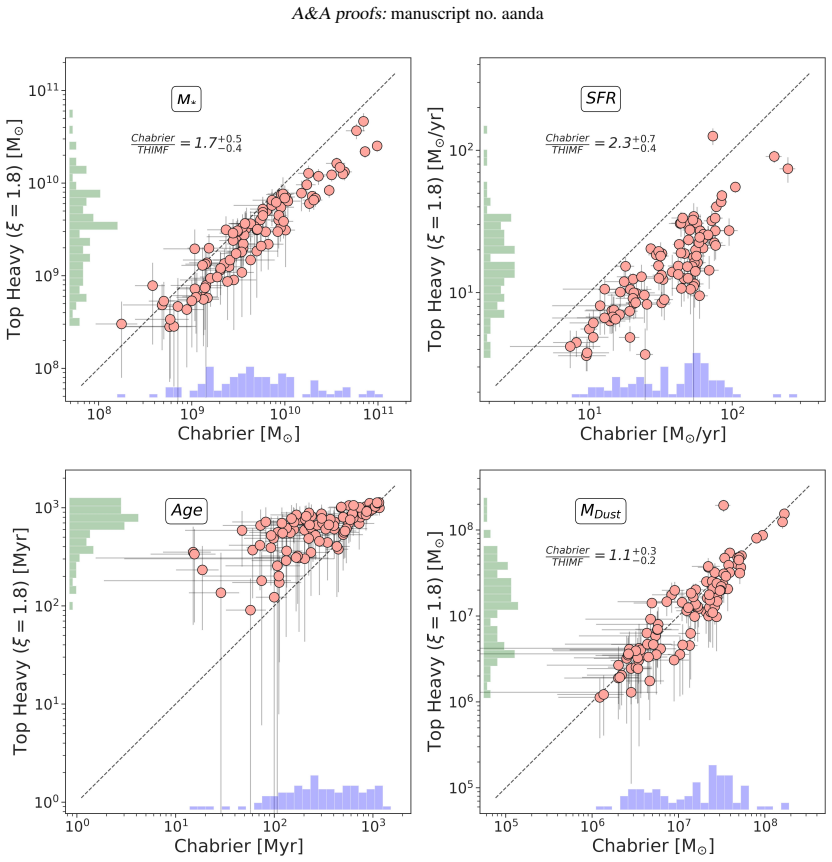
The central claim is that the dust and gas content of z~5 main-sequence star-forming galaxies can be reproduced by chemical evolution models, but only if the models adopt a top-heavy initial mass function and maximal dust condensation in Type II supernovae. In the paper's accounting, Chabrier IMF models reproduce 65% of the 98 galaxies, while top-heavy IMF models reproduce 93%. The top-heavy IMF, implemented as a power law with slope $\xi=1.8$, puts more mass in short-lived massive stars, so supernovae enrich and dust the ISM on the short timescales needed for the youngest galaxies; the model separately requires outflows to lower gas masses with age and ISM dust growth to match intermediate-age galaxies. The same tracks overproduce dust in the oldest galaxies, which the paper reads as evidence for an additional dust destruction mechanism or an overestimate of the observed dust masses.
Load-bearing premise
The load-bearing premise is the dust-mass calibration: the paper divides every SED-derived dust mass by a factor of 2 because the dust model being tested predicts a 70% carbon and 30% silicate mixture, even though the paper states these masses can shift by about a factor of 3 depending on the adopted absorption coefficient.
Editorial extensions
If this is right
- A top-heavy IMF with slope $\xi=1.8$ at $z\sim5$ implies that massive stars and core-collapse supernovae were more numerous relative to low-mass stars than assumed locally, so early galaxies enriched and dusted their ISM faster.
- Outflows with mass-loading factors up to $\eta_{\rm out}\sim2$ are needed to deplete gas in galaxies older than about 300 Myr while keeping metallicities near or below solar.
- For intermediate-age galaxies (300-600 Myr), dust growth in the ISM contributes roughly 60% of the dust, making the dust-to-gas ratio rise with age over that interval.
- The models overproduce dust in the oldest galaxies, so either an unaccounted destruction mechanism (such as rotational disruption in strong radiation fields) is at work, or the observed dust masses are overestimated by up to a factor of about 2.
- Even with a top-heavy IMF, the youngest and dustiest sources (sSFR $\gtrsim10^{-8}\,\mathrm{yr}^{-1}$, sM$_{\rm Dust}\gtrsim10^{-2}$) are not reproduced, identifying them as the key targets for sharper observations.
Reading between the lines
- Extension: if the top-heavy IMF preference is real, z~5 galaxies should carry abundance signatures of massive-star enrichment, such as low C/O ratios, which rest-frame ultraviolet or optical spectra could now test.
- Extension: the 65% versus 93% fractions depend on the factor-of-2 rescaling of dust masses; reporting the reproduced fraction as a function of the assumed dust opacity scale would show how much of the IMF conclusion rests on that calibration.
- Extension: applying the same model grid to JWST-selected samples at z>6, where even less time is available for dust build-up, would test whether the required IMF slope must grow still flatter or whether another rapid dust channel is needed.
- Extension: measuring the carbon-to-silicate ratio or grain size distribution at z~5, through mid-infrared features or far-infrared colors, would test the 70/30 composition that anchors the dust-mass rescaling.
Signed reviews
Editorial analysis
A structured set of objections, weighed in public.
Referee Report
Summary. The paper uses one-zone chemical evolution models, following gas, metals, and dust (SNII/SNIa/AGB enrichment, SN shock destruction, ISM dust growth, inflows and outflows), to interpret gas and dust measurements for 98 ALPINE z~5 star-forming galaxies. Physical parameters such as stellar mass, SFR, age, and dust mass are estimated with cigale under both a Chabrier IMF and a top-heavy IMF with slope xi=1.8. The models are used to constrain initial gas mass, inflow/outflow mass-loading factors, SN destruction efficiency, condensation fractions, and dust growth efficiency by matching specific gas mass, specific dust mass, and dust-to-gas ratio in the sSFR plane. The central quantitative result is that 65% of galaxies are 'reproduced' with a Chabrier IMF versus 93% with a top-heavy IMF, which is interpreted as evidence that a top-heavy IMF alleviates the tension for rapid dust build-up at early times.
Significance. If the central comparison is made rigorous, the paper would be a valuable addition to the debate on dust production at z>4: it uses a comparatively large sample, simultaneously models gas and dust, explicitly contrasts two IMFs, and connects SED fitting to chemical evolution in a consistent way. The authors also make the ALPINE data products and their grid-based model framework transparent, and they are explicit about several degeneracies and systematic uncertainties. However, the headline 65% versus 93% reproduction fractions currently rest on an undefined classification rule, a model-dependent dust-mass rescaling, and parameters fitted to the same data that are later said to be reproduced; these issues must be fixed before the quantitative claim can be evaluated.
major comments (4)
- [Section 6, item 4; Section 3.5; Sections 4.2-4.3] The headline result that '65% of our galaxies can be reproduced with a canonical Chabrier IMF' and '93% with THIMF' is not auditable because the paper never defines what counts as a reproduced galaxy. Section 3.5 gives a reduced chi-square definition (Eq. 19) and probability-weighted mean parameters (Eqs. 20-21), but no acceptance threshold is stated. The text in Sections 4.2 and 4.3 describes galaxies as 'reproduced' or 'overproduced' qualitatively, and Section 5.2 says the models 'fall short' for young sources, again without a formal criterion. Without a rule such as 'the best model or the probability-weighted model must match sM_Gas and sM_Dust simultaneously within a stated confidence interval, with a specified treatment of upper limits,' the reported fractions are not falsifiable and could change substantially under different reasonable definitions.
- [Section 3.3] The observed dust masses used in the comparison are rescaled by a factor of two: 'we divide the dust masses derived from cigale by a factor of 2 for subsequent analysis.' The justification is that the authors' dust evolution model predicts a 70% carbon/30% silicate composition, whereas the Draine et al. (2014) models in cigale assume a different composition and different opacities. Because this normalization comes from the very model family being tested, it is not an independent calibration. The paper acknowledges that dust masses can vary by a factor of about 3 depending on the adopted absorption coefficient, but the impact of this systematic on the 65% versus 93% comparison is not quantified. The authors should show how the reproduction fractions vary when the rescaling factor is varied over the plausible range, or treat the factor as a free parameter in the comparison.
- [Section 3.5 and Table 3] There is a circular element in the use of the words 'reproduce' and 'successfully reproduce.' The parameters M_Gas,ini, eta_in, and eps_SN are determined by minimizing Eq. 19 against the same observed quantities (specific gas mass, dust luminosity, SFR, age) that are later said to be reproduced by the models. A fit to data is not by itself a problem, but the claim that a galaxy is 'reproduced' must be evaluated against the fitted parameters in a way that does not simply reward the ability of the grid to pass near the data. At minimum, the paper should state the reproduction criterion in terms of the posterior predictive distribution, and should report how many galaxies are reproduced with the probability-weighted mean parameters versus the full grid.
- [Section 4.1 and Table 1/Table 2] The top-heavy IMF is fixed to a single slope, xi=1.8, because slopes of 1.35 and 1.5 'provided poorly constrained SED fits' in cigale. Since the central claim is that the THIMF improves the reproduction fraction from 65% to 93%, the choice of xi is load-bearing. The paper should either present the dependence of the reproduction fraction on xi, or explicitly frame the analysis as a test of a specific top-heavy IMF rather than of top-heavy IMFs in general. Otherwise it is not clear whether the result is driven by the IMF shape or by the particular SED-fitting degeneracies that led to the selection of xi=1.8.
minor comments (5)
- [Abstract] There is a typo in the abstract: 'phyiscs' should be 'physics'.
- [Fig. 3 and Fig. 4] The inverse triangles for upper limits are not explicitly defined in the captions; stating 'upper limits on gas mass' and 'upper limits on dust mass' is helpful, but it would also be useful to state how these upper limits enter the reduced chi-square and the reproduction counting.
- [Section 3.5, Eq. 21] The probability p_m in Eq. 21 is described as the chi-square probability, but the expression appears to omit a normalization prefactor that depends on the chi-square value; checking the exact functional form against a standard reference would improve clarity.
- [Section 4.2] The metallicity constraint '12 + log(O/H) ~ 9.0' is stated as an adopted terminal metallicity, but the justification is brief and the value is based on a small subsample; a more explicit discussion of how the constraint propagates into the allowed eta_out range would be helpful.
- [Section 5.2] The statement that THIMF 'falls short for younger galaxies (< 100 Myr)' is interesting, but the paper does not give a quantitative measure of how many galaxies fall into this category; reporting this subset explicitly would make the conclusion easier to assess.
Circularity Check
Dust masses are renormalized using the model's own predicted composition, and the 65%/93% reproduction fractions are counts based on parameters fitted to the same galaxies; the headline comparison is therefore partially circular.
-
self definitional
[Sect. 3.3 (Estimates of the dust masses)]
"Due to this differences in the dust composition and optical properties, our predicted dust masses are∼ 2 times lower than those estimated by cigale. To account for this discrepancy, we divide the dust masses derived from cigale by a factor of 2 for subsequent analysis."
The observed dust masses that enter the dust formation rate diagram and the 65%/93% reproduction fractions are rescaled by a factor of 2 chosen because the authors' own dust-evolution model predicts a 70% carbon / 30% silicate composition. The model's predicted composition is therefore used to calibrate the very data against which the model is tested: MDust,obs is partially constructed from MDust,model. Because all specific dust masses shift by the same factor, the counts of 'reproduced' galaxies and the Chabrier-versus-THIMF comparison are not independent of the model's dust prescriptions. The paper itself notes dust masses can vary by a factor of about 3 depending on the absorption coefficient, so the normalization is not an externally fixed calibration.
-
fitted input called prediction
[Sect. 3.5 (Eq. 19), Table 3, and Sect. 6 item 4]
"For all the other parameters, we determine optimal values for each model that best reproduce our galaxies. We minimize the reduced chi-square for each source... (i.e., Mgas, dust luminosity at 160µm, SFR, and age...) ... We find that 65% of our galaxies can be reproduced with a canonical Chabrier IMF. The fraction increases to 93% when adopting a THIMF."
The global parameters MGas_ini, eta_in, and eps_SN (Table 3) are obtained by minimizing Eq. 19 against the observed Mgas and dust luminosity of the same galaxies. The 65%/93% claim then counts how many of these same galaxies are 'reproduced' by tracks built with those fitted parameters. Thus the reproduction fraction summarizes the quality of the fit to the calibration data rather than an out-of-sample prediction; with no explicit acceptance threshold in Eq. 19, a loose match criterion lets the grid freedom inflate the success count. The comparison retains physical content in the relative behavior of the two IMFs, but the headline percentages are not independent validations.
full rationale
The paper has real independent content: the ALPINE [CII] and continuum measurements are external, the chemical evolution code follows published stellar-yield prescriptions, and the THIMF-versus-Chabrier comparison involves varied physical parameters (condensation fractions, dust-growth efficiency, outflow strength) that are not all determined by the data. The many self-citations (e.g., the Burgarella et al. 2022 stacked IR template and the Nanni et al. 2020 model framework) are not by themselves circular, because the template is empirical and the model code is a stated framework with external assumptions. However, two steps compromise the independence of the central quantitative claim. First, the observed dust masses are divided by 2 using the very dust-evolution model being tested, so the data and model share a common composition assumption. Second, the 'reproduced' fractions in Sect. 6 are computed with parameters that were fitted to the same Mgas and dust-luminosity values used to define reproduction, making the 65%/93% headline a fit-quality statement rather than a prediction. The paper also never defines the threshold for counting a galaxy as reproduced, which makes the fractions non-auditable; that is a falsifiability problem rather than a circular reduction, but it amplifies the circularity concern because no external criterion separates fitting from reproducing. Overall, the central claim is partially circular, warranting a score of 6 rather than a higher score, because the IMF comparison and the physical interpretations (outflows, dust growth, SNII dominance) rest on more than the rescaling and the fit.
Assumptions & free parameters
free parameters (7)
- MGas_ini (initial gas mass) =
3.3 x Mstar_fin (Chabrier), 4.4 x Mstar_fin (THIMF)
- eta_in (inflow mass-loading) =
0.6
- eps_SN (SN destruction efficiency) =
0.1
- SN condensation fraction fcond =
grid 0.05 to 1.0
- dust growth efficiency (sticking coefficient) =
0, 0.5, 1.0
- eta_out (outflow mass-loading) =
0 to 2 (tested up to 3)
- dust mass rescaling factor =
0.5 (divide by 2)
assumptions (7)
- domain assumption One-zone chemical evolution with instantaneous mixing of gas, metals, and dust (Eqs. 3-5)
- domain assumption Type II SN dust yields from Limongi & Chieffi (2018) with rotational weighting from Prantzos et al. (2018)
- domain assumption [CII] luminosity traces total gas mass via the Zanella et al. (2018) relation (Eq. 18)
- domain assumption Delayed star formation history with tau_main=500 Myr used in both SED fitting and chemical models
- domain assumption Terminal gas-phase metallicity constrained to 12+log(O/H)=9.0 from a 10-galaxy stack (Vanderhoof et al. 2022)
- ad hoc to paper Dust mass rescaling by factor of 2 based on model-predicted 70/30 carbon/silicate composition
- ad hoc to paper THIMF slope xi=1.8 adopted because xi=1.35 and 1.5 gave poorly constrained SED fits
Cite this review
Pith. "Pith review of The ALPINE-ALMA [CII] Survey: Unveiling the baryon evolution in the ISM of $z\sim5$ star-forming galaxies." pith.science (2026). https://pith.science/paper/JMC5MELG
@misc{pith2026241202505,
  author       = {Pith},
  title        = {Pith review of: The ALPINE-ALMA [CII] Survey: Unveiling the baryon evolution in the ISM of $z\sim5$ star-forming galaxies},
  year         = {2026},
  howpublished = {\url{https://pith.science/paper/JMC5MELG}},
  note         = {Machine review of arXiv:2412.02505}
}
read the original abstract
Recent observations reveal a rapid dust build-up in high-redshift galaxies (z > 4), challenging current models of galaxy formation. While our understanding of dust production and destruction in the interstellar medium (ISM) is advancing, probing baryonic processes in the early Universe remains a complex task. We characterize the evolution of 98 z~5 star-forming galaxies observed as part of the ALPINE survey by constraining the physical processes underpinning the gas and dust production, consumption, and destruction in their ISM. We make use of chemical evolution models to simultaneously reproduce the observed dust and gas content. For each galaxy, we estimate initial gas mass, inflows and outflows, and efficiencies of dust growth and destruction. We test the models with the canonical Chabrier and top-heavy initial mass functions (IMFs), with the latter enabling rapid dust production on shorter timescales. Our models successfully reproduce gas and dust content in older galaxies (> 600 Myr) regardless of the IMF, with Type II SNe as the primary dust source and no dust growth in ISM with moderate inflow of primordial gas. In case of intermediate-age galaxies (300 - 600 Myr), we reproduce the gas and dust content through Type II SNe and dust growth in ISM, though we observe an over-prediction of dust mass in older galaxies, potentially indicating an unaccounted dust destruction mechanism and/or an overestimation of the observed dust masses. The number of young galaxies (< 300 Myr) reproduced, increases for models assuming top-heavy IMF but with maximal prescriptions of dust production. Galactic outflows are necessary to reproduce observed gas and dust masses. The Chabrier IMF models reproduce 65% of galaxies, while top-heavy IMF models improve this to 93%, easing tensions with observations. Upcoming JWST data will refine these models by resolving degeneracies in intrinsic galaxy properties.
Figures


Figures from the paper (3 more)


Reference graph
Works this paper leans on
-
[1]
, " * write output.state after.block = add.period write newline
ENTRY address archiveprefix author booktitle chapter edition editor howpublished institution eprint journal key month note number organization pages publisher school series title type volume year label extra.label sort.label short.list INTEGERS output.state before.all mid.sentence after.sentence after.block FUNCTION init.state.consts #0 'before.all := #1 ...
-
[2]
write newline
" write newline "" before.all 'output.state := FUNCTION n.dashify 't := "" t empty not t #1 #1 substring "-" = t #1 #2 substring "--" = not "--" * t #2 global.max substring 't := t #1 #1 substring "-" = "-" * t #2 global.max substring 't := while if t #1 #1 substring * t #2 global.max substring 't := if while FUNCTION word.in bbl.in " " * FUNCTION format....
-
[3]
Algera , H. S. B., Inami , H., Oesch , P. A., et al. 2023, , 518, 6142
2023
-
[4]
Algera , H. S. B., Inami , H., Sommovigo , L., et al. 2024, , 527, 6867
2024
-
[5]
R., Mahony , E
Allison , J. R., Mahony , E. K., Moss , V. A., et al. 2019, , 482, 2934
2019
-
[6]
2019, , 484, 1852
Aoyama , S., Hirashita , H., Lim , C.-F., et al. 2019, , 484, 1852
2019
-
[7]
S., Takeuchi , T
Asano , R. S., Takeuchi , T. T., Hirashita , H., & Inoue , A. K. 2013, Earth, Planets and Space, 65, 213
2013
-
[8]
J., & Scott , P
Asplund , M., Grevesse , N., Sauval , A. J., & Scott , P. 2009, , 47, 481
2009
Show all 203 references
-
[9]
Bakx , T. J. L. C., Sommovigo , L., Carniani , S., et al. 2021, , 508, L58
2021
-
[10]
J., Cowie , L
Barger , A. J., Cowie , L. L., Sanders , D. B., et al. 1998, , 394, 248
1998
-
[11]
& Tsujimoto , T
Bekki , K. & Tsujimoto , T. 2023, , 526, L26
2023
-
[12]
2015, , 573, A113
B \'e thermin , M., Daddi , E., Magdis , G., et al. 2015, , 573, A113
2015
-
[13]
2020, , 643, A2
B \'e thermin , M., Fudamoto , Y., Ginolfi , M., et al. 2020, , 643, A2
2020
-
[14]
2017, , 607, A89
B \'e thermin , M., Wu , H.-Y., Lagache , G., et al. 2017, , 607, A89
2017
-
[15]
2022, , 663, A50
Boquien , M., Buat , V., Burgarella , D., et al. 2022, , 663, A50
2022
-
[16]
2019, , 622, A103
Boquien , M., Burgarella , D., Roehlly , Y., et al. 2019, , 622, A103
2019
-
[17]
J., Aravena , M., Decarli , R., et al
Bouwens , R. J., Aravena , M., Decarli , R., et al. 2016, , 833, 72
2016
-
[18]
J., Smit , R., Schouws , S., et al
Bouwens , R. J., Smit , R., Schouws , S., et al. 2022, , 931, 160
2022
-
[19]
2023, Nature Astronomy, 7, 731
Boylan-Kolchin , M. 2023, Nature Astronomy, 7, 731
2023
-
[20]
& Wilson , C
Brown , T. & Wilson , C. D. 2019, , 879, 17
2019
-
[21]
& Charlot , S
Bruzual , G. & Charlot , S. 2003, , 344, 1000
2003
-
[22]
2019, , 632, A79
Buat , V., Ciesla , L., Boquien , M., Ma ek , K., & Burgarella , D. 2019, , 632, A79
2019
-
[23]
2022, , 664, A73
Burgarella , D., Bogdanoska , J., Nanni , A., et al. 2022, , 664, A73
2022
-
[24]
2005, , 360, 1413
Burgarella , D., Buat , V., & Iglesias-P \'a ramo , J. 2005, , 360, 1413
2005
-
[25]
2014, , 438, 2765
Calura , F., Gilli , R., Vignali , C., et al. 2014, , 438, 2765
2014
-
[26]
2023, , 523, 2351
Calura , F., Palla , M., Morselli , L., et al. 2023, , 523, 2351
2023
-
[27]
2008, , 479, 669
Calura , F., Pipino , A., & Matteucci , F. 2008, , 479, 669
2008
-
[28]
2017, , 465, 54
Calura , F., Pozzi , F., Cresci , G., et al. 2017, , 465, 54
2017
-
[29]
C., et al
Calzetti , D., Armus , L., Bohlin , R. C., et al. 2000, , 533, 682
2000
-
[30]
L., Carilli , C., Jones , G., et al
Capak , P. L., Carilli , C., Jones , G., et al. 2015, , 522, 455
2015
-
[31]
M., Alatalo , K., et al
Cappellari , M., McDermid , R. M., Alatalo , K., et al. 2012, , 484, 485
2012
-
[32]
N., van Dokkum , P
Cardamone , C. N., van Dokkum , P. G., Urry , C. M., et al. 2010, , 189, 270
2010
-
[33]
L., Riechers , D., Walter , F., et al
Carilli , C. L., Riechers , D., Walter , F., et al. 2013, , 763, 120
2013
-
[34]
M., Scoville , N
Casey , C. M., Scoville , N. Z., Sanders , D. B., et al. 2014, , 796, 95
2014
-
[35]
M., Zavala , J
Casey , C. M., Zavala , J. A., Spilker , J., et al. 2018, , 862, 77
2018
-
[36]
2003, , 115, 763
Chabrier , G. 2003, , 115, 763
2003
-
[37]
R., Dav \'e , R., Brooks , A., Quinn , T., & Shen , S
Christensen , C. R., Dav \'e , R., Brooks , A., Quinn , T., & Shen , S. 2018, , 867, 142
2018
-
[38]
S., Jones , A
Clemens , M. S., Jones , A. P., Bressan , A., et al. 2010, , 518, L50
2010
-
[39]
K., Hayward , C
Cochrane , R. K., Hayward , C. C., Angl \'e s-Alc \'a zar , D., & Somerville , R. S. 2023, , 518, 5522
2023
-
[40]
D., et al
Combes , F., Rex , M., Rawle , T. D., et al. 2012, , 538, L4
2012
-
[41]
W., Ritter , C., Herwig , F., & Venn , K
C \^o t \'e , B., O'Shea , B. W., Ritter , C., Herwig , F., & Venn , K. A. 2017, , 835, 128
2017
-
[42]
2019, , 627, A132
Cousin , M., Buat , V., Lagache , G., & Bethermin , M. 2019, , 627, A132
2019
-
[43]
2015, , 219, 40
Cristallo , S., Straniero , O., Piersanti , L., & Gobrecht , D. 2015, , 219, 40
2015
-
[44]
R., et al
da Cunha , E., Walter , F., Smail , I. R., et al. 2015, , 806, 110
2015
-
[45]
2012, , 747, 72
Dabringhausen , J., Kroupa , P., Pflamm-Altenburg , J., & Mieske , S. 2012, , 747, 72
2012
-
[46]
2019, , 486, 2827
Dav \'e , R., Angl \'e s-Alc \'a zar , D., Narayanan , D., et al. 2019, , 486, 2827
2019
-
[47]
2022, , 512, 989
Dayal , P., Ferrara , A., Sommovigo , L., et al. 2022, , 512, 989
2022
-
[48]
2014, , 568, A62
De Looze , I., Cormier , D., Lebouteiller , V., et al. 2014, , 568, A62
2014
-
[49]
2020, , 496, 3668
De Looze , I., Lamperti , I., Saintonge , A., et al. 2020, , 496, 3668
2020
-
[50]
Dell'Agli , F., Valiante , R., Kamath , D., Ventura , P., & Garc \' a-Hern \'a ndez , D. A. 2019, , 486, 4738
2019
-
[51]
2020, , 643, A5
Dessauges-Zavadsky , M., Ginolfi , M., Pozzi , F., et al. 2020, , 643, A5
2020
-
[52]
2023, , 519, 4632
Di Cesare , C., Graziani , L., Schneider , R., et al. 2023, , 519, 4632
2023
-
[53]
2018, , 614, A33
Donevski , D., Buat , V., Boone , F., et al. 2018, , 614, A33
2018
-
[54]
2023, , 678, A35
Donevski , D., Damjanov , I., Nanni , A., et al. 2023, , 678, A35
2023
-
[55]
2020, , 644, A144
Donevski , D., Lapi , A., Ma ek , K., et al. 2020, , 644, A144
2020
-
[56]
T., Aniano , G., Krause , O., et al
Draine , B. T., Aniano , G., Krause , O., et al. 2014, , 780, 172
2014
-
[57]
Draine , B. T. & Li , A. 2007, , 657, 810
2007
-
[58]
e , U., Smail , I., Swinbank , A
Dudzevi c i \= u t \. e , U., Smail , I., Swinbank , A. M., et al. 2020, , 494, 3828
2020
-
[59]
S., McLure , R
Dunlop , J. S., McLure , R. J., Biggs , A. D., et al. 2017, , 466, 861
2017
-
[60]
L., Capak , P
Faisst , A. L., Capak , P. L., Davidzon , I., et al. 2016, , 822, 29
2016
-
[61]
L., Schaerer , D., Lemaux , B
Faisst , A. L., Schaerer , D., Lemaux , B. C., et al. 2020, , 247, 61
2020
-
[62]
Ferrarotti , A. S. & Gail , H. P. 2006, , 447, 553
2006
-
[63]
J., Oteo , I., et al
Fudamoto , Y., Ivison , R. J., Oteo , I., et al. 2017, , 472, 2028
2017
-
[64]
A., Magnelli , B., et al
Fudamoto , Y., Oesch , P. A., Magnelli , B., et al. 2020, , 491, 4724
2020
-
[65]
D., Bethermin , M., et al
Fujimoto , S., Silverman , J. D., Bethermin , M., et al. 2020, , 900, 1
2020
-
[66]
C., & Hjorth , J
Gall , C., Andersen , A. C., & Hjorth , J. 2011, , 528, A13
2011
-
[67]
& Hjorth , J
Gall , C. & Hjorth , J. 2018, , 868, 62
2018
-
[68]
2021, , 649, A18
Galliano , F., Nersesian , A., Bianchi , S., et al. 2021, , 649, A18
2021
-
[69]
M., Tumlinson , J., et al
Geha , M., Brown , T. M., Tumlinson , J., et al. 2013, , 771, 29
2013
-
[70]
C., Koekemoer , A
Giavalisco , M., Ferguson , H. C., Koekemoer , A. M., et al. 2004, , 600, L93
2004
-
[71]
2018, , 473, 4538
Ginolfi , M., Graziani , L., Schneider , R., et al. 2018, , 473, 4538
2018
-
[72]
C., B \'e thermin , M., et al
Ginolfi , M., Jones , G. C., B \'e thermin , M., et al. 2020 a , , 643, A7
2020
-
[73]
C., B \'e thermin , M., et al
Ginolfi , M., Jones , G. C., B \'e thermin , M., et al. 2020 b , , 633, A90
2020
-
[74]
2020, , 897, 91
Gonz \'a lez-L \'o pez , J., Novak , M., Decarli , R., et al. 2020, , 897, 91
2020
-
[75]
2020, , 494, 1071
Graziani , L., Schneider , R., Ginolfi , M., et al. 2020, , 494, 1071
2020
-
[76]
2020, , 643, A8
Gruppioni , C., B \'e thermin , M., Loiacono , F., et al. 2020, , 643, A8
2020
-
[77]
C., Giavalisco , M., et al
Guo , Y., Ferguson , H. C., Giavalisco , M., et al. 2013, , 207, 24
2013
-
[78]
2023, arXiv e-prints, arXiv:2308.10672
Hamed , M., Ma ek , K., Buat , V., et al. 2023, arXiv e-prints, arXiv:2308.10672
2023 arXiv
-
[79]
2018, , 858, 77
Hasinger , G., Capak , P., Salvato , M., et al. 2018, , 858, 77
2018
-
[80]
2007, , 172, 29
Hasinger , G., Cappelluti , N., Brunner , H., et al. 2007, , 172, 29
2007
-
[81]
& Woosley , S
Heger , A. & Woosley , S. E. 2010, , 724, 341
2010
-
[82]
2014, , 437, 1268
Heinis , S., Buat , V., B \'e thermin , M., et al. 2014, , 437, 1268
2014
-
[83]
D., Marrone , D
Hezaveh , Y. D., Marrone , D. P., Fassnacht , C. D., et al. 2013, , 767, 132
2013
-
[84]
2015, , 447, 2937
Hirashita , H. 2015, , 447, 2937
2015
-
[85]
N., Lee , H., & Ahn , S.-H
Hoang , T., Tram , L. N., Lee , H., & Ahn , S.-H. 2019, Nature Astronomy, 3, 766
2019
-
[86]
Hodge , J. A. & da Cunha , E. 2020, Royal Society Open Science, 7, 200556
2020
-
[87]
A., Karim , A., Smail , I., et al
Hodge , J. A., Karim , A., Smail , I., et al. 2013, , 768, 91
2013
-
[88]
2019, , 485, 1727
Hou , K.-C., Aoyama , S., Hirashita , H., Nagamine , K., & Shimizu , I. 2019, , 485, 1727
2019
-
[89]
2019, , 483, 3363
Hu , C.-Y. 2019, , 483, 3363
2019
-
[90]
H., Serjeant , S., Dunlop , J., et al
Hughes , D. H., Serjeant , S., Dunlop , J., et al. 1998, , 394, 241
1998
-
[91]
Inami , H., Algera , H. S. B., Schouws , S., et al. 2022, , 515, 3126
2022
-
[92]
K., Li , W., & Ho , L
Inayoshi , K., Harikane , Y., Inoue , A. K., Li , W., & Ho , L. C. 2022, , 938, L10
2022
-
[93]
J., Swinbank , A
Ivison , R. J., Swinbank , A. M., Swinyard , B., et al. 2010, , 518, L35
2010
-
[94]
1999, , 125, 439
Iwamoto , K., Brachwitz , F., Nomoto , K., et al. 1999, , 125, 439
1999
-
[95]
E., et al
Jin , S., Daddi , E., Magdis , G. E., et al. 2019, , 887, 144
2019
-
[96]
1995, Continuous Univariate Distributions, Volume 2, Wiley Series in Probability and Statistics (Wiley)
Johnson, N., Kotz, S., & Balakrishnan, N. 1995, Continuous Univariate Distributions, Volume 2, Wiley Series in Probability and Statistics (Wiley)
1995
-
[97]
2024, arXiv e-prints, arXiv:2402.06728
Jones , E., Smith , B., Dav \'e , R., Narayanan , D., & Li , Q. 2024, arXiv e-prints, arXiv:2402.06728
2024 arXiv
-
[98]
C., Vergani , D., Romano , M., et al
Jones , G. C., Vergani , D., Romano , M., et al. 2021, , 507, 3540
2021
-
[99]
Kirchschlager , F., Mattsson , L., & Gent , F. A. 2022, , 509, 3218
2022
-
[100]
M., Aussel , H., Calzetti , D., et al
Koekemoer , A. M., Aussel , H., Calzetti , D., et al. 2007, , 172, 196
2007
-
[101]
I., Magdis , G
Kokorev , V. I., Magdis , G. E., Davidzon , I., et al. 2021, , 921, 40
2021
-
[102]
P., Coppin , K
Koprowski , M. P., Coppin , K. E. K., Geach , J. E., et al. 2020, , 492, 4927
2020
-
[103]
2013, in Planets, Stars and Stellar Systems
Kroupa , P., Weidner , C., Pflamm-Altenburg , J., et al. 2013, in Planets, Stars and Stellar Systems. Volume 5: Galactic Structure and Stellar Populations, ed. T. D. Oswalt & G. Gilmore , Vol. 5, 115
2013
-
[104]
2023, , 616, 266
Labb \'e , I., van Dokkum , P., Nelson , E., et al. 2023, , 616, 266
2023
-
[105]
G., Baugh , C
Lacey , C. G., Baugh , C. M., Frenk , C. S., et al. 2016, , 462, 3854
2016
-
[106]
2018, , 609, A130
Lagache , G., Cousin , M., & Chatzikos , M. 2018, , 609, A130
2018
-
[107]
Lagos , C. d. P., Robotham , A. S. G., Trayford , J. W., et al. 2019, , 489, 4196
2019
-
[108]
S., Boone , F., et al
Laporte , N., Ellis , R. S., Boone , F., et al. 2017, , 837, L21
2017
-
[109]
Larson , R. B. 1998, , 301, 569
1998
-
[110]
2020, , 643, A1
Le F \`e vre , O., B \'e thermin , M., Faisst , A., et al. 2020, , 643, A1
2020
-
[111]
Le F \`e vre , O., Tasca , L. A. M., Cassata , P., et al. 2015, , 576, A79
2015
-
[112]
C., Johnson , B
Leja , J., Carnall , A. C., Johnson , B. D., Conroy , C., & Speagle , J. S. 2019, , 876, 3
2019
-
[113]
C., Le Floc'h , E., Le F \`e vre , O., et al
Lemaux , B. C., Le Floc'h , E., Le F \`e vre , O., et al. 2014, , 572, A90
2014
-
[114]
& Chieffi , A
Limongi , M. & Chieffi , A. 2018, , 237, 13
2018
-
[115]
2019, , 887, 235
Liu , D., Schinnerer , E., Groves , B., et al. 2019, , 887, 235
2019
-
[116]
2024, arXiv e-prints, arXiv:2404.10568
Lorenzon , G., Donevski , D., Lisiecki , K., et al. 2024, arXiv e-prints, arXiv:2404.10568
2024 arXiv
-
[117]
C., Geach , J
Lovell , C. C., Geach , J. E., Dav \'e , R., Narayanan , D., & Li , Q. 2021, , 502, 772
2021
-
[118]
2020, , 904, 33
Lower , S., Narayanan , D., Leja , J., et al. 2020, , 904, 33
2020
-
[119]
2013, , 553, A132
Magnelli , B., Popesso , P., Berta , S., et al. 2013, , 553, A132
2013
-
[120]
2019, , 484, 2587
Marassi , S., Schneider , R., Limongi , M., et al. 2019, , 484, 2587
2019
-
[121]
Marks , M., Kroupa , P., Dabringhausen , J., & Pawlowski , M. S. 2012, , 422, 2246
2012
-
[122]
2015, , 447, 1033
Mart \' n-Navarro , I., La Barbera , F., Vazdekis , A., Falc \'o n-Barroso , J., & Ferreras , I. 2015, , 447, 1033
2015
-
[123]
S., Rumpl , W., & Nordsieck , K
Mathis , J. S., Rumpl , W., & Nordsieck , K. H. 1977, , 217, 425
1977
-
[124]
J., Milvang-Jensen , B., Dunlop , J., et al
McCracken , H. J., Milvang-Jensen , B., Dunlop , J., et al. 2012, , 544, A156
2012
-
[125]
C., & Marinacci , F
McKinnon , R., Torrey , P., Vogelsberger , M., Hayward , C. C., & Marinacci , F. 2017, , 468, 1505
2017
-
[126]
P., Waters , B., Schiebel , D., Young , W., & Golap , K
McMullin , J. P., Waters , B., Schiebel , D., Young , W., & Golap , K. 2007, in Astronomical Society of the Pacific Conference Series, Vol. 376, Astronomical Data Analysis Software and Systems XVI, ed. R. A. Shaw , F. Hill , & D. J. Bell , 127
2007
-
[127]
2013, , 778, 149
McWilliam , A., Wallerstein , G., & Mottini , M. 2013, , 778, 149
2013
-
[128]
R., Dwek , E., & Slavin , J
Micelotta , E. R., Dwek , E., & Slavin , J. D. 2016, , 590, A65
2016
-
[129]
R., Matsuura , M., & Sarangi , A
Micelotta , E. R., Matsuura , M., & Sarangi , A. 2018, , 214, 53
2018
-
[130]
J., Hjorth , J., Gall , C., et al
Micha owski , M. J., Hjorth , J., Gall , C., et al. 2019, , 632, A43
2019
-
[131]
2023, arXiv e-prints, arXiv:2311.17671
Mitsuhashi , I., Tadaki , K.-i., Ikeda , R., et al. 2023, arXiv e-prints, arXiv:2311.17671
2023 arXiv
-
[132]
2013, , 434, 2390
Nanni , A., Bressan , A., Marigo , P., & Girardi , L. 2013, , 434, 2390
2013
-
[133]
2020, , 641, A168
Nanni , A., Burgarella , D., Theul \'e , P., C \^o t \'e , B., & Hirashita , H. 2020, , 641, A168
2020
-
[134]
2024, , 684, A163
Nanni , A., Cristallo , S., Donevski , D., et al. 2024, , 684, A163
2024
-
[135]
2015, , 525, 496
Narayanan , D., Turk , M., Feldmann , R., et al. 2015, , 525, 496
2015
-
[136]
2017, , 844, 82
Nayyeri , H., Cooray , A., Jullo , E., et al. 2017, , 844, 82
2017
-
[137]
2009, , 507, 1793
Noll , S., Burgarella , D., Giovannoli , E., et al. 2009, , 507, 1793
2009
-
[138]
2020, , 494, 2355
Palla , M., Calura , F., Matteucci , F., et al. 2020, , 494, 2355
2020
-
[139]
2024, , 528, 2407
Palla , M., De Looze , I., Rela \ n o , M., et al. 2024, , 528, 2407
2024
-
[140]
2019, , 880, 129
Pantoni , L., Lapi , A., Massardi , M., Goswami , S., & Danese , L. 2019, , 880, 129
2019
-
[141]
2021, , 507, 3998
Pantoni , L., Massardi , M., Lapi , A., et al. 2021, , 507, 3998
2021
-
[142]
S., & Galametz , M
Popping , G., Somerville , R. S., & Galametz , M. 2017, , 471, 3152
2017
-
[143]
2021, , 653, A84
Pozzi , F., Calura , F., Fudamoto , Y., et al. 2021, , 653, A84
2021
-
[144]
2018, , 476, 3432
Prantzos , N., Abia , C., Limongi , M., Chieffi , A., & Cristallo , S. 2018, , 476, 3432
2018
-
[145]
D., De Looze , I., & Barlow , M
Priestley , F. D., De Looze , I., & Barlow , M. J. 2022, , 509, L6
2022
-
[146]
C., Galliano , F., et al
R \'e my-Ruyer , A., Madden , S. C., Galliano , F., et al. 2015, , 582, A121
2015
-
[147]
A., Bradford , C
Riechers , D. A., Bradford , C. M., Clements , D. L., et al. 2013, , 496, 329
2013
-
[148]
A., Carilli , C
Riechers , D. A., Carilli , C. L., Capak , P. L., et al. 2014, , 796, 84
2014
-
[149]
I., Ivison , R
Robson , E. I., Ivison , R. J., Smail , I., et al. 2014, , 793, 11
2014
-
[150]
2011, , 739, L40
Rodighiero , G., Daddi , E., Baronchelli , I., et al. 2011, , 739, L40
2011
-
[151]
2021, , 653, A111
Romano , M., Cassata , P., Morselli , L., et al. 2021, , 653, A111
2021
-
[152]
2020, , 496, 875
Romano , M., Cassata , P., Morselli , L., et al. 2020, , 496, 875
2020
-
[153]
2024, , 683, L9
Romano , M., Donevski , D., Junais , et al. 2024, , 683, L9
2024
-
[154]
2022, , 660, A14
Romano , M., Morselli , L., Cassata , P., et al. 2022, , 660, A14
2022
-
[155]
2023, , 677, A44
Romano , M., Nanni , A., Donevski , D., et al. 2023, , 677, A44
2023
-
[156]
& Narayanan , D
Salim , S. & Narayanan , D. 2020, , 58, 529
2020
-
[157]
Sarangi , A., Matsuura , M., & Micelotta , E. R. 2018, , 214, 63
2018
-
[158]
2020, , 643, A3
Schaerer , D., Ginolfi , M., B \'e thermin , M., et al. 2020, , 643, A3
2020
-
[159]
& Maiolino , R
Schneider , R. & Maiolino , R. 2024, , 32, 2
2024
-
[160]
C., & Carniani , S
Scholtz , J., Maiolino , R., Jones , G. C., & Carniani , S. 2023, , 519, 5246
2023
-
[161]
G., Aussel , H., et al
Scoville , N., Abraham , R. G., Aussel , H., et al. 2007 a , , 172, 38
2007
-
[162]
2007 b , , 172, 1
Scoville , N., Aussel , H., Brusa , M., et al. 2007 b , , 172, 1
2007
-
[163]
2016, , 820, 83
Scoville , N., Sheth , K., Aussel , H., et al. 2016, , 820, 83
2016
-
[164]
2022, , 928, 68
Shivaei , I., Popping , G., Rieke , G., et al. 2022, , 928, 68
2022
-
[165]
D., Dwek , E., Mac Low , M.-M., & Hill , A
Slavin , J. D., Dwek , E., Mac Low , M.-M., & Hill , A. S. 2020, , 902, 135
2020
-
[166]
D., Aalto , S., & Privon , G
Sliwa , K., Wilson , C. D., Aalto , S., & Privon , G. C. 2017, , 840, L11
2017
-
[167]
J., & Blain , A
Smail , I., Ivison , R. J., & Blain , A. W. 1997, , 490, L5
1997
-
[168]
2017, , 602, A1
Smol c i \'c , V., Novak , M., Bondi , M., et al. 2017, , 602, A1
2017
-
[169]
L., Hensley , H., et al
Sneppen , A., Steinhardt , C. L., Hensley , H., et al. 2022, , 931, 57
2022
-
[170]
2022, , 517, 5930
Sommovigo , L., Ferrara , A., Carniani , S., et al. 2022, , 517, 5930
2022
-
[171]
S., Steinhardt , C
Speagle , J. S., Steinhardt , C. L., Capak , P. L., & Silverman , J. D. 2014, , 214, 15
2014
-
[172]
S., Marrone , D
Spilker , J. S., Marrone , D. P., Aravena , M., et al. 2016, , 826, 112
2016
-
[173]
L., Kokorev , V., Rusakov , V., Garcia , E., & Sneppen , A
Steinhardt , C. L., Kokorev , V., Rusakov , V., Garcia , E., & Sneppen , A. 2023, , 951, L40
2023
-
[174]
L., Sneppen , A., Hensley , H., et al
Steinhardt , C. L., Sneppen , A., Hensley , H., et al. 2022, , 934, 22
2022
-
[175]
L., Weiss , A., De Breuck , C., et al
Strandet , M. L., Weiss , A., De Breuck , C., et al. 2017, , 842, L15
2017
-
[176]
K., Hashimoto , T., et al
Sugahara , Y., Inoue , A. K., Hashimoto , T., et al. 2021, , 923, 5
2021
-
[177]
2024, arXiv e-prints, arXiv:2403.05248
Sun , H., Wang , T., Xu , K., et al. 2024, arXiv e-prints, arXiv:2403.05248
2024 arXiv
-
[178]
J., Genzel , R., & Sternberg , A
Tacconi , L. J., Genzel , R., & Sternberg , A. 2020, , 58, 157
2020
-
[179]
Tasca , L. A. M., Le F \`e vre , O., Ribeiro , B., et al. 2017, , 600, A110
2017
-
[180]
W., Stark , D
Topping , M. W., Stark , D. P., Endsley , R., et al. 2022, , 516, 975
2022
-
[181]
2023, , 673, A41
Tosi , S., Kamath , D., Dell'Agli , F., et al. 2023, , 673, A41
2023
-
[182]
P., Sinha , M., Croton , D
Triani , D. P., Sinha , M., Croton , D. J., Pacifici , C., & Dwek , E. 2020, , 493, 2490
2020
-
[183]
S., & Werk , J
Tumlinson , J., Peeples , M. S., & Werk , J. K. 2017, , 55, 389
2017
-
[184]
2011, , 416, 1916
Valiante , R., Schneider , R., Salvadori , S., & Bianchi , S. 2011, , 416, 1916
2011
-
[185]
N., Faisst , A
Vanderhoof , B. N., Faisst , A. L., Shen , L., et al. 2022, , 511, 1303
2022
-
[186]
D., Schneider , R., et al
Ventura , P., Criscienzo , M. D., Schneider , R., et al. 2012, , 424, 2345
2012
-
[187]
P., Clay , S
Vijayan , A. P., Clay , S. J., Thomas , P. A., et al. 2019, , 489, 4072
2019
-
[188]
P., Wilkins , S
Vijayan , A. P., Wilkins , S. M., Lovell , C. C., et al. 2022, , 511, 4999
2022
-
[189]
2019, , 487, 4870
Vogelsberger , M., McKinnon , R., O'Neil , S., et al. 2019, , 487, 4870
2019
-
[190]
L., et al
Wagg , J., Wiklind , T., Carilli , C. L., et al. 2012, , 752, L30
2012
-
[191]
2024, , 963, 74
Wang , B., Leja , J., Atek , H., et al. 2024, , 963, 74
2024
-
[192]
2016, , 816, 84
Wang , T., Elbaz , D., Schreiber , C., et al. 2016, , 816, 84
2016
-
[193]
K., et al
Watson , D., Christensen , L., Knudsen , K. K., et al. 2015, , 519, 327
2015
-
[194]
Weingartner , J. C. & Draine , B. T. 2001, , 548, 296
2001
-
[195]
E., Narayanan , D., Williams , C
Whitaker , K. E., Narayanan , D., Williams , C. C., et al. 2021, , 922, L30
2021
-
[196]
E., Pope , A., Cybulski , R., et al
Whitaker , K. E., Pope , A., Cybulski , R., et al. 2017, , 850, 208
2017
-
[197]
P., Endsley , R., et al
Whitler , L., Stark , D. P., Endsley , R., et al. 2023, , 519, 5859
2023
-
[198]
C., Labbe , I., Spilker , J., et al
Williams , C. C., Labbe , I., Spilker , J., et al. 2019, , 884, 154
2019
-
[199]
2022, , 515, 1751
Witstok , J., Smit , R., Maiolino , R., et al. 2022, , 515, 1751
2022
-
[200]
K., Cao , C., Lu , N., et al
Xu , C. K., Cao , C., Lu , N., et al. 2014, , 787, 48
2014
-
[201]
2018, , 481, 1976
Zanella , A., Daddi , E., Magdis , G., et al. 2018, , 481, 1976
2018
-
[202]
A., Monta \ n a , A., Hughes , D
Zavala , J. A., Monta \ n a , A., Hughes , D. H., et al. 2018, Nature Astronomy, 2, 56
2018
-
[203]
J., Papadopoulos , P
Zhang , Z.-Y., Romano , D., Ivison , R. J., Papadopoulos , P. P., & Matteucci , F. 2018, , 558, 260
2018
Reviewed August 11, 2026 · model on record in the stance chip above.
Discussion (0). Continue with ORCID to comment.