Higher-Order Debiased Estimators for General Treatment Models
Pith reviewed 2026-06-28 12:07 UTC · model grok-4.3
The pith
Higher-order estimators for quantile treatment effects relax smoothness assumptions on nuisance parameters compared to standard debiasing.
A machine-rendered reading of the paper's core claim, the machinery that carries it, and where it could break.
Core claim
We consider parameters of a class of non-separable structural models in the econometrics literature and develop a class of higher-order estimators for the target parameters. Statistical properties of these higher-order estimators are derived using recent advances in U-processes theory. Our proposed higher-order estimators relax complexity-reducing assumptions, quantified by Holder smoothness, imposed on the nuisance parameters compared to existing alternative estimators for many important parameters in this class, including QTE and quantile dose-response functions, among others.
What carries the argument
higher-order influence functions extended to M/Z-estimation problems for non-separable models, with estimation via U-processes theory
Load-bearing premise
The target parameters admit a representation via higher-order influence functions that can be estimated using U-processes theory while preserving the claimed rate improvements.
What would settle it
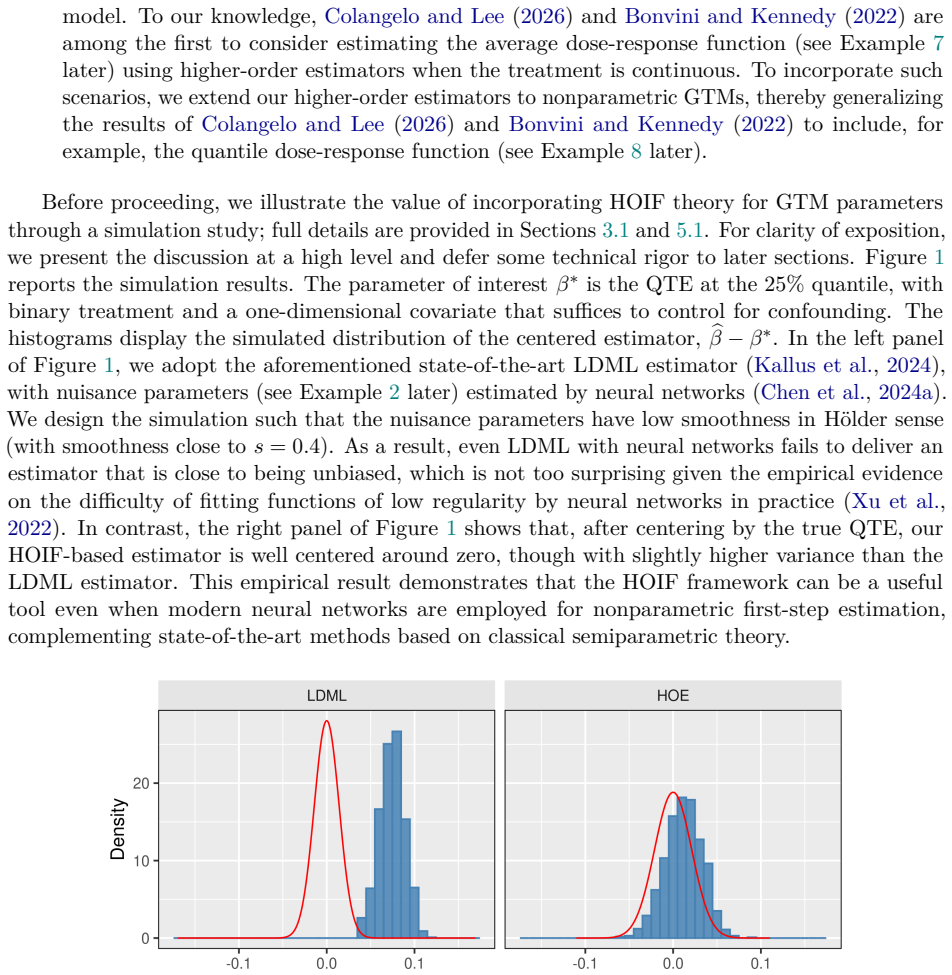
A simulation study or real-data example in which nuisance functions have Holder smoothness below the level needed by first-order methods, yet the higher-order estimator still attains the faster convergence rate.
Figures
read the original abstract
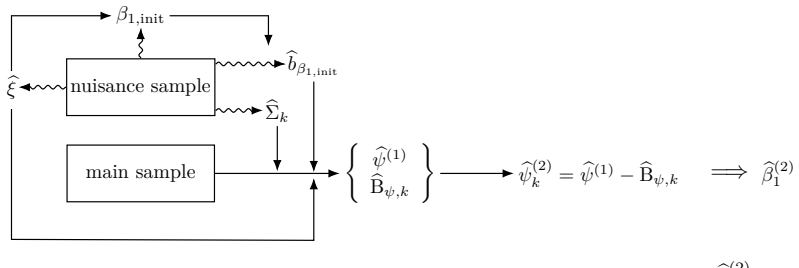
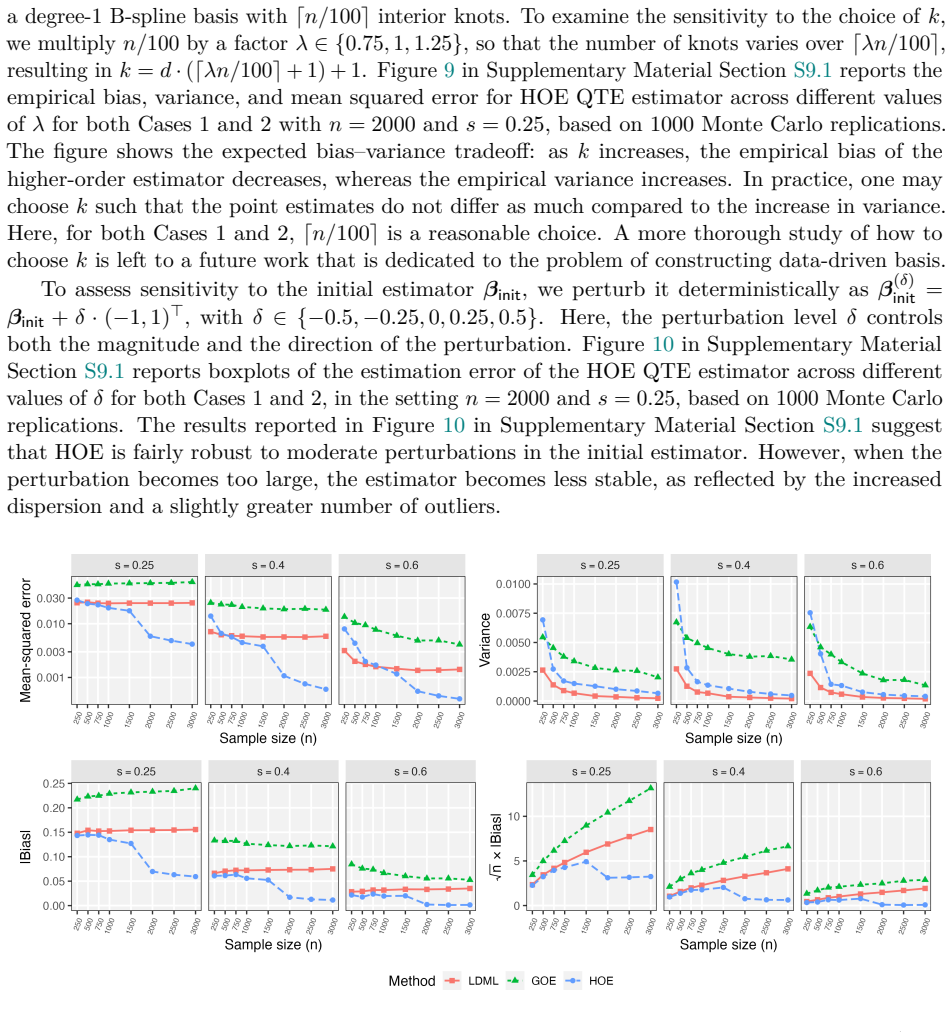
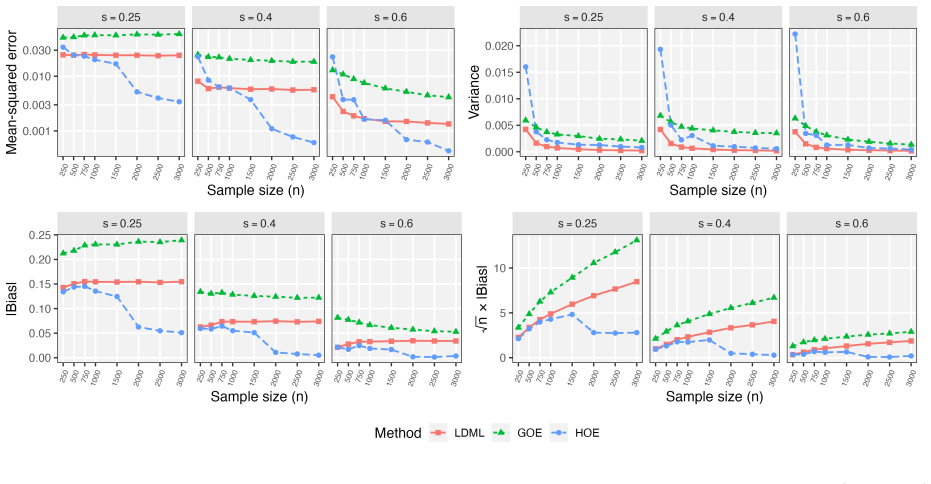
It is now well known that estimators based on influence functions can be sub-optimal in terms of convergence rates in various settings. To address this issue, higher-order influence functions (HOIF) are developed, generalizing the classical semiparametric theory. However, most existing results in this regard focus on treatment effect parameters defined in explicit forms, such as average treatment effects (ATE). In applications, economists are often confronted with tasks of inferring more complex parameters, such as quantile treatment effects (QTE) or effects of complicated treatment regimes/policy. These more complex parameters can often only be implicitly defined as the solution to nonlinear estimating equations, which correspond to M/Z-estimation problems. Our current understanding of these problems is mainly limited to the classical semiparametric theory. Given the foundational role of HOIF for estimating explicit parameters such as ATE, a modest step toward enriching the statistical foundation of econometrics and causal inference is to develop the corresponding higher-order estimators for those more complex parameters. To this end, we consider parameters of a class of non-separable structural models in the econometrics literature and develop a class of higher-order estimators for the target parameters. Statistical properties of these higher-order estimators are derived using recent advances in U-processes theory. Our proposed higher-order estimators relax complexity-reducing assumptions, quantified by Holder smoothness, imposed on the nuisance parameters compared to existing alternative estimators for many important parameters in this class, including QTE and quantile dose-response functions, among others.
Editorial analysis
A structured set of objections, weighed in public.
Referee Report
Summary. The manuscript develops a class of higher-order debiased estimators for implicitly defined parameters arising in non-separable structural models, including quantile treatment effects (QTE) and quantile dose-response functions. These estimators extend the higher-order influence function (HOIF) framework from explicit functionals such as the ATE to M/Z-estimation problems; statistical properties are derived via U-processes theory, with the central claim being that the resulting estimators relax the Hölder smoothness requirements imposed on nuisance functions relative to first-order alternatives.
Significance. If the derivations are correct, the work would meaningfully broaden the applicability of HOIF-based debiasing to a range of economically important parameters that are only implicitly defined. The explicit use of recent U-processes results to handle the implicit case is a technical strength that could yield practical rate improvements under weaker regularity conditions.
minor comments (2)
- [Abstract] The abstract states that statistical properties are derived using U-processes theory but does not indicate the precise order of the influence functions or the form of the U-statistic kernels; adding a short statement of the main convergence-rate theorem (with the relevant section reference) would improve readability.
- Notation for the non-separable structural model and the associated estimating equations should be introduced with an explicit example (e.g., the QTE case) early in the paper to anchor the subsequent general development.
Simulated Author's Rebuttal
We thank the referee for the positive summary, significance assessment, and recommendation of minor revision. No major comments were raised in the report.
Circularity Check
No significant circularity in derivation chain
full rationale
The paper frames its contribution as an extension of higher-order influence functions from explicit functionals (e.g., ATE) to implicitly defined parameters in non-separable structural models via M/Z-estimation and U-processes theory. No equations, derivations, or self-citations are exhibited that reduce the claimed rate improvements or relaxed Holder smoothness assumptions to fitted inputs by construction, self-definitional loops, or load-bearing author citations. The central premise (existence of HOIF representations preserving rate gains) is presented as a technical step forward rather than a re-expression of prior fitted results, rendering the derivation self-contained against external benchmarks.
Axiom & Free-Parameter Ledger
Reference graph
Works this paper leans on
-
[1]
Semiparametric instrumental variable estimation of treatment response models
Alberto Abadie. Semiparametric instrumental variable estimation of treatment response models. Journal of Econometrics, 113 0 (2): 0 231--263, 2003
2003
-
[2]
A unified framework for efficient estimation of general treatment models
Chunrong Ai, Oliver Linton, Kaiji Motegi, and Zheng Zhang. A unified framework for efficient estimation of general treatment models. Quantitative Economics, 12 0 (3): 0 779--816, 2021
2021
-
[3]
Multivalued treatments and decomposition analysis: An application to the WIA program
Wallice Ao, Sebastian Calonico, and Ying-Ying Lee. Multivalued treatments and decomposition analysis: An application to the WIA program. Journal of Business & Economic Statistics, 39 0 (1): 0 358--371, 2021
2021
-
[4]
Bias-aware inference in regularized regression models
Timothy B Armstrong, Michal Koles \'a r, and Soonwoo Kwon. Bias-aware inference in regularized regression models. arXiv preprint arXiv:2012.14823, 2020
-
[5]
Approximate residual balancing: Debiased inference of average treatment effects in high dimensions
Susan Athey, Guido W Imbens, and Stefan Wager. Approximate residual balancing: Debiased inference of average treatment effects in high dimensions. Journal of the Royal Statistical Society Series B: Statistical Methodology, 80 0 (4): 0 597--623, 2018
2018
-
[6]
The fundamental limits of structure-agnostic functional estimation
Sivaraman Balakrishnan, Edward H Kennedy, and Larry Wasserman. The fundamental limits of structure-agnostic functional estimation. Statistical Science, 2026
2026
-
[7]
Some new asymptotic theory for least squares series: Pointwise and uniform results
Alexandre Belloni, Victor Chernozhukov, Denis Chetverikov, and Kengo Kato. Some new asymptotic theory for least squares series: Pointwise and uniform results. Journal of Econometrics, 186 0 (2): 0 345--366, 2015
2015
-
[8]
Does 401 (k) eligibility increase saving? E vidence from propensity score subclassification
Daniel J Benjamin. Does 401 (k) eligibility increase saving? E vidence from propensity score subclassification. Journal of Public Economics, 87 0 (5-6): 0 1259--1290, 2003
2003
-
[9]
A class of U -statistics and asymptotic normality of the number of k -clusters
Rabi N Bhattacharya and Jayanta K Ghosh. A class of U -statistics and asymptotic normality of the number of k -clusters. Journal of Multivariate Analysis, 43 0 (2): 0 300--330, 1992
1992
-
[10]
Efficient and Adaptive Estimation for Semiparametric Models
Peter J Bickel, Chris A J Klaassen, Ya'acov Ritov, and Jon A Wellner. Efficient and Adaptive Estimation for Semiparametric Models. Johns Hopkins Series in the Mathematical Sciences. Springer New York, 1998. ISBN 9780387984735
1998
-
[11]
Higher-Order Neyman Orthogonality in Moment-Condition Models
St \'e phane Bonhomme, Koen Jochmans, Whitney K Newey, and Martin Weidner. Higher-order N eyman orthogonality in moment-condition models. arXiv preprint arXiv:2605.10842, 2026
work page internal anchor Pith review Pith/arXiv arXiv 2026
-
[12]
Fast convergence rates for dose-response estimation
Matteo Bonvini and Edward H Kennedy. Fast convergence rates for dose-response estimation. arXiv preprint arXiv:2207.11825, 2022
work page internal anchor Pith review Pith/arXiv arXiv 2022
-
[13]
Sensitivity analysis for marginal structural models
Matteo Bonvini, Edward Kennedy, Valerie Ventura, and Larry Wasserman. Sensitivity analysis for marginal structural models. arXiv preprint arXiv:2210.04681, 2022
-
[14]
Doubly-robust inference and optimality in structure-agnostic models with smoothness
Matteo Bonvini, Edward H Kennedy, Oliver Dukes, and Sivaraman Balakrishnan. Doubly-robust inference and optimality in structure-agnostic models with smoothness. arXiv preprint arXiv:2405.08525, 2024
-
[15]
Adaptive, rate-optimal hypothesis testing in nonparametric IV models
Christoph Breunig and Xiaohong Chen. Adaptive, rate-optimal hypothesis testing in nonparametric IV models. Econometrica, 92 0 (6): 0 2027--2067, 2024
2027
-
[16]
Augmented balancing weights as linear regression
David Bruns-Smith, Oliver Dukes, Avi Feller, and Elizabeth L Ogburn. Augmented balancing weights as linear regression. Journal of the Royal Statistical Society Series B: Statistical Methodology, 2026
2026
-
[17]
Efficient semiparametric estimation of multi-valued treatment effects under ignorability
Matias D Cattaneo. Efficient semiparametric estimation of multi-valued treatment effects under ignorability. Journal of Econometrics, 155 0 (2): 0 138--154, 2010
2010
-
[18]
Kernel-based semiparametric estimators: Small bandwidth asymptotics and bootstrap consistency
Matias D Cattaneo and Michael Jansson. Kernel-based semiparametric estimators: Small bandwidth asymptotics and bootstrap consistency. Econometrica, 86 0 (3): 0 955--995, 2018
2018
-
[19]
Two-step estimation and inference with possibly many included covariates
Matias D Cattaneo, Michael Jansson, and Xinwei Ma. Two-step estimation and inference with possibly many included covariates. The Review of Economic Studies, 86 0 (3): 0 1095--1122, 2019
2019
-
[20]
Large sample properties of partitioning-based series estimators
Matias D Cattaneo, Max H Farrell, and Yingjie Feng. Large sample properties of partitioning-based series estimators. The Annals of Statistics, 48 0 (3): 0 1718--1741, 2020
2020
-
[21]
Higher-order refinements of small bandwidth asymptotics for density-weighted average derivative estimators
Matias D Cattaneo, Max H Farrell, Michael Jansson, and Ricardo P Masini. Higher-order refinements of small bandwidth asymptotics for density-weighted average derivative estimators. Journal of Econometrics, 252 0 (Part B): 0 105855, 2025
2025
-
[22]
Bootstrap inference in the presence of bias
Giuseppe Cavaliere, S \' lvia Gon c alves, Morten rregaard Nielsen, and Edoardo Zanelli. Bootstrap inference in the presence of bias. Journal of the American Statistical Association, 119 0 (548): 0 2908--2918, 2024
2024
-
[23]
Tail bounds for canonical U -statistics and U -processes with unbounded kernels
Abhishek Chakrabortty and Arun K Kuchibhotla. Tail bounds for canonical U -statistics and U -processes with unbounded kernels. arXiv preprint arXiv:2504.01318, 2025
-
[24]
Local overidentification and efficiency gains in modern causal inference and data combination
Xiaohong Chen and Haitian Xie. Local overidentification and efficiency gains in modern causal inference and data combination. arXiv preprint arXiv:2510.16683, 2025
-
[25]
Estimation of semiparametric models when the criterion function is not smooth
Xiaohong Chen, Oliver Linton, and Ingrid Van Keilegom. Estimation of semiparametric models when the criterion function is not smooth. Econometrica, 71 0 (5): 0 1591--1608, 2003
2003
-
[26]
Causal inference of general treatment effects using neural networks with a diverging number of confounders
Xiaohong Chen, Ying Liu, Shujie Ma, and Zheng Zhang. Causal inference of general treatment effects using neural networks with a diverging number of confounders. Journal of Econometrics, 238 0 (1): 0 105555, 2024 a
2024
-
[27]
Jackknife multiplier bootstrap: Finite sample approximations to the U -process supremum with applications
Xiaohui Chen and Kengo Kato. Jackknife multiplier bootstrap: Finite sample approximations to the U -process supremum with applications. Probability Theory and Related Fields, 176 0 (3): 0 1097--1163, 2020
2020
-
[28]
Method-of-moments inference for GLM s and doubly-robust functionals under proportional asymptotics
Xingyu Chen, Lin Liu, and Rajarshi Mukherjee. Method-of-moments inference for GLM s and doubly-robust functionals under proportional asymptotics. arXiv preprint arXiv:2408.06103, 2024 b
-
[29]
The effects of 401 (k) participation on the wealth distribution: An instrumental quantile regression analysis
Victor Chernozhukov and Christian Hansen. The effects of 401 (k) participation on the wealth distribution: An instrumental quantile regression analysis. Review of Economics and Statistics, 86 0 (3): 0 735--751, 2004
2004
-
[30]
An IV model of quantile treatment effects
Victor Chernozhukov and Christian Hansen. An IV model of quantile treatment effects. Econometrica, 73 0 (1): 0 245--261, 2005
2005
-
[31]
Inference on counterfactual distributions
Victor Chernozhukov, Iv \'a n Fern \'a ndez-Val, and Blaise Melly. Inference on counterfactual distributions. Econometrica, 81 0 (6): 0 2205--2268, 2013
2013
-
[32]
Double/debiased machine learning for treatment and structural parameters
Victor Chernozhukov, Denis Chetverikov, Mert Demirer, Esther Duflo, Christian Hansen, Whitney Newey, and James Robins. Double/debiased machine learning for treatment and structural parameters. The Econometrics Journal, 21 0 (1): 0 C1--C68, 2018
2018
-
[33]
Locally robust semiparametric estimation
Victor Chernozhukov, Juan Carlos Escanciano, Hidehiko Ichimura, Whitney K Newey, and James M Robins. Locally robust semiparametric estimation. Econometrica, 90 0 (4): 0 1501--1535, 2022
2022
-
[34]
Fisher- S chultz lecture: Linear estimation of structural and causal effects for nonseparable panel data
Victor Chernozhukov, Ben Deaner, Ying Gao, Jerry Hausman, and Whitney K Newey. Fisher- S chultz lecture: Linear estimation of structural and causal effects for nonseparable panel data. Technical Report 33325, National Bureau of Economic Research, 2025
2025
-
[35]
Double debiased machine learning nonparametric inference with continuous treatments
Kyle Colangelo and Ying-Ying Lee. Double debiased machine learning nonparametric inference with continuous treatments. Journal of Business & Economic Statistics, 44 0 (1): 0 67--79, 2026
2026
-
[36]
Estimation and inference for distribution functions and quantile functions in treatment effect models
Stephen G Donald and Yu-Chin Hsu. Estimation and inference for distribution functions and quantile functions in treatment effect models. Journal of Econometrics, 178: 0 383--397, 2014
2014
-
[37]
Policy learning with -expected welfare
Yanqin Fan, Yuan Qi, and Gaoqian Xu. Policy learning with -expected welfare. arXiv preprint arXiv:2505.00256, 2025
-
[38]
Efficient semiparametric estimation of quantile treatment effects
Sergio Firpo. Efficient semiparametric estimation of quantile treatment effects. Econometrica, 75 0 (1): 0 259--276, 2007
2007
-
[39]
Uniformly semiparametric efficient estimation of treatment effects with a continuous treatment
Antonio F Galvao and Liang Wang. Uniformly semiparametric efficient estimation of treatment effects with a continuous treatment. Journal of the American Statistical Association, 110 0 (512): 0 1528--1542, 2015
2015
-
[40]
On the role of the propensity score in efficient semiparametric estimation of average treatment effects
Jinyong Hahn. On the role of the propensity score in efficient semiparametric estimation of average treatment effects. Econometrica, 66 0 (2): 0 315--331, 1998
1998
-
[41]
Efficient estimation of average treatment effects using the estimated propensity score
Keisuke Hirano, Guido W Imbens, and Geert Ridder. Efficient estimation of average treatment effects using the estimated propensity score. Econometrica, 71 0 (4): 0 1161--1189, 2003
2003
-
[42]
Sharp structure-agnostic lower bounds for general linear functional estimation
Jikai Jin and Vasilis Syrgkanis. Sharp structure-agnostic lower bounds for general linear functional estimation. arXiv preprint arXiv:2512.17341, 2025
-
[43]
Localized debiased machine learning: Efficient inference on quantile treatment effects and beyond
Nathan Kallus, Xiaojie Mao, and Masatoshi Uehara. Localized debiased machine learning: Efficient inference on quantile treatment effects and beyond. Journal of Machine Learning Research, 25: 0 1--59, 2024
2024
-
[44]
Nonparametric causal effects based on incremental propensity score interventions
Edward H Kennedy. Nonparametric causal effects based on incremental propensity score interventions. Journal of the American Statistical Association, 114 0 (526): 0 645--656, 2019
2019
-
[45]
Non-parametric methods for doubly robust estimation of continuous treatment effects
Edward H Kennedy, Zongming Ma, Matthew D McHugh, and Dylan S Small. Non-parametric methods for doubly robust estimation of continuous treatment effects. Journal of the Royal Statistical Society Series B: Statistical Methodology, 79 0 (4): 0 1229--1245, 2017
2017
-
[46]
Minimax rates for heterogeneous causal effect estimation
Edward H Kennedy, Sivaraman Balakrishnan, James M Robins, and Larry Wasserman. Minimax rates for heterogeneous causal effect estimation. The Annals of Statistics, 52 0 (2): 0 793--816, 2024
2024
-
[47]
Estimation of smooth functionals in high-dimensional models: Bootstrap chains and G aussian approximation
Vladimir Koltchinskii. Estimation of smooth functionals in high-dimensional models: Bootstrap chains and G aussian approximation. The Annals of Statistics, 50 0 (4): 0 2386--2415, 2022
2022
-
[48]
Semiparametric efficient empirical higher order influence function estimators
Lin Liu, Rajarshi Mukherjee, Whitney K Newey, and James M Robins. Semiparametric efficient empirical higher order influence function estimators. arXiv preprint arXiv:1705.07577, 2017
-
[49]
Assumption-lean falsification tests of rate double-robustness of double-machine-learning estimators
Lin Liu, Rajarshi Mukherjee, and James M Robins. Assumption-lean falsification tests of rate double-robustness of double-machine-learning estimators. Journal of Econometrics, 240 0 (2): 0 105500, 2024
2024
-
[50]
Statistical treatment rules for heterogeneous populations
Charles F Manski. Statistical treatment rules for heterogeneous populations. Econometrica, 72 0 (4): 0 1221--1246, 2004
2004
-
[51]
Nuisance function tuning and sample splitting for optimal doubly robust estimation
Sean McGrath and Rajarshi Mukherjee. Nuisance function tuning and sample splitting for optimal doubly robust estimation. arXiv preprint arXiv:2212.14857, 2024
-
[52]
Semiparametric efficiency bounds
Whitney K Newey. Semiparametric efficiency bounds. Journal of Applied Econometrics, 5 0 (2): 0 99--135, 1990
1990
-
[53]
Large sample estimation and hypothesis testing
Whitney K Newey and Daniel McFadden. Large sample estimation and hypothesis testing. Handbook of Econometrics, 4: 0 2111--2245, 1994
1994
-
[54]
Cross-Fitting and Fast Remainder Rates for Semiparametric Estimation
Whitney K Newey and James M Robins. Cross-fitting and fast remainder rates for semiparametric estimation. arXiv preprint arXiv:1801.09138, 2018
work page internal anchor Pith review Pith/arXiv arXiv 2018
-
[55]
Twicing kernels and a small bias property of semiparametric estimators
Whitney K Newey, Fushing Hsieh, and James M Robins. Twicing kernels and a small bias property of semiparametric estimators. Econometrica, 72 0 (3): 0 947--962, 2004
2004
-
[56]
Dynamic semiparametric models for expected shortfall (and value-at-risk)
Andrew J Patton, Johanna F Ziegel, and Rui Chen. Dynamic semiparametric models for expected shortfall (and value-at-risk). Journal of Econometrics, 211 0 (2): 0 388--413, 2019
2019
-
[57]
Quantile treatment effects in the presence of covariates
David Powell. Quantile treatment effects in the presence of covariates. Review of Economics and Statistics, 102 0 (5): 0 994--1005, 2020
2020
-
[58]
Causal etiology of the research of J ames M
Thomas S Richardson and Andrea Rotnitzky. Causal etiology of the research of J ames M . R obins. Statistical Science, 29 0 (4): 0 459--484, 2014
2014
-
[59]
Comment: Performance of double-robust estimators when ``inverse probability'' weights are highly variable
James Robins, Mariela Sued, Quanhong Lei-Gomez, and Andrea Rotnitzky. Comment: Performance of double-robust estimators when ``inverse probability'' weights are highly variable. Statistical Science, 22 0 (4): 0 544--559, 2007
2007
-
[60]
Higher order influence functions and minimax estimation of nonlinear functionals
James Robins, Lingling Li, Eric Tchetgen Tchetgen, and Aad van der Vaart. Higher order influence functions and minimax estimation of nonlinear functionals. In Probability and Statistics: Essays in Honor of David A. Freedman, pages 335--421. Institute of Mathematical Statistics, 2008
2008
-
[61]
Semiparametric minimax rates
James Robins, Eric Tchetgen Tchetgen , Lingling Li, and Aad van der Vaart . Semiparametric minimax rates. Electronic Journal of Statistics, 3: 0 1305--1321, 2009
2009
-
[62]
Technical Report: Higher Order Influence Functions and Minimax Estimation of Nonlinear Functionals
James Robins, Lingling Li, Eric Tchetgen Tchetgen , and Aad van der Vaart . Technical report: Higher order influence functions and minimax estimation of nonlinear functionals. arXiv preprint arXiv:1601.05820, 2016
work page internal anchor Pith review Pith/arXiv arXiv 2016
-
[63]
Toward a curse of dimensionality appropriate ( CODA ) asymptotic theory for semi-parametric models
James M Robins and Ya'acov Ritov. Toward a curse of dimensionality appropriate ( CODA ) asymptotic theory for semi-parametric models. Statistics in Medicine, 16 0 (3): 0 285--319, 1997
1997
-
[64]
Estimation of regression coefficients when some regressors are not always observed
James M Robins, Andrea Rotnitzky, and Lue Ping Zhao. Estimation of regression coefficients when some regressors are not always observed. Journal of the American Statistical Association, 89 0 (427): 0 846--866, 1994
1994
-
[65]
Marginal structural models and causal inference in epidemiology
James M Robins, Miguel A Hern \'a n, and Babette Brumback. Marginal structural models and causal inference in epidemiology. Epidemiology, 11 0 (5): 0 550--560, 2000
2000
-
[66]
Minimax estimation of a functional on a structured high-dimensional model ( C orrected version)
James M Robins, Lingling Li, Lin Liu, Rajarshi Mukherjee, Eric Tchetgen Tchetgen, and Aad van der Vaart. Minimax estimation of a functional on a structured high-dimensional model ( C orrected version). arXiv preprint arXiv:1512.02174, 2023
-
[67]
Characterization of parameters with a mixed bias property
Andrea Rotnitzky, Ezequiel Smucler, and James M Robins. Characterization of parameters with a mixed bias property. Biometrika, 108 0 (1): 0 231--238, 2021
2021
-
[68]
On asymptotically efficient estimation in semiparametric models
Anton Schick. On asymptotically efficient estimation in semiparametric models. The Annals of Statistics, 14 0 (3): 0 1139--1151, 1986
1986
-
[69]
The hardness of conditional independence testing and the generalised covariance measure
Rajen D Shah and Jonas Peters. The hardness of conditional independence testing and the generalised covariance measure. The Annals of Statistics, 48 0 (3): 0 1514--1538, 2020
2020
-
[70]
Optimal global rates of convergence for nonparametric regression
Charles J Stone. Optimal global rates of convergence for nonparametric regression. The Annals of Statistics, 10 0 (4): 0 1040--1053, 1982
1982
-
[71]
Non-separable models with high-dimensional data
Liangjun Su, Takuya Ura, and Yichong Zhang. Non-separable models with high-dimensional data. Journal of Econometrics, 212 0 (2): 0 646--677, 2019
2019
-
[72]
On doubly robust estimation in a semiparametric odds ratio model
Eric J Tchetgen Tchetgen, James M Robins, and Andrea Rotnitzky. On doubly robust estimation in a semiparametric odds ratio model. Biometrika, 97 0 (1): 0 171--180, 2010
2010
-
[73]
Weak Convergence and Empirical Processes: with Applications to Statistics
Aad W van der Vaart and Jon Wellner. Weak Convergence and Empirical Processes: with Applications to Statistics. Springer Science & Business Media, 2023
2023
-
[74]
Deep M ed: Semiparametric causal mediation analysis with debiased deep learning
Siqi Xu, Lin Liu, and Zhonghua Liu. Deep M ed: Semiparametric causal mediation analysis with debiased deep learning. In Proceedings of the 36th International Conference on Neural Information Processing Systems, pages 28238--28251, 2022
2022
-
[75]
Perturbed double machine learning: Nonstandard inference beyond the parametric length
Mengchu Zheng, Matteo Bonvini, and Zijian Guo. Perturbed double machine learning: Nonstandard inference beyond the parametric length. arXiv preprint arXiv:2511.01222, 2025
-
[76]
Efficient estimation of models with conditional moment restrictions containing unknown functions
Chunrong Ai and Xiaohong Chen. Efficient estimation of models with conditional moment restrictions containing unknown functions. Econometrica, 71 0 (6): 0 1795--1843, 2003
2003
-
[77]
Empirical process methods in econometrics
Donald WK Andrews. Empirical process methods in econometrics. Handbook of Econometrics, 4: 0 2247--2294, 1994
1994
-
[78]
Matrix chaos inequalities and chaos of combinatorial type
Afonso S Bandeira, Kevin Lucca, Petar Nizic-Nikolac, and Ramon van Handel. Matrix chaos inequalities and chaos of combinatorial type. In Proceedings of the 57th Annual ACM Symposium on Theory of Computing, pages 795--805, 2025
2025
-
[79]
Introduction to Empirical Processes and Semiparametric Inference
Michael R Kosorok. Introduction to Empirical Processes and Semiparametric Inference. Springer, 2008
2008
-
[80]
When is it worthwhile to jackknife? B reaking the quadratic barrier for Z -estimators
Licong Lin, Fangzhou Su, Wenlong Mou, Peng Ding, and Martin Wainwright. When is it worthwhile to jackknife? B reaking the quadratic barrier for Z -estimators. arXiv preprint arXiv:2411.02909, 2024
discussion (0)
Sign in with ORCID, Apple, or X to comment. Anyone can read and Pith papers without signing in.