REVIEW 2 major objections 1 minor
Competition, Persuasion, and Search
T0 review · 2 major / 1 minor · reviewed 2026-05-23 · grok-4.3
Pith's one-line read When search costs are high, competition among information brokers raises the agent's payoff but lowers total surplus relative to monopoly.
desk verdict The paper characterizes equilibrium payoffs in a spot-contract search model and finds competition reduces total surplus only at high search costs via a repeated-games extension to stopping problems. read the letter →
The pith
A machine-rendered reading of the paper's core claim, the machinery that carries it, and where it could break.
The reading
What carries the argument
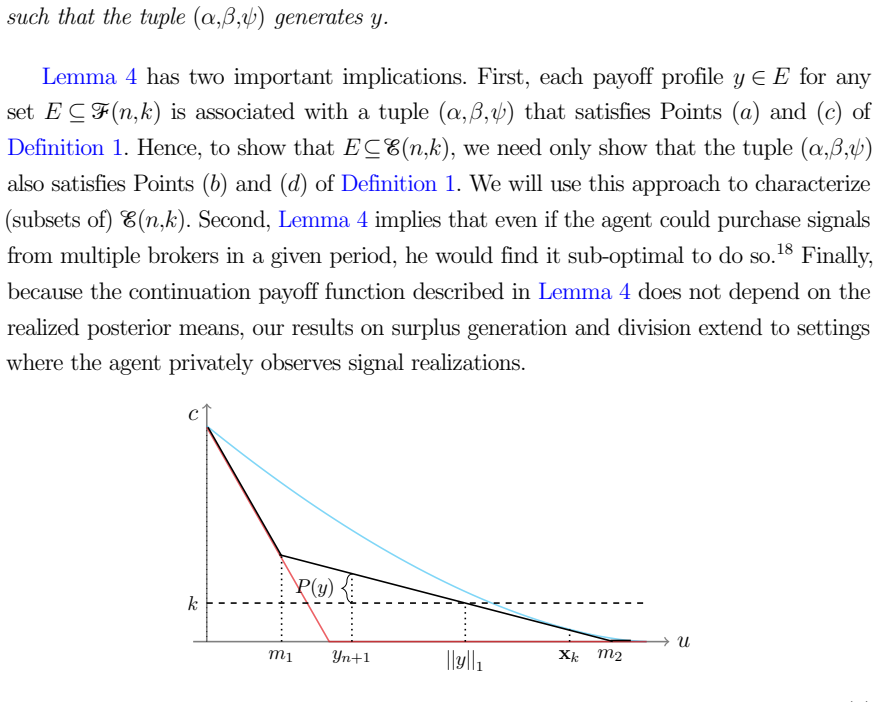
The equilibrium payoff set characterized as a function of the number of competing brokers under spot-contract commitment.
What would settle it
An observation or calibrated simulation in which, under high search costs, increasing the number of brokers leaves total surplus unchanged or higher than under monopoly.
Extended reading notes
Core claim
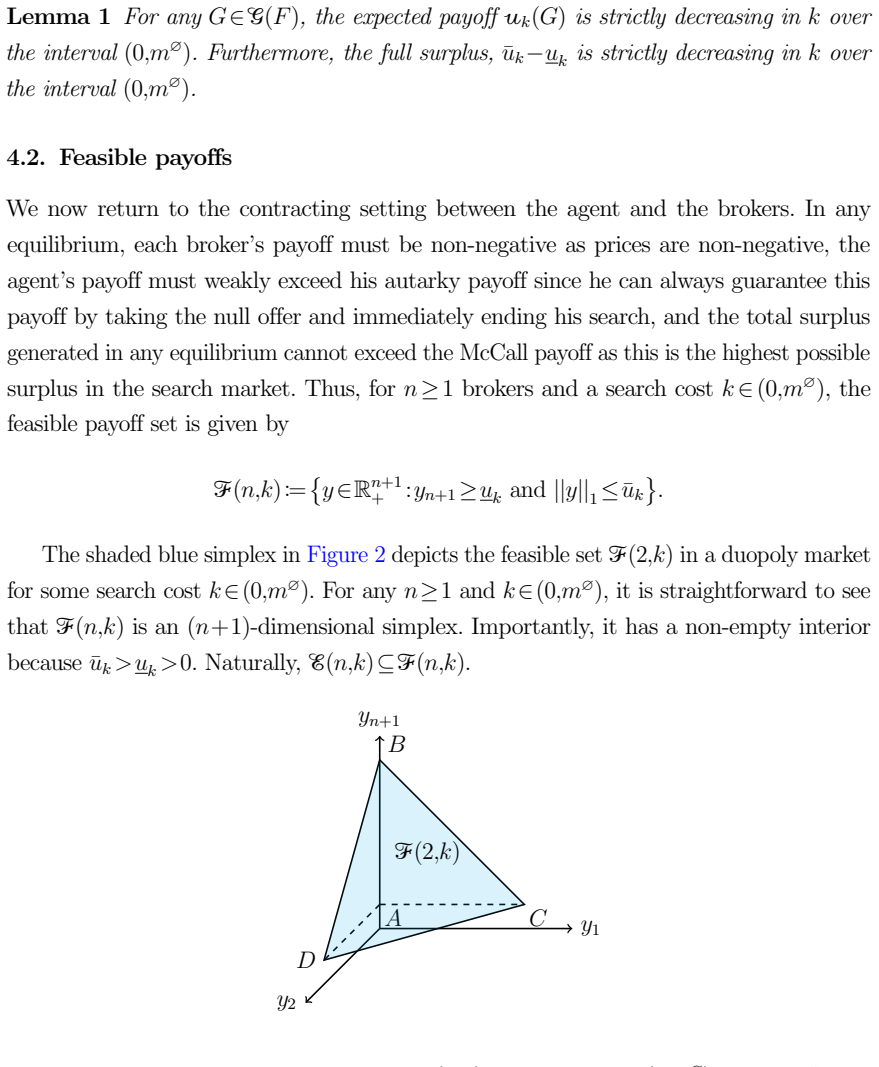
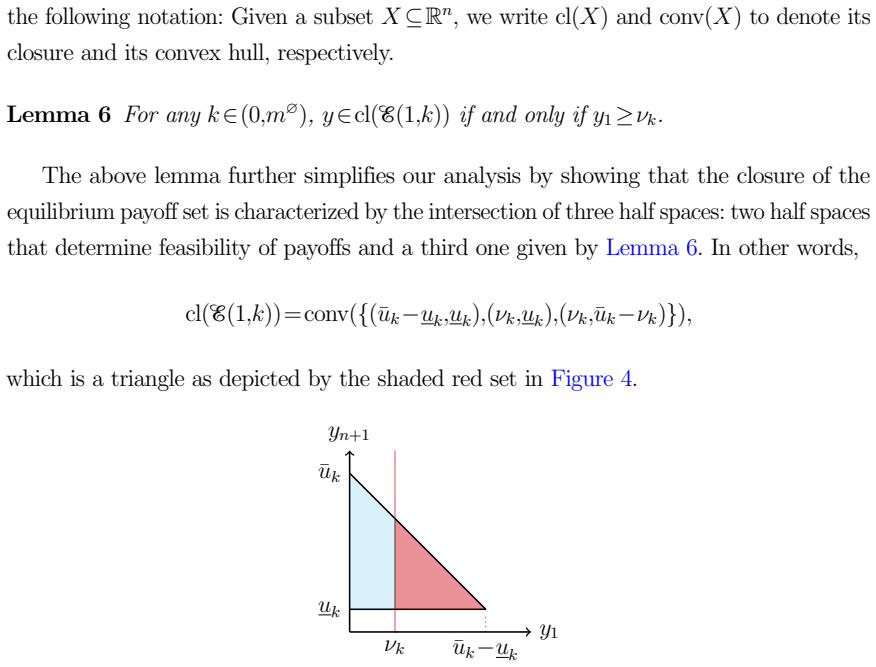
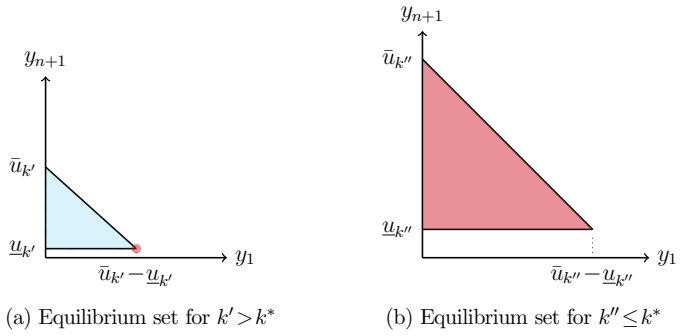
In this sequential search environment the equilibrium payoff set depends on market structure. Low search costs render the number of brokers irrelevant to both total surplus and its division. High search costs produce the opposite pattern: competition raises the agent's payoff and reduces total surplus relative to monopoly. The model therefore implies that breaking up an information monopolist can benefit the searcher while lowering overall welfare.
Load-bearing premise
Brokers can commit only to spot contracts and cannot enter long-term agreements with the agent.
Editorial analysis
A structured set of objections, weighed in public.
Referee Report
Summary. The paper studies competition among information brokers in a sequential search model where an agent purchases signals to learn good quality. Brokers design and price signals but commit only to spot contracts. The equilibrium payoff set is characterized as a function of the number of brokers. With low search costs, market structure affects neither surplus creation nor division. With high search costs, competition benefits the searching agent but reduces total surplus relative to monopoly. The analysis yields a regulatory implication and extends repeated-games methods to endogenous stopping problems.
Significance. If the central comparative static holds, the result is significant for information-market regulation by identifying a trade-off between agent welfare and total surplus under high search costs. The methodological extension of repeated-game techniques to stopping problems is a potential strength if the payoff-set characterization is shown to be robust.
major comments (2)
- [Abstract and main characterization result] Abstract (headline result on surplus effects): the claim that competition reduces total surplus only when search costs are high requires that the equilibrium payoff set, obtained via the spot-contract repeated-game extension, varies with broker count in a cost-dependent manner. The manuscript must explicitly verify that endogenous stopping does not invalidate this by shortening expected duration and tightening continuation values under high costs; without a uniform bound or adjusted folk-theorem-style result that survives cost-dependent horizons, the comparative static on total surplus need not follow from the spot-contract assumption.
- [Conclusion / regulatory implication] The regulatory lesson (breaking up an information monopolist): this conclusion is load-bearing on the high-cost regime result and therefore requires a direct check that the reported surplus reduction is not an artifact of unadjusted continuation values when search costs alter interaction length.
minor comments (1)
- [Main text] Clarify notation for 'total surplus' versus 'agent payoff' when moving from the low-cost to high-cost regime to avoid ambiguity in the comparative statics.
Simulated Author's Rebuttal
We thank the referee for the constructive report and for highlighting the need to confirm robustness of the payoff-set characterization to endogenous stopping. We address each major comment below.
read point-by-point responses
-
Referee: [Abstract and main characterization result] Abstract (headline result on surplus effects): the claim that competition reduces total surplus only when search costs are high requires that the equilibrium payoff set, obtained via the spot-contract repeated-game extension, varies with broker count in a cost-dependent manner. The manuscript must explicitly verify that endogenous stopping does not invalidate this by shortening expected duration and tightening continuation values under high costs; without a uniform bound or adjusted folk-theorem-style result that survives cost-dependent horizons, the comparative static on total surplus need not follow from the spot-contract assumption.
Authors: The equilibrium payoff set is obtained by extending the repeated-game approach directly to the endogenous stopping problem, so the continuation values and feasible payoffs already embed the cost-dependent horizon. Under high search costs the agent stops earlier, which tightens the effective discount factor, but the characterization theorem explicitly solves for the feasible set conditional on this endogenous length; the resulting comparative static (monopoly yields higher total surplus than competition only when costs are high) therefore incorporates the horizon effect rather than assuming a fixed horizon. A uniform bound is not required because the result is stated for each fixed cost level, with the stopping rule solved as part of the equilibrium. We will add a short clarifying paragraph after the main characterization theorem that restates this point and references the relevant proposition on endogenous stopping. revision: partial
-
Referee: [Conclusion / regulatory implication] The regulatory lesson (breaking up an information monopolist): this conclusion is load-bearing on the high-cost regime result and therefore requires a direct check that the reported surplus reduction is not an artifact of unadjusted continuation values when search costs alter interaction length.
Authors: The regulatory implication is derived from the same cost-dependent payoff set characterized in the body of the paper; because the continuation values are computed under the endogenous stopping rule for each cost regime, the surplus comparison between monopoly and competition already reflects any shortening of the interaction under high costs. No separate adjustment is needed. We will insert a brief sentence in the conclusion that cross-references the characterization result to make this explicit. revision: partial
Circularity Check
No circularity: derivation is self-contained game-theoretic extension
full rationale
The paper derives equilibrium payoff sets and comparative statics on surplus from the primitives of sequential search, spot contracts, and an explicit extension of repeated-game methods to endogenous stopping. No quoted equations reduce a claimed prediction to a fitted parameter, self-definition, or load-bearing self-citation; the central results on competition and total surplus under high vs. low search costs are obtained directly from the constructed equilibrium characterization without circular reduction to inputs.
Assumptions & free parameters
assumptions (2)
- domain assumption Agents are rational and brokers are profit-maximizing with commitment limited to spot contracts.
- domain assumption Search occurs sequentially with learning via purchased signals.
Cite this review
Pith. "Pith review of Competition, Persuasion, and Search." pith.science (2026). https://pith.science/paper/JN7LDFTH
@misc{pith2026241111183,
  author       = {Pith},
  title        = {Pith review of: Competition, Persuasion, and Search},
  year         = {2026},
  howpublished = {\url{https://pith.science/paper/JN7LDFTH}},
  note         = {Machine review of arXiv:2411.11183}
}
read the original abstract
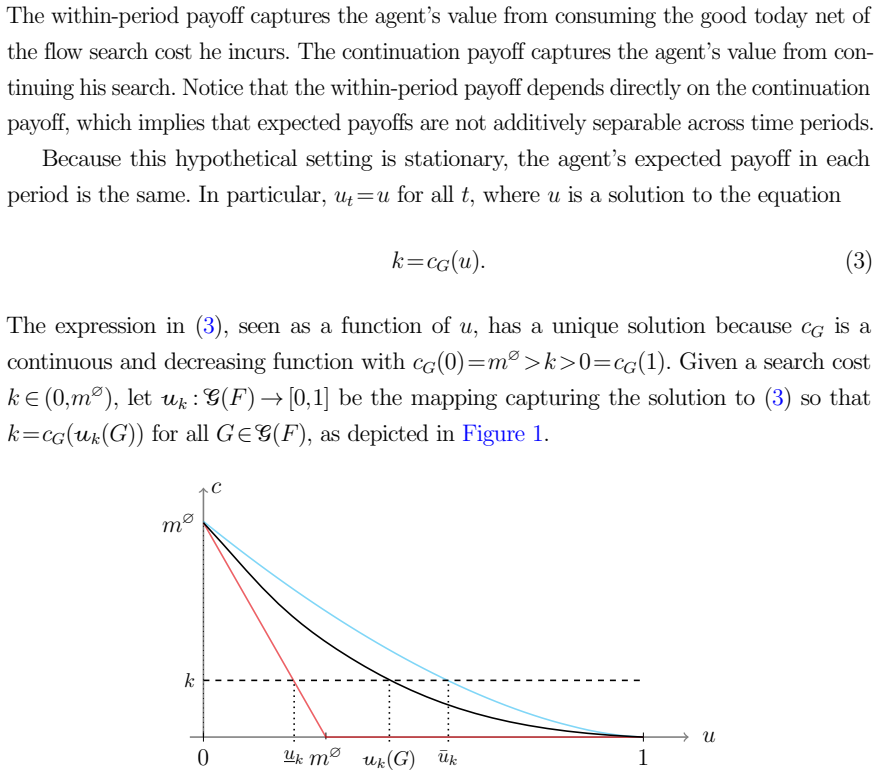
How does competition in markets for information affect the creation and division of surplus? We study this question in a search environment in which an agent searches sequentially for a high-quality good and learns about the quality of sampled goods by repeatedly purchasing signals from profit-maximizing information brokers. Brokers design and price signals but can commit only to spot contracts. We characterize the equilibrium payoff set as a function of the market structure -- the number of competing brokers. When search costs are low, market structure affects neither surplus generation nor its division. When costs are high, however, competition benefits the agent but reduces total surplus relative to monopoly. Methodologically, we extend repeated-games theory to stopping problems such as sequential search.
Figures
Figures from the paper (5 more)
Reviewed May 23, 2026 · model on record in the stance chip above.
Discussion (0). Continue with ORCID to comment.