How optimistic inflow forecasts distort dispatch, prices, and contracts in hydro-dominated power systems: evidence from Brazil
Pith reviewed 2026-07-02 03:32 UTC · model grok-4.3
The pith
Optimistic inflow forecasts reduce water values and increase early hydro discharge relative to the unbiased optimum.
A machine-rendered reading of the paper's core claim, the machinery that carries it, and where it could break.
Core claim
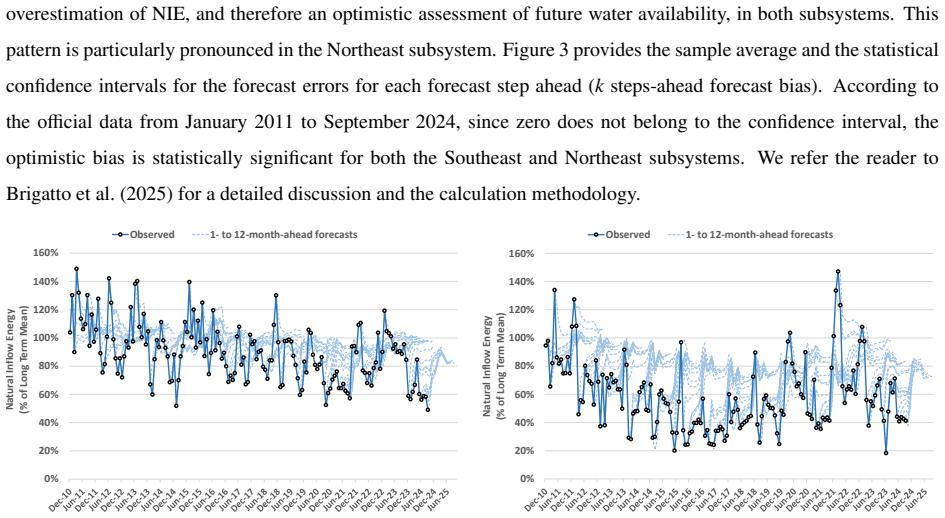
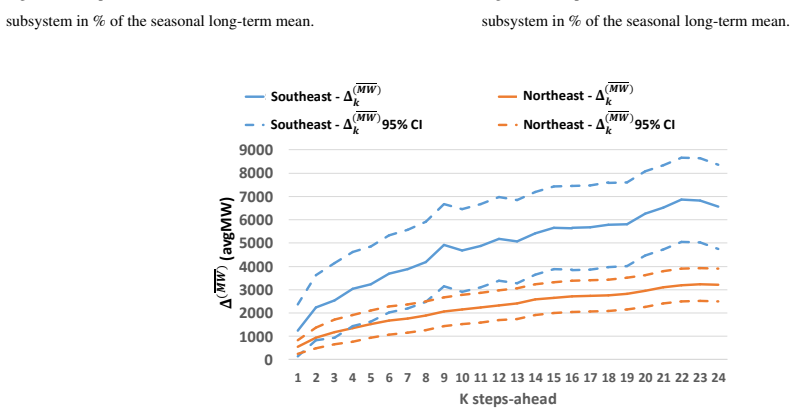
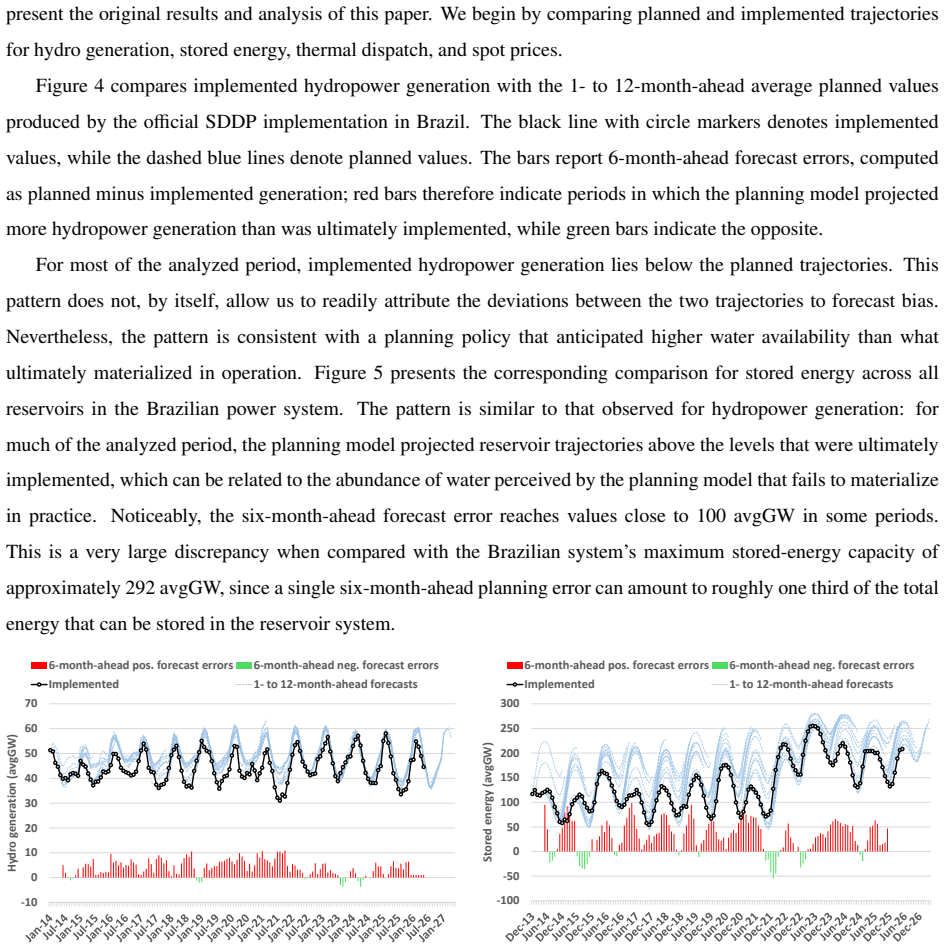
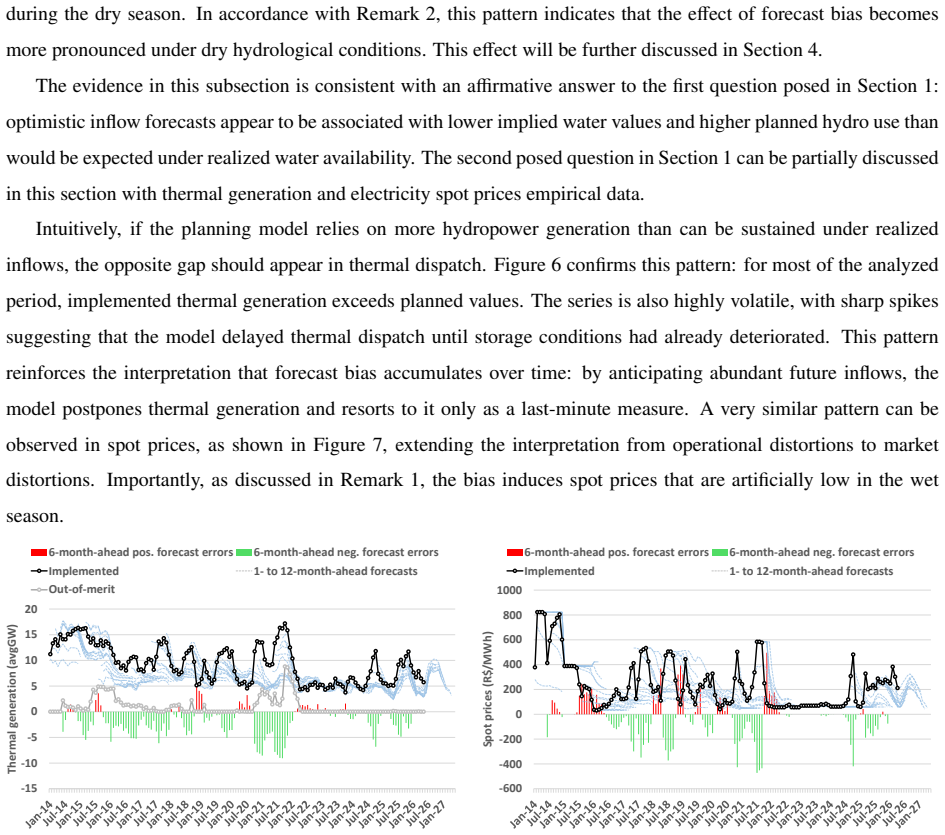
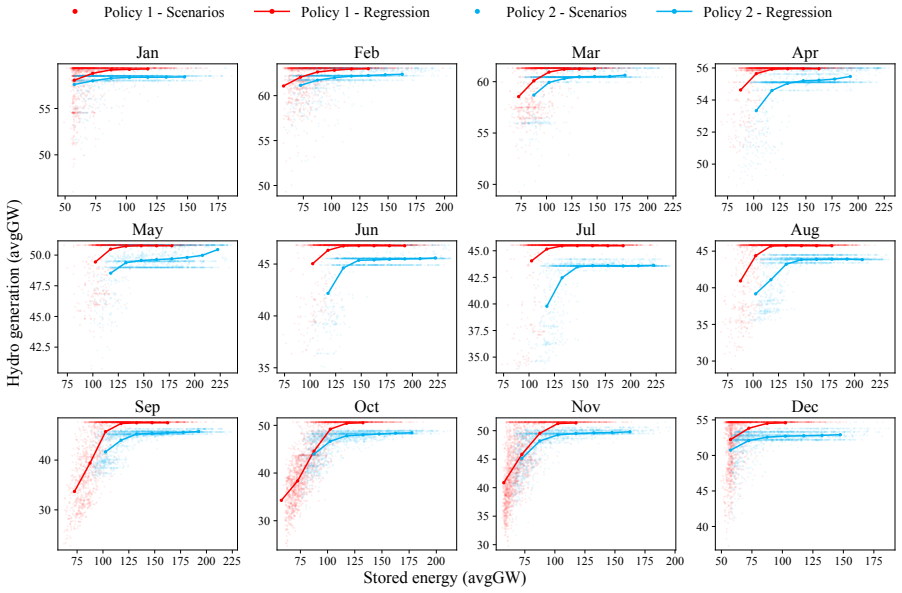
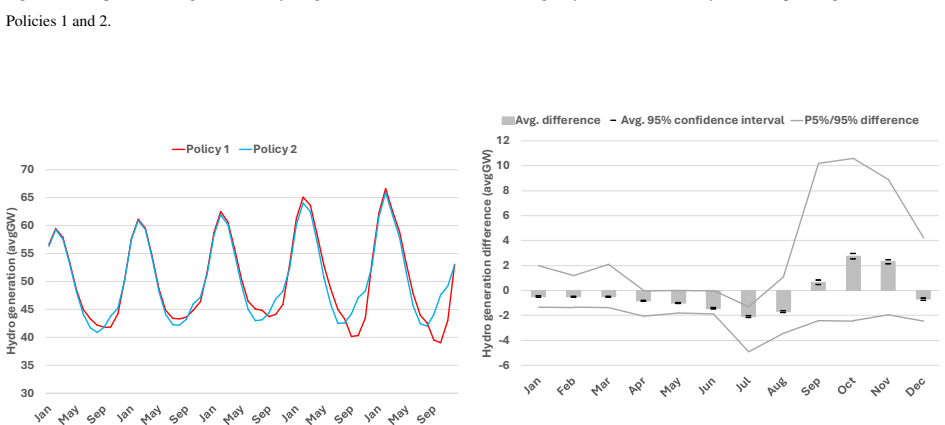
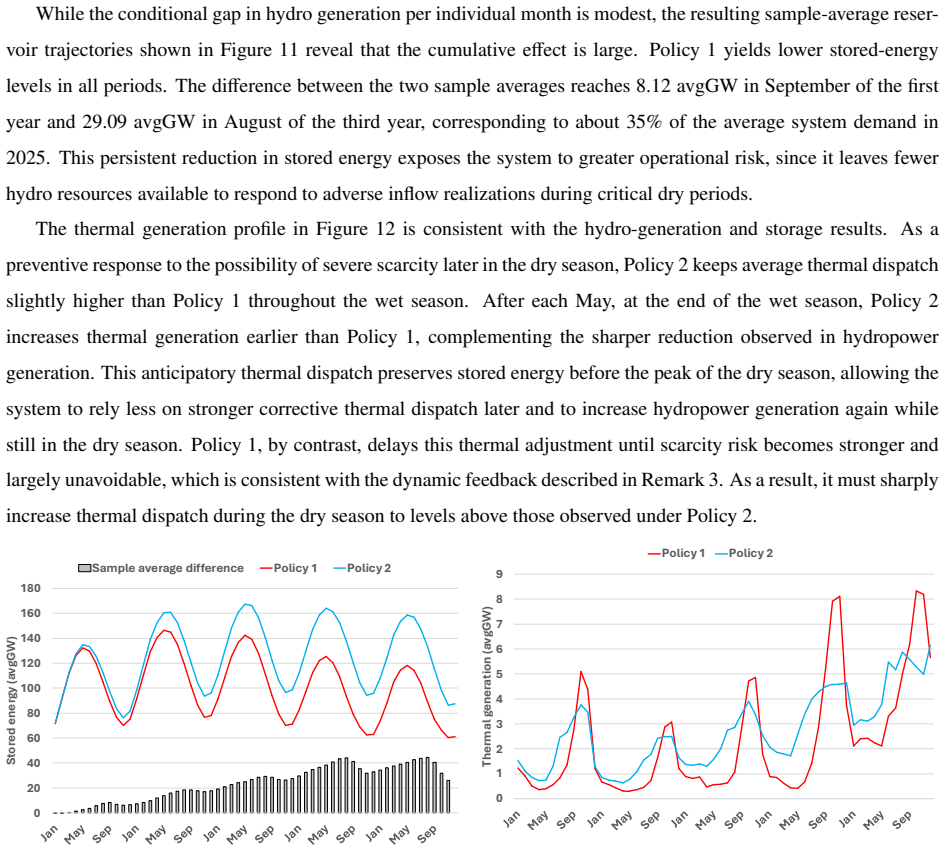
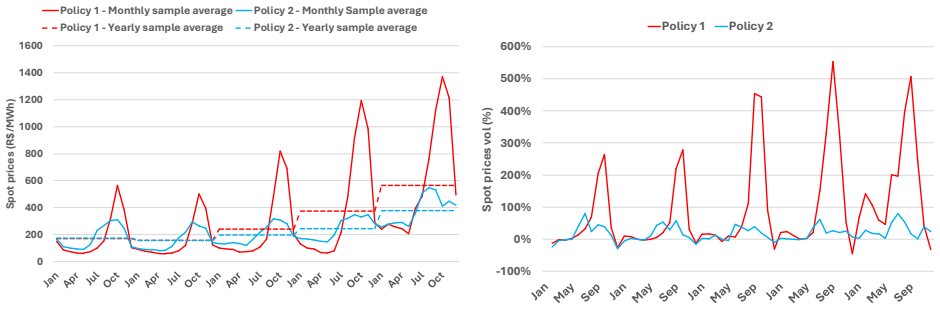
For a stylized hydrothermal model, optimistic bias weakly reduces water values and weakly increases first-stage hydro discharge relative to the unbiased optimum, thereby lowering reservoir storage and postponing thermal commitment. Using official Brazilian data, empirical patterns align with this mechanism. In SDDP experiments, the policy trained under biased forecasts produces lower reservoir levels, delayed dry-season thermal dispatch, sharper spot-price peaks, higher reliability risk, and higher expected operating costs when both policies are evaluated under bias-corrected inflows. These distortions increase price-quantity risk for hydropower producers and reduce their willingness to cont
What carries the argument
Stylized hydrothermal model providing analytical comparison of water values and first-stage discharge under biased versus unbiased forecasts, together with SDDP policies trained separately on biased and bias-corrected inflow processes.
If this is right
- Lower reservoir storage levels across the planning horizon.
- Postponed commitment of thermal generation during the dry season.
- Sharper peaks in spot prices and elevated reliability risk.
- Higher expected operating costs when evaluated under unbiased inflows.
- Increased price-quantity risk that reduces hydropower producers' willingness to contract.
Where Pith is reading between the lines
- The same mechanism could operate in other hydro-dominated markets that rely on similar planning models for price formation and contract benchmarks.
- Routine bias audits of official inflow forecasts might be needed to prevent systematic under-valuation of stored water.
- Market designs that use model-derived prices for settlement could embed persistent distortions if the underlying forecasts remain optimistic.
Load-bearing premise
The stylized model captures the essential dynamics of the Brazilian system and the SDDP bias-correction step accurately isolates the effect of forecast optimism without other real-system confounding factors.
What would settle it
Running the same SDDP experiment with actual historical inflow sequences instead of bias-corrected ones and checking whether the cost and storage gaps between the two policies disappear or reverse.
Figures
read the original abstract
Centralized hydrothermal planning models determine generation schedules and electricity spot prices based on inflow forecasts in audited-cost power systems, such as those prevalent in Latin America, and provide operational benchmarks and decision support in hydro-dominated competitive electricity markets. Consequently, biased forecasts can propagate directly into both operational decisions and market outcomes. This paper studies how persistent optimistic inflow-forecast bias propagates through the Brazilian hydrothermal power system and market. For a stylized hydrothermal model, we show analytically that optimistic bias weakly reduces water values and weakly increases first-stage hydro discharge relative to the unbiased optimum, thereby lowering reservoir storage and postponing thermal commitment. Using official Brazilian planning and operational data, we provide empirical evidence consistent with this mechanism. We then conduct a controlled SDDP experiment to compare policies trained under biased and bias-corrected inflow-forecast processes, evaluating both under the same bias-corrected inflow scenarios. The policy trained under biased forecasts produces lower reservoir levels, delayed dry-season thermal dispatch, sharper spot-price peaks, higher reliability risk, and higher expected operating costs. Finally, we show that these distortions increase the price-quantity risk for hydropower producers and reduce their willingness to contract. The results indicate that inflow-forecast bias is not merely a statistical forecasting problem, but can be a source of operational inefficiency, reliability risk, and distorted market incentives in hydro-dominated power systems. We argue that the insights and policy implications drawn in this paper may be relevant beyond Brazil to other hydro-dominated systems and electricity markets that are increasingly reliant on energy storage.
Editorial analysis
A structured set of objections, weighed in public.
Referee Report
Summary. The paper examines how persistent optimistic bias in inflow forecasts affects operational dispatch, spot prices, reliability, and contracting incentives in hydro-dominated systems, with Brazil as the empirical focus. Analytically, in a stylized hydrothermal model, optimistic bias is shown to weakly lower water values and raise first-stage hydro discharge relative to the unbiased optimum, reducing storage and delaying thermal commitment. Empirical patterns in official Brazilian planning and operational data are presented as consistent with this mechanism. A controlled SDDP experiment then compares policies trained on biased versus bias-corrected inflow processes (both evaluated on the corrected scenarios), finding that the biased policy yields lower reservoir levels, delayed dry-season thermal dispatch, sharper price peaks, elevated reliability risk, and higher expected operating costs; these distortions are further linked to increased price-quantity risk for hydro producers and reduced contracting willingness. The authors conclude that forecast bias constitutes a source of inefficiency and market distortion beyond a pure statistical problem.
Significance. If the central results hold, the work identifies a policy-relevant mechanism linking forecast bias to operational inefficiency, reliability exposure, and distorted market incentives in hydrothermal systems. The analytical derivation (parameter-free directional results on water values and discharge) and the use of official Brazilian data plus a controlled simulation provide concrete strengths. The findings have potential applicability to other hydro-dominated markets that rely on storage and centralized planning models.
major comments (2)
- [§5] §5 (SDDP experiment): The headline result—that the biased policy produces lower reservoirs, delayed thermal dispatch, sharper prices, higher risk, and higher expected cost when both policies are evaluated on bias-corrected scenarios—depends on the bias-correction procedure recovering a distribution that matches the true unbiased inflow process. The manuscript must detail the exact correction method, any validation against empirical moments or spatial/temporal correlations in Brazilian inflow data, and sensitivity checks; without this, the measured distortions could be artifacts of residual bias or introduced variance rather than the optimistic bias itself.
- [§3 and §5] §3 (analytical model) and §5 (translation to SDDP): The stylized hydrothermal model yields a clean directional result on water values and first-stage discharge, but the multi-reservoir, multi-stage SDDP used for Brazil includes binding transmission and reservoir constraints that can alter marginal-value propagation. The manuscript should explicitly discuss or test whether the qualitative effects survive these constraints; otherwise the link between the analytical claim and the SDDP outcomes remains an unverified extrapolation.
minor comments (2)
- [§3] The abstract and introduction refer to “weakly reduces” and “weakly increases”; the precise definition of “weakly” (e.g., in terms of monotonicity or inequality direction) should be stated once in the analytical section for clarity.
- [§5] Figure captions for the SDDP results should explicitly state the number of scenarios, the inflow correction method applied, and whether confidence bands reflect only sampling variability or also parameter uncertainty.
Simulated Author's Rebuttal
We thank the referee for these constructive comments on the robustness of the SDDP experiment and the connection between the analytical model and the numerical results. We address each major comment below.
read point-by-point responses
-
Referee: [§5] §5 (SDDP experiment): The headline result—that the biased policy produces lower reservoirs, delayed thermal dispatch, sharper prices, higher risk, and higher expected cost when both policies are evaluated on bias-corrected scenarios—depends on the bias-correction procedure recovering a distribution that matches the true unbiased inflow process. The manuscript must detail the exact correction method, any validation against empirical moments or spatial/temporal correlations in Brazilian inflow data, and sensitivity checks; without this, the measured distortions could be artifacts of residual bias or introduced variance rather than the optimistic bias itself.
Authors: We agree that greater transparency on the bias-correction step is needed to rule out artifacts. In the revised manuscript we will expand §5 (and add an appendix) with: (i) the precise statistical procedure used to generate the bias-corrected inflow scenarios, (ii) direct comparisons of first and second moments as well as spatial and temporal correlation matrices against both the original forecasts and historical Brazilian inflow records, and (iii) sensitivity runs that vary the strength of the correction and re-estimate the policy-performance gaps. These additions will confirm that the reported distortions are driven by the optimistic bias itself. revision: yes
-
Referee: [§3 and §5] §3 (analytical model) and §5 (translation to SDDP): The stylized hydrothermal model yields a clean directional result on water values and first-stage discharge, but the multi-reservoir, multi-stage SDDP used for Brazil includes binding transmission and reservoir constraints that can alter marginal-value propagation. The manuscript should explicitly discuss or test whether the qualitative effects survive these constraints; otherwise the link between the analytical claim and the SDDP outcomes remains an unverified extrapolation.
Authors: We recognize that binding transmission and reservoir constraints in the full Brazilian SDDP could, in principle, modify marginal-value propagation relative to the single-reservoir stylized model. In the revision we will insert a new paragraph in §5 that discusses how these constraints affect water-value dynamics in the Brazilian topology. We will also report a targeted sensitivity exercise in which selected transmission limits are relaxed within a computationally tractable sub-system and the directional effects on reservoir levels, thermal commitment, and costs are re-checked. This will provide an explicit test of whether the qualitative mechanism survives the richer constraint set. revision: yes
Circularity Check
No significant circularity: analytical derivation, external data, and controlled simulation remain independent
full rationale
The paper's core claims rest on an explicit analytical derivation for a stylized hydrothermal model showing weak effects of optimistic bias on water values and discharge, empirical consistency checks against official Brazilian planning data, and a controlled SDDP experiment that trains separate policies on biased versus bias-corrected inflow processes before evaluating both on identical bias-corrected scenarios. No quoted step equates a claimed prediction to its own fitted inputs by construction, renames a known result, or relies on a self-citation chain whose validity is presupposed; the bias-correction step is an explicit experimental control rather than a fitted parameter whose output is then relabeled a prediction. The derivation chain is therefore self-contained against external benchmarks.
Axiom & Free-Parameter Ledger
free parameters (1)
- optimistic bias level
axioms (2)
- domain assumption The stylized hydrothermal model accurately represents key dynamics of the real system.
- domain assumption The SDDP policies can be trained and evaluated separately under biased and corrected inflow processes.
Reference graph
Works this paper leans on
-
[1]
, year 2021
author Antweiler, W. , year 2021 . title Microeconomic models of electricity storage: Price forecasting, arbitrage limits, curtailment insurance, and transmission line utilization . journal Energy Economics volume 101 , pages 105390
2021
-
[2]
, author Kristiansen, T
author Botterud, A. , author Kristiansen, T. , author Ilic, M.D. , year 2010 . title The relationship between spot and futures prices in the nord pool electricity market . journal Energy Economics volume 32 , pages 967--978
2010
-
[3]
, author Vandenberghe, L
author Boyd, S. , author Vandenberghe, L. , year 2004 . title Convex optimization . publisher Cambridge university press
2004
-
[4]
, year 2026
author Brigatto, A. , year 2026 . title Dataset for the paper ``How Optimistic Inflow Forecasts Distort Dispatch, Prices, and Contracts in Hydro-Dominated Power Systems: Evidence from Brazil'' . howpublished https://github.com/LAMPSPUC/EffectsOfBiasedForecasts . note GitHub repository
2026
-
[5]
author Brigatto, A. , author Street, A. , author Fernandes, C. , author Vallad \ a o, D. , author Bodin, G. , author Garcia, J.D. , year 2025 . title Assessing the optimistic bias in the natural inflow forecasts: A call for model monitoring in brazil . journal IEEE Transactions on Energy Markets, Policy and Regulation volume 3 , pages 463--473 . :10.1109/...
-
[6]
, author Dorsey, J
author Butters, R.A. , author Dorsey, J. , author Gowrisankaran, G. , year 2025 . title Soaking up the sun: Battery investment, renewable energy, and market equilibrium . journal Econometrica volume 93 , pages 891--927
2025
-
[7]
, author Cunha, A.P.M.d.A
author Cuartas, L.A. , author Cunha, A.P.M.d.A. , author Alves, J.A. , author Parra, L.M.P. , author Deusdará-Leal, K. , author Costa, L.C.O. , author Molina, R.D. , author Amore, D. , author Broedel, E. , author Seluchi, M.E. , author Cunningham, C. , author Alvalá, R.C.d.S. , author Marengo, J.A. , year 2022 . title Recent hydrological droughts in brazi...
2022
-
[8]
, author Philpott, A.B
author De Matos, V.L. , author Philpott, A.B. , author Finardi, E.C. , year 2015 . title Improving the performance of stochastic dual dynamic programming . journal Journal of Computational and Applied Mathematics volume 290 , pages 196--208
2015
-
[9]
, author Rebennack, S
author F \"u llner, C. , author Rebennack, S. , year 2025 . title Stochastic dual dynamic programming and its variants: A review . journal SIAM Review volume 67 , pages 415--539
2025
-
[10]
, author Kohler, M
author Gy \"o rfi, L. , author Kohler, M. , author Krzy \.z ak, A. , author Walk, H. , year 2002 . title A Distribution-Free Theory of Nonparametric Regression . Springer Series in Statistics , publisher Springer , address New York, NY
2002
-
[11]
title Hydroelectricity
author International Energy Agency , year 2025 a. title Hydroelectricity . https://www.iea.org/energy-system/renewables/hydroelectricity. note last updated 18 February 2025
2025
-
[12]
title World Energy Outlook 2025
author International Energy Agency , year 2025 b. title World Energy Outlook 2025 . type Technical Report . International Energy Agency. https://www.iea.org/reports/world-energy-outlook-2025
2025
-
[13]
title 2025 World Hydropower Outlook
author International Hydropower Association , year 2025 . title 2025 World Hydropower Outlook . type Report . International Hydropower Association. https://www.hydropower.org/publications/2025-world-hydropower-outlook
2025
-
[14]
, author De Matos, V.L
author Homem-de Mello, T. , author De Matos, V.L. , author Finardi, E.C. , year 2011 . title Sampling strategies and stopping criteria for stochastic dual dynamic programming: a case study in long-term hydrothermal scheduling . journal Energy Systems volume 2 , pages 1--31
2011
-
[15]
, author Bistline, J.E
author Merrick, J.H. , author Bistline, J.E. , author Blanford, G.J. , year 2024 . title On representation of energy storage in electricity planning models . journal Energy Economics volume 136 , pages 107675
2024
-
[16]
title Monitoring Bulletin of the Brazilian Electric Power System: Special Edition -- 2025 Consolidation
author Ministry of Mines and Energy , year 2026 . title Monitoring Bulletin of the Brazilian Electric Power System: Special Edition -- 2025 Consolidation . type Technical Report . National Secretariat for Electric Energy. https://www.gov.br/mme/pt-br/assuntos/secretarias/secretaria-nacional-energia-eletrica/publicacoes/boletim-anual-de-monitoramento-do-si...
2026
-
[17]
, author Favereau, M
author Navarro, A. , author Favereau, M. , author Lorca, \'A . , author Olivares, D. , author Negrete-Pincetic, M. , year 2024 . title Medium-term stochastic hydrothermal scheduling with short-term operational effects for large-scale power and water networks . journal Applied energy volume 358 , pages 122554
2024
-
[18]
, author McLeod, A.I
author Noakes, D.J. , author McLeod, A.I. , author Hipel, K.W. , year 1985 . title Forecasting monthly riverflow time series . journal International Journal of Forecasting volume 1 , pages 179--190
1985
-
[19]
title Monthly Bulletin on Operation Costs and Valuation of Operational Security: January 2022
author Operador Nacional do Sistema El \'e trico , year 2022 . title Monthly Bulletin on Operation Costs and Valuation of Operational Security: January 2022 . type Technical report . Operador Nacional do Sistema El \'e trico (ONS). note Original title: Boletim Mensal de Custos da Opera c \ a o e Valora c \ a o da Seguran c a da Opera c \ a o: Janeiro/2022
2022
-
[20]
, author Oliveira, G
author Pereira, M. , author Oliveira, G. , author Costa, C. , author Kelman, J. , year 1984 . title Stochastic streamflow models for hydroelectric systems . journal Water Resources Research volume 20 , pages 379--390
1984
-
[21]
, author Pinto, L
author Pereira, M. , author Pinto, L. , year 1991 . title Multi-stage stochastic optimization applied to energy planning . journal Mathematical Programming: Series A and B volume 52 , pages 359--375
1991
-
[22]
, author Guan, Z
author Philpott, A.B. , author Guan, Z. , year 2008 . title On the convergence of stochastic dual dynamic programming and related methods . journal Operations Research Letters volume 36 , pages 450--455
2008
-
[23]
, author Vespucci, M.T
author Pisciella, P. , author Vespucci, M.T. , author Bertocchi, M. , author Zigrino, S. , year 2016 . title A time consistent risk averse three-stage stochastic mixed integer optimization model for power generation capacity expansion . journal Energy Economics volume 53 , pages 203--211
2016
-
[24]
title Aprimoramento do Mecanismo de Forma c \ a o de Pre c o de Curto Prazo do Setor El\' e trico Brasileiro (Projeto META II)
author PSR , author C\^ a mara de Comercializa c \ a o de Energia El\' e trica (CCEE) , year 2025 . title Aprimoramento do Mecanismo de Forma c \ a o de Pre c o de Curto Prazo do Setor El\' e trico Brasileiro (Projeto META II) . type Technical Report . C\^ a mara de Comercializa c \ a o de Energia El\' e trica (CCEE). https://www.meta2formacaodepreco.com....
2025
-
[25]
, author Mu \ n oz, F.D
author Ram \' rez-Sagner, G. , author Mu \ n oz, F.D. , year 2019 . title The effect of head-sensitive hydropower approximations on investments and operations in planning models for policy analysis . journal Renewable and Sustainable Energy Reviews volume 105 , pages 38--47
2019
-
[26]
author Rangel, L.F. , year 2008 . title Competition policy and regulation in hydro-dominated electricity markets . journal Energy Policy volume 36 , pages 1292--1302 . :10.1016/j.enpol.2007.12.005
-
[27]
, year 1997
author Rockafellar, R.T. , year 1997 . title Convex analysis . volume volume 28 . publisher Princeton university press
1997
-
[28]
, author Street, A
author Rosemberg, A.W. , author Street, A. , author Garcia, J.D. , author Vallad \ a o, D.M. , author Silva, T. , author Dowson, O. , year 2021 . title Assessing the cost of network simplifications in long-term hydrothermal dispatch planning models . journal IEEE Transactions on Sustainable Energy volume 13 , pages 196--206
2021
-
[29]
, author Kittner, N
author Shan, R. , author Kittner, N. , year 2024 . title Allocation of policy resources for energy storage development considering the inflation reduction act . journal Energy Policy volume 184 , pages 113861
2024
-
[30]
, author Reagan, J
author Shan, R. , author Reagan, J. , author Castellanos, S. , author Kurtz, S. , author Kittner, N. , year 2022 . title Evaluating emerging long-duration energy storage technologies . journal Renewable and Sustainable Energy Reviews volume 159 , pages 112240
2022
-
[31]
, year 2011
author Shapiro, A. , year 2011 . title Analysis of stochastic dual dynamic programming method . journal European Journal of Operational Research volume 209 , pages 63--72
2011
-
[32]
, author Rego, E.E
author Silva, W.N. , author Rego, E.E. , author Vieira, G.G. , author Louren c o, L.F. , author Salles, M.B. , year 2025 . title An overview of brazil's electricity market: Planning, dispatch models, pricing, and modernization . journal Utilities Policy volume 96 , pages 102007
2025
-
[33]
, year 2010
author Street, A. , year 2010 . title On the conditional value-at-risk probability-dependent utility function . journal Theory and Decision volume 68 , pages 49--68
2010
-
[34]
, year 2024
author Street, A. , year 2024 . title Model governance for the brazilian power sector . howpublished https://www.lamps.ind.puc-rio.br/en/noticia/modelgovernance/ . note Accessed: 2024-09-01
2024
-
[35]
, author Shaffer, B
author Tabari, M. , author Shaffer, B. , year 2020 . title Paying for performance: The role of policy in energy storage deployment . journal Energy Economics volume 92 , pages 104949
2020
-
[36]
, year 2009
author Wolak, F.A. , year 2009 . title Report on Market Performance and Market Monitoring in the Colombian Electricity Supply Industry . type Market Monitoring Report . Comisi\' o n de Regulaci\' o n de Energ\' i a y Gas (CREG). https://web.stanford.edu/group/fwolak/cgi-bin/
2009
-
[37]
author Wolfgang, O. , author Haugstad, A. , author Mo, B. , author Gjelsvik, A. , author Wangensteen, I. , author Doorman, G. , year 2009 . title Hydro reservoir handling in Norway before and after deregulation . journal Energy volume 34 , pages 1642--1651 . :10.1016/j.energy.2009.07.025
-
[38]
, author Flores, A
author Águila, D. , author Flores, A. , author Moreno, R. , author Mujica, C. , author Negrete, M. , author Olivares, D. , author Palma, R. , author Suazo, C. , year 2024 . title Recomendaciones regulatorias para la descarbonizacion de la matriz electrica chilena . journal Instituto de Sistemas Complejos de Ingenieria
2024
discussion (0)
Sign in with ORCID, Apple, or X to comment. Anyone can read and Pith papers without signing in.