UI-LIC: A Unified Framework for Evaluating Learned Image Compression Models
Pith reviewed 2026-06-26 01:49 UTC · model grok-4.3
The pith
UI-LIC supplies a single open-source controller and GUI that runs six learned image compression models under identical settings and compares them directly to traditional video encoders at matched bitrates.
A machine-rendered reading of the paper's core claim, the machinery that carries it, and where it could break.
Core claim
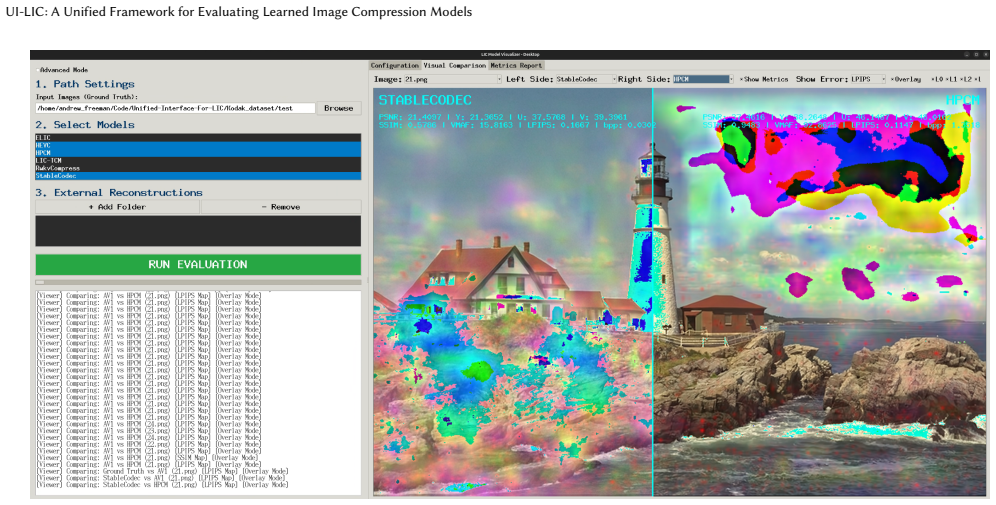
UI-LIC is an open-source framework that integrates six learned image compression models with a centralized controller enforcing shared configuration parameters for training, inference, and analysis, together with a GUI that equalizes bitrates against traditional video intra-frame encoders and computes standard quality metrics plus an interactive image analyzer with heatmap overlays.
What carries the argument
Centralized controller that applies shared configuration parameters across models combined with a GUI that enforces bitrate equalization during side-by-side evaluation.
If this is right
- Direct numerical comparisons of the six included models become possible without researchers reimplementing each one.
- Learned models can be tested against traditional encoders under strictly matched bitrate conditions in the same run.
- Interactive heatmap analysis of quality differences is available without additional custom code.
- A single installation and command sequence replaces separate setups for training, inference, and metric collection.
Where Pith is reading between the lines
- Other research groups could add new models to the controller with relatively little extra effort once the shared-parameter pattern is established.
- Standardized evaluation might reduce the chance that apparent gains come from differences in testing procedures rather than model changes.
- The framework could be extended to video sequences or additional perceptual metrics without changing the core controller logic.
Load-bearing premise
That forcing models to share one set of configuration files and one GUI will remove the differences that arise from each model's original separate software stack and training choices.
What would settle it
Running the identical model and input images once in its original code and once inside UI-LIC and obtaining different PSNR or VMAF values at the same target bitrate.
Figures
read the original abstract
The evaluation and comparison of Learned Image Compression (LIC) systems is complicated by heterogeneous software stacks, varying training conditions, and divergent evaluation methodologies. To address these challenges, we introduce UI-LIC, an open-source software framework for evaluating LIC models. We integrate six high-performance LIC models, and provide a centralized controller for performing training, inference, and analysis with shared configuration parameters. Our GUI program offers a streamlined interface to evaluate these models alongside traditional video intra-frame encoders, equalizing the compressed bitrates and calculating quality metrics such as PSNR, SSIM, VMAF, and LPIPS. Finally, we provide an interactive image analyzer with configurable quality heatmap overlays. Our framework lowers barriers to further LIC research, unlocking comparative metrics and subjective analysis with a single setup command. The open-source software is released under the MIT license and is available at github.com/BaylorMultimediaLab/UI-LIC.
Editorial analysis
A structured set of objections, weighed in public.
Referee Report
Summary. The manuscript introduces UI-LIC, an open-source framework for evaluating Learned Image Compression (LIC) models that addresses challenges from heterogeneous software stacks and methodologies. It integrates six high-performance LIC models and provides a centralized controller for training, inference, and analysis using shared configuration parameters. A GUI enables evaluation of these models alongside traditional video intra-frame encoders, with bitrate equalization and computation of metrics including PSNR, SSIM, VMAF, and LPIPS. An interactive image analyzer with configurable quality heatmap overlays is included. The software is released under the MIT license at a specified GitHub repository.
Significance. If the centralized controller and shared parameters successfully standardize training, inference, and bitrate equalization across the integrated models, the framework would facilitate fair comparative studies in the LIC field and lower setup barriers for researchers. The open-source release and integration of multiple models represent concrete strengths that could support reproducible evaluations.
major comments (1)
- [Abstract] Abstract: The claim that the centralized controller performs training, inference, and analysis with shared configuration parameters while equalizing compressed bitrates across six heterogeneous LIC models (plus traditional codecs) is not supported by any description of mechanisms for handling model-specific architectures, loss functions, or optimization differences, nor by validation experiments or side-by-side comparisons to independent runs. This directly undermines the central assertion of unified evaluation conditions.
Simulated Author's Rebuttal
We thank the referee for the constructive feedback and for recognizing the potential of UI-LIC to facilitate fair comparisons. We address the single major comment below.
read point-by-point responses
-
Referee: [Abstract] Abstract: The claim that the centralized controller performs training, inference, and analysis with shared configuration parameters while equalizing compressed bitrates across six heterogeneous LIC models (plus traditional codecs) is not supported by any description of mechanisms for handling model-specific architectures, loss functions, or optimization differences, nor by validation experiments or side-by-side comparisons to independent runs. This directly undermines the central assertion of unified evaluation conditions.
Authors: We agree that the abstract claim requires stronger textual support. Section 3 of the manuscript outlines the centralized controller and shared configuration schema, with adapter layers that translate common parameters (e.g., target bitrate, training epochs, evaluation metrics) into each model's native format. Bitrate equalization is performed post-inference via a common rate-control module that adjusts quantization parameters or lambda values uniformly. However, the manuscript does not yet include explicit pseudocode, adapter details, or validation experiments comparing unified runs against independent executions. We will add a new subsection (3.4) describing these mechanisms, including a table of model-specific mappings and side-by-side PSNR/bitrate results from both modes. This revision will directly substantiate the abstract. revision: yes
Circularity Check
No circularity: software framework description with no derivations or predictions
full rationale
The paper introduces UI-LIC as an open-source evaluation framework integrating six LIC models with a centralized controller and GUI for training, inference, analysis, and metric computation. No mathematical derivations, equations, fitted parameters, predictions, or first-principles results are present; the content is purely descriptive of software components, configuration sharing, and provided tools. The central claim of equalizing conditions across models is an assertion about the framework's design rather than a derived quantity that reduces to its own inputs by construction. No self-citations, ansatzes, or uniqueness theorems are invoked in a load-bearing way. This matches the default expectation of no significant circularity for non-derivational papers.
Axiom & Free-Parameter Ledger
Reference graph
Works this paper leans on
-
[1]
True Color Kodak Images
2010. True Color Kodak Images. https://r0k.us/graphics/kodak/
2010
-
[2]
2024. FFmpeg. https://ffmpeg.org/
2024
-
[3]
Baylor Multimedia Lab. 2026. Unified Interface For Learned Image Compression (LIC). https://github.com/BaylorMultimediaLab/UI-LIC. Open-source software repository, accessed 28 May 2026
2026
-
[4]
Donghui Feng, Zhengxue Cheng, Shen Wang, Ronghua Wu, Hongwei Hu, Guo Lu, and Li Song. 2025. Linear Attention Modeling for Learned Image Compression. InIEEE/CVF Conference on Computer Vision and Pattern Recognition (CVPR). 1–10. https://arxiv.org/abs/2502.05741
arXiv 2025
-
[5]
Jingning Han, Bohan Li, Debargha Mukherjee, Ching-Han Chiang, Adrian Grange, Cheng Chen, Hui Su, Sarah Parker, Sai Deng, Urvang Joshi, Yue Chen, Yunqing Wang, Paul Wilkins, Yaowu Xu, and James Bankoski. 2021. A Technical Overview of AV1. doi:10.48550/arXiv.2008.06091 arXiv:2008.06091 [eess]
-
[6]
Dailan He, Ziming Yang, Weikun Peng, Rui Ma, Hongwei Qin, and Yan Wang
-
[7]
InProceedings of the IEEE/CVF Conference on Computer Vision and Pattern Recognition
Elic: Efficient learned image compression with unevenly grouped space- channel contextual adaptive coding. InProceedings of the IEEE/CVF Conference on Computer Vision and Pattern Recognition. 5718–5727
-
[8]
Zhaoyang Jia, Bin Li, Jiahao Li, Wenxuan Xie, Linfeng Qi, Houqiang Li, and Yan Lu. 2025. Towards Practical Real-Time Neural Video Compression. InIEEE/CVF UI-LIC: A Unified Framework for Evaluating Learned Image Compression Models Conference on Computer Vision and Pattern Recognition, CVPR 2025, Nashville, TN, USA, June 11-25, 2024
2025
-
[9]
Wei Jiang. 2022. Unofficial ELIC. https://github.com/JiangWeibeta/ELIC
2022
-
[10]
H. Kalva. 2006. The H.264 Video Coding Standard.IEEE Multimedia13, 4 (Oct. 2006), 86–90. doi:10.1109/MMUL.2006.93
-
[11]
Yuqi Li, Haotian Zhang, Li Li, and Dong Liu. 2025. Learned Image Compression with Hierarchical Progressive Context Modeling.arXiv preprint arXiv:2507.19125 (2025)
arXiv 2025
-
[12]
Zhi Li, Anne Aaron, Ioannis Katsavounidis, Anush Krishna Moorthy, and Megha Manohara. 2016. Toward a Practical Perceptual Video Quality Metric. Net- flix Technology Blog. https://techblog.netflix.com/2016/06/toward-practical- perceptual-video.html Introduces Video Multi-Method Assessment Fusion (VMAF)
2016
-
[13]
Jinming Liu, Heming Sun, and Jiro Katto. 2023. Learned Image Compression with Mixed Transformer-CNN Architectures. InProceedings of the IEEE/CVF Conference on Computer Vision and Pattern Recognition. 1–10
2023
-
[14]
Sullivan, Jens-Rainer Ohm, Woo-Jin Han, and Thomas Wiegand
Gary J. Sullivan, Jens-Rainer Ohm, Woo-Jin Han, and Thomas Wiegand. 2012. Overview of the High Efficiency Video Coding (HEVC) Standard.IEEE Transac- tions on Circuits and Systems for Video Technology22, 12 (Dec. 2012), 1649–1668. doi:10.1109/TCSVT.2012.2221191
-
[15]
IEEE Transactions on Image Processing 13(4), 600–612 (Apr 2004)
Zhou Wang, A.C. Bovik, H.R. Sheikh, and E.P. Simoncelli. 2004. Image quality assessment: from error visibility to structural similarity.IEEE Transactions on Image Processing13, 4 (April 2004), 600–612. doi:10.1109/TIP.2003.819861
-
[16]
Sullivan, Gisle Bjontegaard, and Ajay Luthra
Thomas Wiegand, Gary J. Sullivan, Gisle Bjontegaard, and Ajay Luthra. 2003. Overview of the H.264/AVC Video Coding Standard.IEEE Transactions on Circuits and Systems for Video Technology13, 7 (2003), 560–576. doi:10.1109/TCSVT.2003. 815165
-
[17]
Efros, Eli Shechtman, and Oliver Wang
Richard Zhang, Phillip Isola, Alexei A. Efros, Eli Shechtman, and Oliver Wang
-
[18]
InProceedings of the IEEE Conference on Computer Vision and Pattern Recognition
The Unreasonable Effectiveness of Deep Features as a Perceptual Metric. InProceedings of the IEEE Conference on Computer Vision and Pattern Recognition. 586–595
-
[19]
Tianyu Zhang, Xin Luo, Li Li, and Dong Liu. 2025. StableCodec: Taming One- Step Diffusion for Extreme Image Compression. InProceedings of the IEEE/CVF International Conference on Computer Vision (ICCV). 17379–17389
2025
discussion (0)
Sign in with ORCID, Apple, or X to comment. Anyone can read and Pith papers without signing in.