REVIEW 2 major objections 3 minor 28 references
Geometric Kernels of Proper Maps Between Non-Compact Surfaces
T0 review · 2 major / 3 minor · reviewed 2026-08-05 · deepseek-v4-flash
Pith's one-line read For proper degree-one maps between non-compact surfaces, injectivity on loops at every end forces either a geometric kernel or a proper homotopy to a homeomorphism.
desk verdict New cπ1 machinery and a solid cutoff theorem, but the advertised Theorem 3 overstates what is proved and two examples flatly contradict themselves. read the letter →
The pith
A machine-rendered reading of the paper's core claim, the machinery that carries it, and where it could break.
The reading
What carries the argument
The proper fundamental group of an end, based at a proper ray, records loops supported arbitrarily far out along that ray; its conjugacy-class version, cπ1, removes dependence on the chosen ray by encoding sequences of loops converging to the end up to free homotopy near the end. The load-bearing mechanism is the cut-off argument: end-wise π1-injectivity forces the map to behave as a finite-sheeted covering outside a compact set, after which the compact degree-one classification decides whether an essential handle is collapsed.
What would settle it
A counterexample would be a proper degree-one map between oriented non-compact surfaces with injective induced map on ends and injective proper-π1 map along each end, but with no geometric kernel and not properly homotopic to a homeomorphism. The paper notes that the existence of a non-π1-injective, non-π1-surjective prime-degree self-map of the one-ended infinite-genus surface would produce such a counterexample by lifting, so constructing or ruling out such a map would settle the sharpness of the theorem.
Extended reading notes
Core claim
The paper's central result is a cut-off theorem: for a proper map between non-compact surfaces, if for every end of the domain there is a representative ray along which the induced map on proper fundamental groups is injective, then the map can be properly homotoped so that, outside compact submanifolds, it is a finite-sheeted covering on each unbounded component. For a degree-one map whose induced map on ends is injective, this covering behavior has degree one, hence is a homeomorphism outside a compact piece. The compact piece then falls under the classical classification of degree-one maps between compact surfaces, whose two outcomes are a homeomorphism or a collapse of an essential compa
Load-bearing premise
The load-bearing premise is that, at every end of the domain, there is some ray escaping to that end along which every nontrivial sequence of loops far out remains nontrivial after mapping; if this fails at even one end, the covering behavior at infinity that drives the theorem need not hold.
Editorial extensions
If this is right
- A proper degree-one map satisfying the end hypotheses is almost a covering: all failure of π1-injectivity is confined to a compact subsurface.
- If such a map is not properly homotopic to a homeomorphism, it must collapse an essential compact bordered subsurface of genus at least one, so a geometric kernel exists.
- For planar surfaces with at least three ends and injective induced map on ends, having a geometric kernel, having nontrivial kernel of π1, and having degree zero are equivalent.
- Under the cπ1 singleton-preimage condition, a proper map can be homotoped to pinch essential handles, and infinitely many handles can be pinched exactly when the induced cπ1 map fails to be injective at some end.
- Without end-allowability, degree-one planar maps can still produce a homology-level kernel, realized by a simple loop in the kernel of H1.
Reading between the lines
- The end-wise π1-injectivity condition is likely not necessary for the conclusion: the paper's examples suggest that failure at a single end may be the only obstruction, and a natural test is whether a non-π1-injective degree-one self-map of a one-ended infinite-genus surface without a geometric kernel would violate the condition at that end.
- The cπ1 singleton-preimage hypothesis behaves like a unique-lifting property at infinity; it could be rephrased in terms of profinite completions of end groups, raising the question of whether residual finiteness of surface groups makes such conditions automatically true for many quotient maps.
- The planar dichotomy points to a broader pattern: degree-one proper maps between planar surfaces can fail to have geometric kernels, and the homology-level kernel found in the paper may be the strongest conclusion possible once end-allowability is dropped.
Editorial analysis
A structured set of objections, weighed in public.
Referee Report
Summary. The paper studies geometric kernels of proper maps between non-compact orientable surfaces. A map has a geometric kernel if it sends a non-contractible simple loop to a null-homotopic loop. The author uses Brown's proper fundamental group to prove a cut-off theorem (Theorem 4.12): under end-wise monomorphism hypotheses, a proper map is, outside a compact set, a finite-sheeted covering. This is applied to degree-one maps to prove Theorem 4.15, stated in the Introduction as Theorem 3: under degree-one, end-injectivity, and an end-wise proper-π1 monomorphism condition, a geometric kernel exists unless the map is properly homotopic to a homeomorphism. The paper also introduces cπ1, a set of free homotopy classes of sequences of loops near an end, proves it coincides with conjugacy classes in Brown's proper fundamental group (Theorem 5.4), and uses it to give conditions for pinching handles (Theorems 5.5, 5.11) and a dichotomy for planar surfaces (Theorem 5.9).
Significance. If the main theorems are correct, the paper would give a useful extension of Edmonds' and Gabai's compact-surface geometric-kernel results to the non-compact setting, and the cπ1 framework is a natural invariant for end phenomena. The paper contains substantial original proof constructions, including a detailed cut-off argument and a 3-manifold analogue, and it explicitly builds on classical results of Nielsen, Edmonds, Brown-Tucker, and Epstein. However, the central advertised claim as stated in the abstract and Introduction is false, and an internal contradiction in Example 3.3 undermines the necessity discussion. Once the statement of Theorem 3 is corrected to match the body's standing assumptions and the example is repaired, the paper would be a meaningful contribution; in its current form the advertised result is not what is proved.
major comments (2)
- [Abstract / Introduction (Theorem 3) / Section 4 preamble] Theorem 3 as stated in the abstract and Introduction is not the theorem proved in the body. The standing assumptions of Section 4 explicitly require that neither M nor N is homeomorphic to R^2 ('Let M and N be connected, non-compact 2-manifolds ... neither M nor N is homeomorphic to R^2'), and Theorem 4.15 is proved under that setup. The Introduction states only S ≠ R^2. The omitted S' = R^2 case is a genuine counterexample: identify 0 and ∞ in S^2, let q: S^2 → S^2/{0∼∞} be the quotient, choose a homeomorphism h of S^2 fixing ∞ with h(0) not in {0,∞}, and let f = q∘h restricted to S^2∖{∞} ≅ R^2. This is a proper degree-one map R^2 → R^2∖{0}. Since π1(R^2,a)=0, the end-wise Brown-π1 monomorphism condition is vacuous, and π0(f) is injective. But R^2 has no non-contractible simple loop and is not homeomorphic to R^2∖{0}, so the conclusion of Theorem 3 fails. The body's Theorem 4.15 must be
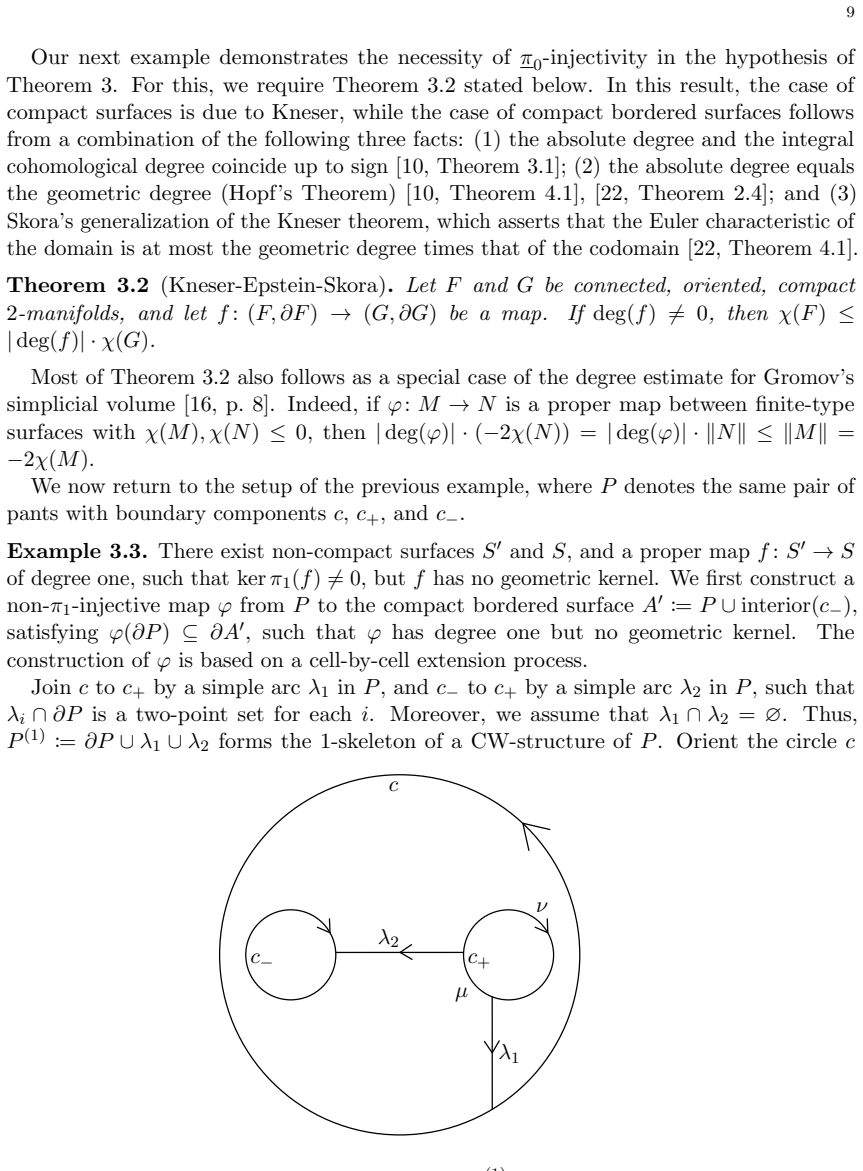
- [Example 3.3] Example 3.3 is internally inconsistent. It opens by asserting 'such that ker π1(f) ≠ 0' and ends with 'On the other hand, π1(f) is injective'. These statements are mutually exclusive, since ker π1(f)=0 is exactly injectivity of π1(f). The example is used to demonstrate the necessity of π0-injectivity in Theorem 3, so this contradiction is load-bearing. Either the initial claim should be changed to π1(f) injective (with the example reframed accordingly) or the final injectivity assertion is false and the proof of it is wrong. As written, the example cannot support the claimed necessity discussion.
minor comments (3)
- [Throughout] The notation for the ordinary fundamental group and Brown's proper fundamental group is not visually distinguished in the typeset text; in the paragraph after Theorem 1 the two symbols appear identical, making the sentence 'if π1(f) is a monomorphism (resp. isomorphism), then π1(f) is as well' nonsensical. Please use a distinct symbol (e.g., an underlined π1) for the proper fundamental group consistently.
- [Example 3.1] In the paragraph after defining the extension f: S' → S, the text says 'We claim that q has no geometric kernel', but q was originally only the map P → A; the claim should refer to the extended map f.
- [Proof of Theorem 5.11] The sentence containing 'or −[η′] = [η′] = [γ′_r] + [γ′_s]' appears to contain a typo; the intended relation should be stated clearly.
Circularity Check
No significant circularity; self-citation [7] is background, not load-bearing.
full rationale
The main claims are derived from the stated hypotheses through a cut-off argument, not by assuming the target conclusions. Theorem 4.15 is proved from Theorem 4.12 plus the Nielsen-Edmonds classification of degree-one maps on compact surfaces; Theorem 4.12 is proved by exhausting sequences and the ladder diagram, reducing to Theorem 4.1. Theorem 4.1 is proved from Theorem 4.8, whose proof is an explicit two-dimensional adaptation of Brown-Tucker using standard lemmas (Lemma 4.6, Lemma 4.7, Waldhausen's Lemma 1.4.3). The end-wise proper fundamental group monomorphism hypothesis is used to force eventual pi_1-injectivity outside a compact set; it is not defined in terms of geometric kernels. The cpi_1 set is not assumed to be the same as conjugacy classes: Theorem 5.4 proves this characterization directly from the definitions using Lemmas 5.2 and 5.3, and Theorem 5.5 then uses it as a tool. No fitted parameter is renamed as a prediction, and no conclusion is fed back into its own assumptions. The only self-citation, [7], concerns the analogous boundaryless classification of pi_1-injective proper maps and is mentioned as background; the bordered classification actually used in the proof is established in this paper itself (Theorem 4.8 and Theorem 4.1), so the self-citation is not load-bearing. There is an apparent correctness issue unrelated to circularity: the Introduction's Theorem 3 states only 'S is not homeomorphic to R^2' and omits the corresponding exclusion for S', while the body's Theorem 4.15 setup assumes neither M nor N is R^2. This is a missing-hypothesis / false-statement concern, but not a circular derivation.
Assumptions & free parameters
assumptions (6)
- domain assumption Nielsen-Edmonds classification (Theorem 4.16): a degree-one map between connected oriented compact 2-manifolds with trivial kernel is homotopic rel boundary to a homeomorphism; otherwise it is homotopic to a quotient collapsing an essential S_{g,1}, g≥1, to a point.
- domain assumption Kneser-Epstein-Skora inequality (Theorem 3.2): χ(F) ≤ |deg(f)| χ(G) for nonzero-degree maps between compact surfaces.
- domain assumption Epstein's degree theory: cohomological degree is properly homotopy invariant, has Hopf geometric realization, and nonzero degree implies π1-surjectivity ([10, Corollary 3.4]).
- domain assumption Richards-Kerékjártó classification: every non-compact surface is homeomorphic to S^2 minus a compact totally disconnected set, with the end space corresponding to that set.
- domain assumption Goldman's inductive exhausting sequences: a non-compact 2-manifold different from R^2 admits an exhausting sequence whose successive differences are annuli, pairs of pants, or two-holed tori.
- standard math Transversality homotopy theorem in dimension two ([17, Lemma 2.2]) and the Palais disk theorem ([19]) plus closedness of proper maps ([20]).
invented entities (1)
-
cπ1(S,e): the set of free homotopy classes of sequences of loops converging to an end e
independent evidence
Cite this review
Pith. "Pith review of Geometric Kernels of Proper Maps Between Non-Compact Surfaces." pith.science (2026). https://pith.science/paper/JOH6I7L3
@misc{pith2026250821057,
  author       = {Pith},
  title        = {Pith review of: Geometric Kernels of Proper Maps Between Non-Compact Surfaces},
  year         = {2026},
  howpublished = {\url{https://pith.science/paper/JOH6I7L3}},
  note         = {Machine review of arXiv:2508.21057}
}
abstract
A map between connected $2$-manifolds has a geometric kernel if it sends a non-contractible simple loop to a null-homotopic loop. While every non-$\pi_1$-injective map between compact surfaces admits a geometric kernel, this generally fails for compact bordered or non-compact surfaces. In this paper, we use Brown's proper fundamental group to give a sufficient condition under which a degree-one map between non-compact surfaces admits a geometric kernel. Furthermore, we characterize conjugacy classes in the proper fundamental group and use this characterization to establish sufficient conditions for the existence of geometric kernels.
Figures
Reference graph
Works this paper leans on
-
[7]
$\pi_1$-injective proper maps between non-compact surfaces
Sumanta Das. π1-injective proper maps between non-compact surfaces. Proc. Amer. Math. Soc. (to appear), 2025. Available at arXiv:2405.09824
work page Pith review arXiv 2025
-
[1]
E. M. Brown. Contractible 3-manifolds of finite genus at infinity.Trans. Amer. Math. Soc., 245:503–514, 1978. 37
work page 1978
-
[2]
E. M. Brown and T. W. Tucker. On proper homotopy theory for noncompact 3-manifolds. Trans. Amer. Math. Soc. , 188:105–126, 1974
work page 1974
-
[3]
Edward M. Brown. Proper homotopy theory in simplicial complexes. In Topology Conference (Virginia Polytech. Inst. and State Univ., Blacksburg, Va., 1973) , volume Vol. 375 of Lecture Notes in Math. , pages 41–46. Springer, Berlin-New York, 1974
work page 1973
-
[4]
Edward M. Brown and Robert Messer. The classification of two-dimensional manifolds. Trans. Amer. Math. Soc., 255:377–402, 1979
work page 1979
-
[5]
Geometry and spectra of compact Riemann surfaces
Peter Buser. Geometry and spectra of compact Riemann surfaces . Modern Birkh¨ auser Classics. Birkh¨ auser Boston, Ltd., Boston, MA, 2010. Reprint of the 1992 edition
work page 2010
-
[6]
R. H. Crowell. Invertible isotopies. Proc. Amer. Math. Soc. , 14:658–664, 1963
work page 1963
-
[8]
Allan L. Edmonds. Deformation of maps to branched coverings in dimension two. Ann. of Math. (2) , 110(1):113–125, 1979
work page 1979
Show all 28 references
-
[9]
D. B. A. Epstein. Curves on 2-manifolds and isotopies. Acta Math., 115:83–107, 1966
1966
-
[10]
D. B. A. Epstein. The degree of a map. Proc. London Math. Soc. (3) , 16:369–383, 1966
1966
-
[11]
Princeton University Press, Princeton, NJ, 2012
Benson Farb and Dan Margalit.A primer on mapping class groups, volume 49 ofPrinceton Mathematical Series. Princeton University Press, Princeton, NJ, 2012
2012
-
[12]
F. T. Farrell, L. R. Taylor, and J. B. Wagoner. The Whitehead theorem in the proper category. Compositio Math., 27:1–23, 1973
1973
-
[13]
Topology
Stefan Friedl. Topology. AMS Open Math Notes, July 2023. Reference OMN:202307.111368. Available at https://www.ams.org/open-math-notes/omn-view-listing?listingId=111368
2023 arXiv
-
[14]
The simple loop conjecture
David Gabai. The simple loop conjecture. J. Differential Geom. , 21(1):143–149, 1985
1985
-
[15]
Open surfaces and an algebraic study of ends
Martin Edward Goldman. Open surfaces and an algebraic study of ends . ProQuest LLC, Ann Arbor, MI,
-
[16]
Volume and bounded cohomology
Michael Gromov. Volume and bounded cohomology. Inst. Hautes ´Etudes Sci. Publ. Math. , 56:5–99, 1982
1982
-
[17]
On irreducible 3-manifolds which do not contain projective planes
Wolfgang Heinrich Heil. On irreducible 3-manifolds which do not contain projective planes . ProQuest LLC, Ann Arbor, MI, 1970. Thesis (Ph.D.)–Rice University. Available at https://hdl.handle.net/ 1911/14612 and https://www.proquest.com/docview/288224648
1970
-
[18]
James R. Munkres. Elementary differential topology, volume No. 54 of Annals of Mathematics Studies . Princeton University Press, Princeton, NJ, revised edition, 1966. Lectures given at Massachusetts Institute of Technology, Fall, 1961
1966
-
[19]
Richard S. Palais. Extending diffeomorphisms. Proc. Amer. Math. Soc. , 11:274–277, 1960
1960
-
[20]
Richard S. Palais. When proper maps are closed. Proc. Amer. Math. Soc. , 24:835–836, 1970
1970
-
[21]
On the classification of noncompact surfaces
Ian Richards. On the classification of noncompact surfaces. Trans. Amer. Math. Soc. , 106:259–269, 1963
1963
-
[22]
The degree of a map between surfaces
Richard Skora. The degree of a map between surfaces. Math. Ann., 276(3):415–423, 1987
1987
-
[23]
Maps between surfaces
Richard Kevin Skora. Maps between surfaces. ProQuest LLC, Ann Arbor, MI, 1984. Thesis (Ph.D.)–The University of Texas at Austin. Available at https://www.proquest.com/docview/303336271
1984
-
[24]
Richard J. Tondra. Homeotopy groups of surfaces whose boundary is the union of 1-spheres. Fund. Math., 105(2):79–85, 1979/80
1979
-
[25]
T. W. Tucker. Boundary-reducible 3-manifolds and Waldhausen’s theorem. Michigan Math. J. , 20:321– 327, 1973
1973
-
[26]
On non-compact 3-manifolds which are end-irreducible
Thomas William Tucker. On non-compact 3-manifolds which are end-irreducible . ProQuest LLC, Ann Arbor, MI, 1971. Thesis (Ph.D.)–Dartmouth College. Available at https://www.proquest.com/ docview/302587773
1971
-
[27]
On irreducible 3-manifolds which are sufficiently large
Friedhelm Waldhausen. On irreducible 3-manifolds which are sufficiently large. Ann. of Math. (2) , 87:56–88, 1968. 38 Department of Mathematics, Indian Institute of Technology Bombay, India Email address : sumanta@math.iitb.ac.in
1968
-
[1967]
Available at https://www.proquest.com/docview/288355577
Thesis (Ph.D.)–Yale University. Available at https://www.proquest.com/docview/288355577
Reviewed August 5, 2026 · model on record in the stance chip above.
Discussion (0). Continue with ORCID to comment.