A Spatially Consistent Geometric D2D Small-Scale Fading Model for Multiple Frequencies
Pith reviewed 2026-05-25 13:42 UTC · model grok-4.3
The pith
A new small-scale fading model integrates spatial consistency, multi-frequency correlation, and mobility into the 3GPP NR channel framework.
A machine-rendered reading of the paper's core claim, the machinery that carries it, and where it could break.
Core claim
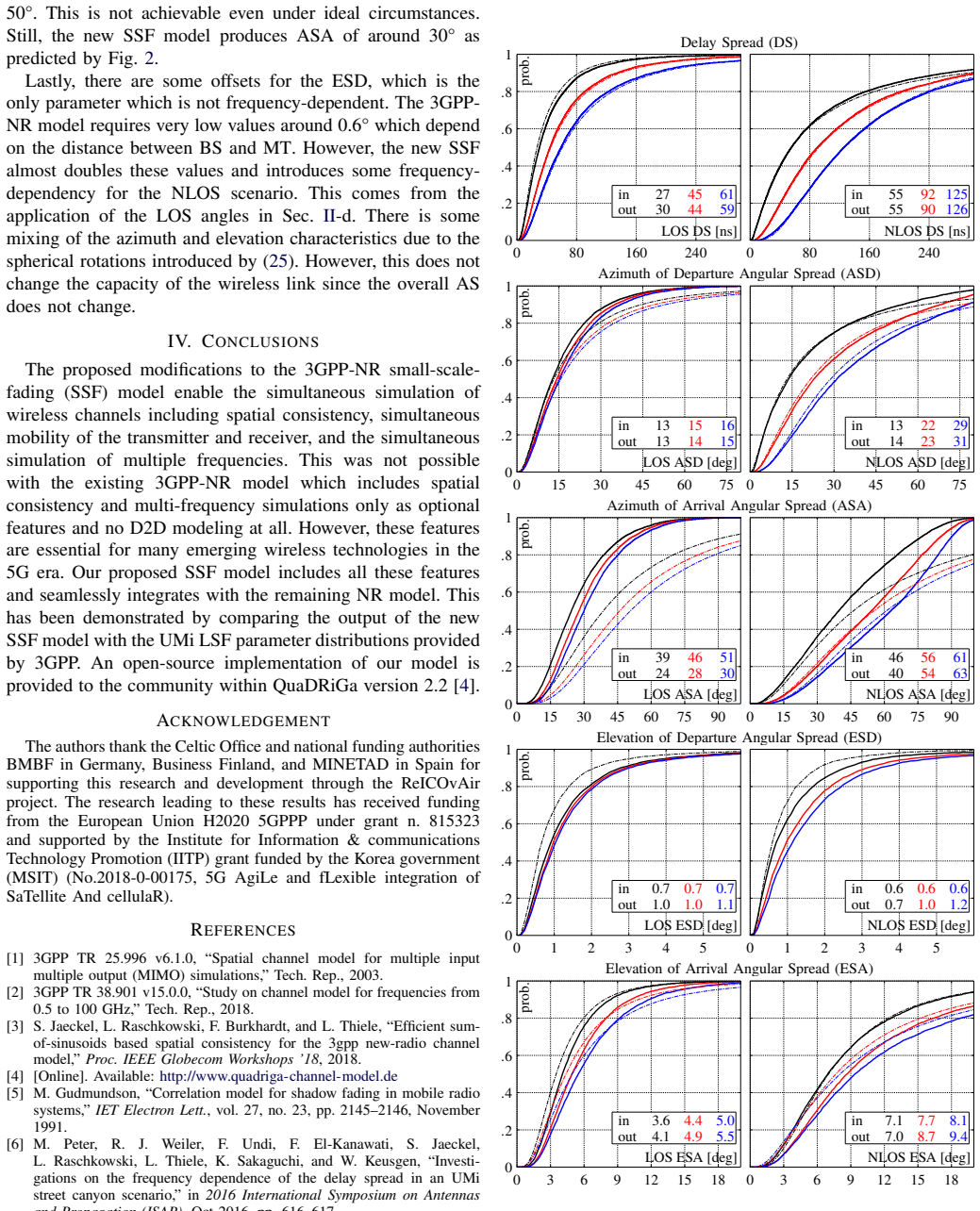
The paper proposes a new SSF model that seamlessly integrates with the remaining NR model and allows the simultaneous simulation of spatial consistency, multi-frequency correlation, and mobility. The output of the new SSF model agrees well with large-scale fading parameter distributions provided by 3GPP. This enables the simulation of new wireless technology proposals that were difficult to realize with existing geometry-based stochastic channel models.
What carries the argument
Spatially consistent geometric D2D small-scale fading model, which generates fading values consistent across locations, frequencies, and time for device-to-device links.
If this is right
- The model supports simultaneous simulation of spatial consistency, multi-frequency correlation, and mobility within the NR framework.
- Generated large-scale fading parameters match the distributions specified by 3GPP.
- The approach removes a barrier to simulating wireless technologies that require all three features together.
- It remains compatible with the existing parts of the 3GPP NR channel model.
Where Pith is reading between the lines
- The same geometric construction could be tested for consistency with measured channel data in specific indoor or outdoor scenarios beyond the 3GPP references.
- Performance evaluations of mobility-aware protocols or beam tracking algorithms may now use a single consistent channel realization across frequencies.
- Extensions to other geometry-based stochastic models could adopt similar parameter generation rules to achieve cross-frequency spatial consistency.
Load-bearing premise
That matching large-scale fading parameter distributions from 3GPP is sufficient to confirm that the small-scale fading model correctly integrates spatial consistency, multi-frequency correlation, and mobility.
What would settle it
A simulation run in which the new model's small-scale fading outputs produce large-scale fading parameter distributions that deviate measurably from the 3GPP reference statistics under combined mobility and multi-frequency conditions.
Figures
read the original abstract
The 3GPP new radio (NR) channel model introduced spatial consistency and a correlation model for multiple frequencies. Future extensions of this model will incorporate mobility at both ends of the link. These features are essential for many emerging wireless technologies in the 5G era. However, the existing small-scale-fading (SSF) model does not integrate these features coherently. To solve this problem, we propose a new SSF model that seamlessly integrates with the remaining NR model and allows the simultaneous simulation of all three features. We demonstrate this integration by showing that the output of the new SSF model agrees well with large-scale fading (LSF) parameter distributions provided by 3GPP. This enables the simulation of new wireless technology proposals that were difficult to realize with existing geometry-based stochastic channel models (GSCMs).
Editorial analysis
A structured set of objections, weighed in public.
Referee Report
Summary. The manuscript proposes a new small-scale fading (SSF) model for device-to-device (D2D) links that integrates spatial consistency, multi-frequency correlation, and mobility into the existing 3GPP NR channel model framework. The central claim is that this SSF model 'seamlessly integrates' with the remaining NR components to enable simultaneous simulation of all three features, with the only empirical support being that the model's output agrees well with 3GPP-provided large-scale fading (LSF) parameter distributions.
Significance. A correctly validated model of this type would address a genuine gap in current geometry-based stochastic channel models by allowing joint simulation of spatial consistency, frequency correlation, and mobility while remaining backward-compatible with 3GPP NR. This could facilitate evaluation of 5G-era technologies that depend on these joint statistics. However, the significance is limited by the narrow scope of the reported validation, which does not exercise the correlation structures the model is intended to enforce.
major comments (1)
- [Abstract] Abstract (and the demonstration described therein): the sole empirical support is agreement between the new SSF output and 3GPP LSF parameter distributions. Because LSF parameters (shadowing standard deviation, correlation distances, etc.) are generated upstream of the SSF block in the NR framework, reproducing their marginal distributions does not test the joint spatial-frequency-time correlation functions, cross-frequency coherence, or Doppler spectra that the new SSF model is claimed to enforce.
Simulated Author's Rebuttal
We thank the referee for the detailed and constructive review. We address the major comment point by point below.
read point-by-point responses
-
Referee: [Abstract] Abstract (and the demonstration described therein): the sole empirical support is agreement between the new SSF output and 3GPP LSF parameter distributions. Because LSF parameters (shadowing standard deviation, correlation distances, etc.) are generated upstream of the SSF block in the NR framework, reproducing their marginal distributions does not test the joint spatial-frequency-time correlation functions, cross-frequency coherence, or Doppler spectra that the new SSF model is claimed to enforce.
Authors: We agree that agreement with the marginal distributions of LSF parameters does not directly validate the joint spatial-frequency-time correlation functions, cross-frequency coherence, or Doppler spectra. The manuscript's demonstration is limited to confirming that the new SSF model produces outputs consistent with the 3GPP-provided LSF parameter distributions, thereby verifying compatibility with the upstream components of the NR framework. The integration of spatial consistency, multi-frequency correlation, and mobility is achieved by construction in the geometric model, which reuses the same large-scale parameters and geometry to enforce these properties without requiring separate mechanisms. We will revise the abstract to clarify the limited scope of the empirical demonstration and add text explaining how the model enforces the target correlations by design. This revision will make the claims more precise. revision: yes
Circularity Check
No significant circularity in derivation or validation chain.
full rationale
The paper proposes a new SSF model for integrating spatial consistency, multi-frequency correlation and mobility into the 3GPP NR framework, then validates by showing output agreement with external 3GPP LSF parameter distributions. This uses an independent benchmark (3GPP standard) rather than reducing any claimed result to the model's own fitted inputs or self-citations by construction. No self-definitional equations, fitted-input predictions, load-bearing self-citations, or ansatz smuggling are present. The derivation remains self-contained against the cited external reference.
Axiom & Free-Parameter Ledger
axioms (1)
- domain assumption The existing 3GPP NR channel model components can be extended with a new SSF model without introducing inconsistencies.
Reference graph
Works this paper leans on
-
[1]
Spatial channel model for multiple input multiple output (MIMO) simulations,
3GPP TR 25.996 v6.1.0, “Spatial channel model for multiple input multiple output (MIMO) simulations,” Tech. Rep., 2003
work page 2003
-
[2]
Study on channel model for frequencies from 0.5 to 100 GHz,
3GPP TR 38.901 v15.0.0, “Study on channel model for frequencies from 0.5 to 100 GHz,” Tech. Rep., 2018
work page 2018
-
[3]
Efficient sum- of-sinusoids based spatial consistency for the 3gpp new-radio channel model,
S. Jaeckel, L. Raschkowski, F. Burkhardt, and L. Thiele, “Efficient sum- of-sinusoids based spatial consistency for the 3gpp new-radio channel model,” Proc. IEEE Globecom Workshops ’18 , 2018
work page 2018
-
[4]
Available: http://www.quadriga-channel-model.de
[Online]. Available: http://www.quadriga-channel-model.de
-
[5]
Correlation model for shadow fading in mobile radio systems,
M. Gudmundson, “Correlation model for shadow fading in mobile radio systems,” IET Electron Lett. , vol. 27, no. 23, pp. 2145–2146, November 1991
work page 1991
-
[6]
Investi- gations on the frequency dependence of the delay spread in an UMi street canyon scenario,
M. Peter, R. J. Weiler, F. Undi, F. El-Kanawati, S. Jaeckel, L. Raschkowski, L. Thiele, K. Sakaguchi, and W. Keusgen, “Investi- gations on the frequency dependence of the delay spread in an UMi street canyon scenario,” in 2016 International Symposium on Antennas and Propagation (ISAP) , Oct 2016, pp. 616–617. Delay Spread (DS) prob. 0 80 160 240 0 .2 .4 ....
work page 2016
discussion (0)
Sign in with ORCID, Apple, or X to comment. Anyone can read and Pith papers without signing in.