REVIEW 3 major objections 4 minor 41 references
K-stability of del Pezzo surfaces with a single quotient singularity
T0 review · 3 major / 4 minor · reviewed 2026-08-06 · deepseek-v4-flash
Pith's one-line read For eight singular del Pezzo surfaces with two exceptional curves in the minimal resolution, K-stability holds; two more lie exactly on the semistable boundary.
desk verdict Solid computational extension of the K-stability classification, but a load-bearing unproved birational identification in Lemma 3.9 needs to be fixed before the main theorem is fully supported. read the letter →
The pith
A machine-rendered reading of the paper's core claim, the machinery that carries it, and where it could break.
The reading
What carries the argument
The $\delta$-invariant stability criterion: a Q-Fano variety is K-semistable if $\delta(X) \ge 1$, uniformly K-stable if $\delta(X) > 1$, and, when the automorphism group is finite, K-stable exactly when K-polystable. The paper estimates local $\delta$-invariants via the Abban–Zhuang theory of admissible flags, which reduces the computation to S-invariants and explicit Zariski decompositions on weighted blow-ups. A volume bound for quotient singularities, stating that $(-K_X)^n \le (n+1)^n/|G|$ for K-semistable $X$, is used to prove K-instability for most of the family. For smooth points, the lower bound $\frac{n+1}{n}\alpha(X) \le \delta(X)$ on the $\alpha$-invariant is combined with log-canonicity lemmas to show $\delta > 1$.
What would settle it
Write explicit equations for the complete intersection $S$ in $\mathbb{P}(1,1,2,2,3)$ and the hypersurface $S'$ in $\mathbb{P}(1,1,2,3)$, perform the weighted blow-up with weights $(1,4)$ at the singular point of $S$, and check whether the resulting surface is isomorphic to $S'$; if it is not, Lemma 3.9 and the stability of $S^7_{4,2}$ would lack support.
Extended reading notes
Core claim
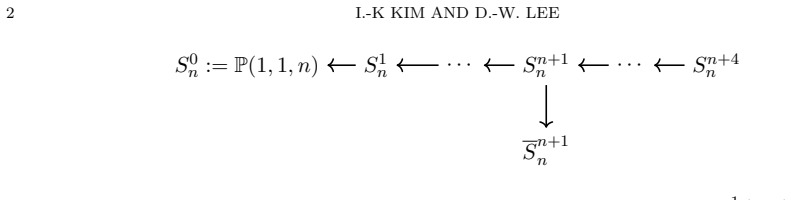
The central claim, Theorem 1.4, is a complete classification of K-stability for the surfaces $S^k_{n,m}$ in Figure 3 and Remark 1.3. If $S$ is a del Pezzo surface in this family, then $S$ is K-stable if and only if it is isomorphic to one of $S^4_{2,2}$, $S^5_{2,2}$, $S^5_{3,2}$, $S^6_{3,2}$, $S^6_{4,2}$, $S^7_{4,2}$, $S^5_{3,3}$, or $S^6_{4,3}$, and $S$ is strictly K-semistable if and only if it is isomorphic to $S^3_{2,2}$ or $S^7_{5,2}$. All other surfaces in the family are K-unstable. For the stable surfaces the local $\delta$-invariant is shown to exceed $1$; for $S^7_{5,2}$ the $\delta$-invariant equals $1$ while the automorphism group is finite, which makes it strictly K-semistable but not K-polystable.
Load-bearing premise
The proof that smooth points of $S^7_{4,2}$ satisfy $\delta > 1$ relies on an asserted isomorphism, stated without proof or reference, between a weighted blow-up with weights $(1,4)$ at the singular point of the surface in Figure 4 and the surface in Figure 5.
Editorial extensions
If this is right
- The K-stability of every del Pezzo surface in the family $S^k_{n,m}$ is now determined, leaving no unclassified cases.
- The eight K-stable surfaces admit Kähler–Einstein metrics by the Yau–Tian–Donaldson correspondence.
- The two strictly K-semistable surfaces lie on the boundary of the moduli space and do not admit Kähler–Einstein metrics, despite being semistable.
- Because the surfaces are anticanonical models of certain smooth rational surfaces, the K-stability of their minimal resolutions is automatically determined as well.
- The result generalizes the earlier one-exceptional-curve classification to the two-exceptional-curve case.
Reading between the lines
- The same Abban–Zhuang strategy with explicit Zariski decompositions could be applied to quotient singularities with longer Hirzebruch–Jung chains, likely yielding finite classifications for each fixed pair of self-intersections.
- The unproved identification in Lemma 3.9, that a weighted blow-up with weights $(1,4)$ at the singular point of the surface in Figure 4 gives the surface in Figure 5, is a concrete computational check; if it fails, the stability of $S^7_{4,2}$ would need a different proof.
- The sparsity of stable cases suggests that as $n+m$ grows, the volume bound forces K-instability for almost all members of the family, so the boundary phenomena are concentrated in small $n,m$.
Editorial analysis
A structured set of objections, weighed in public.
Referee Report
Summary. The paper studies the K-stability of singular del Pezzo surfaces with a single cyclic quotient singularity whose minimal resolution has exactly two exceptional curves with self-intersections -n and -m. For the family S^k_{n,m} constructed by blowing up points on a line in P(1,1,n) and then contracting the strict transform of that line, the authors give a complete classification: eight surfaces are K-stable and two are strictly K-semistable. The proof combines the delta-invariant criterion, Liu's volume bound for K-semistable varieties, and Abban-Zhuang theory, supported by a long sequence of explicit Zariski decompositions and S-invariant computations.
Significance. If the proof is completed, the result gives a full classification of K-(semi)stability for a natural family of singular del Pezzo surfaces with two exceptional curves in the minimal resolution, extending earlier results for blow-ups of P(1,1,n). The computational core is systematic, the arithmetic in the S-invariant calculations is consistent in the cases checked, and the paper makes effective use of external theorems rather than fitted parameters. The main caveats are a missing justification of a key birational identification and a small gap in the transfer argument used for the smooth-point bounds; both appear fixable within the present framework.
major comments (3)
- [§3.2.2, Lemma 3.9] The assertion that a weighted blow-up with weights (1,4) at the singular point of S in Figure 4 yields exactly the surface S' of Figure 5, with K_{S'} = f^*K_S + (2/3)E and E^2 = -3/4, is stated without proof or reference. This identification is load-bearing: it transfers the smooth-point log-canonicity statement of Lemma 3.5 to S^7_{4,2}, and it is reused for S^6_{4,2} in Lemma 3.16 and for S^6_{4,3} in Lemma 3.26. Please provide a toric verification using the Hirzebruch-Jung description of the singularity 1/3(1,1), or an explicit reference containing this weighted blow-up computation and the associated discrepancy and self-intersection data.
- [§3.2.2, Lemma 3.9] The contradiction to Lemma 3.5 requires the point f(q) to lie in the smooth locus of S. The proof does not rule out the possibility that q lies on the exceptional divisor E of f; in that case f(q) is the singular point of S and Lemma 3.5 does not apply. This gap also affects Lemmas 3.16 and 3.26, which reuse Lemma 3.9. The authors should either justify that q can be chosen away from E (for instance by taking p_1 in the exceptional divisor of π_1 so that q = p ∈ L, which is disjoint from E), or prove the required log canonicity at the singular point of S separately.
- [§3.2.5, Lemma 3.20] The proof that Aut(S^7_{5,2}) is finite is too terse. It asserts that the kernel of ρ preserves every geometric basis of Pic(S^7_{5,2}) and that each automorphism in the kernel descends to an automorphism of S^0_{5,2} fixing seven points in general position, but neither statement is justified. This lemma is needed to upgrade δ = 1 to strict K-semistability in Theorem 3.21, so a complete argument or a precise reference is required.
minor comments (4)
- [§3.2.2, Lemma 3.8] There is a typo in the displayed formula: it reads ψ^*(R_S) = π_2^*(C_1 + 4/5 L_1), but the preceding computation gives φ^*(R_{S'}) = C_1 + 5/7 L_1, and the following equality uses C_2 + 5/7 L_2 + 3/7 E. The '4/5' should be '5/7'.
- [§3.2.2, Lemma 3.9] The letter S is used for several different surfaces (the blow-up of P(1,1,3) in Figure 4, the blow-up of P(1,1,4) in Figure 5, and a general surface in Lemmas 3.5 and 3.9). Renaming these or adding a table of notation would substantially improve readability.
- [§3.2.1, Lemma 3.5] The reference [22, Lemma 4.1] is invoked for log canonicity of a curve C ∈ |O_S(1)|. Since C may be singular and the ambient surface S has a quotient singularity, please state the exact form of the lemma being used or give a short proof of this assertion.
- [§3.2.5, Lemma 3.20] The notation O(K^⊥_{S^7_{5,2}}) and the phrase 'geometric basis' are not defined. A more standard formulation of the argument, for example in terms of the action on the Picard lattice and the fixed-point set of the seven marked points, would help the reader.
Circularity Check
No significant circularity: the derivation uses external δ-invariant criteria and direct computations, with no fitted parameters renamed as predictions.
full rationale
The paper's derivation is self-contained against external benchmarks. The K-unstable range n+m≥8 is proved by applying Liu's volume bound (Theorem 2.17) to the anticanonical degree formulas computed directly from the resolution data, not from the target classification. The K-stable cases are proved by lower bounds on the δ-invariant via the Abban–Zhuang theory; the constant λ=3/4 is justified by the explicit log-canonicity statement of Lemma 3.5 and by the inequalities in Theorem 2.16, so it is a proven bound rather than an assumed parameter. The cases (2,2) are cited from the independent δ-invariant computations of Denisova and of Odaka–Spotti–Sun. The only fragile step is Lemma 3.9, where the identification of the weighted blow-up with weights (1,4) at the singular point of the surface in Figure 4 with the surface in Figure 5, together with the discrepancy formula KS'=f*(KS)+(2/3)E and E2=-3/4, is asserted without proof or reference. That is a genuine correctness risk for the smooth-point bound of S7_4,2 and for the later transfer arguments, but it is not circular: the identification is a geometric statement about the surfaces, and it does not presuppose K-stability of S7_4,2 nor define any invariant in terms of the conclusion. No fitted parameters are relabeled as predictions, no load-bearing self-citation chain is used, and no uniqueness theorem from the authors' prior work is imported to force the classification.
Assumptions & free parameters
assumptions (5)
- standard math The delta-invariant criterion: delta(X) > 1 iff uniformly K-stable, delta(X) = 1 iff K-semistable (Blum-Jonsson, Theorem 2.14)
- standard math Abban-Zhuang lower bound for local delta-invariant via admissible flags (Theorem 2.20)
- standard math Liu's volume bound: for a quotient singularity with local group G, K-semistability implies (-K_X)^n <= (n+1)^n/|G| (Theorem 2.17)
- domain assumption General position of the blown-up points in Definitions 1.2 and the constructions of Section 3
- ad hoc to paper The weighted blow-up f: S' -> S in Lemma 3.9 is a birational morphism to the surface of Figure 4
Cite this review
Pith. "Pith review of K-stability of del Pezzo surfaces with a single quotient singularity." pith.science (2026). https://pith.science/paper/JP27KXUU
@misc{pith2026250713649,
  author       = {Pith},
  title        = {Pith review of: K-stability of del Pezzo surfaces with a single quotient singularity},
  year         = {2026},
  howpublished = {\url{https://pith.science/paper/JP27KXUU}},
  note         = {Machine review of arXiv:2507.13649}
}
abstract
In this paper, we study the K-stability of del Pezzo surfaces with a single quotient singularity whose minimal resolution admits exactly two exceptional curves \(E_1\) and \(E_2\) with \(E_{1}^2=-n\), \(E_{2}^2=-m\) for \(n,m\geq 2\).
Figures


Reference graph
Works this paper leans on
-
[1]
H. Abban and Z. Zhuang. K-stability of Fano varieties via admissible flags. Forum of Mathematics, Pi , 10:43,
-
[2]
C. Araujo, A.-M. Castravet, I. Cheltsov, K. Fujita, A.-S. Kaloghiros, J. Martinez-Garcia, C. Shramov, H. S¨ uß, and N. Viswanathan. The Calabi problem for Fano threefolds , volume 485 of Lond. Math. Soc. Lect. Note Ser. Cambridge: Cambridge University Press, 2023. doi:10.1017/9781009193382
-
[3]
H. Blum and M. Jonsson. Thresholds, valuations, and K-stability. Adv. Math., 365:107062, 57, 2020. doi: 10.1016/j.aim.2020.107062
-
[4]
H. Blum and C. Xu. Uniqueness of K-polystable degenerations of Fano varieties.Ann. of Math. (2), 190(2):609– 656, 2019. doi:10.4007/annals.2019.190.2.4
-
[5]
D. Cavey and T. Prince. Del Pezzo surfaces with a single 1 /k(1, 1) singularity. J. Math. Soc. Japan , 72(2):465– 505, 2020. doi:10.2969/jmsj/79337933
arXiv 2020
-
[6]
I. Cheltsov. Log canonical thresholds of del Pezzo surfaces. Geom. Funct. Anal. , 18(4):1118–1144, 2008. doi:10.1007/s00039-008-0687-2
-
[7]
I. Cheltsov and K. Zhang. Delta invariants of smooth cubic surfaces. Eur. J. Math. , 5(3):729–762, 2019. doi:10.1007/s40879-019-00357-0 . K-STABILITY OF SINGULAR DEL PEZZO SURF ACES 35
-
[8]
G. D. Chen and N. Tsakanikas. On the termination of flips for log canonical generalized pairs. Acta Math. Sin. Engl. Ser. , pages 1–28, 2023. doi:10.1007/s10114-023-0116-3
Show all 41 references
-
[9]
X. Chen, S. Donaldson, and S. Sun. K¨ ahler-Einstein metrics on Fano manifolds. I: Approximation of metrics with cone singularities. J. Amer. Math. Soc. , 28(1):183–197, 2015. doi:10.1090/S0894-0347-2014-00799-2
2015 doi
-
[10]
X. Chen, S. Donaldson, and S. Sun. K¨ ahler-Einstein metrics on Fano manifolds. II: Limits with cone angle less than 2 π. J. Amer. Math. Soc. , 28(1):199–234, 2015. doi:10.1090/S0894-0347-2014-00800-6
2015 doi
-
[11]
X. Chen, S. Donaldson, and S. Sun. K¨ ahler-Einstein metrics on Fano manifolds. III: Limits as cone angle approaches 2π and completion of the main proof. J. Amer. Math. Soc. , 28(1):235–278, 2015. doi:10.1090/ S0894-0347-2014-00801-8
2015
-
[12]
S. Choi, S. Jang, and D. Kim. Adjoint asymptotic multiplier ideal sheaves. arXiv:2311.07441, 2024
2024
-
[13]
S. Choi, S. Jang, and D.-W. Lee. Plc pairs with good asymptotic base loci. arXiv:2411.04628, 2024
2024 arXiv
-
[14]
S. Choi, S. Jang, and D.-W. Lee. On Minimal Model Program and Zariski Decomposition of Potential Triples. Taiwanese J. Math. , pages 1–14, 2025. doi:10.11650/tjm/250406
2025 doi
-
[15]
Choi and J
S. Choi and J. Park. Potentially non-klt locus and its applications. Math. Ann. , 366(1-2):141–166, 2016. doi:10.1007/s00208-015-1317-6 . See arXiv:1412.8024v2 for updates
2016 arXiv
-
[16]
Denisova
E. Denisova. δ-invariant of Du Val del pezzo surfaces of degree ≥ 4. arXiv:2304.11412, 2023
2023 arXiv
-
[17]
Denisova
E. Denisova. δ-invariants of cubic surfaces with Du Val singularities. arXiv:2311.14181, 2023
2023 arXiv
-
[18]
Denisova
E. Denisova. δ-invariants of Du Val del pezzo surfaces of degree 1. arXiv:2410.19853, 2024
2024 arXiv
-
[19]
Denisova
E. Denisova. δ-invariants of Du Val del pezzo surfaces of degree 2. arXiv:2410.12512, 2024
2024 arXiv
-
[20]
I. V. Dolgachev. Classical algebraic geometry. Cambridge University Press, Cambridge, 2012. doi:10.1017/ CBO9781139084437. A modern view
2012
-
[21]
K. Fujita. A valuative criterion for uniform K-stability of Q-Fano varieties. J. Reine Angew. Math. , 751:309– 338, 2019. doi:10.1515/crelle-2016-0055
2019 doi
-
[22]
Kim and J
I.-K. Kim and J. Won. Delta-invariants of complete intersection log del Pezzo surfaces. Proc. Roy. Soc. Edinburgh Sect. A , 153(3):1021–1036, 2023. doi:10.1017/prm.2022.30
2023 doi
-
[23]
Kim and J
I.-K. Kim and J. Won. On K-stability of blow-ups of weighted projective planes. preprint, 2025
2025
-
[24]
Koll´ ar.Lectures on resolution of singularities , volume 166 of Annals of Mathematics Studies
J. Koll´ ar.Lectures on resolution of singularities , volume 166 of Annals of Mathematics Studies . Princeton University Press, Princeton, NJ, 2007
2007
-
[25]
E. Kutas. Log del Pezzo surfaces, degenerations and Torus actions . PhD thesis, University of Warwick, 2021
2021
-
[26]
Lazarsfeld
R. Lazarsfeld. Positivity in algebraic geometry. II , volume 49 of Ergebnisse der Mathematik und ihrer Grenzgebiete. 3. Folge. A Series of Modern Surveys in Mathematics [Results in Mathematics and Related Areas. 3rd Series. A Series of Modern Surveys in Mathematics] . Springer...
2004
-
[27]
D.-W. Lee. Characterizations of Fano type varieties and projective spaces via absolute complexity.Manuscripta Math., 174(3-4):731–747, 2024. doi:10.1007/s00229-023-01526-y
2024 doi
-
[28]
C. Li. K-semistability is equivariant volume minimization. Duke Math. J. , 166(16):3147–3218, 2017. doi: 10.1215/00127094-2017-0026
2017 doi
-
[29]
Y. Liu. The volume of singular K¨ ahler-Einstein Fano varieties. Compos. Math. , 154(6):1131–1158, 2018. doi:10.1112/S0010437X18007042
2018 doi
-
[30]
Nakayama
N. Nakayama. Zariski-decomposition and abundance, volume 14 of MSJ Memoirs . Mathematical Society of Japan, Tokyo, 2004
2004
-
[31]
Odaka, C
Y. Odaka, C. Spotti, and S. Sun. Compact moduli spaces of del Pezzo surfaces and K¨ ahler-Einstein metrics. J. Differential Geom. , 102(1):127–172, 2016. URL http://projecteuclid.org/euclid.jdg/1452002879
2016
-
[32]
Park and J
J. Park and J. Won. K-stability of smooth del Pezzo surfaces. Math. Ann. , 372(3-4):1239–1276, 2018. doi:10.1007/s00208-017-1602-7
2018 doi
-
[33]
Reid and K
M. Reid and K. Suzuki. Cascades of projections from log del Pezzo surfaces. In Number theory and algebraic geometry, volume 303 of London Math. Soc. Lecture Note Ser. , pages 227–249. Cambridge Univ. Press, Cambridge, 2003
2003
-
[34]
Testa, A
D. Testa, A. V´ arilly-Alvarado, and M. Velasco. Big rational surfaces. Math. Ann. , 351(1):95–107, 2011. doi:10.1007/s00208-010-0590-7 . 36 I.-K KIM AND D.-W. LEE
2011 doi
-
[35]
G. Tian. On K¨ ahler-Einstein metrics on certain K¨ ahler manifolds withC1(M ) > 0. Invent. Math. , 89(2):225– 246, 1987. doi:10.1007/BF01389077
1987 doi
-
[36]
G. Tian. On Calabi’s conjecture for complex surfaces with positive first Chern class. Invent. Math., 101(1):101– 172, 1990. doi:10.1007/BF01231499
1990 doi
-
[37]
G. Tian. Corrigendum: K-stability and K¨ ahler-Einstein metrics [MR3352459]. Comm. Pure Appl. Math. , 68(11):2082–2083, 2015. doi:10.1002/cpa.21612
2015 doi
-
[38]
G. Tian. K-stability and K¨ ahler-Einstein metrics.Comm. Pure Appl. Math. , 68(7):1085–1156, 2015. doi: 10.1002/cpa.21578
2015 doi
-
[39]
Tian and S.-T
G. Tian and S.-T. Yau. K¨ ahler-Einstein metrics on complex surfaces with C1 > 0. Comm. Math. Phys. , 112(1):175–203, 1987. URL http://projecteuclid.org/euclid.cmp/1104159814
1987
-
[40]
C. Xu. K-stability for varieties with a big anticanonical class. ´Epijournal de G´ eom´ etrie Alg´ ebrique. EPIGA, Spec. Vol.:9, 2023. doi:10.46298/epiga.2023.10231. Id/No 7. (In-Kyun Kim) June E Huh Center for Mathematical Challenges, Korea Institute for Advanced Study, 85 Ho...
2023
- [2022]
Reviewed August 6, 2026 · model on record in the stance chip above.
Discussion (0). Continue with ORCID to comment.