REVIEW 2 major objections 5 minor 1 cited by
Effect of Neutron Star Jets on Common Envelope Evolution
T0 review · 2 major / 5 minor · reviewed 2026-08-02 · deepseek-v4-flash
Pith's one-line read In 3D simulations of a common envelope with a neutron-star companion, jets break out of the envelope and unbind about twice as much gas as a no-jet run, but breakout then decouples the jets and sharply lowers their unbinding efficiency.
desk verdict Honest, well-scoped simulation study: NS jets can break out of a common envelope and self-limit their own unbinding, though the constant accretion-decoupled jet power is the load-bearing assumption — worth refereeing. read the letter →
The pith
A machine-rendered reading of the paper's core claim, the machinery that carries it, and where it could break.
The reading
What carries the argument
The jet injection subgrid: two narrow opposed spherical sectors around the companion feed mass at a fixed rate and speed (a fast jet core plus a broader wind). The early thermalization and subsequent drilling/breakout of these sectors is the mechanism that carries the argument; the key diagnostic is the difference in unbound envelope mass between runs with and without jets, which isolates the jet's contribution.
What would settle it
A simulation that couples jet power to the instantaneous accretion rate (instead of holding it fixed) is the cleanest test: if the jet fades or stays choked before breakout (around day 35), the breakout-driven self-limiting picture is wrong.
Extended reading notes
Core claim
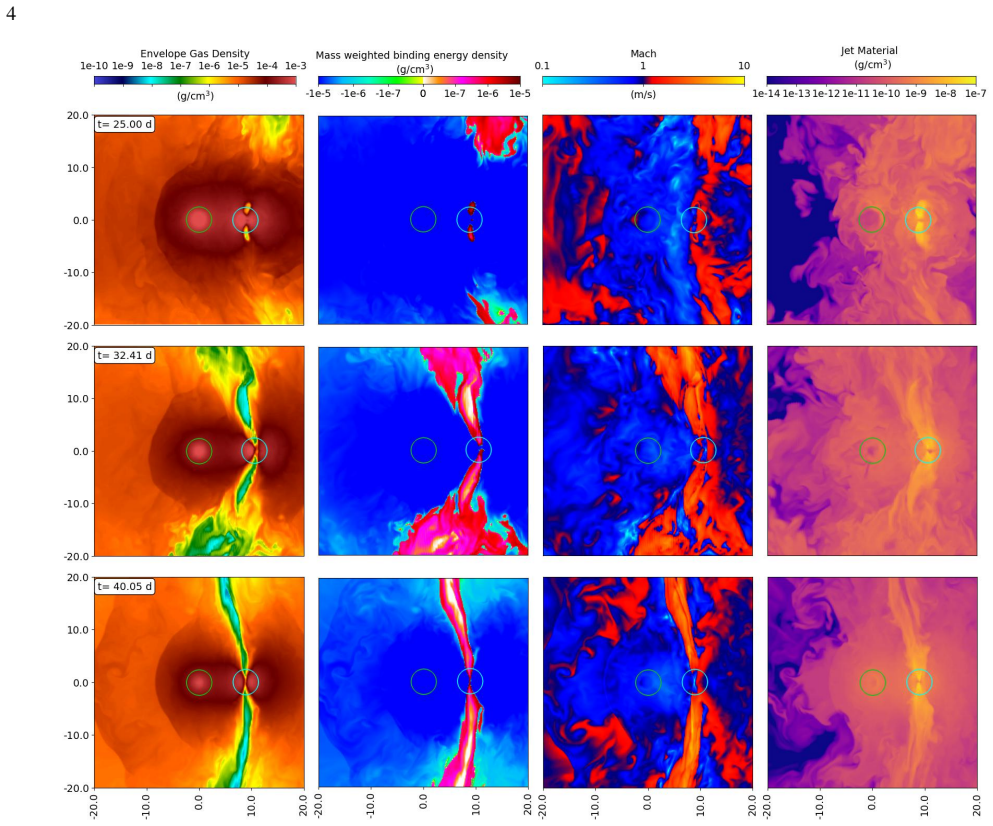
With a constant jet mass-loss rate of roughly 2e-4 solar masses per year (up to 2e-3 in one run) and a launch speed near 0.1c, the neutron-star jet is initially choked: its energy is thermalized in the dense envelope. Over ~15 days it pushes a bipolar channel outward and, by around day 35, largely breaks out, leaving hot low-density cavities expanding at hundreds to thousands of kilometers per second. During the 40-day simulation the jet unbinds about as much envelope mass as the orbital tightening of the binary alone, but the rate of unbinding falls because the jet increasingly pushes on already-unbound or ambient gas rather than on bound envelope. The paper argues that this breakout is a n
Load-bearing premise
The conclusions assume the neutron star sustains a constant super-Eddington jet (mass-loss 2e-4 to 2e-3 solar masses per year at ~0.1c) regardless of how its accretion supply evolves; if the jet cannot be maintained at this level, it may never break out.
Editorial extensions
If this is right
- NS jets in CE events create bipolar cavities and asymmetric lobes; morphology alone may not reliably indicate the jet's role in ejection.
- Jets from a NS can unbind envelope mass at a rate comparable to orbital energy release, so they can alter the inspiral timescale, but not by an order of magnitude.
- Because breakout reduces drag, the binary orbit tightens more slowly than in no-jet models; final separations should be slightly larger.
- Simple energy arguments that assume 100% jet energy goes into unbinding overestimate the jet's role; breakout must be included in analytic estimates.
- Post-breakout, the jet's residual energy transfer through a turbulent boundary layer is too slow to dominate envelope ejection (about 20-500 yr to unbind remaining bound gas).
Reading between the lines
- If jet power were instead tied self-consistently to the accretion rate (which the jet itself suppresses), the jet might die out before breaking out; in that case it would remain choked and deposit energy deep in the envelope, overturning the breakout/negative-feedback conclusion.
- The jets' strong asymmetry in the simulations hints that small perturbations or jet precession could increase jet-envelope coupling; precessing or jittering jets might unbind significantly more mass than the fixed-axis jets studied here.
- A testable corollary: post-CE binaries with a NS companion should show bipolar cavities if such constant high-power jets operate; absence of such structures would cast doubt on the assumed jet parameters.
Editorial analysis
A structured set of objections, weighed in public.
Referee Report
Summary. This paper uses 3D global hydrodynamic simulations with adaptive mesh refinement to study the effect of powerful bipolar jets from a neutron star companion on common envelope evolution. The jets are modeled with a subgrid prescription that injects a constant mass-loss rate and kinetic power, restarting from an earlier WD-jet companion simulation (Z22). The simulations show that, unlike main-sequence or white-dwarf jets, the NS jets break out of the envelope by roughly 30–40 days, producing bipolar low-density lobes and unbinding about twice as much envelope mass as a no-jet control run. The rate of jet-driven unbinding decreases as the jets break out and energetically decouple from the envelope. A secondary negative feedback is found: jet activity reduces gravitational drag, slightly slowing orbital shrinkage and thus reducing the rate of orbital energy deposition. The paper extrapolates post-breakout behavior with a boundary-layer turbulence estimate, concluding that jets are likely subdominant to orbital energy over the full CE phase.
Significance. If the main result holds, this is a meaningful advance: it is, to my knowledge, the first global 3D simulation of CE evolution with NS jets, and it shows a qualitatively new behavior (breakout) compared to the choked MS/WD jets of Zou et al. (2022). The finding that jet breakout self-regulates the unbinding efficiency is important for CE modeling and for interpreting bipolar post-CE nebulae. The paper includes several valuable checks: a no-jet control, runs with and without subgrid accretion, a resolution study, and tracer-particle analysis. These strengthen the qualitative conclusions. However, the quantitative claims are sensitive to the imposed constant jet power, which is decoupled from the simulated accretion rate; this limits the generality of the central 'negative feedback' conclusion.
major comments (2)
- [§2.2/Table 1/§3.5/§5] The central self-limiting conclusion rests on the assumption of a constant, highly super-Eddington jet power that is independent of the accretion flow. §3.5 shows that, after the jet is activated, the simulated accretion rate declines markedly with time. If the jet power were coupled to the accretion rate, the jet would weaken before breakout and could remain choked inside the envelope (as in Z22 for MS/WD jets). In that case the unbinding rate would not decline due to breakout, and the conclusion that jets are subdominant after ~40 d would not follow. The authors acknowledge this in §5 ("we have also kept the jet power constant, even though it should depend on the accretion rate"), but the abstract and §5 present the negative-feedback result as a general property. The paper should either restrict the conclusions to the constant-power scenario, or provide a physical argument (e.g., neutr
- [§4, Eq. (1)] The estimate of the post-breakout unbinding timescale (E_bind/E_dot_t ≈ 20–500 yr) is based on a highly simplified cylindrical boundary-layer model with parameters chosen at or near the end of Run 03. The turbulent speed is assumed to be 10–30 km/s, but the paper does not measure this quantity directly; the authors state that it 'varies strongly across the boundary layer.' The resulting factor-of-25 uncertainty propagates directly to the conclusion that post-breakout jets are 'likely subdominant' to orbital energy. I recommend either deriving E_dot_t directly from the simulation (e.g., by computing turbulent energy flux across a surface) or presenting the estimate as a very rough illustration with a clear statement that it does not drive the main conclusion.
minor comments (5)
- [Abstract] The claim that 'the jets cause about twice as much envelope mass to be unbound' is not true for Run 01, which has the same jet power as the WD run J8 but a higher mass-loss rate (Table 1, §3.2). Please qualify this statement to the high-speed NS jet models (Runs 03–09).
- [§3.4] The sentence 'After t=32 d, the orbital separation evolution curve of Run NJ1 is slightly steeper than that of Run 11 (Appendix 3.4)' should refer to Section 3.4, not Appendix 3.4.
- [§4] The rate of 0.2% per day is taken from the top panel of Fig. 4, which shows the total unbound envelope mass. Since the bottom panel isolates the jet contribution, please clarify whether the estimate of the jet-driven unbinding rate uses the total or the jet-subtracted curve.
- [Table 1/§2.5] The statement in the Table 1 footnote that 'Runs 03 and 05differinonlyoneinconsequentialparameter,notlisted' is awkward; the explanation in §2.5 is clear, but it would help to add a footnote to the table itself.
- [§4, Eq. (1)] In Eq. (1), the notation v_t is used both as a subscript of E and in the numerator; please clarify with parentheses or a footnote that the term is v_t^3 = (v_t)^3.
Circularity Check
No significant circularity: the breakout and negative-feedback results are emergent from a prescribed jet scenario; self-citations are to prior reproducible methods and control runs, not load-bearing.
full rationale
Walked the claimed derivation chain. The load-bearing results (jet breakout, bipolar lobes, roughly twice the unbound mass relative to NJ1, declining unbinding rate as jets decouple, reduced drag) are outputs of 3D hydrodynamic simulations with a prescribed jet subgrid model (Section 2.2 and Table 1); they are not obtained by fitting a parameter to those same outcomes. The jet mass-loss rate and power are inputs, chosen to represent an explicitly labeled 'somewhat speculative' super-Eddington NS scenario, and the paper nowhere claims to derive those jet properties from the accretion flow. The negative-feedback conclusion is emergent: the simulation shows the unbinding rate declines at late times despite constant jet power, so it is not written into the input. Self-citations to Z22, Chamandy et al. 2018/2019/2024 are used for the CE setup, the subgrid jet implementation, the no-jet baseline (NJ1), and the unbound-mass criterion; these are prior published, externally reproducible methods and control runs, not an unverified uniqueness/authority chain invoked to forbid alternatives. The paper itself flags the main scope limitation at Section 5: 'we have also kept the jet power constant, even though it should depend on the accretion rate.' This makes the conclusions contingent on a constant-power scenario (if jet power tracked the declining accretion rate, breakout might not occur, cf. Section 3.5), but contingency is a physical robustness concern, not a definitional equivalence. No equation in the paper reduces to an input by construction. No significant circularity found.
Assumptions & free parameters
free parameters (6)
- Jet mass-loss rate Mḋj =
2e-4 Msun/yr (Runs 01, 03–08, 11); 2e-3 Msun/yr (Run 09)
- Jet speed vj =
8640 km/s (Run 01); 3e4 km/s ≈0.1c (Runs 03–09, 11)
- Jet turn-on time tres =
13.8 d or 19.9 d
- Secondary mass =
1.0 Msun
- Ambient medium density and pressure =
rho = 6.7e-9 g/cm3, P = 1e5 dyn/cm2
- Gravitational softening radius r_soft =
2.4 Rsun
assumptions (7)
- domain assumption NS accretion can proceed at rates orders of magnitude above the Eddington limit via neutrino cooling or direct jet channeling.
- ad hoc to paper The subgrid jet injection model (Federrath et al. 2014/Z22) faithfully represents the jet–envelope interaction, including adding matter without removing pre-existing envelope gas in the launch region.
- domain assumption The adopted unbound-mass criterion (kinetic + thermal + self-gravity + particle–gas potential, §2.6) is appropriate and qualitative results are insensitive to its precise form.
- domain assumption Subgrid accretion does not directly affect the unbound mass significantly.
- domain assumption The numerical resolution up to 40 d is sufficient for the central qualitative conclusions.
- domain assumption Ideal gas EOS with gamma = 5/3 and point-particle self-gravity is adequate for this CE simulation.
- domain assumption The ambient medium and box size do not corrupt the envelope-unbinding analysis.
Cite this review
Pith. "Pith review of Effect of Neutron Star Jets on Common Envelope Evolution." pith.science (2026). https://pith.science/paper/JPNMRYDS
@misc{pith2026260710267,
  author       = {Pith},
  title        = {Pith review of: Effect of Neutron Star Jets on Common Envelope Evolution},
  year         = {2026},
  howpublished = {\url{https://pith.science/paper/JPNMRYDS}},
  note         = {Machine review of arXiv:2607.10267}
}
read the original abstract
The common envelope (CE) phase is a key stage in binary star evolution that is still not very well understood. Once engulfed by the giant star, the binary companion may accrete envelope material. For neutron star (NS) companions, such accretion may in principle occur at mass rates several orders of magnitude above the Eddington limit and may result in outflows dominated by powerful bi-polar jets with mass-loss rates similar to the accretion rates. Such jets would impact the morphology of the system and the rate of envelope unbinding, which affect the duration and outcome of the CE event. Employing 3D global hydrodynamic simulations, we study the role of such NS jets in a CE event involving a red giant branch star. The jets eventually drill through and break out of the envelope, producing prominent low-density bi-polar lobes. The jets cause about twice as much envelope mass to be unbound as compared to simulations of the same duration without NS jets. However, the rate of mass unbinding due to the jets decreases towards the ends of the simulations as the jets break out and energetically decouple from the envelope. Moreover, jet activity leads to slightly reduced drag on the binary, decreasing the rate of orbital energy transfer to the envelope. Hence, while such powerful jets can play an important role, negative feedback effects tend to prevent them from dominating envelope unbinding and dictating CE outcomes.
Figures


Figures from the paper (5 more)


Forward citations
Cited by 1 Pith paper
-
Hyperaccreting Magnetised Neutron Stars inside Rotating Massive Envelopes: Low-Power Jets and Precursor Flares
In 2D GRMHD simulations, magnetised neutron stars hyperaccreting inside massive envelopes can halt accretion above B_surf ~2.3e13 G and launch ~1e46 erg/s precursor jets that still cannot unbind the envelope.
Reference graph
Works this paper leans on
-
[1]
Armitage, P. J., & Livio, M. 2000, ApJ, 532, 540, doi: 10.1086/308548
doi:10.1086/308548 2000
-
[2]
J., Shroyer, B., Frank, A., & Ding, C
Carroll-Nellenback, J. J., Shroyer, B., Frank, A., & Ding, C. 2013, Journal of Computational Physics, 236, 461, doi: 10.1016/j.jcp.2012.10.004
-
[3]
Chamandy, L., Carroll-Nellenback, J., Blackman, E. G., et al. 2024, MNRAS, 528, 234, doi: 10.1093/mnras/stae036
-
[4]
Chamandy, L., Tu, Y., Blackman, E. G., et al. 2019, MNRAS, 486, 1070, doi: 10.1093/mnras/stz887
-
[5]
Chamandy, L., Tu, Y., Blackman, E. G., et al. 2021, MNRAS, 501, 2209, doi: 10.1093/mnras/staa3846
-
[6]
Chamandy, L., Frank, A., Blackman, E. G., et al. 2018, MNRAS, 480, 1898, doi: 10.1093/mnras/sty1950
-
[7]
Chevalier, R. A. 1993, ApJ, 411, L33, doi: 10.1086/186905 Federrath,C.,Schrön,M.,Banerjee,R.,&Klessen,R.S.2014,ApJ, 790, 128, doi: 10.1088/0004-637X/790/2/128
doi:10.1086/186905 1993
-
[8]
2023, MNRAS, 523, 6041, doi: 10.1093/mnras/stad1872
Grichener, A., & Soker, N. 2023, MNRAS, 523, 6041, doi: 10.1093/mnras/stad1872
Show all 29 references
-
[9]
2023, ApJ, 955, 7, doi: 10.3847/1538-4357/acf19a
Hillel, S., Schreier, R., & Soker, N. 2023, ApJ, 955, 7, doi: 10.3847/1538-4357/acf19a
2023 doi
-
[10]
C., & Chevalier, R
Houck, J. C., & Chevalier, R. A. 1991, ApJ, 376, 234, doi: 10.1086/170272
1991 doi
-
[11]
2020, Common Envelope Evolution, doi: 10.1088/2514-3433/abb6f0
Ivanova, N., Justham, S., & Ricker, P. 2020, Common Envelope Evolution, doi: 10.1088/2514-3433/abb6f0
2020 doi
-
[12]
2013, ARA&A, 21, 59, doi: 10.1007/s00159-013-0059-2
Ivanova, N., Justham, S., Chen, X., et al. 2013, ARA&A, 21, 59, doi: 10.1007/s00159-013-0059-2
2013 doi
-
[13]
R., McKee, C
Krumholz, M. R., McKee, C. F., & Klein, R. I. 2004, ApJ, 611, 399, doi: 10.1086/421935 López-Cámara, D., De Colle, F., & Moreno Méndez, E. 2019, MNRAS, 482, 3646, doi: 10.1093/mnras/sty2959 López-Cámara, D., De Colle, F., Moreno Méndez, E., Shiber, S., &
2004 doi
-
[14]
2022, MNRAS, 513, 3634, doi: 10.1093/mnras/stac932
Iaconi, R. 2022, MNRAS, 513, 3634, doi: 10.1093/mnras/stac932
2022 doi
-
[15]
2015, ApJ, 798, L19, doi: 10.1088/2041-8205/798/1/L19
MacLeod, M., & Ramirez-Ruiz, E. 2015, ApJ, 798, L19, doi: 10.1088/2041-8205/798/1/L19
2015 doi
-
[16]
T., Röpke, F
Ohlmann, S. T., Röpke, F. K., Pakmor, R., & Springel, V. 2017, A&A, 599, A5, doi: 10.1051/0004-6361/201629692
2017 doi
-
[17]
1976, in IAU Symposium, Vol
Paczynski, B. 1976, in IAU Symposium, Vol. 73, Structure and Evolution of Close Binary Systems, ed. P. Eggleton, S. Mitton, & J. Whelan, 75
1976
-
[18]
2011, MNRAS, 416, 1697, doi: 10.1111/j.1365-2966.2011.18671.x
Papish, O., & Soker, N. 2011, MNRAS, 416, 1697, doi: 10.1111/j.1365-2966.2011.18671.x
2011
-
[19]
2011, ApJS, 192, 3, doi: 10.1088/0067-0049/192/1/3
Paxton, B., Bildsten, L., Dotter, A., et al. 2011, ApJS, 192, 3, doi: 10.1088/0067-0049/192/1/3
2011 doi
-
[20]
2013, ApJS, 208, 4, doi: 10.1088/0067-0049/208/1/4
Paxton, B., Cantiello, M., Arras, P., et al. 2013, ApJS, 208, 4, doi: 10.1088/0067-0049/208/1/4
2013 doi
-
[21]
2015, ApJS, 220, 15, doi: 10.1088/0067-0049/220/1/15
Paxton, B., Marchant, P., Schwab, J., et al. 2015, ApJS, 220, 15, doi: 10.1088/0067-0049/220/1/15
2015 doi
-
[22]
2019, ApJS, 243, 10, doi: 10.3847/1538-4365/ab2241
Paxton, B., Smolec, R., Schwab, J., et al. 2019, ApJS, 243, 10, doi: 10.3847/1538-4365/ab2241
2019 doi
-
[23]
J., & Chang, P
Prust, L. J., & Chang, P. 2019, MNRAS, 486, 5809, doi: 10.1093/mnras/stz1219
2019 doi
- [24]
-
[25]
M., & Taam, R
Ricker, P. M., & Taam, R. E. 2012, ApJ, 746, 74, doi: 10.1088/0004-637X/746/1/74
2012 doi
- [26]
-
[27]
2023, MNRAS, 520, 4182, doi: 10.1093/mnras/stad360
Schreier, R., Hillel, S., & Soker, N. 2023, MNRAS, 520, 4182, doi: 10.1093/mnras/stad360
2023 doi
-
[28]
2021, MNRAS, 504, 5967, doi: 10.1093/mnras/stab1275
Soker, N. 2021, MNRAS, 504, 5967, doi: 10.1093/mnras/stab1275
2021 doi
-
[29]
Frank, A. 2022, MNRAS, 514, 3041, doi: 10.1093/mnras/stac1529 11 Figure 8.Comparison of a slice through the particles of the gas density for runs that are identical except for the maximum resolution, which improves by a factor of two between successive columns (from left to ri...
2022 doi
Reviewed August 2, 2026 · model on record in the stance chip above.
Discussion (0). Continue with ORCID to comment.