REVIEW 3 major objections 4 minor 12 references
The number of maximal matchings in polygon rings
T0 review · 3 major / 4 minor · reviewed 2026-08-07 · deepseek-v4-flash
Pith's one-line read The number of maximal matchings in a hexagonal ring is the trace of a product of 9x9 matrices chosen from S, L, and R.
desk verdict Hexagon-ring trace formula is probably right and worth publishing, but the polygon-ring extension rests on an unproved algorithm and needs verification. read the letter →
The pith
A machine-rendered reading of the paper's core claim, the machinery that carries it, and where it could break.
The reading
What carries the argument
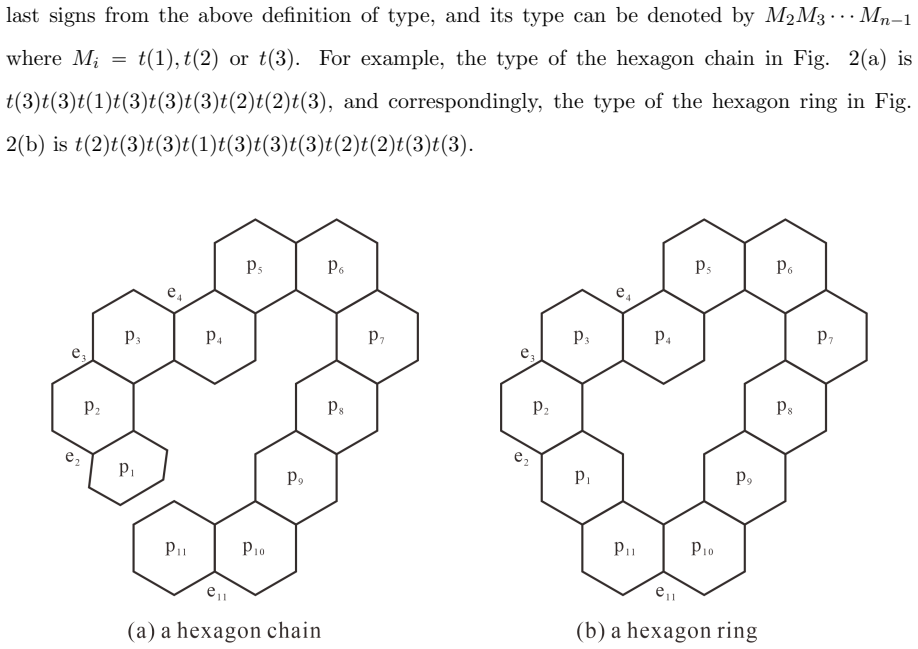
The maximal matching vector $\Psi_{xy}(G)$ is a nine-component column vector whose entries count maximal matchings of $G$ under nine conditions on the boundary vertices $x$ and $y$: unconstrained, with $x$ or $y$ removed, with both removed, with both required to be covered, and the four asymmetric combinations. The transfer matrices $S$, $L$, $R$, taken from the earlier chain result, propagate this vector along a hexagonal chain. For the ring, the chain is torn along edge $dc$, the graph $F$ is formed by gluing an arbitrary subgraph $K$ to the tear, and the nine decomposition lemmas (Lemmas 2.3–2.11) convert each boundary case into a column of the product matrix, so the closed ring corresponds to summing the diagonal, i.e., the trace. For general polygon rings, Algorithm 3.2 constructs the analogous $9\times 9$ transition matrix $T_{m,i}$ by listing the maximal matchings of a single $m$-gon with two distinguished edges and sorting them into the nine boundary categories.
What would settle it
Enumerate all maximal matchings by brute force for every hexagonal ring with a fixed small number of hexagons, for example all $3^6$ type sequences with $n=6$, and compare each count with the trace of the corresponding matrix product; any mismatch would refute Theorem 1.1. Independently, verify the nine identities in Lemmas 2.3–2.11 on the two-hexagon terminal subgraph $D$ for each of the three connection modes, and check Algorithm 3.2's matrices against direct computation of $\Psi_{ab}(Z)$ on small polygon chains.
Extended reading notes
Core claim
The central claim is Theorem 1.1: for a hexagonal ring $H$ with type $M_1 M_2 \cdots M_n$, where each $M_i$ is $t(1)$, $t(2)$, or $t(3)$, the number of maximal matchings is $\Psi(H)=\operatorname{tr}(\prod_{i=1}^{n} f(M_i))$, with $f(t(1))=L$, $f(t(2))=S$, $f(t(3))=R$. The proof tears the ring open along a shared edge to form a hexagonal chain, attaches an arbitrary subgraph to the two open ends, and classifies the maximal matchings of this auxiliary graph into nine cases by whether the two boundary edges $ed$ and $fc$ are included and whether the vertices $e$ and $f$ are covered. Nine lemmas (Lemmas 2.3–2.11) show that each case contributes exactly one diagonal entry of the product matrix $M=\prod_i f(M_i)$, so summing the cases gives the trace. Theorem 1.2 asserts the identical trace formula for arbitrary polygon rings, where each face's matrix $T_{s_i,j}$ is generated by Algorithm 3.2; the paper computes two examples as exact values.
Load-bearing premise
The load-bearing premise is that the unproved terminal identities asserted in Lemmas 2.3–2.11 hold for all three hexagon connection modes, and that Algorithm 3.2 correctly produces the transition matrices $T_{m,i}$, because every diagonal entry of the product matrix used in the trace is built from those steps.
Editorial extensions
If this is right
- For a hexagonal ring of any length, $\Psi(H)$ can be computed by multiplying $n$ $9\times 9$ matrices and taking the trace, giving an $O(n)$ algorithm with exact integer output.
- The same trace product works for rings with arbitrary polygonal faces once the finite family of matrices $T_{m,i}$ is generated for the face sizes appearing in the ring.
- The count depends only on the cyclic sequence of connection types, not on the geometric embedding, so topologically equivalent rings have identical maximal matching numbers.
Reading between the lines
- A direct brute-force enumeration of maximal matchings on small hexagonal rings (say $n \le 10$) and comparison with the trace formula would test the unproved terminal identities on which the proof depends.
- If the nine-state vector collapse works here, the same tearing-and-gluing trace argument may transfer to other planar 2-connected graphs whose faces meet their neighbours along single edges, such as rings of squares or mixed polygons.
- Symmetries of the matrices $S$, $L$, $R$ (and of the $T_{m,i}$) would imply congruences or identities among maximal matching counts of rings related by rotations or reflections; the paper does not explore these.
- The transfer-matrix form also suggests studying growth rates of $\Psi$ for families of rings as $n$ grows, governed by the spectral behaviour of the matrix product.
Editorial analysis
A structured set of objections, weighed in public.
Referee Report
Summary. The paper studies the number of maximal matchings in polygon rings, i.e., planar graphs obtained by cyclically gluing polygon chains. For hexagonal rings the authors state (Theorem 1.1) that the number of maximal matchings equals the trace of a product of 9-by-9 matrices S, L, and R assigned according to the connection types t(1), t(2), t(3), and they illustrate this with the value 2804280 for the ring in Fig. 2(b). The proof tears the ring along an edge into a hexagonal chain, introduces an auxiliary graph F, and decomposes maximal matchings into nine cases according to the status of the two edges ed and fc (Lemmas 2.3–2.11), each case contributing one diagonal entry of the product matrix M. The paper then extends the claim to arbitrary polygon rings (Theorem 1.2), introducing Algorithm 3.2 to generate 9-by-9 transition matrices T_{m,i} for each face size and connection type, and reports the value 481614 for the polygon ring in Fig. 1. The polygonal extension is stated without proof: Theorem 1.2 is justified only by 'So we omit its proof here,' and its foundational Lemma 3.1 is justified by a one-sentence appeal to Algorithm 3.2.
Significance. If the results are correct, they provide a compact and purely combinatorial transfer-matrix formula for maximal matchings of hexagonal and general polygon rings, with no fitted parameters and with exact numerical predictions. The explicit 9-by-9 matrices, the worked examples, and the absence of circularity are genuine strengths; the paper also builds transparently on the authors' earlier work [11]. However, the correctness of the main theorems currently rests on several unproved or underproved finite checks: the terminal two-hexagon identities in Lemmas 2.3–2.11 and the correctness of Algorithm 3.2 for arbitrary polygons. These are load-bearing rather than cosmetic: they determine the entries of the transfer matrices, and hence every value computed from the trace formula. Because these gaps appear fillable by supplying detailed verifications or a machine-checked certificate, the appropriate outcome is revision rather than rejection.
major comments (3)
- [§2.1, Lemmas 2.3–2.11 and Eq. (2)] The proof of Theorem 1.1 depends on nine lemmas whose terminal-hexagon identities are asserted rather than proved. For example, in Lemma 2.3 the three possible positions of the shared edge uv in the two-hexagon graph D are dismissed with 'it is easy to check that Ψ_xy(D) = f(M_{n-1}) f(M_n) e_4' (and similarly for the other cases in Lemmas 2.4–2.11). These identities determine the columns of the matrix M, and every diagonal entry summed in Eq. (2) is obtained from exactly one of them. The current manuscript gives no derivation and no explicit enumeration for these checks, so the proof of Theorem 1.1 is incomplete as written.
- [§3, Lemma 3.1] Lemma 3.1, the transfer-matrix statement for arbitrary polygon chains, is proved only by the sentence 'By the process of the Algorithm 3.2, this conclusion clearly holds.' This is not a proof. Algorithm 3.2 must establish three nontrivial facts: every maximal matching of the combined graph decomposes uniquely into a maximal matching of J1 and a maximal matching of K; the nine case conditions in steps (5.10.1)–(5.10.9) are exhaustive and disjoint; and the assigned column y is exactly the corresponding component of Ψ_{dc}(K). None of these is demonstrated, and the matrices T_{m,i} in Table 3.1 are therefore unsupported.
- [§3, Theorem 1.2] Theorem 1.2 is the stated extension of the trace formula to arbitrary polygon rings, but its proof is explicitly omitted: 'So we omit its proof here.' Since Theorem 1.2 depends on Lemma 3.1 and Algorithm 3.2, neither of which is proved, the central claim for arbitrary polygon rings is not established in the manuscript. The computed sample value 481614 for the ring in Fig. 1 rests on these unverified matrices, so its correctness cannot currently be assessed.
minor comments (4)
- [Tables 2.1 and 3.1] Both tables are announced but no actual data appear in the manuscript; readers cannot reproduce the claimed checks from the tables.
- [Throughout] There are several typos and notational slips, including 'maxiaml' in Lemma 2.4, 'Algprithm' in Section 3, and inconsistent use of 'trp' for trace; these should be corrected.
- [Theorem 1.2] The range 'tps_i, si−4q' is confusing and appears inconsistent with the earlier definition k_j ∈ [1, s_j−3]; for s_i = 4 this would include an invalid index 0.
- [Algorithm 3.2, step 5.10] The comments explaining the sets R, V, and V' are difficult to follow and should be rewritten as a precise definition, since the correctness of the column assignment depends on them.
Circularity Check
No circular reduction: the hexagonal trace formula is derived from published chain transfer matrices and new local lemmas; the polygon-ring extension rests on omitted proofs, but not on circularity.
full rationale
The claimed derivation is not circular. Theorem 1.1 is obtained by tearing the hexagonal ring along dc, applying the chain transfer matrices S, L, R from the authors' earlier published paper [11] (Theorems 2.1-2.2), decomposing maximal matchings of the auxiliary graph F into nine cases (Lemmas 2.3-2.11), and identifying each diagonal entry of M = product_i f(M_i) with one of the nine subcase counts; Equation (2) then sums these entries to tr(M). The local terminal-hexagon identities in Lemmas 2.3-2.11 are asserted as 'easy to check' or 'we can check' finite computations, but they do not presuppose the trace formula: they compute restricted maximal-matching vectors of the two-hexagon subgraph D and thereby determine the relevant columns of M. Thus the diagonal entries are derived, not fitted. No parameter is fitted to the final counts, and the printed values (2804280 and 481614) are computed from the stated matrices. The only self-citation is [11], which is transparent and supplies the chain-level transfer matrices; it is external published support rather than an unverified self-referential premise. The polygon-ring extension is less rigorously supported: Lemma 3.1 is justified only by 'By the process of the Algorithm 3.2, this conclusion clearly holds' and Theorem 1.2 by 'So we omit its proof here.' These are genuine proof gaps and a correctness risk, because Algorithm 3.2's nine-case classification and column assignments must be exhaustive and faithful for the trace formula to hold, but they are not circular: the algorithm defines T_{m,i} by enumerating matchings of the modified polygon J1 independently of the ring count. Overall circularity score is 1.
Assumptions & free parameters
assumptions (5)
- standard math Disjoint-union multiplicativity: Psi(G) = Psi(G1) * Psi(G2) when G is the disjoint union of G1 and G2.
- domain assumption Transfer-matrix identities of Theorem 2.1 and the chain formula of Theorem 2.2, imported from ref. [11]: Psi_ab(G) = S * Psi_dc(W), Psi_ga(G) = L * Psi_dc(W), Psi_bf(G) = R * Psi_dc(W).
- domain assumption The 9-state maximal-matching vector is a complete boundary description: a maximal matching of the ring is captured by one of the nine subcases of Section 2.2, with no overcounting.
- ad hoc to paper Terminal-hexagon computations in Lemmas 2.3-2.11: e.g. Psi_xy(D) = f(M_{n-1}) * f(M_n) * e_4 in all three connection modes (Lemma 2.3), with analogous identities for e_2, e_6, e_3, e_7, e_1, e_9, e_8, e_5 in the other lemmas.
- ad hoc to paper Algorithm 3.2 computes the transfer matrices T_{m,i} correctly (Lemma 3.1), and the conclusion extends to all polygon rings (Theorem 1.2).
Cite this review
Pith. "Pith review of The number of maximal matchings in polygon rings." pith.science (2026). https://pith.science/paper/JPRUFTHA
@misc{pith2026250608687,
  author       = {Pith},
  title        = {Pith review of: The number of maximal matchings in polygon rings},
  year         = {2026},
  howpublished = {\url{https://pith.science/paper/JPRUFTHA}},
  note         = {Machine review of arXiv:2506.08687}
}
abstract
A matching of graph $G$ is maximal if it cannot be expanded by adding any edge to create a larger matching. In this paper, for a hexagonal ring $H$ with $n$ hexagons, we show that the number of maximal matchings of $H$ equals to the trace of the product of $n$ matrices, each of which is $S$, $L$, or $R$ according to the type of the connection mode of $H$. Finally, we extend this conclusion to arbitrary polygon rings and provide an algorithm to determine the transition matrices of polygon chains (rings).
Figures


Figures from the paper (2 more)


Reference graph
Works this paper leans on
- [11]
-
[1]
R. Cruz, C. Mar ´ ın, and J. Rada. Computing the hosoya index of catacondensed hexagonal systems.MATCH Commun. Math. Comput. Chem, 77(3):749–764, 2017
work page 2017
-
[2]
S. Cyvin and I. Gutman. Kekul´ e structures in benzenoid hydrocarbons, volume 46 of. Lecture Notes in Chemistry, 1988
work page 1988
-
[3]
T. Doˇ sli´ c and T. Short. Maximal matchings in polyspiro and benzenoid chains.Applicable Analysis and Discrete Mathematics, 15(1):179–200, 2021
work page 2021
-
[4]
T. Doˇ slic and I. Zubac. Saturation number of benzenoid graphs.MATCH Commun. Math. Comput. Chem, 73:491–500, 2015
work page 2015
-
[5]
T. Doˇ slic and I. Zubac. Counting maximal matchings in linear polymers.Ars Math. Contemp, 11:255–276, 2016. 20
work page 2016
-
[6]
Z. Galil. Efficient algorithms for finding maximum matching in graphs.ACM Computing Surveys (CSUR), 18(1):23–38, 1986
work page 1986
-
[7]
J. G´ orska and Z. Skupie´ n. Trees with maximum number of maximal matchings.Discrete mathematics, 307(11-12):1367–1377, 2007
work page 2007
Show all 12 references
-
[8]
M. Klazar. Twelve countings with rooted plane trees.European Journal of Combinatorics, 18(2):195–210, 1997
1997
-
[9]
Lov´ asz and M
L. Lov´ asz and M. D. Plummer. Matching theory, vol. 29.Annals of Discrete Mathematics, North-Holland, Amsterdam, 1986
1986
-
[10]
M. S. Oz and I. N. Cangul. Computing the merrifield-simmons indices of benzenoid chains and double benzenoid chains.Journal of Applied Mathematics and Computing, 68(5):3263– 3293, 2022
2022
-
[12]
H. A. Staab, F. Diederich, and V. ˇCaplar. Cycloarenes, a new class of aromatic compounds, iii. studies towards the synthesis of cyclo [dedeededee] decakisbenzene.Liebigs Annalen der Chemie, 1983(12):2262–2273, 1983. 21
1983
Reviewed August 7, 2026 · model on record in the stance chip above.
Discussion (0). Sign in to comment.