REVIEW 3 major objections 5 minor 170 references
The influence of feedback on the baryonic content of haloes in the COLIBRE simulations
T0 review · 3 major / 5 minor · reviewed 2026-08-01 · deepseek-v4-flash
Pith's one-line read Halo gas fractions are a sensitive probe of feedback: COLIBRE and its predecessor produce similar galaxies but very different gas contents in groups and clusters, and the difference traces to a black-hole-mass-scaled AGN heating temperature
desk verdict Solid, transparent simulation paper with genuinely new COLIBRE gas-fraction predictions, but the abstract oversells the resolution/dataset dependence of the 'better agreement' claim. read the letter →
The pith
A machine-rendered reading of the paper's core claim, the machinery that carries it, and where it could break.
The reading
What carries the argument
The load-bearing object is the AGN heating temperature increment ΔT_AGN, which scales with black hole mass, so the energy per feedback event grows with it. This scaling lets AGN feedback expel gas from the deep potential wells of groups and clusters, where a fixed heating increment fails. The hybrid model applies the same idea through a jet velocity scaling with the square root of black hole mass, half the energy traveling in collimated jets that couple to gas efficiently. A second mechanism, a supernova heating temperature scaling with gas density, makes stellar feedback gentler and raises gas fractions in dwarf haloes. These scalings drive the non-monotonic f_gas-M relation and COLIBRE's l
What would settle it
The cleanest check is a single-change simulation: take the fiducial model at fixed resolution and replace the BH-mass-scaled ΔT_AGN with a fixed value (the predecessor's 10^8.5 K) without re-calibrating anything; if group gas fractions do not rise back toward the predecessor's values, the scaling is not the cause. Observationally, the available group gas fractions are mutually inconsistent: a cross-calibration of eROSITA stacks, XMM-Newton profiles, and kSZ baryonification constraints at M500 ~ 10^13-10^14 M_sun that converged on one value would decide whether the low fractions the hybrid mode
Extended reading notes
Core claim
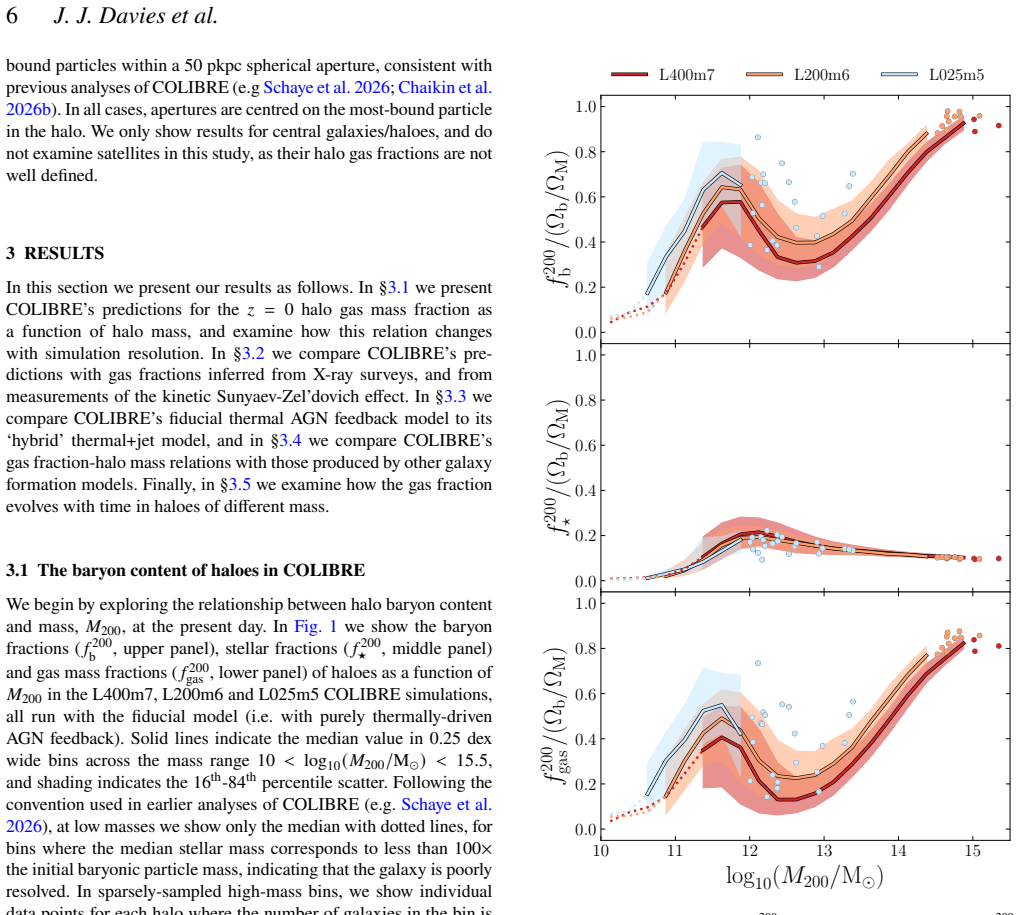
COLIBRE's claim: halo gas fractions are non-monotonic in halo mass, peaking near 10^11.5-12 M_sun; supernova feedback strips dwarf haloes, AGN feedback depletes groups and clusters. The fiducial thermal model, whose heating increment ΔT_AGN scales with black hole mass, matches Chandra/XMM-Newton gas fractions but runs high versus eROSITA stacks and kSZ-derived values; the hybrid thermal-plus-jet model runs lower and matches those newer data. The paper attributes the reduction mostly to the BH-mass scaling, which makes feedback events more energetic where potential wells are deepest; most expulsion occurs above the predecessor's fixed 10^8.5 K heating. Both variants were calibrated to observe
Load-bearing premise
The claim that black-hole-mass-scaled AGN heating is what makes COLIBRE's groups and clusters gas-poor rests on model variants that removed that feature while also re-calibrating other parameters, so the scaling itself, rather than a correlated choice such as black hole seed mass or coupling efficiency, is the assumed cause—and separately, gas fractions rise with resolution, so the observed-level comparison is not unique.
Editorial extensions
If this is right
- Simulations whose AGN heating does not grow with black hole mass will tend to over-predict the gas content of groups and clusters, and hence under-predict the feedback-driven suppression of the matter power spectrum on group scales; Appendix D shows COLIBRE expels most baryons with a heating temperature well above the predecessor's fixed value.
- Galaxy-scale observables alone cannot fix the baryon content of haloes: two calibrated COLIBRE variants pass the same galaxy tests yet differ significantly in halo gas, a degeneracy the paper argues only halo-gas observations can break.
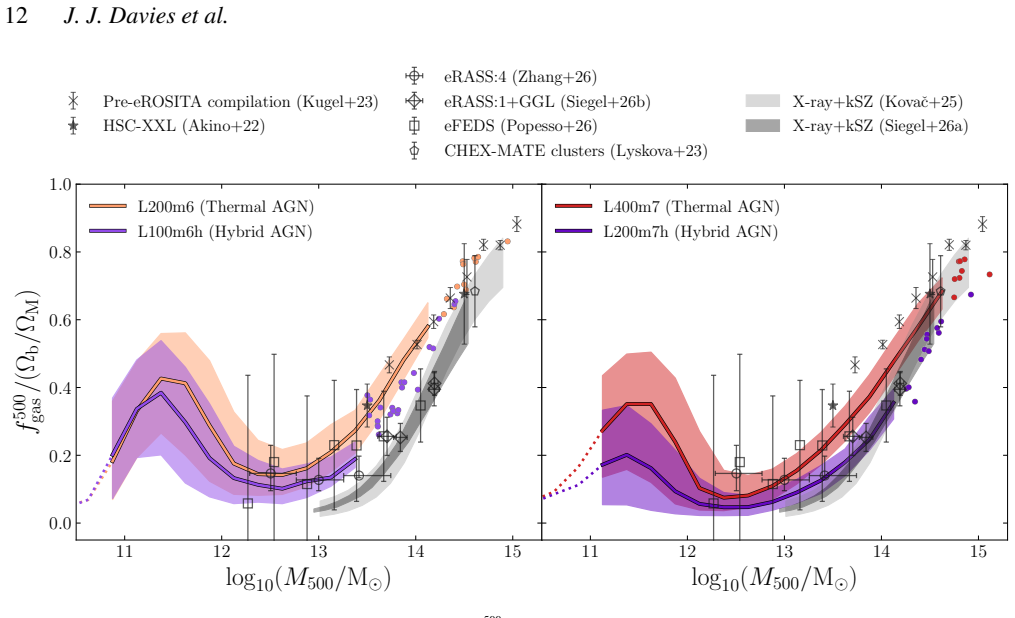
- The hybrid jet model reaches the low group gas fractions suggested by eROSITA and kSZ data within a model that still matches galaxy populations, showing the stronger feedback those data appear to require is compatible with a successful galaxy formation model (with the paper's caveat that comparably strong models can fail like-for-like X-ray comparisons of cluster thermodynamics).
- Gas fractions increase with resolution at fixed halo mass in COLIBRE, so the same physics gives different observed-level gas fractions at different resolutions; any simulation-observation comparison must be read at a specified resolution.
- The expulsion-then-re-accretion sequence — clusters re-accrete gas and end up gas-rich while groups stay depleted — explains how strong-feedback models can lower group gas fractions without over-depleting clusters, because cluster progenitors were depleted less and replenish later.
Reading between the lines
- A controlled experiment the paper does not run: replace ΔT_AGN with a fixed value inside the fiducial model without re-calibrating anything, and re-measure group-scale gas fractions; the paper's re-calibrated variants leave the scaling entangled with other parameter changes, so this single-change test would isolate the cause.
- The resolution trend means inferred feedback strength from kSZ and X-ray 'missing baryons' analyses is likely resolution-degenerate in the same direction: higher-resolution runs of one model bracket observations differently, so observational claims of strong feedback should be quoted against a specific resolution.
- COLIBRE's cold-gas census — up to half of halo gas below 10^4.5 K at M200 near 10^11.4 M_sun, down to 10 K — is invisible to the X-ray and kSZ constraints this paper compares against; CGM absorption-line surveys of low-mass haloes could test that temperature breakdown directly.
- The lower group gas fractions imply stronger baryon-feedback suppression of the matter power spectrum on group scales than the predecessor predicted; plugging COLIBRE's f_gas relation into baryonification fits to kSZ data is a direct way to test whether a COLIBRE-like baryon model also addresses the current S8 tension.
Editorial analysis
A structured set of objections, weighed in public.
Referee Report
Summary. The paper presents predictions for the z=0 halo gas mass fraction relation f_gas-M_200 in the COLIBRE cosmological simulations, using three resolution levels and two AGN feedback prescriptions (fiducial thermal and hybrid thermal/jet). It reports a non-monotonic relation, a multiphase census of halo gas, and significant resolution dependence. Comparisons with X-ray and kSZ constraints show that the m6 fiducial model matches pre-eROSITA X-ray data while the m7 hybrid model matches eROSITA and kSZ constraints. The paper argues that COLIBRE generally produces lower group/cluster gas fractions than EAGLE and most contemporary simulations, attributes this mainly to the BH-mass-dependent AGN heating temperature ΔT_AGN (and, in the hybrid model, to jets), and explores the redshift history of gas expulsion and re-accretion.
Significance. The strength of the paper is that COLIBRE was calibrated to galaxy stellar mass functions and size-mass relations, not to halo gas fractions, so the f_gas-M_200 relation is a genuine prediction. The use of multiple resolutions and two calibrated AGN prescriptions, plus the comparison with a broad set of observational constraints, makes this a valuable contribution. The demonstration that two models with similar galaxy populations can have substantially different halo gas content is an important result for feedback modelling. The paper is also transparent about the non-convergence with resolution and the inconsistency between observational datasets. If the claims are appropriately qualified, this will be a useful reference for interpreting eROSITA and kSZ constraints.
major comments (3)
- [Abstract; §3.1.2, Fig. 3] The headline claim that "COLIBRE produces lower gas fractions for groups and clusters than EAGLE and other contemporary simulations, and better agreement with observational constraints" is not a single, resolution-independent claim. §3.1.2 and Fig. 1 show that f_gas at fixed M_200 increases with resolution and is not converged. In Fig. 3, the m6 fiducial simulation agrees with the pre-eROSITA X-ray compilation but is high relative to eROSITA/kSZ constraints, while the m7 simulation falls below the pre-eROSITA data. In Fig. 4, the m7 hybrid model matches eROSITA/kSZ but is low relative to pre-eROSITA data. Since §3.2.3 states that the observational constraints are mutually inconsistent, "better agreement" is conditional on choosing one resolution and one dataset. The body is transparent about this, but the abstract and the summary bullets present the result as robust and unique. Please qu
- [§3.4.1, Appendix C/D] The causal attribution of COLIBRE's lower group/cluster gas fractions relative to EAGLE to the BH-mass-dependent ΔT_AGN (Eq. 7) is only partially supported. The model variants in Appendix C were each independently recalibrated, and the paper itself states that "the removal of individual model features ... are therefore not strictly the only changes made." The non-calibrated AGN parameter variations in Fig. C1 do show that ΔT_AGN affects f_gas, and Appendix D shows that in L200m6 the bulk of AGN-driven expulsion occurs at ΔT_AGN higher than EAGLE's fixed 10^8.5 K. However, other BH modelling changes (repositioning, super-Eddington accretion, changed energy injection method) are acknowledged as potential contributors. The conclusion that the improvement "can be attributed to" the ΔT_AGN scaling is therefore stronger than the evidence. Please soften to "is consistent with" or, ideally, add
- [§3.3, Fig. 4] The comparison between the fiducial and hybrid AGN models is not a controlled experiment: the hybrid simulations also use different calibrated values of the BH seed mass and feedback efficiencies, and §3.3 states that the seed-mass difference amplifies the m7 difference. Thus the statement "the hybrid AGN feedback model produces lower gas fractions" describes the effect of the whole recalibrated model variant, not of the jet prescription alone. This distinction matters for the abstract's claim that a "hybrid AGN feedback model" produces lower gas fractions. Either present these as model-level comparisons, or add a run in which only the jet/wind mechanism is changed while all other calibration parameters are held fixed.
minor comments (5)
- [Fig. 2 / Fig. A1] The stacked temperature-bin bars in Fig. 2 and Fig. A1 are informative, but the stacking order is not stated. A sentence in the caption explaining the order (e.g. coldest at bottom) would help.
- [Fig. 3] The grey shaded bands from the two baryonification models are easily confused with individual data points. Consider using labelled filled bands with distinct edge styles.
- [§2.4] The definition of f_gas includes all gas within r_500, while the X-ray/kSZ constraints largely trace hot gas. The temperature-cut comparison is given later, but a one-sentence reminder in the Fig. 3/4 captions would improve readability.
- [§3.2.1] Typo: "observational contraints" should be "observational constraints."
- [Appendix C] The model variant names (ThermalKinetic_varΔT_SN_varfE etc.) are hard to parse. A small table or a list with the deactivated features would make the comparison much easier to follow.
Circularity Check
No significant circularity: the fgas predictions are not calibrated inputs and the key attributions are tested by controlled model variants.
full rationale
The paper's central claim is that COLIBRE's fgas-M200 relation is a prediction of a model calibrated to galaxy stellar masses and sizes, not to halo gas fractions. The paper states explicitly: 'the subgrid prescriptions in COLIBRE and the parameter values used in those prescriptions were not calibrated at any resolution to reproduce observed constraints on halo gas fractions' (Section 3.1.2). The comparison with X-ray, eROSITA, and kSZ data is therefore a genuine out-of-sample test, not a fitted parameter renamed as a prediction. The attribution of COLIBRE's lower group/cluster gas fractions to the BH-mass-dependent AGN heating temperature (Eq. 7) is supported by controlled, non-calibrated variants in Appendix C (right panel of Fig. C1) in which only DeltaT_AGN or epsilon_f is varied, and by the redshift evolution of DeltaT_AGN in Appendix D. The left panel of Fig. C1 does use individually recalibrated variants from Chaikin et al. (2026b), and the paper honestly notes that 'the removal of individual model features ... are therefore not strictly the only changes made'; this is a limitation on isolating individual feedback components, but it is not circular because the recalibration targets are galaxy population observables, not fgas. Self-citations to Schaye et al. (2026), Chaikin et al. (2026b), and Huško et al. (2026) define the simulation model and its calibration, which is standard practice; they do not supply the fgas values or the agreement with observations, which are computed and compared here for the first time. No self-definitional loop, no uniqueness theorem imported from the authors, and no ansatz smuggled in via citation were found. The resolution and dataset dependence of the observational comparison is a scientific caveat, not circularity.
Assumptions & free parameters
free parameters (7)
- f_E,min (minimum CCSN energy per supernova) =
0.1–0.8 (calibrated per resolution)
- P_E,pivot (pressure pivot for f_E) =
8.0e3–1.5e4 K cm^-3
- n_H,pivot (density pivot for ΔT_SN) =
0.5–1.5 cm^-3
- ΔT_AGN,max (maximum AGN heating temperature) =
10^9.5 K (m7), 10^10 K (m6/m5)
- ε_f (AGN feedback coupling efficiency) =
0.1 (m7), 0.05 (m6/m5)
- m_BH,seed (SMBH seed mass) =
2e4–5e5 M_sun
- Hybrid AGN jet/wind efficiencies (ε_jet, ε_wind, ε_accr)
assumptions (4)
- domain assumption DES Y3 ΛCDM cosmology (Ω_M=0.306, Ω_b=0.0486, σ8=0.807, h=0.681, n_s=0.967, m_ν=0.06 eV) is the correct background cosmology.
- domain assumption Subgrid prescriptions for unresolved processes (cooling/chemistry, star formation, SN/AGN feedback) are adequate representations of the real physics that sets halo gas fractions.
- domain assumption The SPHENIX SPH scheme and Swift code accurately capture hydrodynamics at resolved scales, including multiphase gas, outflows, and halo gas retention.
- domain assumption HBT-HERONS and SOAP correctly identify central haloes/subhaloes and define M_200/M_500 and gas fractions.
Cite this review
Pith. "Pith review of The influence of feedback on the baryonic content of haloes in the COLIBRE simulations." pith.science (2026). https://pith.science/paper/JQ2L3ZY2
@misc{pith2026260727319,
  author       = {Pith},
  title        = {Pith review of: The influence of feedback on the baryonic content of haloes in the COLIBRE simulations},
  year         = {2026},
  howpublished = {\url{https://pith.science/paper/JQ2L3ZY2}},
  note         = {Machine review of arXiv:2607.27319}
}
abstract
We present predictions for the relation between the halo gas mass fraction and halo mass, $f_{\rm gas}^{200}-M_{200}$, from the COLIBRE cosmological simulations of galaxy formation, and explore how the gas content of haloes is influenced by feedback from supernovae and active galactic nuclei (AGN) over time. The $f_{\rm gas}^{200}-M_{200}$ relation in COLIBRE is non-monotonic, with a peak at $M_{200}\sim 10^{11.5-12}$~M$_\odot$. Below this mass, feedback from supernovae efficiently expels gas from the haloes of dwarf galaxies, and above it, AGN feedback efficiently depletes the haloes of galaxy groups. The fiducial COLIBRE model yields gas fractions for galaxy groups and clusters that agree with constraints from Chandra and XMM-Newton X-ray data, but which are high relative to gas fractions inferred from eROSITA stacks and measurements of the kinetic Sunyaev-Zel-dovich (kSZ) effect. COLIBRE's hybrid AGN feedback model, which combines thermal and jet-driven feedback, produces lower gas fractions in better agreement with eROSITA and kSZ measurements. COLIBRE produces lower gas fractions for groups and clusters than EAGLE and other contemporary simulations, and better agreement with observational constraints. We investigate the origin of this improvement relative to EAGLE, and how the resolution of the simulation affects the impact of feedback. Our results demonstrate that halo gas fractions are a sensitive probe of feedback physics, and that they can differ significantly between simulations that otherwise produce very similar galaxy populations.
Figures


Figures from the paper (4 more)


Reference graph
Works this paper leans on
-
[1]
Abbott T. M. C., et al., 2022, @doi [ ] 10.1103/PhysRevD.105.023520 , https://ui.adsabs.harvard.edu/abs/2022PhRvD.105b3520A 105, 023520
-
[2]
Akino D., et al., 2022, @doi [ ] 10.1093/pasj/psab115 , https://ui.adsabs.harvard.edu/abs/2022PASJ...74..175A 74, 175
-
[3]
Amon A., Efstathiou G., 2022, @doi [ ] 10.1093/mnras/stac2429 , https://ui.adsabs.harvard.edu/abs/2022MNRAS.516.5355A 516, 5355
-
[4]
Appleby S., Dav \'e R., Sorini D., Storey-Fisher K., Smith B., 2021, @doi [ ] 10.1093/mnras/stab2310 , https://ui.adsabs.harvard.edu/abs/2021MNRAS.507.2383A 507, 2383
-
[5]
Ayromlou M., Nelson D., Pillepich A., 2023, @doi [ ] 10.1093/mnras/stad2046 , https://ui.adsabs.harvard.edu/abs/2023MNRAS.524.5391A 524, 5391
-
[6]
Bah \'e Y. M., et al., 2022, @doi [ ] 10.1093/mnras/stac1339 , https://ui.adsabs.harvard.edu/abs/2022MNRAS.516..167B 516, 167
-
[7]
Balzer F., et al., 2025, @doi [ ] 10.1051/0004-6361/202553942 , https://ui.adsabs.harvard.edu/abs/2025A&A...701A.283B 701, A283
-
[8]
Ben \' tez-Llambay A., et al., 2026, @doi [ ] 10.1093/mnras/stag268 , https://ui.adsabs.harvard.edu/abs/2026MNRAS.546ag268B 546, stag268
Show all 170 references
-
[9]
Bigwood L., et al., 2024, @doi [ ] 10.1093/mnras/stae2100 , https://ui.adsabs.harvard.edu/abs/2024MNRAS.534..655B 534, 655
2024 doi
-
[10]
arXiv:2510.15822
Bigwood L., et al., 2025a, @doi [arXiv e-prints] 10.48550/arXiv.2510.15822 , https://ui.adsabs.harvard.edu/abs/2025arXiv251015822B p. arXiv:2510.15822
-
[11]
A., Ir s i c V., Amon A., Sijacki D., 2025b, @doi [ ] 10.1093/mnras/staf1435 , https://ui.adsabs.harvard.edu/abs/2025MNRAS.542.3206H 542, 3206
Bigwood L., Bourne M. A., Ir s i c V., Amon A., Sijacki D., 2025b, @doi [ ] 10.1093/mnras/staf1435 , https://ui.adsabs.harvard.edu/abs/2025MNRAS.542.3206H 542, 3206
-
[12]
D., Znajek R
Blandford R. D., Znajek R. L., 1977, @doi [ ] 10.1093/mnras/179.3.433 , https://ui.adsabs.harvard.edu/abs/1977MNRAS.179..433B 179, 433
1977 doi
-
[13]
Bondi H., 1952, @doi [ ] 10.1093/mnras/112.2.195 , https://ui.adsabs.harvard.edu/abs/1952MNRAS.112..195B 112, 195
1952 doi
-
[14]
M., Schaye J., 2009, @doi [ ] 10.1111/j.1365-2966.2009.15043.x , https://ui.adsabs.harvard.edu/abs/2009MNRAS.398...53B 398, 53
Booth C. M., Schaye J., 2009, @doi [ ] 10.1111/j.1365-2966.2009.15043.x , https://ui.adsabs.harvard.edu/abs/2009MNRAS.398...53B 398, 53
2009
-
[15]
M., Schaye J., 2010, @doi [ ] 10.1111/j.1745-3933.2010.00832.x , https://ui.adsabs.harvard.edu/abs/2010MNRAS.405L...1B 405, L1
Booth C. M., Schaye J., 2010, @doi [ ] 10.1111/j.1745-3933.2010.00832.x , https://ui.adsabs.harvard.edu/abs/2010MNRAS.405L...1B 405, L1
2010
-
[16]
Borrow J., Borrisov A., 2020, @doi [The Journal of Open Source Software] 10.21105/joss.02430 , https://ui.adsabs.harvard.edu/abs/2020JOSS....5.2430B 5, 2430
2020 doi
-
[17]
G., Schaye J., 2022, @doi [ ] 10.1093/mnras/stab3166 , https://ui.adsabs.harvard.edu/abs/2022MNRAS.511.2367B 511, 2367
Borrow J., Schaller M., Bower R. G., Schaye J., 2022, @doi [ ] 10.1093/mnras/stab3166 , https://ui.adsabs.harvard.edu/abs/2022MNRAS.511.2367B 511, 2367
2022 doi
-
[18]
G., Schaye J., Frenk C
Bower R. G., Schaye J., Frenk C. S., Theuns T., Schaller M., Crain R. A., McAlpine S., 2017, @doi [ ] 10.1093/mnras/stw2735 , https://ui.adsabs.harvard.edu/abs/2017MNRAS.465...32B 465, 32
2017 doi
-
[19]
Braspenning J., et al., 2024, @doi [ ] 10.1093/mnras/stae1436 , https://ui.adsabs.harvard.edu/abs/2024MNRAS.533.2656B 533, 2656
2024 doi
-
[20]
Bulbul E., et al., 2024, @doi [ ] 10.1051/0004-6361/202348264 , https://ui.adsabs.harvard.edu/abs/2024A&A...685A.106B 685, A106
2024 doi
-
[21]
CHEX-MATE Collaboration et al., 2021, @doi [ ] 10.1051/0004-6361/202039632 , https://ui.adsabs.harvard.edu/abs/2021A&A...650A.104C 650, A104
2021 doi
-
[22]
D., Kraft R
Chadayammuri U., Bogd \'a n \'A ., Oppenheimer B. D., Kraft R. P., Forman W. R., Jones C., 2022, @doi [ ] 10.3847/2041-8213/ac8936 , https://ui.adsabs.harvard.edu/abs/2022ApJ...936L..15C 936, L15
2022 doi
-
[23]
M., Nobels F
Chaikin E., Schaye J., Schaller M., Bah \'e Y. M., Nobels F. S. J., Ploeckinger S., 2022, @doi [ ] 10.1093/mnras/stac1132 , https://ui.adsabs.harvard.edu/abs/2022MNRAS.514..249C 514, 249
2022 doi
-
[24]
Chaikin E., Schaye J., Schaller M., Ben \' tez-Llambay A., Nobels F. S. J., Ploeckinger S., 2023, @doi [ ] 10.1093/mnras/stad1626 , https://ui.adsabs.harvard.edu/abs/2023MNRAS.523.3709C 523, 3709
2023 doi
-
[25]
G., Ploeckinger S., Schaller M., 2026a, @doi [arXiv e-prints] 10.48550/arXiv.2601.15207 , https://ui.adsabs.harvard.edu/abs/2026arXiv260115207C p
Chaikin E., Schaye J., Hu s ko F., Lacey C. G., Ploeckinger S., Schaller M., 2026a, @doi [arXiv e-prints] 10.48550/arXiv.2601.15207 , https://ui.adsabs.harvard.edu/abs/2026arXiv260115207C p. arXiv:2601.15207
-
[26]
Chaikin E., et al., 2026b, @doi [ ] 10.1093/mnras/stag300 , https://ui.adsabs.harvard.edu/abs/2026MNRAS.548ag300C 548, stag300
-
[27]
Chaikin E., et al., 2026c, @doi [ ] 10.1093/mnras/stag740 , https://ui.adsabs.harvard.edu/abs/2026MNRAS.548ag740C 548, stag740
-
[28]
A., et al., 2026, @doi [ ] 10.1093/mnras/stag645 , https://ui.adsabs.harvard.edu/abs/2026MNRAS.548ag645C 548, stag645
Correa C. A., et al., 2026, @doi [ ] 10.1093/mnras/stag645 , https://ui.adsabs.harvard.edu/abs/2026MNRAS.548ag645C 548, stag645
2026 doi
- [29]
-
[30]
A., van de Voort F., 2023, @doi [ ] 10.1146/annurev-astro-041923-043618 , https://ui.adsabs.harvard.edu/abs/2023ARA&A..61..473C 61, 473
Crain R. A., van de Voort F., 2023, @doi [ ] 10.1146/annurev-astro-041923-043618 , https://ui.adsabs.harvard.edu/abs/2023ARA&A..61..473C 61, 473
2023 doi
-
[31]
A., et al., 2015, @doi [ ] 10.1093/mnras/stv725 , https://ui.adsabs.harvard.edu/abs/2015MNRAS.450.1937C 450, 1937
Crain R. A., et al., 2015, @doi [ ] 10.1093/mnras/stv725 , https://ui.adsabs.harvard.edu/abs/2015MNRAS.450.1937C 450, 1937
2015 doi
-
[32]
Dalal N., To C.-H., Hirata C., Hyeon-Shin T., Hilton M., Pandey S., Richard Bond J., 2026, @doi [ ] 10.1088/1475-7516/2026/03/036 , https://ui.adsabs.harvard.edu/abs/2026JCAP...03..036D 2026, 036
2026 doi
-
[33]
Dalla Vecchia C., Schaye J., 2012, @doi [ ] 10.1111/j.1365-2966.2012.21704.x , https://ui.adsabs.harvard.edu/abs/2012MNRAS.426..140D 426, 140
2012
-
[34]
Das S., Truong N., Chiang Y.-K., Mathur S., 2025, @doi [ ] 10.3847/1538-4357/adfdd6 , https://ui.adsabs.harvard.edu/abs/2025ApJ...991..205D 991, 205
2025 doi
-
[35]
H., Appleby S., 2019, @doi [ ] 10.1093/mnras/stz937 , https://ui.adsabs.harvard.edu/abs/2019MNRAS.486.2827D 486, 2827
Dav \'e R., Angl \'e s-Alc \'a zar D., Narayanan D., Li Q., Rafieferantsoa M. H., Appleby S., 2019, @doi [ ] 10.1093/mnras/stz937 , https://ui.adsabs.harvard.edu/abs/2019MNRAS.486.2827D 486, 2827
2019 doi
-
[36]
J., Crain R
Davies J. J., Crain R. A., McCarthy I. G., Oppenheimer B. D., Schaye J., Schaller M., McAlpine S., 2019, @doi [ ] 10.1093/mnras/stz635 , https://ui.adsabs.harvard.edu/abs/2019MNRAS.485.3783D 485, 3783
2019 doi
-
[37]
J., Crain R
Davies J. J., Crain R. A., Oppenheimer B. D., Schaye J., 2020, @doi [ ] 10.1093/mnras/stz3201 , https://ui.adsabs.harvard.edu/abs/2020MNRAS.491.4462D 491, 4462
2020 doi
-
[38]
J., Pontzen A., Crain R
Davies J. J., Pontzen A., Crain R. A., 2022, @doi [ ] 10.1093/mnras/stac1742 , https://ui.adsabs.harvard.edu/abs/2022MNRAS.515.1430D 515, 1430
2022 doi
-
[39]
J., Pontzen A., Crain R
Davies J. J., Pontzen A., Crain R. A., 2024, @doi [ ] 10.1093/mnras/stad3456 , https://ui.adsabs.harvard.edu/abs/2024MNRAS.527.4705D 527, 4705
2024 doi
-
[40]
P., Meyer M., Robotham A., Obreschkow D., Popesso P., Comparat J., 2024, @doi [ ] 10.1093/mnras/stae2485 , https://ui.adsabs.harvard.edu/abs/2024MNRAS.535.2357D 535, 2357
Dev A., Driver S. P., Meyer M., Robotham A., Obreschkow D., Popesso P., Comparat J., 2024, @doi [ ] 10.1093/mnras/stae2485 , https://ui.adsabs.harvard.edu/abs/2024MNRAS.535.2357D 535, 2357
2024 doi
-
[41]
Dey A., et al., 2019, @doi [ ] 10.3847/1538-3881/ab089d , https://ui.adsabs.harvard.edu/abs/2019AJ....157..168D 157, 168
2019 doi
-
[42]
Di Matteo T., Springel V., Hernquist L., 2005, @doi [ ] 10.1038/nature03335 , https://ui.adsabs.harvard.edu/abs/2005Natur.433..604D 433, 604
2005 doi
-
[43]
arXiv:2504.01061
Dolag K., et al., 2025, @doi [arXiv e-prints] 10.48550/arXiv.2504.01061 , https://ui.adsabs.harvard.edu/abs/2025arXiv250401061D p. arXiv:2504.01061
2025 doi
-
[44]
P., et al., 2022, @doi [ ] 10.1093/mnras/stac472 , https://ui.adsabs.harvard.edu/abs/2022MNRAS.513..439D 513, 439
Driver S. P., et al., 2022, @doi [ ] 10.1093/mnras/stac472 , https://ui.adsabs.harvard.edu/abs/2022MNRAS.513..439D 513, 439
2022 doi
-
[45]
Eckert D., et al., 2016, @doi [ ] 10.1051/0004-6361/201527293 , https://ui.adsabs.harvard.edu/abs/2016A&A...592A..12E 592, A12
2016 doi
-
[46]
Eckert D., Gastaldello F., O'Sullivan E., Finoguenov A., Brienza M., X-GAP Collaboration 2024, @doi [Galaxies] 10.3390/galaxies12030024 , https://ui.adsabs.harvard.edu/abs/2024Galax..12...24E 12, 24
2024 doi
-
[47]
Eckert D., et al., 2026, @doi [ ] 10.1051/0004-6361/202558334 , https://ui.adsabs.harvard.edu/abs/2026A&A...709L...4E 709, L4
2026 doi
-
[48]
Efstathiou G., McCarthy F., 2025, @doi [ ] 10.1093/mnras/staf709 , https://ui.adsabs.harvard.edu/abs/2025MNRAS.540.1055E 540, 1055
2025 doi
-
[50]
J., Helly J., McGibbon R., Schaye J., Schaller M., Han J., Kugel R., Bah \'e Y
Forouhar Moreno V. J., Helly J., McGibbon R., Schaye J., Schaller M., Han J., Kugel R., Bah \'e Y. M., 2025, @doi [ ] 10.1093/mnras/staf1478 , https://ui.adsabs.harvard.edu/abs/2025MNRAS.tmp.1440F
2025 doi
-
[51]
Gatti M., et al., 2022, @doi [Phys. Rev. D] 10.1103/PhysRevD.105.123525 , 105, 123525
2022 doi
-
[52]
Gebhardt M., et al., 2024, @doi [Monthly Notices of the Royal Astronomical Society] 10.1093/mnras/stae817 , 529, 4896
2024 doi
-
[53]
K., Schneider A., 2021, @doi [ ] 10.1088/1475-7516/2021/12/046 , https://ui.adsabs.harvard.edu/abs/2021JCAP...12..046G 2021, 046
Giri S. K., Schneider A., 2021, @doi [ ] 10.1088/1475-7516/2021/12/046 , https://ui.adsabs.harvard.edu/abs/2021JCAP...12..046G 2021, 046
2021 doi
-
[54]
A., Zhang Y., Shreeram S., Br \"u ggen M., Bulbul E., 2025, @doi [ ] 10.3847/1538-4357/ae100f , https://ui.adsabs.harvard.edu/abs/2025ApJ...994...89G 994, 89
Grayson S., Scannapieco E., Comparat J., ZuHone J. A., Zhang Y., Shreeram S., Br \"u ggen M., Bulbul E., 2025, @doi [ ] 10.3847/1538-4357/ae100f , https://ui.adsabs.harvard.edu/abs/2025ApJ...994...89G 994, 89
2025 doi
-
[55]
T., 2026, @doi [ ] 10.3847/1538-4357/ae3dac , https://ui.adsabs.harvard.edu/abs/2026ApJ...999....9G 999, 9
Grayson S., Scannapieco E., Dav \'e R., Babul A., Hough R. T., 2026, @doi [ ] 10.3847/1538-4357/ae3dac , https://ui.adsabs.harvard.edu/abs/2026ApJ...999....9G 999, 9
2026 doi
-
[56]
Hadzhiyska B., et al., 2025a, @doi [ ] 10.1103/kclp-x5j1 , https://ui.adsabs.harvard.edu/abs/2025PhRvD.112h3509H 112, 083509
-
[57]
S., Sailer N., Zhou R., 2025b, @doi [ ] 10.1103/mdhz-fgj8 , https://ui.adsabs.harvard.edu/abs/2025PhRvD.112l3507H 112, 123507
Hadzhiyska B., Ferraro S., Farren G. S., Sailer N., Zhou R., 2025b, @doi [ ] 10.1103/mdhz-fgj8 , https://ui.adsabs.harvard.edu/abs/2025PhRvD.112l3507H 112, 123507
-
[58]
E., 2020, MUSIC2-monofonIC: 3LPT initial condition generator , Astrophysics Source Code Library, record ascl:2008.024 ( @eprint ascl 2008.024 )
Hahn O., Michaux M., Rampf C., Uhlemann C., Angulo R. E., 2020, MUSIC2-monofonIC: 3LPT initial condition generator , Astrophysics Source Code Library, record ascl:2008.024 ( @eprint ascl 2008.024 )
2020
-
[59]
S., Benitez-Llambay A., Helly J., 2018, @doi [ ] 10.1093/mnras/stx2792 , https://ui.adsabs.harvard.edu/abs/2018MNRAS.474..604H 474, 604
Han J., Cole S., Frenk C. S., Benitez-Llambay A., Helly J., 2018, @doi [ ] 10.1093/mnras/stx2792 , https://ui.adsabs.harvard.edu/abs/2018MNRAS.474..604H 474, 604
2018 doi
-
[60]
M., Costa T., Tadhunter C
Harrison C. M., Costa T., Tadhunter C. N., Fl \"u tsch A., Kakkad D., Perna M., Vietri G., 2018, @doi [Nature Astronomy] 10.1038/s41550-018-0403-6 , https://ui.adsabs.harvard.edu/abs/2018NatAs...2..198H 2, 198
2018 doi
-
[61]
M., Best P
Heckman T. M., Best P. N., 2014, @doi [Annual Review of Astronomy and Astrophysics] 10.1146/annurev-astro-081913-035722 , 52, 589–660
2014 doi
- [62]
-
[63]
A., Puchwein E., Shen S., Sijacki D., 2018, @doi [ ] 10.1093/mnras/sty1780 , https://ui.adsabs.harvard.edu/abs/2018MNRAS.479.5385H 479, 5385
Henden N. A., Puchwein E., Shen S., Sijacki D., 2018, @doi [ ] 10.1093/mnras/sty1780 , https://ui.adsabs.harvard.edu/abs/2018MNRAS.479.5385H 479, 5385
2018 doi
-
[64]
Hirschmann M., Dolag K., Saro A., Bachmann L., Borgani S., Burkert A., 2014, @doi [ ] 10.1093/mnras/stu1023 , https://ui.adsabs.harvard.edu/abs/2014MNRAS.442.2304H 442, 2304
2014 doi
-
[65]
T., Rennehan D., Kobayashi C., Loubser S
Hough R. T., Rennehan D., Kobayashi C., Loubser S. I., Dav \'e R., Babul A., Cui W., 2023, @doi [ ] 10.1093/mnras/stad2394 , https://ui.adsabs.harvard.edu/abs/2023MNRAS.525.1061H 525, 1061
2023 doi
-
[66]
A., 1939, @doi [Proceedings of the Cambridge Philosophical Society] 10.1017/S0305004100021150 , https://ui.adsabs.harvard.edu/abs/1939PCPS...35..405H 35, 405
Hoyle F., Lyttleton R. A., 1939, @doi [Proceedings of the Cambridge Philosophical Society] 10.1017/S0305004100021150 , https://ui.adsabs.harvard.edu/abs/1939PCPS...35..405H 35, 405
1939 doi
-
[67]
G., Schaye J., Nobels F
Hu s ko F., Lacey C. G., Schaye J., Nobels F. S. J., Schaller M., 2024, @doi [ ] 10.1093/mnras/stad3548 , https://ui.adsabs.harvard.edu/abs/2024MNRAS.527.5988H 527, 5988
2024 doi
-
[68]
Hu s ko F., et al., 2026, @doi [ ] 10.1093/mnras/stag324 , https://ui.adsabs.harvard.edu/abs/2026MNRAS.547ag324H 547, stag324
2026 doi
-
[69]
J., Jenkins A., Frenk C
Kelly A. J., Jenkins A., Frenk C. S., 2021, @doi [ ] 10.1093/mnras/stab255 , https://ui.adsabs.harvard.edu/abs/2021MNRAS.502.2934K 502, 2934
2021 doi
-
[70]
H., Davé R., 2005, @doi [Monthly Notices of the Royal Astronomical Society] 10.1111/j.1365-2966.2005.09451.x , 363, 2
Kereš D., Katz N., Weinberg D. H., Davé R., 2005, @doi [Monthly Notices of the Royal Astronomical Society] 10.1111/j.1365-2966.2005.09451.x , 363, 2
2005
-
[71]
S., Sorini D., Lee K.-G., Dav \'e R., 2024, @doi [ ] 10.1093/mnras/stae525 , https://ui.adsabs.harvard.edu/abs/2024MNRAS.529..537K 529, 537
Khrykin I. S., Sorini D., Lee K.-G., Dav \'e R., 2024, @doi [ ] 10.1093/mnras/stae525 , https://ui.adsabs.harvard.edu/abs/2024MNRAS.529..537K 529, 537
2024 doi
-
[72]
Kova c M., et al., 2025, @doi [ ] 10.1088/1475-7516/2025/11/046 , https://ui.adsabs.harvard.edu/abs/2025JCAP...11..046K 2025, 046
2025 doi
-
[73]
R., McKee C
Krumholz M. R., McKee C. F., Klein R. I., 2006, @doi [ ] 10.1086/498844 , https://ui.adsabs.harvard.edu/abs/2006ApJ...638..369K 638, 369
2006 doi
-
[74]
Kugel R., et al., 2023, @doi [ ] 10.1093/mnras/stad2540 , https://ui.adsabs.harvard.edu/abs/2023MNRAS.526.6103K 526, 6103
2023 doi
-
[75]
Lagos C. d. P., et al., 2026, @doi [ ] 10.1093/mnras/stag947 , https://ui.adsabs.harvard.edu/abs/2026MNRAS.549ag947L 549, stag947
2026 doi
-
[76]
Liu A., et al., 2022, @doi [ ] 10.1051/0004-6361/202141120 , https://ui.adsabs.harvard.edu/abs/2022A&A...661A...2L 661, A2
2022 doi
-
[77]
H., et al., 2025, @doi [ ] 10.1103/jqn8-19gx , https://ui.adsabs.harvard.edu/abs/2025PhRvD.112h3561L 112, 083561
Liu R. H., et al., 2025, @doi [ ] 10.1103/jqn8-19gx , https://ui.adsabs.harvard.edu/abs/2025PhRvD.112h3561L 112, 083561
2025 doi
-
[78]
Louis T., et al., 2025, @doi [ ] 10.1088/1475-7516/2025/11/062 , https://ui.adsabs.harvard.edu/abs/2025JCAP...11..062L 2025, 062
2025 doi
-
[79]
H., Schellenberger G., 2015, @doi [ ] 10.1051/0004-6361/201423954 , https://ui.adsabs.harvard.edu/abs/2015A&A...573A.118L 573, A118
Lovisari L., Reiprich T. H., Schellenberger G., 2015, @doi [ ] 10.1051/0004-6361/201423954 , https://ui.adsabs.harvard.edu/abs/2015A&A...573A.118L 573, A118
2015 doi
- [80]
-
[81]
Lucie-Smith L., et al., 2025, @doi [ ] 10.1103/vh8n-9cr2 , https://ui.adsabs.harvard.edu/abs/2025PhRvD.112f3541L 112, 063541
2025 doi
-
[82]
D., Schaye J., Schaller M., Richings J., 2019, @doi [ ] 10.1093/mnrasl/slz110 , https://ui.adsabs.harvard.edu/abs/2019MNRAS.488L.123L 488, L123
Ludlow A. D., Schaye J., Schaller M., Richings J., 2019, @doi [ ] 10.1093/mnrasl/slz110 , https://ui.adsabs.harvard.edu/abs/2019MNRAS.488L.123L 488, L123
2019 doi
-
[83]
D., Fall S
Ludlow A. D., Fall S. M., Schaye J., Obreschkow D., 2021, @doi [ ] 10.1093/mnras/stab2770 , https://ui.adsabs.harvard.edu/abs/2021MNRAS.508.5114L 508, 5114
2021 doi
-
[84]
D., Fall S
Ludlow A. D., Fall S. M., Wilkinson M. J., Schaye J., Obreschkow D., 2023, @doi [ ] 10.1093/mnras/stad2615 , https://ui.adsabs.harvard.edu/abs/2023MNRAS.525.5614L 525, 5614
2023 doi
- [85]
-
[86]
I., Burenin R., Starobinsky A
Lyskova N., Churazov E., Khabibullin I. I., Burenin R., Starobinsky A. A., Sunyaev R., 2023, @doi [ ] 10.1093/mnras/stad2305 , https://ui.adsabs.harvard.edu/abs/2023MNRAS.525..898L 525, 898
2023 doi
-
[87]
Marini I., et al., 2024, @doi [ ] 10.1051/0004-6361/202450442 , https://ui.adsabs.harvard.edu/abs/2024A&A...689A...7M 689, A7
2024 doi
-
[88]
Marini I., et al., 2025a, @doi [ ] 10.1051/0004-6361/202452028 , https://ui.adsabs.harvard.edu/abs/2025A&A...694A.207M 694, A207
-
[89]
Marini I., et al., 2025b, @doi [ ] 10.1051/0004-6361/202554677 , https://ui.adsabs.harvard.edu/abs/2025A&A...698A.191M 698, A191
-
[90]
McAlpine S., et al., 2016, @doi [Astronomy and Computing] 10.1016/j.ascom.2016.02.004 , https://ui.adsabs.harvard.edu/abs/2016A&C....15...72M 15, 72
2016 doi
-
[91]
G., Rosario D
McAlpine S., Bower R. G., Rosario D. J., Crain R. A., Schaye J., Theuns T., 2018, @doi [ ] 10.1093/mnras/sty2489 , https://ui.adsabs.harvard.edu/abs/2018MNRAS.481.3118M 481, 3118
2018 doi
-
[93]
G., Le Brun A
McCarthy I. G., Le Brun A. M. C., Schaye J., Holder G. P., 2014, @doi [ ] 10.1093/mnras/stu543 , https://ui.adsabs.harvard.edu/abs/2014MNRAS.440.3645M 440, 3645
2014 doi
-
[94]
G., Schaye J., Bird S., Le Brun A
McCarthy I. G., Schaye J., Bird S., Le Brun A. M. C., 2017, @doi [ ] 10.1093/mnras/stw2792 , https://ui.adsabs.harvard.edu/abs/2017MNRAS.465.2936M 465, 2936
2017 doi
-
[95]
G., et al., 2023, @doi [ ] 10.1093/mnras/stad3107 , https://ui.adsabs.harvard.edu/abs/2023MNRAS.526.5494M 526, 5494
McCarthy I. G., et al., 2023, @doi [ ] 10.1093/mnras/stad3107 , https://ui.adsabs.harvard.edu/abs/2023MNRAS.526.5494M 526, 5494
2023 doi
-
[96]
G., et al., 2025, @doi [ ] 10.1093/mnras/staf731 , https://ui.adsabs.harvard.edu/abs/2025MNRAS.540..143M 540, 143
McCarthy I. G., et al., 2025, @doi [ ] 10.1093/mnras/staf731 , https://ui.adsabs.harvard.edu/abs/2025MNRAS.540..143M 540, 143
2025 doi
-
[97]
McGibbon R., Helly J., Schaye J., Schaller M., Vandenbroucke B., 2025, @doi [The Journal of Open Source Software] 10.21105/joss.08252 , https://ui.adsabs.harvard.edu/abs/2025JOSS...10.8252M 10, 8252
2025 doi
-
[98]
Medlock I., et al., 2025, @doi [ ] 10.3847/1538-4357/ada442 , https://ui.adsabs.harvard.edu/abs/2025ApJ...980...61M 980, 61
2025 doi
- [99]
-
[100]
Merloni A., et al., 2024, @doi [ ] 10.1051/0004-6361/202347165 , https://ui.adsabs.harvard.edu/abs/2024A&A...682A..34M 682, A34
2024 doi
-
[101]
E., 2021, @doi [ ] 10.1093/mnras/staa3149 , https://ui.adsabs.harvard.edu/abs/2021MNRAS.500..663M 500, 663
Michaux M., Hahn O., Rampf C., Angulo R. E., 2021, @doi [ ] 10.1093/mnras/staa3149 , https://ui.adsabs.harvard.edu/abs/2021MNRAS.500..663M 500, 663
2021 doi
-
[102]
D., Schaye J., 2022a, @doi [ ] 10.1093/mnras/stab3686 , https://ui.adsabs.harvard.edu/abs/2022MNRAS.511.2600M 511, 2600
Mitchell P. D., Schaye J., 2022a, @doi [ ] 10.1093/mnras/stab3686 , https://ui.adsabs.harvard.edu/abs/2022MNRAS.511.2600M 511, 2600
-
[103]
D., Schaye J., 2022b, @doi [ ] 10.1093/mnras/stab3339 , https://ui.adsabs.harvard.edu/abs/2022MNRAS.511.2948M 511, 2948
Mitchell P. D., Schaye J., 2022b, @doi [ ] 10.1093/mnras/stab3339 , https://ui.adsabs.harvard.edu/abs/2022MNRAS.511.2948M 511, 2948
-
[105]
D., Schaye J., Bower R
Mitchell P. D., Schaye J., Bower R. G., Crain R. A., 2020b, @doi [ ] 10.1093/mnras/staa938 , https://ui.adsabs.harvard.edu/abs/2020MNRAS.494.3971M 494, 3971
-
[106]
D., Schaye J., Bower R
Mitchell P. D., Schaye J., Bower R. G., 2020c, @doi [ ] 10.1093/mnras/staa2252 , https://ui.adsabs.harvard.edu/abs/2020MNRAS.497.4495M 497, 4495
-
[107]
Naess S., et al., 2020, @doi [ ] 10.1088/1475-7516/2020/12/046 , https://ui.adsabs.harvard.edu/abs/2020JCAP...12..046N 2020, 046
2020 doi
-
[108]
V., Abramowicz M
Narayan R., Igumenshchev I. V., Abramowicz M. A., 2003, @doi [ ] 10.1093/pasj/55.6.L69 , https://ui.adsabs.harvard.edu/abs/2003PASJ...55L..69N 55, L69
2003 doi
-
[109]
Nelson D., et al., 2019a, @doi [Computational Astrophysics and Cosmology] 10.1186/s40668-019-0028-x , https://ui.adsabs.harvard.edu/abs/2019ComAC...6....2N 6, 2
-
[110]
Nelson D., et al., 2019b, @doi [Monthly Notices of the Royal Astronomical Society] 10.1093/mnras/stz2306 , 490, 3234
-
[111]
Ni Y., Chen N., Zhou Y., Park M., Yang Y., Di Matteo T., Bird S., Croft R., 2025, @doi [ ] 10.3847/1538-4357/adf3a7 , https://ui.adsabs.harvard.edu/abs/2025ApJ...990..120N 990, 120
2025 doi
-
[112]
D., Crain R
Nica A., Oppenheimer B. D., Crain R. A., Bogd \'a n \'A ., Davies J. J., Forman W. R., Kraft R. P., ZuHone J. A., 2022, @doi [ ] 10.1093/mnras/stac2020 , https://ui.adsabs.harvard.edu/abs/2022MNRAS.517.1958N 517, 1958
2022 doi
-
[113]
Nobels F. S. J., Schaye J., Schaller M., Ploeckinger S., Chaikin E., Richings A. J., 2024, @doi [ ] 10.1093/mnras/stae1390 , https://ui.adsabs.harvard.edu/abs/2024MNRAS.532.3299N 532, 3299
2024 doi
-
[114]
A., 2025, @doi [The Journal of Open Source Software] 10.21105/joss.09278 , https://ui.adsabs.harvard.edu/abs/2025JOSS...10.9278O 10, 9278
Oman K. A., 2025, @doi [The Journal of Open Source Software] 10.21105/joss.09278 , https://ui.adsabs.harvard.edu/abs/2025JOSS...10.9278O 10, 9278
2025 doi
-
[115]
D., Dav \'e R., Kere s D., Fardal M., Katz N., Kollmeier J
Oppenheimer B. D., Dav \'e R., Kere s D., Fardal M., Katz N., Kollmeier J. A., Weinberg D. H., 2010, @doi [ ] 10.1111/j.1365-2966.2010.16872.x , https://ui.adsabs.harvard.edu/abs/2010MNRAS.406.2325O 406, 2325
2010
-
[116]
D., et al., 2020, @doi [ ] 10.3847/2041-8213/ab846f , https://ui.adsabs.harvard.edu/abs/2020ApJ...893L..24O 893, L24
Oppenheimer B. D., et al., 2020, @doi [ ] 10.3847/2041-8213/ab846f , https://ui.adsabs.harvard.edu/abs/2020ApJ...893L..24O 893, L24
2020 doi
-
[117]
D., Babul A., Bah \'e Y., Butsky I
Oppenheimer B. D., Babul A., Bah \'e Y., Butsky I. S., McCarthy I. G., 2021, @doi [Universe] 10.3390/universe7070209 , https://ui.adsabs.harvard.edu/abs/2021Univ....7..209O 7, 209
2021 doi
-
[118]
S., Genel S., Omoruyi O., Sternberg A., 2026, @doi [ ] 10.3847/1538-4357/ae41bc , https://ui.adsabs.harvard.edu/abs/2026ApJ...999..259O 999, 259
Oren Y., Pandya V., Somerville R. S., Genel S., Omoruyi O., Sternberg A., 2026, @doi [ ] 10.3847/1538-4357/ae41bc , https://ui.adsabs.harvard.edu/abs/2026ApJ...999..259O 999, 259
2026 doi
-
[119]
arXiv:2506.07432
Pandey S., et al., 2025, @doi [arXiv e-prints] 10.48550/arXiv.2506.07432 , https://ui.adsabs.harvard.edu/abs/2025arXiv250607432P p. arXiv:2506.07432
2025 doi
-
[120]
Pillepich A., et al., 2018, @doi [ ] 10.1093/mnras/stx2656 , https://ui.adsabs.harvard.edu/abs/2018MNRAS.473.4077P 473, 4077
2018 doi
-
[121]
J., Schaye J., Trayford J
Ploeckinger S., Richings A. J., Schaye J., Trayford J. W., Schaller M., Chaikin E., 2025, @doi [ ] 10.1093/mnras/staf1402 , https://ui.adsabs.harvard.edu/abs/2025MNRAS.543..891P 543, 891
2025 doi
-
[122]
V., Schaye J., Schaller M., 2026, @doi [arXiv e-prints] 10.48550/arXiv.2605.16483 , https://ui.adsabs.harvard.edu/abs/2026arXiv260516483P p
Pontzen A., Peiris H. V., Schaye J., Schaller M., 2026, @doi [arXiv e-prints] 10.48550/arXiv.2605.16483 , https://ui.adsabs.harvard.edu/abs/2026arXiv260516483P p. arXiv:2605.16483
-
[123]
Popesso P., et al., 2024, @doi [ ] 10.1093/mnras/stad3253 , https://ui.adsabs.harvard.edu/abs/2024MNRAS.527..895P 527, 895
2024 doi
-
[124]
Popesso P., et al., 2025a, @doi [ ] 10.1051/0004-6361/202453253 , https://ui.adsabs.harvard.edu/abs/2025A&A...704A.277P 704, A277
-
[125]
Popesso P., et al., 2025b, @doi [ ] 10.1051/0004-6361/202453255 , https://ui.adsabs.harvard.edu/abs/2025A&A...704A.278P 704, A278
-
[126]
Popesso P., et al., 2026, @doi [ ] 10.1051/0004-6361/202453256 , https://ui.adsabs.harvard.edu/abs/2026A&A...707A.362P 707, A362
2026 doi
-
[127]
Preston C., Amon A., Efstathiou G., 2023, @doi [ ] 10.1093/mnras/stad2573 , https://ui.adsabs.harvard.edu/abs/2023MNRAS.525.5554P 525, 5554
2023 doi
-
[128]
arXiv:2602.10107
Raghunathan S., et al., 2026, @doi [arXiv e-prints] 10.48550/arXiv.2602.10107 , https://ui.adsabs.harvard.edu/abs/2026arXiv260210107R p. arXiv:2602.10107
2026 doi
-
[129]
J., Schaye J., Oppenheimer B
Richings A. J., Schaye J., Oppenheimer B. D., 2014a, @doi [ ] 10.1093/mnras/stu525 , https://ui.adsabs.harvard.edu/abs/2014MNRAS.440.3349R 440, 3349
-
[130]
J., Schaye J., Oppenheimer B
Richings A. J., Schaye J., Oppenheimer B. D., 2014b, @doi [ ] 10.1093/mnras/stu1046 , https://ui.adsabs.harvard.edu/abs/2014MNRAS.442.2780R 442, 2780
-
[131]
Ried Guachalla B., et al., 2025, @doi [ ] 10.1103/lqbj-wcqj , https://ui.adsabs.harvard.edu/abs/2025PhRvD.112j3512R 112, 103512
2025 doi
-
[132]
J., Davies J
Roberts R. J., Davies J. J., Crain R. A., 2026, @doi [ ] 10.1093/mnras/stag629 , https://ui.adsabs.harvard.edu/abs/2026MNRAS.tmp..592R
2026 doi
-
[134]
Robson D., Dav \'e R., 2023, @doi [ ] 10.1093/mnras/stac2982 , https://ui.adsabs.harvard.edu/abs/2023MNRAS.518.5826R 518, 5826
2023 doi
-
[135]
A., Cai Y.-C., Peacock J
Roper F. A., Cai Y.-C., Peacock J. A., 2025, @doi [arXiv e-prints] 10.48550/arXiv.2510.12553 , https://ui.adsabs.harvard.edu/abs/2025arXiv251012553R p. arXiv:2510.12553
2025 doi
-
[136]
M., et al., 2015, @doi [ ] 10.1093/mnras/stv2056 , https://ui.adsabs.harvard.edu/abs/2015MNRAS.454.1038R 454, 1038
Rosas-Guevara Y. M., et al., 2015, @doi [ ] 10.1093/mnras/stv2056 , https://ui.adsabs.harvard.edu/abs/2015MNRAS.454.1038R 454, 1038
2015 doi
-
[137]
N., et al., 2024, @doi [ ] 10.3847/1538-4357/ad39eb , https://ui.adsabs.harvard.edu/abs/2024ApJ...967..100S 967, 100
Sanchez N. N., et al., 2024, @doi [ ] 10.3847/1538-4357/ad39eb , https://ui.adsabs.harvard.edu/abs/2024ApJ...967..100S 967, 100
2024 doi
-
[138]
Schaan E., et al., 2021, @doi [ ] 10.1103/PhysRevD.103.063513 , https://ui.adsabs.harvard.edu/abs/2021PhRvD.103f3513S 103, 063513
2021 doi
-
[139]
Schaller M., et al., 2024, @doi [ ] 10.1093/mnras/stae922 , https://ui.adsabs.harvard.edu/abs/2024MNRAS.530.2378S 530, 2378
2024 doi
-
[140]
Schaye J., et al., 2015, @doi [ ] 10.1093/mnras/stu2058 , https://ui.adsabs.harvard.edu/abs/2015MNRAS.446..521S 446, 521
2015 doi
-
[141]
Schaye J., et al., 2023, @doi [ ] 10.1093/mnras/stad2419 , https://ui.adsabs.harvard.edu/abs/2023MNRAS.526.4978S 526, 4978
2023 doi
-
[142]
Schaye J., et al., 2026, @doi [ ] 10.1093/mnras/stag375 , https://ui.adsabs.harvard.edu/abs/2026MNRAS.548ag375S 548, stag375
2026 doi
-
[143]
Schneider A., Teyssier R., 2015, @doi [ ] 10.1088/1475-7516/2015/12/049 , https://ui.adsabs.harvard.edu/abs/2015JCAP...12..049S 2015, 049
2015 doi
-
[144]
K., Amodeo S., Refregier A., 2022, @doi [ ] 10.1093/mnras/stac1493 , https://ui.adsabs.harvard.edu/abs/2022MNRAS.514.3802S 514, 3802
Schneider A., Giri S. K., Amodeo S., Refregier A., 2022, @doi [ ] 10.1093/mnras/stac1493 , https://ui.adsabs.harvard.edu/abs/2022MNRAS.514.3802S 514, 3802
2022 doi
-
[145]
Schneider A., et al., 2025, @doi [ ] 10.1088/1475-7516/2025/12/043 , https://ui.adsabs.harvard.edu/abs/2025JCAP...12..043S 2025, 043
2025 doi
-
[146]
Seppi R., et al., 2025, @doi [ ] 10.1051/0004-6361/202553977 , https://ui.adsabs.harvard.edu/abs/2025A&A...699A.206S 699, A206
2025 doi
-
[147]
Seppi R., et al., 2026, @doi [ ] 10.1051/0004-6361/202660011 , https://ui.adsabs.harvard.edu/abs/2026A&A...710A.153S 710, A153
2026 doi
- [148]
-
[149]
Shreeram S., et al., 2025, @doi [ ] 10.1051/0004-6361/202554508 , https://ui.adsabs.harvard.edu/abs/2025A&A...703A.137S 703, A137
2025 doi
-
[150]
Siegel J., et al., 2026a, @doi [ ] 10.1093/mnras/stag993 , https://ui.adsabs.harvard.edu/abs/2026MNRAS.tmp..950S
-
[151]
C., et al., 2026b, @doi [ ] 10.3847/1538-4357/ae5dc2 , https://ui.adsabs.harvard.edu/abs/2026ApJ..1003..151S 1003, 151
Siegel J. C., et al., 2026b, @doi [ ] 10.3847/1538-4357/ae5dc2 , https://ui.adsabs.harvard.edu/abs/2026ApJ..1003..151S 1003, 151
-
[152]
M., et al., 2025, @doi [ ] 10.3847/1538-4357/ae08a3 , https://ui.adsabs.harvard.edu/abs/2025ApJ...993..125S 993, 125
Silich E. M., et al., 2025, @doi [ ] 10.3847/1538-4357/ae08a3 , https://ui.adsabs.harvard.edu/abs/2025ApJ...993..125S 993, 125
2025 doi
-
[153]
Sorini D., Dav \'e R., Cui W., Appleby S., 2022, @doi [ ] 10.1093/mnras/stac2214 , https://ui.adsabs.harvard.edu/abs/2022MNRAS.516..883S 516, 883
2022 doi
-
[154]
A., et al., 2002, @doi [ ] 10.1086/342343 , https://ui.adsabs.harvard.edu/abs/2002AJ....124.1810S 124, 1810
Strauss M. A., et al., 2002, @doi [ ] 10.1086/342343 , https://ui.adsabs.harvard.edu/abs/2002AJ....124.1810S 124, 1810
2002 doi
-
[155]
M., Donahue M., Jones C., Forman W., Vikhlinin A., 2009, @doi [ ] 10.1088/0004-637X/693/2/1142 , https://ui.adsabs.harvard.edu/abs/2009ApJ...693.1142S 693, 1142
Sun M., Voit G. M., Donahue M., Jones C., Forman W., Vikhlinin A., 2009, @doi [ ] 10.1088/0004-637X/693/2/1142 , https://ui.adsabs.harvard.edu/abs/2009ApJ...693.1142S 693, 1142
2009 doi
-
[156]
G., Muñoz-Tuñón C., Elmegreen D
Sánchez Almeida J., Elmegreen B. G., Muñoz-Tuñón C., Elmegreen D. M., 2014, @doi [The Astronomy and Astrophysics Review] 10.1007/s00159-014-0071-1 , 22
2014 doi
-
[157]
A., et al., 2020, @doi [ ] 10.1093/mnras/staa374 , https://ui.adsabs.harvard.edu/abs/2020MNRAS.493.1888T 493, 1888
Terrazas B. A., et al., 2020, @doi [ ] 10.1093/mnras/staa374 , https://ui.adsabs.harvard.edu/abs/2020MNRAS.493.1888T 493, 1888
2020 doi
-
[158]
J., et al., 2016, @doi [ ] 10.3847/1538-4365/227/2/21 , https://ui.adsabs.harvard.edu/abs/2016ApJS..227...21T 227, 21
Thornton R. J., et al., 2016, @doi [ ] 10.3847/1538-4365/227/2/21 , https://ui.adsabs.harvard.edu/abs/2016ApJS..227...21T 227, 21
2016 doi
-
[159]
L., 2021, @doi [ ] 10.3847/1538-4357/ac2aaa , https://ui.adsabs.harvard.edu/abs/2021ApJ...923..154T 923, 154
Tinker J. L., 2021, @doi [ ] 10.3847/1538-4357/ac2aaa , https://ui.adsabs.harvard.edu/abs/2021ApJ...923..154T 923, 154
2021 doi
-
[160]
W., et al., 2026, @doi [ ] 10.1093/mnras/staf2040 , https://ui.adsabs.harvard.edu/abs/2026MNRAS.545f2040T 545, staf2040
Trayford J. W., et al., 2026, @doi [ ] 10.1093/mnras/staf2040 , https://ui.adsabs.harvard.edu/abs/2026MNRAS.545f2040T 545, staf2040
2026 doi
-
[161]
Tr \"o ster T., et al., 2022, @doi [ ] 10.1051/0004-6361/202142197 , https://ui.adsabs.harvard.edu/abs/2022A&A...660A..27T 660, A27
2022 doi
-
[162]
Truong N., Pillepich A., Nelson D., Werner N., Hernquist L., 2021, @doi [ ] 10.1093/mnras/stab2638 , https://ui.adsabs.harvard.edu/abs/2021MNRAS.508.1563T 508, 1563
2021 doi
-
[163]
S., Werk J
Tumlinson J., Peeples M. S., Werk J. K., 2017, @doi [ ] 10.1146/annurev-astro-091916-055240 , https://ui.adsabs.harvard.edu/abs/2017ARA&A..55..389T 55, 389
2017 doi
-
[164]
D., Aalto S., 2020, @doi [ ] 10.1007/s00159-019-0121-9 , https://ui.adsabs.harvard.edu/abs/2020A&ARv..28....2V 28, 2
Veilleux S., Maiolino R., Bolatto A. D., Aalto S., 2020, @doi [ ] 10.1007/s00159-019-0121-9 , https://ui.adsabs.harvard.edu/abs/2020A&ARv..28....2V 28, 2
2020 doi
-
[165]
M., Oppenheimer B
Voit G. M., Oppenheimer B. D., Bell E. F., Terrazas B., Donahue M., 2024, @doi [ ] 10.3847/1538-4357/ad0039 , https://ui.adsabs.harvard.edu/abs/2024ApJ...960...28V 960, 28
2024 doi
-
[166]
Weinberger R., et al., 2017, @doi [ ] 10.1093/mnras/stw2944 , https://ui.adsabs.harvard.edu/abs/2017MNRAS.465.3291W 465, 3291
2017 doi
-
[167]
J., Ludlow A
Wilkinson M. J., Ludlow A. D., Lagos C. d. P., Fall S. M., Schaye J., Obreschkow D., 2023, @doi [ ] 10.1093/mnras/stad055 , https://ui.adsabs.harvard.edu/abs/2023MNRAS.519.5942W 519, 5942
2023 doi
-
[168]
J., Somerville R
Wright R. J., Somerville R. S., Lagos C. d. P., Schaller M., Dav \'e R., Angl \'e s-Alc \'a zar D., Genel S., 2024, @doi [ ] 10.1093/mnras/stae1688 , https://ui.adsabs.harvard.edu/abs/2024MNRAS.532.3417W 532, 3417
2024 doi
-
[169]
Zhang Y., et al., 2024, @doi [ ] 10.1051/0004-6361/202449412 , https://ui.adsabs.harvard.edu/abs/2024A&A...690A.267Z 690, A267
2024 doi
-
[170]
Zhang Y., et al., 2025, @doi [ ] 10.1051/0004-6361/202452273 , https://ui.adsabs.harvard.edu/abs/2025A&A...693A.197Z 693, A197
2025 doi
-
[171]
Zhang Y., et al., 2026, @doi [ ] 10.1051/0004-6361/202556835 , https://ui.adsabs.harvard.edu/abs/2026A&A...706A.102Z 706, A102
2026 doi
-
[172]
Zinger E., et al., 2020, @doi [ ] 10.1093/mnras/staa2607 , https://ui.adsabs.harvard.edu/abs/2020MNRAS.499..768Z 499, 768
2020 doi
-
[173]
P., McCarthy I
van Daalen M. P., McCarthy I. G., Schaye J., 2020, @doi [ ] 10.1093/mnras/stz3199 , https://ui.adsabs.harvard.edu/abs/2020MNRAS.491.2424V 491, 2424
2020 doi
-
[175]
M., Dalla Vecchia C., 2011b, @doi [ ] 10.1111/j.1365-2966.2011.18896.x , https://ui.adsabs.harvard.edu/abs/2011MNRAS.415.2782V 415, 2782
van de Voort F., Schaye J., Booth C. M., Dalla Vecchia C., 2011b, @doi [ ] 10.1111/j.1365-2966.2011.18896.x , https://ui.adsabs.harvard.edu/abs/2011MNRAS.415.2782V 415, 2782
2011
Reviewed August 1, 2026 · model on record in the stance chip above.
Discussion (0). Sign in to comment.