REVIEW 3 major objections 2 minor 38 references
Sample correlation adjustments for robust Multi-fidelity Monte Carlo under limited pilot sampling
T0 review · 3 major / 2 minor · reviewed 2026-05-25 · grok-4.3
Pith's one-line read A discrepancy function selects correlation estimates minimizing worst-case suboptimality in multi-fidelity Monte Carlo with limited pilots.
desk verdict The paper gives a discrepancy-based rule for picking correlation estimators in MFMC that beats plain sample correlation on small pilots in the bivariate Gaussian and NASA EDL cases, but the whole thing rests on having an accurate model for the sample covariance distribution. read the letter →
The pith
A machine-rendered reading of the paper's core claim, the machinery that carries it, and where it could break.
The reading
What carries the argument
The discrepancy function, which quantifies worst-case expected suboptimality of the MFMC estimator with respect to pilot sampling variability and is minimized to select an improved correlation estimate.
What would settle it
Repeated draws of small pilot samples from a setting with known true correlations, followed by a direct comparison showing that the average variance of the MFMC estimator using the adjusted correlations exceeds the average variance obtained with the standard sample correlations.
Extended reading notes
Core claim
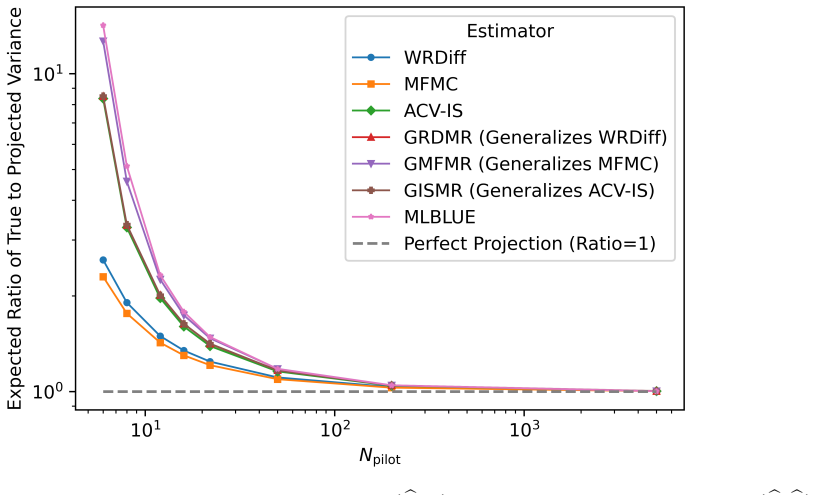
Leveraging probabilistic information about the sample covariance matrix, the authors construct a discrepancy function that measures the worst-case expected suboptimality of an MFMC estimator arising from correlation estimation error; the correlation estimator is then chosen to minimize this expected discrepancy, producing MFMC estimators with lower variance than those based on the ordinary sample correlation when pilot sample sizes are small.
Load-bearing premise
Accurate probabilistic information about the sample covariance matrix is available to build the discrepancy function.
Editorial extensions
If this is right
- MFMC estimators achieve lower variance for the same total computational budget when pilot samples are few.
- The adjustment improves performance in applications such as the NASA EDL multi-fidelity model.
- The bivariate Gaussian example confirms analytically that the method reduces expected suboptimality relative to the sample correlation.
- The approach applies whenever correlations must be estimated from limited offline samples before the main MFMC run.
Reading between the lines
- The same discrepancy construction could be applied to other variance-reduction techniques that depend on estimated parameters from small pilot sets.
- Practitioners facing budget constraints might routinely replace sample correlations with this adjusted version in existing MFMC codes.
- The method highlights a general pattern of using sampling distributions to guard against estimation error in Monte Carlo tuning parameters.
Editorial analysis
A structured set of objections, weighed in public.
Referee Report
Summary. The paper proposes a method to adjust sample correlation estimates for multi-fidelity Monte Carlo (MFMC) under limited pilot sampling. It defines a discrepancy function that quantifies worst-case expected suboptimality of the MFMC estimator by leveraging probabilistic information about the sample covariance matrix, then selects the correlation estimator minimizing the expected discrepancy over pilot-sample variability. The approach is demonstrated via a bivariate Gaussian example and a NASA Entry, Descent, and Landing (EDL) multi-fidelity modeling application, with the claim that it yields better MFMC estimators than the standard sample correlation for small pilot sizes and limited total budgets.
Significance. If validated, the adjustment could improve robustness of MFMC variance reduction in resource-limited settings common to engineering applications. The grounding in external probabilistic properties of the sample covariance (rather than data-dependent fitting) is a methodological strength. However, the current demonstrations provide limited quantitative support, so the practical significance remains provisional pending further analysis.
major comments (3)
- [Abstract] Abstract: the central claim that the method 'produces better MFMC estimators' rests on two examples, yet the abstract supplies no derivation steps for the discrepancy function, no quantitative metrics (e.g., variance ratios or MSE), and no error analysis; this leaves the improvement unsubstantiated beyond qualitative assertion.
- [Bivariate Gaussian example and NASA EDL application] Bivariate Gaussian example and NASA EDL application: the discrepancy function is constructed from the distribution (or moments) of the sample covariance; when fidelity outputs are non-Gaussian or the joint distribution is misspecified, the expectation is taken under the wrong measure, so the selected estimator need not reduce—and may increase—the true MFMC variance relative to the plain sample correlation.
- [Method description (discrepancy function construction)] The method's optimality guarantee is conditional on accurate specification of the sample-covariance distribution; no sensitivity analysis or robustness check against distributional misspecification is reported, which is load-bearing for the 'robust' claim under limited pilot sampling.
minor comments (2)
- The explicit mathematical form of the discrepancy function and the procedure for minimizing its expectation should be stated in a dedicated section or appendix for reproducibility.
- Figure captions and table headings would benefit from clearer indication of which estimator (adjusted vs. sample) is being compared and the precise pilot-sample sizes used.
Simulated Author's Rebuttal
We thank the referee for the constructive comments highlighting issues with the abstract, distributional assumptions, and lack of sensitivity analysis. We address each major comment below and indicate planned revisions where appropriate.
read point-by-point responses
-
Referee: [Abstract] Abstract: the central claim that the method 'produces better MFMC estimators' rests on two examples, yet the abstract supplies no derivation steps for the discrepancy function, no quantitative metrics (e.g., variance ratios or MSE), and no error analysis; this leaves the improvement unsubstantiated beyond qualitative assertion.
Authors: We agree the abstract is concise and omits key quantitative details and derivation references. In the revision we will expand the abstract to include a one-sentence description of the discrepancy function, report the observed variance-reduction ratios from both examples, and reference the relevant sections for the derivation. revision: yes
-
Referee: [Bivariate Gaussian example and NASA EDL application] Bivariate Gaussian example and NASA EDL application: the discrepancy function is constructed from the distribution (or moments) of the sample covariance; when fidelity outputs are non-Gaussian or the joint distribution is misspecified, the expectation is taken under the wrong measure, so the selected estimator need not reduce—and may increase—the true MFMC variance relative to the plain sample correlation.
Authors: The discrepancy function is derived under the known Wishart distribution of the sample covariance for jointly Gaussian outputs (Section 3). The NASA EDL example applies the same framework. We acknowledge that misspecification could degrade performance relative to the sample correlation; we will add an explicit limitations paragraph noting this and outlining a bootstrap-based extension for non-Gaussian settings. revision: partial
-
Referee: [Method description (discrepancy function construction)] The method's optimality guarantee is conditional on accurate specification of the sample-covariance distribution; no sensitivity analysis or robustness check against distributional misspecification is reported, which is load-bearing for the 'robust' claim under limited pilot sampling.
Authors: We concur that the optimality claim is conditional on correct specification of the sample-covariance distribution and that the absence of sensitivity checks weakens the robustness assertion. In the revised manuscript we will add a new subsection with sensitivity experiments that perturb the assumed distribution parameters and compare resulting MFMC performance. revision: yes
Circularity Check
No significant circularity in derivation chain
full rationale
The paper introduces a discrepancy function that quantifies worst-case expected suboptimality of the MFMC estimator, with the expectation taken over pilot-sample variability using external probabilistic information about the sample covariance matrix (e.g., scaled Wishart under bivariate Gaussian). This construction relies on known distributional properties independent of the target MFMC result rather than defining the adjustment in terms of itself. No steps reduce by construction to fitted inputs, self-citations, or renamed known results; the improvement is shown via explicit examples without tautological equivalence. The method is self-contained against the stated assumptions.
Assumptions & free parameters
assumptions (1)
- domain assumption Probabilistic information about the sample covariance matrix is available and sufficient to define a discrepancy function for worst-case expected suboptimality
Cite this review
Pith. "Pith review of Sample correlation adjustments for robust Multi-fidelity Monte Carlo under limited pilot sampling." pith.science (2026). https://pith.science/paper/JQFE5TZP
@misc{pith2026260523016,
  author       = {Pith},
  title        = {Pith review of: Sample correlation adjustments for robust Multi-fidelity Monte Carlo under limited pilot sampling},
  year         = {2026},
  howpublished = {\url{https://pith.science/paper/JQFE5TZP}},
  note         = {Machine review of arXiv:2605.23016}
}
read the original abstract
Multi-fidelity Monte Carlo (MFMC) is a variance reduction method that leverages a multi-fidelity ensemble of models of varying cost and accuracy levels. Constructing an MFMC estimator with optimal variance requires knowledge of the correlation coefficients between the different fidelity models which are not usually known in practice. The correlations are typically estimated using offline pilot samples and the sample correlation formula, after which the MFMC method proceeds as if the estimated correlations are the true correlations. Computational cost often restricts the number of pilot samples used leading to poor correlation estimates and suboptimal estimators. Leveraging the MFMC problem setting and probabilistic information about the sample covariance matrix, we present a method to improve standard sample-based correlation estimates in the presence of limited pilot samples. We define a novel discrepancy function quantifying the estimator suboptimality which in turn facilitates selecting a correlation estimator minimizing the worst-case expected discrepancy, where the expectation is taken with respect to the pilot sampling variability. Through a simple bivariate Gaussian example and a multi-fidelity modeling application from a NASA Entry, Descent, and Landing (EDL) problem, we show that this method produces better MFMC estimators than the standard sample covariance under small pilot sample sizes and limited total budgets.
Figures


Figures from the paper (8 more)


Reference graph
Works this paper leans on
-
[1]
Adams, B. M., Eldred, M. S., Geraci, G., Portone, T., Ridgway, E. M., Stephens, J. A., and Wildey, T. M. (2022). Deployment of Multifidelity Uncertainty Quantification for Thermal Bat- tery Assessment Part I: Algorithms and Single Cell Results. Technical report, Sandia National Laboratories (SNL-NM), Albuquerque, NM (United States)
work page 2022
-
[2]
Anderson, T. W. (2003).An Introduction to Multivariate Statistical Analysis. Wiley Inter- science, Hoboken, N.J
work page 2003
-
[3]
Azadkia, M. and Chatterjee, S. (2021). A simple measure of conditional dependence.The Annals of Statistics, 49(6):3070–3102
work page 2021
-
[4]
Berger, J. O. (1985).Statistical Decision Theory and Bayesian Analysis. Springer-Verlag, New York
work page 1985
-
[5]
Bomarito, G., Leser, P., Warner, J., and Leser, W. (2022). On the optimization of approxi- mate control variates with parametrically defined estimators.Journal of Computational Physics, 451(C)
work page 2022
-
[6]
(2017).Theδ—Importance Measure, pages 163–180
Borgonovo, E. (2017).Theδ—Importance Measure, pages 163–180. Springer International Publishing, Cham. 37
work page 2017
-
[7]
Broto, B., Bachoc, F., and Depecker, M. (2020). Variance Reduction for Estimation of Shapley Effects and Adaptation to Unknown Input Distribution.SIAM/ASA Journal on Uncertainty Quantification, 8(2):693–716
work page 2020
-
[8]
Busing, F. M. T. A. (2022). Monotone Regression: A Simple and Fast O(n) PAVA Implemen- tation.Journal of Statistical Software, Code Snippets, 102(1):1–25
work page 2022
Show all 38 references
-
[9]
and Lugosi, G
Cesa-Bianchi, N. and Lugosi, G. (2006).Prediction, Learning, and Games. Wiley Interscience
2006
-
[10]
Chen, X., Lin, Q., and Xu, G. (2022). Distributionally robust optimization with confidence bands for probability density functions.INFORMS Journal on Optimization, 4(1):65–89
2022
-
[11]
E., Jivani, A., and Huan, X
Coons, T. E., Jivani, A., and Huan, X. (2025). Bayesian Covariance Uncertainty for Adap- tive Pilot-Sampling Termination in Multi-fidelity Uncertainty Quantification.arXiv preprint arXiv:2508.18490 [stat.ME]
2025
-
[12]
Dixon, T., Gorodetsky, A., Jakeman, J., Narayan, A., and Xu, Y. (2026). Optimally balancing exploration and exploitation to automate multi-fidelity statistical estimation.arXiv preprint arXiv:2505.09828 [stat.CO]
2026
-
[13]
Giles, M. B. (2015). Multilevel Monte Carlo methods.Acta Numerica, 24:259–328
2015
-
[14]
A., Geraci, G., Eldred, M
Gorodetsky, A. A., Geraci, G., Eldred, M. S., and Jakeman, J. D. (2020). A generalized approximate control variate framework for multifidelity uncertainty quantification.Journal of Computational Physics, 408:109257
2020
-
[15]
A., Jakeman, J
Gorodetsky, A. A., Jakeman, J. D., and Eldred, M. S. (2024). Grouped approximate control variate estimators.arXiv preprint arXiv:2402.14736 [stat.CO]
2024
-
[16]
Gramacy, R. B. (2020).Surrogates: Gaussian Process Modeling, Design and Optimization for the Applied Sciences. Chapman Hall/CRC.https://bookdown.org/rbg/surrogates/
2020
-
[17]
Hotelling, H. (1953). New light on the correlation coefficient and its transforms.Journal of the Royal Statistical Society. Series B (Methodological), 15(2):193–232
1953
-
[18]
Jin, C., Netrapalli, P., and Jordan, M. (2020). What is local optimality in nonconvex- nonconcave minimax optimization? InProceedings of the 37th International Conference on Machine Learning, volume 119 ofProceedings of Machine Learning Research, pages 4880–4889. PMLR
2020
-
[19]
I., M¨ uhlemann, A., and Ziegel, J
Jordan, A. I., M¨ uhlemann, A., and Ziegel, J. F. (2020). Optimal solutions to the isotonic regression problem.arXiv preprint arXiv:1904.04761 [math.ST]
2020
-
[20]
Kosorok, M. R. (2008).Introduction to Empirical Processes and Semiparametric Inference. Springer Series in Statistics. Springer, New York, NY
2008
-
[21]
Kossaifi, J., Panagakis, Y., Anandkumar, A., and Pantic, M. (2019). TensorLy: Tensor Learning in Python.Journal of Machine Learning Research (JMLR), 20(26):1–6
2019
-
[22]
and Xia, Y
Krishnamoorthy, K. and Xia, Y. (2007). Inferences on correlation coefficients: One-sample, independent and correlated cases.Journal of Statistical Planning and Inference, 137:2362–2379
2007
-
[23]
S., Moeller, T
Lavenberg, S. S., Moeller, T. L., and Welch, P. D. (1982). Statistical results on control variables with applications to queueing network simulation.Operations Research, 30(1):182–202. 38
1982
-
[24]
Lin, T., Jin, C., and Jordan, M. (2020). On gradient descent ascent for nonconvex-concave minimax problems. InProceedings of the 37th International Conference on Machine Learning, volume 119 ofProceedings of Machine Learning Research, pages 6083–6093. PMLR
2020
-
[25]
Nemirovski, A., Juditsky, A., Lan, G., and Shapiro, A. (2009). Robust stochastic approximation approach to stochastic programming.SIAM Journal on Optimization, 19(4):1574–1609
2009
-
[26]
Owen, A. B. (2014). Sobol’ Indices and Shapley Value.SIAM/ASA Journal on Uncertainty Quantification, 2(1):245–251
2014
-
[27]
Owen, A. B. and Prieur, C. (2017). On Shapley Value for Measuring Importance of Dependent Inputs.SIAM/ASA Journal on Uncertainty Quantification, 5(1):986–1002
2017
-
[28]
Peherstorfer, B., Willcox, K., and Gunzburger, M. (2016). Optimal Model Management for Multifidelity Monte Carlo Estimation.SIAM Journal on Scientific Computation, 38(5):A3163– A3194
2016
-
[29]
Pollard, D. (1989). Asymptotics via Empirical Processes.Statistical Science, 4(4):341–354
1989
-
[30]
Rasmussen, C. E. and Williams, C. K. I. (2006).Gaussian Processes for Machine Learning. MIT Press, Cambridge, Mass
2006
-
[31]
(1991).Functional Analysis
Rudin, W. (1991).Functional Analysis. International series in pure and applied mathematics. McGraw-Hill, New York, 2nd edition
1991
-
[32]
and Ullmann, E
Schaden, D. and Ullmann, E. (2020). On Multilevel Best Linear Unbiased Estimators. SIAM/ASA Journal on Uncertainty Quantification, 8(2):601–635
2020
-
[33]
Shapley, L. S. (2016).A Value for n-Person Games, chapter 17, pages 307–318. Princeton University Press, Princeton
2016
-
[34]
Sobol’, I. (2001). Global sensitivity indices for nonlinear mathematical models and their Monte Carlo estimates.Mathematics and Computers in Simulation, 55(1):271–280. The Second IMACS Seminar on Monte Carlo Methods
2001
-
[35]
L., and Staum, J
Song, E., Nelson, B. L., and Staum, J. (2016). Shapley Effects for Global Sensitivity Analysis: Theory and Computation.SIAM/ASA Journal on Uncertainty Quantification, 4(1):1060–1083
2016
-
[36]
P., Eldred, M
Thompson, M., Geraci, G., Bomarito, G., Warner, J., Leser, P., Leser, W. P., Eldred, M. S., Jakeman, J., and Gorodetsky, A. (2023). Strategies for automation of model tuning in multi- fidelity trajectory uncertainty propagation.AIAA SCITECH 2023 Forum
2023
-
[37]
E., Bomarito, G
Warner, J. E., Bomarito, G. F., Geraci, G., and Eldred, M. S. (2026). Automated Model Tuning for Multifidelity Uncertainty Propagation in Trajectory Simulation.arXiv preprint arXiv:2509.16007 [stat.CO]
2026
-
[38]
E., Niemoeller, S
Warner, J. E., Niemoeller, S. C., Morrill, L., Bomarito, G. F., Leser, P. E., Leser, W. P., Williams, R. A., and Dutta, S. (2021). Multi-Model Monte Carlo Estimators for Trajectory Simulation.AIAA SciTech Forum. 39
2021
Reviewed May 25, 2026 · model on record in the stance chip above.
Discussion (0). Continue with ORCID to comment.