Cavity-Induced Excitonic Insulation and Non-Fermi-Liquid Behavior in Dirac Materials
Pith reviewed 2026-05-21 09:04 UTC · model grok-4.3
The pith
A cavity formed by metasurface can turn Dirac materials into excitonic insulators or non-Fermi liquids based on flavor number.
A machine-rendered reading of the paper's core claim, the machinery that carries it, and where it could break.
Core claim
The interaction engineered by the metasurface cavity drives an excitonic insulating phase for N_f below 16/π through an infinite-order quantum phase transition that spontaneously generates a mass gap, while for N_f above 16/π the system remains gapless but exhibits non-Fermi-liquid behavior with singularly suppressed quasiparticle residue and nonanalytic Dirac cone dispersion, and cavity fluctuations lift the zeroth Landau level degeneracy across all N_f.
What carries the argument
Quasielectrostatic transverse-magnetic modes in the metasurface cavity that mediate long-range interactions between Dirac electrons, analyzed through Dyson-Schwinger equations combined with static screening.
If this is right
- For fermion flavors below 16/π the ground state acquires a spontaneous mass gap.
- Above the critical flavor number the quasiparticle residue is driven to zero.
- The Dirac dispersion relation becomes nonanalytic in the non-Fermi liquid regime.
- Cavity fluctuations eliminate the degeneracy of the lowest Landau level regardless of flavor number.
Where Pith is reading between the lines
- This setup offers a way to control correlated phases in Dirac materials using cavity engineering rather than chemical means.
- The non-Fermi liquid regime may exhibit unusual scattering rates or conductivity that could be measured in experiments.
- Similar cavity designs might be applied to other Dirac systems like topological insulators to induce analogous phases.
Load-bearing premise
The metasurfaces support quasielectrostatic transverse-magnetic modes that mediate a long-range interaction between the two-dimensional electrons.
What would settle it
Measuring whether a mass gap opens in the electronic spectrum for small N_f or detecting the vanishing of the quasiparticle peak in spectroscopy for large N_f in a metasurface cavity setup.
Figures

read the original abstract
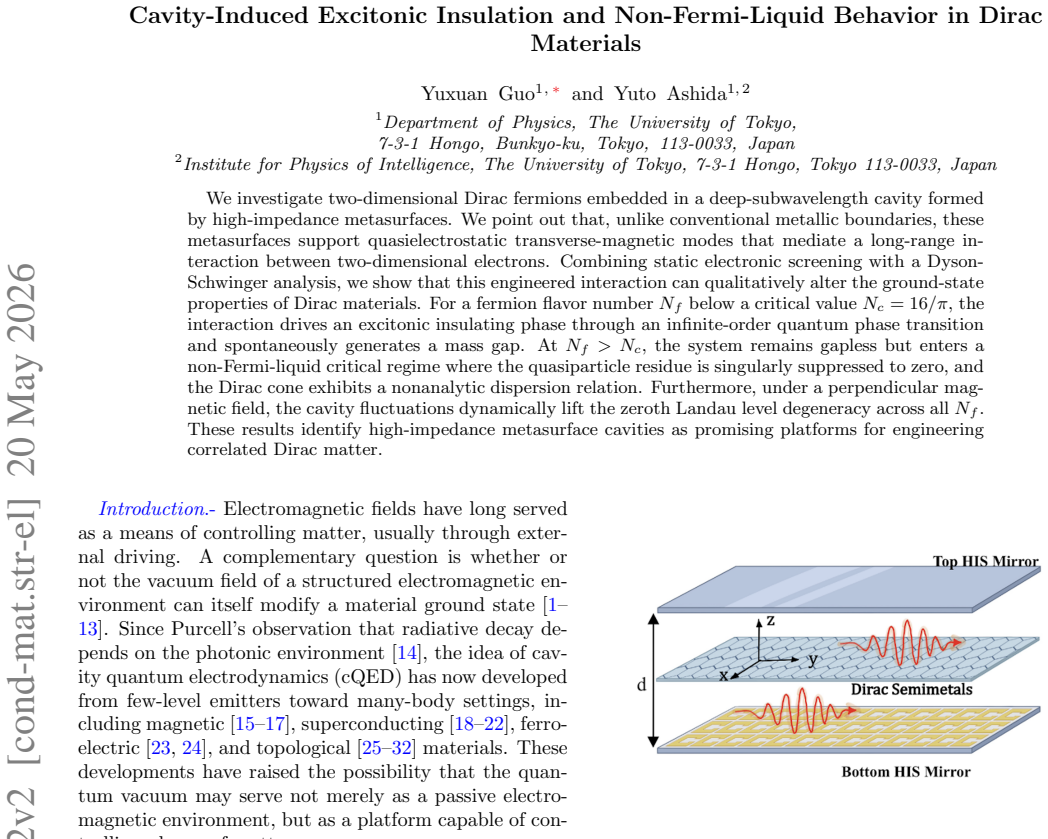
We investigate two-dimensional Dirac fermions embedded in a deep-subwavelength cavity formed by high-impedance metasurfaces. We point out that, unlike conventional metallic boundaries, these metasurfaces support quasielectrostatic transverse-magnetic modes that mediate a long-range interaction between two-dimensional electrons. Combining static electronic screening with a Dyson-Schwinger analysis, we show that this engineered interaction can qualitatively alter the ground-state properties of Dirac materials. For a fermion flavor number $N_{f}$ below a critical value $N_{c}=16/\pi$, the interaction drives an excitonic insulating phase through an infinite-order quantum phase transition and spontaneously generates a mass gap. At $N_{f}>N_{c}$, the system remains gapless but enters a non-Fermi-liquid critical regime where the quasiparticle residue is singularly suppressed to zero, and the Dirac cone exhibits a nonanalytic dispersion relation. Furthermore, under a perpendicular magnetic field, the cavity fluctuations dynamically lift the zeroth Landau level degeneracy across all $N_{f}$. These results identify high-impedance metasurface cavities as promising platforms for engineering correlated Dirac matter.
Editorial analysis
A structured set of objections, weighed in public.
Referee Report
Summary. The manuscript examines two-dimensional Dirac fermions embedded in a deep-subwavelength cavity formed by high-impedance metasurfaces. These metasurfaces support quasielectrostatic transverse-magnetic modes that mediate a long-range interaction. Combining static electronic screening with a Dyson-Schwinger analysis, the authors report that for fermion flavor number N_f below a critical value N_c = 16/π the interaction drives an excitonic insulating phase via an infinite-order quantum phase transition that spontaneously generates a mass gap. For N_f > N_c the system remains gapless but enters a non-Fermi-liquid regime with singularly vanishing quasiparticle residue and nonanalytic Dirac dispersion. Under a perpendicular magnetic field the cavity fluctuations lift the zeroth Landau level degeneracy for all N_f.
Significance. If the results hold, the work identifies high-impedance metasurface cavities as a platform for engineering correlated phases in Dirac materials, separating an excitonic insulator from a non-Fermi liquid via a tunable critical flavor number and providing a magnetic-field route to lift Landau-level degeneracy. The non-perturbative Dyson-Schwinger treatment supplies concrete, falsifiable predictions for cavity-QED experiments on 2D Dirac systems.
major comments (2)
- [Dyson-Schwinger analysis of the gapless regime] The central NFL claim for N_f > N_c relies on the static-screening approximation in the Dyson-Schwinger self-energy integral. Static screening eliminates retardation and the Landau-damped frequency dependence that normally produces the infrared singularity required for Z → 0 and nonanalytic dispersion; the resulting scaling may reduce to marginal-Fermi-liquid logarithms, which would shift or remove the reported critical N_c and undermine the phase diagram.
- [Excitonic phase and critical flavor number] The quoted critical value N_c = 16/π and the infinite-order character of the transition are presented as outputs of the combined screening plus gap equation. Without explicit error estimates, comparison to frequency-dependent screening, or a clear statement of the functional form of the gap opening (essential singularity versus power law), it is unclear whether these features survive beyond the static approximation.
minor comments (2)
- [Abstract] The abstract states the central results but supplies no derivation steps or checks against the full Dyson-Schwinger equations; a brief reference to the relevant equation or section that yields N_c = 16/π would improve readability.
- [Model and interaction Hamiltonian] Notation for the screened interaction potential mediated by the metasurface modes should be defined explicitly at first use, including any assumptions about quasielectrostatic character.
Simulated Author's Rebuttal
We thank the referee for their thorough review and valuable feedback on our manuscript. Below, we provide detailed responses to the major comments. We will make revisions to improve clarity on the approximations used.
read point-by-point responses
-
Referee: The central NFL claim for N_f > N_c relies on the static-screening approximation in the Dyson-Schwinger self-energy integral. Static screening eliminates retardation and the Landau-damped frequency dependence that normally produces the infrared singularity required for Z → 0 and nonanalytic dispersion; the resulting scaling may reduce to marginal-Fermi-liquid logarithms, which would shift or remove the reported critical N_c and undermine the phase diagram.
Authors: We thank the referee for this observation. In our work, the cavity-induced interaction is mediated by quasielectrostatic TM modes, which are inherently static in the deep-subwavelength limit. This justifies the use of static screening. The long-range nature of the interaction leads to a singular self-energy in the Dyson-Schwinger equation even without retardation, resulting in the vanishing quasiparticle residue and nonanalytic dispersion for N_f > N_c. This is distinct from the marginal Fermi liquid behavior in systems with short-range interactions. We will add a discussion section elaborating on this point and the differences from conventional 2D electron gases. revision: partial
-
Referee: The quoted critical value N_c = 16/π and the infinite-order character of the transition are presented as outputs of the combined screening plus gap equation. Without explicit error estimates, comparison to frequency-dependent screening, or a clear statement of the functional form of the gap opening (essential singularity versus power law), it is unclear whether these features survive beyond the static approximation.
Authors: The critical flavor number N_c = 16/π is determined analytically from the condition where the gap equation admits a nontrivial solution in the static approximation. The transition is of infinite order, with the gap opening exhibiting an essential singularity, akin to the Berezinskii-Kosterlitz-Thouless transition. We agree that a comparison to dynamical screening would strengthen the result, but given the quasistatic character of the metasurface modes, we expect the qualitative features to persist. We will revise the manuscript to explicitly state the functional form of the gap and provide a brief error analysis based on the approximations made. revision: partial
- Comparison to frequency-dependent screening in the Dyson-Schwinger analysis.
Circularity Check
Derivation self-contained via Dyson-Schwinger analysis
full rationale
The paper derives N_c = 16/π and the phase distinction (excitonic insulator for N_f < N_c, gapless NFL for N_f > N_c) as outputs of combining static screening with the Dyson-Schwinger equations applied to the cavity-mediated long-range interaction. No load-bearing step reduces by construction to a fitted input, self-definition, or unverified self-citation chain. The metasurface mode premise is an external assumption, not smuggled in via prior author work, and the results are presented as solutions to the stated equations rather than renamed known patterns or forced by internal definitions.
Axiom & Free-Parameter Ledger
axioms (1)
- domain assumption Dyson-Schwinger equations provide a reliable non-perturbative description of the ground state for this interacting Dirac system
Lean theorems connected to this paper
-
IndisputableMonolith/Cost/FunctionalEquation.leanwashburn_uniqueness_aczel unclear?
unclearRelation between the paper passage and the cited Recognition theorem.
Combining static electronic screening with a Dyson-Schwinger analysis... Nc=16/π... oscillatory solutions... M(0)=α exp[-2π-δNf / sqrt(Nc/Nf-1)]
-
IndisputableMonolith/Foundation/AlexanderDuality.leanalexander_duality_circle_linking unclear?
unclearRelation between the paper passage and the cited Recognition theorem.
d/dp (p² dM/dp) + (4 vF / π Nf) M(p) / sqrt(vF²p² + M²) = 0
What do these tags mean?
- matches
- The paper's claim is directly supported by a theorem in the formal canon.
- supports
- The theorem supports part of the paper's argument, but the paper may add assumptions or extra steps.
- extends
- The paper goes beyond the formal theorem; the theorem is a base layer rather than the whole result.
- uses
- The paper appears to rely on the theorem as machinery.
- contradicts
- The paper's claim conflicts with a theorem or certificate in the canon.
- unclear
- Pith found a possible connection, but the passage is too broad, indirect, or ambiguous to say the theorem truly supports the claim.
Reference graph
Works this paper leans on
-
[1]
F. J. Garcia-Vidal, C. Ciuti, and T. W. Ebbesen, Ma- nipulating matter by strong coupling to vacuum fields, Science373, eabd0336 (2021)
work page 2021
-
[2]
M. Scheucher, J. Volz, and A. Rauschenbeutel, Cav- ity quantum electrodynamics and chiral quantum op- tics, arXiv:2012.06546 [quant-ph] 10.1142/8964 (2020), arXiv:2012.06546 [quant-ph]
- [3]
-
[4]
M. Ruggenthaler, N. Tancogne-Dejean, J. Flick, H. Ap- pel, and A. Rubio, From a quantum-electrodynamical light–matter description to novel spectroscopies, Nat Rev Chem2, 1 (2018)
work page 2018
- [5]
-
[6]
N. S. Mueller, Y. Okamura, B. G. M. Vieira, S. Juer- gensen, H. Lange, E. B. Barros, F. Schulz, and S. Re- ich, Deep strong light–matter coupling in plasmonic nanoparticle crystals, Nature583, 780 (2020)
work page 2020
-
[7]
J. C. Owens, M. G. Panetta, B. Saxberg, G. Roberts, S. Chakram, R. Ma, A. Vrajitoarea, J. Simon, and D. I. Schuster, Chiral cavity quantum electrodynamics, Nat. Phys. , 1 (2022)
work page 2022
- [8]
-
[9]
T. W. Ebbesen, Hybrid Light–Matter States in a Molec- ular and Material Science Perspective, Acc. Chem. Res. 49, 2403 (2016)
work page 2016
- [10]
-
[11]
R. F. Ribeiro, L. A. Mart´ ınez-Mart´ ınez, M. Du, J. Campos-Gonzalez-Angulo, and J. Yuen-Zhou, Polari- ton chemistry: Controlling molecular dynamics with op- tical cavities, Chem. Sci.9, 6325 (2018)
work page 2018
- [12]
-
[13]
A. Stockklauser, P. Scarlino, J. V. Koski, S. Gas- parinetti, C. K. Andersen, C. Reichl, W. Wegscheider, T. Ihn, K. Ensslin, and A. Wallraff, Strong coupling cav- ity qed with gate-defined double quantum dots enabled by a high impedance resonator, Phys. Rev. X7, 011030 (2017)
work page 2017
-
[14]
E. M. Purcell, Spontaneous emission probabilities at ra- dio frequencies, Phys. Rev.69, 681 (1946)
work page 1946
-
[15]
E. Vi˜ nas Bostr¨ om, A. Sriram, M. Claassen, and A. Ru- 6 bio, Controlling the magnetic state of the proximate quantum spin liquidα-RuCl 3 with an optical cavity, npj Computational Materials9, 202 (2023)
work page 2023
-
[16]
A. Chiocchetta, D. Kiese, C. P. Zelle, F. Piazza, and S. Diehl, Cavity-induced quantum spin liquids, Nat. Commun.12, 5901 (2021)
work page 2021
-
[17]
J. Mochida and Y. Ashida, Cavity-enhanced kondo ef- fect, Phys. Rev. B110, 035158 (2024)
work page 2024
-
[18]
J. B. Curtis, Z. M. Raines, A. A. Allocca, M. Hafezi, and V. M. Galitski, Cavity Quantum Eliashberg En- hancement of Superconductivity, Phys. Rev. Lett.122, 167002 (2019)
work page 2019
-
[19]
M. A. Sentef, M. Ruggenthaler, and A. Rubio, Cav- ity quantum-electrodynamical polaritonically enhanced electron-phonon coupling and its influence on supercon- ductivity, Sci. Adv.4, eaau6969 (2018)
work page 2018
-
[20]
F. Schlawin, A. Cavalleri, and D. Jaksch, Cavity- Mediated Electron-Photon Superconductivity, Phys. Rev. Lett.122, 133602 (2019)
work page 2019
-
[21]
J. B. Curtis, A. Grankin, N. R. Poniatowski, V. M. Galitski, P. Narang, and E. Demler, Cavity magnon- polaritons in cuprate parent compounds, Phys. Rev. Res.4, 013101 (2022)
work page 2022
-
[22]
J. Li, L. Schamriß, and M. Eckstein, Effective theory of lattice electrons strongly coupled to quantum electro- magnetic fields, Phys. Rev. B105, 165121 (2022)
work page 2022
- [23]
- [24]
-
[26]
V. Rokaj, M. Penz, M. A. Sentef, M. Ruggenthaler, and A. Rubio, Quantum Electrodynamical Bloch Theory with Homogeneous Magnetic Fields, Phys. Rev. Lett. 123, 047202 (2019); Polaritonic Hofstadter butterfly and cavity control of the quantized Hall conductance, Phys. Rev. B105, 205424 (2022)
work page 2019
-
[27]
C. A. Downing, T. J. Sturges, G. Weick, M. Stobi´ nska, and L. Mart´ ın-Moreno, Topological Phases of Polaritons in a Cavity Waveguide, Phys. Rev. Lett.123, 217401 (2019)
work page 2019
-
[28]
I. V. Tokatly, D. R. Gulevich, and I. Iorsh, Vacuum anomalous Hall effect in gyrotropic cavity, Phys. Rev. B104, L081408 (2021)
work page 2021
-
[29]
K. Masuki and Y. Ashida, Berry phase and topology in ultrastrongly coupled quantum light-matter systems, Phys. Rev. B107, 195104 (2023)
work page 2023
-
[30]
H. H¨ ubener, U. De Giovannini, C. Sch¨ afer, J. And- berger, M. Ruggenthaler, J. Faist, and A. Rubio, Engi- neering quantum materials with chiral optical cavities, Nat. Mater.20, 438 (2021)
work page 2021
-
[31]
O. Dmytruk and M. Schir´ o, Gauge fixing for strongly correlated electrons coupled to quantum light, Phys. Rev. B103, 075131 (2021)
work page 2021
-
[32]
A. G´ omez-Le´ on, M. Schir` o, and O. Dmytruk, Majorana bound states from cavity embedding in an interacting two-site kitaev chain, Phys. Rev. B111, 155410 (2025)
work page 2025
- [33]
-
[34]
F. Schlawin, D. M. Kennes, and M. A. Sentef, Cavity quantum materials, Appl. Phys. Rev.9, 011312 (2022)
work page 2022
-
[35]
H. H¨ ubener, E. Vi˜ nas Bostr¨ om, M. Claassen, S. Latini, and A. Rubio, Quantum materials engineering by struc- tured cavity vacuum fluctuations, Materials for Quan- tum Technology4, 023002 (2024)
work page 2024
- [36]
- [37]
-
[38]
H. Liu, F. Troisi, H. H¨ ubener, and A. Rubio, Cavity- mediated electron-electron interactions: Renormalizing dirac states in graphene, Science Advances11, eadz1855 (2025)
work page 2025
- [39]
- [40]
-
[41]
G. Nambiar, A. Grankin, and M. Hafezi, Diagnosing electronic phases of matter using photonic correlation functions, Phys. Rev. X15, 041020 (2025)
work page 2025
-
[42]
S. Gambino, M. Mazzeo, A. Genco, O. Di Stefano, S. Savasta, S. Patan` e, D. Ballarini, F. Mangione, G. Ler- ario, D. Sanvitto, and G. Gigli, Exploring Light–Matter Interaction Phenomena under Ultrastrong Coupling Regime, ACS Photonics1, 1042 (2014)
work page 2014
-
[43]
R. Chikkaraddy, B. de Nijs, F. Benz, S. J. Barrow, O. A. Scherman, E. Rosta, A. Demetriadou, P. Fox, O. Hess, and J. J. Baumberg, Single-molecule strong coupling at room temperature in plasmonic nanocavities, Nature 535, 127 (2016)
work page 2016
-
[44]
F. Yoshihara, T. Fuse, S. Ashhab, K. Kakuyanagi, S. Saito, and K. Semba, Superconducting qubit–oscillator circuit beyond the ultrastrong-coupling regime, Nat. Phys.13, 44 (2017)
work page 2017
- [45]
-
[46]
M. Halbhuber, J. Mornhinweg, V. Zeller, C. Ciuti, D. Bougeard, R. Huber, and C. Lange, Non-adiabatic stripping of a cavity field from electrons in the deep- strong coupling regime, Nat. Photon.14, 675 (2020)
work page 2020
- [47]
- [48]
-
[49]
P. Forn-D´ ıaz, L. Lamata, E. Rico, J. Kono, and E. Solano, Ultrastrong coupling regimes of light-matter interaction, Rev. Mod. Phys.91, 025005 (2019)
work page 2019
-
[50]
A. Frisk Kockum, A. Miranowicz, S. De Liberato, S. Savasta, and F. Nori, Ultrastrong coupling between light and matter, Nat. Rev. Phys.1, 19 (2019)
work page 2019
-
[51]
R. S´ aez-Bl´ azquez, D. de Bernardis, J. Feist, and P. Rabl, Can we observe nonperturbative vacuum shifts in cavity qed?, Phys. Rev. Lett.131, 013602 (2023)
work page 2023
-
[52]
L. Novotny and B. Hecht,Principles of Nano-Optics, 2nd ed. (Cambridge University Press, Cambridge, 2012)
work page 2012
-
[53]
D. N. Basov, A. Asenjo-Garcia, P. J. Schuck, X. Zhu, and A. Rubio, Polariton panorama, Nanophotonics10, 549 (2021)
work page 2021
-
[54]
A. Reserbat-Plantey, I. Epstein, I. Torre, A. T. Costa, P. A. Gon¸ calves, N. A. Mortensen, M. Polini, J. C. Song, N. M. Peres, and F. H. Koppens, Quantum nanophoton- ics in two-dimensional materials, ACS Photonics8, 85 (2021)
work page 2021
-
[55]
N. Rivera and I. Kaminer, Light–matter interactions with photonic quasiparticles, Nat. Rev. Phys.2, 538 (2020)
work page 2020
-
[56]
F. Helmrich, H. S. Adlong, I. Khanonkin, M. Kro- ner, G. Scalari, J. Faist, A. Imamo˘ glu, and T. F. Nova, Cavity-driven attractive interactions in quan- tum materials, arXiv preprint arXiv:2408.00189 (2024), arXiv:2408.00189 [cond-mat.mtrl-sci]
- [57]
- [58]
-
[59]
E. Cortese, N.-L. Tran, J.-M. Manceau, A. Bousseksou, I. Carusotto, G. Biasiol, R. Colombelli, and S. De Lib- erato, Excitons bound by photon exchange, Nature Physics17, 31 (2021)
work page 2021
-
[60]
E. Cortese, I. Carusotto, R. Colombelli, and S. De Lib- erato, Strong coupling of ionising transitions, Optica6, 354 (2023), arXiv:1809.08876 [physics.optics]
-
[61]
D. Sievenpiper, L. Zhang, R. F. J. Broas, N. G. Alex´ opolous, and E. Yablonovitch, High-impedance electromagnetic surfaces with a forbidden frequency band, IEEE Trans. Microw. Theory Techn.47, 2059 (1999)
work page 2059
-
[62]
D. Sievenpiper,High-Impedance Electromagnetic Sur- faces(PhD Thesis, University of California, Los An- geles, 1999)
work page 1999
-
[63]
T. Cui, D. Martin-Cano, F. J. Garcia-Vidal, and J. B. Pendry, Spoof surface plasmon photonics, Rev. Mod. Phys.94, 025004 (2022)
work page 2022
-
[64]
T.-J. Yen, W. Padilla, N. Fang, D. Vier, D. Smith, J. Pendry, D. Basov, and X. Zhang, Terahertz mag- netic response from artificial materials, Science303, 1494 (2004)
work page 2004
-
[65]
G. Scalari, C. Maissen, D. Turˇ cinkov´ a, D. Hagenm¨ uller, S. De Liberato, C. Ciuti, C. Reichl, D. Schuh, W. Wegscheider, M. Beck, and J. Faist, Ultrastrong Coupling of the Cyclotron Transition of a 2D Electron Gas to a THz Metamaterial, Science335, 1323 (2012)
work page 2012
-
[66]
G. Scalari, C. Maissen, S. Cibella, R. Leoni, P. Carelli, F. Valmorra, M. Beck, and J. Faist, Superconducting complementary metasurfaces for THz ultrastrong light- matter coupling, New Journal of Physics16, 033005 (2014)
work page 2014
-
[67]
H.-T. Chen, H. Yang, R. Singh, J. F. O’Hara, A. K. Azad, S. A. Trugman, Q. X. Jia, and A. J. Taylor, Tun- ing the resonance in high-temperature superconducting terahertz metamaterials, Phys. Rev. Lett.105, 247402 (2010)
work page 2010
-
[68]
Z. Fang, Y. Wang, A. E. Schlather, Z. Liu, P. M. Ajayan, F. J. Garc´ ıa de Abajo, P. Nordlander, X. Zhu, and N. J. Halas, Active tunable absorption enhancement with graphene nanodisk arrays, Nano Letters14, 299 (2014)
work page 2014
-
[69]
L. Ju, B. Geng, J. Horng, C. Girit, M. Martin, Z. Hao, H. A. Bechtel, X. Liang, A. Zettl, Y. R. Shen,et al., Graphene plasmonics for tunable terahertz metamate- rials, Nature nanotechnology6, 630 (2011)
work page 2011
-
[70]
J. D. Caldwell, A. V. Kretinin, Y. Chen, V. Giannini, M. M. Fogler, Y. Francescato, C. T. Ellis, J. G. Tischler, K. S. Novoselov, S. A. Maier,et al., Sub-diffractional volume-confined polaritons in the natural hyperbolic material hexagonal boron nitride, Nature Communica- tions5, 5221 (2014)
work page 2014
-
[71]
S. Dai, Z. Fei, Q. Ma, A. Rodin, M. Wagner, A. McLeod, M. Liu, W. Gannett, W. Regan, K. Watanabe,et al., Tunable phonon polaritons in ultrathin van der waals crystals of boron nitride, Science343, 1125 (2014)
work page 2014
-
[72]
A. H. Castro Neto, F. Guinea, N. M. R. Peres, K. S. Novoselov, and A. K. Geim, The electronic properties of graphene, Reviews of Modern Physics81, 109 (2009)
work page 2009
-
[73]
N. P. Armitage, E. J. Mele, and A. Vishwanath, Weyl and dirac semimetals, Reviews of Modern Physics90, 015001 (2018)
work page 2018
-
[74]
B. Q. Lv, T. Qian, and H. Ding, Experimental perspec- tive on three-dimensional topological semimetals, Re- views of Modern Physics93, 025002 (2021)
work page 2021
-
[75]
V. N. Kotov, B. Uchoa, V. M. Pereira, F. Guinea, and A. H. Castro Neto, Electron-electron interactions in graphene: Current status and perspectives, Rev. Mod. Phys.84, 1067 (2012)
work page 2012
-
[76]
D. V. Khveshchenko, Massive Dirac fermions in single- layer graphene, J. Phys. Condens. Matter21, 075303 (2009)
work page 2009
-
[77]
D. V. Khveshchenko, Ghost excitonic insulator transi- tion in layered graphite, Phys. Rev. Lett.87, 246802 (2001)
work page 2001
-
[78]
J. Gonzalez, F. Guinea, and M. A. H. Vozmediano, Non- Fermi liquid behavior of electrons in the half filled hon- eycomb lattice (A Renormalization group approach), Nucl. Phys. B424, 595 (1994)
work page 1994
-
[79]
E. H. Hwang, B. Y.-K. Hu, and S. Das Sarma, Inelastic carrier lifetime in graphene, Phys. Rev. B76, 115434 (2007)
work page 2007
-
[80]
B. L. Altshuler, L. B. Ioffe, and A. J. Millis, Low-energy properties of fermions with singular interactions, Phys- ical Review B50, 14048 (1994)
work page 1994
-
[81]
Y. B. Kim, A. Furusaki, X.-G. Wen, and P. A. Lee, Gauge-invariant response functions of fermions coupled to a gauge field, Physical Review B50, 17917 (1994)
work page 1994
discussion (0)
Sign in with ORCID, Apple, or X to comment. Anyone can read and Pith papers without signing in.