Fast Multichannel NMF with Block-Diagonal Spatial Covariance Matrices for Efficient Blind Source Separation Using Distributed Microphone Arrays
Pith reviewed 2026-05-20 02:36 UTC · model grok-4.3
The pith
Imposing block-diagonal structure on spatial covariance matrices enables efficient blind source separation across distributed microphone subarrays.
A machine-rendered reading of the paper's core claim, the machinery that carries it, and where it could break.
Core claim
By imposing a block-diagonal structure on the source spatial covariance matrices, matrix inversions can be performed within each subarray while the shared NMF spectrogram model aggregates source activity across subarrays, discarding inter-subarray covariance information.
What carries the argument
Block-diagonal source spatial covariance matrices with a shared NMF-based source spectrogram model across subarrays.
If this is right
- Computational cost grows more slowly as the total number of microphones increases.
- Separation quality exceeds that of single-subarray processing.
- Separation remains possible even when each local subarray is underdetermined.
- Distributed arrays can cover larger areas without prohibitive computation.
Where Pith is reading between the lines
- This structure may extend to other methods that rely on spatial covariance estimation in array signal processing.
- Real-world tests with noise and synchronization errors would clarify how much performance is lost by ignoring inter-subarray correlations.
- Hardware implementations on separate devices could benefit from reduced data exchange between subarrays.
Load-bearing premise
That forcing block-diagonal structure on the spatial covariance matrices loses little separation performance and that sharing only the spectrogram model is enough without inter-subarray covariance data.
What would settle it
A direct comparison experiment in which full-covariance FastMNMF and the block-diagonal version are run on the same recordings and the block-diagonal version shows markedly lower source-to-distortion ratios.
Figures

read the original abstract
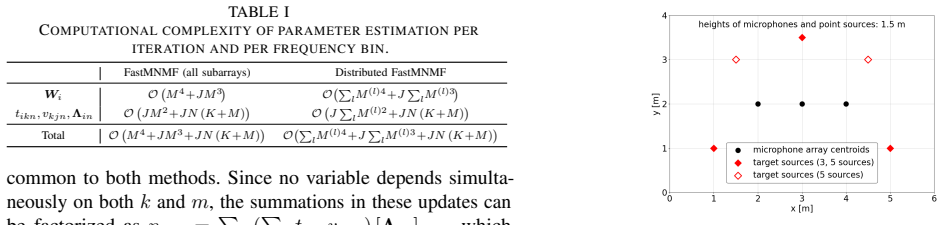
Distributed microphone arrays composed of multiple subarrays enable blind source separation over a wide spatial area. Directly applying fast multichannel nonnegative matrix factorization (FastMNMF) to all subarrays can exploit observations from all subarrays, but it requires repeated inversions of large matrices spanning all microphones, causing the computational cost to increase rapidly as the number of microphones grows. In contrast, applying FastMNMF to one subarray reduces the matrix size but cannot exploit observations from other subarrays. We propose distributed FastMNMF, which imposes a block-diagonal structure on the source spatial covariance matrices, so that matrix inversions are performed within subarrays. The NMF-based source spectrogram model is shared across subarrays, allowing the method to aggregate source activity information while discarding inter-subarray covariance. In synchronized, noiseless simulations with fixed room and array/source geometry, the method required less computation time than conventional FastMNMF using all subarrays, achieved a higher average source-to-distortion ratio than conventional FastMNMF using one subarray, and was applicable in the tested five-source condition, where each four-microphone subarray was locally underdetermined.
Editorial analysis
A structured set of objections, weighed in public.
Referee Report
Summary. The manuscript proposes 'distributed FastMNMF' for blind source separation using distributed microphone arrays. It imposes a block-diagonal structure on the source spatial covariance matrices to allow matrix inversions to be performed independently within each subarray, thereby reducing computational complexity compared to applying FastMNMF to the full array. The NMF source spectrogram model is shared across subarrays to pool source activity estimates. Simulations in synchronized, noiseless conditions demonstrate reduced computation time relative to full-array FastMNMF, improved average SDR over single-subarray FastMNMF, and applicability to a five-source underdetermined scenario with four-microphone subarrays.
Significance. This work addresses the scalability challenge in multichannel NMF for large distributed arrays by trading inter-subarray spatial covariance information for computational savings. If the performance claims hold under broader conditions, it could facilitate practical deployment of BSS in wide-area microphone networks. The use of a shared spectrogram model to compensate for the structural constraint is a notable design choice.
major comments (2)
- [Method (distributed FastMNMF)] The central construction sets each source's spatial covariance matrix to block-diagonal, explicitly zeroing cross-subarray blocks. This reduces inversion cost but discards inter-subarray correlations. In the tested five-source underdetermined regime, sources whose energy reaches multiple subarrays may lose critical phase/delay cues. The shared NMF model is intended to compensate via pooled activity estimates, but the update rules still depend on the block-diagonal covariance for spatial filtering. Additional analysis or experiments are needed to confirm that this does not substantially degrade separation when sources are not strictly localized to one subarray.
- [Simulation results / Abstract] The reported performance gains (lower computation time, higher SDR) are presented as high-level summaries without error bars, statistical tests, number of trials, or detailed exclusion criteria. This weakens confidence in the robustness of the claims, particularly since the central performance claims rest on these simulation outcomes.
minor comments (2)
- [Abstract] Specify the number of subarrays, total microphones, and exact simulation parameters (e.g., room size, reverberation time) to allow better assessment of generalizability.
- The paper could benefit from a discussion of potential limitations, such as sensitivity to array synchronization errors or noise, which are not present in the noiseless synchronized simulations.
Simulated Author's Rebuttal
We thank the referee for the constructive and detailed comments. We address each major comment below, providing clarifications and indicating planned revisions to the manuscript.
read point-by-point responses
-
Referee: [Method (distributed FastMNMF)] The central construction sets each source's spatial covariance matrix to block-diagonal, explicitly zeroing cross-subarray blocks. This reduces inversion cost but discards inter-subarray correlations. In the tested five-source underdetermined regime, sources whose energy reaches multiple subarrays may lose critical phase/delay cues. The shared NMF model is intended to compensate via pooled activity estimates, but the update rules still depend on the block-diagonal covariance for spatial filtering. Additional analysis or experiments are needed to confirm that this does not substantially degrade separation when sources are not strictly localized to one subarray.
Authors: We agree that the block-diagonal constraint on the source spatial covariance matrices discards inter-subarray correlations, which could impact separation for sources whose signals reach multiple subarrays and thereby lose some phase and delay information. The shared NMF spectrogram model is designed to mitigate this by pooling source activity estimates across all subarrays, enabling the use of observations from the full distributed array to inform the common basis and activation matrices. Although spatial filtering remains local due to the block-diagonal structure, the aggregated activity information improves overall separation performance, as evidenced by the higher average SDR relative to single-subarray FastMNMF in our simulations. We will revise the manuscript to include an expanded discussion of this design trade-off, the underlying assumptions, and the conditions (e.g., source localization relative to subarray coverage) under which the method is expected to perform well. revision: yes
-
Referee: [Simulation results / Abstract] The reported performance gains (lower computation time, higher SDR) are presented as high-level summaries without error bars, statistical tests, number of trials, or detailed exclusion criteria. This weakens confidence in the robustness of the claims, particularly since the central performance claims rest on these simulation outcomes.
Authors: The simulations were conducted under fixed room, array, and source geometry in synchronized, noiseless conditions to demonstrate the core properties of the distributed approach in a controlled setting, as described in the abstract. This choice avoids confounding factors from randomization and focuses on the computational savings and separation quality for the reported configuration. We will revise the manuscript to explicitly state that the results correspond to this single fixed-geometry setup, specify the number of trials (one per reported condition), and detail that no exclusion criteria were applied beyond the synchronized and noiseless assumptions. We acknowledge that error bars or statistical tests would strengthen the presentation and will consider incorporating variability through additional randomized simulations in the revision if space and scope permit. revision: yes
Circularity Check
No significant circularity; derivation is self-contained modeling choice
full rationale
The paper proposes imposing a block-diagonal structure on source spatial covariance matrices within the existing FastMNMF framework for distributed arrays, explicitly to reduce inversion cost while sharing the NMF spectrogram model. This is presented as a design assumption rather than a derived result. Performance claims (lower computation time, higher SDR than single-subarray baseline, applicability to underdetermined cases) are evaluated via simulations with fixed geometry and noiseless conditions, without any reduction of outputs to fitted parameters from the same data or self-referential definitions. No load-bearing self-citation chains, uniqueness theorems, or ansatzes smuggled via prior work are evident in the provided abstract and description that would make the central construction equivalent to its inputs by construction. The method extends prior FastMNMF with an independent structural constraint.
Axiom & Free-Parameter Ledger
axioms (1)
- domain assumption Block-diagonal structure on source spatial covariance matrices is a reasonable approximation that preserves sufficient separation performance while discarding inter-subarray covariances.
Lean theorems connected to this paper
-
IndisputableMonolith/Cost/FunctionalEquation.leanwashburn_uniqueness_aczel unclear?
unclearRelation between the paper passage and the cited Recognition theorem.
imposes a block-diagonal structure on the source spatial covariance matrices... discarding inter-subarray covariance. The NMF-based source spectrogram model is shared across subarrays
-
IndisputableMonolith/Foundation/AlexanderDuality.leanalexander_duality_circle_linking unclear?
unclearRelation between the paper passage and the cited Recognition theorem.
joint diagonalizability of Rin across all sources... W_i^H R_in W_i = Λ_in
What do these tags mean?
- matches
- The paper's claim is directly supported by a theorem in the formal canon.
- supports
- The theorem supports part of the paper's argument, but the paper may add assumptions or extra steps.
- extends
- The paper goes beyond the formal theorem; the theorem is a base layer rather than the whole result.
- uses
- The paper appears to rely on the theorem as machinery.
- contradicts
- The paper's claim conflicts with a theorem or certificate in the canon.
- unclear
- Pith found a possible connection, but the passage is too broad, indirect, or ambiguous to say the theorem truly supports the claim.
Reference graph
Works this paper leans on
-
[1]
Makino, Ed.,Audio Source Separation
S. Makino, Ed.,Audio Source Separation. Springer, 2018
work page 2018
-
[2]
A. Hiroe, “Solution of permutation problem in frequency domain ICA, using multivariate probability density functions,” inProc. ICA, 2006, pp. 601–608
work page 2006
-
[3]
Blind source separation exploiting higher-order frequency de- pendencies,
T. Kim, H. T. Attias, S. -Y . Lee, and T.-W. Lee, “Blind source separation exploiting higher-order frequency de- pendencies,”IEEE Trans. ASLP, vol. 15, no. 1, pp. 70–79, 2007
work page 2007
-
[4]
D. Kitamura, N. Ono, H. Sawada, H. Kameoka, and H. Saruwatari, “Determined blind source separation unifying independent vector analysis and nonnegative matrix factorization,”IEEE/ACM Trans. ASLP, vol. 24, no. 9, pp. 1626–1641, 2016
work page 2016
-
[5]
Multichannel nonnegative matrix factorization in convolutive mixtures for audio source separation,
A. Ozerov and C. F ´evotte, “Multichannel nonnegative matrix factorization in convolutive mixtures for audio source separation,”IEEE Trans. ASLP, vol. 18, no. 3, pp. 550–563, 2010
work page 2010
-
[6]
Mul- tichannel extensions of non-negative matrix factorization with complex-valued data,
H. Sawada, H. Kameoka, S. Araki, and N. Ueda, “Mul- tichannel extensions of non-negative matrix factorization with complex-valued data,”IEEE Trans. ASLP, vol. 21, no. 5, pp. 971–982, 2013. 2This condition holds under the positive definiteness assumption on the observed covariance matrix
work page 2013
-
[7]
N. Ito and T. Nakatani, “FastMNMF: Joint diagonal- ization based accelerated algorithms for multichannel nonnegative matrix factorization,” inProc. ICASSP, 2019, pp. 371–375
work page 2019
-
[8]
Fast multichannel source separation based on jointly diagonalizable spatial covariance matrices,
K. Sekiguchi, A. A. Nugraha, Y . Bando, and K. Yoshii, “Fast multichannel source separation based on jointly diagonalizable spatial covariance matrices,” inProc. EUSIPCO, 2019, pp. 1–5
work page 2019
-
[9]
Fast multichannel nonnegative matrix factorization with con- straints on active source candidates,
R. Ikeshita, Y . Kawaguchi, and K. Nagamatsu, “Fast multichannel nonnegative matrix factorization with con- straints on active source candidates,” inProc. IWAENC, 2018, pp. 520–524
work page 2018
-
[10]
Efficient joint optimization of sampling rate offsets using entire multichannel signal,
Y . Masuyama, K. Yamaoka, T. Kawamura, and N. Ono, “Efficient joint optimization of sampling rate offsets using entire multichannel signal,”IEEE/ACM Trans. ASLP, vol. 32, pp. 1816–1828, 2024
work page 2024
-
[11]
S. Kindt, J. Thienpondt, and N. Madhu, “Exploiting speaker embeddings for improved microphone clustering and speech separation in ad-hoc microphone arrays,” in Proc. ICASSP, 2023, pp. 1–5
work page 2023
-
[12]
Y . Sumura, D. Di Carlo, A. A. Nugraha, Y . Bando, and K. Yoshii, “Joint audio source localization and separation with distributed microphone arrays based on spatially- regularized multichannel NMF,” inProc. IWAENC, 2024, pp. 145–149
work page 2024
-
[13]
K. Yamaoka, K. Morita, N. Takamune, and H. Saruwatari, “Auxiliary-function-based decentralized independent vec- tor analysis for distributed microphone arrays,” inProc. APSIPA ASC, 2025, pp. 54–59
work page 2025
-
[14]
Acoustic echo suppressor with multichannel semi-blind non-negative matrix factorization,
M. Togami, Y . Kawaguchi, H. Kokubo, and Y . Obuchi, “Acoustic echo suppressor with multichannel semi-blind non-negative matrix factorization,” inProc. APSIPA ASC, 2010, pp. 522–525
work page 2010
-
[15]
H. Chiba et al., “Amplitude-based speech enhancement with nonnegative matrix factorization for asynchronous distributed recording,” inProc. IWAENC, 2014, pp. 203– 207
work page 2014
-
[16]
Stable and fast update rules for independent vector analysis based on auxiliary function technique,
N. Ono, “Stable and fast update rules for independent vector analysis based on auxiliary function technique,” inProc. WASPAA, 2011, pp. 189–192
work page 2011
-
[17]
JNAS: Japanese speech corpus for large vocabulary continuous speech recognition research,
K. Itou et al., “JNAS: Japanese speech corpus for large vocabulary continuous speech recognition research,”J. Acoust. Soc. Japan (E), vol. 20, no. 3, pp. 199–206, 1999
work page 1999
-
[18]
H. Sawada, S. Araki, and S. Makino, “Underdetermined convolutive blind source separation via frequency bin- wise clustering and permutation alignment,”IEEE Trans. ASLP, vol. 19, no. 3, pp. 516–527, 2011
work page 2011
-
[19]
New notions of simultaneous diagonalizability of quadratic forms with applications to QCQPs,
A. L. Wang and R. Jiang, “New notions of simultaneous diagonalizability of quadratic forms with applications to QCQPs,”Math. Program., vol. 212, no. 1, pp. 635–682, 2025
work page 2025
discussion (0)
Sign in with ORCID, Apple, or X to comment. Anyone can read and Pith papers without signing in.