REVIEW 2 major objections 5 minor 44 references
Predictions for the diffuse cosmic dipole at radio frequencies from reionization imprints
T0 review · 2 major / 5 minor · reviewed 2026-08-14 · deepseek-v4-flash
Pith's one-line read The paper predicts that the kinematic dipole spectrum of a diffuse radio background is set entirely by that background's own frequency spectrum, so reionization-era imprints (free-free plus Comptonization distortions, the redshifted 21-cm…
desk verdict Solid kinematic-dipole predictions; the missing treatment of intrinsic cosmic dipoles keeps the observability claim from landing. read the letter →
The pith
A machine-rendered reading of the paper's core claim, the machinery that carries it, and where it could break.
The reading
What carries the argument
The load-bearing object is the kinematic (Compton–Getting) dipole of a diffuse background, obtained by Lorentz-boosting the photon occupation number according to $\nu' = \nu(1-\hat n\cdot\beta)/(1-\beta^2)^{1/2}$ and converting back to thermodynamic temperature with $T_{\rm th}(\nu) = h\nu/[k\ln(1+1/\eta(\nu))]$. The specific identity that carries the whole argument is Eq. (17), which expresses the first-order dipole as $-\beta T_0$ times the logarithmic derivative of $\eta$ with respect to frequency; it translates any monopole spectral shape into a dipole spectrum, so every prediction in the paper follows from inserting the monopole models of Section 2 into this relation.
What would settle it
Measure the dipole of the residual extragalactic radio background at several frequencies (e.g., 0.15–8 GHz) on a wide-sky survey after subtracting detected sources: if the dipole direction does not match the CMB dipole direction, or the dipole amplitude is not described by $\beta T_{\rm ant}(1+\alpha)$ with $\alpha$ the monopole spectral index, the kinematic-only isotropy assumption is falsified.
Extended reading notes
Core claim
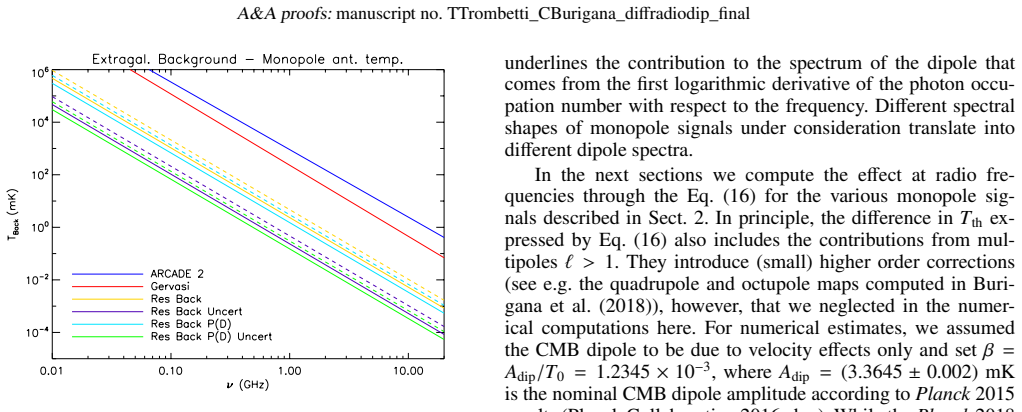
The central claim is that the spectral shape of the cosmic dipole generated by the observer's peculiar motion is fixed by the logarithmic frequency derivative of the photon occupation number $\eta(\nu)$ of the monopole background, via the first-order relation $\Delta T_{\rm th} \simeq - x \beta T_0\, [(1+\eta)\ln^2(1+1/\eta)]^{-1}\, d\ln\eta/d\ln x$ (Eq. 17). Using this identity on representative monopole models, the paper predicts that the free-free plus Comptonization dipole rises as a positive power law at low frequencies and then crosses to the negative Comptonization regime; the redshifted 21-cm line produces sign-changing dipole features whose amplitude tracks the steepness of the monopole, with the deep absorption-profile model yielding a dipole about an order of magnitude larger than milder models; and the residual extragalactic background yields a dipole with nearly the same power-law index as its monopole. In combined spectra, the 21-cm line shows up as a modulation between roughly 60 and 200 MHz over the smoother extragalactic and free-free dipoles. The paper argues that these spectral fingerprints require only relative calibration and can therefore be extracted from wide surveys or sky patches.
Load-bearing premise
The predictions assume that each diffuse radio background is isotropic on large angular scales in the CMB rest frame, so that the only dipole is the kinematic one induced by the observer's motion; the intrinsic dipoles from source clustering and patchy reionization are not modeled.
Editorial extensions
If this is right
- A measurement of the dipole spectrum of the residual extragalactic background, with only relative calibration, can constrain the amplitude and spectral index of that background after source subtraction.
- The predicted 60–200 MHz modulation and the sign inversions in the combined dipole spectrum can serve as diagnostics to distinguish global 21-cm reionization models, including the deep absorption profile observed near 78 MHz.
- The frequency where the free-free dipole gives way to the Comptonization dipole shifts with the residual background level, so wide-frequency radio-to-microwave observations can separate the components.
- Because the dipoles are two to three orders of magnitude smaller than the corresponding monopoles, precise dipole corrections are required when measuring weak monopole components such as the 21-cm line, while the dipole measurement itself avoids absolute calibration.
- Comparing dipoles measured for different backgrounds tests whether the observer's motion is the same with respect to each background frame, which bears on the cosmological principle.
Reading between the lines
- (Editorial inference) A wide-area radio survey that measures both the monopole and dipole of the residual background after source subtraction could directly test the kinematic-only assumption: if intrinsic source-clustering dipoles dominate, the dipole direction would not align with the CMB dipole direction.
- (Editorial inference) The same boosting formalism applies to other monopole components such as the cosmic infrared background, so the differential approach could become a general consistency check on foreground subtraction in CMB spectral-distortion experiments.
- (Editorial inference) Because the 21-cm line is tomographic, a future analysis might attempt to reconstruct the dipole per redshift shell rather than for the integrated global signal; this would require modeling the intrinsic dipole from density gradients and patchy reionization that the paper leaves out.
- (Editorial inference) The strongest test of the relative-calibration advantage would be a joint measurement of the dipole pattern's direction and frequency shape across the 60–200 MHz range on many independent sky patches, separating the coherent kinematic pattern from intrinsic fluctuations.
Editorial analysis
A structured set of objections, weighed in public.
Referee Report
Summary. The paper computes the kinematic dipole induced by the observer's peculiar motion on four diffuse radio backgrounds: the free-free plus Comptonization distortion, the redshifted 21cm line, the residual extragalactic background, and their combinations. The dipole is obtained by Lorentz-boosting an isotropic occupation number via Eq. (16), with the first-order approximation Eq. (17), and the monopole models are taken from the literature. Analytic approximations in Eqs. (21)-(27) are validated against the exact computation in Figs. 4 and 7. The central claims are that each background leaves a characteristic dipole spectrum (power-law slopes, sign changes, and a 60-200 MHz modulation from the 21cm line) and that these signatures can be measured with relative calibration alone.
Significance. If the predictions correspond to observable sky signals, the paper provides a useful link between monopole and anisotropy analyses and offers falsifiable spectral signatures. The derivation of the kinematic dipole from the monopole is parameter-free given isotropy, and the analytic approximations are checked against the exact numerical computation. The paper is strongest as a calculation of the kinematic dipole component of reionization-related backgrounds, identifying frequency ranges and spectral shapes that could be searched for; the observability claim, however, rests on an unstated isotropy assumption that requires substantial additional support.
major comments (2)
- [Section 3, Eqs. (15)-(17); Figs. 5-7] The computation assumes that each background is isotropic in the CMB rest frame, so that the only dipole is the kinematic one induced by the observer's motion. This premise is never stated or justified. For the redshifted 21cm line, the intrinsic dipole from large-scale density and ionization fluctuations during reionization is expected to be of order the brightness-temperature fluctuations themselves, tens of mK at 50-200 MHz, whereas the kinematic dipole from a monopole of 10-100 mK is only beta times that, i.e. roughly 0.01-0.1 mK. The 60-200 MHz modulation emphasized in Fig. 7 would therefore be completely dominated by the intrinsic term unless that term is separately removed. For the residual extragalactic background, source clustering produces a dipole that is known to be comparable to or larger than the kinematic dipole for the same source populations. Section 6 discusses Galactic foreground subtraction but does not propose any strategy for separating or removing intrinsic cosmic dipoles, and the sentence in Section 6 stating that all patch variations from cosmic diffuse dipoles should follow the observer-motion pattern is exactly the unproven assumption. The abstract's claim that these signatures can be observed relying only on relative calibration is therefore not supported for the 21cm and residual-background components.
- [Section 2.3, Eq. (14) and Fig. 6] The residual extragalactic background is treated as a smooth power-law monopole, and its dipole is computed by boosting that monopole. Radio source populations, however, carry an intrinsic dipole from clustering and from the source-count dipole, which is comparable to or larger than the kinematic dipole; the paper itself cites Colin et al. (2017) and Bengaly et al. (2018, 2019), where such radio dipoles are reported. The predicted power-law dipole spectrum in Fig. 6 is thus not the observable sky dipole unless the intrinsic dipole is modeled or shown to be subdominant. A concrete test would be to evaluate the dipole spectrum of simulated EoR light-cones or of the residual source population and compare with Eqs. (26)-(27); until this is done, the predictions should be framed as predictions for the kinematic component only.
minor comments (5)
- [Eq. (18)] As printed, Eq. (18) appears to read "eta = 1 - 3u x + ...", but the first two terms should be (1 - 3u)/x to be consistent with Eq. (5); the missing division by x makes the formula confusing.
- [Eq. (15)] The notation in Eq. (15) would be clearer as T_th = x T0 / ln(1 + 1/eta(nu,n,beta)); the current placement of "BB/dist" inside the logarithm is hard to parse.
- [Section 2.1] There is a typo in the phrase "two pairs of different FF and Componization distortion models": "Componization" should be "Comptonization".
- [Section 2.2] The phrase "The CMB is assumed as a back light" should read "The CMB is assumed as a background light".
- [Section 5] There are small formatting issues in the text, such as "The conditionF2+F3+F4 = 0" missing a space, and references to "Fig. (7)" and "Figs. (4) and (6)" where the parentheses are unnecessary.
Circularity Check
No significant circularity: the dipole spectra follow from a standard Lorentz-boost formula applied to independently chosen monopole models, and the dipole results are never used to fit a parameter.
full rationale
The paper's central derivation is the mapping from a monopole occupancy eta(nu) to a kinematic dipole via Eqs. (16)-(17), a standard Compton-Getting/Lorentz-invariance result (Forman 1970; Danese & de Zotti 1981). The monopole models in Sect. 2 are taken from prior literature or fitted to source counts, optical depth, and absolute-temperature data, not to dipole data; the dipole spectra in Figs. 4-7 are therefore genuinely derivative predictions. The approximate analytic expressions in Eqs. (21)-(27) are Taylor expansions of the same differential relation and recover the known (1+alpha) boost factors, which is a consistency check rather than a repackaging of the inputs. Self-citations (Trombetti & Burigana 2014; Burigana et al. 2018) supply the FF model and the map-level form of the boost, but the underlying physics is standard and the cited FF model is validated against numerical simulations, so the self-citations are not load-bearing for the dipole claim. The implicit isotropy assumption (kinematic dipole only) is a physical limitation, not a circular reduction: the paper does not define the predicted dipole in terms of the observed dipole, and no parameter is fitted to the predicted quantity. Hence no significant circularity is present.
Assumptions & free parameters
free parameters (6)
- Comptonization parameter u =
1e-7 and 2e-6
- Free-free amplitude yB(2 GHz) for Oh halo model =
1.5e-6
- Free-free amplitude AFF for Gnedin-based model =
7.012e-9 at 1 GHz, with yB ~ AFF (nu/GHz)^-zeta, zeta ~ 0.15
- Residual extragalactic background amplitude A =
2.35 mK and 1.51 mK (Eq. 14), plus 4.7 mK and 0.151 mK variants
- Power-law slope of extragalactic background alpha =
2.57 to 2.707, plus 2.65 for residuals
- Clumping factor cutoff kmax =
100
assumptions (5)
- standard math Lorentz invariance of the photon distribution function under the observer boost (Forman 1970; Danese & de Zotti 1981)
- domain assumption The CMB dipole is entirely kinematic, with beta = A_dip/T0 = 1.2345e-3 (Planck 2015)
- domain assumption Each diffuse radio background is isotropic in the CMB frame on dipole scales; the only dipole is the kinematic one
- domain assumption The free-free plus Comptonization occupation number in Eq. (4) is accurate over the observable radio range
- domain assumption The selected monopole models are representative of the plausible range of reionization and radio background scenarios
Cite this review
Pith. "Pith review of Predictions for the diffuse cosmic dipole at radio frequencies from reionization imprints." pith.science (2026). https://pith.science/paper/JSIYISK4
@misc{pith2026190807496,
  author       = {Pith},
  title        = {Pith review of: Predictions for the diffuse cosmic dipole at radio frequencies from reionization imprints},
  year         = {2026},
  howpublished = {\url{https://pith.science/paper/JSIYISK4}},
  note         = {Machine review of arXiv:1908.07496}
}
read the original abstract
The cosmological reionization can be studied in the radio through the tomographic view offered by the redshifted 21-cm line and the integrated information carried out by the diffuse free-free emission, coupled to the Comptonization distortion, relevant at higher frequencies. Current predictions span a wide range of possibilities, while the recent EDGES observations disagree with the standard models and call, if confirmed, for non-standard physical processes and/or for an early population of extragalactic sources producing a remarkable background at high redshifts almost consistent with the ARCADE 2 claim of a significant excess of CMB absolute temperature at low frequency. These signatures can be observed in global signal and fluctuations, from very large to small angular scales. The observer peculiar motion with respect to a reference frame in rest with respect to the CMB produces boosting effects in various observable quantities, remarkable at low multipoles, and particularly in the dipole, with frequency spectral behaviours depending on the monopole emission spectrum. We present a novel investigation at radio frequencies, aimed at predicting the imprints expected in the redshifted 21-cm line signal and in the diffuse free-free emission plus the Comptonization distortion for several models. Furthermore, we consider the same type of signal but expected from the cosmological radio background determining the offset for 21-cm line. The combination of these signals and their relevance in the various frequency ranges are studied. This approach, linking monopole and anisotropy analyses, can be applied on wide sky coverage surveys as well as to sets of sky patches. Relying only on the quality of interfrequency and relative data calibration, it in principle by-passes the need for precise absolute calibration, a critical point of current and future radio interferometric facilities.
Figures


Figures from the paper (3 more)


Reference graph
Works this paper leans on
-
[1]
On a possible nonequilibrium imprint in the cosmic background at low frequencies
Baiesi, M., Burigana, C., Conti, L., et al. 2019, arXiv e-prints, arXiv:1908.08876
work page Pith review arXiv 2019
-
[2]
Balashev, S. A., Kholupenko, E. E., Chluba, J., Ivanchik, A. V ., & Varshalovich, D. A. 2015, ApJ, 810, 131
work page 2015
-
[3]
2018, Nature, 555, 71
Barkana, R. 2018, Nature, 555, 71
2018
-
[4]
Bengaly, C. A. P., Maartens, R., & Santos, M. G. 2018, J. Cosmology Astropart. Phys., 2018, 031
work page 2018
-
[5]
Bengaly, C. A. P., Siewert, T. M., Schwarz, D. J., & Maartens, R. 2019, MNRAS, 486, 1350
work page 2019
-
[6]
Bernardi, G., Zwart, J. T. L., Price, D., et al. 2016, MNRAS, 461, 2847
work page 2016
-
[7]
D., Rogers, A
Bowman, J. D., Rogers, A. E. E., Monsalve, R. A., Mozdzen, T. J., & Mahesh, N. 2018, Nature, 555, 67
2018
-
[8]
Burigana, C., Carvalho, C. S., Trombetti, T., et al. 2018, J. Cosmology Astropart. Phys., 4, 021
work page 2018
Show all 44 references
-
[9]
1995, A&A, 303, 323
Burigana, C., de Zotti, G., & Danese, L. 1995, A&A, 303, 323
1995
-
[10]
A., Salvaterra, R., et al
Burigana, C., Popa, L. A., Salvaterra, R., et al. 2008, MNRAS, 385, 404
2008
-
[11]
O., Lazio, J., Bale, S., et al
Burns, J. O., Lazio, J., Bale, S., et al. 2012, Advances in Space Research, 49, 433
2012
-
[12]
2017, MNRAS, 472, 1915
Cohen, A., Fialkov, A., Barkana, R., & Lotem, M. 2017, MNRAS, 472, 1915
2017
-
[13]
2017, MNRAS, 471, 1045
Colin, J., Mohayaee, R., Rameez, M., & Sarkar, S. 2017, MNRAS, 471, 1045
2017
-
[14]
& de Zotti, G
Danese, L. & de Zotti, G. 1981, A&A, 94, L33 De Zotti, G., González-Nuevo, J., Lopez-Caniego, M., et al. 2018, J. Cosmology Astropart. Phys., 4, 020 De Zotti, G., Negrello, M., Castex, G., Lapi, A., & Bonato, M. 2016, J. Cosmol- ogy Astropart. Phys., 3, 047
1981
-
[15]
Deshpande, A. A. 2018, ApJ, 866, L7
2018
-
[16]
E., Turner, W., Millenaar, R., et al
Dewdney, P. E., Turner, W., Millenaar, R., et al. 2013, SKA Program Develop- ment Office, SKA-TEL-SKO-DD-001, Revision: 1
2013
-
[17]
& Taylor, G
Dowell, J. & Taylor, G. B. 2018, ApJ, 858, L9
2018
-
[18]
2018, ApJ, 868, 63
Ewall-Wice, A., Chang, T.-C., Lazio, J., et al. 2018, ApJ, 868, 63
2018
-
[19]
& Holder, G
Feng, C. & Holder, G. 2018, ApJ, 858, L17
2018
-
[20]
Fixsen, D. J. 2009, ApJ, 707, 916
2009
-
[21]
J., Cheng, E
Fixsen, D. J., Cheng, E. S., Gales, J. M., et al. 1996, ApJ, 473, 576
1996
-
[22]
Forman, M. A. 1970, Planet. Space Sci., 18, 25
1970
-
[23]
R., Oh, S
Furlanetto, S. R., Oh, S. P., & Briggs, F. H. 2006, Phys. Rep., 433, 181
2006
-
[24]
& Theuns, T
Gao, L. & Theuns, T. 2007, Science, 317, 1527
2007
-
[25]
Gnedin, N. Y . 2000, ApJ, 542, 535
2000
-
[26]
D., & Puchwein, E
Hills, R., Kulkarni, G., Meerburg, P. D., & Puchwein, E. 2018, Nature, 564, E32
2018
-
[27]
Mirabel, I. F. 2019, arXiv e-prints [arXiv:1902.00511] Muñoz, J. B. & Loeb, A. 2018, Nature, 557, 684
2019 arXiv
-
[28]
Oh, S. P. 1999, ApJ, 527, 16 Planck Collaboration. 2016a, A&A, 594, A1 Planck Collaboration. 2016b, A&A, 594, A5 Planck Collaboration. 2016c, A&A, 594, A8 Planck Collaboration, Aghanim, N., Akrami, Y ., et al. 2018a, arXiv e-prints [arXiv:1807.06209] Planck Collaboration, Agha...
1999 arXiv
-
[29]
P., Diego, J
Ponente, P. P., Diego, J. M., Sheth, R. K., et al. 2011, MNRAS, 410, 2353
2011
-
[30]
2018, MNRAS, 481, 4548
Prandoni, I., Guglielmino, G., Morganti, R., et al. 2018, MNRAS, 481, 4548
2018
-
[31]
& Seymour, N
Prandoni, I. & Seymour, N. 2015, Advancing Astrophysics with the Square Kilo- metre Array (AASKA14), 67
2015
-
[32]
Pritchard, J. R. & Loeb, A. 2010, Phys. Rev. D, 82, 023006
2010
-
[33]
Retana-Montenegro, E., Röttgering, H. J. A., Shimwell, T. W., et al. 2018, A&A, 620, A74
2018
-
[34]
& Burigana, C
Salvaterra, R. & Burigana, C. 2002, MNRAS, 336, 592
2002
-
[35]
R., et al
Schneider, R., Salvaterra, R., Choudhury, T. R., et al. 2008, MNRAS, 384, 1525 Seiffert, M., Fixsen, D. J., Kogut, A., et al. 2011, ApJ, 734, 6
2008
-
[36]
2018, MNRAS, 481, L6
Sharma, P. 2018, MNRAS, 481, L6
2018
-
[37]
J., Kogut, A., et al
Singal, J., Fixsen, D. J., Kogut, A., et al. 2011, ApJ, 730, 138
2011
-
[38]
2017, Physical Review Letters, 118, 151301
Slosar, A. 2017, Physical Review Letters, 118, 151301
2017
-
[39]
& Cowsik, R
Subrahmanyan, R. & Cowsik, R. 2013, ApJ, 776, 42
2013
-
[40]
N., Pritchard, J., & Vedantham, H
Subrahmanyan, R., Shankar, U. N., Pritchard, J., & Vedantham, H. K. 2015, Advancing Astrophysics with the Square Kilometre Array (AASKA14), 14
2015
-
[41]
& Burigana, C
Trombetti, T. & Burigana, C. 2014, MNRAS, 437, 2507
2014
-
[42]
V ., et al
Vernstrom, T., Scott, D., Wall, J. V ., et al. 2014, MNRAS, 440, 2791
2014
-
[43]
V ., et al
Vernstrom, T., Scott, D., Wall, J. V ., et al. 2016, MNRAS, 462, 2934
2016
-
[44]
G., Matarrese, S., & Riotto, A
Viel, M., Lesgourgues, J., Haehnelt, M. G., Matarrese, S., & Riotto, A. 2005, Phys. Rev. D, 71, 063534 Zel’dovich, Y . B., Illarionov, A. F., & Sunyaev, R. A. 1972, Soviet Journal of Experimental and Theoretical Physics, 35, 643 Article number, page 11 of 12 A&A proofs: manusc...
1995
Reviewed August 14, 2026 · model on record in the stance chip above.
Discussion (0). Continue with ORCID to comment.