GK-Mapper: A Stability Framework for Gustafson-Kessel Fuzzy Mapper Graphs
Pith reviewed 2026-06-26 12:31 UTC · model grok-4.3
The pith
Gustafson-Kessel Mapper graphs stay constant between finite critical events set by membership threshold crossings.
A machine-rendered reading of the paper's core claim, the machinery that carries it, and where it could break.
Core claim
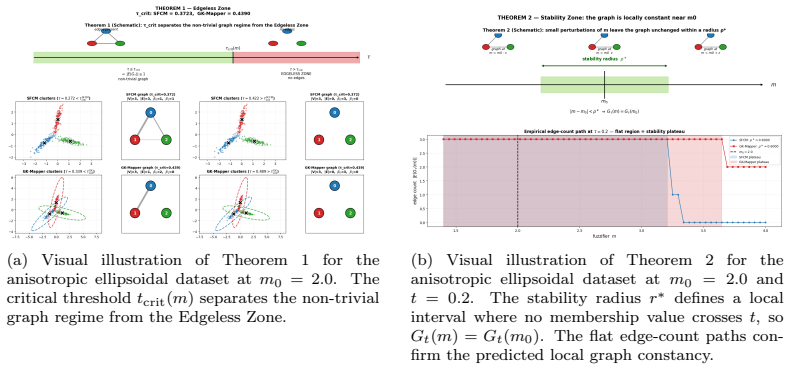
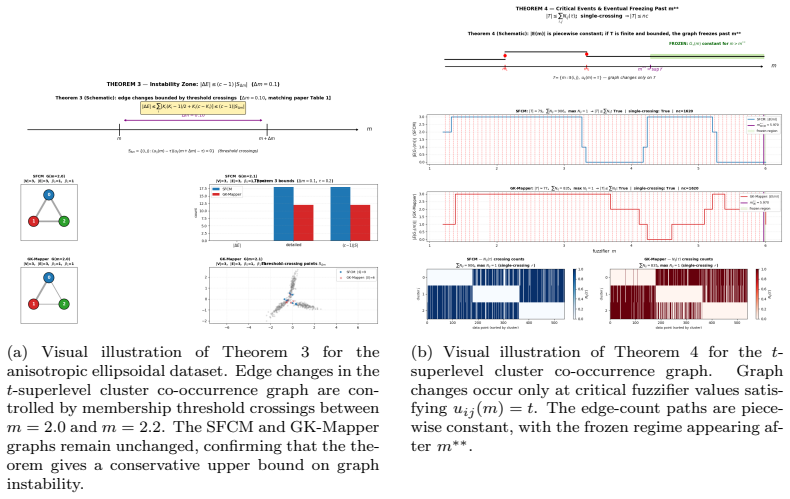
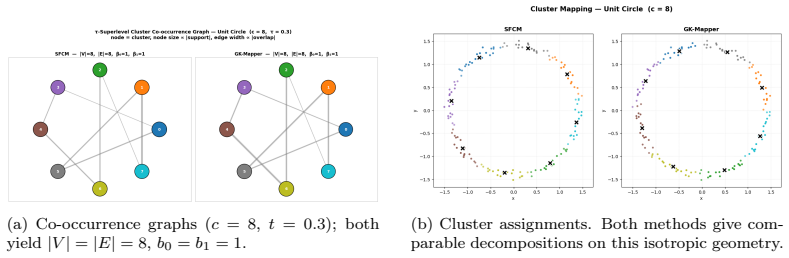
The graphs produced by Gustafson-Kessel Fuzzy Mapper and Shape Fuzzy C-Means Mapper are locally stable under small perturbations of the fuzzifier. Membership functions depend smoothly on the fuzzifier. Edges exist precisely when a certain condition on membership values holds. Changes in the graph are completely described by threshold crossings of the membership functions, and the graph is constant between consecutive critical events. When the threshold-crossing set is finite, this produces an eventual freezing threshold beyond which the graph no longer changes.
What carries the argument
The critical-event structure of graph changes, defined by threshold crossings of the membership functions induced by the fuzzifier.
If this is right
- The graph can be tracked by computing membership functions only up to the last critical event.
- Small fuzzifier perturbations leave the graph unchanged unless they cross a membership threshold.
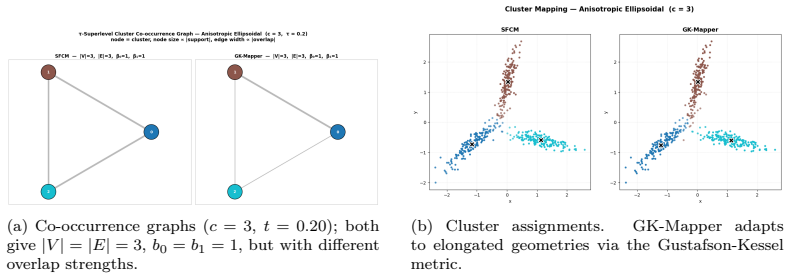
- Ellipsoidal covers allow the method to capture non-spherical cluster shapes in high dimensions.
- Empirical tests show the graphs remain more stable than those from spherical fuzzy covers on complex data.
Where Pith is reading between the lines
- Parameter tuning for Mapper could shift from visual inspection toward locating the freezing threshold directly from the membership functions.
- The same threshold-crossing analysis might apply to other fuzzy or soft clustering methods used inside topological summaries.
- One could monitor the derivative of membership values with respect to the fuzzifier to predict the next critical event without exhaustive search.
Load-bearing premise
The set of threshold crossings of the membership functions is finite for the data under study.
What would settle it
A concrete dataset and range of fuzzifier values in which membership functions cross their edge-existence thresholds at infinitely many distinct points, so that the graph keeps changing without bound.
Figures
read the original abstract
Topological Data Analysis uses tools from algebraic topology to study the shape and structure of data. The Mapper algorithm provides a graph-based summary of high-dimensional datasets by combining a filter function, a cover of the filter range, and clustering on the corresponding pullback sets. Several variants of Mapper have been proposed, including Conventional Mapper, F-Mapper, and Shape Fuzzy C-Means Mapper. In this article, we introduce Gustafson-Kessel Fuzzy Mapper Graphs, a geometry-adaptive extension of Shape Fuzzy C-Means Mapper. The proposed method replaces spherical fuzzy covers with ellipsoidal covers induced by the Gustafson-Kessel fuzzy clustering framework, making it more suitable for high-dimensional datasets with anisotropic and non-spherical geometry. We develop a stability framework for the graphs produced by Gustafson-Kessel Mapper and Shape Fuzzy C-Means Mapper. We prove that the membership functions depend smoothly on the fuzzifier, establish a precise condition for the existence of edges, and show that the graph is locally stable under small perturbations of the fuzzifier. We further describe the critical-event structure of graph changes in terms of threshold crossings of the membership functions and show that the graph is constant between consecutive critical events. When the threshold-crossing set is finite, this yields an eventual freezing threshold. Finally, we empirically show that Gustafson-Kessel Mapper can produce more stable graphs than Shape Fuzzy C-Means Mapper on high-dimensional and geometrically complex datasets.
Editorial analysis
A structured set of objections, weighed in public.
Referee Report
Summary. The paper introduces Gustafson-Kessel Fuzzy Mapper Graphs (GK-Mapper) as a geometry-adaptive extension of Shape Fuzzy C-Means Mapper, replacing spherical covers with ellipsoidal ones induced by Gustafson-Kessel fuzzy clustering. It develops a stability framework proving that membership functions depend smoothly on the fuzzifier, establishing a precise condition for edge existence, showing local stability of the graph under small fuzzifier perturbations, describing graph changes via threshold crossings of membership functions with constancy between consecutive critical events, and noting that finiteness of the crossing set yields an eventual freezing threshold. Empirical comparisons indicate GK-Mapper produces more stable graphs than prior variants on high-dimensional, anisotropic datasets.
Significance. If the stability results hold, the work supplies a useful parameter-sensitivity analysis for fuzzy Mapper constructions in TDA, clarifying how graph structure evolves with the fuzzifier and offering a mechanism to identify stable regimes. The local stability and critical-event description are potentially valuable for practitioners working with non-spherical data geometries.
major comments (1)
- [Abstract] Abstract: the global claim that the graph is eventually constant (via an eventual freezing threshold) rests on the hypothesis that the threshold-crossing set is finite. No argument, bound, or genericity condition is supplied showing this holds for finite point clouds or for continuous distributions equipped with the Gustafson-Kessel distance; without it only local stability follows.
Simulated Author's Rebuttal
We thank the referee for the careful review and constructive feedback on the stability framework. We address the single major comment below.
read point-by-point responses
-
Referee: [Abstract] Abstract: the global claim that the graph is eventually constant (via an eventual freezing threshold) rests on the hypothesis that the threshold-crossing set is finite. No argument, bound, or genericity condition is supplied showing this holds for finite point clouds or for continuous distributions equipped with the Gustafson-Kessel distance; without it only local stability follows.
Authors: We agree that the eventual-freezing statement is conditional on finiteness of the threshold-crossing set and that the manuscript supplies no general proof or genericity argument establishing this finiteness for arbitrary finite point clouds or continuous distributions. The abstract and theorems already qualify the claim with the clause “When the threshold-crossing set is finite.” To make the conditional nature fully explicit and to respond to the referee’s concern, we will revise the abstract to foreground the hypothesis, add a short remark in the stability section noting that finiteness is an assumption (with isolated crossings expected for smooth membership functions on finite data, though a rigorous bound is not provided), and clarify that unconditional results are limited to local stability. These changes will be incorporated in the revised manuscript. revision: partial
Circularity Check
No circularity: stability claims rest on independent smoothness and crossing analysis
full rationale
The paper's core results—smooth dependence of membership functions on the fuzzifier, edge-existence conditions, local stability under perturbations, and constancy between critical events—are derived from standard properties of Gustafson-Kessel clustering and Mapper constructions. The finiteness assumption for the threshold-crossing set is stated explicitly as a hypothesis yielding eventual constancy, without any reduction of the stability statements to fitted parameters or self-referential definitions. No load-bearing step equates a claimed prediction or uniqueness result to its own inputs by construction, and no self-citation chain is invoked to justify the central theorems. The derivation therefore remains self-contained against external fuzzy-clustering and topological-data-analysis benchmarks.
Axiom & Free-Parameter Ledger
free parameters (1)
- fuzzifier parameter
axioms (2)
- domain assumption Membership functions depend smoothly on the fuzzifier
- ad hoc to paper Threshold-crossing set is finite
Reference graph
Works this paper leans on
-
[1]
A sober look at clustering stability,
S. Ben-David, U. von Luxburg, and D. Pál, “A sober look at clustering stability,” inProc. 19th Annu. Conf. Learning Theory (COLT), 2006, pp. 5-19
2006
-
[2]
J. C. Bezdek,Pattern Recognition with Fuzzy Objective Function Algo- rithms. New York, NY, USA: Plenum Press, 1981
1981
-
[3]
FCM: The fuzzyC-Mean clus- tering algorithm,
J. C. Bezdek, R. Ehrlich, and W. Full, “FCM: The fuzzyC-Mean clus- tering algorithm,”Comput. Geosci., vol. 10, no. 2-3, pp. 191-203, 1984
1984
-
[4]
F- Mapper: A fuzzy mapper clustering algorithm,
Q.-T. Bui, B. Vo, H.-A. N. Do, N. Q. V. Hung, and V. Snasel, “F- Mapper: A fuzzy mapper clustering algorithm,”Knowl.-Based Syst., vol. 189, p. 105097, 2020
2020
-
[5]
SFCM: A fuzzy clustering algorithm of extracting the shape information of data,
Q.-T. Bui, B. Vo, V. Snasel, W. Pedrycz, T.-P. Hong, N.-T. Nguyen, and M.-Y. Chen, “SFCM: A fuzzy clustering algorithm of extracting the shape information of data,”IEEE Trans. Fuzzy Syst., vol. 29, no. 1, pp. 75-89, Jan. 2021
2021
-
[6]
Structure and stability of the 1-dimensional Mapper,
M. Carrière and S. Oudot, “Structure and stability of the 1-dimensional Mapper,”Found. Comput. Math., vol. 18, no. 6, pp. 1333-1396, 2018
2018
-
[7]
Statistical analysis and parame- ter selection for Mapper,
M. Carrière, B. Michel, and S. Oudot, “Statistical analysis and parame- ter selection for Mapper,”J. Mach. Learn. Res., vol. 19, no. 1, pp. 1-39, 2018
2018
-
[8]
Chazal, V
F. Chazal, V. de Silva, M. Glisse, and S. Oudot,The Structure and Stability of Persistence Modules. Cham, Switzerland: Springer, 2016. 23
2016
-
[9]
An introduction to topological data analy- sis: Fundamental and practical aspects for data scientists,
F. Chazal and B. Michel, “An introduction to topological data analy- sis: Fundamental and practical aspects for data scientists,”Front. Artif. Intell., vol. 4, p. 667963, 2021
2021
-
[10]
Stability of persis- tence diagrams,
D. Cohen-Steiner, H. Edelsbrunner, and J. Harer, “Stability of persis- tence diagrams,”Discrete Comput. Geom., vol. 37, no. 1, pp. 103-120, 2007
2007
-
[11]
The Ma- halanobis distance,
R. De Maesschalck, D. Jouan-Rimbaud, and D. L. Massart, “The Ma- halanobis distance,”Chemom. Intell. Lab. Syst., vol. 50, no. 1, pp. 1-18, 2000
2000
-
[12]
Multiscale Mapper: Topologi- cal summarisation via codomain covers,
T. K. Dey, F. Mémoli, and Y. Wang, “Multiscale Mapper: Topologi- cal summarisation via codomain covers,” inProc. ACM-SIAM Symp. Discrete Algorithms (SODA), 2016, pp. 997-1013
2016
-
[13]
Topological persis- tence and simplification,
H. Edelsbrunner, D. Letscher, and A. Zomorodian, “Topological persis- tence and simplification,” inProc. IEEE Symp. Found. Comput. Sci., 2000, pp. 454-463
2000
-
[14]
Barcodes: The persistent topology of data,
R. Ghrist, “Barcodes: The persistent topology of data,”Bull. Amer. Math. Soc., vol. 45, no. 1, pp. 61-75, 2008
2008
-
[15]
Fuzzy clustering with a fuzzy covari- ance matrix,
D. E. Gustafson and W. C. Kessel, “Fuzzy clustering with a fuzzy covari- ance matrix,” inProc. IEEE Conf. Decision Control, 1979, pp. 761-766
1979
-
[16]
Deconstructing the Mapper algorithm to extract richer topological and temporal features from functional neuroimaging data,
D. Haşeganet al., “Deconstructing the Mapper algorithm to extract richer topological and temporal features from functional neuroimaging data,”Netw. Neurosci., vol. 8, no. 4, pp. 1355-1382, 2024
2024
-
[17]
A possibilistic approach to cluster- ing,
R. Krishnapuram and J. M. Keller, “A possibilistic approach to cluster- ing,”IEEE Trans. Fuzzy Syst., vol. 1, no. 2, pp. 98-110, May 1993
1993
-
[18]
The theory of the interleaving distance on multidimensional persistence modules,
M. Lesnick, “The theory of the interleaving distance on multidimensional persistence modules,”Found. Comput. Math., vol. 15, no. 3, pp. 613-650, 2015
2015
-
[19]
Identification of type 2 diabetes subgroups through topo- logical analysis of patient similarity,
L. Liet al., “Identification of type 2 diabetes subgroups through topo- logical analysis of patient similarity,”Sci. Transl. Med., vol. 7, no. 311, p. 311ra174, 2015. 24
2015
-
[20]
A comprehensive review of the Mapper algorithm and its applications across various fields (2007–2025),
V. N. Madukpeet al., “A comprehensive review of the Mapper algorithm and its applications across various fields (2007–2025),”Int. J. Data Sci. Anal., vol. 21, 2025
2007
-
[21]
Nicolau, A
M. Nicolau, A. J. Levine, and G. Carlsson, Topology-based data analysis identifies a subgroup of breast cancers with a unique mutational profile and excellent survival,”Proc. Natl. Acad. Sci. USA, vol. 108, no. 17, pp. 7265-7270, 2011
2011
-
[22]
A topological approach for cancer subtyping from gene expression data,
O. Rafique and A. H. Mir, “A topological approach for cancer subtyping from gene expression data,”J. Biomed. Inf., vol. 102, p. 103357, 2020
2020
-
[23]
Simulating mixtures of mul- tivariate data with fixed cluster overlap in FSDA library,
M. Riani, A. Cerioli, D. Perrottaet al., “Simulating mixtures of mul- tivariate data with fixed cluster overlap in FSDA library,”Adv. Data Anal. Classif., vol. 9, pp. 461–481, 2015
2015
-
[24]
Topological methods for the analysis of high-dimensional data sets and 3D object recognition,
G. Singh, F. Mémoli, and G. Carlsson, “Topological methods for the analysis of high-dimensional data sets and 3D object recognition,” in Eurographics Symp. Point-Based Graphics, 2007, pp. 91-100
2007
-
[25]
Kepler Mapper: A flexible Python implementation of the Mapper algorithm,
H. J. van Veen, N. Saul, D. Eargle, and S. Mangham, “Kepler Mapper: A flexible Python implementation of the Mapper algorithm,”J. Open Source Softw., vol. 4, no. 42, p. 1315, 2019
2019
-
[26]
Distance metric learning with application to clustering with side-information,
E. P. Xing, A. Y. Ng, M. I. Jordan, and S. Russell, “Distance metric learning with application to clustering with side-information,” inAdv. Neural Inf. Process. Syst. (NeurIPS), vol. 15, 2002
2002
-
[27]
A novel kernelized fuzzyC-Mean algo- rithm with application in medical image segmentation,
D. Q. Zhang and S. C. Chen, “A novel kernelized fuzzyC-Mean algo- rithm with application in medical image segmentation,”Artif. Intell. Med., vol. 32, no. 1, pp. 37-50, 2004
2004
-
[28]
Mapper Interactive: A scalable, extendable, and inter- active toolbox for the visual exploration of high-dimensional data,
Y. Zhouet al., “Mapper Interactive: A scalable, extendable, and inter- active toolbox for the visual exploration of high-dimensional data,” in Proc. IEEE Pacific Vis. Symp. (PacificVis), 2021, pp. 101-110
2021
-
[29]
H. J. Zimmermann,Fuzzy Set Theory-and Its Applications, 4th ed. Dor- drecht, Netherlands: Springer, 2001
2001
-
[30]
UCI Machine Learning Repository,
D. Dua and C. Graff, “UCI Machine Learning Repository,” University of California, Irvine, School of Information and Computer Sciences, 2019. 25
2019
-
[31]
Scikit-learn: Machine Learning in Python,
F. Pedregosaet al., “Scikit-learn: Machine Learning in Python,”J. Mach. Learn. Res., vol. 12, pp. 2825-2830, 2011
2011
-
[32]
Breast cancer Wisconsin (diagnostic) data set,
W. H. Wolberg, W. N. Street, and O. L. Mangasarian, “Breast cancer Wisconsin (diagnostic) data set,” UCI Machine Learning Repository, 1995. 26 Algorithm 1Gustafson-Kessel FuzzyC-Mean (GK-FCM) Require:DatasetX={x 1, . . . , xn} ⊂R p, number of clustersc, fuzzifier m >1, volume parametersq j >0, tolerancetol Ensure:Membership matrixU= [u ij], cluster centre...
1995
discussion (0)
Sign in with ORCID, Apple, or X to comment. Anyone can read and Pith papers without signing in.