Strain localization in softening plasticity without modifying standard constitutive models: a deformable Cosserat approach
Pith reviewed 2026-06-27 19:36 UTC · model grok-4.3
The pith
A deformable Cosserat model lets standard elastoplastic constitutive laws simulate strain localization without any changes to their stress-update algorithms or tangent operators.
A machine-rendered reading of the paper's core claim, the machinery that carries it, and where it could break.
Core claim
The central claim is that a deformable Cosserat continuum with strict separation of dissipative macro-mechanisms and energetic micro-mechanisms allows any standard elastoplastic model formulated for a classical Cauchy continuum to be used without modification of its stress-update algorithm or consistent tangent, while the naturally arising internal length scale from the micro-continuum governs localization pattern development, interaction and selection.
What carries the argument
Deformable Cosserat continuum that confines dissipation to the macro-continuum and restricts the micro-continuum to linear elastic director-field terms.
If this is right
- Existing elastoplastic models can be inserted unchanged into the Cosserat framework and still produce regularized localization.
- The internal length scale controls band spacing and interaction without requiring artificial diffusion terms.
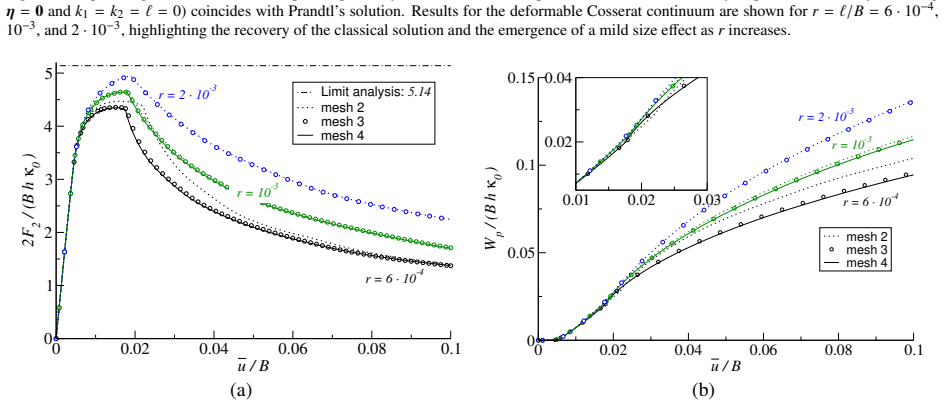
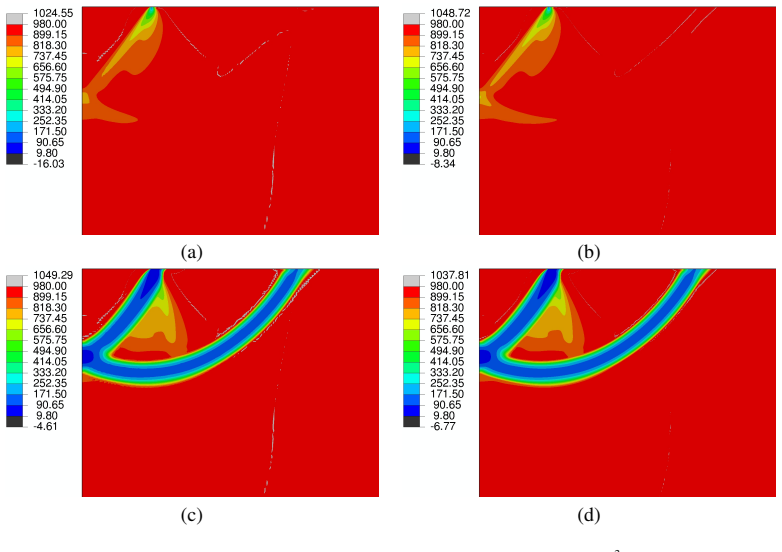
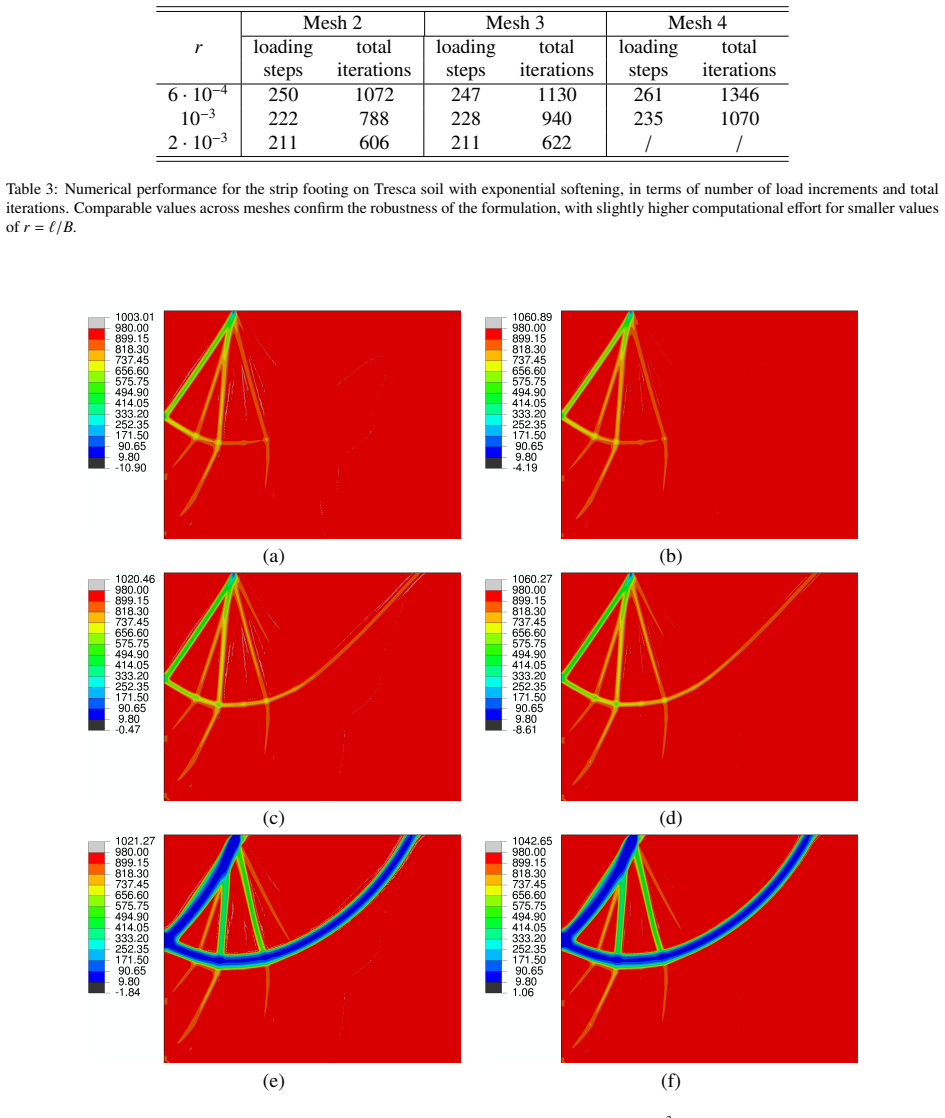
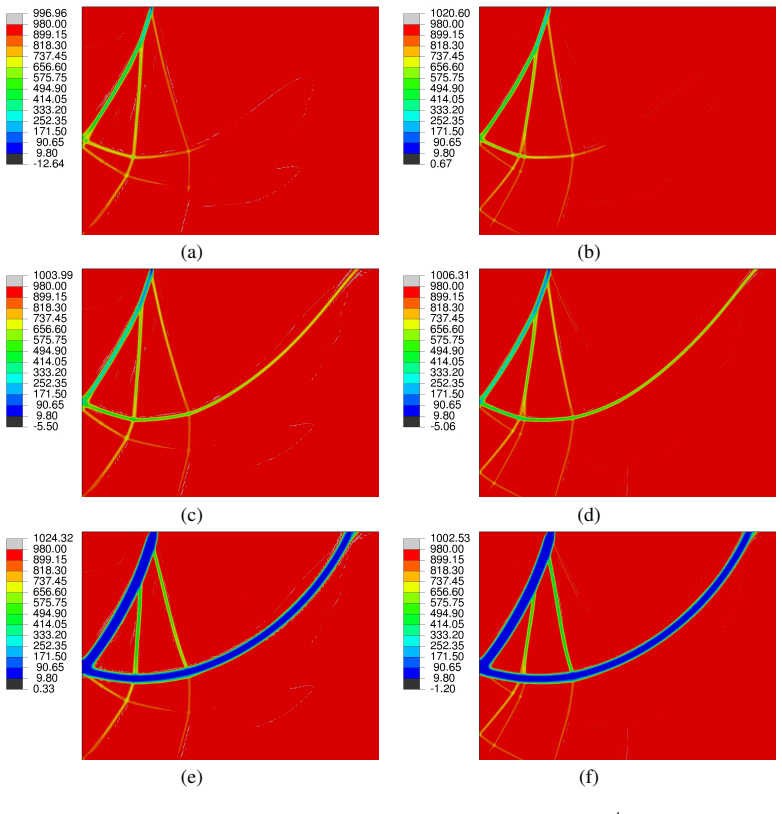
- Load-displacement responses, total dissipated energy, and shear-band geometries converge with mesh refinement even for nonlinearly interacting, unstable localization processes.
- Only linear additions to the residual and tangent operators are needed, preserving the structure of conventional finite-element implementations.
Where Pith is reading between the lines
- The separation of dissipation and elasticity could be tested by comparing the approach against a fully coupled Cosserat plasticity model on the same mesh to quantify any algorithmic overhead introduced by the black-box assumption.
- The method may extend naturally to three-dimensional problems where multiple intersecting bands interact, since the length scale is set by the micro-continuum rather than mesh size.
- Because the length scale is tied to the director-field stiffness, varying that stiffness independently offers a route to explore how material microstructure influences band selection without altering the macro constitutive law.
Load-bearing premise
The added Cosserat contributions remain purely energetic and never enter the dissipative constitutive response, so they leave standard stress-update algorithms untouched.
What would settle it
A single-element or single-band test in which the Cosserat formulation with an unmodified black-box constitutive model produces a different post-peak load-displacement curve or dissipated-energy value than the same model run with its internal variables explicitly coupled to the director strain.
Figures
read the original abstract
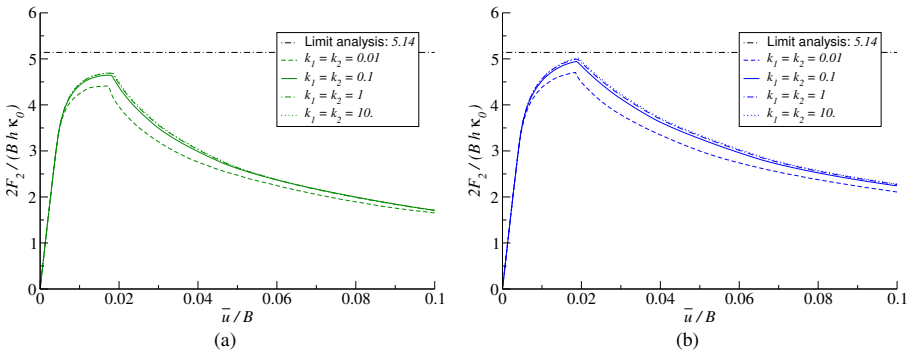
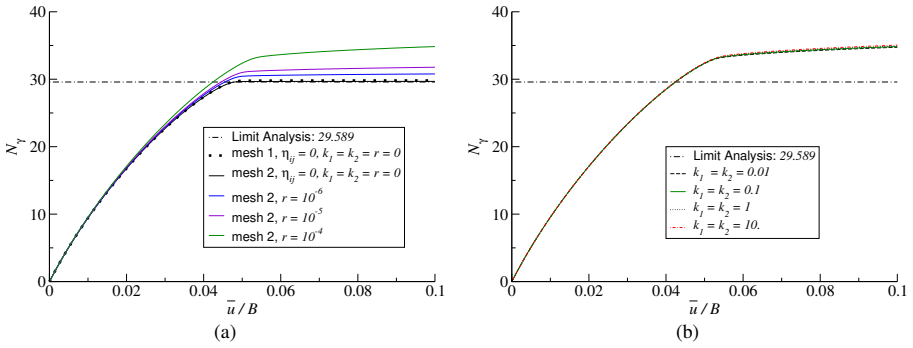
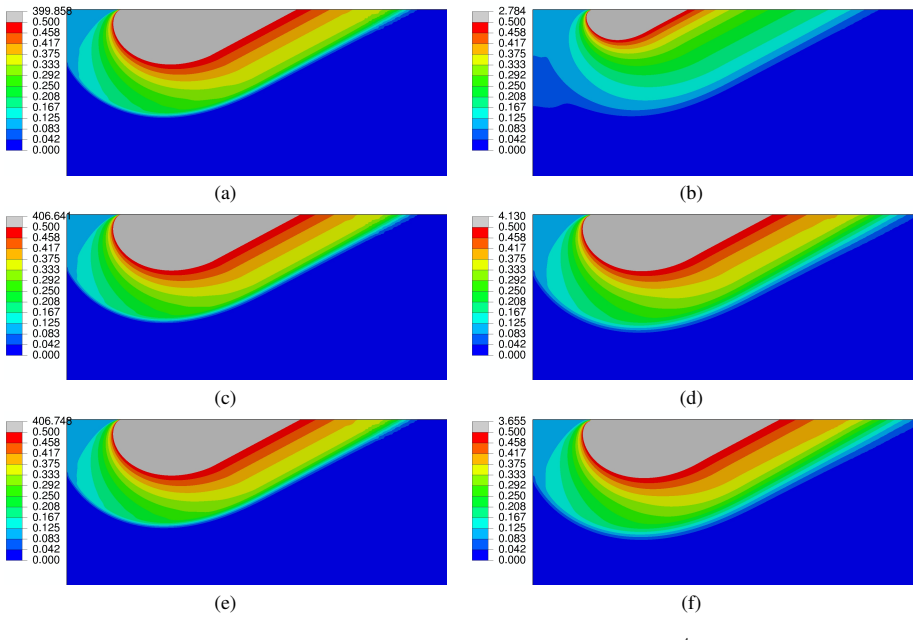
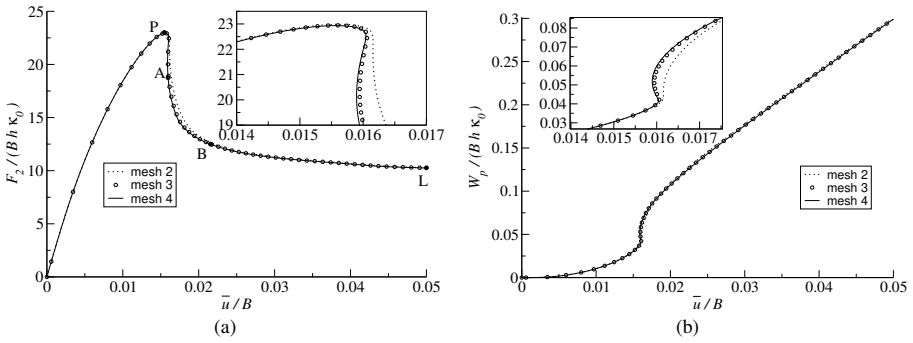
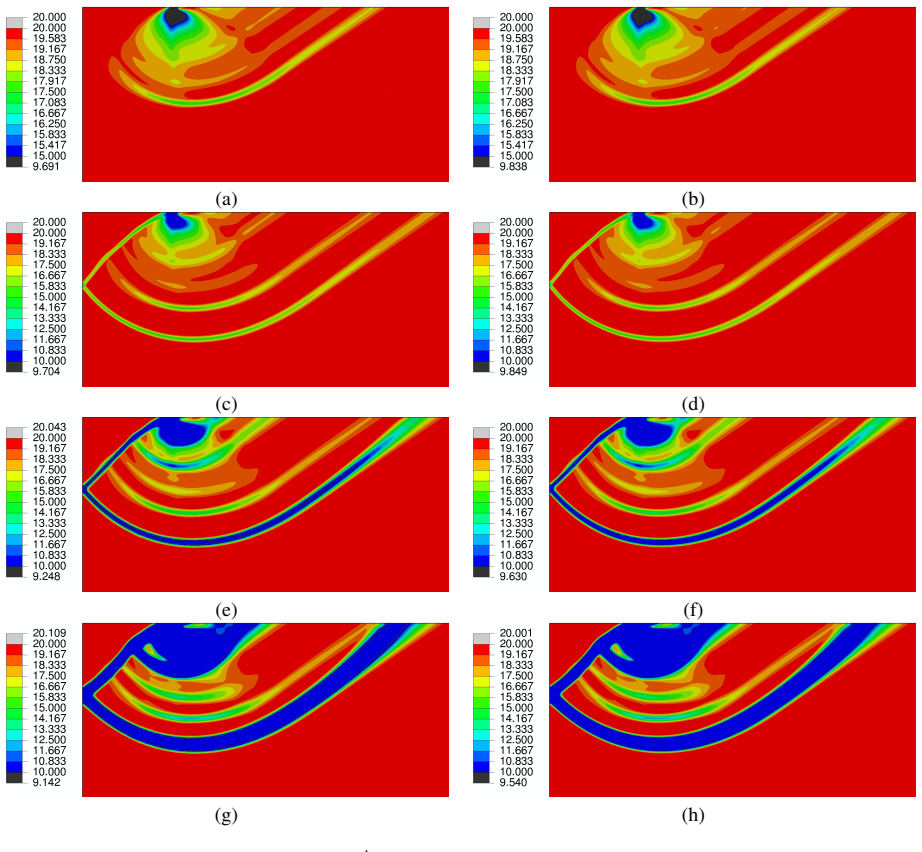
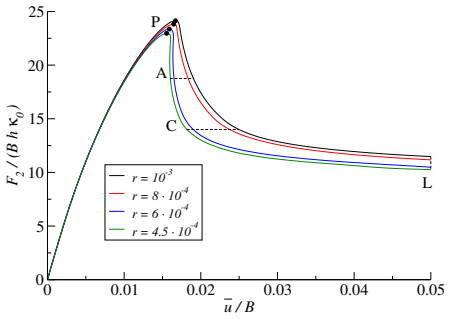
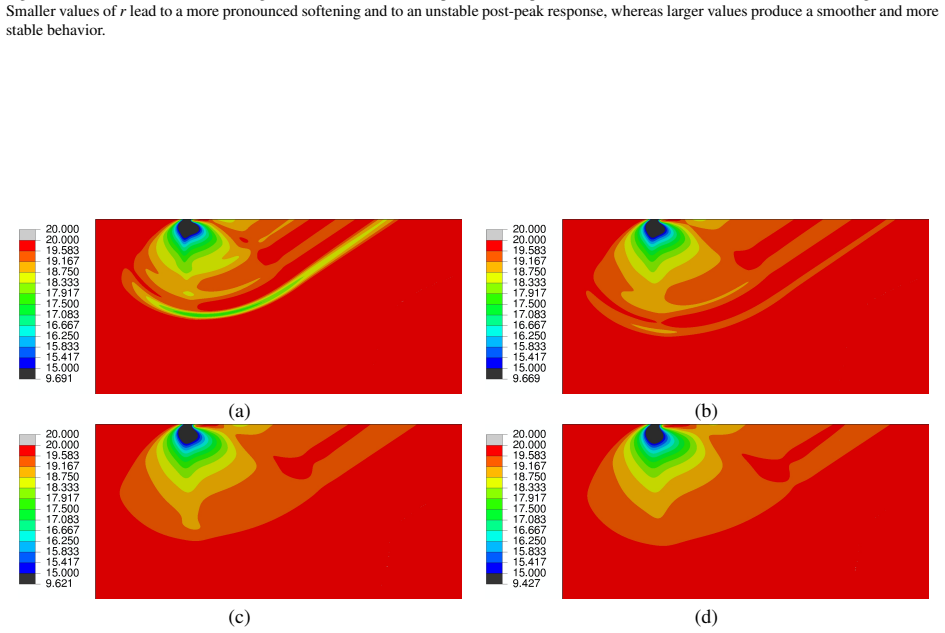
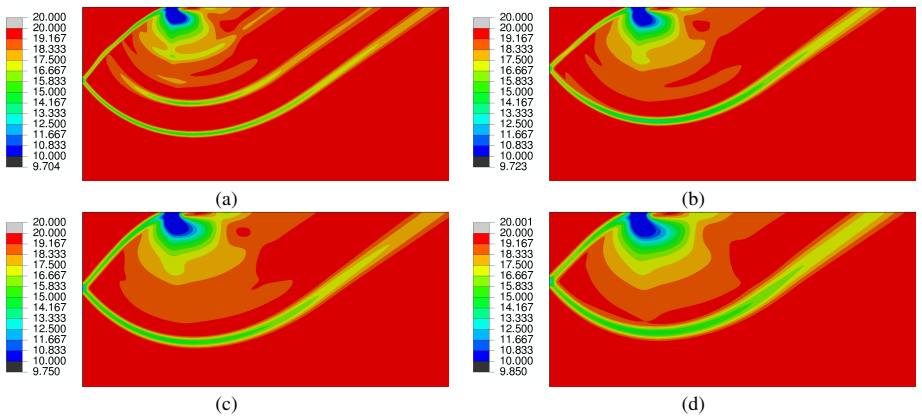
This paper presents a formulation for strain localization in softening plasticity based on a deformable Cosserat model. The approach enables the direct use of standard elastoplastic constitutive models formulated for a classical Cauchy continuum, without modifying the stress update algorithm or consistent tangent operator. A key feature of the framework is the strict separation of dissipative and energetic mechanisms: all dissipation is confined to the macro-continuum, while the micro-continuum contributes only through linear elastic terms associated with the director field. As a result, the constitutive structure of the elastoplastic model is preserved, and existing models can be employed as black-box components. The internal length scale arises naturally from the micro-continuum and governs the development, interaction and selection of localization patterns, rather than acting as a diffusive parameter. The formulation is easy to implement within standard finite element frameworks, requiring only additional linear contributions to the residual and tangent operators. The performance of the approach is assessed through benchmark problems involving shallow foundations on soil, a demanding test due to complex and unstable localization mechanisms. Both Tresca and Matsuoka-Nakai plasticity models are considered, including cases with highly unstable post-peak responses. Numerical results show convergence of load-displacement responses, dissipated energy and shear-band patterns upon mesh refinement, even in the presence of nonlinear interacting localization processes. These findings demonstrate a robust and physically consistent approach for the analysis of strain localization in softening plasticity.
Editorial analysis
A structured set of objections, weighed in public.
Referee Report
Summary. The manuscript proposes a deformable Cosserat continuum formulation for strain localization in softening plasticity that permits direct use of unmodified standard elastoplastic constitutive models (e.g., Tresca, Matsuoka-Nakai) formulated for Cauchy continua. Dissipation is confined to the macro-scale symmetric strain while the micro-director field contributes only linear-elastic energetic terms; the internal length emerges from the micro-continuum rather than as a diffusive regularization parameter. The approach requires only additional linear terms in the global residual and tangent. Benchmark results on shallow-foundation problems demonstrate mesh-convergent load-displacement curves, dissipated energy, and shear-band patterns even under unstable post-peak response.
Significance. If the claimed strict energetic/dissipative separation holds, the method offers a practical route to regularization that preserves existing, often complex and validated stress-update algorithms as black-box components. This is valuable in computational geomechanics where constitutive-model reuse is essential. The benchmarks are demanding and the reported convergence of interacting localization patterns is a positive indicator of robustness.
major comments (2)
- [Formulation and implementation sections] The central claim of black-box compatibility rests on the assertion that the local constitutive integration receives only the symmetric macro strain and that the yield function, flow rule, and consistent tangent remain independent of micro-rotation and curvature. The manuscript must explicitly show (in the section describing the stress-update procedure and the weak-form residuals) that no hidden coupling enters the return-mapping algorithm through the director-field terms or the global tangent assembly.
- [Numerical examples and discussion] The internal-length interpretation as governing pattern selection rather than diffusion is load-bearing for the physical claim. The paper should demonstrate, via a parameter study or analytic argument, that the micro-continuum stiffness parameters control band width and interaction independently of any numerical diffusion introduced by the finite-element discretization.
minor comments (2)
- Notation for the micro-director field and its curvature measure should be introduced with a clear table or diagram to avoid confusion with standard Cosserat rotation tensors.
- [Numerical results] The abstract states convergence upon mesh refinement; the main text should report quantitative measures (e.g., L2 norms of strain or band-width evolution) rather than qualitative statements alone.
Simulated Author's Rebuttal
We thank the referee for the careful reading and constructive comments. We address each major comment below and indicate the revisions that will be incorporated.
read point-by-point responses
-
Referee: [Formulation and implementation sections] The central claim of black-box compatibility rests on the assertion that the local constitutive integration receives only the symmetric macro strain and that the yield function, flow rule, and consistent tangent remain independent of micro-rotation and curvature. The manuscript must explicitly show (in the section describing the stress-update procedure and the weak-form residuals) that no hidden coupling enters the return-mapping algorithm through the director-field terms or the global tangent assembly.
Authors: We agree that the separation must be shown with greater explicitness. The formulation applies the standard elastoplastic return mapping exclusively to the symmetric macro-strain tensor; the micro-rotation and curvature enter only the linear-elastic director terms of the weak form (Eqs. 8-10) and are assembled as additional linear contributions to the global residual and tangent. No coupling reaches the local constitutive routine. To satisfy the request we will add a short dedicated paragraph (and a clarifying flowchart) in the stress-update and implementation sections that isolates the macro-strain input to the black-box model and confirms that the consistent tangent operator remains unmodified. revision: yes
-
Referee: [Numerical examples and discussion] The internal-length interpretation as governing pattern selection rather than diffusion is load-bearing for the physical claim. The paper should demonstrate, via a parameter study or analytic argument, that the micro-continuum stiffness parameters control band width and interaction independently of any numerical diffusion introduced by the finite-element discretization.
Authors: We accept that an explicit demonstration strengthens the physical claim. While the reported mesh-convergent results already indicate that regularization is not controlled by discretization, we will add a parameter study in the numerical-examples section that varies the micro-stiffness coefficients (bending and curvature moduli) at fixed mesh size and documents the resulting changes in band width and pattern interaction. A short analytic argument based on the characteristic length extracted from the linearized micro-continuum equations will also be included to confirm independence from numerical diffusion. revision: yes
Circularity Check
No significant circularity; derivation is self-contained
full rationale
The paper's central claim is that a deformable Cosserat formulation permits black-box use of standard Cauchy elastoplastic models by confining all dissipation to the macro-continuum and restricting micro-director contributions to linear elastic terms. No equations, parameters, or steps are shown to reduce by construction to fitted inputs, self-citations, or renamed known results. The separation is asserted as a modeling choice whose validity is demonstrated through numerical benchmarks rather than derived from prior self-referential results. The framework is presented as independent of specific model parameters and implementable via standard FE additions to residuals and tangents.
Axiom & Free-Parameter Ledger
free parameters (1)
- internal length scale
axioms (1)
- domain assumption The micro-continuum contributes only through linear elastic terms associated with the director field
Reference graph
Works this paper leans on
-
[1]
De Borst, Simulation of strain localization: a reappraisal of the Cosserat continuum, Eng
R. De Borst, Simulation of strain localization: a reappraisal of the Cosserat continuum, Eng. Comput. 8 (4) (1991) 317–332. doi:10.1108/eb023842
-
[2]
R. de Borst, L. Sluys, Localisation in a Cosserat continuum under static and dynamic loading conditions, Com- put. Method. Appl. M. 90 (1) (1991) 805–827. doi:https://doi.org/10.1016/0045-7825(91)90185-9
-
[3]
S. A. Sabet, R. de Borst, Mesh bias and shear band inclination in standard and non-standard continua, Arch. Appl. Mech. 89 (12) (2019) 2577–2590. doi:10.1007/s00419-019-01593-2
-
[4]
S. A. Sabet, R. de Borst, Structural softening, mesh dependence, and regularisation in non-associated plastic flow, Int. J. Numer. Anal. Met. 43 (13) (2019) 2170–2183. doi:https://doi.org/10.1002/nag.2973
-
[5]
E. M. P. Cosserat, F. Cosserat, Théorie des corps déformables, A. Hermann et fils, 1909
1909
-
[6]
H.-B. Mühlhaus, I. Vardoulakis, The thickness of shear bands in granular materials, Geotechnique 37 (3) (1987) 271–283. doi:10.1680/geot.1987.37.3.271
-
[7]
Peri ´c, J
D. Peri ´c, J. Yu, D. Owen, On error estimates and adaptivity in elastoplastic solids: Applications to the numerical simulation of strain localization in classical and Cosserat continua, Int. J. Num. Meth. Eng. 37 (8) (1994) 1351–
1994
-
[8]
doi:10.1002/nme.1620370806
-
[9]
E. Sharbati, R. Naghdabadi, Computational aspects of the Cosserat finite element analysis of localization phe- nomena, Comput. Mater. Sci. 38 (2) (2006) 303–315. doi:10.1016/j.commatsci.2006.03.003
-
[10]
A. Khoei, K. Karimi, An enriched-FEM model for simulation of localization phenomenon in Cosserat continuum theory, Comput. Mater. Sci. 44 (2) (2008) 733–749. doi:10.1016/j.commatsci.2008.05.019
-
[11]
A. Khoei, S. Yadegari, S. Biabanaki, 3D finite element modeling of shear band localization via the micro-polar Cosserat continuum theory, Comput. Mater. Sci. 49 (4) (2010) 720–733. doi:10.1016/j.commatsci.2010.06.015
-
[12]
A. Panteghini, R. Lagioia, A micropolar isotropic plasticity formulation for non-associated flow rule and softening featuring multiple classical yield criteria, Int. J. Numer. Anal. Met. 46 (4) (2022) 674–696. doi:https://doi.org/10.1002/nag.3316. 31
-
[13]
A. Panteghini, R. Lagioia, An implicit integration algorithm based on invariants for isotropic elasto- plastic models of the cosserat continuum, Int. J. Numer. Anal. Met. 46 (12) (2022) 2233–2267. doi:https://doi.org/10.1002/nag.3386
-
[14]
G. Russo, S. Forest, C. Girot-Mata, Thermomechanics of Cosserat media: modeling adiabatic shear bands in metals, Continuum Mech. Therm. 32 (2020) 1051–1076. doi:10.1007/s00161-020-00930-z
-
[15]
H. Ebrahimian, S. Pietruszczak, I. Vardoulakis, Modeling shear localization along granular soil-structure interfaces using elasto-plastic Cosserat continuum, Int. J. Solids Struct. 49 (19-20) (2012) 2797–2809. doi:10.1016/j.ijsolstr.2011.09.005
-
[16]
T. Duretz, L. Räss, R. de Borst, T. Hageman, A comparison of plasticity regularization approaches for geody- namic modeling, Geochem. Geophys. Geosyst. 24 (7) (2023). doi:10.1029/2022GC010675
-
[17]
A. Panteghini, M. Rubin, On the evolution of damage-induced localization in a deformable-director Cosserat continuum, Comput. Method. Appl. M. 453 (2026) 118797. doi:10.1016/j.cma.2026.118797
-
[18]
A. C. Eringen, E. Suhubi, Nonlinear theory of simple micro-elastic solids–I, Int. J. Eng. Sci. 2 (2) (1964) 189–
1964
-
[19]
doi:10.1016/0020-7225(64)90004-7
-
[20]
E. Suhubi, A. C. Eringen, Nonlinear theory of micro-elastic solids–II, Int. J. Eng. Sci. 2 (4) (1964) 389–404. doi:10.1016/0020-7225(64)90017-5
-
[21]
Forest, Micromorphic approach for gradient elasticity, viscoplasticity, and damage, J
S. Forest, Micromorphic approach for gradient elasticity, viscoplasticity, and damage, J. Eng. Mech. 135 (3) (2009) 117–131. doi:10.1061/(ASCE)0733-9399(2009)135:3(117)
-
[22]
Forest, Micromorphic approach to materials with internal length, in: H
S. Forest, Micromorphic approach to materials with internal length, in: H. Altenbach, A. Öchsner (Eds.), En- cyclopedia of Continuum Mechanics, Springer Berlin Heidelberg, Berlin, Heidelberg, 2020, pp. 1643–1652. doi:10.1007/978-3-662-55771-6_150
-
[23]
R. H. J. Peerlings, R. de Borst, W. A. M. Brekelmans, J. H. P. de Vree, Gradient enhanced damage for quasi-brittle materials, Int. J. Num. Meth. Eng. 39 (19) (1996) 3391–3403. doi:10.1002/(SICI)1097- 0207(19961015)39:19<3391::AID-NME7>3.0.CO;2-D
-
[24]
R. H. J. Peerlings, R. de Borst, W. A. M. Brekelmans, J. H. P. de Vree, Gradient-enhanced damage modelling of concrete fracture, Eng. Fract. Mech. 60 (1) (1998) 1–12. doi:10.1016/S0013-7944(97)00117-9
-
[25]
Jirásek, Comparison of integral-type nonlocal plasticity models for strain-softening materials, Int
M. Jirásek, Comparison of integral-type nonlocal plasticity models for strain-softening materials, Int. J. Eng. Sci. 41 (13-14) (2003) 1553–1602. doi:10.1016/S0020-7225(03)00027-2
-
[26]
Lorentz, Gradient damage models: Toward full-scale computations, Comput
E. Lorentz, Gradient damage models: Toward full-scale computations, Comput. Method. Appl. M. 200 (1-4) (2011) 90–109. doi:10.1016/j.cma.2010.07.015
-
[27]
Anand, Fracture of rock-like materials: a gradient-damage theory, Int
L. Anand, Fracture of rock-like materials: a gradient-damage theory, Int. J. Solids Struct. 325 (2026) 113739. doi:10.1016/j.ijsolstr.2025.113739
-
[28]
A. Needleman, V . Tvergaard, Analyses of plastic flow localization in metals, Appl. Mech. Rev. 45 (3S) (1992) S3–S18. doi:10.1115/1.3121390
-
[29]
Z. P. Bažant, G. Pijaudier-Cabot, Nonlocal continuum damage, localization instability and convergence, J. Appl. Mech. 55 (2) (1988) 287–293. doi:10.1115/1.3173674
-
[30]
Z. P. Bažant, M. Jirásek, Nonlocal integral formulations of plasticity and damage: survey of progress, J. Eng. Mech. 128 (11) (2002) 1119–1149. doi:10.1061/(ASCE)0733-9399(2002)128:11(1119)
-
[31]
Miehe, M
C. Miehe, M. Hofacker, F. Welschinger, A phase field model for rate-independent crack propagation: Robust algorithmic implementation based on operator splits, Comput. Method. Appl. M. 199 (45–48) (2010) 2765–
2010
-
[32]
doi:10.1016/j.cma.2010.01.008. 32
-
[33]
C. Miehe, F. Welschinger, M. Hofacker, Thermodynamically consistent phase-field models of fracture in elastic solids, Int. J. Num. Meth. Eng. 83 (10) (2010) 1273–1311. doi:10.1002/nme.2861
-
[34]
F. P. Duda, A. Ciarbonetti, P. J. Sánchez, A. E. Huespe, A phase-field/gradient damage model for brittle fracture in elastic–plastic solids, Int. J. Plasticity 65 (2015) 269–296. doi:10.1016/j.ijplas.2014.09.005
-
[35]
C. Miehe, F. Aldakheel, S. Teichtmeister, Phase-field modeling of ductile fracture at finite strains: a robust variational-based numerical implementation of a gradient-extended theory by micromorphic regularization, Int. J. Num. Meth. Eng. 111 (9) (2017) 816–863. doi:10.1002/nme.5484
-
[36]
M. B. Rubin, A thermomechanical Eulerian formulation of a size-dependent elastic-inelastic Cosserat contin- uum, J. Elast. 157 (12) (2025). doi:10.1007/s10659-024-10105-5
-
[37]
M. B. Rubin, Correction to: A Thermomechanical Eulerian Formulation of a Size-Dependent Elastic-Inelastic Cosserat Continuum, J. Elast. 157 (77) (2025). doi:10.1007/s10659-025-10173-1
-
[38]
Rubin, A
M. Rubin, A. Panteghini, An Eulerian deformable Cosserat model for large deformations of porous geomaterials, Submitted to J. Elast (2026)
2026
-
[39]
M. B. Rubin, On the balance of angular momentum and the balances of director momentum in a deformable Cosserat continuum, Submitted to J. Elast (2026)
2026
-
[40]
R. D. Mindlin, Microstructure in linear elasticity, Archive of Rational Mechanics 16 (1964) 51–78. doi:10.1007/BF00248490
-
[41]
Matsuoka, T
H. Matsuoka, T. Nakai, Stress-deformation and strength characteristics of soil under three different principal stresses, Proceedings of the Japan Society of Civil Engineers 1974 (232) (1974) 59–70
1974
-
[42]
A. Panteghini, R. Lagioia, A fully convex reformulation of the original Matsuoka–Nakai failure criterion and its implicit numerically efficient integration algorithm, Int. J. Numer. Anal. Met. 38 (6) (2014) 593–614. doi:https://doi.org/10.1002/nag.2228
-
[43]
R. De Borst, P. A. Vermeer, Possibilities and limitations of finite elements for limit analysis, Geotechnique 34 (2) (1984) 199–210. doi:10.1680/geot.1984.34.2.199
-
[44]
R. Lagioia, A. Panteghini, On the existence of a unique class of yield and failure criteria comprising Tresca, von Mises, Drucker–Prager, Mohr–Coulomb, Galileo–Rankine, Matsuoka–Nakai and Lade-Duncan, Proc. R. Soc. A 472 (2185) (2016) 20150713. doi:10.1098/rspa.2015.0713
-
[45]
P. V . Lade, J. M. Duncan, Elasto Plastic stress–strain theory for cohesionless soil, J. Geotech. Eng. Div., Am. Soc. Civ. Eng 101 (GT10) (1974) 1037–1053. doi:10.1061/AJGEB6.0000204
-
[46]
A. Panteghini, R. Lagioia, An approach for providing quasi-convexity to yield functions and a generalized im- plicit integration scheme for isotropic constitutive models based on 2 unknowns, Int. J. Numer. Anal. Met. 42 (6) (2018) 829–855. doi:https://doi.org/10.1002/nag.2767
-
[47]
Dassault Systèmes, ABAQUS User’s & Theory Manuals — Release 6.24, Providence, RI, USA (2024)
2024
-
[48]
Prandtl, Uber die Harte Plastischer Korper, Nachrichten von der Koeniglichen Gesellschaft der Wis- senschaften zu Goettingen, Mathematisch-physikalische Klasse (1920) 74–85
L. Prandtl, Uber die Harte Plastischer Korper, Nachrichten von der Koeniglichen Gesellschaft der Wis- senschaften zu Goettingen, Mathematisch-physikalische Klasse (1920) 74–85
1920
-
[49]
C. M. Martin, New software for rigorous bearing capacity calculations, in: Proc. International Conference on Foundations, Dundee, 2003, pp. 581–592
2003
-
[50]
C. M. Martin, User Guide for ABC-Analysis of Bearing Capacity Version 1.0 Department of Engineering Sci- ence University of Oxford (2004). 33
2004
-
[51]
R. Lagioia, A. Panteghini, Accounting for specific failure criteria in the slip-line method for plane strain prob- lems, Geotech. Lett. 7 (2) (2017) 184–189. doi:10.1680/jgele.17.00014
-
[52]
E. A. de Souza Neto, D. Peric, D. R. J. Owen, Computational Methods for Plasticity, John Wiley & Sons, Ltd, Chichester, UK, 2008. 34
2008
discussion (0)
Sign in with ORCID, Apple, or X to comment. Anyone can read and Pith papers without signing in.