REVIEW 3 major objections 6 minor 25 references
Markov-Functional Models with Local Drift
T0 review · 3 major / 6 minor · reviewed 2026-08-12 · deepseek-v4-flash
Pith's one-line read Given a discrete set of option-implied marginals, the paper constructs a local volatility model whose latent process carries a local drift $\mu=-f''/(2f')$, and whose fixed-point iterations aim to match every marginal maturity.
desk verdict A genuinely new fixed-point construction for stepwise time-homogeneous local volatility models, with honest numerical evidence, but the missing convergence proof makes the headline existence claim conditional rather than established. read the letter →
The pith
A machine-rendered reading of the paper's core claim, the machinery that carries it, and where it could break.
The reading
What carries the argument
The central object is the pair $(f,\mu)$: a flow function $f$ mapping a latent flow variable $X_t$ to the asset price $S_t$, and a local drift $\mu$ on $X_t$. The martingale property forces the relation $\mu=-f''/(2f')$, so the drift is not an extra input but is determined by the convexity of the flow function. The iteration consists of solving the Fokker-Planck equation for the flow variable density, quantile-matching the target marginal to define $f$, and updating $\mu$; for later periods the initial flow distribution $F_{X_{T_i}}$ is updated jointly through the fixed-point equation $F_{X_{T_i}}(x)=F_{\nu_i}\circ F_{\nu_{i+1}}^{-1}\circ \hat{K}^{\mathrm{forward},\mu}_{T_i\to T_{i+1}}[F_{X_{T_i}}(x)]$. This is what turns a static list of marginals into a dynamic model.
What would settle it
Run Algorithm 2 on a pair of strictly increasing target CDFs with a very low-density tail and check whether the iterated drift $\mu=-f''/(2f')$ remains finite and whether $S_{T_{i+1}}$ reproduces the target CDF within tolerance; divergence or a blow-up in the drift would show the advertised fixed-point construction fails for that input.
Extended reading notes
Core claim
The paper's central assertion is that, given a discrete set of marginals $\nu_i$ on $\mathbb{R}$ and a maturity grid $0=T_0<T_1<\cdots<T_n$, the fixed-point Algorithms 1 and 2 produce a step-wise time-homogeneous diffusion $S_t=f(X_t)$ with $dX_t=\mu(X_t)dt+dW_t$, $\mu=-f''/(2f')$, such that $S_{T_i}\sim\nu_i$ for every $i$. The flow function is determined at each marginal maturity by quantile matching, $f(T_i,x)=F_{\nu_i}^{-1}(F_{X_{T_i}}(x))$, and inside each forward period the same $f$ and $\mu$ are reused without time dependence. The paper also constructs a continuous variant (Algorithm 3) by interpolating the flow function snapshots $f(T_i,\cdot)$ with a specified term structure such as $f(t,x)=a_i+b_i\sqrt{t}$, which makes the local volatility continuous across maturities. In both cases the paper is explicit that the claim holds when the fixed-point iteration converges.
Load-bearing premise
The whole construction rests on the assumption that the fixed-point iterations of Algorithms 1, 2, and 3 converge and that the drift $\mu=-f''/(2f')$ stays well-defined, meaning $f'$ never hits zero or infinity over the relevant range.
Editorial extensions
If this is right
- A correct construction gives a parameter-free interpolation of the local volatility term structure from the marginals alone, with no additional model parameters.
- The resulting process is Markov and a martingale, so Monte Carlo pricing can be done by simulating the flow variable and applying the same flow function within each forward period.
- Because the first construction is time-homogeneous within each interval, it avoids the oscillatory local volatility shapes that Brownian-flow interpolation can produce, at the cost of discontinuities at the marginal maturities.
- The continuous variant removes the need to match the flow variable across maturities in a simulation, but the paper finds its term structure can oscillate when the total variance is not matched exactly.
- If the fixed point converges, the same algorithm applies to real market data after an arbitrage-free fitting of the marginals, as demonstrated on the paper's market example.
Reading between the lines
- Beyond the paper: the convergence rates in Table 1 suggest the fixed-point map contracts geometrically, so a proof of contraction via monotonicity of the quantile-matching update would convert the conditional claim into a theorem.
- Beyond the paper: the identity $\mu=-f''/(2f')$ turns the fixed point into a second-order boundary-value problem for $f$, which may yield existence and uniqueness criteria for general marginals.
- Beyond the paper: Assumption 2.1 rules out flat regions in the target CDF, so handling assets with an absorbing zero would require an extension with boundary conditions or jumps.
- Beyond the paper: the continuous variant's term structure $f(t,x)=a_i+b_i\sqrt{t}$ is one member of a family of choices, and optimizing over that family to reduce the oscillatory local volatility is a natural extension.
Editorial analysis
A structured set of objections, weighed in public.
Referee Report
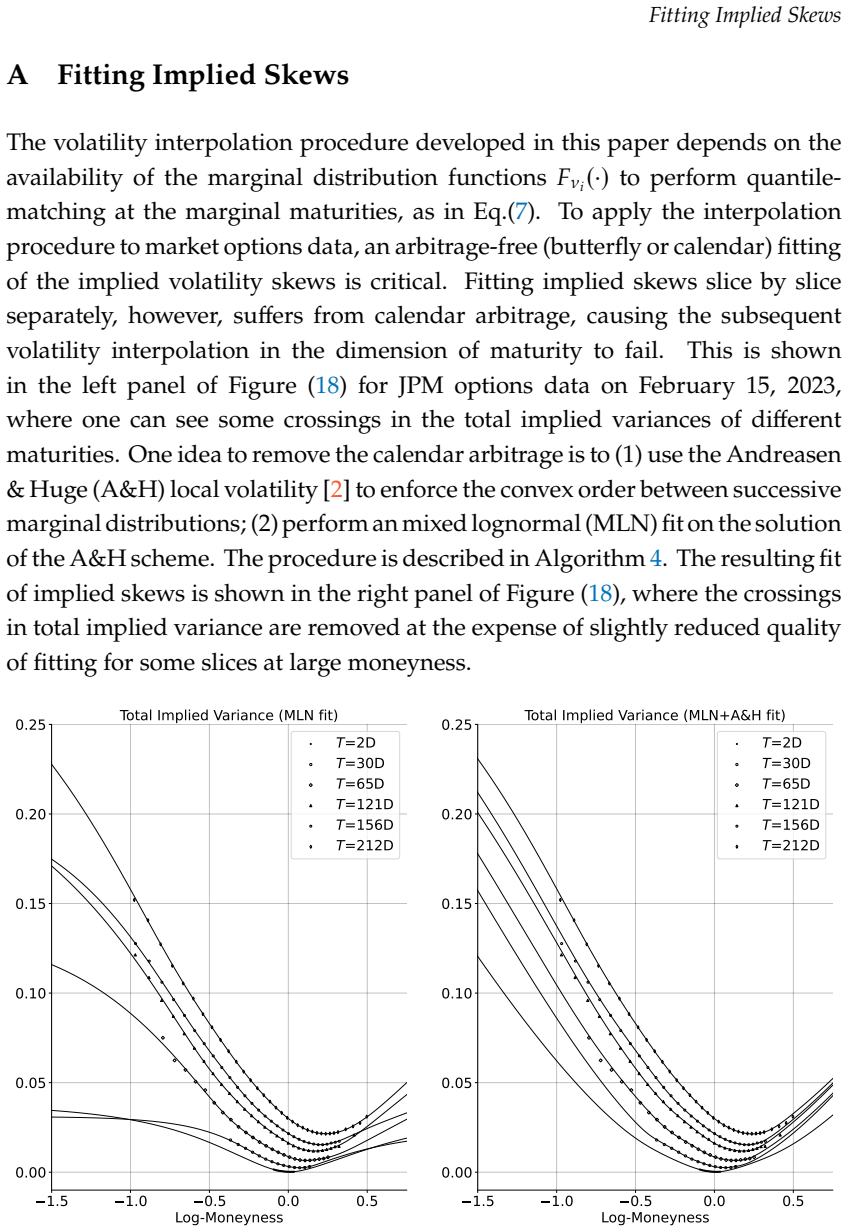
Summary. The paper develops a Markov-functional framework for constructing local volatility models from a discrete set of marginal distributions. It extends the Bass (1983) construction by introducing a local drift function mu(x) in the flow process, with the martingale condition mu = -f''/(2f') (Eq. 20). Two constructions are proposed: a step-wise time-homogeneous diffusion (Algorithms 1-2) and a continuous-in-time flow function (Algorithm 3). The method is tested on synthetic double-exponential marginals and on JPMorgan options data, and the paper also contributes an arbitrage-free skew fitting pipeline (Algorithm 4).
Significance. If the fixed-point iterations converge and preserve sufficient regularity, the proposed method yields a parsimonious, step-wise time-homogeneous representation of the local volatility term structure, which is a genuinely useful alternative to the maturity-wise discontinuous Bass/Conze-Henry-Labordère surfaces. The derivation of the drift-flow relation and the quantile-matching equations is clean, and the numerical examples are encouraging: the double-exponential test is validated against a closed-form continuum model, and the market data example shows geometric fixed-point convergence (Fig. 13). The paper is also honest in flagging the conditional status of convergence. However, the central claim as stated in the abstract is stronger than what is established, because the existence and convergence of the fixed-point iterations are not proven and the boundary treatment is ad hoc.
major comments (3)
- [Section 2.3 (Eq. 21); Section 2.4] The central algorithmic claim is conditional. Algorithm 2 is introduced with the sentence "The following joint fixed-point equation produces such a solution when the iteration converges," and Section 2.4 states "Subject to the condition that the fixed-point iteration converges." No existence, uniqueness, or convergence theorem is provided for Algorithms 1-3. Since the abstract claims to "construct local volatility models that are calibrated to a discrete set of marginal distributions" without this caveat, the paper's headline result is not established. The cited Noble (2013) result covers only a single marginal and does not imply convergence of the multi-period fixed point in Eq. (21). This is load-bearing: the calibration claim rests entirely on the fixed-point iteration. The authors should either supply a convergence proof or a precise set of sufficient conditions, or they should reformulate the claims as heuristic/numerical.
- [Eq. (20) and Section 3.1, first bullet] The drift update mu = -f''/(2f') requires f' > 0 and finite f'', but Assumption 2.1 only guarantees that the target CDF is strictly increasing. For f = F_nu^{-1} ∘ F_X_Ti, the derivative is f' = (dF_nu^{-1}/dq)(F_X_Ti(x)) · p_X_Ti(x), and the flow density p_X_Ti can be arbitrarily small or zero in the tails, so f' need not be bounded away from zero. The linear extrapolation beyond |f(x)| > y_max with mu set to zero, described in Section 3.1, replaces the drift on the tails by an ad hoc value, so the SDE actually implemented is not the claimed time-homogeneous diffusion on the whole real line. Moreover, the convergence measure |f^n - f^{n-1}| does not control f'' or mu, so sup-norm convergence of the flow function does not imply convergence of the drift update. The paper needs to analyze the boundary treatment or explicitly restrict the domain of the claim.
- [Section 3, Figures 6-9 and 13] The numerical evidence does not directly verify the central calibration claim. The paper reports convergence of successive iterates |f^n - f^{n-1}| and |mu^n - mu^{n-1}|, but it never reports a calibration error: for example, the maximum or L1 distance between the constructed process's marginal CDF at each T_i and the target CDF ν_i after convergence. Convergence of the iterates is necessary but not sufficient to establish that the target marginals are matched to within a stated tolerance, especially given the ad hoc tail extrapolation. The authors should add such an empirical calibration-error analysis, including sensitivity to grid size and y_max.
minor comments (6)
- [Throughout] There are numerous typographical and spacing errors in the text (e.g., "Weintroduce" in the Abstract and "alocaldriftfunction" in Section 2), which may be LaTeX artifacts but should be cleaned in the published version.
- [Assumption 2.1] Assumption 2.1 requires the target CDFs to be strictly increasing on [0,∞) or (-∞,∞). This excludes target distributions with flat regions, such as those with atoms or vanishing density on an interval. The abstract and introduction present the method for a general "discrete set of marginal distributions," so this restriction should be stated prominently in the abstract or introduction.
- [Section 3.1, numerical setup] The numerical grid (100, 500) in (t,x), the extrapolation threshold y_max, and the re-centering multipliers C_± in Eq. (32) are introduced ad hoc. A brief sensitivity analysis or a stated criterion for choosing these parameters would make the experiments more reproducible.
- [References] Reference [22] has an incomplete arXiv identifier ("2310.1379" without the trailing digits), and reference [24] appears to be a 2019 preprint but is cited with a 2023 date; please verify.
- [Section 2.3] The phrase "trades the same degrees of freedom in each marginal distribution with a time-homogeneous local volatility function" is vague, since a finite set of marginals does not have degrees of freedom in the same sense as the functional parameter σ_i(S). Consider rephrasing for clarity.
- [Code/data availability] The paper does not mention availability of code or data. Since the algorithms are the main contribution, providing reproducible code would substantially strengthen the paper.
Circularity Check
No significant circularity: the fixed-point construction is self-consistent and externally benchmarked; the unproved convergence is a correctness gap, not circularity.
full rationale
The paper's derivation is a self-consistent fixed-point construction, not a fit disguised as prediction. The inputs are the marginal distributions ν_i; the unknowns are the flow density, flow function, and drift function. Equation (20) defines μ from f so that S_t = f(X_t) is a martingale, and Eq. (7) imposes quantile matching at each T_i; the algorithms search for a fixed point of this system. The output local volatility is a function of the calibrated f, not a separately fitted quantity. No parameter is fitted to a subset of data and then 'predicted' for a closely related quantity. There are no self-citations by the author that carry a load-bearing premise; references to Bass, Conze–Henry-Labordère, Krylov, Noble, and Acciaio et al. are external prior results, and the paper does not invoke a uniqueness theorem from its own authors. The synthetic double-exponential example is a genuine external benchmark: the marginals are generated from a closed-form model and the algorithm's output is compared to that model's local volatility. The only notable gap is that existence and convergence of the fixed-point iterations are assumed rather than proved ('produces such a solution when the iteration converges'), but a missing convergence proof is a correctness risk, not circular reasoning. The construction's equations are not equivalent to their inputs by construction, so the circularity score is 0.
Assumptions & free parameters
free parameters (4)
- time grid for Fokker-Planck solver =
(100, 500)
- extrapolation threshold y_max =
not specified
- term structure interpolation coefficient =
equation (24) with a_i, b_i
- mixed lognormal 4-mode parameters =
fitted to market data
assumptions (4)
- domain assumption Given target marginals are in convex order and free of calendar arbitrage
- domain assumption Assumption 2.1: target CDFs are strictly increasing on [0, infinity) or (-infinity, +infinity)
- ad hoc to paper The fixed-point iterations (Algorithms 1, 2, 3) converge to a unique solution
- domain assumption Numerical solvers for Fokker-Planck and convolutions are sufficiently accurate
Cite this review
Pith. "Pith review of Markov-Functional Models with Local Drift." pith.science (2026). https://pith.science/paper/JUGD7VO5
@misc{pith2026241115053,
  author       = {Pith},
  title        = {Pith review of: Markov-Functional Models with Local Drift},
  year         = {2026},
  howpublished = {\url{https://pith.science/paper/JUGD7VO5}},
  note         = {Machine review of arXiv:2411.15053}
}
read the original abstract
We introduce a Markov-functional approach to construct local volatility models that are calibrated to a discrete set of marginal distributions. The method is inspired by and extends the volatility interpolation of Bass (1983) and Conze and Henry-Labord\`ere (2022). The method is illustrated with efficient numerical algorithms in the cases where the constructed local volatility functions are: (1) time-homogeneous between or (2) continuous across, the successive maturities. The step-wise time-homogeneous construction produces a parsimonious representation of the local volatility term structure.
Figures


Figures from the paper (15 more)


Reference graph
Works this paper leans on
-
[1]
Carr, P., Local variance gamma option pricing model, Presentation given to IEOR, Columbia University, June 2010
work page 2010
-
[2]
and Huge, B., Volatility interpolation, Risk, 2011
Andreasen, J. and Huge, B., Volatility interpolation, Risk, 2011
work page 2011
-
[3]
and Sepp, A., Filling the gaps, Risk, 2011
Lipton, A. and Sepp, A., Filling the gaps, Risk, 2011
work page 2011
-
[4]
Henry-Labord\` e re, P., From Schr\" o dinger bridges to a new class of stochastic volatility models, Preprint, arXiv:1904.04554, 2019
arXiv 1904
-
[5]
Avellaneda, M., Friedman, C., Holmes, R. and Samperi, D., Calibrating volatility surfaces via relative-entropy minimization, Applied Mathematical Finance, Vol. 4, No. 1, 1997
work page 1997
-
[6]
Coleman, T., Li, Y. and Verma, A., Reconstructing the unknown local volatility function, Journal of Computational Finance, Vol. 2, No. 3, 1999
work page 1999
-
[7]
Dupire, B., Pricing with a smile, Risk, Vol. 7, 1994
work page 1994
-
[8]
and Kani, I., Riding on a smile, Risk, Vol
Derman, E. and Kani, I., Riding on a smile, Risk, Vol. 7, 1994
work page 1994
Show all 25 references
-
[9]
F., Skorokhod imbedding via stochastic integrals, S\' e minaire de Probabilit\' e s de Strasbourg , Vol
Bass, R. F., Skorokhod imbedding via stochastic integrals, S\' e minaire de Probabilit\' e s de Strasbourg , Vol. 17, 1983
1983
-
[10]
and Henry-Labord\` e re, P., A new fast local volatility model, Risk, 2022
Conze, A. and Henry-Labord\` e re, P., A new fast local volatility model, Risk, 2022
2022
-
[11]
V., On the relation between differential operators of second order and the solutions of stochastic differential equations, Steklov Seminar 1984
Krylov, N. V., On the relation between differential operators of second order and the solutions of stochastic differential equations, Steklov Seminar 1984
1984
-
[12]
71, 1986
Gy\" o ngy, I., Mimicking the one-dimensional marginal distributions of processes having an It\^ o differential, Probability Theory and Related Fields, Vol. 71, 1986
1986
-
[13]
and Shreve, S., Mimicking an It\^ o process by a solution of a stochastic differential equation, The Annals of Applied Probability, Vol
Brunick, G. and Shreve, S., Mimicking an It\^ o process by a solution of a stochastic differential equation, The Annals of Applied Probability, Vol. 23, No. 4, 2013
2013
-
[14]
Lacker, D., Shkolnikov, M., and Zhang, J., Inverting the Markovian projection, with an application to local stochastic volatility models, The Annals of Probability, Vol. 48, No. 5, 2020
2020
-
[15]
G., Markov-Komposition und eine Anwendung auf Martingale, Mathematische Annalen, Vol
Kellerer, H. G., Markov-Komposition und eine Anwendung auf Martingale, Mathematische Annalen, Vol. 198, 1972
1972
-
[16]
A., and Schachermayer, W., A Regularized Kellerer theorem in arbitrary dimension, Preprint, arXiv:2210.13847, 2023
Pammer, G., Robinson, B. A., and Schachermayer, W., A Regularized Kellerer theorem in arbitrary dimension, Preprint, arXiv:2210.13847, 2023
2023 arXiv
-
[17]
Madan, D. B. and Yor, M., Making Markov martingales meet marginals: with explicit constructions, Bernoulli, Vol. 8, 2002
2002
-
[18]
Bergomi, L., Stochastic Volatility Modeling, 2.10, Chapman & Hall/CRC Financial Mathematics Series, 2016
2016
-
[19]
LXIX, No
Rubinstein, M., Implied binomial trees, The Journal of Finance, Vol. LXIX, No. 3, 1994
1994
-
[20]
o ck, M., Huesmann, M. and K\
Backhoff-Veraguas, J., Beiglb\" o ck, M., Huesmann, M. and K\" a llblad, S., Martingale Benamou-Brenier: A probabilistic perspective, The Annals of Probability, Vol. 48, No. 5, 2020
2020
-
[21]
and Pammer, G., Calibration of the Bass local volatility model, Preprint, arXiv:2311.14567, 2023
Acciaio, B., Marini, A. and Pammer, G., Calibration of the Bass local volatility model, Preprint, arXiv:2311.14567, 2023
2023 arXiv
-
[22]
and Ob \'oj, J., The measure preserving martingale Sinkhorn algorithm, Preprint, arXiv:2310.1379, 2023
Joseph, B., Loeper, G. and Ob \'oj, J., The measure preserving martingale Sinkhorn algorithm, Preprint, arXiv:2310.1379, 2023
2023
-
[23]
and Florent, I., Computing the Implied volatility in stochastic volatility models, Communications on Pure and Applied Mathematics, Vol
Berestycki, H., Busca, J. and Florent, I., Computing the Implied volatility in stochastic volatility models, Communications on Pure and Applied Mathematics, Vol. 57, No. 10, 2004
2004
-
[24]
and Henry-Labord\` e re, P., Building arbitrage-free implied volatility: Sinkhorn's algorithm and variants, Preprint, arXiv:1902.04456, 2023
De March, H. and Henry-Labord\` e re, P., Building arbitrage-free implied volatility: Sinkhorn's algorithm and variants, Preprint, arXiv:1902.04456, 2023
1902 arXiv
-
[25]
M., Time homogeneous diffusions with a given marginal at a deterministic time, Stochastic Processes and their Applications, Vol
Noble, J. M., Time homogeneous diffusions with a given marginal at a deterministic time, Stochastic Processes and their Applications, Vol. 123, No. 3, 2013
2013
Reviewed August 12, 2026 · model on record in the stance chip above.
Discussion (0). Continue with ORCID to comment.