REVIEW 2 major objections 4 minor 20 references
Geometry and Generation of a New Graph Planarity Game
T0 review · 2 major / 4 minor · reviewed 2026-08-14 · deepseek-v4-flash
Pith's one-line read Deciding whether a sequence of vertex swaps can untangle a drawing is NP-complete, and for trees deciding whether k swaps suffice is NP-complete as well.
desk verdict Worth reading for the clean lower bound, the Cabello-based NP-completeness reduction, and the order-type equivalence theorem, but the tree NP-hardness proof has an unproved clause-gadget lower bound that is load-bearing. read the letter →
The pith
A machine-rendered reading of the paper's core claim, the machinery that carries it, and where it could break.
The reading
What carries the argument
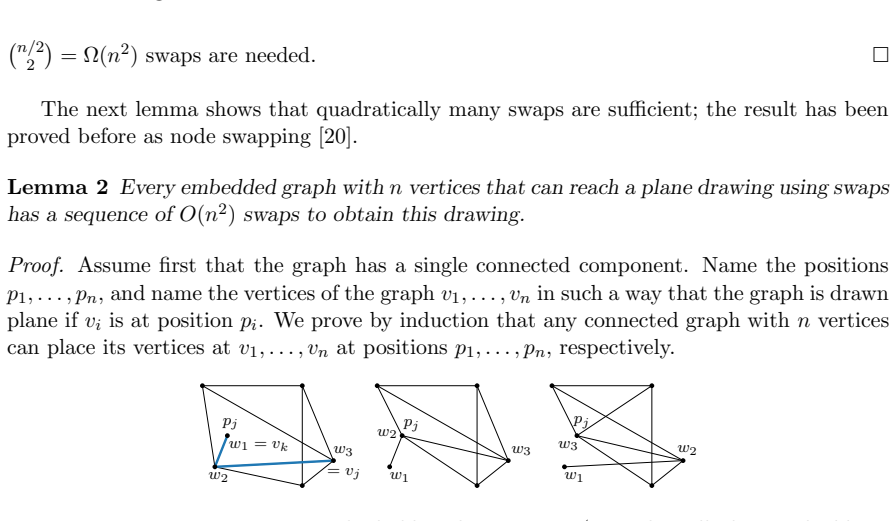
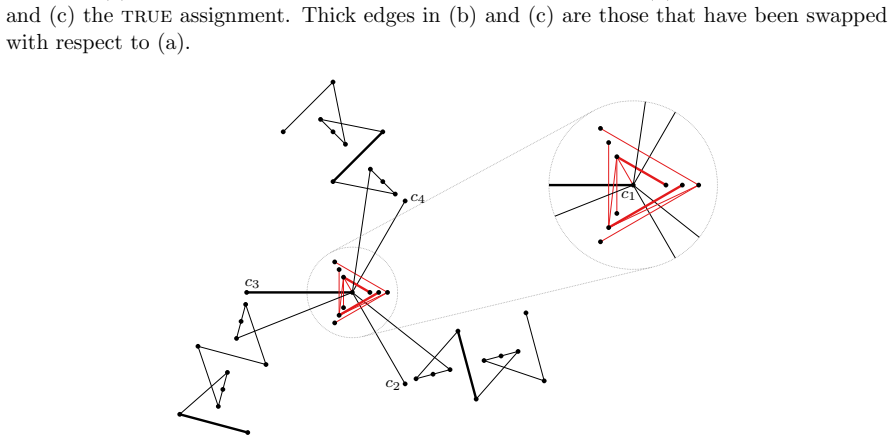
The argument is carried by a gadget reduction from positive planar 1-in-3-SAT. Variable gadgets are long paths whose crossings are resolved by swapping either all even or all odd vertical edges, encoding false or true; split gadgets pass that value to a clause; and each clause gadget is designed so that exactly one true variable lets all crossings be removed in five swaps while zero or multiple true variables force at least six. For the upper bound, the paper uses a path-bubble argument in which swapping along a path between a misplaced vertex and its target position moves one token into place in $O(n)$ swaps, yielding $O(n^2)$ overall. A separate equivalence result identifies a drawing with another precisely when the underlying graphs are isomorphic and the point sets share the same order type, enabling an $O(n^3)$ equivalence test.
What would settle it
Enumerate all swap sequences of length at most five on the clause gadget with zero, two, or three true incoming variables; if any such sequence produces a plane drawing, the Theorem 4 reduction fails to separate satisfiable from unsatisfiable instances.
Extended reading notes
Core claim
The central discovery is that swap-based untangling is NP-complete even for trees: given an embedded tree and an integer $k$, asking whether $k$ swaps of edge endpoints can produce a plane drawing is NP-complete (Theorem 4). The proof reduces positive planar 1-in-3-SAT to the swap-count problem, wiring variable, split, and clause gadgets so that each satisfied clause can be untangled in five swaps while unsatisfied clauses require more. In addition, the paper proves that deciding solvability for general graphs is NP-complete (Theorem 3), that any solvable instance can be planarized with $O(n^2)$ swaps while some cycles with a single crossing require $\Omega(n^2)$ swaps, and that two connected non-star drawings are swap-equivalent exactly when their graphs are isomorphic and their point sets have the same order type.
Load-bearing premise
The load-bearing premise is the claim that no clever alternative sequence of swaps can untangle the small arrangement that encodes a logical clause in fewer than six moves when the clause is unsatisfied; this is argued informally rather than proved exhaustively, and the NP-completeness reduction depends on it.
Editorial extensions
If this is right
- Every solvable instance can be solved in $O(n^2)$ swaps, so the puzzle never demands unboundedly long solution sequences.
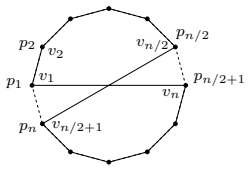
- Some instances with only one edge crossing require $\Omega(n^2)$ swaps, so a visually simple puzzle can hide a large search.
- Because the general decision problem is NP-complete, no polynomial-time algorithm solves arbitrary instances unless P equals NP.
- Because the tree version with a swap budget is NP-complete, optimal play is hard to automate even for the simplest graph class.
- Swap-equivalence of two connected non-star drawings can be tested in $O(n^3)$ time, giving a concrete notion of instance diversity.
Reading between the lines
- A corollary the paper does not spell out is that exact optimal play is out of reach for large instances, so practical generators must fall back on brute force for small swap counts or heuristics, the trade-off the experimental section measures.
- The equivalence theorem suggests a natural distance measure for puzzle instances based on the size of the order-type matching that also preserves graph isomorphism, which could be used to diversify generated puzzles beyond the geometric indicators reported.
- If the clause-gadget lower bound is correct, the same gadget family could probably be adapted to prove NP-completeness for other swap-restricted drawing variants, such as the rotation or stretch variants the paper lists but does not analyze.
Signed reviews
Editorial analysis
A structured set of objections, weighed in public.
Referee Report
Summary. The paper introduces Swap Planarity, a puzzle in which a move exchanges the positions of the two endpoints of an edge, and the goal is to reach a crossing-free straight-line drawing. It proves that some n-vertex instances require Ω(n²) swaps (Lemma 1), that any solvable instance can be solved in O(n²) swaps (Lemma 2), that deciding solvability is NP-complete for general graphs (Theorem 3), and that deciding whether a tree can be solved in at most k swaps is NP-complete (Theorem 4). The paper then proposes a five-step generator for puzzle instances with guarantees on visual separation, diversity, and absence of recognizable structure, reports experiments on point generation and convex-hull statistics, and characterizes swap-equivalence of two instances in terms of simultaneous graph isomorphism and order-type equivalence (Section 6).
Significance. If the proofs are completed, the paper's main algorithmic contribution is the NP-completeness of bounded-swap planarity for trees, which is a genuinely nontrivial contrast with the polynomial-time solvability of ordinary planarity for trees; the Ω(n²)/O(n²) bounds and the order-type characterization are also useful. The generation process and experiments are a practical contribution, and the paper is clearly written with reproducible constructions. Its central complexity claims are, however, conditional on the clause-gadget lower bound in Theorem 4, and the equivalence theorem needs a small domain correction.
major comments (2)
- [§3, Theorem 4 (clause-gadget lower bound)] The NP-hardness reduction for trees is not yet proven, because the lower bound for unsatisfied clauses is only sketched in the paragraph beginning 'It remains to argue that there is no globally different set of swaps...'. The text asserts that each crossing must be paid for by a dedicated nearby swap, that aligning the three triangle layers is the only way to clear the central crossings in few moves, and that swapping a triangle-layer vertex out costs at least two swaps per layer, but none of these assertions is derived. In particular, the argument does not rule out a swap that simultaneously resolves crossings in several layers, nor swaps shared between the clause gadget and the adjacent split or variable gadgets. Since the reduction's threshold is five swaps per clause, any unsatisfied assignment admitting a five-swap solution would invalidate the if-and-only-if. A complete case analysis (or a machine-checked enumeration of the gadget's swap sequences) is needed before Theorem 4 can be considered proved.
- [§6, Lemma 8 and Theorem 9] The claim that every connected non-star graph has two edges with four distinct vertices is false: the triangle K3 is connected and not a star, but its edges pairwise share vertices. For K3, any two straight-line drawings on three non-collinear points are swap-equivalent under every vertex matching, because all three edges are mutually adjacent and no two edges can cross; however, the two point sets can have different order types (opposite orientations). This contradicts Theorem 9 as stated. The theorem needs an explicit exception for triangle graphs, or a hypothesis that the graph has at least four vertices (or matching number at least two).
minor comments (4)
- [§3, Theorem 4] The total k for the reduction is not defined explicitly; the proof should state a concrete formula, for example k = B + 5m for a baseline B depending only on the variable and split structure, and should prove that B is independent of the truth assignment.
- [§3, Theorem 4] The step 'To construct a tree, we remove the middle edges from some basic constructions' should specify that the removed edges are chosen on cycles so that the graph remains connected; removing a bridge would produce a forest rather than a tree.
- [§3, Lemma 2 and Theorem 3] Lemma 2 is stated only for reaching a plane drawing, but Theorem 3 and Lemma 8 invoke the stronger fact that any target bijection can be realized in a connected graph; the lemma's proof actually establishes this stronger statement, so it should be stated explicitly.
- [References] Reference [19] misspells 'Theoretical Computer Science' as 'Theoretical Compututer Science'.
Circularity Check
No circularity found: NP-completeness results rest on external reductions, and the only weakness is an informal lower-bound argument, which is a proof gap rather than a circular step.
full rationale
The paper's central results (Theorem 3 and Theorem 4) are reductions from external NP-complete problems: Cabello's fixed point-set planar embeddability for general graphs, and Mulzer and Rote's positive planar 1-in-3-SAT for trees. Lemma 2's O(n^2) upper bound is proved in the text and attributed to prior token-swapping work [20]; it is used as a subroutine, not as the target claim. Lemma 1 is self-contained via an inversion argument. The generation section's delta-general position idea is new, and the sole author self-citation [18] is for a geometric separation criterion that is not load-bearing for the complexity claims. The one passage that deserves scrutiny is in Theorem 4's proof: 'It remains to argue that there is no globally different set of swaps that makes the graph plane with fewer operations.' That paragraph is an informal sketch, not a complete case analysis; if the lower bound fails, the tree NP-completeness proof would be incomplete. However, this is a missing proof case, not circularity: the conclusion is not assumed in the premises, no fitted parameter is relabeled as a prediction, and no equation is equal to another by construction. Hence the circularity score is 0.
Assumptions & free parameters
assumptions (4)
- domain assumption Point-set embeddability of a graph onto a given point set is NP-complete (Cabello, 2006).
- domain assumption Positive planar 1-in-3-SAT is NP-complete (Mulzer and Rote, 2008).
- domain assumption Any tree can be embedded without crossings on any set of points in general position (Pach et al., 1991; Bose, 2002).
- standard math Whether two segments with four distinct endpoints cross depends only on the order type of the endpoints.
Cite this review
Pith. "Pith review of Geometry and Generation of a New Graph Planarity Game." pith.science (2026). https://pith.science/paper/JVKAAZDG
@misc{pith2026190801426,
  author       = {Pith},
  title        = {Pith review of: Geometry and Generation of a New Graph Planarity Game},
  year         = {2026},
  howpublished = {\url{https://pith.science/paper/JVKAAZDG}},
  note         = {Machine review of arXiv:1908.01426}
}
read the original abstract
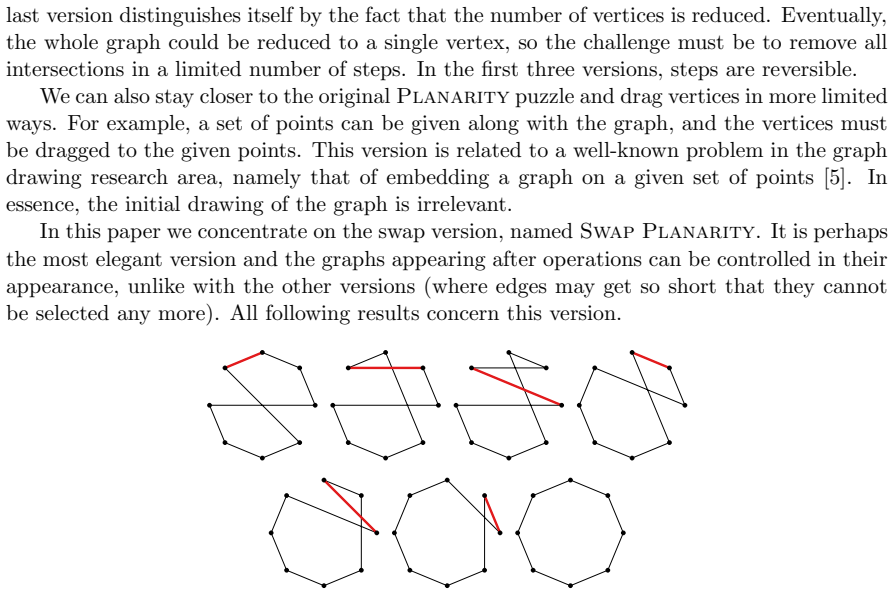
We introduce a new abstract graph game, Swap Planarity, where the goal is to reach a state without edge intersections and a move consists of swapping the locations of two vertices connected by an edge. We analyze this puzzle game using concepts from graph theory and graph drawing, computational geometry, and complexity. Furthermore, we specify quality criteria for puzzle instances, and describe a method to generate high-quality instances. We also report on experiments that show how well this generation process works.
Figures

Figures from the paper (12 more)




Reference graph
Works this paper leans on
-
[1]
Enumerating order types for small point sets with applications
Oswin Aichholzer, Franz Aurenhammer, and Hannes Krasser. Enumerating order types for small point sets with applications. Order, 19(3):265–281, 2002
work page 2002
-
[2]
On the number of plane geometric graphs
Oswin Aichholzer, Thomas Hackl, Clemens Huemer, Ferran Hurtado, Hannes Krasser, and Birgit Vogtenhuber. On the number of plane geometric graphs. Graphs and Combi- natorics, 23(1):67–84, 2007
work page 2007
-
[3]
On embedding an outer-planar graph in a point set
Prosenjit Bose. On embedding an outer-planar graph in a point set. Computational Geometry, 23(3):303–312, 2002
work page 2002
-
[4]
Prosenjit Bose, Vida Dujmovic, Ferran Hurtado, Stefan Langerman, Pat Morin, and David R. Wood. A polynomial bound for untangling geometric planar graphs. Discrete & Computational Geometry , 42(4):570–585, 2009
work page 2009
-
[5]
Planar embeddability of the vertices of a graph using a fixed point set is NP-hard
Sergio Cabello. Planar embeddability of the vertices of a graph using a fixed point set is NP-hard. Journal of Graph Algorithms and Applications , 10(2):353–363, 2006
work page 2006
-
[6]
A linear algorithm for embedding planar graphs using PQ-trees
Norishige Chiba, Takao Nishizeki, Shigenobu Abe, and Takao Ozawa. A linear algorithm for embedding planar graphs using PQ-trees. Journal of Computer and System Sciences , 30(1):54–76, 1985
work page 1985
-
[7]
Computational Geometry – Algorithms and Applications
Mark de Berg, Otfried Cheong, Marc van Kreveld, and Mark Overmars. Computational Geometry – Algorithms and Applications . Springer, Berlin, 3rd edition, 2008
work page 2008
-
[8]
How to draw a planar graph on a grid
Hubert De Fraysseix, J´ anos Pach, and Richard Pollack. How to draw a planar graph on a grid. Combinatorica, 10(1):41–51, 1990
work page 1990
Show all 20 references
-
[9]
Untangling a planar graph
Xavier Goaoc, Jan Kratochv´ ıl, Yoshio Okamoto, Chan-Su Shin, Andreas Spillner, and Alexander Wolff. Untangling a planar graph. Discrete & Computational Geometry , 42(4):542–569, 2009
2009
-
[10]
Goodman and Richard Pollack
Jacob E. Goodman and Richard Pollack. Semispaces of configurations, cell complexes of arrangements. Journal of Combinatorial Theory, Series A , 37(3):257–293, 1984
1984
-
[11]
Arrangements
Dan Halperin and Micha Sharir. Arrangements. In Jacob E. Goodman, Joseph O’Rourke, and Csaba D. T´ oth, editors,Handbook of Discrete and Computational Geometry , pages 723–762. 3rd edition, 2018
2018
-
[12]
Minimum-weight triangulation is NP-hard
Wolfgang Mulzer and G¨ unter Rote. Minimum-weight triangulation is NP-hard. Journal of the ACM , 55(2):11:1–11:29, 2008. 18
2008
-
[13]
Every graph admits an unambiguous bold drawing
J´ anos Pach. Every graph admits an unambiguous bold drawing. In International Sym- posium on Graph Drawing , pages 332–342, 2011
2011
-
[14]
Embedding a planar triangulation with vertices at specified points
J´ anos Pach, Peter Gritzmann, Bojan Mohar, and Richard Pollack. Embedding a planar triangulation with vertices at specified points. The American Mathematical Monthly , 98(2):165–166, 1991
1991
-
[15]
Handbook of Graph Drawing and Visualization
Roberto Tamassia. Handbook of Graph Drawing and Visualization . CRC Press, 2013
2013
-
[16]
Planarity
John Tantalo. Planarity. http://planarity.net/, 2007. Accessed: 2018-05-25
2007
-
[17]
NetLogo: A simple environment for modeling complexity
Seth Tisue and Uri Wilensky. NetLogo: A simple environment for modeling complexity. In International Conference on Complex Systems , volume 21, pages 16–21, 2004
2004
-
[18]
Bold graph drawings
Marc van Kreveld. Bold graph drawings. Computational Geometry, 44(9):499–506, 2011
2011
-
[19]
On the obfuscation complexity of planar graphs
Oleg Verbitsky. On the obfuscation complexity of planar graphs. Theoretical Compututer Science, 396(1-3):294–300, 2008
2008
-
[20]
Demaine, Takehiro Ito, Jun Kawahara, Masashi Kiyomi, Yoshio Okamoto, Toshiki Saitoh, Akira Suzuki, Kei Uchizawa, and Takeaki Uno
Katsuhisa Yamanaka, Erik D. Demaine, Takehiro Ito, Jun Kawahara, Masashi Kiyomi, Yoshio Okamoto, Toshiki Saitoh, Akira Suzuki, Kei Uchizawa, and Takeaki Uno. Swap- ping labeled tokens on graphs. Theoretical Computer Science, 586:81–94, 2015. 19
2015
Reviewed August 14, 2026 · model on record in the stance chip above.
Discussion (0). Continue with ORCID to comment.