A Boundary-Consistent Two-Zone Electron Kernel for Distant Pulsar Contributions to Positron Flux and Anisotropy
Pith reviewed 2026-06-26 04:29 UTC · model grok-4.3
The pith
A two-zone diffusion kernel shows Geminga-scale halos remain compatible with positron data while distant pulsars dominate the GeV flux.
A machine-rendered reading of the paper's core claim, the machinery that carries it, and where it could break.
Core claim
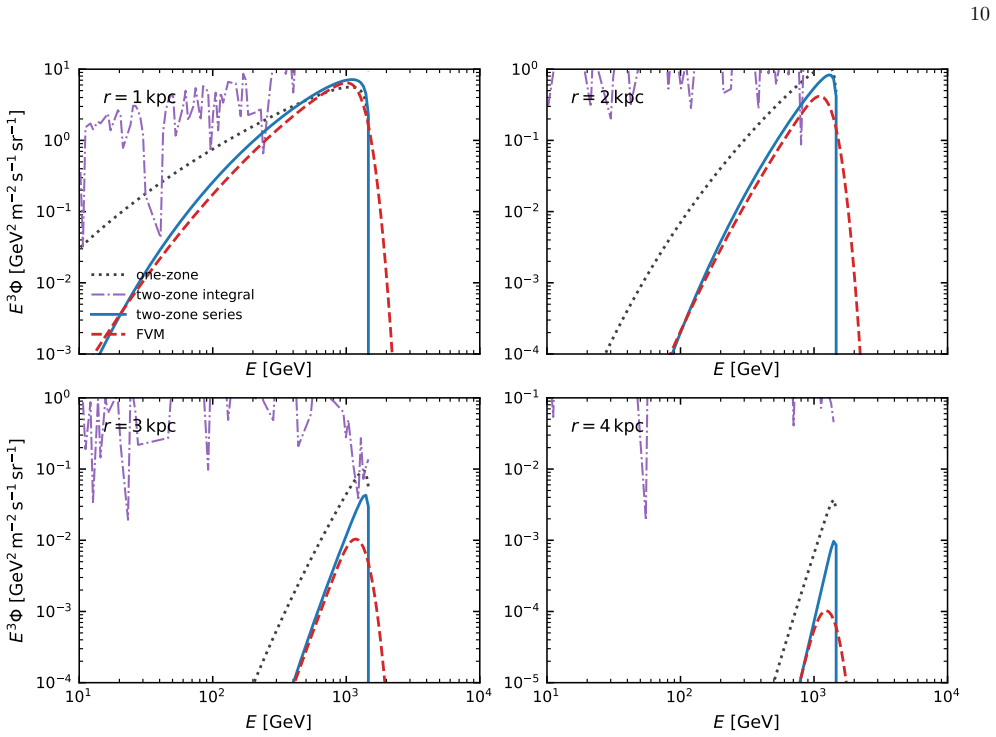
We present a semi-analytical series solution for electron and positron propagation in a spherical two-zone diffusion model. The solution treats slow diffusion inside a near-source region and standard interstellar diffusion outside it, while synchrotron and Klein-Nishina inverse-Compton cooling are included through energy characteristics. The formulation avoids the oscillatory cancellations of direct two-zone integral evaluations and preserves the sharp radiative cooling boundary seen in finite-volume checks. Applying the kernel to pulsar contributions to the local cosmic-ray lepton flux and comparing with AMS-02 positron data and all-electron anisotropy limits while imposing an inner 100 pc
What carries the argument
The semi-analytical series solution for the spherical two-zone diffusion model, which separates slow inner diffusion from outer standard diffusion and incorporates energy-dependent cooling via characteristics.
If this is right
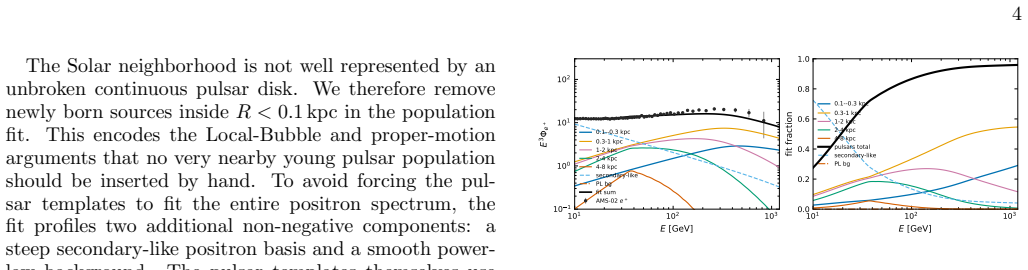
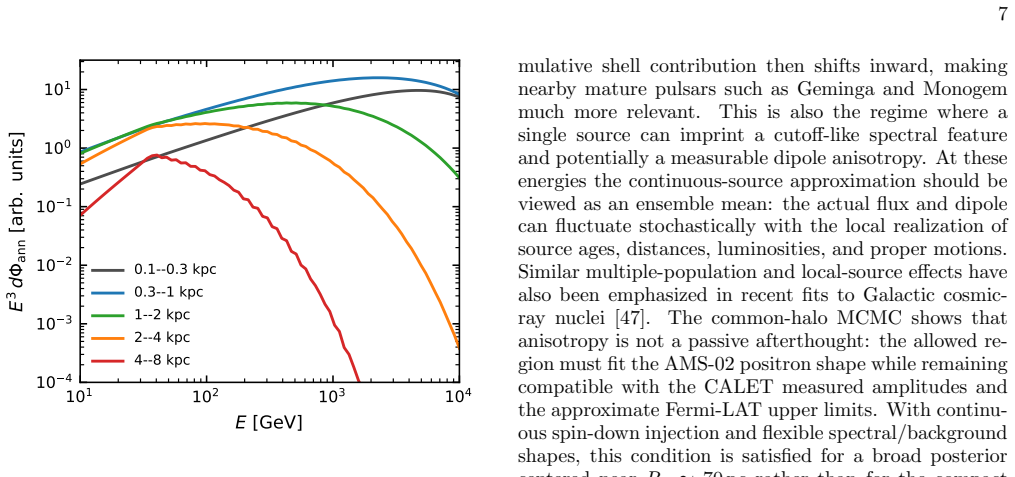
- Sources beyond 1 kpc can still provide 37-47% of the 10-100 GeV flux for a disk half-thickness of 0.2 kpc.
- Nearby pulsars remain the dominant contributors near the TeV cutoff.
- The pulsar component of the flux is dominated by sources beyond 0.3 kpc under the fitted parameters.
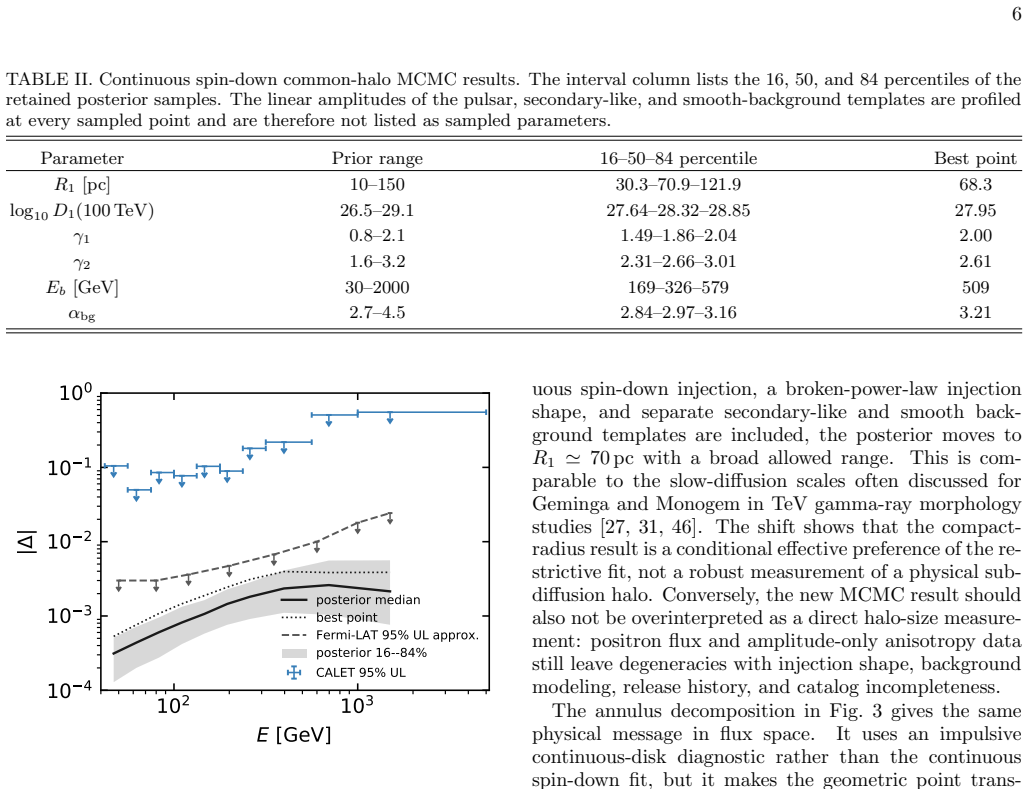
- Flux and anisotropy data by themselves leave the halo size underdetermined.
- External constraints such as TeV halo morphology are required to fix the halo size.
Where Pith is reading between the lines
- The series solution could be applied to other nearby sources or different energy ranges to test consistency across cosmic-ray species.
- If TeV observations independently confirm small halo sizes, the two-zone approach would gain support over single-zone models.
- The finding that distant sources matter at GeV energies suggests re-examination of how source distributions affect other lepton observables.
Load-bearing premise
The two-zone spherical diffusion model with a fixed 100 pc inner cavity and 0.2 kpc disk half-thickness accurately represents the interstellar medium and pulsar environments.
What would settle it
Future data showing that no combination of pulsar sources within the two-zone model with Geminga-scale halos can simultaneously reproduce both the observed positron flux spectrum and the anisotropy upper limits.
Figures
read the original abstract
We present a semi-analytical series solution for electron and positron propagation in a spherical two-zone diffusion model. The solution treats slow diffusion inside a near-source region and standard interstellar diffusion outside it, while synchrotron and Klein--Nishina inverse-Compton cooling are included through energy characteristics. The formulation avoids the oscillatory cancellations of direct two-zone integral evaluations and preserves the sharp radiative cooling boundary seen in finite-volume checks. We apply the kernel to pulsar contributions to the local cosmic-ray lepton flux. Nearby pulsars remain natural candidates near the TeV cutoff, but at tens to hundreds of GeV the larger source volume allows more distant pulsars to contribute collectively: for a disk half-thickness of $0.2\,{\rm kpc}$, sources beyond $1\,{\rm kpc}$ can still provide $37$--$47\%$ of the $10$--$100\,{\rm GeV}$ flux. Comparing with AMS-02 positron data and all-electron anisotropy limits, and imposing an inner $100\,{\rm pc}$ cavity motivated by the Local Bubble and pulsar proper motions, we find that Geminga-scale slow-diffusion halos remain compatible with current data. The fitted pulsar component is dominated by sources beyond $0.3\,{\rm kpc}$, but flux and anisotropy data alone do not uniquely determine the halo size; external information such as TeV halo morphology is still required.
Editorial analysis
A structured set of objections, weighed in public.
Referee Report
Summary. The manuscript develops a semi-analytical series solution for electron and positron propagation in a spherical two-zone diffusion model (slow diffusion inside a near-source region, standard diffusion outside) that incorporates synchrotron and Klein-Nishina cooling via energy characteristics. The kernel is applied to pulsar contributions to the local cosmic-ray lepton flux and anisotropy. For a fixed disk half-thickness of 0.2 kpc and an imposed 100 pc inner cavity, the work reports that sources beyond 1 kpc contribute 37-47% of the 10-100 GeV flux, that Geminga-scale slow-diffusion halos remain compatible with AMS-02 positron flux and anisotropy limits, that the fitted pulsar component is dominated by sources beyond 0.3 kpc, and that flux plus anisotropy data alone do not uniquely determine the halo size (external TeV halo morphology information is still required).
Significance. If the central claims survive scrutiny, the semi-analytical kernel supplies a practical, numerically stable tool for evaluating collective distant-pulsar contributions to the lepton spectrum without the oscillatory cancellations that plague direct two-zone integrals. The result would reinforce that current AMS-02 flux and anisotropy data are insufficient by themselves to exclude slow-diffusion halos around nearby pulsars, thereby underscoring the necessity of multi-messenger constraints such as TeV halo morphology.
major comments (2)
- [Abstract and §3] Abstract and §3 (application to pulsar flux): the reported 37-47% contribution from sources >1 kpc, the dominance of sources >0.3 kpc, and the conclusion that data do not uniquely fix the halo size are all obtained after fixing the disk half-thickness at 0.2 kpc and the inner cavity radius at 100 pc. No scan or robustness test over plausible variations of these boundary lengths is presented, so it remains unclear whether the compatibility with AMS-02 data and the inference that external TeV information is required would survive modest changes in cavity size or disk thickness.
- [§2] §2 (two-zone kernel derivation): the boundary conditions that encode the 100 pc cavity and 0.2 kpc disk thickness enter the series solution directly; the manuscript should demonstrate that the claimed non-uniqueness of halo size and the distant-source dominance percentages are insensitive to reasonable variations of these lengths before the central claim can be regarded as load-bearing.
minor comments (1)
- [§2] The definition of the energy-characteristic cooling lengths and the precise matching conditions at the zone interface would benefit from an explicit equation reference or short appendix derivation to aid reproducibility.
Simulated Author's Rebuttal
We thank the referee for the constructive and detailed comments. The points raised concern the lack of robustness tests for the fixed boundary parameters (disk half-thickness and cavity radius) used in the application to pulsar contributions. We address each major comment below and will incorporate the requested sensitivity analysis in the revised manuscript.
read point-by-point responses
-
Referee: [Abstract and §3] Abstract and §3 (application to pulsar flux): the reported 37-47% contribution from sources >1 kpc, the dominance of sources >0.3 kpc, and the conclusion that data do not uniquely fix the halo size are all obtained after fixing the disk half-thickness at 0.2 kpc and the inner cavity radius at 100 pc. No scan or robustness test over plausible variations of these boundary lengths is presented, so it remains unclear whether the compatibility with AMS-02 data and the inference that external TeV information is required would survive modest changes in cavity size or disk thickness.
Authors: We agree that the central claims would be strengthened by explicit robustness checks. The fiducial values (0.2 kpc disk half-thickness and 100 pc cavity) are observationally motivated—the cavity by the Local Bubble and pulsar proper motions, and the disk thickness by standard cosmic-ray propagation models—but we acknowledge that no variations were explored in the submitted version. In the revision we will add a dedicated subsection (or appendix) to §3 that varies the cavity radius over 50–150 pc and the disk half-thickness over 0.15–0.25 kpc. Preliminary internal checks indicate that the distant-source flux fraction remains between ~30–50 % and that the non-uniqueness of halo size persists, although the precise percentages shift modestly. These results will be quantified with additional tables or figures. revision: yes
-
Referee: [§2] §2 (two-zone kernel derivation): the boundary conditions that encode the 100 pc cavity and 0.2 kpc disk thickness enter the series solution directly; the manuscript should demonstrate that the claimed non-uniqueness of halo size and the distant-source dominance percentages are insensitive to reasonable variations of these lengths before the central claim can be regarded as load-bearing.
Authors: The series solution derived in §2 is written with the cavity radius and disk half-thickness as explicit parameters in the boundary conditions, so the kernel itself is general. The application in §3, however, uses fixed values. To address the referee’s concern we will extend the sensitivity study described above to the kernel-level quantities (flux fractions and anisotropy limits) and confirm that the reported conclusions on distant-source dominance and halo-size degeneracy remain qualitatively unchanged across the explored range. Any quantitative dependence will be reported. revision: yes
Circularity Check
No significant circularity; model assumptions and fitting results are independent
full rationale
The paper constructs a semi-analytical two-zone diffusion kernel with explicit boundary conditions (inner 100 pc cavity and 0.2 kpc disk half-thickness) that are stated as imposed and motivated by external observations such as the Local Bubble. It then fits the pulsar component to AMS-02 flux and anisotropy data, reporting that sources beyond 0.3 kpc dominate and that halo size is not uniquely fixed by those data alone. These outcomes are direct numerical results of the fit under the stated boundaries rather than any reduction of a claimed prediction to the inputs by construction. No self-definitional equations, fitted parameters renamed as predictions, load-bearing self-citations, or ansatz smuggling appear in the provided derivation chain. The non-uniqueness conclusion is a finding from the fitting exercise itself and does not collapse to the model assumptions.
Axiom & Free-Parameter Ledger
free parameters (3)
- disk half-thickness =
0.2 kpc
- inner cavity radius =
100 pc
- slow diffusion halo size =
Geminga-scale
axioms (2)
- domain assumption Spherical symmetry in the two-zone diffusion model
- domain assumption Standard interstellar diffusion outside the near-source region
Reference graph
Works this paper leans on
-
[1]
For a three-dimensional uniform pulsar population, the shell factor 4πr 2drmakes kiloparsec distances dominate the age-integrated contribution at 10– 100 GeV
-
[2]
In a disk-like population withh= 0.2 kpc, the contribution is shifted inward, but sources beyond 1 kpc still supply 37–47% of the 10–100 GeV flux in the fiducial model
-
[3]
At 300 GeV the contribution begins to localize in both geometries
-
[4]
At 1 TeV radiative cooling makes the flux local: ap- proximately two thirds of the contribution comes from within 1 kpc in the three-dimensional model and about 90% in the disk model
-
[5]
With continuous spin-down injection, a 10 kyr early-release delay, and no newly born source in- sideR <0.1 kpc, the fit to AMS-02 positrons de- composes into a pulsar fraction of about 28% at 10 GeV and more than 85% above 100 GeV, with the remaining low-energy flux mostly assigned to the secondary-like basis
-
[6]
The dominance is strongest at low energy and remains present through the sub- TeV range
In the continuous-disk annulus decomposition of this fitted pulsar component, sources beyond 0.3 kpc dominate over the local 0.1–0.3 kpc annulus at all plotted energies. The dominance is strongest at low energy and remains present through the sub- TeV range
-
[7]
ForR > 0.3 kpc the two-zone/one-zone ratio is about 0.94 at 100 GeV, 0.85 at 300 GeV, and 0.67 at 800 GeV
Relative to a one-zone interstellar diffusion ker- nel, the two-zone halo reduces the absolute distant- source flux rather than increasing it. ForR > 0.3 kpc the two-zone/one-zone ratio is about 0.94 at 100 GeV, 0.85 at 300 GeV, and 0.67 at 800 GeV. The survival of the distant component is therefore a population-geometry effect, not a slow-halo en- hancement
-
[8]
A continuous spin-down common-halo MCMC with fixedD 2 = 3×10 28(E/GeV)1/3 cm2 s−1 finds anisotropy-safe posterior support aroundR 1 = 0.0709+0.0510 −0.0407 kpc andD 1(100 TeV) = 2.08 +4.97 −1.65 × 1028 cm2 s−1. This Geminga-scale result replaces the compact effective radius found in the earlier restrictive two-parameter diagnostic, but it is still a condi...
- [9]
-
[10]
Aguilar et al
M. Aguilar et al. (AMS), Phys. Rev. Lett.110, 141102 11 TABLE III. Fiducial parameters for the shell-volume diagnostic. Parameter Value R1 0.05 kpc R2 20 kpc D2(E) 3×10 28(E/GeV) 1/3 cm2 s−1 D1(100 TeV) 4.5×10 27 cm2 s−1 η=D 2/D1 309.4 B 3µG ISRF CMB + IR + optical blackbodies γ 1.9 Ecut 100 TeV age range 0.03–10 Myr TABLE IV. Age-integrated shell contrib...
2013
-
[11]
Aguilar et al
M. Aguilar et al. (AMS), Phys. Rev. Lett.122, 041102 (2019)
2019
-
[12]
Aguilar et al
M. Aguilar et al. (AMS), Phys. Rev. Lett.122, 101101 (2019)
2019
-
[13]
S. Abdollahi et al. (Fermi-LAT), Phys. Rev. D95, 082007 (2017), 1704.07195
Pith/arXiv arXiv 2017
- [14]
-
[15]
O. Adriani et al. (CALET), Phys. Rev. Lett.120, 261102 (2018), 1806.09728
Pith/arXiv arXiv 2018
-
[16]
F. Aharonian et al. (H.E.S.S.), Phys. Rev. Lett.101, 261104 (2008), 0811.3894
Pith/arXiv arXiv 2008
-
[17]
L. Bergstr¨ om, T. Bringmann, and J. Edsj¨ o, Phys. Rev. D78, 103520 (2008), 0808.3725
Pith/arXiv arXiv 2008
-
[18]
M. Cirelli, G. Corcella, A. Hektor, G. H¨ utsi, M. Kadastik, P. Panci, M. Raidal, F. Sala, and A. Strumia, JCAP03, 051 (2011), 1012.4515
Pith/arXiv arXiv 2011
-
[19]
A. M. Atoyan, F. A. Aharonian, and H. J. V¨ olk, Phys. Rev. D52, 3265 (1995)
1995
-
[20]
D. Hooper, P. Blasi, and P. D. Serpico, JCAP01, 025 (2009), 0810.1527
Pith/arXiv arXiv 2009
-
[21]
H. Y¨ uksel, M. D. Kistler, and T. Stanev, Phys. Rev. Lett. 103, 051101 (2009), 0810.2784
Pith/arXiv arXiv 2009
- [22]
-
[23]
D. Malyshev, I. Cholis, and J. Gelfand, Phys. Rev. D80, 063005 (2009), 0903.1310
Pith/arXiv arXiv 2009
-
[24]
D. Grasso et al. (Fermi-LAT), Astropart. Phys.32, 140 (2009), 0905.0636
Pith/arXiv arXiv 2009
-
[25]
M. Di Mauro, F. Donato, N. Fornengo, R. Lineros, and A. Vittino, JCAP04, 006 (2014), 1402.0321
Pith/arXiv arXiv 2014
-
[26]
S. Manconi, M. Di Mauro, and F. Donato, JCAP01, 006 (2017), 1611.06237
Pith/arXiv arXiv 2017
-
[27]
K. Fang, X.-J. Bi, and P.-F. Yin, Astrophys. J.854, 57 (2018), 1711.10996
Pith/arXiv arXiv 2018
-
[28]
S. Abdollahi et al. (Fermi-LAT), Phys. Rev. Lett.118, 091103 (2017), 1703.01073
Pith/arXiv arXiv 2017
-
[29]
S. C. C. Ting (AMS), in41st International Conference on High Energy Physics(2022), vol. ICHEP2022, p. 1116
2022
-
[30]
T. Delahaye, J. Lavalle, R. Lineros, F. Donato, and N. Fornengo, Astron. Astrophys.524, A51 (2010), 1002.1910
Pith/arXiv arXiv 2010
-
[31]
I. Cholis, T. Karwal, and M. Kamionkowski, Phys. Rev. D98, 063008 (2018), 1807.05230
Pith/arXiv arXiv 2018
-
[32]
S. Manconi, M. Di Mauro, and F. Donato, Phys. Rev. D 102, 023015 (2020), 2001.09985
arXiv 2020
-
[33]
O. M. Bitter and D. Hooper, JCAP10, 081 (2022), 2205.05200
arXiv 2022
- [34]
-
[35]
A. U. Abeysekara et al., Science358, 911 (2017), 1711.06223
Pith/arXiv arXiv 2017
-
[36]
T. Linden and B. J. Buckman, Phys. Rev. Lett.120, 121101 (2018), 1707.01905
Pith/arXiv arXiv 2018
-
[37]
D. Hooper, I. Cholis, T. Linden, and K. Fang, Phys. Rev. D96, 103013 (2017), 1702.08436
Pith/arXiv arXiv 2017
-
[38]
S. Profumo, J. Reynoso-Cordova, N. Kaaz, and M. Sil- verman, Phys. Rev. D97, 123008 (2018), 1803.09731
Pith/arXiv arXiv 2018
-
[39]
S. Recchia, M. Di Mauro, F. A. Aharonian, L. Orusa, F. Donato, S. Gabici, and S. Manconi, Phys. Rev. D 104, 123017 (2021), 2106.02275
arXiv 2021
-
[40]
G.-Y. Zhou, Z.-H. Yu, Q. Yuan, and H.-H. Zhang, Com- mun. Theor. Phys.74, 105403 (2022), 2205.07038
arXiv 2022
-
[41]
Cao et al
Z. Cao et al. (LHAASO), Nature594, 33 (2021)
2021
-
[42]
C. Evoli, T. Linden, and G. Morlino, Phys. Rev. D98, 12 063017 (2018), 1807.09263
Pith/arXiv arXiv 2018
-
[43]
L. Nava, S. Gabici, A. Marcowith, G. Morlino, and V. S. Ptuskin, Mon. Not. Roy. Astron. Soc.461, 3552 (2016), 1606.06902
Pith/arXiv arXiv 2016
-
[44]
K. Fang, X.-J. Bi, and P.-F. Yin, Mon. Not. Roy. Astron. Soc.488, 4074 (2019), 1903.06421
arXiv 2019
-
[45]
S. J. Smartt, Ann. Rev. Astron. Astrophys.47, 63 (2009), 0908.0700
Pith/arXiv arXiv 2009
-
[46]
R. Lallement, J. L. Vergely, B. Valette, L. Puspitarini, L. Eyer, and L. Casagrande, Astron. Astrophys.561, A91 (2014), 1309.6100
Pith/arXiv arXiv 2014
- [47]
- [48]
-
[49]
Z.-H. Liu, Y. Bao, and R.-Y. Liu, arXiv e-prints arXiv:2606.19701 (2026), 2606.19701
Pith/arXiv arXiv 2026
-
[50]
D. Khangulyan, F. A. Aharonian, and S. R. Kelner, As- trophys. J.783, 100 (2014), 1310.7971
Pith/arXiv arXiv 2014
-
[51]
D. F. Torres, A. N. Cillis, J. Mart´ ın, and E. de O˜ na Wil- helmi, JHEAp1-2, 31 (2014), 1402.5485
Pith/arXiv arXiv 2014
-
[52]
Aguilar et al
M. Aguilar et al. (AMS), Phys. Rept.894, 1 (2021)
2021
-
[53]
Motz and Y
H. Motz and Y. Akaike (CALET), inProceedings of the 39th International Cosmic Ray Conference (ICRC2025) (2025), vol. 501 ofPoS, p. 100, URLhttps://pos. sissa.it/501/100/
2025
-
[54]
B. Schroer, C. Evoli, and P. Blasi, Phys. Rev. D107, 123020 (2023), 2305.08019
arXiv 2023
- [55]
-
[56]
S. M. Osipov, A. M. Bykov, A. E. Petrov, and V. I. Romansky, J. Phys. Conf. Ser.1697, 012009 (2020)
2020
discussion (0)
Sign in with ORCID, Apple, or X to comment. Anyone can read and Pith papers without signing in.