REVIEW 3 major objections 6 minor 24 references
Acceleration of rank-constrained spatial covariance matrix estimation for blind speech extraction
T0 review · 3 major / 6 minor · reviewed 2026-08-14 · deepseek-v4-flash
Pith's one-line read Rank-constrained covariance estimation for blind speech extraction can run on scalar updates only, cutting per-iteration cost from $O(IJM^3)$ to $O(IJ)$ and running 87 times faster.
desk verdict A clean algebraic acceleration of rank-constrained SCM estimation, with a real complexity reduction, but the experimental support is thinner than it should be for the 87x claim. read the letter →
The pith
A machine-rendered reading of the paper's core claim, the machinery that carries it, and where it could break.
The reading
What carries the argument
The machinery is the inverse identity $(R'_i + \lambda_i b_i b_i^H)^{-1} = (R'_i)^+ + \lambda_i^{-1} b_i b_i^H$, valid when $R'_i$ is a rank-$(M-1)$ positive semidefinite matrix with unit null vector $b_i$, combined with the Sherman–Morrison expansion of the inverse of the mixture covariance $\tilde{R}^{(x)}_{ij} = \tilde{r}^{(h)}_{ij} a_i^{(h)}(a_i^{(h)})^H + \tilde{r}^{(u)}_{ij} \tilde{R}^{(u)}_i$. These convert every $M\times M$ matrix inversion in the E-step and M-step into precomputed scalar quadratic forms $\tau_i$ and $\sigma_i$, leaving only scalar arithmetic inside the iteration.
What would settle it
Take a synthetic mixture where the ILRMA-derived $R'_i$ is perturbed by adding $εI$ or by truncating tiny eigenvalues, run the second-stage accelerated update and the naive matrix-inversion update on the same data, and compare the resulting parameters; any material divergence shows the $O(IJ)$ rules depend on exact rank deficiency.
Extended reading notes
Core claim
The paper contends that the EM update rules for rank-constrained spatial covariance estimation—previously needing the inversion of an $M\times M$ matrix at every time–frequency slot—can be rearranged so that each iteration consists only of scalar operations, with no matrix inversion or multiplication. Using the Sherman–Morrison formula and the pseudoinverse identity for a rank-$(M-1)$ matrix plus its null direction, the authors rewrite the updates for the target-source variance, the noise variance, and the missing eigenvalue $\lambda_i$ in terms of quantities that are either fixed by ILRMA preprocessing or computed once. The result is a drop in per-iteration complexity from $O(IJM^3)$ to $O(IJ)$, with no change in the model or the EM convergence point; the experiment reports 87 times faster per-iteration computation and 12 times faster than FastMNMF while reaching the same SDR.
Load-bearing premise
The speedup is exact only if the diffuse-noise covariance matrix $R'_i$ is exactly rank-$(M-1)$ with a fixed null vector $b_i$ and a positive $λ_i$; if ILRMA’s estimate carries numerical noise or regularization, the scalar identities become approximations.
Editorial extensions
If this is right
- With per-iteration cost independent of the microphone count $M$, the same algorithm scales to large microphone arrays rather than the fixed four-microphone setup tested here.
- The reported 87 times speedup per iteration and 12 times speedup over FastMNMF, at unchanged SDR, make real-time operation on low-resource hearing-aid hardware plausible.
- Because the accelerated rules are algebraically equivalent to the naive ones, separation quality should be identical up to floating-point roundoff, so the algorithm can be dropped in as a substitute without retuning.
- The method remains tied to ILRMA as preprocessing; the acceleration does not change the initialization or the EM iterations, only the arithmetic per iteration.
- The one-time pseudoinverse computation can be done offline, leaving only scalar operations for the actual online extraction loop.
Reading between the lines
- A left-implicit consequence is that the same pseudoinverse-plus-rank-one identity could accelerate other covariance models where one spatial direction is known a priori, such as beamforming postfilters or rank-constrained noise suppression, not only ILRMA-based extraction.
- The one-time $O(IM^3)$ pseudoinverse precomputation will eventually dominate as $M$ grows, so a fast approximation or online decomposition may be needed for very large arrays, which the paper does not address.
- A natural testable extension is measuring end-to-end wall-clock latency on a hearing-aid-class processor rather than MATLAB on a 10-core CPU; the scalar-only loop should translate directly to a low-power fixed-point implementation.
- For robustness, one could project the ILRMA-estimated $R'_i$ onto the nearest exactly rank-$(M-1)$ matrix before precomputing the pseudoinverse; this would restore exactness of the identity under noise, at the cost of one extra eigendecomposition per frequency bin.
Signed reviews
Editorial analysis
A structured set of objections, weighed in public.
Referee Report
Summary. The manuscript proposes accelerated EM update rules for rank-constrained spatial covariance matrix estimation, a method for blind extraction of a directional target source in diffuse noise. The naive update requires a matrix inversion at every time-frequency slot, costing O(IJM^3). The first acceleration stage applies the Sherman–Morrison formula to the inverse in (25), reducing the cost to O(IM^3 + IJM^2). The second stage invokes the pseudoinverse identity (26) to express all remaining matrix-vector quantities through precomputable scalars, giving an O(IJ) scalar update algorithm. The authors report an 87-fold speedup over the naive update in a single simulated experiment with one target speech and diffuse babble noise.
Significance. If the accelerated update rules are exact and numerically stable, this is a valuable contribution: it removes the dominant computational bottleneck of rank-constrained SCM estimation, making the method practical for low-resource hardware such as hearing aids and for microphone arrays with many channels. The derivation is internally consistent and parameter-free; no fitted constants or heuristic corrections are introduced, and the pseudocode in Algorithms 1 and 2 is directly usable. The complexity table (Table I) is clear. The main reservations concern the conditions under which the key identity (26) is exact in floating-point arithmetic and the thinness of the experimental validation.
major comments (3)
- [III-B2, Eq. (26)] The second-stage acceleration rests entirely on the identity (R'(u)_i + λ_i b_i b_i^H)^{-1} = (R'(u)_i)^+ + (1/λ_i) b_i b_i^H, which is exact only when R'(u)_i is exactly rank-(M-1) with b_i in its nullspace. Although the construction (11) forces a zero in the target output coordinate and therefore yields rank at most M-1 in exact arithmetic, floating-point computation and the use of a numerically computed eigenvector b_i will generally produce a matrix whose smallest eigenvalue is nonzero. The paper does not report any eigenvalue diagnostics, nor does it compare the final SDR of the naive and accelerated algorithms to confirm that they converge to the same solution. Please add a numerical robustness analysis: report the distribution of the smallest eigenvalue of R'(u)_i, and either show that it is negligible relative to λ_i or provide a modified update that is stable in the presence of numerical rank deficiency.
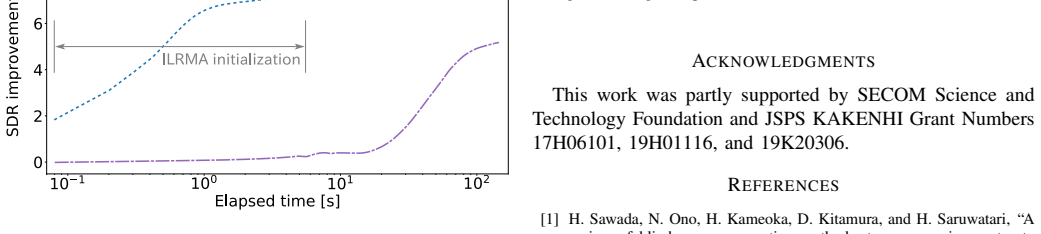
- [IV, Figs. 2 and 3] The experimental validation consists of a single configuration (one target position, one reverberation time, one SNR, one babble-noise realization), with no error bars or repeated trials. The headline speedup of 87x is the average computation time of one iteration (Fig. 3), not the total runtime to convergence, and the paper does not show that the naive and accelerated updates reach the same final SDR. Please provide multiple trials with different impulse responses, SNRs, and reverberation times, report mean and variance of computational time and SDR, and include a quantitative comparison of the final SDR and the number of iterations required for the naive, first-stage, and second-stage algorithms.
- [III-C2, Eqs. (49)-(53)] The scalar update rules contain terms with 1/λ_i and 1/λ̃_i. If λ_i is close to zero for some frequency bin, these terms become large and the update may be numerically unstable. The paper does not discuss any lower bound on λ_i or a regularization strategy. Please state the range of λ_i observed in the experiment and, if necessary, propose a safeguarded version of the update (for example, a threshold or a hybrid update when λ_i is small).
minor comments (6)
- [Abstract] The abstract contains a typo: 'naive updat e rule' should read 'naive update rule.'
- [II-B1] The notation n_h is used without a precise formal definition; please state explicitly that n_h denotes the index of the directional target source among the N sources.
- [I, II] The self-citation [20] is appropriately used as the source of the method being accelerated, but the novelty of the present paper relative to [20] could be stated more crisply in Section I.
- [III-C2] The abstract and conclusion claim that 'neither matrix inversion nor multiplication' is needed, but this is only true for the iterative update after the initialization and precomputation steps, which still involve matrix operations (e.g., computing the pseudoinverse and τ terms). Please qualify the claim.
- [IV-A, Table II] The experimental conditions table does not list the number of microphones M explicitly, although M is used in the complexity discussion; please add M to Table II.
- [Fig. 3] The bars in Fig. 3 appear to have no error bars or markers for individual trials; adding variability information would make the speedup claim more convincing.
Circularity Check
No significant circularity: the accelerated updates are algebraic rearrangements of the EM equations.
full rationale
The paper's central claim is a computational acceleration, not a scientific prediction. The accelerated update rules (54)-(56) are obtained by algebraic manipulation of the EM update equations (15)-(20). Specifically, Eq. (25) follows from the Sherman-Morrison formula, and Eq. (26) is the pseudoinverse identity (R' + lambda b b^H)^{-1} = (R')^+ + (1/lambda) b b^H, which holds exactly when R' is rank-(M-1) with b in its nullspace and lambda>0; this is precisely the structure constructed in Eqs. (10)-(11). No fitted constant is renamed as a prediction, and no parameter is calibrated to the data used for evaluation. The self-citation [20] supplies the rank-constrained SCM estimation algorithm being accelerated; it is not invoked as a uniqueness theorem, and it does not carry the load of the acceleration claim. The only substantive concern is numerical: if ILRMA-estimated R'_i is only approximately rank-deficient, Eq. (26) is only approximate, and the accelerated and naive updates may diverge. That is a robustness/correctness issue, not circularity. The derivation chain is self-contained and the 87x speedup claim rests on direct execution-time measurement rather than on circular reasoning.
Assumptions & free parameters
free parameters (3)
- alpha =
1.1
- beta =
1e-16
- K (NMF bases) =
10
assumptions (4)
- domain assumption R'(u)_i has exactly rank M-1 with unit null vector b_i
- domain assumption The naive EM update rules (15)-(18) are correct
- standard math Sherman-Morrison formula for rank-1 updates
- standard math Spectral decomposition of Hermitian matrices
Cite this review
Pith. "Pith review of Acceleration of rank-constrained spatial covariance matrix estimation for blind speech extraction." pith.science (2026). https://pith.science/paper/JVQ4G3HF
@misc{pith2026190801964,
  author       = {Pith},
  title        = {Pith review of: Acceleration of rank-constrained spatial covariance matrix estimation for blind speech extraction},
  year         = {2026},
  howpublished = {\url{https://pith.science/paper/JVQ4G3HF}},
  note         = {Machine review of arXiv:1908.01964}
}
read the original abstract
In this paper, we propose new accelerated update rules for rank-constrained spatial covariance model estimation, which efficiently extracts a directional target source in diffuse background noise.The naive updat e rule requires heavy computation such as matrix inversion or matrix multiplication. We resolve this problem by expanding matrix inversion to reduce computational complexity; in the parameter update step, we need neither matrix inversion nor multiplication. In an experiment, we show that the proposed accelerated update rule achieves 87 times faster calculation than the naive one.
Figures


Reference graph
Works this paper leans on
-
[1]
H. Sawada, N. Ono, H. Kameoka, D. Kitamura, and H. Saruwatari, “A review of blind source separation methods: two converging routes to ILRMA originating from ICA and NMF,” APSIPA Trans. Signal and Inf. Process., vol. 8, no. e12, pp. 1–14, 2019
work page 2019
-
[2]
Blind separation of convolved mixtures in the frequency domain,
P. Smaragdis, “Blind separation of convolved mixtures in the frequency domain,” Neurocomputing, vol. 22, no. 1, pp. 21–34, 1998
1998
-
[3]
S. Araki, R. Mukai, S. Makino, T. Nishikawa, and H. Saruwatari, “The fundamental limitation of frequency domain blind source separation for convolutive mixtures of speech,” IEEE Trans. ASP , vol. 11, no. 2, pp. 109–116, 2003
work page 2003
-
[4]
Blind source separation based on a fast-convergence algorithm com- bining ICA and beamforming,
H. Saruwatari, T. Kawamura, T. Nishikawa, A. Lee, and K. Shikano, “Blind source separation based on a fast-convergence algorithm com- bining ICA and beamforming,” IEEE Trans. ASLP , vol. 14, no. 2, pp. 666–678, 2006
work page 2006
-
[5]
A. Hiroe, “Solution of permutation problem in frequency domain ICA using multivariate probability density functions,” in Proc. ICA , 2006, pp. 601–608
work page 2006
-
[6]
Blind source separation exploiting higher-order frequency dependencies,
T. Kim, H. T. Attias, S.-Y . Lee, and T.-W. Lee, “Blind source separation exploiting higher-order frequency dependencies,” IEEE Trans. ASLP , vol. 15, no. 1, pp. 70–79, 2007
work page 2007
-
[7]
Stable and fast update rules for independent vector analysis based on auxiliary function technique,
N. Ono, “Stable and fast update rules for independent vector analysis based on auxiliary function technique,” in Proc. WASPAA, 2011, pp. 189–192
work page 2011
-
[8]
D. Kitamura, N. Ono, H. Sawada, H. Kameoka, and H. Saruwatari, “De- termined blind source separation unifying independent vector analysis and nonnegative matrix factorization,” IEEE/ACM Trans. ASLP, vol. 24, no. 9, pp. 1626–1641, 2016
work page 2016
Show all 24 references
-
[9]
Determined blind source separation with independent low-rank matrix analysis,
D. Kitamura, N. Ono, H. Sawada, H. Kameoka, and H. Saruwatari, “Determined blind source separation with independent low-rank matrix analysis,” in Audio Source Separation , S. Makino, Ed., pp. 125–155. Springer, Cham, 2018
2018
-
[10]
Generalized independent low- rank matrix analysis using heavy-tailed distributions for blind source separation,
D. Kitamura, S. Mogami, Y . Mitsui, N. Takamune, H. Saruwatari, N. Ono, Y . Takahashi, and K. Kondo, “Generalized independent low- rank matrix analysis using heavy-tailed distributions for blind source separation,” EURASIP JASP, vol. 2018, no. 1, pp. 1–28, 2018
2018
-
[11]
Independent low-rank matrix analysis based on time-variant sub-Gaussian source model,
S. Mogami, N. Takamune, D. Kitamura, H. Saruwatari, Y . Takahashi, K. Kondo, H. Nakajima, and N. Ono, “Independent low-rank matrix analysis based on time-variant sub-Gaussian source model,” in Proc. APSIPA, 2018, pp. 1684–1691
2018
-
[12]
Independent low-rank matrix analysis based on generalized Kullback-Leibler diver- gence,
S. Mogami, Y . Mitsui, N. Takamune, D. Kitamura, H. Saruwatari, Y . Takahashi, K. Kondo, H. Nakajima, and H. Kameoka, “Independent low-rank matrix analysis based on generalized Kullback-Leibler diver- gence,” IEICE Trans. Fundamentals , vol. E102-A, no. 2, pp. 458–463, 2019
2019
-
[13]
Equivalence between frequency-domain blind source separation and frequency-domain adaptive beamforming for convolutive mixtures,
S. Araki, S. Makino, Y . Hinamoto, R. Mukai, T. Nishikawa, and H. Saruwatari, “Equivalence between frequency-domain blind source separation and frequency-domain adaptive beamforming for convolutive mixtures,” EURASIP JASP, vol. 2003, no. 11, pp. 1–10, 2003
2003
-
[14]
Multichannel nonnegative matrix factoriza- tion in convolutive mixtures for audio source separation,
A. Ozerov and C. F ´evotte, “Multichannel nonnegative matrix factoriza- tion in convolutive mixtures for audio source separation,” IEEE Trans. ASLP, vol. 18, no. 3, pp. 550–563, 2010
2010
-
[15]
Multichannel extensions of non-negative matrix factorization with complex-valued data,
H. Sawada, H. Kameoka, S. Araki, and N. Ueda, “Multichannel extensions of non-negative matrix factorization with complex-valued data,” IEEE Trans. ASLP , vol. 21, no. 5, pp. 971–982, 2013
2013
-
[16]
Direction of arrival based spatial covariance model for blind sound source separation,
J. Nikunen and T. Virtanen, “Direction of arrival based spatial covariance model for blind sound source separation,” IEEE Trans. ASLP , vol. 22, no. 3, pp. 727–739, 2014
2014
-
[17]
Under-determined reverberant audio source separation using a full-rank spatial covariance model,
N. Q. K. Duong, E. Vincent, and R. Gribonval, “Under-determined reverberant audio source separation using a full-rank spatial covariance model,” IEEE Trans. ASLP , vol. 18, no. 7, pp. 1830–1840, 2010
2010
-
[18]
FastMNMF: Joint diagonalization based accel- erated algorithms for multichannel nonnegative matrix factorization,
N. Ito and T. Nakatani, “FastMNMF: Joint diagonalization based accel- erated algorithms for multichannel nonnegative matrix factorization,” in Proc. ICASSP, 2019, pp. 371–375
2019
-
[19]
Fast multichan- nel source separation based on jointly diagonalizable spatial covariance matrices,
K. Sekiguchi, A. A. Nugraha, Y . Bando, and K. Yoshii, “Fast multichan- nel source separation based on jointly diagonalizable spatial covariance matrices,” CoRR, vol. abs/1903.03237, 2019
1903 arXiv
-
[20]
Efficient full- rank spatial covariance estimation using independent low-rank matrix analysis for blind source separation,
Y . Kubo, N. Takamune, D. Kitamura, and H. Saruwatari, “Efficient full- rank spatial covariance estimation using independent low-rank matrix analysis for blind source separation,” in Proc. EUSIPCO, 2019
2019
-
[21]
Blind spatial subtraction array for speech enhancement in noisy envi- ronment,
Y . Takahashi, T. Takatani, K. Osako, H. Saruwatari, and K. Shikano, “Blind spatial subtraction array for speech enhancement in noisy envi- ronment,” IEEE Trans. ASLP , vol. 17, no. 4, pp. 650–664, 2009
2009
-
[22]
An approach to blind source sepa- ration based on temporal structure of speech signals,
N. Murata, S. Ikeda, and A. Ziehe, “An approach to blind source sepa- ration based on temporal structure of speech signals,” Neurocomputing, vol. 41, no. 1–4, pp. 1–24, 2001
2001
-
[23]
JNAS: Japanese speech corpus for large vocabulary continuous speech recognition research,
K. Itou, M. Yamamoto, K. Takeda, T. Takezawa, T. Matsuoka, T. Kobayashi, K. Shikano, and S. Itahashi, “JNAS: Japanese speech corpus for large vocabulary continuous speech recognition research,” J. Acoust. Soc. Jpn. (E) , vol. 20, no. 3, pp. 199–206, 1999
1999
-
[24]
Performance measurement in blind audio source separation,
E. Vincent, R. Gribonval, and C. F ´evotte, “Performance measurement in blind audio source separation,” IEEE Trans. ASLP , vol. 14, no. 4, pp. 1462–1469, 2006
2006
Reviewed August 14, 2026 · model on record in the stance chip above.
Discussion (0). Continue with ORCID to comment.