REVIEW 46 references
POLYDIM: A C++ library for POLYtopal DIscretization Methods
T0 review · reviewed 2026-08-07 · deepseek-v4-flash
Pith's one-line read PolyDiM is a new open-source C++ library that implements Virtual Element and other polytopal discretizations for PDEs in 2D and 3D on complex meshes.
desk verdict Software announcement with solid math but missing repository details; worth refereeing if the authors can make the artifact verifiable. read the letter →
The pith
A machine-rendered reading of the paper's core claim, the machinery that carries it, and where it could break.
The reading
The library is built on top of an existing geometry library called GeDiM, also written by the same team. PolyDiM provides several choices for the polynomial bases inside each element, including a monomial basis, an orthonormal basis for better conditioning at high order, and an inertial basis that is robust on badly-shaped elements. It also supports three flavors of VEM: the primal (single unknown), the mixed (velocity and pressure), and a divergence-free version that is useful for fluid problems like Stokes and Brinkman.
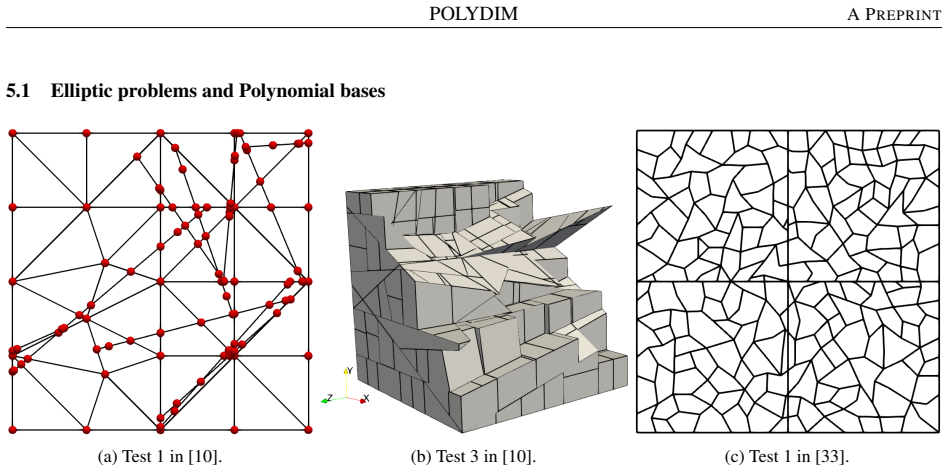
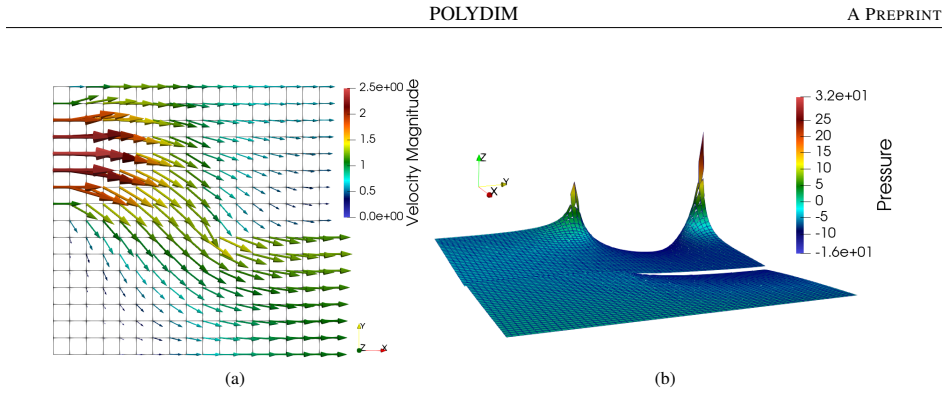
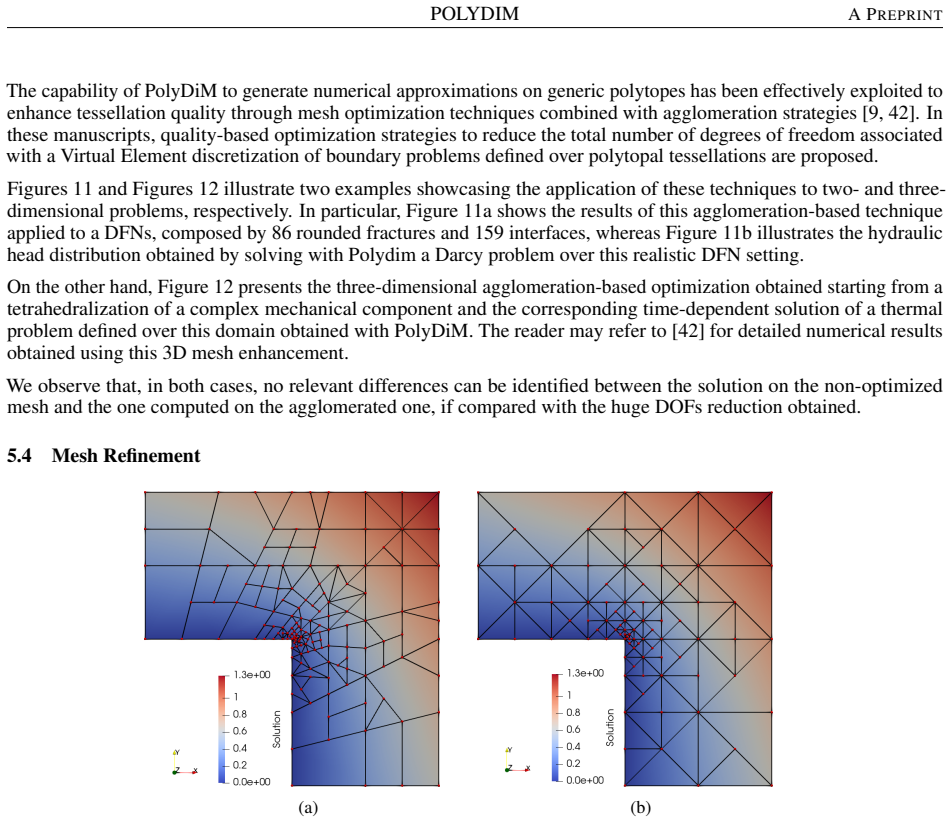
The paper shows many past and new examples: elliptic problems on concave meshes, elasticity (Cook's membrane), Navier-Stokes, Brinkman, mesh refinement and agglomeration, discrete fracture networks, and even 3D-1D coupling for root water uptake. Most of these tests come from the authors' earlier papers that used PolyDiM. The key practical point is that all examples are claimed to be available on GitHub, and there are Python and MATLAB interfaces, so the library is meant to be used by other researchers.
Extended reading notes
Core claim
The central claim is that PolyDiM is an open-source C++ library that implements polytopal discretization methods, especially VEM in 2D and 3D, with support for non-convex geometries, hanging nodes, Discrete Fracture Networks, and mixed-dimensional coupling (abstract and Sections 3 to 5). If true, it provides a reusable research and production tool for solving PDEs on complex polytopal meshes.
Load-bearing premise
The paper's claims depend on the actual availability and correctness of the released code. Specifically, the statement in Section 5 that 'All examples are fully implemented and publicly available on GitHub' must hold, and the version of the code must be capable of reproducing the convergence results shown in Figures 5, 9, 10, and similar. If the public repository is incomplete, outdated relative to the paper, or contains implementation bugs in the VEM projections, the central claim that PolyDiM is a robust tool is not established.
Editorial analysis
A structured set of objections, weighed in public.
Assumptions & free parameters
assumptions (4)
- domain assumption Polytopal mesh decompositions consist of star-shaped polytopes satisfying standard regularity assumptions (Section 2).
- standard math The local degrees of freedom are unisolvent and allow exact computation of the projections in Propositions 1, 2, and 3.
- standard math The discrete bilinear forms satisfy the consistency and stability properties (Section 3.1.2) that imply the error bounds (21), (34), and (35).
- standard math The divergence-free VEM spaces yield pointwise or projected divergence-free solutions as in Remark 2.
Cite this review
Pith. "Pith review of POLYDIM: A C++ library for POLYtopal DIscretization Methods." pith.science (2026). https://pith.science/paper/JVTEH6ZS
@misc{pith2026250514063,
  author       = {Pith},
  title        = {Pith review of: POLYDIM: A C++ library for POLYtopal DIscretization Methods},
  year         = {2026},
  howpublished = {\url{https://pith.science/paper/JVTEH6ZS}},
  note         = {Machine review of arXiv:2505.14063}
}
read the original abstract
This paper introduces PolyDiM, an open-source C++ library tailored for the development and implementation of polytopal discretization methods for partial differential equations. The library provides robust and modular tools to support advanced numerical techniques, with a focus on the Virtual Element Method in both 2D and 3D settings. PolyDiM is designed to address a wide range of challenging problems, including those involving non-convex geometries, Discrete Fracture Networks, and mixed-dimensional coupling. It is integrated with the geometry library GeDiM, and offers interfaces for MATLAB and Python to enhance accessibility. Distinguishing features include support for multiple polynomial bases, advanced stabilization strategies, and efficient local-to-global assembly procedures. PolyDiM aims to serve both as a research tool and a foundation for scalable scientific computing in complex geometrical settings.
Figures


Figures from the paper (12 more)








Reference graph
Works this paper leans on
-
[1]
L. Beirão da Veiga, F. Brezzi, L. D. Marini, and A. Russo, “The virtual element method,”Acta Numerica, vol. 32, p. 123–202, 2023. 21 POLYDIM A PREPRINT
work page 2023
-
[2]
A hybrid high-order locking-free method for linear elasticity on general meshes,
D. A. Di Pietro and A. Ern, “A hybrid high-order locking-free method for linear elasticity on general meshes,” Computer Methods in Applied Mechanics and Engineering , vol. 283, pp. 1–21, 2015. [Online]. Available: https://www.sciencedirect.com/science/article/pii/S0045782514003181
work page 2015
-
[3]
hp-version discontinuous galerkin methods on polygonal and polyhedral meshes,
A. Cangiani, E. H. Georgoulis, and P. Houston, “hp-version discontinuous galerkin methods on polygonal and polyhedral meshes,” Mathematical Models and Methods in Applied Sciences , vol. 24, no. 10, pp. 2009–2041,
work page 2009
-
[4]
H m-conforming virtual elements in arbitrary dimension,
C. Chen, X. Huang, and H. Wei, “H m-conforming virtual elements in arbitrary dimension,” SIAM Journal on Numerical Analysis, vol. 60, no. 6, pp. 3099–3123, 2022. [Online]. Available: https://doi.org/10.1137/21M1440323
-
[5]
An h1-conforming virtual element for darcy and brinkman equations,
G. Vacca, “An h1-conforming virtual element for darcy and brinkman equations,” Mathematical Models and Methods in Applied Sciences , vol. 28, no. 01, pp. 159–194, 2018. [Online]. Available: https://doi.org/10.1142/S0218202518500057
-
[6]
S. C. Brenner and L. R. Scott, The Mathematical Theory of Finite Element Methods , ser. Texts in Applied Mathematics. Springer, 2008, vol. 15. [Online]. Available: http://dx.doi.org/10.1007/978-0-387-75934-0
-
[7]
Effective polygonal mesh generation and refinement for vem,
S. Berrone and F. Vicini, “Effective polygonal mesh generation and refinement for vem,” Mathematics and Computers in Simulation , vol. 231, pp. 239–258, 2025. [Online]. Available: https://www.sciencedirect.com/ science/article/pii/S0378475424004786
work page 2025
-
[8]
A 3d-1d virtual element method for modeling root water uptake,
S. Berrone, S. Ferraris, D. Grappein, G. Teora, and F. Vicini, “A 3d-1d virtual element method for modeling root water uptake,” 2024. [Online]. Available: https://arxiv.org/abs/2412.12884
arXiv 2024
Show all 46 references
-
[9]
Mesh Quality Agglomeration Algorithm for the Virtual Element Method Applied to Discrete Fracture Networks,
T. Sorgente, F. Vicini, S. Berrone, S. Biasotti, G. Manzini, and M. Spagnuolo, “Mesh Quality Agglomeration Algorithm for the Virtual Element Method Applied to Discrete Fracture Networks,”Calcolo, vol. 60, no. 2, apr
-
[10]
Improving high-order vem stability on badly-shaped elements,
S. Berrone, G. Teora, and F. Vicini, “Improving high-order vem stability on badly-shaped elements,” Mathematics and Computers in Simulation , vol. 216, pp. 367–385, 2024. [Online]. Available: https://www.sciencedirect.com/science/article/pii/S0378475423004287
2024
-
[11]
Orthogonal polynomial bases in the mixed virtual element method,
S. Berrone, S. Scialò, and G. Teora, “Orthogonal polynomial bases in the mixed virtual element method,” Numerical Methods for Partial Differential Equations , vol. 40, no. 6, p. e23144, 2024. [Online]. Available: https://onlinelibrary.wiley.com/doi/abs/10.1002/num.23144
2024 doi
-
[12]
The Role of Mesh Quality and Mesh Quality Indicators in the Virtual Element Method,
T. Sorgente, S. Biasotti, G. Manzini, and M. Spagnuolo, “The Role of Mesh Quality and Mesh Quality Indicators in the Virtual Element Method,” Adv. Comput. Math., vol. 48, no. 1, feb 2022. [Online]. Available: https://doi.org/10.1007/s10444-021-09913-3
2022 doi
-
[13]
Polyhedral mesh quality indicator for the Virtual Element Method,
——, “Polyhedral mesh quality indicator for the Virtual Element Method,” Computers & Mathematics with Applications, vol. 114, pp. 151–160, 2022. [Online]. Available: https://www.sciencedirect.com/science/article/pii/ S0898122122001390
2022
-
[14]
GEDiM: GEometry for DIscretization MEthod library,
S. Berrone, A. Borio, G. Teora, and F. Vicini, “GEDiM: GEometry for DIscretization MEthod library,” Apr. 2025. [Online]. Available: https://github.com/AURION-Polito/gedim
2025
-
[15]
Vemcomp: a virtual elements matlab package for bulk-surface pdes in 2d and 3d,
M. Frittelli, A. Madzvamuse, and I. Sgura, “Vemcomp: a virtual elements matlab package for bulk-surface pdes in 2d and 3d,” Numerical Algorithms, 2024. [Online]. Available: https://doi.org/10.1007/s11075-024-01919-4
2024 doi
-
[16]
mvem: A matlab software package for the virtual element methods,
Y . Yu, “mvem: A matlab software package for the virtual element methods,” 2022. [Online]. Available: https://arxiv.org/abs/2204.01339
2022 arXiv
-
[17]
Vemlab: a matlab library for the virtual element method
A. Ortiz-Bernardin, “Vemlab: a matlab library for the virtual element method.” [Online]. Available: https://camlab.cl/vemlab/
-
[18]
Veamy: an extensible object-oriented c++ library for the virtual element method,
A. Ortiz-Bernardin, C. Alvarez, N. Hitschfeld-Kahler, A. Russo, R. Silva-Valenzuela, and E. Olate-Sanzana, “Veamy: an extensible object-oriented c++ library for the virtual element method,” Numerical Algorithms, vol. 82, pp. 1189– 1220, 2019. [Online]. Available: https://doi.o...
2019 doi
-
[19]
A framework for implementing general virtual element spaces,
A. Dedner and A. Hodson, “A framework for implementing general virtual element spaces,” SIAM Journal on Scientific Computing , vol. 46, no. 3, pp. B229–B253, 2024. [Online]. Available: https: //doi.org/10.1137/23M1573653
2024 doi
-
[20]
High-order Virtual Element Method on polyhedral meshes,
L. Beirão da Veiga, F. Dassi, and A. Russo, “High-order Virtual Element Method on polyhedral meshes,” Computers & Mathematics with Applications, vol. 74, no. 5, pp. 1110–1122, 2017, sI: SDS2016 – Methods for PDEs. [Online]. Available: https://www.sciencedirect.com/science/arti...
2017
-
[21]
Ill-conditioning in the virtual element method: Stabilizations and bases,
L. Mascotto, “Ill-conditioning in the virtual element method: Stabilizations and bases,” Numerical Methods for Partial Differential Equations , vol. 34, no. 4, pp. 1258–1281, 2018. [Online]. Available: https://onlinelibrary.wiley.com/doi/abs/10.1002/num.22257 22 POLYDIM A PREPRINT
2018 doi
-
[22]
Exploring high-order three dimensional virtual elements: Bases and stabilizations,
F. Dassi and L. Mascotto, “Exploring high-order three dimensional virtual elements: Bases and stabilizations,” Computers & Mathematics with Applications , vol. 75, no. 9, pp. 3379–3401, 2018. [Online]. Available: https://www.sciencedirect.com/science/article/pii/S0898122118300786
2018
-
[23]
Parallel solvers for virtual element discretizations of elliptic equations in mixed form,
F. Dassi and S. Scacchi, “Parallel solvers for virtual element discretizations of elliptic equations in mixed form,” Computers & Mathematics with Applications , vol. 79, no. 7, pp. 1972–1989, 2020, advanced Computational methods for PDEs. [Online]. Available: https://www.scien...
1972
-
[24]
Divergence free virtual elements for the stokes problem on polygonal meshes,
L. Beirão da Veiga, C. Lovadina, and G. Vacca, “Divergence free virtual elements for the stokes problem on polygonal meshes,” ESAIM: M2AN , vol. 51, no. 2, pp. 509–535, 2017. [Online]. Available: https://doi.org/10.1051/m2an/2016032
2017
-
[25]
Virtual element method for general second order elliptic problems on polygonal meshes,
L. Beirão da Veiga, F. Brezzi, L. D. Marini, and A. Russo, “Virtual element method for general second order elliptic problems on polygonal meshes,” Mathematical Models and Methods in Applied Sciences, vol. 26, no. 04, pp. 729–750, 2016. [Online]. Available: https://doi.org/10....
2016 doi
-
[26]
Basic principles of Virtual Element Methods,
L. Beirão da Veiga, F. Brezzi, A. Cangiani, G. Manzini, and A. Russo, “Basic principles of Virtual Element Methods,” Mathematical Models and Methods in Applied Sciences, vol. 23, no. 01, pp. 199–214, 2013
2013
-
[27]
Equivalent Projectors for Virtual Element Methods,
B. Ahmad, A. Alsaedi, F. Brezzi, L. Marini, and A. Russo, “Equivalent Projectors for Virtual Element Methods,” Comput Math Appl, vol. 66, no. 3, pp. 376–391, 2013
2013
-
[28]
Beirão da Veiga, F
L. Beirão da Veiga, F. Brezzi, L. D. Marini, and A. Russo, Virtual Element Implementation for General Elliptic Equations. Springer International Publishing, 2016
2016
-
[29]
Stability analysis for the virtual element method,
L. Beirão da Veiga, C. Lovadina, and A. Russo, “Stability analysis for the virtual element method,”Mathematical Models and Methods in Applied Sciences , vol. 27, no. 13, pp. 2557–2594, 2017. [Online]. Available: https://doi.org/10.1142/S021820251750052X
2017 doi
-
[30]
Virtual elements for linear elasticity problems,
L. Beirão da Veiga, F. Brezzi, and L. D. Marini, “Virtual elements for linear elasticity problems,”SIAM Journal on Numerical Analysis, vol. 51, no. 2, pp. 794–812, 2013. [Online]. Available: https://doi.org/10.1137/120874746
2013 doi
-
[31]
Mixed virtual element methods for general second order elliptic problems on polygonal meshes,
L. Beirão da Veiga, F. Brezzi, L. D. Marini, and A. Russo, “Mixed virtual element methods for general second order elliptic problems on polygonal meshes,” ESAIM: M2AN, vol. 50, no. 3, pp. 727–747, 2016. [Online]. Available: https://doi.org/10.1051/m2an/2015067
2016
-
[32]
H(div) and H(curl)-conforming VEM,
——, “H(div) and H(curl)-conforming VEM,” NUMERISCHE MATHEMATIK, vol. 133, pp. 303–332, 2016
2016
-
[33]
The mixed virtual element discretization for highly-anisotropic problems: the role of the boundary degrees of freedom,
S. Berrone, S. Scialò, and G. Teora, “The mixed virtual element discretization for highly-anisotropic problems: the role of the boundary degrees of freedom,” Mathematics in Engineering, vol. 5, no. 6, pp. 1–32, 2023. [Online]. Available: https://www.aimspress.com/article/doi/1...
2023 doi
-
[34]
The stokes complex for virtual elements in three dimensions,
L. Beirão da Veiga, F. Dassi, and G. Vacca, “The stokes complex for virtual elements in three dimensions,” Mathematical Models and Methods in Applied Sciences, vol. 30, no. 03, pp. 477–512, 2020. [Online]. Available: https://doi.org/10.1142/S0218202520500128
2020 doi
-
[35]
Virtual elements for the navier–stokes problem on polygonal meshes,
L. Beirão da Veiga, C. Lovadina, and G. Vacca, “Virtual elements for the navier–stokes problem on polygonal meshes,” SIAM Journal on Numerical Analysis , vol. 56, no. 3, pp. 1210–1242, 2018. [Online]. Available: https://doi.org/10.1137/17M1132811
2018 doi
-
[36]
The stokes complex for virtual elements with application to navier–stokes flows,
L. Beirão da Veiga, D. Mora, and G. Vacca, “The stokes complex for virtual elements with application to navier–stokes flows,” Journal of Scientific Computing , vol. 81, 2019. [Online]. Available: https://doi.org/10.1007/s10915-019-01049-3
2019 doi
-
[37]
Eigen v3,
G. Guennebaud, B. Jacob et al., “Eigen v3,” http://eigen.tuxfamily.org, 2010
2010
-
[38]
PETSc Web page,
S. Balay, S. Abhyankar, M. F. Adams, S. Benson, J. Brown, P. Brune, K. Buschelman, E. M. Constantinescu, L. Dalcin, A. Dener, V . Eijkhout, J. Faibussowitsch, W. D. Gropp, V . Hapla, T. Isaac, P. Jolivet, D. Karpeev, D. Kaushik, M. G. Knepley, F. Kong, S. Kruger, D. A. May, L....
2025
-
[39]
Benchmarking the geometrical robustness of a virtual element poisson solver,
M. Attene, S. Biasotti, S. Bertoluzza, D. Cabiddu, M. Livesu, G. Patanè, M. Pennacchio, D. Prada, and M. Spagnuolo, “Benchmarking the geometrical robustness of a virtual element poisson solver,” Mathematics and Computers in Simulation , vol. 190, pp. 1392–1414, 2021. [Online]....
2021
-
[40]
Order preserving supg stabilization for the virtual element formulation of advection–diffusion problems,
M. Benedetto, S. Berrone, A. Borio, S. Pieraccini, and S. Scialò, “Order preserving supg stabilization for the virtual element formulation of advection–diffusion problems,” Computer Methods in Applied Mechanics and Engineering, vol. 311, pp. 18–40, 2016. [Online]. Available: h...
2016
-
[41]
Arbitrary order 2D virtual elements for polygonal meshes: part I, elastic problem,
E. Artioli, L. Beirão da Veiga, C. Lovadina, and E. Sacco, “Arbitrary order 2D virtual elements for polygonal meshes: part I, elastic problem,” Computational Mechanics, vol. 60, pp. 355–377, 2017. [Online]. Available: https://doi.org/10.1007/s00466-017-1404-5
2017 doi
-
[42]
Mesh optimization for the virtual element method: How small can an agglomerated mesh become?
T. Sorgente, F. Vicini, S. Berrone, S. Biasotti, G. Manzini, and M. Spagnuolo, “Mesh optimization for the virtual element method: How small can an agglomerated mesh become?” Journal of Computational Physics, vol. 521, p. 113552, 2025. [Online]. Available: https://www.sciencedi...
2025
-
[43]
3d adaptive vem with stabilization-free a posteriori error bounds,
S. Berrone, D. Fassino, and F. Vicini, “3d adaptive vem with stabilization-free a posteriori error bounds,”Journal of Scientific Computing, vol. 103, p. 35, 2025. [Online]. Available: https://doi.org/10.1007/s10915-025-02852-x
2025 doi
-
[44]
Higher-order adaptive virtual element methods with contraction properties,
C. Canuto and D. Fassino, “Higher-order adaptive virtual element methods with contraction properties,” Mathematics in Engineering, vol. 5, no. 6, pp. 1–33, 2023. [Online]. Available: https://www.aimspress.com/ article/doi/10.3934/mine.2023101 24
2023 doi
-
[2014]
Available: https://doi.org/10.1142/S0218202514500146
[Online]. Available: https://doi.org/10.1142/S0218202514500146
-
[2023]
Available: https://doi.org/10.1007/s10092-023-00517-5
[Online]. Available: https://doi.org/10.1007/s10092-023-00517-5
Reviewed August 7, 2026 · model on record in the stance chip above.
Discussion (0). Continue with ORCID to comment.