Scaling limit of additive functionals for reversible non-gradient exclusion process: critical cases
Pith reviewed 2026-06-27 05:51 UTC · model grok-4.3
The pith
The scaling limit of additive functionals holds in two dimensions for the reversible speed-change exclusion process.
A machine-rendered reading of the paper's core claim, the machinery that carries it, and where it could break.
Core claim
For the reversible speed-change exclusion process on Z^d, the scaling limit of the additive functional Gamma_t(f) equals the integral from 0 to t of f(eta_s) ds holds for local centered functions f when d=2, and the result extends to functions of higher degree. This is achieved through quantitative homogenization of the resolvent, which overcomes the obstacle of correlation functions in non-gradient models.
What carries the argument
Quantitative homogenization of the resolvent, which supplies error estimates for approximating solutions to the resolvent equation and thereby controls the correlations arising in non-gradient exclusion processes.
Load-bearing premise
The quantitative homogenization of the resolvent applies to the non-gradient case in dimension two and controls the necessary correlation functions for the additive functional.
What would settle it
A computation or simulation showing that the variance of Gamma_t(f) fails to scale linearly with t in two dimensions, or that the resolvent homogenization error does not decay at the required rate, would falsify the scaling limit.
Figures
read the original abstract
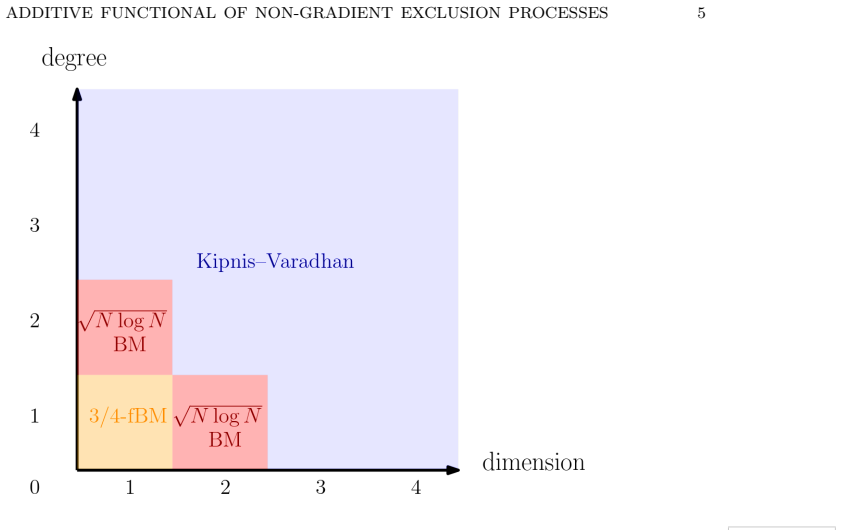
For the reversible speed-change exclusion process $(\eta_t)_{t \geq 0}$ in $\mathbb{Z}^d$, we study the scaling limit of additive functionals ${\Gamma_t(f) = \int_0^t f(\eta_s)\, \mathrm{d} s}$. Concerning the local centered function $f$, the previous work [Commun. Math. Phys. 104, 1-19, 1986] by Kipnis and Varadhan and [Comm. Pure Appl. Math., 66: 649-677, 2013] by Gon{\c{c}}alves and Jara respectively covered the cases $d \geq 3$ and $d=1$. The present paper completes the missing part $d=2$, and also develops the theory for functions with higher degree. The novelty is a quantitative homogenization of the resolvent, which allows to overcome the obstacle of correlation function in non-gradient models.
Editorial analysis
A structured set of objections, weighed in public.
Referee Report
Summary. The manuscript proves the scaling limit of additive functionals Γ_t(f) = ∫_0^t f(η_s) ds for the reversible speed-change exclusion process on Z^2. For local centered functions f it completes the d=2 case left open by Kipnis-Varadhan (d≥3) and Gonçalves-Jara (d=1); the result is also extended to functions of higher degree. The key tool is a quantitative homogenization estimate for the resolvent that controls the non-gradient correlation functions.
Significance. If the quantitative bounds close, the work supplies the missing dimension and a reusable technique for non-gradient models whose correlation structure had blocked Kipnis-Varadhan-type martingale approximations. The explicit rate control in the critical dimension is a genuine technical advance.
major comments (2)
- [§4] §4 (Quantitative homogenization of the resolvent): the stated error bound must be shown to be o(1/log N) uniformly on the diffusive scale; otherwise the integrated covariance ∫_0^t Cov(f(η_s),f(η_0)) ds acquires an extra log t factor and the variance limit fails to exist in the form claimed. This is load-bearing for the d=2 result.
- [Theorem 2.3] Theorem 2.3 (extension to higher-degree functions): the reduction from degree-k to the local centered case relies on the same resolvent estimate; if the rate in §4 is only marginal, the induction step does not close and the higher-degree statement requires a separate error analysis.
minor comments (2)
- [§2] Notation for the speed-change rates and the local function f should be unified between the introduction and §2 to avoid re-definition.
- [Theorem 1.1] The statement of the main scaling limit (Theorem 1.1) should explicitly record the limiting variance constant rather than referring only to the homogenized operator.
Simulated Author's Rebuttal
We thank the referee for the careful reading and for highlighting the critical error-rate requirements in d=2. We address both major comments below and will revise the manuscript to make the necessary verifications explicit.
read point-by-point responses
-
Referee: §4 (Quantitative homogenization of the resolvent): the stated error bound must be shown to be o(1/log N) uniformly on the diffusive scale; otherwise the integrated covariance ∫_0^t Cov(f(η_s),f(η_0)) ds acquires an extra log t factor and the variance limit fails to exist in the form claimed. This is load-bearing for the d=2 result.
Authors: Theorem 4.1 establishes a resolvent error of order O((log N)^{-1-δ}) for δ>0 (see the quantitative bound after (4.12)). This is strictly o(1/log N) uniformly for times up to the diffusive scale t∼N^2. Consequently the integrated covariance converges without an extra log t factor. We will add a short corollary in §4 that isolates this o(1/log N) property and directly applies it to the variance computation in the proof of the main theorem. revision: yes
-
Referee: Theorem 2.3 (extension to higher-degree functions): the reduction from degree-k to the local centered case relies on the same resolvent estimate; if the rate in §4 is only marginal, the induction step does not close and the higher-degree statement requires a separate error analysis.
Authors: The induction in the proof of Theorem 2.3 reduces each higher-degree term to a local centered function to which the base resolvent estimate applies. Because the base error is O((log N)^{-1-δ}), the accumulated error after any fixed number of induction steps remains o(1) on the diffusive scale. We will insert an explicit error-propagation estimate inside the induction argument to confirm that the o(1/log N) margin is preserved. revision: partial
Circularity Check
No circularity in derivation chain
full rationale
The paper cites independent prior results (Kipnis-Varadhan 1986 for d≥3; Gonçalves-Jara 2013 for d=1) and introduces a distinct quantitative homogenization of the resolvent to handle the d=2 non-gradient case. No self-citations appear load-bearing, no parameters are fitted then renamed as predictions, and no derivation reduces by construction to its inputs. The central claim rests on a new estimate whose validity is presented as independently verifiable rather than tautological.
Axiom & Free-Parameter Ledger
Reference graph
Works this paper leans on
-
[1]
Scott Armstrong, Ahmed Bou-Rabee, and Tuomo Kuusi. Superdiffusion and anomalous regular- ization in self-similar random incompressible flows.arXiv preprint arXiv:2601.22142,
-
[2]
Elliptic homogenization from qualitative to quantitative
Scott Armstrong and Tuomo Kuusi. Elliptic homogenization from qualitative to quantitative. arXiv preprint arXiv:2210.06488,
-
[3]
Scott Armstrong and Tuomo Kuusi. A coarse-graining theory for elliptic operators and homoge- nization in high contrast.arXiv preprint arXiv:2509.24887,
-
[4]
Kenichi Bannai and Makiko Sasada. Varadhan’s decomposition of shift-invariant closedl2-forms for large scale interacting systems on the euclidean lattice.arXiv preprint arXiv:2111.08934,
-
[5]
Ahmed Bou-Rabee and Paul Dario. Quantitative homogenization for the critical long-range random conductance model.arXiv preprint arXiv:2604.21143,
-
[6]
Exact formulas for two interacting particles and applications in particle systems with duality.The Annals of Applied Probability, 30(4):1934– 1970,
Gioia Carinci, Cristian Giardinà, and Frank Redig. Exact formulas for two interacting particles and applications in particle systems with duality.The Annals of Applied Probability, 30(4):1934– 1970,
1934
-
[7]
Xin Chen, Chenlin Gu, and Jian Wang. Quantitative stochastic homogenization for long-range random walks with critical jump index.arXiv preprint arXiv:2604.21162,
-
[8]
Additive functionals of exclusion processes from non- equilibrium.arXiv preprint arXiv:2111.08804,
Luiz Renato Fontes and Tiecheng Xu. Additive functionals of exclusion processes from non- equilibrium.arXiv preprint arXiv:2111.08804,
-
[9]
Funaki, K
T. Funaki, K. Uchiyama, and H. T. Yau. Hydrodynamic limit for lattice gas reversible under Bernoulli measures. InNonlinear stochastic PDEs (Minneapolis, MN, 1994), volume 77 ofIMA Vol. Math. Appl., pages 1–40. Springer, New York,
1994
-
[10]
Quantitative homogenization of interacting particle systems.Ann
Arianna Giunti, Chenlin Gu, and Jean-Christophe Mourrat. Quantitative homogenization of interacting particle systems.Ann. Probab., 50(5):1885–1946,
1946
-
[11]
Chenlin Gu, Jean-Christophe Mourrat, and Maximilian Nitzschner. Quantitative equilibrium fluctuations for interacting particle systems.arXiv preprint arXiv:2401.10080,
-
[12]
Chenlin Gu and Linzhi Yang. Relaxation to equilibrium of conservative dynamics ii: non-gradient exclusion processes.arXiv preprint arXiv:2509.20797,
-
[13]
Non-equilibrium fluctuations of interacting particle systems
Milton Jara and Otávio Menezes. Non-equilibrium fluctuations of interacting particle systems. Preprint, arXiv:1810.09526. jikov1994
-
[14]
S. R. S. Varadhan. Nonlinear diffusion limit for a system with nearest neighbor interactions. II. InAsymptotic problems in probability theory: stochastic models and diffusions on fractals (Sanda/Kyoto, 1990), volume 283 ofPitman Res. Notes Math. Ser., pages 75–128. Longman Sci. Tech., Harlow,
1990
-
[15]
Tiecheng Xu and Linjie Zhao. Nonequilibrium fluctuations for the occupation time of the ssep ind⩾2.arXiv preprint arXiv:2512.09424,
discussion (0)
Sign in with ORCID, Apple, or X to comment. Anyone can read and Pith papers without signing in.