REVIEW 1 major objections 6 minor 58 references
Circumbinary disk formation through AGB star winds
T0 review · 1 major / 6 minor · reviewed 2026-07-07 · glm-5.2
Pith's one-line read Slow winds and massive companions forge circumbinary disks
desk verdict Long-term (600+ orbit) SPH simulations of circumbinary disk formation through WRLOF — a genuine advance in timescale, but the thermodynamic treatment is load-bearing and under-tested. read the letter →
The pith
A machine-rendered reading of the paper's core claim, the machinery that carries it, and where it could break.
The reading
What carries the argument
The specific energy ratio η = e_max / (e_max − e_min) governs whether wind material remains bound to the binary. When 0 ≤ η ≤ 1, a fraction of the wind is captured, enabling the WRLOF → L2 outflow → circumbinary disk formation chain.
What would settle it
If simulations with self-consistent radiative transfer and realistic cooling (H/R ≈ 0.2–0.3) fail to produce circumbinary disks in the WRLOF regime for the same binary parameters, the formation pathway demonstrated here would be an artifact of the simplified thermodynamics.
Extended reading notes
Core claim
The central mechanism is a two-step angular-momentum transfer chain: the AGB wind fills the companion's Roche lobe, forms a circumsingle disk, and that disk feeds material through the L2 point into circumbinary orbits. Whether this chain activates depends on a dimensionless energy ratio η that compares the specific energy of injected wind particles to the binary's gravitational potential. When η < 1 (slow winds, massive companions), enough material remains gravitationally bound for the WRLOF pathway to operate and build a circumbinary disk. When η > 1 (fast winds or low-mass companions), the wind stays unbound and only produces a spiral density pattern. Over 600 orbits, the circumbinary disk
Load-bearing premise
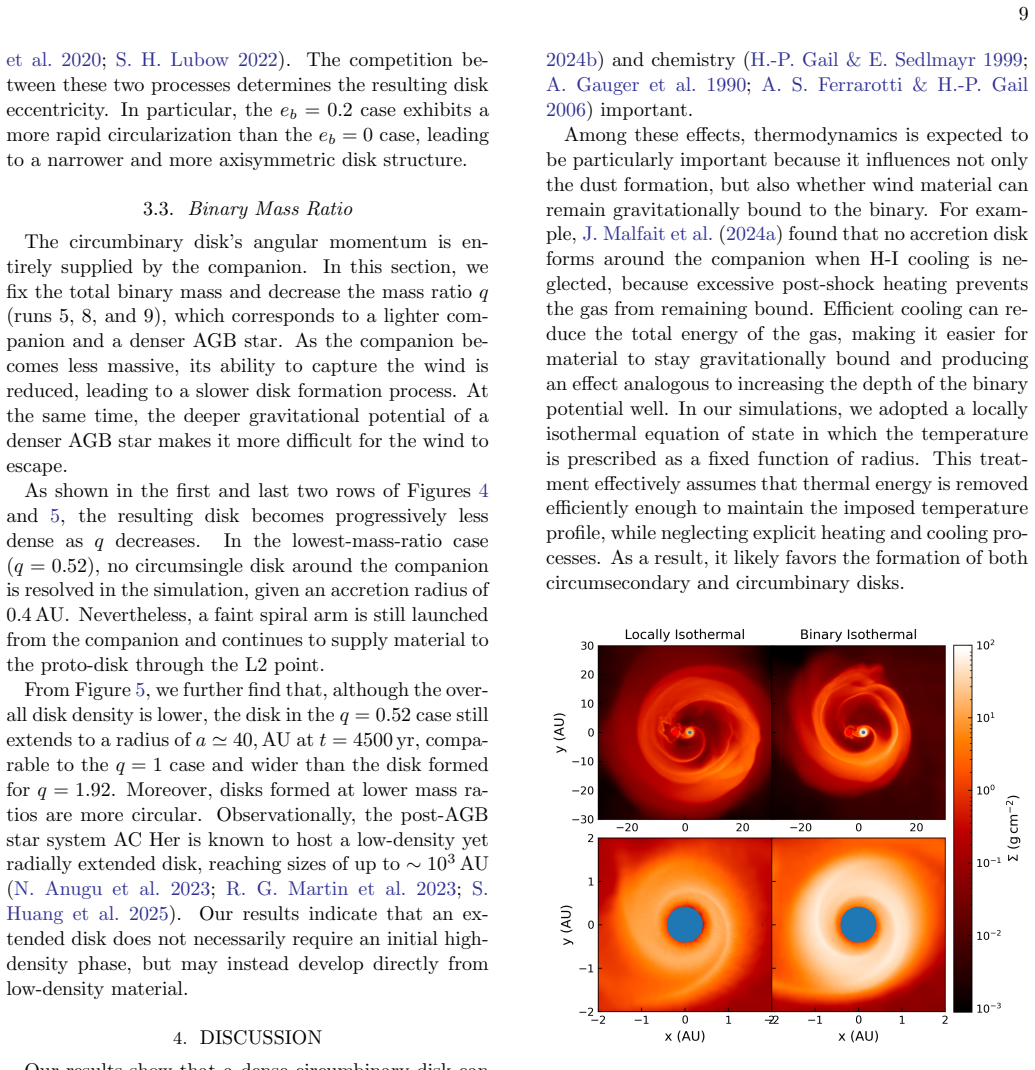
The simulations adopt a locally isothermal equation of state with a disk aspect ratio of H/R = 0.1, which assumes efficient cooling and relatively cool gas. Observations and other simulations suggest the real value could be 0.17–0.3, and higher thermal energy would make wind capture less efficient and disk formation harder. The authors acknowledge this likely biases their results in favor of disk formation.
Editorial extensions
If this is right
- The diversity of observed circumbinary disk morphologies around post-AGB stars can be explained by varying binary eccentricity and mass ratio, without invoking additional formation channels like common-envelope ejection.
- Extended low-density disks around post-AGB systems like AC Her may form directly from low-density material without passing through a compact high-density phase, consistent with the low mass-ratio simulations.
- Angular momentum transport in these disks is dominated by binary-induced spiral shocks rather than turbulent viscosity, which affects how one models disk evolution and accretion in post-AGB systems.
- The polar-aligned circumbinary disk observed in AC Her cannot be explained by this co-planar wind-binary interaction mechanism, indicating an additional physical process is needed for polar disk alignment.
Reading between the lines
- If the disk aspect ratio H/R is as large as observations suggest (0.17–0.3), the WRLOF disk-formation pathway may operate only in a narrower region of parameter space than these simulations imply, potentially requiring even slower winds or more massive companions.
- The sensitivity of disk properties to binary eccentricity suggests that observed circumbinary disk eccentricities could be used to infer or constrain the orbital eccentricity of the underlying binary, even when direct orbital parameters are difficult to measure.
- Since the companion supplies all angular momentum to the disk, systems with very low mass ratios may produce disks too tenuous to be detectable, potentially explaining why some post-AGB binaries lack observed circumbinary disks.
Editorial analysis
A structured set of objections, weighed in public.
Referee Report
Summary. The manuscript presents SPH simulations of AGB wind-binary interactions using PHANTOM, investigating the formation of circumbinary disks in both the Bondi-Hoyle and WRLOF regimes. The key finding is that in the WRLOF regime (slow winds, massive companions), a circumsingle disk forms around the companion and transfers material through the L2 point into circumbinary orbits, producing a long-lived circumbinary disk. Simulations extend over 600 orbital periods—significantly longer than most prior work—and systematically explore the effects of binary eccentricity (e_b = 0, 0.2, 0.4) and mass ratio (q = 0.52, 1.0, 1.92). The authors find that higher eccentricities produce more extended and eccentric disks, while lower mass ratios yield lower-density disks. Angular momentum transport is shown to be dominated by spiral structures and shocks rather than the imposed artificial viscosity. The paper is clearly written and the physical picture is well-motivated.
Significance. The primary contribution is the long-term evolution of circumbinary disks formed via WRLOF, extending to 600 orbital periods where most prior simulations stop at ~100. The distinction between BH and WRLOF regimes via the specific energy ratio η (Eq. 2) provides a useful diagnostic. The α_eff analysis (Eq. 10) demonstrating that physical stresses dominate over imposed viscosity is a valuable check. Comparisons with Esseldeurs et al. (2023) for spiral structure and Chen et al. (2017, 2020) for disk formation provide external validation. However, the significance of the central claim is tempered by the thermodynamic treatment: the locally isothermal EoS with H/R = 0.1 is acknowledged by the authors as likely favoring disk formation, and no simulation with H/R > 0.1 is presented to test robustness across the observationally motivated range (0.17–0.3).
major comments (1)
- Section 2 and Section 4 (Discussion): The locally isothermal EoS with H/R = 0.1 is load-bearing for the central claim that WRLOF naturally produces circumbinary disks. The authors themselves cite Malfait et al. (2024a) finding that no disk forms when H-I cooling is neglected, and note that observational estimates place H/R at 0.17–0.3. The partial mitigation (run 10, binary isothermal) does not address this concern because it retains the same H/R = 0.1 and isothermal treatment—cooling is still effectively instantaneous. No simulation with H/R > 0.1 is presented. The claim in the abstract and conclusions that WRLOF 'naturally' produces circumbinary disks should be qualified to state that this result holds under the assumption of efficient cooling (small H/R), and that robustness at observationally motivated H/R values remains untested. At minimum, the authors should add a simulation at HR
minor comments (6)
- Table 1: The EoS column lists 'Locally Isothermal' and 'Binary Isothermal' but the distinction between these two prescriptions is only explained in Section 4. A brief footnote in the table caption would help.
- Equation (10): The alpha_eff stress proxy is defined but the spatially averaged or rms value is not reported quantitatively in the text. The statement that typical values range between -0.3 and 0.3 is given, but a radial profile or azimuthally averaged comparison with alpha = 0.1 would make the claim more quantitative.
- Section 2: The statement that the injection rate is 'not equivalent to the physical mass loss rate' because particles fall back is important but briefly stated. A quantitative estimate of the fraction of injected mass that is re-accreted versus escaping would clarify the effective mass-loss rate.
- Figure 5: The y-axis label uses e_d for disk-averaged eccentricity, but the text sometimes refers to 'disk eccentricity' and sometimes to particle eccentricity e_p. Please ensure consistent terminology.
- Section 3.1: The terminal wind velocities of ~20 and ~14 km/s are compared to Esseldeurs et al. (2023) values of 15–25 km/s. The injection velocity for runs 1–2 is 42 km/s. A brief discussion of the deceleration mechanism would help the reader assess this comparison.
- The reference to 'S. Huang et al. 2025' in the conclusions appears to be self-referential; please ensure this is properly cited and that readers unfamiliar with that work are given sufficient context.
Simulated Author's Rebuttal
We thank the referee for a careful and constructive report. The referee's central concern regarding the thermodynamic treatment and its potential impact on disk formation is well-taken. We address it below.
read point-by-point responses
-
Referee: The locally isothermal EoS with H/R = 0.1 is load-bearing for the central claim that WRLOF naturally produces circumbinary disks. The authors cite Malfait et al. (2024a) finding no disk when H-I cooling is neglected, and note observational estimates place H/R at 0.17–0.3. The partial mitigation (run 10, binary isothermal) does not address this because it retains H/R = 0.1. No simulation with H/R > 0.1 is presented. The claim that WRLOF 'naturally' produces circumbinary disks should be qualified, and at minimum a simulation at H/R > 0.1 should be added.
Authors: We agree with the referee that the thermodynamic treatment is the most important caveat in our work, and we appreciate the referee pushing us on this point. We will make the following changes in the revised manuscript. revision: yes
-
Referee: Qualify the claim in the abstract and conclusions that WRLOF 'naturally' produces circumbinary disks to state that this result holds under the assumption of efficient cooling (small H/R), and that robustness at observationally motivated H/R values remains untested.
Authors: We agree. The word 'naturally' in the abstract and conclusions overstates what our simulations demonstrate, given that H/R = 0.1 assumes efficient cooling and sits at the lower end of the observationally inferred range. We will revise the abstract to read that wind-binary interactions 'can generate' rather than 'can naturally generate' diverse circumbinary disk morphologies, and we will add an explicit caveat in both the abstract and the conclusions stating that our results assume efficient cooling (H/R = 0.1) and that robustness at the observationally motivated range H/R ~ 0.17–0.3 has not yet been tested. The Discussion (Section 4) already acknowledges this limitation; we will strengthen the language there as well to make clear that H/R = 0.1 likely favors disk formation. revision: yes
-
Referee: At minimum, add a simulation at H/R > 0.1 to test robustness.
Authors: We agree that this is the most direct way to address the concern. We will add a new simulation with H/R = 0.2 (within the observationally inferred range of 0.17–0.3, citing Gallardo Cava et al. 2021 and Malfait et al. 2024a), using the same binary parameters as run 5 (e_b = 0, q = 1.92, eta = 0.781, Gaussian injection). Given computational constraints, we will run this simulation for at least 200 orbital periods, which is sufficient to determine whether a circumsingle disk forms around the companion and whether material is transferred through L2 into circumbinary orbits — the key qualitative question. We will present the results in a new figure and discuss them in the context of the referee's concern. If disk formation is suppressed or significantly weakened at H/R = 0.2, we will state this explicitly and further temper our conclusions. If a disk still forms, we will note that the result is robust to at least this value of H/R, while acknowledging that the full parameter space remains to be explored. We note that a full 600-orbit simulation at higher H/R would be computationally expensive and is beyond what we can complete within the revision timeframe, but the shorter run will directly address whether the qualitative disk-formation mechanism survives at a more realistic disk thickness. revision: yes
Circularity Check
No significant circularity; self-citations are observational references, not load-bearing theoretical premises
full rationale
The paper's derivation chain is self-contained against external benchmarks. The specific energy ratio η (Eq. 2) is defined from first principles (kinetic + potential energy at injection) and used to classify wind regimes — it is not a fitted parameter renamed as a prediction. The α_eff stress proxy (Eq. 10) is computed directly from SPH particle velocities, not fitted to any target. The central claims (spiral structure in the BH regime, circumbinary disk formation in the WRLOF regime) are validated against external simulations: Esseldeurs et al. (2023) for spiral morphology and terminal velocities, Chen et al. (2017, 2020) for disk formation, and Malfait et al. (2024a) for the thermodynamic dependence. The self-citations present (Huang et al. 2025, Martin et al. 2023) refer to observational properties of the AC Her system (disk extent, polar alignment) and are not invoked as theoretical premises that would make the derivation circular. The H/R = 0.1 assumption and the locally isothermal EoS are acknowledged limitations that may favor disk formation, but these are correctness/robustness concerns — the authors explicitly state this — not circularity, since no prediction is defined in terms of these assumptions in a way that reduces to the input by construction. The binary-isothermal comparison (run 10) is a partial sensitivity test, not a circular step. Score 2 reflects the minor self-citation to Huang et al. (2025) for observational context, which is not load-bearing for the simulation results.
Assumptions & free parameters
free parameters (6)
- H/R (disk aspect ratio) =
0.1
- α (effective viscosity) =
~0.1
- Ṁ (injection rate) =
1×10^-6 M☉/yr
- R_s,1 (AGB accretion radius) =
1.0 AU
- R_s,2 (companion accretion radius) =
0.4 AU
- Δ (Gaussian angular width) =
0.5
assumptions (4)
- domain assumption Locally isothermal equation of state: c_s/v_Kep = H/R = 0.1, with c_s^2 = c_{s,0}^2 · R^{-1}
- domain assumption Wind is injected as supersonic particles at R1=1.1 AU with constant radial velocity, rather than self-consistently driven by dust formation and radiative transfer
- domain assumption Binary parameters based on AC Her system (M1=0.73 M☉, M2=1.4 M☉, a=5 AU)
- standard math Stars treated as sink particles with fixed accretion radii
Cite this review
Pith. "Pith review of Circumbinary disk formation through AGB star winds." pith.science (2026). https://pith.science/paper/JVZZGU4X
@misc{pith2026260705275,
  author       = {Pith},
  title        = {Pith review of: Circumbinary disk formation through AGB star winds},
  year         = {2026},
  howpublished = {\url{https://pith.science/paper/JVZZGU4X}},
  note         = {Machine review of arXiv:2607.05275}
}
read the original abstract
Circumbinary disks are commonly observed around post-asymptotic giant branch (post-AGB) star binaries, yet their formation and especially their long-term evolution remain unclear. We investigate this process using smoothed-particle hydrodynamics simulations of AGB star wind-binary interactions across different wind velocities, binary eccentricities, and mass ratios. When the wind is fast, or the companion is relatively low-mass, corresponding to the Bondi-Hoyle regime, the outflow remains largely unbound and forms a spiral density pattern. In contrast, slower winds and more massive companions lead to wind Roche-lobe overflow (WRLOF), where a circumsingle disk forms around the companion and efficiently transfers angular momentum to the outflow, producing a circumbinary disk. We perform simulations for over 600 binary orbital periods and find that the resulting disk properties depend sensitively on binary parameters, with higher eccentricities producing more extended and eccentric circumbinary disks, while lower mass companions reduce the disk density and growth rate. We further find that angular momentum transport within the circumbinary disk is dominated by spiral structures and shocks generated by the binary-wind interaction, corresponding to effective stresses comparable to or larger than the imposed viscosity. These results show that wind-binary interactions can naturally generate diverse circumbinary disk morphologies observed in AGB and post-AGB star systems.
Figures


Figures from the paper (3 more)


Reference graph
Works this paper leans on
-
[1]
Mink, S. E. 2013, A&A, 552, A26, doi: 10.1051/0004-6361/201220007
-
[2]
2023, MNRAS, 524, 4168, doi: 10.1093/mnras/stad1968
Andrych, K., Kamath, D., Kluska, J., et al. 2023, MNRAS, 524, 4168, doi: 10.1093/mnras/stad1968
-
[3]
2023, ApJ, 950, 149, doi: 10.3847/1538-4357/acd1e6
Anugu, N., Kluska, J., Gardner, T., et al. 2023, ApJ, 950, 149, doi: 10.3847/1538-4357/acd1e6
-
[4]
Bate, M. R., Bonnell, I. A., & Price, N. M. 1995, MNRAS, 277, 362, doi: 10.1093/mnras/277.2.362
-
[5]
1944, MNRAS, 104, 273, doi: 10.1093/mnras/104.5.273
Bondi, H., & Hoyle, F. 1944, MNRAS, 104, 273, doi: 10.1093/mnras/104.5.273
-
[6]
2013, A&A, 557, L11, doi: 10.1051/0004-6361/201322232
Bujarrabal, V., Castro-Carrizo, A., Alcolea, J., et al. 2013, A&A, 557, L11, doi: 10.1051/0004-6361/201322232
-
[7]
2017, MNRAS, 468, 4465, doi: 10.1093/mnras/stx680
Carroll-Nellenback, J. 2017, MNRAS, 468, 4465, doi: 10.1093/mnras/stx680
-
[8]
2020, ApJ, 892, 110, doi: 10.3847/1538-4357/ab7b6e de Ruyter, S., van Winckel, H., Maas, T., et al
Chen, Z., Ivanova, N., & Carroll-Nellenback, J. 2020, ApJ, 892, 110, doi: 10.3847/1538-4357/ab7b6e de Ruyter, S., van Winckel, H., Maas, T., et al. 2006, A&A, 448, 641, doi: 10.1051/0004-6361:20054062
Show all 58 references
-
[9]
Decin, L., Montarg` es, M., Richards, A. M. S., et al. 2020, Science, 369, 1497, doi: 10.1126/science.abb1229
2020 doi
-
[10]
2004, NewAR, 48, 843, doi: 10.1016/j.newar.2004.06.001
Edgar, R. 2004, NewAR, 48, 843, doi: 10.1016/j.newar.2004.06.001
2004 doi
-
[11]
G., Nordhaus, J., Blackman, E
Edgar, R. G., Nordhaus, J., Blackman, E. G., & Frank, A. 2008, ApJL, 675, L101, doi: 10.1086/533436
2008 doi
-
[12]
Eggleton, P. P. 1983, ApJ, 268, 368, doi: 10.1086/160960
1983 doi
-
[13]
2023, A&A, 674, A122, doi: 10.1051/0004-6361/202346282
Esseldeurs, M., Siess, L., De Ceuster, F., et al. 2023, A&A, 674, A122, doi: 10.1051/0004-6361/202346282
2023 doi
-
[14]
D., Duffell, P., MacFadyen, A
Farris, B. D., Duffell, P., MacFadyen, A. I., & Haiman, Z. 2014, ApJ, 783, 134, doi: 10.1088/0004-637X/783/2/134
2014 doi
-
[15]
S., & Gail, H.-P
Ferrarotti, A. S., & Gail, H.-P. 2006, A&A, 447, 553, doi: 10.1051/0004-6361:20041198
2006 doi
-
[16]
1999, A&A, 347, 594 Gallardo Cava, I., G´ omez-Garrido, M., Bujarrabal, V., et al
Gail, H.-P., & Sedlmayr, E. 1999, A&A, 347, 594 Gallardo Cava, I., G´ omez-Garrido, M., Bujarrabal, V., et al. 2021, A&A, 648, A93, doi: 10.1051/0004-6361/202039604
1999 doi
-
[17]
P., & Sedlmayr, E
Gauger, A., Gail, H. P., & Sedlmayr, E. 1990, A&A, 235, 345
1990
-
[18]
J., & Olofsson, H
Habing, H. J., & Olofsson, H. 2004, Asymptotic Giant Branch Stars, doi: 10.1007/978-1-4757-3876-6
2004 doi
-
[19]
L., Menu, J., et al
Hillen, M., de Vries, B. L., Menu, J., et al. 2015, A&A, 578, A40, doi: 10.1051/0004-6361/201425372 H¨ ofner, S. 2008, A&A, 491, L1, doi: 10.1051/0004-6361:200810641 H¨ ofner, S., & Olofsson, H. 2018, A&A Rv, 26, 1, doi: 10.1007/s00159-017-0106-5
2015 doi
-
[20]
Hoyle, F., & Lyttleton, R. A. 1939, Proceedings of the Cambridge Philosophical Society, 35, 405, doi: 10.1017/S0305004100021150
1939 doi
-
[21]
G., & Lubow, S
Huang, S., Martin, R. G., & Lubow, S. H. 2025, ApJ, 985, 65, doi: 10.3847/1538-4357/adcf1f Hubov´ a, D., & Pejcha, O. 2019, MNRAS, 489, 891, doi: 10.1093/mnras/stz2208
2025 doi
-
[22]
1993, PASP, 105, 1373, doi: 10.1086/133321
Iben, Icko, J., & Livio, M. 1993, PASP, 105, 1373, doi: 10.1086/133321
1993 doi
-
[23]
2013, A&A Rv, 21, 59, doi: 10.1007/s00159-013-0059-2
Ivanova, N., Justham, S., Chen, X., et al. 2013, A&A Rv, 21, 59, doi: 10.1007/s00159-013-0059-2
2013 doi
-
[24]
G., & Jermyn, A
Izzard, R. G., & Jermyn, A. S. 2018, Galaxies, 6, 97, doi: 10.3390/galaxies6030097
2018 doi
-
[25]
G., & Jermyn, A
Izzard, R. G., & Jermyn, A. S. 2023, MNRAS, 521, 35, doi: 10.1093/mnras/stac2899 12
2023 doi
-
[26]
R., Adams, S
Karambelkar, V. R., Adams, S. M., Whitelock, P. A., et al. 2019, ApJ, 877, 110, doi: 10.3847/1538-4357/ab1a41
2019 doi
-
[27]
2011, MNRAS, 417, 1466, doi: 10.1111/j.1365-2966.2011.19361.x
Kashi, A., & Soker, N. 2011, MNRAS, 417, 1466, doi: 10.1111/j.1365-2966.2011.19361.x
2011 doi
-
[28]
Kervella, P., Homan, W., Richards, A. M. S., et al. 2016, A&A, 596, A92, doi: 10.1051/0004-6361/201629877
2016 doi
-
[29]
2015, ApJ, 814, 61, doi: 10.1088/0004-637X/814/1/61
Kim, H., Liu, S.-Y., Hirano, N., et al. 2015, ApJ, 814, 61, doi: 10.1088/0004-637X/814/1/61
2015 doi
-
[30]
2022, A&A, 658, A36, doi: 10.1051/0004-6361/202141690
Kluska, J., Van Winckel, H., Copp´ ee, Q., et al. 2022, A&A, 658, A36, doi: 10.1051/0004-6361/202141690
2022 doi
-
[31]
Lodato, G., & Price, D. J. 2010, MNRAS, 405, 1212, doi: 10.1111/j.1365-2966.2010.16526.x
2010 doi
-
[32]
2023, MNRAS, 519, 1409, doi: 10.1093/mnras/stac3621
Lu, W., Fuller, J., Quataert, E., & Bonnerot, C. 2023, MNRAS, 519, 1409, doi: 10.1093/mnras/stac3621
2023 doi
-
[33]
Lubow, S. H. 2022, MNRAS, 516, 5446, doi: 10.1093/mnras/stac2636
2022 doi
-
[34]
Maercker, M., Mohamed, S., Vlemmings, W. H. T., et al. 2012, Nature, 490, 232, doi: 10.1038/nature11511
2012 doi
-
[35]
2024a, A&A, 691, A84, doi: 10.1051/0004-6361/202450338
Malfait, J., Siess, L., Esseldeurs, M., et al. 2024a, A&A, 691, A84, doi: 10.1051/0004-6361/202450338
-
[36]
2024b, A&A, 691, A57, doi: 10.1051/0004-6361/202450844
Malfait, J., Siess, L., Vermeulen, O., et al. 2024b, A&A, 691, A57, doi: 10.1051/0004-6361/202450844
-
[37]
G., Lubow, S
Martin, R. G., Lubow, S. H., Vallet, D., Anugu, N., & Gies, D. R. 2023, ApJL, 957, L28, doi: 10.3847/2041-8213/ad0730
2023 doi
-
[38]
1998, ApJ, 497, 303, doi: 10.1086/305465
Mastrodemos, N., & Morris, M. 1998, ApJ, 497, 303, doi: 10.1086/305465
1998 doi
-
[39]
Mauron, N., & Huggins, P. J. 2006, A&A, 452, 257, doi: 10.1051/0004-6361:20054739
2006 doi
-
[40]
2007, in Astronomical Society of the Pacific Conference Series, Vol
Mohamed, S., & Podsiadlowski, P. 2007, in Astronomical Society of the Pacific Conference Series, Vol. 372, 15th European Workshop on White Dwarfs, ed. R. Napiwotzki & M. R. Burleigh, 397
2007
-
[41]
2018, A&A, 618, A58, doi: 10.1051/0004-6361/201833366 Mu˜ noz, D
Mowlavi, N., Lecoeur-Ta¨ ıbi, I., Lebzelter, T., et al. 2018, A&A, 618, A58, doi: 10.1051/0004-6361/201833366 Mu˜ noz, D. J., Lai, D., Kratter, K., & Miranda, R. 2020, ApJ, 889, 114, doi: 10.3847/1538-4357/ab5d33
2018 doi
-
[42]
2018, A&A, 620, A85, doi: 10.1051/0004-6361/201833816 Paczy´ nski, B
Oomen, G.-M., Van Winckel, H., Pols, O., et al. 2018, A&A, 620, A85, doi: 10.1051/0004-6361/201833816 Paczy´ nski, B. 1971, ARA&A, 9, 183, doi: 10.1146/annurev.aa.09.090171.001151
2018 doi
-
[43]
1976, in IAU Symposium, Vol
Paczynski, B. 1976, in IAU Symposium, Vol. 73, Structure and Evolution of Close Binary Systems, ed. P. Eggleton, S. Mitton, & J. Whelan, 75
1976
-
[44]
D., & Tomida, K
Pejcha, O., Metzger, B. D., & Tomida, K. 2016a, MNRAS, 455, 4351, doi: 10.1093/mnras/stv2592
-
[45]
D., & Tomida, K
Pejcha, O., Metzger, B. D., & Tomida, K. 2016b, MNRAS, 461, 2527, doi: 10.1093/mnras/stw1481
-
[46]
A., & Yungelson, L
Postnov, K. A., & Yungelson, L. R. 2014, Living Reviews in Relativity, 17, 3, doi: 10.12942/lrr-2014-3
2014 doi
-
[47]
J., & Federrath, C
Price, D. J., & Federrath, C. 2010, MNRAS, 406, 1659, doi: 10.1111/j.1365-2966.2010.16810.x
2010 doi
-
[48]
J., Wurster, J., Tricco, T
Price, D. J., Wurster, J., Tricco, T. S., et al. 2018, PASA, 35, e031, doi: 10.1017/pasa.2018.25
2018 doi
-
[49]
Price, D. J. 2019, MNRAS, 484, 631, doi: 10.1093/mnras/sty3485
2019 doi
-
[50]
I., Pols, O
Saladino, M. I., Pols, O. R., & Abate, C. 2019, A&A, 626, A68, doi: 10.1051/0004-6361/201834598
2019 doi
-
[51]
E., de Koter, A., et al
Sana, H., de Mink, S. E., de Koter, A., et al. 2012, Science, 337, 444, doi: 10.1126/science.1223344
2012 doi
-
[52]
2025, ApJ, 990, 172, doi: 10.3847/1538-4357/adf067
Scherbak, P., Lu, W., & Fuller, J. 2025, ApJ, 990, 172, doi: 10.3847/1538-4357/adf067
2025 doi
-
[53]
2024, A&A Rv, 32, 2, doi: 10.1007/s00159-024-00151-2
Schneider, R., & Maiolino, R. 2024, A&A Rv, 32, 2, doi: 10.1007/s00159-024-00151-2
2024 doi
-
[54]
2014, MNRAS, 442, 1440, doi: 10.1093/mnras/stu861
Schneider, R., Valiante, R., Ventura, P., et al. 2014, MNRAS, 442, 1440, doi: 10.1093/mnras/stu861
2014 doi
-
[55]
I., & Sunyaev, R
Shakura, N. I., & Sunyaev, R. A. 1973, A&A, 24, 337
1973
-
[56]
H., Lubow, S
Shu, F. H., Lubow, S. H., & Anderson, L. 1979, ApJ, 229, 223, doi: 10.1086/156948
1979 doi
-
[57]
Siess, L., Homan, W., Toupin, S., & Price, D. J. 2022, A&A, 667, A75, doi: 10.1051/0004-6361/202243540
2022 doi
-
[58]
2024, ApJ, 969, 8, doi: 10.3847/1538-4357/ad47c1 van Loon, J
Sun, M., Levina, S., Gossage, S., et al. 2024, ApJ, 969, 8, doi: 10.3847/1538-4357/ad47c1 van Loon, J. T., Cioni, M.-R. L., Zijlstra, A. A., & Loup, C. 2005, A&A, 438, 273, doi: 10.1051/0004-6361:20042555
2024 doi
Reviewed July 7, 2026 · model on record in the stance chip above.
Discussion (0). Continue with ORCID to comment.