REVIEW 3 major objections 5 minor 1 cited by
Scattering of stellar-mass black holes and gravitational wave bremsstrahlung radiation in AGN disks
T0 review · 3 major / 5 minor · reviewed 2026-08-16 · deepseek-v4-flash
Pith's one-line read Close hyperbolic encounters of stellar-mass black holes in AGN disks emit gravitational-wave bremsstrahlung at rates ground-based detectors may already be able to see.
desk verdict The MMR criterion and the simulation campaign are solid and worth referee time, but the headline 3.2 Gpc^-3 yr^-1 rate is not established because the fBH,enc scaling is internally inconsistent. read the letter →
The pith
A machine-rendered reading of the paper's core claim, the machinery that carries it, and where it could break.
The reading
What carries the argument
The load-bearing machinery is a direct scattering experiment: two stellar-mass black holes orbit a supermassive black hole, started five mutual Hill radii apart, with the outer black hole migrating inward under either a gas-drag force or a migration-trap force while both feel 1PN and 2.5PN post-Newtonian corrections in an N-body integrator. The key analytic result that organizes the outcomes is the critical total mass for resonance capture, which decides whether the pair is trapped in a low-order mean-motion resonance (quiet) or passes close enough for gravitational-wave emission (loud). The energy radiated in each close passage is computed with the standard quadrupole-approximation formula for hyperbolic encounters, $\Delta E_{\rm GW} = (85\pi/12\sqrt{2})\, G^{7/2}\mu^2 m_{12}^{5/2}/(c^5 r_p^{7/2})$, and the waveforms are produced by spline-differentiating the simulated trajectories in the quadrupole approximation, which yields the burst frequencies and signal-to-noise ratios used in the detectability estimates.
What would settle it
Search the existing public burst data from current ground-based detectors with the paper's template waveforms (Figures 14-17): if the fiducial rate of $3.2\,\mathrm{Gpc}^{-3}\,\mathrm{yr}^{-1}$ is correct, a handful of such one-off flyby bursts should already be present in the data, whereas a null result with an upper limit below roughly $0.1\,\mathrm{Gpc}^{-3}\,\mathrm{yr}^{-1}$ would rule out the optimistic half of the claimed range.
Extended reading notes
Core claim
The central claim is that gravitational-wave bremsstrahlung from hyperbolic encounters between stellar-mass black holes migrating in AGN disks is a real, possibly detectable population. The paper shows that whether such an encounter emits strong gravitational waves is controlled by mean-motion-resonance capture: pairs whose total mass exceeds a critical value, $M_{\rm tot}=24(f^{2/3}-1)^3 M_{\rm SMBH}/\big((f^{2/3}+1)^3 k_{\rm hill}^3\big)$ for a $p:q$ resonance (with $f=q/p$ and $k_{\rm hill}$ the initial separation in mutual Hill radii), are locked into resonance and stay well separated, while pairs below the boundary scatter to periastra of a few gravitational radii and emit up to several solar masses of energy in one burst. Detectable scattering is more frequent around lower-mass SMBHs because the mutual Hill radius is smaller, making close approaches easier; at $10^5\,M_\odot$ SMBHs, resonance capture suppresses encounters again, and at higher SMBH masses the larger Hill radius spreads the black holes apart. Combining the simulated burst fraction with a population model of AGN disks and scaling by SMBH mass yields a fiducial rate of $3.2\,\mathrm{Gpc}^{-3}\,\mathrm{yr}^{-1}$ for encounters emitting more than one solar mass of gravitational-wave energy, with the range $0.08$-$1194\,\mathrm{Gpc}^{-3}\,\mathrm{yr}^{-1}$. The paper's rate estimate is therefore a statement that AGN-disk flybys could already be hiding in ground-based data.
Load-bearing premise
The rate estimate assumes that each migrating stellar-mass black hole experiences about $10^3$ close interactions with other black holes during the AGN disk lifetime; this factor is an order-of-magnitude guess not derived from the simulations or from data, and when multiplied by the simulated bremsstrahlung fraction it implies an encounter fraction larger than unity, so the normalization of the headline rate is not independently established.
Editorial extensions
If this is right
- Detectable bremsstrahlung bursts are most common around SMBHs of $10^5$-$10^6\,M_\odot$, so searches should weight low-mass AGN nuclei rather than the most massive ones.
- Including 1PN precession suppresses close encounters relative to 2.5PN-only treatments, so earlier scattering studies that omitted 1PN likely overpredict encounter and emission rates.
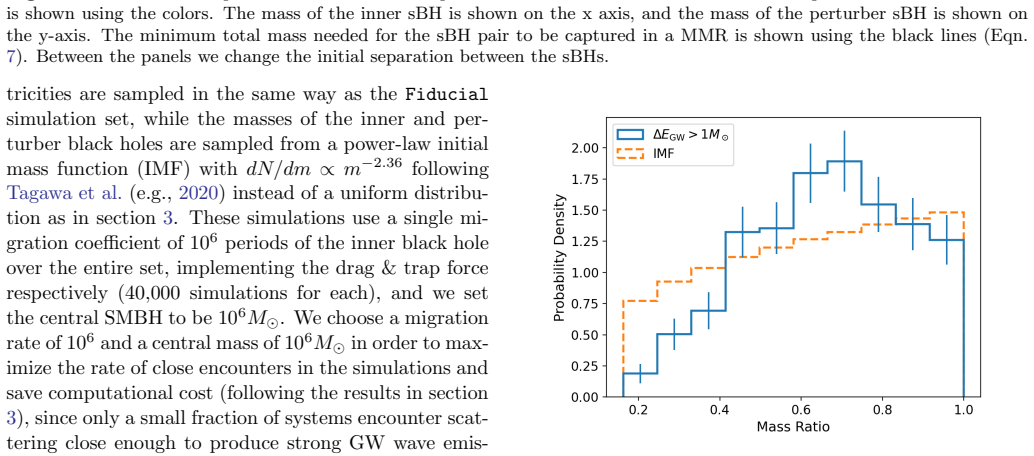
- Resonance capture splits the population by total sBH mass: pairs near 4:3, 5:4, and 6:5 resonances stay quiet, while pairs below the critical mass can produce strong bursts or mergers, producing alternating regions in the mass-ratio plane.
- The predicted flyby rate ($\sim 3\,\mathrm{Gpc}^{-3}\,\mathrm{yr}^{-1}$ fiducial) is comparable to or higher than the estimated AGN-disk merger rate, making flybys a competitive channel.
- Some simulated waveforms peak near $100\,\mathrm{Hz}$, within current detector bands, while others peak near $5\,\mathrm{Hz}$, making them targets for future low-frequency ground-based detectors.
Reading between the lines
- If resonance capture is a real gatekeeper, the chirp-mass distribution of detected AGN-disk bursts should show deficits at total masses corresponding to low-order resonances; looking for a resonant 'comb' in burst masses would test the mechanism independently of the rate.
- The same encounters produce repeated bursts with sub-second gaps (centered near $0.03$-$0.04\,\mathrm{s}$ for high-energy events), a distinctive time-frequency fingerprint that unmodeled burst searches could use to separate AGN-disk flybys from detector glitches.
- Replacing the assumed $10^3$ encounters per black hole with a self-consistent multi-body simulation of the migrating population would either firm up or rescale the rate estimate; this is a testable modeling improvement rather than a prediction.
- If the fiducial rate is near correct, AGN-disk flybys would add an impulsive, non-Gaussian foreground to the stochastic gravitational-wave background in the roughly $5$-$100\,\mathrm{Hz}$ band, separable from the merger background by its burst character.
Signed reviews
Editorial analysis
A structured set of objections, weighed in public.
Referee Report
Summary. The paper studies gravitational-wave (GW) bremsstrahlung from hyperbolic encounters of stellar-mass black holes (sBHs) embedded in AGN disks. The authors use N-body simulations with gas drag and migration-trap prescriptions, including 1PN and 2.5PN corrections, to characterize how close-encounter rates and GW emission depend on SMBH mass, migration rate, mutual inclination, and sBH masses. They identify first-order mean-motion resonances as a key suppression mechanism and derive an analytical criterion for resonance capture. They then run 80,000 population-synthesis simulations and convert the simulated bremsstrahlung fraction into a volumetric detection rate, quoting a fiducial rate of 3.2 Gpc^-3 yr^-1 and a range of 0.08-1194 Gpc^-3 yr^-1. Finally, they construct approximate GW templates from selected trajectories and evaluate their SNR against LIGO A+ sensitivity.
Significance. If the rate estimate were reliable, the paper would identify a new, potentially detectable GW burst channel from AGN disks and provide motivation for unmodeled burst searches. The parameter study is systematic and valuable: the finding that 1PN precession suppresses close encounters relative to 2.5PN-only runs is a useful correction to earlier treatments, and the mean-motion-resonance criterion (Eq. 7) is checked against simulations and works well. The paper is also transparent about several limitations, including simplified migration forces and the exclusion of disk turbulence. However, the headline rate is not established: the conversion from the simulated bremsstrahlung fraction to the per-BH encounter fraction used in the rate integral is internally inconsistent, the normalization of Eq. (9) is asserted without derivation, and the detection proxy used in the rate calculation is not a validated LIGO criterion. These issues affect the central quantitative claim of the paper.
major comments (3)
- [Section 4, Eq. (9) and following paragraph] The derivation of fBH,enc is internally inconsistent and not reproducible. The text states that NBH,NSC = 2e4, that 10% of these BHs are in the disk, and that 50% interact, concluding that 'each inner black hole will have ~10^3 encounters' and hence fBH,enc ~ 10^3 fbrem,BH. The arithmetic actually yields 10^3 total interacting BHs in the disk, not an encounter multiplicity per BH. Using the reported fbrem,drag(>1 Msun) = 0.0039 gives fBH,enc = 3.9, which is unphysical for a fraction. Inserting fBH,enc = 3.9 into Eq. (9) gives a fiducial rate of roughly 23 Gpc^-3 yr^-1, not the 3.2 Gpc^-3 yr^-1 reported in Table 2. The tabulated rate corresponds to fBH,enc ~ 0.5, indicating that the stated 10^3 scaling has not actually been applied. If the scaling is applied correctly via fBH,enc = 1 - exp(-N_enc fbrem,BH) with N_enc = 10^3, the fiducial rate would be about 5.9 Gpc^-3 yr^-1. The headline rate must be reconciled with a consistent, physically meaningful definition of fBH,enc.
- [Section 4, Eq. (9)] The normalization constant '3 Gpc^-3 yr^-1' in Eq. (9) is asserted without derivation. The text says the calculation follows Tagawa et al. (2020), but the cited work gives a broad merger-rate range (0.02-60 Gpc^-3 yr^-1), and no calculation is shown that turns that information into the point value 3. Because all subsequent rates scale linearly with this constant, the rate estimate is not self-contained. The authors should derive this normalization explicitly from the integral in Eq. (8), using an AGN number density and SMBH mass function, or identify it as a free parameter and propagate it as such.
- [Sections 3.1 and 4] The rates in Table 2 are quoted as 'detectable by LIGO' based on a peak GW energy threshold of >1 Msun or >3 Msun, with the statement 'assuming an observational distance of ~1 Mpc' (Section 3.1). This is not a validated detection criterion: no LIGO sensitivity curve, SNR threshold, or search duty cycle is folded into the population rate. The SNR calculations in Section 5.1 are performed for only four example events and are not used to derive a selection function. Consequently, the abstract's 'rate for ground-based gravitational-wave detections' is stronger than what the calculation actually supports. Either fold an SNR-based selection function into the rate calculation or revise the language to 'events emitting more than X Msun in GWs' rather than 'detectable events.'
minor comments (5)
- [Section 4, paragraph after Eq. (9)] The sentence 'each inner black hole will have ~10^3 encounters' is an unsupported interpretation; the preceding numbers give 10^3 total interacting BHs, not an encounter multiplicity per BH, and the encounter multiplicity is a separate quantity that should be modeled or measured.
- [Section 5.1] The term 'first-principle gravitational wave templates' overstates the method, since the paper itself lists the quadrupole spline approximation as a source of error; 'approximate quadrupole templates' would be more accurate.
- [Section 3.1] The close-encounter criterion is described as 'within 100Rg,1' in Section 2.3 but as 'within 50 times the sum of their gravitational radii' in Section 3.1; please specify which criterion is used for the population synthesis and the rates in Table 2.
- [References] The bibliography contains malformed or duplicated entries, including 'et al., B. P. A. 2016' and two entries for Abbott et al. 2016 with different DOIs; these need correction in production.
- [Figure 18] The sentence 'most of the gap time center around ~0.5 sec' should be reworded, e.g., 'most time gaps are centered around ~0.5 s.'
Circularity Check
No significant circularity: the simulation fraction is measured independently, and the rate estimate is a scaling calculation whose main problems are unsupported normalizations, not self-referential definitions.
full rationale
The paper's central quantitative inputs—fbrem,BH (0.39% for drag and 0.56% for trap at peak GW energy >1 M⊙) and the encounter properties—are measured from 80,000 REBOUNDx scattering runs and are not defined in terms of the final Gpc^-3 yr^-1 rate. The rate calculation (Section 4, Eqs. 8–9) follows the external Tagawa et al. (2020) scaling relation and inserts fBH,enc, which is derived from fbrem,BH times an assumed "~10^3 encounters" factor. This is a model-to-rate conversion, not a definitional identity: the rate is proportional to the simulated fraction, but it is not the same quantity under a new name. The MMR capture criterion (Eq. 7) is derived from equating the Hill-separation formula with the resonance condition, and the waveform templates (Section 5.1) are quadrupole-approximation calculations from simulated trajectories, with the paper explicitly conceding that the "first-principle" templates use a simplified quadrupole moment and omit higher-order multipoles and relativistic corrections. The main legitimate concerns are correctness and normalization, not circularity: the 10^3 factor is asserted from the 10%/50% assumptions, fBH,enc ~ 10^3 fbrem,BH would exceed unity for the stated fbrem,BH, and plugging that fBH,enc into Eq. 9 does not reproduce Table 2's 3.2 Gpc^-3 yr^-1. These are internal-consistency and support problems in the rate estimate, but they do not make the derivation equivalent to its inputs by construction, and no load-bearing self-citation chain is present. Accordingly, no circular step is exhibited.
Assumptions & free parameters
free parameters (3)
- Rate normalization R0 in Eq. 9 =
~3 Gpc^-3 yr^-1
- Encounters per black hole N_enc =
10^3
- Detection proxy threshold =
peak GW energy > 1 M_sun at ~1 Mpc
assumptions (4)
- standard math The quadrupole formula (Eq. 11) gives the GW strain for the simulated trajectories.
- domain assumption The migration forces in Eqs. 3 and 4 (drag and trap) represent the gas dynamical effect in AGN disks.
- domain assumption The rate framework of Tagawa et al. (2020), Eq. 8, applies to bremsstrahlung events as well as mergers.
- domain assumption Mean motion resonance capture determines whether a BH pair avoids close encounters.
Cite this review
Pith. "Pith review of Scattering of stellar-mass black holes and gravitational wave bremsstrahlung radiation in AGN disks." pith.science (2026). https://pith.science/paper/JWSX6OI6
@misc{pith2026250416457,
  author       = {Pith},
  title        = {Pith review of: Scattering of stellar-mass black holes and gravitational wave bremsstrahlung radiation in AGN disks},
  year         = {2026},
  howpublished = {\url{https://pith.science/paper/JWSX6OI6}},
  note         = {Machine review of arXiv:2504.16457}
}
abstract
Dynamics of stellar mass black holes (sBHs) embedded in active galactic nuclei (AGNs) could produce highly eccentric orbits near the central supermassive black hole, leading to repeated close encounters that emit gravitational waves in the LIGO frequency band. Many works have focused on the mergers of sBH in the disk that produce gravitational waves; however, sBHs in hyperbolic orbits also emit gravitational-wave \bremss{} that can be detected by ground-based interferometers like LIGO. In this work, we analyze the scattering of sBHs in an AGN disk as they migrate inside the disk, focusing on gravitational-wave \bremss{} emission. We determine how the gravitational-wave emission depends on the different parameters of the scattering experiments, such as the mass of the supermassive black hole and the sBH migration rate and mass ratio. We find that scattering with detectable gravitational-wave \bremss{} is more frequent around lower mass SMBHs ($\sim 10^{5-6}$M$_\odot$). We then conduct a suite of Monte Carlo simulations and estimated the rate for ground-based gravitational-wave detections to be in the range of 0.08 - 1194 $\text{Gpc}^{-3} \text{ yr}^{-1}$, depending on migration forces and detection thresholds, with large uncertainties accounting for variations in possible AGN environments. The expected rate for our {\tt Fiducial} parameters is 3.2 $\text{Gpc}^{-3} \text{ yr}^{-1}$. Finally, we provide first-principle gravitational wave templates produced by the encounters.
Figures


Figures from the paper (11 more)




Forward citations
Cited by 1 Pith paper
-
Parameter estimation of gravitational waves from hyperbolic black hole encounters
RIFT can recover the masses, spins, and orbital energy and angular momentum of simulated hyperbolic black hole encounters when paired with the TEOBResumSDALI waveform model.
Reference graph
Works this paper leans on
-
[1]
, " * write output.state after.block = add.period write newline
ENTRY address archivePrefix author booktitle chapter doi edition editor eprint howpublished institution journal key month number organization pages publisher school series title misctitle type volume year version url label extra.label sort.label short.list INTEGERS output.state before.all mid.sentence after.sentence after.block FUNCTION init.state.consts ...
-
[2]
write newline
" write newline "" before.all 'output.state := FUNCTION format.url url empty "" new.block "" url * "" * if FUNCTION format.eprint eprint empty "" archivePrefix empty "" archivePrefix "arXiv" = new.block " " eprint * " " * new.block " " eprint * " " * if if if FUNCTION format.doi doi empty "" " " doi * " " * if FUNCTION format.pid doi empty eprint empty ur...
-
[3]
:|稷BQ NV q+R_A. q OJK k?2cSEQV ޏ悐u b 4c1 FNl4cBk@d PCE1F[f
thebibliography [1] 20pt to REFERENCES 6pt =0pt -12pt 10pt plus 3pt =0pt =0pt =1pt plus 1pt =0pt =0pt -12pt =13pt plus 1pt =20pt =13pt plus 1pt \@M =10000 =-1.0em =0pt =0pt 0pt =0pt =1.0em @enumiv\@empty 10000 10000 `\.\@m \@noitemerr \@latex@warning Empty `thebibliography' environment \@ifnextchar \@reference \@latexerr Missing key on reference command E...
arXiv 2021
-
[4]
Abbott, B. P., et al. 2016, Living Rev. Rel., 19, 1, 10.1007/s41114-020-00026-9
-
[5]
---. 2019, Phys. Rev. X, 9, 031040, 10.1103/PhysRevX.9.031040
-
[6]
Abbott, R., et al. 2021 a . 2111.03606
arXiv 2021
-
[7]
---. 2021 b , Phys. Rev. D, 103, 122002, 10.1103/PhysRevD.103.122002
-
[8]
---. 2021 c . 2112.06861
arXiv 2021
Show all 108 references
- [9]
- [10]
- [11]
-
[12]
2023, Astrophys
Agazie, G., et al. 2023, Astrophys. J. Lett., 951, L8, 10.3847/2041-8213/acdac6
2023 doi
-
[13]
Antonini, F., Toonen, S., & Hamers, A. S. 2017, The Astrophysical Journal, 841, 77, 10.3847/1538-4357/aa6f5e
2017 doi
-
[14]
Artymowicz , P., Lin , D. N. C., & Wampler , E. J. 1993, , 409, 592, 10.1086/172690
1993 doi
-
[15]
2017, mnras, 464, L36, 10.1093/mnrasl/slw177
Askar, A., Szkudlarek, M., Gondek-Rosińska, D., Giersz, M., & Bulik, T. 2017, mnras, 464, L36, 10.1093/mnrasl/slw177
2017 doi
-
[16]
Bae, Y.-B., Hyun, Y.-H., & Kang, G. 2023. 2310.18686
2023 arXiv
-
[17]
M., & Kang, G
Bae, Y.-B., Lee, H. M., & Kang, G. 2020, Astrophys. J., 900, 175, 10.3847/1538-4357/aba82b
2020 doi
- [19]
-
[20]
2017, Monthly Notices of the Royal Astronomical Society, 467, 524, 10.1093/mnras/stw3392
Banerjee, S. 2017, Monthly Notices of the Royal Astronomical Society, 467, 524, 10.1093/mnras/stw3392
2017 doi
-
[21]
S., Fragos, T., Qin, Y., et al
Bavera, S. S., Fragos, T., Qin, Y., et al. 2020, åp, 635, A97, 10.1051/0004-6361/201936204
2020 doi
-
[22]
E., Bulik, T., & O'Shaughnessy, R
Belczynski, K., Holz, D. E., Bulik, T., & O'Shaughnessy, R. 2016, Nature, 534, 512, 10.1038/nature18322
2016 doi
-
[23]
2018, Astronomy and Astrophysics, 615, A91, 10.1051/0004-6361/201732428
Belczynski, K., Askar, A., Arca-Sedda, M., et al. 2018, Astronomy and Astrophysics, 615, A91, 10.1051/0004-6361/201732428
2018 doi
-
[24]
M., Mac Low , M.-M., McKernan , B., & Ford , K
Bellovary , J. M., Mac Low , M.-M., McKernan , B., & Ford , K. E. S. 2016, , 819, L17, 10.3847/2041-8205/819/2/L17
2016 doi
-
[25]
G., Li , G., & Lin , D
Bhaskar , H. G., Li , G., & Lin , D. N. C. 2022, , 934, 141, 10.3847/1538-4357/ac7b26
2022 doi
-
[26]
2024, Phys
Bini, S., Tiwari, S., Xu, Y., et al. 2024, Phys. Rev. D, 109, 042009, 10.1103/PhysRevD.109.042009
2024 doi
-
[27]
2006, Living Reviews in Relativity, 9, 4, 10.12942/lrr-2006-4
Blanchet , L. 2006, Living Reviews in Relativity, 9, 4, 10.12942/lrr-2006-4
2006 doi
-
[28]
2014, Living Reviews in Relativity, 17
Blanchet, L. 2014, Living Reviews in Relativity, 17. https://doi.org/10.12942/lrr-2014-2
2014 doi
-
[29]
Boekholt , T. C. N., Rowan , C., & Kocsis , B. 2023, , 518, 5653, 10.1093/mnras/stac3495
2023 doi
-
[30]
2008, Astropart
Capozziello, S., & De Laurentis, M. 2008, Astropart. Phys., 30, 105, 10.1016/j.astropartphys.2008.07.005
2008 doi
-
[31]
Cho, G., Gopakumar, A., Haney, M., & Lee, H. M. 2018, Phys. Rev. D, 98, 024039, 10.1103/PhysRevD.98.024039
2018 doi
-
[32]
A., & Yang, Z
Cho, G., Porto, R. A., & Yang, Z. 2022, Phys. Rev. D, 106, L101501, 10.1103/PhysRevD.106.L101501
2022 doi
-
[33]
J., & Littenberg, T
Cornish, N. J., & Littenberg, T. B. 2015, Class. Quant. Grav., 32, 135012, 10.1088/0264-9381/32/13/135012
2015 doi
-
[34]
J., Littenberg, T
Cornish, N. J., Littenberg, T. B., B\'ecsy, B., et al. 2021, Phys. Rev. D, 103, 044006, 10.1103/PhysRevD.103.044006
2021 doi
-
[35]
J., Alexander , R
Cuadra , J., Armitage , P. J., Alexander , R. D., & Begelman , M. C. 2009, , 393, 1423, 10.1111/j.1365-2966.2008.14147.x
2009
-
[36]
2014, Phys
Damour, T., Guercilena, F., Hinder, I., et al. 2014, Phys. Rev. D, 89, 081503, 10.1103/PhysRevD.89.081503
2014 doi
-
[37]
2023, Phys
Damour, T., & Rettegno, P. 2023, Phys. Rev. D, 107, 064051, 10.1103/PhysRevD.107.064051
2023 doi
-
[38]
2023, Phys
Dandapat, S., Ebersold, M., Susobhanan, A., et al. 2023, Phys. Rev. D, 108, 024013, 10.1103/PhysRevD.108.024013
2023 doi
-
[39]
N., Giacobbo, N., Mapelli, M., et al
Di Carlo, U. N., Giacobbo, N., Mapelli, M., et al. 2019, mnras, 487, 2947, 10.1093/mnras/stz1453
2019 doi
-
[40]
2012, The Astrophysical Journal, 759, 52, 10.1088/0004-637X/759/1/52
Dominik, M., Belczynski, K., Fryer, C., et al. 2012, The Astrophysical Journal, 759, 52, 10.1088/0004-637X/759/1/52
2012 doi
-
[41]
Drago, M., et al. 2020. 2006.12604
2020 arXiv
-
[42]
et al., B. P. A. 2016, Physical Review Letters, 116, 061102, 10.1103/PhysRevLett.116.061102
2016 doi
-
[43]
Evans, M., et al. 2021. 2109.09882
2021 arXiv
-
[44]
2010, Class
Favata, M. 2010, Class. Quant. Grav., 27, 084036, 10.1088/0264-9381/27/8/084036
2010 doi
-
[45]
Generozov , A., & Perets , H. B. 2023, , 522, 1763, 10.1093/mnras/stad1016
2023 doi
-
[46]
2021, Nature Astronomy, 5, 749, 10.1038/s41550-021-01398-w
Gerosa , D., & Fishbach , M. 2021, Nature Astronomy, 5, 749, 10.1038/s41550-021-01398-w
2021 doi
-
[47]
A., et al
Ghonge, S., Chatziioannou, K., Clark, J. A., et al. 2020, Phys. Rev. D, 102, 064056, 10.1103/PhysRevD.102.064056
2020 doi
-
[48]
2018, mnras, 474, 2959, 10.1093/mnras/stx2933
Giacobbo, N., Mapelli, M., & Spera, M. 2018, mnras, 474, 2959, 10.1093/mnras/stx2933
2018 doi
-
[49]
1993, , 106, 247, 10.1006/icar.1993.1169
Gladman , B. 1993, , 106, 247, 10.1006/icar.1993.1169
1993
-
[50]
1979, , 233, 857, 10.1086/157448
Goldreich , P., & Tremaine , S. 1979, , 233, 857, 10.1086/157448
1979 doi
-
[51]
J., Ford , K
Graham , M. J., Ford , K. E. S., McKernan , B., et al. 2020, , 124, 251102, 10.1103/PhysRevLett.124.251102
2020 doi
-
[52]
P., & Burns, J
Hamilton, D. P., & Burns, J. A. 1992, Icarus, 96, 43, https://doi.org/10.1016/0019-1035(92)90005-R
1992 doi
-
[53]
Hansen, R. O. 1972, Post-Newtonian Gravitational Radiation from Point Masses in a Hyperbolic Kepler Orbit*
1972
-
[54]
2009, Phys
Healy, J., Levin, J., & Shoemaker, D. 2009, Phys. Rev. Lett., 103, 131101, 10.1103/PhysRevLett.103.131101
2009 doi
-
[56]
A., & Dosopoulou , F
Hoang , B.-M., Naoz , S., Kocsis , B., Rasio , F. A., & Dosopoulou , F. 2018, , 856, 140, 10.3847/1538-4357/aaafce
2018 doi
-
[57]
Hopper, S., Nagar, A., & Rettegno, P. 2022. 2204.10299
2022 arXiv
-
[58]
B., Littenberg , T
Kanner , J. B., Littenberg , T. B., Cornish , N., et al. 2016, , 93, 022002, 10.1103/PhysRevD.93.022002
2016 doi
-
[59]
F., Meiron , Y., Shukirgaliyev , B., et al
Kennedy , G. F., Meiron , Y., Shukirgaliyev , B., et al. 2016, , 460, 240, 10.1093/mnras/stw908
2016 doi
-
[60]
2014, Monthly Notices of the Royal Astronomical Society, 442, 2963, 10.1093/mnras/stu1022
Kinugawa, T., Inayoshi, K., Hotokezaka, K., Nakauchi, D., & Nakamura, T. 2014, Monthly Notices of the Royal Astronomical Society, 442, 2963, 10.1093/mnras/stu1022
2014 doi
-
[61]
E., & Márka, S
Kocsis, B., Gáspár, M. E., & Márka, S. 2006, The Astrophysical Journal, 648, 411, 10.1086/505641
2006 doi
-
[62]
Kormendy , J., & Ho , L. C. 2013, , 51, 511, 10.1146/annurev-astro-082708-101811
2013 doi
- [63]
-
[64]
Leigh , N. W. C., Geller , A. M., McKernan , B., et al. 2018, , 474, 5672, 10.1093/mnras/stx3134
2018 doi
-
[65]
2009, Phys
Levin, J., & Grossman, B. 2009, Phys. Rev. D, 79, 043016, 10.1103/PhysRevD.79.043016
2009 doi
-
[66]
2014, , 785, 116, 10.1088/0004-637X/785/2/116
Li , G., Naoz , S., Kocsis , B., & Loeb , A. 2014, , 785, 116, 10.1088/0004-637X/785/2/116
2014 doi
-
[67]
2022, The Astrophysical Journal, 934, 154, 10.3847/1538-4357/ac7c0d
Li, J., Lai, D., & Rodet, L. 2022, The Astrophysical Journal, 934, 154, 10.3847/1538-4357/ac7c0d
2022 doi
- [68]
-
[69]
2020, JCAP, 03, 050, 10.1088/1475-7516/2020/03/050
Maggiore, M., et al. 2020, JCAP, 03, 050, 10.1088/1475-7516/2020/03/050
2020 doi
-
[70]
McKernan , B., Ford , K. E. S., Lyra , W., & Perets , H. B. 2012, , 425, 460, 10.1111/j.1365-2966.2012.21486.x
2012
-
[71]
McKernan , B., Ford , K. E. S., Bellovary , J., et al. 2018, , 866, 66, 10.3847/1538-4357/aadae5
2018 doi
-
[72]
McKernan , B., Ford , K. E. S., Bartos , I., et al. 2019, , 884, L50, 10.3847/2041-8213/ab4886
2019 doi
-
[73]
2022, Phys
Morr\'as, G., Garc\' a-Bellido, J., & Nesseris, S. 2022, Phys. Dark Univ., 35, 100932, 10.1016/j.dark.2021.100932
2022
-
[74]
2021, Monthly Notices of the Royal Astronomical Society, 508, 5064, 10.1093/mnras/stab2721
Mukherjee, S., Mitra, S., & Chatterjee, S. 2021, Monthly Notices of the Royal Astronomical Society, 508, 5064, 10.1093/mnras/stab2721
2021 doi
-
[75]
1995, Orbital Mechanics for Engineering Students (Butterworth-Heinemann)
Murphy, H. 1995, Orbital Mechanics for Engineering Students (Butterworth-Heinemann)
1995
- [76]
-
[77]
S., Fabj , G., Caban , F., et al
Nasim , S. S., Fabj , G., Caban , F., et al. 2023, , 522, 5393, 10.1093/mnras/stad1295
2023 doi
-
[78]
M., Kocsis, B., & Loeb, A
O'Leary, R. M., Kocsis, B., & Loeb, A. 2009, Mon. Not. Roy. Astron. Soc., 395, 2127, 10.1111/j.1365-2966.2009.14653.x
2009
-
[79]
M., Rasio, F
O'Leary, R. M., Rasio, F. A., Fregeau, J. M., Ivanova, N., & O'Shaughnessy, R. 2006, apj, 637, 937, 10.1086/498446
2006 doi
-
[80]
J., Annis , J., & Liu , X
Palmese , A., Fishbach , M., Burke , C. J., Annis , J., & Liu , X. 2021, , 914, L34, 10.3847/2041-8213/ac0883
2021 doi
-
[81]
2021, , 505, 1324, 10.1093/mnras/stab1419
Peng , P., & Chen , X. 2021, , 505, 1324, 10.1093/mnras/stab1419
2021 doi
-
[82]
Peters, P. C. 1964, Phys. Rev., 136, B1224, 10.1103/PhysRev.136.B1224
1964 doi
-
[83]
Poisson, E., & Will, C. M. 2014, Gravity: Newtonian, Post-Newtonian, Relativistic (Cambridge University Press). https://doi.org/10.1017/CBO9780511975663
2014 doi
-
[84]
H., Teukolsky, S
Press, W. H., Teukolsky, S. A., Vetterling, W. T., & Flannery, B. P. 1986, Numerical Recipes: The Art of Scientific Computing (Cambridge University Press)
1986
-
[85]
D., & Shapiro, S
Quinlan, G. D., & Shapiro, S. L. 1989, DYNAMICAL EVOLUTION OF DENSE CLUSTERS OF COMPACT STARS
1989
-
[86]
2022, Phys
Ramos-Buades, A., Buonanno, A., Khalil, M., & Ossokine, S. 2022, Phys. Rev. D, 105, 044035, 10.1103/PhysRevD.105.044035
2022 doi
-
[87]
Rein , H., & Liu , S. F. 2012, , 537, A128, 10.1051/0004-6361/201118085
2012 doi
-
[88]
L., Chatterjee, S., & Rasio, F
Rodriguez, C. L., Chatterjee, S., & Rasio, F. A. 2016, prd, 93, 084029, 10.1103/PhysRevD.93.084029
2016 doi
-
[89]
2023, , 524, 2770, 10.1093/mnras/stad1926
Rowan , C., Boekholt , T., Kocsis , B., & Haiman , Z. 2023, , 524, 2770, 10.1093/mnras/stad1926
2023 doi
-
[90]
Rozner , M., Generozov , A., & Perets , H. B. 2023, , 521, 866, 10.1093/mnras/stad603
2023 doi
-
[91]
2014, The Astrophysical Journal, 784, 71, 10.1088/0004-637X/784/1/71
Samsing, J., MacLeod, M., & Ramirez-Ruiz, E. 2014, The Astrophysical Journal, 784, 71, 10.1088/0004-637X/784/1/71
2014 doi
-
[92]
J., et al
Samsing , J., Bartos , I., D'Orazio , D. J., et al. 2022, , 603, 237, 10.1038/s41586-021-04333-1
2022 doi
-
[93]
Schumaker, L. L. 1994, Mathematics of Computation, 63, 427. http://www.jstor.org/stable/2153590
1994
-
[94]
M., et al
Secunda, A., Bellovary, J., Low, M.-M. M., et al. 2019, The Astrophysical Journal, 878, 85, 10.3847/1538-4357/ab20ca
2019 doi
-
[95]
2020, The Astrophysical Journal, 903, 133, 10.3847/1538-4357/abbc1d
---. 2020, The Astrophysical Journal, 903, 133, 10.3847/1538-4357/abbc1d
2020 doi
-
[96]
2017, apj, 836, 39, 10.3847/1538-4357/aa5729
Silsbee, K., & Tremaine, S. 2017, apj, 836, 39, 10.3847/1538-4357/aa5729
2017 doi
-
[97]
2019, mnras, 485, 889, 10.1093/mnras/stz359
Spera, M., Mapelli, M., Giacobbo, N., et al. 2019, mnras, 485, 889, 10.1093/mnras/stz359
2019 doi
-
[98]
C., Metzger , B
Stone , N. C., Metzger , B. D., & Haiman , Z. 2017, , 464, 946, 10.1093/mnras/stw2260
2017 doi
-
[99]
2021, Phys
Szczepa\'nczyk, M., et al. 2021, Phys. Rev. D, 103, 082002, 10.1103/PhysRevD.103.082002
2021 doi
-
[100]
2020, , 898, 25, 10.3847/1538-4357/ab9b8c
Tagawa , H., Haiman , Z., & Kocsis , B. 2020, , 898, 25, 10.3847/1538-4357/ab9b8c
2020 doi
-
[101]
Thorne, K. S. 1992, Phys. Rev. D, 45, 520, 10.1103/PhysRevD.45.520
1992 doi
-
[102]
2002, The Astrophysical Journal, 578, 345, 10.1086/342118
---. 2002, The Astrophysical Journal, 578, 345, 10.1086/342118
2002 doi
- [103]
-
[104]
Vallado, D. A. 2007, Fundamentals of Astrodynamics and Applications (Springer)
2007
- [105]
-
[106]
1998, , 298, 53, 10.1046/j.1365-8711.1998.01564.x
Vokrouhlicky , D., & Karas , V. 1998, , 298, 53, 10.1046/j.1365-8711.1998.01564.x
1998
- [107]
-
[108]
2023, Astropart
Wette, K. 2023, Astropart. Phys., 153, 102880, 10.1016/j.astropartphys.2023.102880
2023
-
[109]
2019, , 123, 181101, 10.1103/PhysRevLett.123.181101
Yang , Y., Bartos , I., Gayathri , V., et al. 2019, , 123, 181101, 10.1103/PhysRevLett.123.181101
2019 doi
-
[110]
B., & Polnarev, A
Zel'dovich, Y. B., & Polnarev, A. G. 1974, Sov. Astron., 18, 17
1974
Reviewed August 16, 2026 · model on record in the stance chip above.
Discussion (0). Continue with ORCID to comment.