Containerizing BIDSme : A Reproducible Tool for BIDS Conversion
Pith reviewed 2026-06-27 14:36 UTC · model grok-4.3
The pith
Containerizing BIDSme with Docker makes the neuroimaging data conversion tool portable and reproducible.
A machine-rendered reading of the paper's core claim, the machinery that carries it, and where it could break.
Core claim
Packaging BIDSme into Docker containers with Docker Compose produces a portable, reproducible, and user-friendly application that preserves the original tool's semi-automated conversion of raw neuroimaging data into BIDS format while enabling easier integration into existing platforms like Neurodesk.
What carries the argument
Docker and Docker Compose containerization, which bundles BIDSme and its dependencies for consistent execution across environments.
If this is right
- Users can execute BIDSme conversions without complex local software installations.
- BIDS conversion results become reproducible across different operating systems and hardware.
- The tool integrates directly into platforms such as Neurodesk for streamlined workflows.
- Iterative refinements produce a lightweight container that remains flexible for varied use cases.
Where Pith is reading between the lines
- The same container approach could extend to other semi-automated neuroimaging conversion tools facing adoption barriers.
- Standardized container access might reduce variability in how different research groups prepare BIDS datasets.
- Embedding validation scripts inside the container could enable automated checks of output quality during conversion.
Load-bearing premise
The containerized version preserves the full functionality and exact behavior of the original BIDSme tool without compatibility problems.
What would settle it
Running identical raw neuroimaging datasets through both the original BIDSme and the containerized version, then comparing the resulting BIDS folder structures and metadata files for any differences.
Figures
read the original abstract
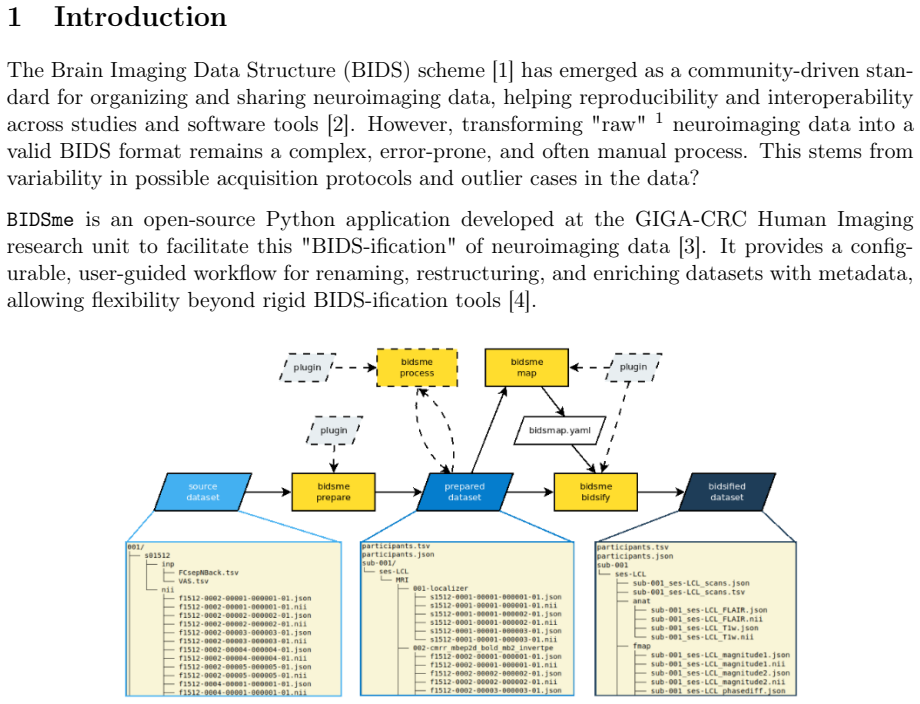
The "Brain Imaging Data Structure" (BIDS) has become a widely adopted standard for organizing and sharing neuroimaging datasets of various modalities. However, converting raw brain imaging data into BIDS framework remains a complex and time-consuming task. BIDSme is a semi-automated tool developed to streamline this conversion process, but until recently, it lacked the portability and accessibility needed for widespread adoption. This paper presents the containerization of BIDSme using Docker and Docker Compose, improving usability, reproducibility, and integration into existing platforms like Neurodesk. It also details the design choices, iterative refinements, and validation process that led to a flexible, lightweight, and user-friendly containerized application.
Editorial analysis
A structured set of objections, weighed in public.
Referee Report
Summary. The manuscript describes the containerization of BIDSme, a semi-automated tool for converting raw neuroimaging data to the BIDS standard, using Docker and Docker Compose. It covers the design choices, iterative refinements, and validation process that produced a flexible, lightweight containerized application with improved usability, reproducibility, and integration into platforms such as Neurodesk.
Significance. If the containerized version preserves full original functionality while delivering the stated gains in portability and ease of use, the work would lower practical barriers to BIDS adoption in neuroimaging by enabling reproducible data-conversion workflows across diverse computing environments.
major comments (1)
- [validation process] The validation process (described in the abstract and presumably detailed in the methods/results sections) is presented only narratively; no quantitative metrics, test-dataset success rates, error analysis, or before/after comparisons are supplied to support the claims of improved usability and reproducibility.
minor comments (2)
- Provide explicit links to the public Dockerfiles, compose files, and any test data in the manuscript so that readers can reproduce the container exactly as described.
- Clarify the precise host-system prerequisites (e.g., Docker version, GPU support) required for the Neurodesk integration example.
Simulated Author's Rebuttal
We thank the referee for the positive summary and the recommendation of minor revision. The single major comment is addressed point-by-point below.
read point-by-point responses
-
Referee: [validation process] The validation process (described in the abstract and presumably detailed in the methods/results sections) is presented only narratively; no quantitative metrics, test-dataset success rates, error analysis, or before/after comparisons are supplied to support the claims of improved usability and reproducibility.
Authors: We agree that the validation section would be strengthened by quantitative evidence. In the revised manuscript we will add: (i) success rates on a curated set of test neuroimaging datasets (raw DICOM and NIfTI files from multiple modalities), (ii) a brief error analysis of the few conversion failures encountered, and (iii) before/after comparisons of setup time and number of manual steps required. These additions will appear in the Methods and Results sections and will be supported by a supplementary table. revision: yes
Circularity Check
No significant circularity
full rationale
The paper is a purely descriptive engineering report on Docker containerization of the existing BIDSme tool. It contains no equations, fitted parameters, predictions, uniqueness theorems, or derivation chains of any kind. The central claim (successful containerization with improved usability and reproducibility) is advanced through narrative description of design choices and iterative validation, with no load-bearing step that reduces to a self-citation, ansatz, or input-by-construction. This is self-contained software packaging work with no opportunity for the enumerated circularity patterns.
Axiom & Free-Parameter Ledger
Reference graph
Works this paper leans on
-
[1]
The Brain Imaging Data Structure, a Format for Organizing and Describing Outputs of Neuroimaging Experiments,
K. J. Gorgolewski, T. Auer, V. D. Calhoun, R. C. Craddock, S. Das, E. P. Duff, G. Flandin, S. S. Ghosh, T. Glatard, Y. O. Halchenko, D. A. Handwerker, M. Hanke, D. Keator, X. Li, Z. Michael, C. Maumet, B. N. Nichols, T. E. Nichols, J. Pellman, J.-B. Poline, A. Rokem, G. Schaefer, V. Sochat, W. Triplett, J. A. Turner, G. Varoquaux, and R. A. Poldrack, “The...
2016
-
[2]
The past, present, and future of the brain imaging data structure (BIDS),
R. A. Poldrack, C. J. Markiewicz, S. Appelhoff, Y. K. Ashar, T. Auer, S. Baillet, S. Bansal, L. Beltrachini, C. G. Benar, G. Bertazzoli, S. Bhogawar, R. W. Blair, M. Bortoletto, M. Boudreau, T. L. Brooks, V. D. Calhoun, F. M. Castelli, P. Clement, A. L. Cohen, J. Cohen-Adad, S. D’Ambrosio, G. de Hollander, M. de la Iglesia-Vayá, A. de la Vega, A. Delorme,...
-
[3]
Beliy, G
N. Beliy, G. Hammad, and C. Phillips, “BIDSme.” [Online]. Available: https: //github.com/CyclotronResearchCentre/BIDSme
-
[4]
BIDSme: Expandable BIDS-ifier of Brain Imagery Datasets,
N. Beliy, C. Guillemin, E. Pommier, G. Hammad, and C. Phillips, “BIDSme: Expandable BIDS-ifier of Brain Imagery Datasets,”Journal of Open Source Software, vol. 8, no. 92, p. 5575, Dec. 2023
2023
-
[5]
Docker: lightweight linux containers for consistent development and deploy- ment,
D. Merkel, “Docker: lightweight linux containers for consistent development and deploy- ment,”Linux journal, vol. 2014, no. 239, p. 2, 2014. 11
2014
-
[6]
A. I. Renton, T. T. Dao, T. Johnstone, O. Civier, R. P. Sullivan, D. J. White, P. Lyons, B. M. Slade, D. F. Abbott, T. J. Amos, S. Bollmann, A. Botting, M. E. J. Campbell, J. Chang, T. G. Close, M. Dörig, K. Eckstein, G. F. Egan, S. Evas, G. Flandin, K. G. Garner, M. I. Garrido, S. S. Ghosh, M. Grignard, Y. O. Halchenko, A. J. Hannan, A. S. Heinsfeld, L. ...
-
[7]
BIDSme tutorial
N. Beliy, “BIDSme tutorial.” [Online]. Available: https://github.com/ CyclotronResearchCentre/bidsme_tutorial
-
[8]
BIDSme example dataset
——, “BIDSme example dataset.” [Online]. Available: https://github.com/ CyclotronResearchCentre/bidsme_examples
-
[9]
Jupyter Notebooks – a publishing format for reproducible computational workflows,
T. Kluyver, B. Ragan-Kelley, F. Pérez, B. Granger, M. Bussonnier, J. Frederic, K. Kelley, J. Hamrick, J. Grout, S. Corlay, P. Ivanov, D. Avila, S. Abdalla, and C. Willing, “Jupyter Notebooks – a publishing format for reproducible computational workflows,” inPosition- ing and Power in Academic Publishing: Players, Agents and Agendas, F. Loizides and B. Sch...
2016
-
[10]
Data Structures for Statistical Computing in Python,
Wes McKinney, “Data Structures for Statistical Computing in Python,” inProceedings of the 9th Python in Science Conference, Stéfan van der Walt and Jarrod Millman, Eds., 2010, pp. 56 – 61
2010
-
[11]
pyparsing: A Python parsing module,
P. T. McGuire, “pyparsing: A Python parsing module,” GitHub, 2024, version 3.1.2. [Online]. Available: https://github.com/pyparsing/pyparsing
2024
-
[12]
nipy/nibabel: NiBabel Release 5.3.1,
M. Brett, C. Markiewicz, J. Millman, S. Ghosh, G. Varoquaux, O. Esteban, F. Peréz-García, F. Morency, and C. Burns, “nipy/nibabel: NiBabel Release 5.3.1,” Oct 2024. [Online]. Available: https://nipy.org/nibabel/
2024
-
[13]
SU-E-T-33: pydicom: an open source DICOM library,
D. Mason, “SU-E-T-33: pydicom: an open source DICOM library,”Medical Physics, vol. 38, no. 6, p. 3493, 2011
2011
-
[14]
The first step for neuroimaging data analysis: DICOM to NIfTI conversion,
X. Li, P. S. Morgan, J. Ashburner, J. Smith, and C. Rorden, “The first step for neuroimaging data analysis: DICOM to NIfTI conversion,”Journal of Neuroscience Methods, vol. 264, pp. 47–56, 2016
2016
-
[15]
DCM-parser: A Lightning DICOM Parser,
L. Peng, “DCM-parser: A Lightning DICOM Parser,” https://github.com/PL97/DICOM_ Parser, 2022
2022
-
[16]
BIDSme Containerization Project
B. Spitz, N. Beliy, and C. Phillips, “BIDSme Containerization Project.” [Online]. Available: https://github.com/CyclotronResearchCentre/BIDSme_containerisation 12
discussion (0)
Sign in with ORCID, Apple, or X to comment. Anyone can read and Pith papers without signing in.