REVIEW 3 major objections 5 minor 17 references
Gbake: Baking 3D Gaussian Splats into Reflection Probes
T0 review · 3 major / 5 minor · reviewed 2026-08-06 · deepseek-v4-flash
Pith's one-line read The paper introduces GBake, which converts 3D Gaussian Splatting scenes into grids of ray-traced reflection probes so that ordinary meshes in Unity can show realistic reflections of the splatted environment.
desk verdict A small, honest engineering contribution: baking 3DGS scenes into reflection probes via 3DGRT to avoid splatting seams, but the evaluation is qualitative and the probe-grid parameters are unexamined. read the letter →
The pith
A machine-rendered reading of the paper's core claim, the machinery that carries it, and where it could break.
The reading
What carries the argument
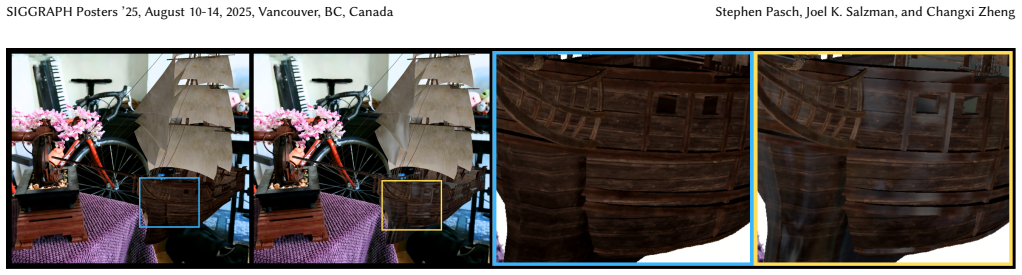
The central object is a ray-traced cubemap reflection probe: a point in space from which six perspective views are rendered along the coordinate axes with a 90-degree field of view and composited into a cube environment map. The load-bearing mechanism is 3D Gaussian ray tracing, which computes each pixel color by volume rendering along a ray with a maximum-opacity intersection model, so identical ray origins and directions always give identical colors. This orientation independence is what removes the seam discontinuities that occur when EWA splatting approximates Gaussian footprints differently for the two cameras meeting at a cube edge. A grid of such probes, with artist-controlled overlap, is the data structure that encodes spatially varying incident radiance for mesh relighting.
What would settle it
Render a small, highly specular sphere inside a splatted scene with a point light placed midway between two probes instead of at a probe; if GBake's interpolated reflections fail to show the light's bright highlight, the finite-probe representation is insufficient for high-frequency lighting. A metric version would compare the baked probe interpolation against a full reference render of the same scene at the mesh location.
Extended reading notes
Core claim
GBake places a regular grid of cubemap reflection probes inside a user-defined bounding volume, renders the six axis-aligned faces of each probe by ray tracing the 3D Gaussian scene, and exports the cubemaps with their spatial locations so Unity can interpolate between influence zones. The central discovery is that ray-traced baking, unlike splatting-based baking, yields cubemap faces that agree at their shared edges, because the maximum-opacity volume rendering used for a ray is independent of camera orientation, whereas EWA splatting's approximation error depends on each camera's polar angles. The resulting probe grid captures spatially varying incident lighting and supports plausible reflections on specular and diffuse-specular meshes.
Load-bearing premise
The load-bearing assumption is that a finite grid of cubemap probes with artist-chosen spacing and overlap can represent all the incident light that a mesh needs for convincing reflections; if a small bright light sits between two probes, interpolation misses it.
Editorial extensions
If this is right
- Artists can insert mirrors, chrome objects, and other specular meshes into Gaussian-splatted scenes in Unity and have them reflect the surrounding splatted environment.
- Reflection quality no longer requires converting the splat scene to an explicit surface; the environment map itself carries the appearance information.
- Because probes are baked once, runtime reflection costs remain free of the 3DGS renderer, limited only by standard Unity reflection-probe interpolation.
- The seam-free property of ray-traced baking makes cubemap-based environment maps reliable for any six-face cube orientation.
- Baking time is short enough for interactive iteration, with the reported scenes taking about 21 to 36 seconds at a 5 by 5 by 5 grid resolution.
Reading between the lines
- If GBake is right, the same ray-traced baking recipe could be applied to other appearance-encoded scene representations, such as radiance fields or neural volumes, whenever a clean environment map is needed.
- A natural extension would be to choose grid density automatically from the spatial frequency of the scene's lighting, since the paper leaves probe placement and overlap to the artist.
- The approach could be tested on dynamic or edited scenes by re-baking only the probes whose incident light changes, rather than the whole grid.
- Equirectangular probes or octahedral maps might reduce the six-face seam concern entirely and offer a cheaper interpolation scheme, a direction the paper itself flags.
Editorial analysis
A structured set of objections, weighed in public.
Referee Report
Summary. The paper presents GBake, a tool that bakes 3D Gaussian Splatting scenes into a regular grid of cubemap reflection probes using ray tracing, and loads them into the Unity game engine to enable environment reflections on inserted mesh objects. The authors argue that splatting-based baking produces seams between cubemap faces due to orientation-dependent EWA splatting errors, whereas raytracing avoids this artifact. They demonstrate the tool on four scenes from the Mip-NeRF 360 dataset with qualitative visual comparisons and report bake runtimes in Table 1.
Significance. If validated, GBake provides a practical bridge between 3D Gaussian Splatting and traditional mesh-based rendering, addressing a real need in interactive applications. The paper's strength is its direct, engineering-oriented pipeline: it uses ray tracing to produce cubemaps, exports a JSON description, and integrates with Unity's reflection probe system, with runtime measurements on multiple scenes. However, the paper provides no quantitative evaluation of reflection accuracy, seam quality, or interpolation error, and the choice of probe-grid parameters (bounding box, resolution, overlap) is left entirely to the artist without guidance or sensitivity analysis. The central claim is plausible for low-frequency lighting, but the current evidence does not establish how well it generalizes to high-frequency lighting or to arbitrary mesh positions.
major comments (3)
- [Section 5, Table 1] The evaluation is entirely qualitative. The paper claims seam-free cubemaps, consistent lighting, and physically plausible reflections, but the only quantitative result in Table 1 is bake runtime. There is no error metric for reflection accuracy, no quantitative measurement of seam discontinuities (e.g., pixel differences across cube-face edges), and no comparison against ground-truth renders or alternative relighting methods. This leaves the central claim supported only by a handful of images and does not establish robustness across scenes or mesh placements.
- [Section 3] The load-bearing assumption of probe-grid interpolation is unquantified. The paper states that the user manually defines the bounding box and grid resolution, and that influence volumes are based on inter-probe distances with artist-controlled overlap, but it provides no rule or heuristic for choosing these parameters and no analysis of interpolation error for off-grid points. For high-frequency lighting, such as a point light near the object or small bright emissive regions, a sparse grid will miss angular and spatial variation, reintroducing the 'same incoming rays irrespective of location' problem that Section 1 claims to solve. A sensitivity study varying grid resolution and overlap, or at least a theoretical bound on interpolation error, is needed to support the central claim.
- [Section 4] The explanation that splatting-based baking produces seam artifacts due to EWA splatting's orientation-dependent error is plausible but not quantitatively verified. The paper does not measure the color discontinuity across cube edges for splatting versus raytracing; it only shows a visual comparison. Since the choice to use raytracing is justified by this artifact, a numeric comparison (e.g., mean or max pixel difference along seam lines) would provide direct evidence for the paper's technical motivation.
minor comments (5)
- [Figure 2 caption] The caption contains a typo: "distinguised" should be "distinguished," and "artists control" should include an apostrophe as "artist's control."
- [Figure 4] The figure label "cubmap" is a typo; it should read "cubemap."
- [Section 1, Introduction] The phrase about the same incoming rays irrespective of location is clear, but the paper could benefit from a more precise definition of what constitutes a "near" light source relative to probe spacing.
- [References] Reference [14] is cited as a HuggingFace dataset, but the URL is not included; please provide the full URL or dataset identifier for reproducibility.
- [Section 6, Conclusions] The future work statement about equirectangular projection is vague; if this is intended as an improvement over cubemaps, a brief rationale would help readers understand the direction.
Circularity Check
No significant circularity: the paper is a direct bake-and-load pipeline with no fitted parameters, no self-citation load-bearing steps, and no predictions that reduce to its own inputs.
full rationale
The paper makes no derived prediction that reduces to its inputs. GBake's pipeline is direct: the user defines a bounding box, the system places a regular grid of probes, renders six orthogonal views per probe with 3DGRT, composites cubemaps, exports them with a JSON manifest, and loads them into Unity. The central claim is evaluated by qualitative demonstration (Figures 1, 5, and 6) and by a bake-time measurement (Table 1), not by a derivation from assumed premises. No parameter is fitted to a subset of data and then used to 'predict' a closely related quantity; the only quantitative output is runtime, which is not a claim about reflection fidelity. The cited dependencies are external tools and standard references (3DGRT, Splatfacto, EWA splatting, reflection mapping); none is a self-citation by the authors, and none is invoked as a uniqueness theorem or to forbid alternatives. The grid-interpolation concern about probe density and overlap is a correctness and robustness limitation, not circularity: the method does not define the target reflections as the interpolation output by construction, and no equation equates an output with an input. Therefore the circularity burden is zero.
Assumptions & free parameters
free parameters (3)
- per-scene bounding box =
manually defined by the artist
- grid resolution =
5x5x5 in the experiments
- probe overlap =
artist-controlled
assumptions (3)
- domain assumption 3DGS scenes contain neither explicit light emitters nor surface geometry.
- domain assumption 3DGRT's ray contribution depends only on ray direction and particle attributes, not on camera orientation.
- domain assumption A finite set of cubemap probes with interpolated influence zones can represent incident radiance for arbitrary mesh positions.
invented entities (1)
-
none
Cite this review
Pith. "Pith review of Gbake: Baking 3D Gaussian Splats into Reflection Probes." pith.science (2026). https://pith.science/paper/JXDMZEGA
@misc{pith2026250702257,
  author       = {Pith},
  title        = {Pith review of: Gbake: Baking 3D Gaussian Splats into Reflection Probes},
  year         = {2026},
  howpublished = {\url{https://pith.science/paper/JXDMZEGA}},
  note         = {Machine review of arXiv:2507.02257}
}
read the original abstract
The growing popularity of 3D Gaussian Splatting has created the need to integrate traditional computer graphics techniques and assets in splatted environments. Since 3D Gaussian primitives encode lighting and geometry jointly as appearance, meshes are relit improperly when inserted directly in a mixture of 3D Gaussians and thus appear noticeably out of place. We introduce GBake, a specialized tool for baking reflection probes from Gaussian-splatted scenes that enables realistic reflection mapping of traditional 3D meshes in the Unity game engine.
Figures


Figures from the paper (3 more)


Reference graph
Works this paper leans on
-
[1]
Barron, Ben Mildenhall, Dor Verbin, Pratul P
Jonathan T. Barron, Ben Mildenhall, Dor Verbin, Pratul P. Srinivasan, and Peter Hedman. 2022. Mip-NeRF 360: Unbounded Anti-Aliased Neural Radiance Fields. arXiv:2111.12077 [cs.CV] https://arxiv.org/abs/2111.12077
arXiv 2022
-
[2]
Paul Debevec. [n. d.]. The Story of Reflection Mapping. https://www.pauldebevec. com/ReflectionMapping/
-
[3]
Letian Huang, Jiayang Bai, Jie Guo, Yuanqi Li, and Yanwen Guo. 2024. On the Error Analysis of 3D Gaussian Splatting and an Optimal Projection Strategy. arXiv:2402.00752 [cs.CV] https://arxiv.org/abs/2402.00752
arXiv 2024
-
[4]
Jan Kautz, Peter-Pike Sloan, and John Snyder. 2002. Fast, arbitrary BRDF shad- ing for low-frequency lighting using spherical harmonics. In Proceedings of the 13th Eurographics Workshop on Rendering (Pisa, Italy) (EGRW ’02). Eurographics Association, Goslar, DEU, 291–296
work page 2002
-
[5]
Bernhard Kerbl, Georgios Kopanas, Thomas Leimkühler, and George Drettakis
-
[6]
Morgan McGuire. 2017. Computer Graphics Archive. https://casual-effects.com/ data
2017
-
[7]
Nicolas Moenne-Loccoz, Ashkan Mirzaei, Or Perel, Riccardo de Lutio, Janick Mar- tinez Esturo, Gavriel State, Sanja Fidler, Nicholas Sharp, and Zan Gojcic. 2024. 3D Gaussian Ray Tracing: Fast Tracing of Particle Scenes. ACM Transactions on Graphics and SIGGRAPH Asia (2024)
work page 2024
-
[8]
Nokobot. 2018. Colonial Ship. Unity Asset Store. https://assetstore.unity.com/ packages/3d/environments/historic/colonial-ship-70472 Accessed: April 24, 2025
work page 2018
Show all 17 references
-
[9]
Aras Pranckevičius. 2024. UnityGaussianSplatting. https://github.com/aras- p/UnityGaussianSplatting. Accessed: 2024-12-13
2024
-
[10]
Ravi Ramamoorthi and Pat Hanrahan. 2001. An efficient representation for irradiance environment maps. In Proceedings of the 28th Annual Conference on Computer Graphics and Interactive Techniques (SIGGRAPH ’01) . Association for Computing Machinery, New York, NY, USA, 497–500. ...
2001
-
[11]
Peter-Pike Sloan. 2008. Stupid Spherical Harmonics (SH) Tricks.Game Developers Conference (01 2008)
2008
-
[12]
Peter-Pike Sloan, Jan Kautz, and John Snyder. 2002. Precomputed radiance transfer for real-time rendering in dynamic, low-frequency lighting environments. ACM Trans. Graph. 21, 3 (July 2002), 527–536. https://doi.org/10.1145/566654. 566612
2002 doi
-
[13]
Unity. [n. d.]. https://unity.com/. [Accessed 24-07-2024]
2024
-
[14]
Voxel51. [n. d.]. https://huggingface.co/datasets/pjramg/gaussian_splatting/
-
[15]
Congrong Xu, Justin Kerr, and Angjoo Kanazawa. 2024. Splatfacto-W: A Nerfstu- dio Implementation of Gaussian Splatting for Unconstrained Photo Collections. arXiv:2407.12306 [cs.CV] https://arxiv.org/abs/2407.12306
2024 arXiv
-
[16]
Zwicker, H
M. Zwicker, H. Pfister, J. van Baar, and M. Gross. 2002. EWA splatting. IEEE Transactions on Visualization and Computer Graphics 8, 3 (2002), 223–238. https: //doi.org/10.1109/TVCG.2002.1021576
2002 arXiv
-
[2023]
ACM Transactions on Graphics 42, 4 (July 2023)
3D Gaussian Splatting for Real-Time Radiance Field Rendering. ACM Transactions on Graphics 42, 4 (July 2023). https://repo-sam.inria.fr/fungraph/3d- gaussian-splatting/
2023
Reviewed August 6, 2026 · model on record in the stance chip above.
Discussion (0). Continue with ORCID to comment.